1. 소개
Cutting boards play a pivotal role in kitchen hygiene and food preparation.
They protect countertops, preserve knife edges, and help prevent cross-contamination.
아직, selecting the right cutting-board material involves more than aesthetics; it directly impacts durability, 안전, and maintenance efforts.
이 기사에서, we compare stainless steel and titanium cutting board across material properties, cutting performance, 위생, 장수, 비용, 설계, 및 실제 응용 프로그램.
결국, you’ll have a clear framework for choosing the ideal board for your culinary needs.
2. 재료 특성
스테인레스 스틸
스테인레스 스틸 cutting boards typically use 성적 304 그리고 316.
등급 304 comprises approximately 18% 크롬 (Cr) 그리고 8% 니켈 (~ 안에), while grade 316 raises molybdenum (모) content to about 2%, boosting resistance to chlorides.

Both grades achieve a Rockwell hardness of B80–B95 (≈170–220 HV) and possess a density of 7.8 g/cm³.
Chromium drives corrosion resistance by forming a passive cr₂o₂ 층. When scratched, that film self-heals within minutes in oxygenated environments.
Thanks to this passivation, stainless boards resist rust and staining even after years of kitchen use.
티탄
티탄 cutting board come in commercially pure (CP) 성적 or the alloy TI-6AL-4V.
CP titanium offers a tensile strength of 300–500 MPa, a hardness of ≈150 HV, and a density of 4.5 g/cm³.
대조적으로, Ti-6Al-4V—employed where extra durability matters—reaches 900 MPA tensile strength and ≈350 HV 경도.

Titanium’s native 이산화 티타늄 layer forms spontaneously, providing unmatched corrosion resistance in all pH conditions, including saline and acidic environments.
That oxide film remains stable even under extreme thermal or chemical exposure.
3. Cutting Performance & Knife Friendliness
Surface Hardness and Wear Resistance
Stainless steel boards achieve 200–220 HV, sufficient to resist scoring but hard enough to dull knives over time.
Titanium alloy boards, ~에 ≈350 HV, endure heavy use with minimal wear. 하지만, pure titanium’s lower hardness (~150 HV) makes it more susceptible to scratches.
Effects on Knife Edge Retention
Frequent chopping on stainless steel accelerates blade dulling: knives lose approximately 20–30% of edge sharpness after 500 chops.
Titanium alloy boards reduce that loss to 10–15%, thanks to titanium’s lower abrasion coefficient.
Yet both materials remain less forgiving than wood or plastic; steel-or-titanium boards trade knife longevity for hygienic benefits.
Traction and Safety
Stainless and titanium surfaces can become slippery when wet. Manufacturers often integrate machined grooves 또는 textured patterns to enhance grip.
예를 들어, 에이 1 mm bead-blasted finish increases coefficient of friction by 25%, reducing slip-related accidents.
4. 위생 & 식품 안전
Ensuring a cutting board resists bacterial growth and cross-contamination ranks among the most critical considerations in any kitchen.
Both stainless steel and titanium offer inherent advantages over porous materials like wood or certain plastics, yet they differ in key hygiene metrics.

Non-Porosity and Bacterial Harboring
Both metals present 다공성 surfaces that deny bacteria the microscopic crevices they need to colonize.
In independent lab tests, stainless steel retained fewer than 10 colony-forming units (CFU) per cm² ~의 Escherichia coli after a standard wash cycle,
while titanium registered effectively 0 CFU/cm² under identical conditions.
따라서, neither surface harbors moisture or food particles, and both surpass polymer boards (which can trap up to 1,000 CFU/cm²) in microbial cleanliness.
Cleanability and Sterilization
게다가, stainless steel withstands repeated chemical and thermal sanitation.
Commercial kitchens routinely sterilize stainless boards in autoclaves at 121 ° C or with chlorinated sanitizers—practices that leave no lasting surface damage.
비슷하게, titanium’s robust 티오 oxide film resists pitting or etching from aggressive detergents and bleach, enabling both dishwasher and UV-light sanitizing without degradation.
Resistance to Staining, Odors, and Cross-Contamination
뿐만 아니라, both materials resist absorption of pigments and odors.
a 500-hour accelerated staining test, 등급 316 stainless steel showed zero color transfer from tomato juice and turmeric,
and titanium exhibited no surface discoloration or retained odors even after direct contact with garlic and onion extracts.
This non-reactive behavior ensures that a single board can safely prepare disparate food types—meat, fish, 과일, and vegetables—without risk of flavor carryover or chemical leaching.
By combining non-porous metallurgy with exceptional cleanability and stain resistance, stainless steel and titanium cutting boards deliver the food-safety performance that professional and home kitchens demand.
5. 내구성 & 유지
Scratch Resistance and Deformation
Stainless steel deforms under loads above 500 N, showing shallow dents. Titanium alloy survives loads up to 800 N without permanent deformation.
Pure titanium dents at 300 N, so users often prefer Ti-6Al-4V in high-stress environments.
Dimensional Stability and Warping
Both metals resist warping under thermal cycling between –20 °C to 80 ° C.
In prolonged dishwasher cycles, 등급 304 boards exhibit 0.1% dimensional change, whereas titanium remains unchanged.
청소 프로토콜
Stainless steel boards clean effectively in commercial dishwashers and resist acidic cleaners.
Titanium also stands up to dishwashers but requires no post-wash passivation, since its oxide layer never degrades.
6. 비용 & 경제적 고려 사항
| 메트릭 | 스테인레스 스틸 (304/316) | Commercially Pure Titanium | Ti-6Al-4V Alloy |
|---|---|---|---|
| Raw Material Price (USD/kg) | $3–$5 | $10–$15 | $20–$30 |
| 제조 복잡성 | 보통의 (스탬핑 & 마무리 손질) | 높은 (정밀 가공) | 매우 높습니다 |
| 수명주기 비용 | 보통의 (replace every 5–10 yrs) | 낮은 (20+ yrs) | 매우 낮습니다 |
7. 미학 & 디자인 유연성
Beyond performance and hygiene, cutting boards serve as visual and tactile focal points in modern kitchens.
Stainless steel and titanium each offer unique aesthetic qualities and customization opportunities, allowing manufacturers and users to tailor form as well as function.

표면 마감
스테인레스 스틸
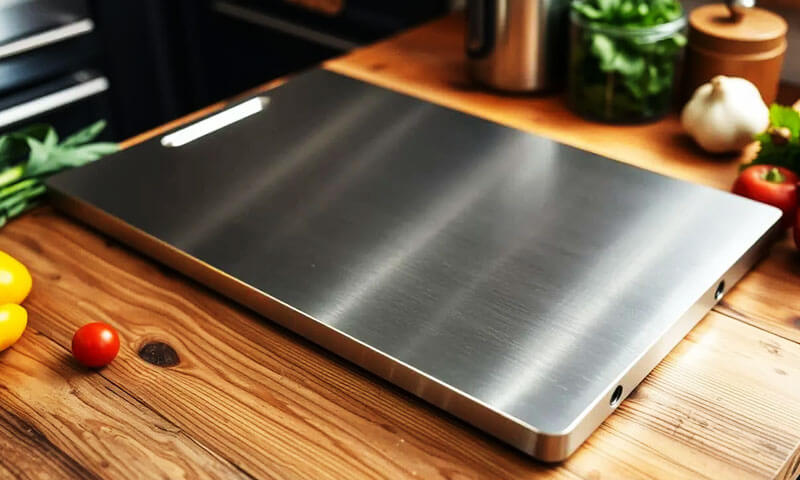
- 거울-우아한: Delivers a reflective, high-gloss finish that complements professional and residential kitchens alike.
Maintenance requires occasional buffing to remove fine scratches. - 브러시 (공단): Exhibits uniform linear grain lines, concealing minor abrasions while projecting a sleek, matte look.
Brushed surfaces maintain a coefficient of friction (COF) around 0.35—enhancing grip under damp conditions. - Bead-Blasted: Produces a soft, low-reflectivity texture. This finish reduces visible fingerprints and provides a CoF of approximately 0.45, boosting slip resistance during food prep.
티탄
- Natural Matte: The native oxide layer presents a soft gray matte that hides wear exceptionally well.
Its CoF near 0.40 strikes a balance between slip resistance and ease of knife movement. - 양극화 그림 물감: Electrochemical anodization can yield vibrant hues—blues, purples, golds—without compromising corrosion resistance.
Color options range across the color spectrum, enabling bespoke kitchen accessories. - Patterned Machining: CNC milling creates micro-textured surfaces (예를 들어, crosshatch or grooved) that augment both aesthetics and functional grip, with minimal impact on knife edges.
Customization Options
Manufacturers and artisans can tailor these metals to precise design requirements:
- Inlays and Inserts: Recessed silicone or wood inlays provide cushioned knife landing zones and introduce contrasting accents.
Both metals accept precise pocket milling for flush inlay integration. - Edge Profiles: Chamfered, bull-nose, or beveled edges enhance comfort and safety.
Titanium’s superior machinability (even at higher hardness grades) allows intricate edge geometries without cracking. - 레이저 조각 & 에칭: High-energy laser systems produce permanent etchings—logos, measurement scales, or recipe guides—at resolutions finer than 100 µm, adding functional or branding elements.
User Perception: 무게, Feel, and Premium Appeal
- Weight Differences:
-
- 에이 30×30×0.5 cm stainless steel board (밀도 7.8 g/cm³) weighs approximately 3.5 kg, whereas an identical titanium board (밀도 4.5 g/cm³) weighs only 2.0 kg—a 43% 절감.
Lightweight titanium boards improve handling, especially in busy kitchens or outdoor settings.
- 에이 30×30×0.5 cm stainless steel board (밀도 7.8 g/cm³) weighs approximately 3.5 kg, whereas an identical titanium board (밀도 4.5 g/cm³) weighs only 2.0 kg—a 43% 절감.
- Tactile Experience:
-
- Stainless steel’s cool, solid feel on contact conveys durability and a professional aesthetic.
대조적으로, titanium’s slightly warmer touch and subtle spring-back give a more responsive, premium sensation.
- Stainless steel’s cool, solid feel on contact conveys durability and a professional aesthetic.
- Visual Impact:
-
- Mirror-polished steel reflects ambient colors, integrating seamlessly into modern stainless-centric kitchens.
Anodized titanium offers bold accent colors—allowing designers to match or contrast cabinetry, 가전 제품, 그리고 조리기구.
- Mirror-polished steel reflects ambient colors, integrating seamlessly into modern stainless-centric kitchens.
8. Use-Case Scenarios & 권장 사항
Selecting between stainless steel and titanium cutting boards hinges on specific usage contexts, 예산 제약, and performance priorities.
아래에, we outline four common scenarios—professional kitchens, home cooking, outdoor use, and high-volume food service—followed by tailored recommendations.
Professional Kitchens
In restaurant and catering environments, chefs demand durability, sanitation, and ease of cleaning under intense daily use.
- 추천:등급 316 스테인레스 스틸 boards, 0.5–1.0 cm thick
-
- 이론적 해석: ~에 ~$4 per kg, 등급 316 provides excellent corrosion resistance against acidic foods and frequent sanitizer exposure.
Autoclave-safe and dishwasher-compatible, these boards require minimal maintenance. - 성능: Withstands 500+ daily wash cycles and resists dents under typical chef’s knife forces (최대 600 N).
- 이론적 해석: ~에 ~$4 per kg, 등급 316 provides excellent corrosion resistance against acidic foods and frequent sanitizer exposure.
Home Cooks
Home chefs balance performance with cost and aesthetics. They often prepare varied ingredients but at lower volumes.
- 추천:브러시 304 스테인레스 스틸 또는 commercially pure titanium boards, 0.5 cm thick
-
- 이론적 해석: 브러시 304 stainless costs $3- kg 당 $ 5, resists staining from tomatoes and citrus, and integrates seamlessly with kitchen décor.
Pure titanium boards cost $12- kg 당 $ 15 but weigh 43% 더 적은 (≈2 kg vs. 3.5 kg for a 30×30 cm board). - 성능: Stainless steel offers excellent hygiene and knife-edge preservation for moderate home use.
Titanium adds a premium feel and easy handling for small kitchens.
- 이론적 해석: 브러시 304 stainless costs $3- kg 당 $ 5, resists staining from tomatoes and citrus, and integrates seamlessly with kitchen décor.
Outdoor and Camping
Portability, corrosion resistance in unpredictable weather, and multipurpose use drive board choice for campers and backpackers.
- 추천:상업적으로 순수한 티타늄, 0.3–0.5 cm thick
-
- 이론적 해석: 티타늄 4.5 g/cm³ density yields a board weighing 1.2–2.0 kg, compared to 2.6–3.5 kg for stainless steel.
Its oxide layer resists rain, 강물, and acidic campfire residues. - 성능: Titanium endures thermal shocks—e.g., placing hot pans directly on the board—and requires no coatings or treatments to maintain corrosion immunity.
- 이론적 해석: 티타늄 4.5 g/cm³ density yields a board weighing 1.2–2.0 kg, compared to 2.6–3.5 kg for stainless steel.
High-Volume Food Service
Catering halls, institutional cafeterias, and food-production lines demand heavy-duty boards that endure rapid throughput and continuous sanitation.
- 추천:Ti-6Al-4V alloy boards, 0.8–1.2 cm thick, combined with stainless steel back-up boards
-
- 이론적 해석: Though $20–$30 per kg, Ti-6Al-4V withstands up to 800 N of localized force without deformation and survives 1,000+ daily cleanings.
Pairing with a stainless steel base provides cost-effective support and additional work surface. - 성능: These boards minimize downtime for replacements, cutting lifecycle costs despite higher initial investment.
- 이론적 해석: Though $20–$30 per kg, Ti-6Al-4V withstands up to 800 N of localized force without deformation and survives 1,000+ daily cleanings.
Balancing Budget and Performance
When budgets are tight, 선택하십시오 브러시 304 스테인레스 스틸 as a versatile, mid-priced solution.
If you require lightweight portability or premium longevity—and the budget allows—티탄 또는 티타늄 합금 boards justify their cost through reduced maintenance and enhanced user experience.
Summary Recommendation Table
| Scenario | Material Choice | 두께 | 대략. 비용 | 주요 이점 |
|---|---|---|---|---|
| Professional Kitchens | 316 스테인레스 스틸 | 0.5–1.0 cm | $4 / kg | 부식 & sanitation resilience |
| Home Cooks | 304 Stainless Steel or Pure Titanium | 0.5 cm | $3–$5 / kg (봄 여름 시즌); $12–$15 / kg (의) | Cost-effective or lightweight |
| Outdoor & Camping | 순수한 티타늄 | 0.3–0.5 cm | $12–$15 / kg | Portability & all-weather durability |
| High-Volume Food Service | Ti-6Al-4V Alloy + SS Back-up | 0.8–1.2 cm | $20–$30 / kg | Extreme durability & 장수 |
9. 결론
Stainless steel and titanium cutting board each deliver compelling advantages.
Stainless steel offers a balance of affordability, 부식 저항, and easy maintenance.
Titanium—particularly Ti-6Al-4V—excels in hardness, 가벼움, and ultimate corrosion immunity, albeit at a higher upfront cost.
By weighing cutting performance, hygiene requirements, 예산 제약, and design preferences, you can select the material that fits your culinary environment and usage demands.
궁극적으로, both metals represent a significant step up from traditional wood or plastic boards, offering unmatched durability and cleanliness for modern kitchens.