1. Introduktion
3D utskrift, även känd som tillsatsstillverkning, har revolutionerat modern produktion genom att möjliggöra snabb prototypframställning, anpassning, och kostnadseffektiv tillverkning.
Till skillnad från traditionell subtraktiv tillverkning, som tar bort material från ett fast block, 3D printing konstruerar objekt lager för lager baserat på digitala modeller.
Ursprungligen utvecklad för prototypframställning, det har nu expanderat till storskaliga industriella tillämpningar, allt från flyg till sjukvård.
Den här artikeln utforskar grunderna för 3D-utskrift, nyckelteknologier, materialalternativ, branschapplikationer, fördelar, utmaningar, och framtida innovationer som formar denna transformativa teknik.
2. Grunderna i 3D-utskrift
3D utskrift, även känd som tillsatsstillverkning, har förändrat hur produkter designas, prototyp, och tillverkas.
Till skillnad från traditionell subtraktiv tillverkning, där material avlägsnas från ett fast block, 3D-printing bygger objekt lager för lager baserat på digitala modeller.
Detta tillvägagångssätt möjliggör komplexa geometrier, minskar materialavfall, och möjliggör on-demand-produktion.
Vad är 3D-utskrift?
3D utskrift är en additiv tillverkningsprocess som skapar fysiska objekt från digital design genom att successivt lägga till material i lager.
Processen styrs av datorstyrda maskiner som följer instruktioner från en 3D model.
Grundläggande arbetsflöde för 3D-utskrift
The process of 3D printing follows a standardized workflow:
- 3D -modellering – The object is designed using Kad (Datorstödd design) programvara.
- Slicing – The model is converted into layers and instructions using slicing software.
- Printing – The 3D printer follows the instructions to build the object.
- Efterbehandling – The printed object undergoes cleaning, härdning, or finishing treatments.
3. Kärnteknologier inom 3D-utskrift
3D printing technologies have evolved significantly, offering diverse solutions for various industries.
Each method has distinct advantages in terms of precision, materiell kompatibilitet, produktionshastighet, and application scope.
The most widely used technologies include Fused Deposition Modeling (FDM), Stereolitografi (SLA), Selektiv lasersintring (Sls),
Direkt metalllaser sintring (Dmls) / Elektronstråle smältning (Ebm), Binder Jetting, och Material Jetting.
Fused Deposition Modeling (FDM) – Prisvärt och mångsidigt
Behandla:
FDM, även känd som Fused Filament Fabrication (FFF), extrudes thermoplastic filament through a heated nozzle, depositing material layer by layer to create an object.
The printer moves according to the sliced digital model, gradually building the structure.

Nyckelfunktioner:
- Gemensamma material: Pla, ABS, PETG, Nylon, Tpu
- Upplösning: 50–400 microns
- Styrkor: Lågkostnads-, user-friendly, fast prototyping
- Begränsningar: Visible layer lines, limited surface quality, lower strength compared to industrial methods
Branschinsikt:
According to market analysis, FDM accounts for over 50% of desktop 3D printing applications, making it the most widely used technique globally.
Stereolitografi (SLA) – Högupplöst hartsutskrift
Behandla:
SLA employs an ultraviolet (Uv) laser to solidify liquid resin, forming precise layers. The laser selectively cures the photopolymer, gradually shaping the final object.

Nyckelfunktioner:
- Gemensamma material: Standard resins, tough resins, dental resins
- Upplösning: 25–100 microns
- Styrkor: Högprecision, slät yta finish, fina detaljer
- Begränsningar: Kräver efterbehandling (tvättning, härdning), sprött material
Selektiv lasersintring (Sls) – Starka och hållbara delar
Behandla:
SLS uses a high-powered laser to fuse powdered material, typiskt nylon or thermoplastics, into solid layers.
Since SLS does not require support structures, it enables the creation of complex geometries.

Nyckelfunktioner:
- Gemensamma material: Nylon, Tpu, composite powders
- Upplösning: 50–120 microns
- Styrkor: Stark, durable parts with complex designs, no support structures needed
- Begränsningar: Expensive industrial-grade printers, grov ytfinish
Branschinsikt:
SLS is widely used for industrial applications, med Nylon 12 being the most commonly printed material due to its high tensile strength and flexibility.
Direkt metalllaser sintring (Dmls) & Elektronstråle smältning (Ebm) – Metall 3D-utskrift för industriella tillämpningar
Behandla:
DMLS and EBM are metal additive manufacturing technologies that use high-energy sources (lasers or electron beams) to fuse metal powders into solid parts.
The main difference is that DMLS uses a laser in an inert gas environment, medan EBM employs an electron beam in a vacuum chamber.

Nyckelfunktioner:
- Gemensamma material: Titan, aluminium, rostfritt stål, kobolt-krom
- Upplösning: 20–100 microns
- Styrkor: High-strength metal parts, utmärkta mekaniska egenskaper, lätta strukturer
- Begränsningar: Dyr, slow printing speeds, extensive post-processing required
Branschinsikt:
Av 2030, de metal 3D printing industry is projected to surpass $20 miljard, driven by aerospace and medical advancements.
Binder Jetting – Snabb och skalbar tillverkning
Behandla:
Binder jetting sprays a liquid binding agent onto layers of powdered material, bonding them together.
Unlike SLS or DMLS, binder jetting does not use lasers, göra det faster and more cost-effective för produktion med hög volym.

Nyckelfunktioner:
- Gemensamma material: Metall, sand, keramik, full-color polymers
- Upplösning: 50–200 microns
- Styrkor: Fast production speeds, multi-material kapacitet, fullfärgstryck
- Begränsningar: Kräver efterbehandling (sintring, infiltration), lägre mekanisk styrka
Branschinsikt:
Binder jetting vinner dragkraft för massproducerande metalldelar, erbjudande 50–100 gånger snabbare utskriftshastigheter än DMLS.
Materialsprutning – utskrift i fullfärg och multimaterial
Behandla:
Genom sprutning avsätts vätskedroppar av fotopolymer, som sedan härdas lager för lager med UV-ljus.
Detta möjliggör högupplösta utskrifter med flera färger och materialkombinationer.

Nyckelfunktioner:
- Gemensamma material: Fotopolymerer, vax, keramik
- Upplösning: 16–50 mikron
- Styrkor: Hög noggrannhet, fullfärgskapacitet, släta ytor
- Begränsningar: Dyr, sprött material, begränsad styrka
Branschinsikt:
Material jetting möjliggör multi-material utskrift med över 500,000 färgvariationer, gör det till ett ledande val för avancerad produktprototyp.
4. Material som används i 3D-utskrift
Valet av material är en avgörande faktor vid 3D-utskrift, påverkar de mekaniska egenskaperna, varaktighet, kosta, och användningsområde för tryckta delar.
Brett, 3D-tryckmaterial kan kategoriseras i polymerer, metaller, keramik, och kompositer.
Each category has unique characteristics that make it suitable for specific applications.
4.1 Polymerer – mångsidig och kostnadseffektiv
Polymers are the most commonly used materials in 3D printing due to their affordability, bearbetning, and wide application range. These materials are available in filament, harts, or powder form, depending on the 3D printing process.
Termoplast (FDM, Sls)
Thermoplastics soften when heated and solidify upon cooling, att göra dem lämpliga för Fused Deposition Modeling (FDM) och Selektiv lasersintring (Sls).
| Material | Nyckelegenskaper | Gemensamma applikationer |
|---|---|---|
| Pla (Polylactic Acid) | Biodegradable, easy to print, low warping | Prototyp, hobbyist models |
| ABS (Akrylnitril Butadien Styren) | Tuff, slagbeständig, värmebeständig | Bildelar, konsumtionsvaror |
| PETG (Polyethylene Terephthalate Glycol) | Stark, kemikalisk, livsmedelssäker | Medicinsk utrustning, water bottles |
| Nylon (Polyamid) | Flexibel, slitfast, hållbar | Växlar, mekaniska delar |
Fotopolymerer (SLA, Dlp)
Photopolymers are light-sensitive resins som används i Stereolitografi (SLA) och Digital ljusbehandling (Dlp) printing.
De erbjuder high resolution and smooth surface finishes, but tend to be brittle.
| Material | Nyckelegenskaper | Gemensamma applikationer |
|---|---|---|
| Standard Resin | High detail, smidig finish | Prototyper, figurines |
| Tough Resin | Impact-resistant, stronger than standard resin | Functional parts |
| Flexible Resin | Rubber-like, elastic properties | Wearable devices, grips |
| Dental Resin | Biokompatibel, exakt | Dental aligners, kronor |
Högpresterande polymerer (TITT, Ultem)
Som används i industrial and aerospace applications, high-performance polymers exhibit superior mechanical and thermal properties.
| Material | Nyckelegenskaper | Gemensamma applikationer |
|---|---|---|
| TITT (Polyetereter keton) | High heat & kemisk motstånd, stark | Flyg-, medicinsk implantat |
| Ultem (Polyetherimide – PEI) | Högstyrka, flame-resistant | Aircraft interiors, bil- |
4.2 Metaller – höghållfasthet och industriella tillämpningar
Metal 3D printing enables the creation of komplex, högstyrka delar for demanding industries such as aerospace, medicinsk, och bil.
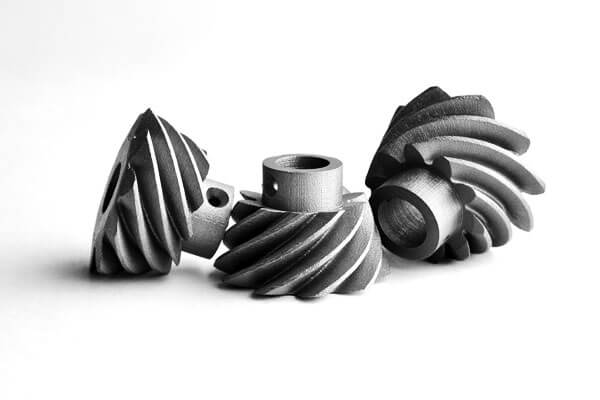
These materials are typically used in Direkt metalllaser sintring (Dmls), Elektronstråle smältning (Ebm), and Binder Jetting.
| Material | Nyckelegenskaper | Gemensamma applikationer |
|---|---|---|
| Titan (TI-6AL-4V) | Lättvikt, stark, korrosionsbeständig | Flyg-, medicinsk implantat |
| Rostfritt stål (316L, 17-4 PH) | Hållbar, slitfast | Industrial tools, kirurgiska instrument |
Aluminium (Alsi10 mg) |
Lättvikt, Bra värmeledningsförmåga | Bil, elektronik |
| Cobalt-Chrome (CoCr) | Biokompatibel, high-temperature resistant | Tandimplantat, turbinblad |
| Nicklegeringar (Ocny 625, 718) | Heat and corrosion-resistant | Jetmotorer, kraftverk |
4.3 Keramik – Värme- och slitstyrka
Ceramic materials are used in applications that require high-temperature resistance, kemisk stabilitet, och hårdhet.
These materials are printed using binder jetting, SLA, or extrusion-based methods.
| Material | Nyckelegenskaper | Gemensamma applikationer |
|---|---|---|
| Kiselkarbid (Sic) | Högstyrka, värmebeständig | Flyg-, elektronik |
| Aluminiumoxid (Al2o3) | Hård, kemiskt inert | Biomedicinska implantat, industrikomponenter |
| Zirkonium (Zro2) | Tuff, slitfast | Dental crowns, skärverktyg |
4.4 Sammansatt & Avancerat material – förbättrad prestanda
Composites combine polymerer, metaller, or ceramics with reinforcing fibers to enhance mekanisk styrka, ledningsförmåga, or flexibility.
Fiberförstärkta kompositer
Carbon fiber and glass fiber are embedded into thermoplastics to improve strength and reduce weight.
| Material | Nyckelegenskaper | Gemensamma applikationer |
|---|---|---|
| Kolfiber Reinforced Nylon | Höghållfasthetsförhållande | Drones, robotik, bil- |
| Glass Fiber Reinforced PLA | Stel, slagbeständig | Strukturella komponenter |
Smarta och biologiskt nedbrytbara material
Innovationer i bio-based and self-healing materials are expanding 3D printing possibilities.
| Material | Nyckelegenskaper | Gemensamma applikationer |
|---|---|---|
| Conductive Polymers | Elektrisk ledningsförmåga | Printed electronics, sensorer |
| Självläkande polymerer | Repairs minor damage | Bärbar, flyg- |
| Biologiskt nedbrytbara PLA-blandningar | Miljövänlig, komposterbar | Hållbar förpackning, medicinsk implantat |
5. Efterbearbetning av 3D-utskrifter
Efterbehandling är ett kritiskt steg i 3D-utskrift som förbättrar de mekaniska egenskaperna, ytkvalitet, och funktionalitet hos tryckta delar.
Eftersom råa 3D-printade objekt ofta ställer ut lagerlinjer, ytjämnhet, och restmaterial, olika efterbehandlingstekniker tillämpas baserat på materialtyp, tryckprocess, och avsedd tillämpning.

Valet av efterbearbetningsmetod beror på faktorer som t.ex estetiska krav, dimensionell noggrannhet, strukturell integritet, och miljöförhållanden delen kommer att utsättas för.
Nedan är en omfattande analys av de vanligaste efterbehandlingsteknikerna för olika 3D-utskriftstekniker.
Varför är efterbehandling viktigt?
- Förbättrar ytfinishen – Minskar strävhet och förbättrar estetiken.
- Förbättrar den mekaniska styrkan – Tar bort mikrodefekter och förstärker delarnas hållbarhet.
- Optimerar funktionalitet – Justerar egenskaper som flexibilitet, ledningsförmåga, och slitmotstånd.
- Tar bort stöd & Residual Material – Ensures the part is free from excess material or unsightly artifacts.
- Enables Additional Treatments – Allows for målning, plåt, eller tätning, depending on application needs.
Vanliga efterbearbetningstekniker med tryckteknik
Fused Deposition Modeling (FDM) Efterbehandling
FDM prints often have visible layer lines and require support removal. The most common post-processing techniques include:
| Teknik | Behandla | Gynn | Utmaningar |
|---|---|---|---|
| Support Removal | Cutting or dissolving support structures (PVA dissolves in water, HIPS dissolves in limonene). | Prevents surface damage. | Requires careful handling to avoid breakage. |
| Sandning & Putsning | Using sandpaper (120–2000 grit) to smooth the surface. | Enhances aesthetics and reduces layer visibility. | Tidskrävande, can alter dimensions. |
Kemisk utjämning |
Exposing part to solvent vapors (acetone for ABS, ethyl acetate for PLA). | Achieves glossy finish, eliminates layer lines. | Can weaken part structure if overexposed. |
| Målning & Beläggning | Priming and applying paint, clear coatings, or hydrophobic treatments. | Improves color, varaktighet, and protection. | Requires proper surface preparation. |
Stereolitografi (SLA) & Digital ljusbehandling (Dlp) Efterbehandling
Since SLA and DLP use liquid resin, post-processing focuses on curing and improving the fragile surface finish.
| Teknik | Behandla | Gynn | Utmaningar |
|---|---|---|---|
| UV Curing | Exposing prints to UV light to strengthen the resin. | Enhances durability. | Requires proper curing time to avoid brittleness. |
| Isopropyl Alcohol (IPA) Skölja | Cleaning excess uncured resin with IPA (90%+ koncentration). | Ensures smooth, clean prints. | Over-soaking can cause warping. |
| Sandning & Putsning | Wet sanding to achieve a smoother surface. | Improves aesthetics and paint adhesion. | Can remove fine details. |
| Clear Coating & Målning | Applying UV-resistant coatings or dyes. | Adds color and protection. | Can alter the print’s translucency. |
Branschexempel:
I dental and medical applications, SLA-printed surgical guides and orthodontic models undergo IPA cleaning and UV curing to ensure biocompatibility and mechanical strength.
Selektiv lasersintring (Sls) Efterbehandling
SLS prints are powder-based and often exhibit a grainy texture. Post-processing primarily focuses on smoothing and strengthening the parts.
| Teknik | Behandla | Gynn | Utmaningar |
|---|---|---|---|
| Powder Removal | Blasting with compressed air or tumbling to remove excess powder. | Ensures clean and functional parts. | Fine powders require proper disposal. |
| Färgning & Färg | Submerging parts in dye baths for uniform coloration. | Aesthetically enhances parts. | Limited to dark colors. |
| Vapor Smoothing | Using chemical vapors to melt and smooth outer layers. | Creates a semi-gloss finish, improves mechanical properties. | Requires controlled chemical exposure. |
| Pärlblåsning & Trumling | Using fine media (keramisk, glaspärlor) till släta ytor. | Reduces porosity and enhances finish. | May slightly alter dimensions. |
Branschexempel:
Nike and Adidas använda SLS for manufacturing shoe soles, där vapor smoothing and dyeing provide a soft-touch finish and better slitbidrag.
Direkt metalllaser sintring (Dmls) & Elektronstråle smältning (Ebm) Efterbehandling
Metal 3D prints require extensive post-processing to achieve the desired mechanical properties and surface finish.
| Teknik | Behandla | Gynn | Utmaningar |
|---|---|---|---|
| Support Removal (Edm, CNC Cutting) | Avskärning av metallstödstrukturer med hjälp av elektrisk urladdningsbearbetning (EDM). | Säkerställer precision i komplexa geometrier. | Arbetskrävande för intrikata delar. |
| Värmebehandling (Glödgning, HÖFT) | Uppvärmning för att minska kvarvarande stress och förbättra segheten. | Förbättrar delstyrkan, förhindrar sprickbildning. | Kräver kontrollerade termiska cykler. |
| Bearbetning (Cnc, Slipning, Pip) | Förfina dimensioner med CNC-fräsning eller slipning. | Uppnår hög precision och jämna finish. | Lägger till handläggningstid och kostnad. |
| Elektrisk | Använd en elektrolytisk process för att jämna ut ytor. | Förbättrar korrosionsmotståndet, estetik. | Fungerar endast på ledande metaller. |
Branschexempel:
I flyg-, DMLS-tillverkade titandelar för jetmotorer undergo Het isostatisk pressning (HÖFT) att eliminera mikrokondositet och förbättra trötthetsmotstånd.
Avancerade efterbehandlingstekniker
För högpresterande ansökningar, ytterligare efterbehandlingstekniker används:
- Galvanisering – Belägga delar med nickel, koppar, eller guld för att förbättra konduktiviteten och korrosionsbeständigheten.
- Keramisk beläggning – Förbättra slitstyrkan och termiskt skydd för metallkomponenter.
- Hybridtillverkning – Kombinera 3D-utskrift med CNC-bearbetning för högprecisionsdelar.
6. Fördelar och utmaningar med 3D-utskrift
Detta avsnitt ger en djupgående analys av viktiga fördelar och utmaningar av 3D-utskrift i moderna industrier.
Viktiga fördelar med 3D-utskrift
Designfrihet och anpassning
Till skillnad från traditionell tillverkning, som förlitar sig på mögel, skärande, och montering,
3D-utskrift möjliggör skapa komplexa geometrier det skulle vara omöjligt eller oöverkomligt dyrt med konventionella metoder.
- Massanpassning – Produkter kan skräddarsys för enskilda kunder utan extra kostnad.
- Komplexa geometrier – Intrikata gitterstrukturer, interna kanaler, och organiska former är möjliga.
- Lättviktsdesigner – Flyg- och bilindustrin använder topologioptimering för att minska vikten utan att offra styrka.
Snabb prototypframställning och snabbare produktion
Traditionell prototyping kan ta veckor eller månader, men 3D-utskrift påskyndar utvecklingscykeln väsentligt.
- 90% snabbare prototyper – Ett koncept kan gå från design till en funktionell prototyp i fråga om timmar eller dagar.
- Accelererad innovation – Companies can test multiple design iterations quickly, förbättring product development efficiency.
- On-demand production – Eliminates long supply chains, reducerande warehousing and inventory costs.
Minskat materialavfall och hållbarhet
Unlike subtractive manufacturing (TILL EXEMPEL., CNC-bearbetning), which removes material to shape an object, 3D printing builds parts layer by layer, significantly reducing waste.
- Fram till 90% less material waste compared to conventional machining.
- Recyclable materials such as bio-based PLA and recycled polymers enhance sustainability.
- Localized production reduces the carbon footprint associated with global supply chains.
Kostnadsminskning i lågvolymproduktion
För low-volume or specialty manufacturing, 3D printing is significantly more cost-effective than traditional manufacturing.
- No mold or tooling costs – Ideal for short-run production and low-demand markets.
- Reduces expensive machining steps – Eliminates multiple manufacturing processes (gjutning, fräsning, borrning).
- Affordable for startups & small businesses – Lowers entry barriers to manufacturing innovation.
Funktionell integration & Monteringsminskning
3D printing enables part consolidation, allowing multiple components to be combined into a single integrated design.
- Reduces assembly complexity – Fewer parts mean less labor and fewer potential failure points.
- Improves structural integrity – Eliminates the need for screws, svetsar, or adhesives.
Utmaningar och begränsningar för 3D-utskrift
Begränsat materialval
While 3D printing has expanded beyond plastics to include metals, keramik, och kompositer, de range of printable materials remains limited compared to traditional manufacturing.
- Mekaniska egenskaper – Many printed materials do not match the styrka, duktilitet, eller värmebeständighet of conventionally manufactured parts.
- Material costs – High-performance materials (TILL EXEMPEL., titan, TITT, Ultem) are expensive.
- Lack of standardization – Material properties vary between different printer models and manufacturers.
Krav efterbehandling
Most 3D-printed parts require additional finishing steps before they are usable.
- Ytutjämning – Många delar har synliga lagerlinjer och kräva sandning, putsning, eller ångutjämning.
- Värmebehandling – Metalltryck behöver ofta glödgning eller varm isostatisk pressning (HÖFT) för att ta bort inre spänningar.
- Borttagning av stödstruktur – Många processer, såsom SLA, Sls, och DMLS, kräver noggrann borttagning av överflödigt material.
Höga initiala investeringskostnader
Även om kostnaderna minskar, 3D-skrivare och material av industriell kvalitet förblir dyra.
- 3D-skrivare i metall kosta $250,000 till $1 miljon.
- Avancerade polymerskrivare (SLA, Sls) sträcker sig från $50,000 till $200,000.
- Material costs är ofta 5–10x högre än konventionella tillverkningsmaterial.
Hastighets- och skalbarhetsproblem
Medan prototypframställning är snabb, massproduktion med 3D-utskrift förblir långsammare än formsprutning eller bearbetning.
- Låga utskriftshastigheter – Stora delar kan ta flera dagar att skriva ut.
- Begränsad skalbarhet – Utskrift tusentals delar är stilla långsammare och dyrare än traditionella metoder.
- Batchbearbetning krävs – Att öka effektiviteten, flera delar skrivs ofta ut samtidigt, which complicates quality control.
7. Tillämpningar av 3D-utskrift över branscher
From rapid prototyping to mass production of complex geometries, 3D printing offers unprecedented design flexibility, kostnadsminskning, och materiell effektivitet.
Its impact spans a wide range of sectors, inklusive tillverkning, flyg, healthcare, bil-, konstruktion, och mer.
Tillverkning & Prototyp
Snabb prototyp
One of the most significant applications of 3D printing in manufacturing is snabb prototyp.
Traditional prototyping methods, such as injection molding, can take weeks or months to set up and produce.
Däremot, 3D printing enables faster iteration, with prototypes typically being created in timmar eller dagar, allowing for quick testing and design validation.
- Kostnadseffektivitet: 3D printing eliminates the need for expensive molds, verktyg, and the associated long setup times.
- Anpassning: Komplex, customized parts can be produced without additional costs or setup.
This is especially useful in small-batch production or when creating components that need to be tailored to specific customer needs.
Verktyg och slutanvändningsproduktion
Beyond prototyping, 3D-utskrift spelar också en nyckelroll i verktyg och till och med delar för slutanvändning.
Komponenter som jiggar, fixturer, och formar kan produceras snabbt och effektivt med 3D-utskrift, minska produktionstid och kostnader.
- On-demand verktyg möjliggör snabba anpassningar i design utan långa ledtider.
- Företag producerar allt mer delar för slutanvändning För specifika applikationer, som skräddarsydda medicinska implantat eller lätta fordonskomponenter.
Flyg- & Bil
Flyg-
Flygindustrin har legat i framkant när det gäller att ta till sig 3D-utskrift på grund av sin förmåga att producera lättvikt, komplexa delar med exceptionella styrka-till-vikt-förhållanden.
Komponenter tillverkade med hjälp av direkt metalllasersintring (Dmls) eller elektronstrålesmältning (Ebm) är avgörande för att minska flygplanens vikt,
som direkt bidrar till bränsleeffektivitet och kostnadsbesparingar.
- Anpassning: 3D utskrift möjliggör skräddarsydda delar för specifika flygtillämpningar, såsom turbinblad eller fästen som är optimerade för prestanda.
- Kostnadsbesparingar: Produktion av komplexa geometrier that would otherwise require multiple manufacturing steps can reduce costs significantly.
Tillämpningar för fordon
Inom fordonssektorn, 3D printing is used for creating funktionella prototyper, anpassade delar, och till och med production tools.
As the industry shifts toward more sustainable och energy-efficient fordon, 3D printing offers ways to produce lightweight, komplexa komponenter.
- Anpassning: 3D printing allows car manufacturers to produce customized parts on demand,
such as specialized interior components, prototypes for new models, and even lightweight, durable engine parts. - Snabbare tid till marknad: 3D printing reduces development time by allowing for quicker testing and iteration of prototypes.

Medicinsk & Healthcare
Skräddarsydda proteser och implantat
One of the most impactful uses of 3D printing is in medicinsk utrustning, särskilt för customized prosthetics och implantat.
Traditional manufacturing methods often struggle with producing highly tailored devices, but 3D printing excels in creating patient-specific solutions.
- Anpassning: With 3D printing, prosthetics can be designed and produced to exact specifications, ensuring a perfect fit for the patient.
- Kostnadseffektivitet: Traditional prosthetics and implants often involve expensive and time-consuming processes. 3D printing allows for faster production och sänka kostnaderna.
Bioprinting
Bioprinting is an emerging field within 3D printing that uses living cells to create tissue structures och till och med organ models.
While still in the early stages, bioprinting holds great promise for the future of personalized medicine, potentially leading to the creation of bioengineered tissues and organs.
- Tissue Engineering: Bioprinted tissues could eventually be used for drug testing, reducing the need for animal testing.
- Regenerative Medicine: Research in bioprinting is exploring the possibility of printing fully functional organs for transplantation.
Konstruktion & Arkitektur
3D-tryckta byggnader
I byggbranschen, 3D printing is revolutionizing the way bebyggelse och strukturer are designed and constructed.
The technology has made it possible to print entire buildings, reducing construction costs and time significantly.
- Cost Reduction: 3D printing can cut construction costs by up to 50%, as it requires fewer workers and materials.
- Hållbarhet: With the ability to use recycled materials in the printing process, 3D printing is contributing to more sustainable construction methods.
Komplexa geometrier
One of the primary benefits of 3D printing in construction is the ability to design and print complex architectural shapes that are difficult or impossible to create using traditional methods.
This opens up new possibilities for innovative architectural designs and structures.
Konsumtionsvaror & Elektronik
Anpassade konsumentprodukter
In the consumer goods industry, 3D printing enables manufacturers to produce customized, made-to-order products.
Whether it’s personalized jewelry, bespoke footwear, or custom-fit fashion accessories, 3D printing offers unparalleled customization at a fraction of the cost of traditional methods.
- Product Personalization: Consumers can design their products and have them printed on-demand, eliminating mass production and reducing waste.
- Fashion Industry: Designers are leveraging 3D printing to create innovative fashion pieces, såsom customized jewelry och till och med wearable tech.
Elektroniktillverkning
3D printing is also playing an important role in the electronics industry, where it is used to print kretskort, miniaturized components, och hölje for electronic devices.
Förmågan att produce complex geometries in small-scale, intricate parts has opened up possibilities for customized electronics.
- Functional Electronics: Companies are now using conductive 3D printing materials att skriva ut functional electronic components, such as antennas, capacitors, and circuit traces.
- Prototyping and Testing: 3D printing enables rapid iteration and testing of new electronic products and devices.
8. Additiv vs traditionell tillverkning
The comparison between tillsatsstillverkning (3D utskrift) and traditional manufacturing methods,
såsom subtraktiv och formative manufacturing, highlights the unique strengths and challenges of each approach.
Understanding these methods is crucial for industries looking to select the most efficient and cost-effective manufacturing process based on their specific needs.
Tillsatsstillverkning (3D -tryckning)
Processöversikt
Tillsatsstillverkning (Jag är), vanligtvis hänvisas till som 3D utskrift, involves creating three-dimensional objects by depositing material layer by layer based on a digital design.
Till skillnad från traditionell tillverkning, where material is removed or shaped by force, AM is a process of building up material, which gives it unique advantages in design freedom and material efficiency.
Nyckelegenskaper
- Materiell effektivitet: AM uses only the material necessary for the part, minskning.
Unlike subtractive methods, which cut away material from a solid block, 3D printing builds the object, using less raw material. - Designflexibilitet: AM enables the creation of komplexa geometrier lätt,
including intricate internal structures, organiska former, and customized designs that would be impossible or costly with traditional methods. - Hastighet: While AM can be slower than traditional processes for large batches, det erbjuder rapid prototyping capabilities.
You can create and test a prototype in a matter of hours or days, a process that could take veckor with traditional methods.
Subtraktiv tillverkning
Processöversikt
Subtractive manufacturing involves removing material from a solid block (referred to as a tom) using mechanical tools like fräsning, vändning, och slipning.
The material is gradually cut away to shape the object, leaving behind the final part. This method is one of the oldest and most commonly used in manufacturing.
Nyckelegenskaper
- Precision and Surface Finish: Subtractive manufacturing is known for its högprecision och
ability to create parts with excellent surface finishes, making it ideal for producing components with tight tolerances. - Materialtillfall: One major disadvantage of subtractive manufacturing is the materialtillfall generated during the cutting process.
The majority of the material is discarded as scrap, making it less material-efficient compared to additive processes. - Tooling and Setup Costs: Subtractive methods often require expensive tooling, såsom formar och dy, which can increase costs, especially for small production runs.
Formativ tillverkning
Processöversikt
Formative manufacturing involves creating objects by shaping material through värme, tryck, eller båda.
Examples of formative methods include formsprutning, pressgjutning, extrudering, och stämpling.
These methods are often used for high-volume production runs of parts with simple to moderately complex shapes.
Nyckelegenskaper
- Höghastighetsproduktion: Formative methods like formsprutning föreskriva rapid mass production of parts,
making them ideal for industries requiring large quantities of identical components. - Materialanvändning: Like additive manufacturing, formative methods are materialeffektiv, as they often involve creating parts from a mold with little waste.
- Verktygskostnader: While the production speed is high, mold and die costs kan vara betydande, speciellt för komplexa former.
These costs are typically spread out over large production volumes, making the method economically viable for high-volume runs.
Jämför additiv tillverkning med traditionell tillverkning
| Särdrag | Tillsatsstillverkning (3D -tryckning) | Subtraktiv tillverkning | Formativ tillverkning |
|---|---|---|---|
| Materiell effektivitet | High – Uses only material needed for the part. | Low – Material waste from cutting away stock. | High – Minimal waste in molding processes. |
| Complexity of Design | Can create complex shapes and internal structures. | Limited by tool geometry and cutting paths. | Moderate – Complex shapes require expensive molds. |
Produktionshastighet |
Slower for large batches but fast for prototyping. | Fast for mass production of simple parts. | Extremely fast for large batches, slow setup for molds. |
| Cost of Equipment | Moderate – Lower entry costs for desktop printers. | High–CNC machines and tooling can be expensive. | High – Tooling and molds are costly. |
| Materialalternativ | Begränsad, but growing (plast, metaller, keramik). | Broad – Metals, plast, och kompositer. | Broad – Primarily plastics and metals. |
| Anpassning | High – Ideal for bespoke, lågvolym, anpassade delar. | Low–standardized parts. | Moderate – Limited to mold capabilities. |
| Scale of Production | Best for low-volume, komplex, and customized parts. | Idealisk för hög volym, delar med hög precision. | Best for mass production of simple parts. |
9. Slutsats
3D printing continues to reshape industries by offering unprecedented flexibility, effektivitet, och innovation.
While it has limitations in material properties and scalability, ongoing advancements in hybrid manufacturing, AI -integration, and sustainable materials will further enhance its capabilities.
Langel is the perfect choice for your manufacturing needs if you need high-quality 3D printing services.
Artikelreferens: https://www.hubs.com/guides/3d-printing/