In large-scale mining operations, excavator bucket teeth are small relative to the overall machine, but they play a critical role in productivity, equipment reliability, and operating cost. Every tooth is exposed to severe abrasive wear, repeated impact, bending loads, and highly variable working conditions. Premature wear reduces digging efficiency, while internal casting defects can initiate cracks and lead to unexpected tooth failure.
Para sa kadahilanang ito, the production of high-manganese steel bucket teeth cannot be treated simply as a conventional casting operation. Material selection, disenyo ng amag, Mga parameter ng pagbuhos, daloy ng metal, pag-uugali ng solidification, feeding capacity, and defect control must be considered as an integrated engineering system.
Recent advances in casting simulation provide a practical way to achieve this integration. By combining high-manganese steel metallurgy, numerical simulation, design of experiments, gating-system optimization, and production validation, manufacturers can move from experience-based casting toward a more predictable and data-driven precision casting process.
1. What Are High Manganese Steel Bucket Teeth?
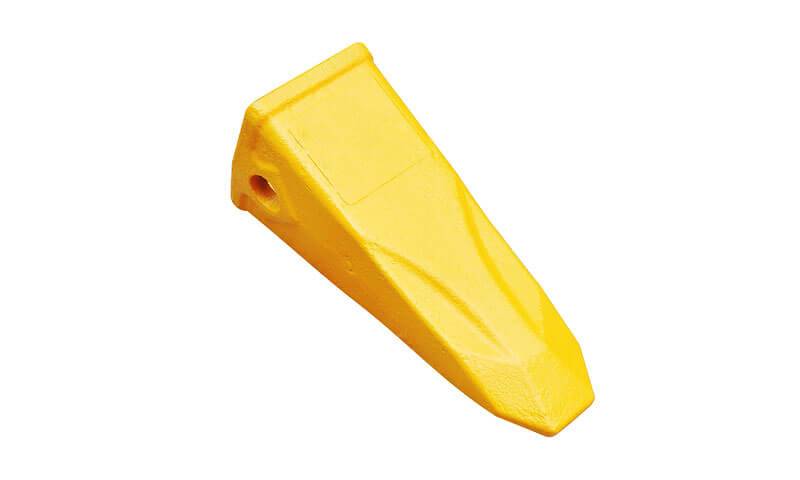
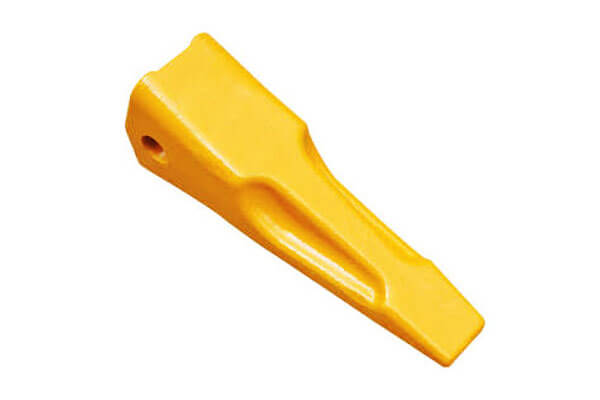
High manganese steel bucket teeth are replaceable wear components installed at the cutting edge of excavator and mining equipment buckets. They penetrate rock, ore, coal, gravel, soil, and other materials while transferring excavation forces from the bucket structure into the material being excavated.
The tooth must withstand two fundamentally different forms of loading simultaneously:
- Severe abrasive wear caused by continuous contact with hard particles.
- Impact and bending loads generated when the tooth penetrates compacted soil, rock, or mineral deposits.
This combination makes material selection particularly important. A material that provides excellent hardness but insufficient toughness may fracture under impact, while a material with high toughness but poor work-hardening behavior may wear rapidly.
High manganese austenitic steel addresses this conflict through its ability to undergo substantial pagpapatigas ng trabaho during service. The surface layer can become significantly harder under repeated impact while the underlying material retains comparatively high toughness.
For large mining bucket teeth, the casting process must therefore preserve the fundamental advantage of the alloy while minimizing casting defects that could become fracture initiation sites.
2. Why High Manganese Steel Is Used for Bucket Teeth
The characteristic performance of high manganese steel originates from its austenitic matrix and its relatively high manganese content. Conventional Hadfield-type manganese steels commonly contain approximately 10–14% Mn, with carbon typically around 0.9–1.4%, although exact chemistry varies according to grade and application.
Elements such as chromium, molibdenum, Silicon, and nickel may also be introduced to modify hardenability, wear behavior, paglaban sa kaagnasan, or microstructural stability.
High Impact Toughness
Bucket teeth experience repeated impact when they strike hard material. High manganese steel can absorb considerable impact energy without catastrophic fracture when properly heat treated and free from critical internal defects.
This toughness is particularly important for large mining excavators, where tooth dimensions and operating loads are substantially greater than those of ordinary construction equipment.
Work-Hardening Capability
The most distinctive characteristic of high manganese steel is its ability to harden under mechanical deformation.
During service, repeated impact causes plastic deformation in the surface region. This deformation increases dislocation density and can induce additional hardening mechanisms, producing a hardened surface while maintaining a relatively tough interior.
This creates an important performance gradient:
Tough core → work-hardened surface → improved resistance to abrasive wear.
The effectiveness of this mechanism depends strongly on the actual working environment. High-impact applications are generally more favorable for manganese steel than low-impact sliding wear conditions.
Good Combination of Strength and Wear Resistance
Properly processed high manganese steel can provide a useful balance between tensile strength, tigas na tigas, at magsuot ng resistensya. This makes it suitable for components where both impact and abrasion are unavoidable.
Gayunpaman, these properties cannot be evaluated independently of casting quality. Internal shrinkage, mga inclusions, mga bitak, or coarse microstructural regions can severely compromise the mechanical reliability of an otherwise suitable alloy.
3. Typical High Manganese Steel Grades for Bucket Teeth
High manganese steel is not a single standardized alloy. Different equipment manufacturers and mining applications may use different chemical compositions and specifications.
A typical Hadfield-type alloy may be based on grades such as Mn13, while modified grades containing chromium or molybdenum are used where improved performance is required.
| Uri ng Materyal | Typical Characteristics | Suitable Applications |
| Mn13-type high manganese steel | High toughness and strong work-hardening capability | General excavator and mining bucket teeth |
| Mn13Cr-type steel | Improved wear resistance and modified hardenability | Heavy-duty mining components |
| Mn13Mo-type steel | Molybdenum improves resistance to undesirable carbide precipitation and supports thick-section performance | Large bucket teeth and heavy mining equipment |
| Modified high-Mn cast steel | Chemistry adjusted according to section thickness and service conditions | Customized high-impact and high-abrasion applications |
For large bucket teeth, alloy selection should not be based solely on nominal manganese content. Section thickness, impact intensity, abrasive conditions, heat-treatment capability, and casting geometry should all be considered during material selection.
4. Structural Characteristics of Large Bucket Teeth
Bucket teeth may appear relatively simple from the outside, but their casting geometry creates several important metallurgical and solidification challenges.
A typical large tooth includes a pointed working tip, a thick central body, a mounting or adapter interface, and locally reinforced sections. These regions have significantly different thermal masses.
Ang thick central section and mounting area tend to retain heat for longer than thin edges and protruding sections. During solidification, this creates thermal gradients and localized hot spots.
The problem can be represented conceptually as:
Thin section → rapid cooling → early solidification
Thick section → slow cooling → late solidification → feeding requirement
If liquid metal cannot adequately compensate for solidification shrinkage in these hot spots, shrinkage cavities or dispersed shrinkage porosity may develop.
This is particularly dangerous for bucket teeth because internal defects are difficult to identify visually but can become crack initiation points under repeated impact.
5. Major Casting Challenges of High Manganese Steel Bucket Teeth
Shrinkage Porosity and Shrinkage Cavities
Shrinkage is one of the most serious casting defects in large high manganese steel bucket teeth.
As molten steel cools and solidifies, its volume decreases. The solidifying casting therefore requires continuous feeding from surrounding liquid metal. If the feeding path is interrupted by premature solidification, internal shrinkage defects can form.
The risk becomes particularly high around thick sections where solidification is delayed.
A well-designed process should establish a controlled solidification sequence:
thin sections → intermediate sections → major hot spots → riser
This allows the riser to remain liquid longer and supply the regions that solidify later.
Excessive Pouring Temperature
High manganese steel requires sufficient temperature to maintain fluidity during filling, particularly for large and geometrically complex castings.
Gayunpaman, excessively high superheat is not automatically beneficial.
An excessively high pouring temperature can:
- increase solidification time;
- enlarge thermal gradients;
- increase heat accumulation in thick sections;
- intensify shrinkage tendencies;
- increase interaction between molten steel and the mold;
- potentially promote undesirable microstructural changes.
Kaya nga, the objective is not simply to maximize pouring temperature, but to establish an optimized temperature window that provides adequate fluidity without unnecessarily increasing thermal exposure.
Slow Filling
Large bucket teeth have substantial mold volumes and complex geometries. If filling is too slow, the molten metal loses excessive heat before the cavity is completely filled.
This can increase the risk of:
- Mga Pagkakamali;
- malamig na mga shut;
- hindi kumpletong pagsasanib;
- non-uniform solidification;
- poor surface quality.
The solution is not simply to accelerate the metal arbitrarily. Excessive flow velocity can produce mold erosion, kaguluhan, oxide formation, and slag entrapment.
The ideal filling process must therefore balance filling time, thermal loss, flow stability, and mold erosion resistance.
Gas Defects
Gas defects can originate from mold materials, core materials, residual moisture, inadequate venting, or turbulent metal flow.
For a large bucket tooth, trapped gas may form:
- blowholes;
- pinholes;
- subsurface porosity;
- gas-related inclusions.
Effective venting is therefore essential, particularly around the tooth tip and other high points where gas naturally accumulates during filling.
Non-Metallic Inclusions
High manganese steel is sensitive to oxide and slag contamination.
Poorly designed gating systems can carry slag or oxidized metal into the casting. Once trapped, these inclusions can reduce local ductility and become potential fatigue or impact-crack initiation sites.
A high-quality gating system should therefore provide:
smooth filling + controlled flow direction + slag separation + adequate filtration where appropriate.
6. Precision Casting Process for High Manganese Steel Bucket Teeth
Producing high manganese steel bucket teeth is fundamentally different from casting relatively simple steel components. The tooth must combine complex geometry, high impact toughness, napakahusay na paglaban sa pagsusuot, and reliable internal soundness. For large mining bucket teeth, the casting process must therefore be designed around the entire filling–solidification–feeding–heat-treatment sequence, rather than focusing only on mold filling or dimensional accuracy.
Casting Requirements for Large High-Manganese Steel Bucket Teeth
Large mining bucket teeth typically contain a pointed working tip, a relatively thick central body, and a heavy mounting section. These geometrical features create substantial differences in local thermal mass.
The thin tooth tip loses heat rapidly, whereas the central and mounting regions retain molten metal for much longer. During solidification, these thick sections therefore become thermal hot spots and require effective feeding.
This creates a fundamental casting requirement:
The gating system must ensure complete and stable filling, while the feeding system must keep the major hot spots supplied with liquid metal until the final stages of solidification.
Para sa kadahilanang ito, casting design should begin with identification of the casting’s thermal centers. The position of the parting line, pouring location, sprue, Mga Runner, ingates, Mga Riser, Mga panginginig, and vents should then be established according to the predicted filling and solidification behavior.
Representative Large Mining Bucket Tooth
A useful engineering example is a large bucket tooth for a P&H 2800-class mining excavator, manufactured from ZGMn13Mo-type high manganese steel.
The representative casting has a mass of approximately 385 kg and maximum dimensions of about 1,340 × 425 × 255 mm. Because of its large size and severe service conditions, the component requires both excellent surface quality and high internal integrity.
The original production process employed sand casting with a bottom-gating system. A riser was positioned near the thick central portion of the tooth to provide feeding, while venting was arranged near the tooth tip to facilitate mold-gas evacuation.
The initial process parameters were approximately:
| Process Parameter | Initial Condition |
| Materyal | ZGMn13Mo high manganese steel |
| Casting mass | ~385 kg |
| Maximum dimensions | ~1,340 × 425 × 255 mm |
| Pagbuhos ng temperatura | ~1,600 °C |
| Pouring rate | ~14 kg/s |
| Mold preheating temperature | ~400 °C |
| Filling time | ~45 s |
| Casting process | Buhangin paghahagis |
| Gating concept | Bottom gating |
These parameters provide a useful illustration of why a casting process cannot be judged solely by its filling behavior.
Mold and Casting Preparation
For large high manganese steel castings, the mold must withstand substantial thermal loading while providing adequate dimensional stability, pagkamatagusin, and resistance to metal penetration.
An appropriate sand system is selected according to casting size, surface-quality requirements, dami ng produksyon, and mold-making equipment. Large bucket teeth generally benefit from a rigid mold capable of maintaining dimensional stability during filling and solidification, while sufficient permeability and venting must be maintained to prevent gas-related defects.
The mold should also be thoroughly dried and preheated before pouring. This is particularly important for high-temperature steel casting because residual moisture can rapidly generate large quantities of gas when contacted by molten metal.
Preheating provides several benefits. It reduces the initial thermal shock between the molten steel and mold, moderates heat extraction from the metal, improves filling of complex regions, and reduces the risk of moisture-related gas defects.
Gayunpaman, mold preheating must be optimized rather than simply maximized. Excessive mold temperature can excessively prolong solidification and alter the thermal balance of the casting, whereas insufficient preheating can accelerate local freezing and increase filling defects.
Bottom-Gating Design
A bottom-gating system is particularly useful for large steel castings when stable, relatively low-turbulence filling is required.
Instead of allowing molten steel to fall directly into the cavity from above, the metal enters from a lower region and progressively rises through the mold.
This arrangement can reduce:
- direct metal impact on the mold;
- kaguluhan;
- oxide formation;
- slag entrainment;
- localized mold erosion.
For high manganese steel, these advantages are important because inclusions and oxide films can become harmful internal discontinuities in an impact-critical component.
Gayunpaman, bottom gating also introduces a thermal challenge. The upper regions of the casting may receive relatively cooler metal later in the filling process. The gating system therefore needs to be designed together with the riser system to ensure that filling stability does not compromise subsequent feeding.
The objective is not simply to make the metal enter from the bottom, but to establish a controlled flow and thermal history throughout the entire casting.
Filling Stage: Controlling Fluidity and Thermal Loss
During filling, high manganese steel must remain sufficiently fluid to reach all areas of the tooth before local solidification blocks the flow path.
For the representative bucket tooth, the initial simulation showed that the cavity could be completely filled in approximately 45 Mga segundo. The metal flowed relatively smoothly, and the simulation did not indicate large-scale splashing or severe turbulence.
This is an important result, but it does not prove that the casting process is satisfactory.
The key distinction is between filling quality at solidification quality.
A casting can achieve complete mold filling while still developing internal shrinkage because the metal distribution during subsequent solidification is unfavorable.
Kaya nga, a proper process evaluation should always proceed from:
Filling analysis → temperature-field analysis → solidification analysis → feeding analysis → defect prediction.
Kontrol sa Solidification: The Critical Stage
The most important challenge for a large high manganese steel bucket tooth is often the solidification stage.
As the casting cools, thin sections and exposed regions solidify first, while thick central sections remain liquid for longer. If the liquid metal in the riser or feeding channel freezes before the hot spot has completed solidification, the remaining liquid cannot compensate for volumetric contraction.
The result can be:
liquid contraction → insufficient feeding → interdendritic shrinkage → shrinkage porosity or shrinkage cavity.
In the representative case, simulation showed that the gating system solidified relatively early, while the casting continued to solidify progressively. At a later stage, the central thick region remained at a substantially lower solid fraction than its surrounding areas.
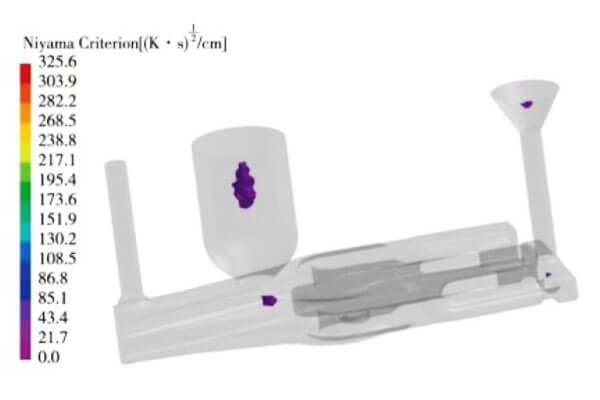
This indicated a potential feeding problem in the center of the tooth.
The finding is particularly significant because this region is mechanically important. A shrinkage defect located in a non-functional riser may simply be removed with the riser. The same defect inside the working body of the bucket tooth can significantly reduce fatigue and impact resistance.
Riser Design and Hot-Spot Feeding
The riser is the primary reservoir that compensates for solidification shrinkage.
For a large bucket tooth, the riser should be positioned near the major thermal center rather than simply placed where it is convenient for molding.
The fundamental design requirement is:
Riser solidification time > hot-spot solidification time.
This can be achieved by increasing the effective thermal modulus of the riser, using insulating or exothermic sleeves, and designing a sufficiently large feeding connection.
Kasabay nito, riser size should not be increased without limit. An oversized riser may improve feeding but significantly reduce casting yield and increase metal consumption.
The optimum design therefore balances:
feeding efficiency + casting soundness + metal yield + fettling cost.
7. ProCAST as a Digital Tool for Casting Optimization
Modern precision casting increasingly uses numerical simulation to evaluate process designs before physical production.
Software tulad ng ProCAST can simulate metal filling, paglipat ng init, pagpapatibay, temperature distribution, and potential shrinkage defects.
For a large bucket tooth, simulation can answer several critical questions:
- Where does molten metal arrive first?
- Where does the temperature fall most rapidly?
- Which regions solidify first?
- Where are the final liquid pools?
- Are risers capable of feeding the hot spots?
- Where is shrinkage porosity most likely?
- Is filling sufficiently stable?
- Will increasing pouring speed create mold erosion or turbulence?
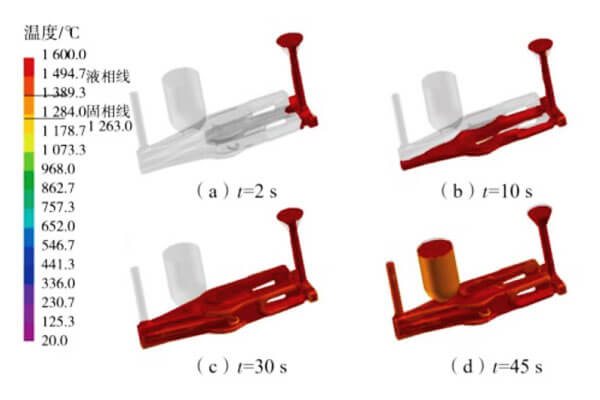
Niyama Criterion
The Niyama criterion is commonly used as an indicator for shrinkage-related defect risk.
In simplified terms, regions experiencing an unfavorable combination of temperature gradient and cooling rate are more susceptible to shrinkage porosity.
Simulation can therefore identify potentially dangerous regions before actual production.
This changes the process-development strategy from:
Casting → defect → root-cause analysis → redesign
sa:
Simulation → optimization → trial casting → validation.
The latter approach can significantly reduce development time and scrap.
8. Casting Simulation for Process Optimization
For large high-manganese steel bucket teeth, casting simulation provides an effective way to optimize the process before costly production trials. Instead of relying entirely on empirical gating and pouring parameters, software such as ProCAST can simulate molten-metal filling, paglipat ng init, pagpapatibay, and shrinkage formation. This is particularly valuable for bucket teeth because their thick central sections and complex transitions create significant differences in cooling rate and feeding demand.
The optimization objective is not simply to obtain complete mold filling. A successful process must achieve stable filling, sufficient fluidity, kinokontrol na pagpapatibay, and effective feeding, while keeping shrinkage defects outside critical load-bearing regions.
Simulation of Filling and Solidification
The initial simulation should include the complete casting geometry, gating system, Mga Riser, and sand mold. Material properties and thermal boundary conditions are established before analyzing the filling process.
During filling, key variables include metal temperature, filling time, flow velocity, and potential turbulence. Excessively slow filling causes substantial heat loss and increases the risk of premature solidification, while excessive flow velocity may cause mold erosion, kaguluhan, and oxide or slag entrainment.
Solidification analysis is even more important for large bucket teeth. The thick central region generally remains liquid longer than thinner sections, creating a localized hot spot. If feeding is interrupted before this region completes solidification, volumetric contraction can produce shrinkage porosity or shrinkage cavities.
Defect-prediction criteria such as the Niyama criterion can therefore be used to identify areas with an increased risk of internal shrinkage. The ideal result is for predicted defects to remain concentrated within the riser or gating system rather than the functional body of the bucket tooth.
Orthogonal Experimental Design
To systematically optimize the casting process, three major parameters can be evaluated through a three-level orthogonal experimental design:
| Parameter | Level 1 | Level 2 | Level 3 |
| A: Pagbuhos ng Temperatura | 1,450°C | 1,500°C | 1,550°C |
| B: Pouring Speed | 16 kg/s | 14 kg/s | 12 kg/s |
| C: Mold Preheat Temperature | 600°C | 500°C | 400°C |
Each parameter combination is simulated, kasama ang predicted shrinkage defect volume used as the primary response variable. Among the simulated combinations, the lowest shrinkage tendency was obtained with 1,450°C pouring temperature, 16 kg/s pouring speed, and 600°C mold preheating.
The simulation results demonstrate an important process relationship. A higher pouring temperature does not necessarily improve casting quality. Excessive superheat prolongs the liquid state of the metal and can increase the thermal load and shrinkage tendency of thick sections. Katulad din nito, a low pouring rate increases filling time and allows greater heat loss. Adequate mold preheating, meanwhile, reduces the temperature difference between the molten metal and mold, helping maintain fluidity and achieve a more uniform thermal field.
Optimized Process Parameters
The optimized parameters can be summarized as follows:
| Parameter | Initial Process | Optimized Process | Main Benefit |
| Pagbuhos ng temperatura | 1,600°C | 1,450°C | Reduces excessive superheat and shrinkage tendency |
| Pouring speed | ~14 kg/s | 16 kg/s | Shortens filling time and reduces heat loss |
| Mold preheating | 400°C | 600°C | Improves thermal uniformity and feeding conditions |
| Filling time | ~45 s | ~35 s | Reduces premature cooling during filling |
The optimized pouring temperature is sufficiently high to maintain the required fluidity of high-manganese steel while avoiding the excessive superheat associated with the original 1,600°C process. Increasing the pouring rate from approximately 14 sa 16 kg/s compensates for the lower pouring temperature by shortening filling time. Raising mold preheating from 400°C to 600°C further reduces the thermal gradient between the molten metal and mold.
Gating System Redesign
Process parameters alone cannot solve defects caused by an inadequate gating system. The original configuration, consisting essentially of a single sprue, runner, and ingate, was therefore redesigned to accommodate the optimized pouring conditions.
Ang sprue diameter was increased to improve metal delivery capacity and maintain a stable filling rate. Two additional ingates were introduced to improve metal distribution and provide better feeding access to critical sections. A difference in ingate height creates a useful pressure differential, helping accelerate filling of more remote areas.
Runner wells were also incorporated near the relevant runner bases. These features provide a buffering effect, reduce abrupt changes in flow direction, and assist in trapping slag and other inclusions before the metal enters the casting cavity.
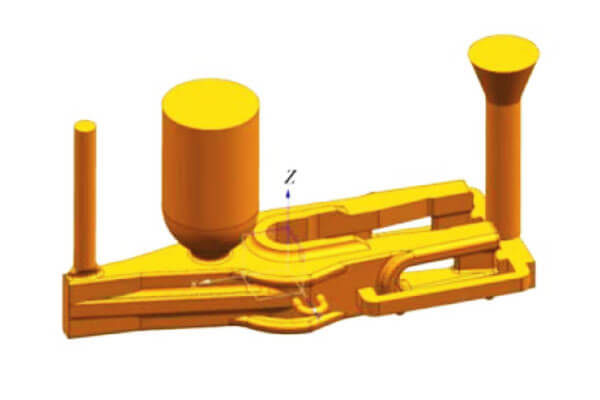
The optimized gating concept can therefore be summarized as:
| Gating Modification | Layunin | Expected Benefit |
| Larger sprue diameter | Increase metal flow capacity | Faster and more stable filling |
| Two additional ingates | Improve flow distribution | Better filling of critical sections |
| Different ingate elevations | Generate pressure differential | Improve filling of remote regions |
| Runner wells | Buffer flow and trap slag | Reduced turbulence and cleaner metal |
Simulation-Based Optimization Results
After applying the optimized process parameters and redesigned gating system, the complete casting process is simulated again. The predicted solidification pattern becomes more favorable, with improved feeding of the thick central region and a reduced risk of internal shrinkage.
Most importantly, the predicted shrinkage defects are relocated from the functional body of the bucket tooth to the riser, pouring cup, and runner system. This is the desired outcome of feeding optimization because these regions are removed during fettling and do not compromise the structural integrity of the finished component.
The comparison between the initial and optimized processes demonstrates the effectiveness of the simulation approach:
| Process Variable | Initial Condition | Optimized Condition |
| Pagbuhos ng temperatura | 1,600°C | 1,450°C |
| Pouring speed | ~14 kg/s | 16 kg/s |
| Mold preheat | 400°C | 600°C |
| Filling time | ~45 s | ~35 s |
| Mga Tip sa Pag-install | Single ingate | Multi-ingate + runner wells |
| Internal shrinkage risk | Makabuluhan | Substantially reduced |
| Main predicted defect location | Casting body + feeding system | Primarily riser and gating system |
From Numerical Simulation to Production
Casting simulation should ultimately be verified through physical production. After implementing the optimized parameters and gating design, trial castings can be evaluated by visual inspection, dimensional inspection, metallographic examination, Pagsubok sa Katigasan, and appropriate non-destructive testing, particularly ultrasonic testing for internal soundness.
The significance of the optimization is therefore broader than simply obtaining a better simulation result. It establishes a repeatable relationship between pouring temperature, filling rate, mold thermal condition, gating configuration, and solidification behavior.
For high-manganese steel bucket teeth, this simulation-driven methodology reduces trial-and-error development, improves casting yield, minimizes internal shrinkage defects, and provides a more reliable foundation for producing large mining components capable of withstanding severe impact and abrasive wear.
9. Validation and Results
The effectiveness of the optimized casting process must be demonstrated through both numerical simulation and physical production validation. For high-manganese steel bucket teeth, eliminating visible surface defects alone is insufficient. The critical objective is to obtain a sound internal structure capable of resisting repeated impact, pagbaluktot, and abrasive wear during mining operations.
Post-Optimization Simulation Results
After optimizing the pouring parameters and redesigning the gating system, the casting process was simulated again under the new conditions. Compared with the original process, the predicted solidification behavior became significantly more favorable.
| Parameter | Before Optimization | After Optimization |
| Pag-urong ng porosity | Significant risk in central thick section | No significant shrinkage predicted in tooth body |
| Defect location | Tooth body and feeding system | Mainly riser and gating system |
| Solidification pattern | Non-uniform; local feeding deficiency | More controlled and directional |
| Feeding efficiency | Insufficient in critical hot spots | Improved feeding of thick sections |
| Casting soundness | Internal defects possible | High internal soundness |
| Production risk | Mataas na | Significantly reduced |
The most important result is the relocation of predicted shrinkage. In the original process, the central thick section of the bucket tooth remained vulnerable to insufficient feeding, allowing shrinkage to develop inside the functional casting. After optimization, the feeding system was able to compensate for solidification contraction more effectively, and the remaining predicted defects were concentrated mainly in the riser and gating system.
This is a critical distinction in casting engineering. The objective is not necessarily to eliminate all shrinkage from the entire mold system, because volumetric contraction is inherent to metal solidification. Sa halip, the process should be designed so that shrinkage occurs in sacrificial feeding regions rather than in the load-bearing tooth body.
Production Validation
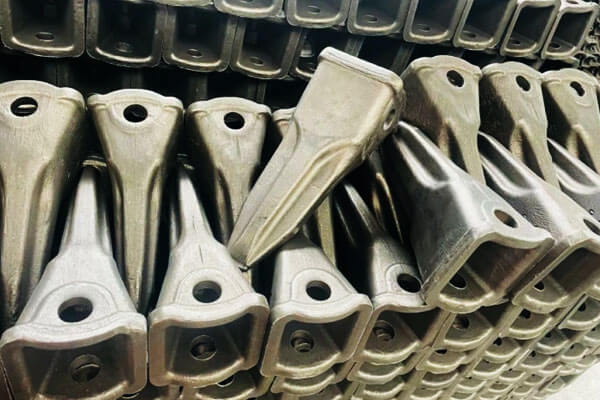
The optimized process was subsequently applied to physical production. The resulting bucket teeth showed a substantial improvement in both surface quality and internal integrity compared with castings produced using the original process.
| Performance Indicator | Initial Process | Optimized Process |
| Kalidad ng ibabaw | Local surface defects and imperfections | Significantly improved surface quality |
| Internal soundness | Risk of shrinkage cavities and porosity | Dense structure with no significant shrinkage defects |
| Defect distribution | Defects could occur within tooth body | Defects primarily confined to removable feeding regions |
| Rejection rate | Medyo mataas na | Substantially reduced |
| Structural consistency | Variable | More consistent |
| Production stability | Sensitive to process fluctuations | Improved process repeatability |
Physical inspection confirmed the main trend predicted by the simulation: the optimized bucket teeth exhibited improved surface quality and significantly reduced internal shrinkage defects. The reduction in casting rejection also demonstrates the practical value of optimizing the process before large-scale production.
For mining bucket teeth, this improvement has direct engineering significance. Internal shrinkage can act as a stress concentration under severe impact loading and may initiate crack propagation, premature tooth fracture, or accelerated failure. By improving internal soundness, the optimized process provides a stronger foundation for achieving consistent mechanical properties and longer service life.
Engineering Significance of the Validation
The agreement between simulation and production demonstrates the value of integrating casting simulation, process parameter optimization, and gating-system redesign into the manufacturing development process.
The optimized process established a more favorable balance among pouring temperature, filling rate, mold preheating, and feeding behavior. Instead of relying on repeated production trials to identify defects, potential problems can be identified and corrected at the virtual-process stage.
For high-manganese steel bucket teeth, this approach is particularly effective because component size, thick-section solidification, and demanding service conditions make internal casting quality critical. A sound casting with controlled solidification provides the necessary basis for subsequent heat treatment and final inspection, ultimately contributing to more reliable performance in high-impact and high-abrasion mining applications.
10. Precision Casting Versus Forging for Bucket Teeth
For mining excavator bucket teeth, both precision casting and forging can produce high-strength components, but they follow fundamentally different manufacturing principles.
| Comparison Factor | katumpakan paghahagis | Pagbubuo ng mga |
| Manufacturing principle | Molten high-manganese steel is poured into a precisely designed mold and solidified into the required geometry. | Heated steel billet is plastically deformed under high compressive forces using dies, Pindutin ang mga pindutin, or hammers. |
| Design flexibility | Mataas na; complex tooth profiles, curved surfaces, internal transitions, Mga Boss, and integrated features can be produced directly. | Katamtaman; complex geometries may require multiple forging operations, preforms, pag-trim, and subsequent machining. |
| Material utilization | Generally favorable because the near-net-shape casting can closely follow the final component geometry, although gating and riser metal must be removed. | Material losses can increase because of flash, pag-trim, Mga Allowance sa Machining, and billet preparation. |
| Large bucket teeth | Particularly suitable for large mining teeth where component dimensions and mass make forging equipment requirements substantial. | Large teeth require very high forging loads and large-capacity equipment, which can significantly increase tooling and production requirements. |
Internal soundness |
Requires careful control of solidification, feeding, Disenyo ng Riser, and casting simulation to prevent shrinkage porosity and cavities. | Generally provides excellent internal integrity when properly forged, although laps, mga bitak, mga inclusions, and forging-related defects remain possible. |
| Microstructure | Solidification produces a cast structure that may require solution treatment and controlled cooling to achieve the required high-manganese steel properties. | Plastic deformation can refine and homogenize the microstructure and produce favorable grain flow. |
| Grain flow | No mechanically induced directional grain flow; properties depend strongly on solidification structure and heat treatment. | Major advantage; continuous grain flow can follow the component geometry and improve resistance to impact and fatigue loading. |
| Email Address * | High when an appropriate high-manganese steel grade, sound casting structure, and suitable heat treatment are used. | Mataas na, with mechanical working potentially contributing to structural refinement and toughness. |
Katigasan ng epekto |
Can provide excellent toughness, but internal shrinkage, coarse structure, or casting defects must be strictly controlled. | Typically offers strong toughness and fatigue resistance because of forged grain flow and reduced internal porosity. |
| Dimensional complexity | Napakahusay for near-net-shape production of irregular tooth profiles and integrated geometric features. | More difficult for highly three-dimensional or undercut geometries; additional machining may be necessary. |
| Tooling cost | Mold and pattern costs can be relatively economical, particularly for medium-volume production and large components. | Forging dies are usually expensive and require substantial tooling strength and maintenance. |
| Production volume | Suitable for prototypes, small and medium batches, and high-volume production when tooling is optimized. | Most economically attractive when production volume is high enough to justify expensive forging dies and equipment. |
| Process development | Can be optimized through casting simulation, including filling, pagpapatibay, Niyama-based shrinkage prediction, Email Address *, and riser design. | Requires forging simulation and careful control of billet temperature, deformation sequence, die filling, and forging force. |
Machining requirements |
Can achieve near-net shape and reduce machining to functional interfaces and dimensional-critical areas. | Forged blanks may require substantial machining depending on the final tooth geometry and dimensional requirements. |
| Typical defect concerns | Pag-urong ng porosity, pag urong ng mga cavities, gas defects, mga inclusions, malamig na mga shut, Mga Pagkakamali, and casting cracks. | Forging laps, underfill, mga bitak, mga inclusions, die mismatch, decarburization, and residual stresses. |
| Process optimization | Mga Tip sa Pag-install, feeding, pouring temperature, rate ng pagbuhos, mold preheating, and heat treatment can be optimized systematically. | Billet temperature, deformation ratio, forging sequence, die temperature, lubrication, and cooling must be controlled. |
| Economic suitability | Strong choice for large, complex mining bucket teeth, especially where casting geometry reduces machining and tooling complexity. | Attractive when exceptionally high mechanical integrity is required and the component geometry, dami ng produksyon, and available forging capacity justify the investment. |
| Best-fit application | Large and complex high-manganese steel bucket teeth requiring wear resistance, impact toughness, geometric flexibility, and scalable production. | Components where maximum mechanical integrity and forged grain flow outweigh geometric complexity, tooling cost, and equipment requirements. |
11. Custom High Manganese Steel Bucket Teeth from LangHe
LangHe provides customized metal casting solutions for demanding industrial applications, including large wear-resistant components and high manganese steel castings.
For custom bucket teeth, the manufacturing approach can integrate casting process design, mold and core development, optimized gating and feeding, alloy control, paggamot ng init, CNC machining, at inspeksyon into a coordinated production workflow.
For engineering-driven projects, the process can begin with the customer’s 2D drawing, 3D CAD model, existing worn tooth, or equipment interface dimensions. The casting design can then be reviewed for manufacturability, thermal hot spots, Mga Allowance sa Machining, draft requirements, and feeding strategy.
For large and technically demanding bucket teeth, simulation-assisted process development is particularly valuable. Filling and solidification behavior can be evaluated before production, allowing gating, Mga Riser, Mga panginginig, and process parameters to be optimized before committing to full-scale manufacturing.
A professional supplier should ultimately provide more than a cast metal shape. The objective is a repeatable, traceable, defect-controlled wear component capable of surviving the intended mining environment.
12. Pangwakas na Salita
For large bucket teeth, the most critical technical challenges are concentrated around pag-urong ng solidification, thermal hot spots, filling stability, mold temperature, gas management, mga inclusions, and internal structural integrity.
Modern manufacturing therefore increasingly relies on an integrated methodology:
Material Selection → Casting Design → Simulation → Gating & Feeding Optimization → Controlled Melting → Precision Casting → Heat Treatment → NDT → Dimensional Inspection → Production Validation
Among these stages, casting simulation provides a particularly valuable bridge between theoretical process design and physical production. By analyzing filling, temperature fields, pag-uugali ng solidification, and shrinkage risk before production, manufacturers can significantly reduce trial-and-error development and improve casting consistency.
A properly engineered high manganese steel bucket tooth is therefore not merely a cast wear part—it is a carefully controlled engineering component designed to deliver reliable performance under some of the harshest working conditions in the mining industry.
Mga Sanggunian:
[1] Qiu G X, Li J N, Chen K, Xu G, Yang Y K, Li X M. “Research Status of High-Manganese High-Aluminum Steel and Key Points of Continuous Casting“. JOM, 2024, 76(12): 7011–7022.
[2] Yang L, Winkler J, Presoly P, et al.Crack sensitivity of high-manganese cryogenic steels in initial solidification during continuous casting [J]. Journal of Iron and Steel Research International, 2025, 32 (3 ) : 682-694.
[3]Lee Seunghee,Park Jiwon,Kim Yongrai,et al.Microstructural homogenization and mechanical property enhancement of highmanganese cast steel through a hot forging process[J]. Korean Journal of Metals and Materials, 2025, 63 (7):483-493.
[4] Zeng Y P, Ji H C, Song C Z, et al.Numerical simulation and experiment on hot forging of high-Mn steel turnout core[J]. Materials Today Communications, 2024, 40: 109588.
[5] Salem I, Elfawkhry M K, El-Salam H M A ,et al.Enhancing manganese steel castings: the role of magnesium, kaltsyum, and surface-active elements in reinforcing ceramic-metal composite structures[J].International Journal ng Metalcasting, 2026, 20(2) : 1289-1298.