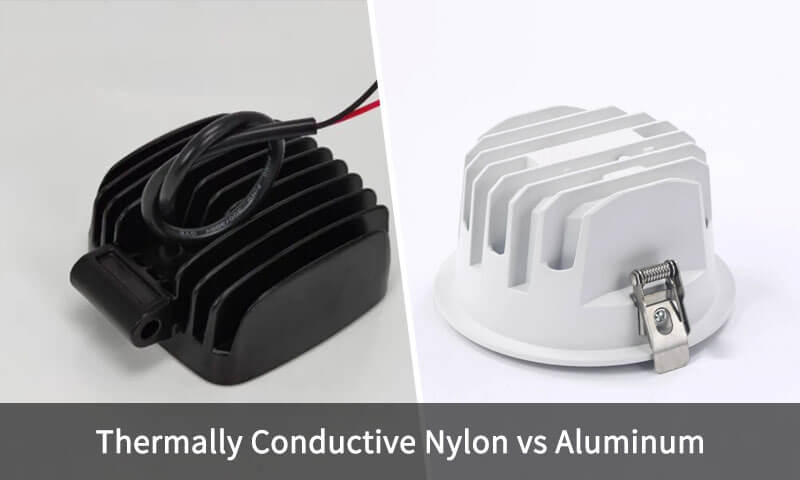
Thermally conductive nylon is becoming an alternative for certain heat-dissipation components.
LED lamp housings, power supply enclosures, electronic cooling structures, and other medium- and low-power applications are increasingly adopting thermally conductive engineering plastics to reduce weight, simplify assembly, and integrate electrical insulation.
This raises an important engineering question: Aluminum has a thermal conductivity of about 200 W/m·K. Pure nylon is only 0.25–0.3 W/m·K. That is a difference of several hundred times. Can thermally conductive nylon really replace aluminum in heat sinks?
It is a fair question. The number on the datasheet looks impossible. But the answer is more interesting than a simple yes or no.
Whether a part can dissipate heat is not decided by a single material property—it is decided by the whole thermal path: conduction, spreading, convection, and radiation.
This article explains how thermally conductive nylon works, where it can genuinely replace aluminum, where it cannot, and how to select a grade without being misled by a single impressive number.
1. What Is Thermally Conductive Nylon?
Naylon, kilala rin bilang polyamide (PA), is a widely used engineering thermoplastic valued for its mechanical strength, Paglaban sa Pagsusuot, paglaban sa kemikal, and processing versatility.
Common engineering grades include PA6 and PA66. Gayunpaman, unfilled nylon is naturally a poor thermal conductor, with a typical thermal conductivity of approximately 0.25–0.3 W/(m · K).
This is comparable to many conventional engineering plastics and far below aluminum.
Thermally conductive nylon works by loading the matrix with a high volume of thermally conductive filler.
The filler particles contact each other and form a continuous conductive network. Heat travels along this network rather than through the polymer.
Common Thermal Conductive Fillers
Thermal fillers can generally be divided into electrically insulating and electrically conductive categories.
| Filler Material | Electrical Characteristics | Main Advantages | Mga Karaniwang Aplikasyon |
| Aluminyo oksido (Al O) | Electrically insulating | Good cost-performance balance, stable insulation properties | Email Address *, Mga de-koryenteng enclosure |
| Aluminum nitride (AlN) | Electrically insulating | High thermal conductivity and good insulation potential | High-performance electronic thermal components |
| Boron nitride (BN) | Electrically insulating | Mataas na thermal kondaktibiti, especially in preferred orientations | Insulated heat-dissipation components |
| Graphite | Electrically conductive | High in-plane thermal conductivity | Heat spreaders and thermal management components |
| Carbon fiber | Electrically conductive | Improves thermal transport and mechanical reinforcement | Structural thermal components |
| Graphene | Generally electrically conductive | High intrinsic thermal conductivity and potential for advanced composites | Specialized thermal management materials |
Typical Thermal Conductivity of Thermally Conductive Nylon
The following values provide general material-selection references:
| Materyal | Typical Thermal Conductivity (W/m·K) | Mga Katangian |
| Unfilled nylon | 0.25–0.3 | Standard engineering thermoplastic |
| Thermally conductive nylon | 1–5 | Common range for insulating formulations |
| High-performance filled nylon | 5–10+ | Higher filler loading or advanced filler systems |
| Specialized BN/graphite-filled composites | 10+ | Can achieve higher conductivity in preferred directions |
| Mga haluang metal ng aluminyo | Tinatayang 200 | High thermal conductivity and good heat spreading |
Tala: These are indicative ranges, not guaranteed specifications. Actual performance depends on the nylon grade, filler type, loading, processing conditions, and measurement direction.
Specialized composites may achieve higher values, but their mechanical and processing characteristics must also be evaluated.
2. Can Thermally Conductive Nylon Really Dissipate Heat?
A heat sink does not work by conductivity alone. It works through a sequence: conduction from the source, spreading through the part, convection from the surface to air, and radiation from the surface.
Aluminum conducts heat quickly, but conduction is only the first step. The final step—getting heat into the air—depends on surface area and airflow, not on the material’s conductivity.
A part with excellent conductivity and insufficient surface area will still run hot.
Thermally conductive nylon compensates for its lower conductivity through several design and functional advantages.
Higher Surface Emissivity
Aluminum surfaces, particularly bright or polished ones, generally have relatively low thermal emissivity.
Polymer surfaces typically exhibit higher emissivity, allowing them to release a greater proportion of heat through thermal radiation at the same surface temperature.
This advantage becomes more relevant in enclosed equipment with limited airflow. Under natural convection conditions, radiation can contribute a meaningful share of total heat dissipation.
Gayunpaman, the actual contribution depends on surface temperature, emissivity, surrounding surface temperatures, and the geometry of the enclosure.
Higher emissivity does not automatically make nylon a better heat sink, but it can help compensate for lower thermal conductivity in appropriately designed applications.
Greater Design Freedom for Heat-Dissipating Structures
Injection molding allows thermally conductive nylon to form complex geometries that may be difficult or expensive to produce through conventional aluminum machining.
Manufacturers can integrate dense fins, curved surfaces, irregular heat-dissipation features, and internal cavities into a single molded component.
These structures can increase the effective heat-transfer area without requiring multiple machining or assembly operations.
For compact electronic products, where available installation space is limited, geometry can be just as important as material conductivity.
Gayunpaman, more fins do not always mean better cooling. Fin spacing, kapal naman, taas, Oryentasyon, and airflow resistance must be considered together.
If fins are too closely spaced, restricted airflow may reduce their effectiveness.
Integrated Electrical Insulation
Electrical insulation is an important consideration in LED lighting, power electronics, charging equipment, and other electrical assemblies.
Aluminum conducts heat efficiently but also conducts electricity, so designers may need additional insulation between the heat source and the metal housing.
Thermally conductive nylon can combine heat transfer and electrical insulation in one material when the formulation uses electrically insulating fillers, such as aluminum oxide, aluminum nitride, or boron nitride.
This can reduce the need for separate insulating sheets, pads, mga panaklaw, or other isolation components.
The result may be a simpler assembly with fewer interfaces and fewer opportunities for installation errors.
Gayunpaman, electrical insulation must be verified against the product’s voltage, creepage and clearance requirements, operating environment, and applicable safety standards.
Lower Weight and Reduced Part Count
With a typical density of approximately 1.3–1.8 g/cm³, thermally conductive nylon is considerably lighter than aluminum, which generally has a density of approximately 2.65–2.80 g/cm³.
Beyond material weight, injection molding also allows manufacturers to integrate mounting bosses, screw posts, wire channels, snap-fit features, and positioning structures directly into the heat-dissipating housing.
These integrated features can eliminate separate brackets, mga fastener, and support components.
For portable electronics, compact power modules, automotive electronics, and other weight-sensitive products, reducing both component mass and assembly complexity can provide a practical advantage.
Lower Manufacturing Cost at Production Volume
For complex components, injection molding can offer a cost advantage once production volume justifies the tooling investment.
A molded thermally conductive nylon housing can combine several functions in one part, potentially replacing an aluminum component that requires machining or die casting, secondary insulation, additional brackets, and manual assembly.
The economic advantage depends on part geometry, material grade, dami ng produksyon, tooling cost, Oras ng pag-ikot, and quality requirements.
For simple heat sinks or low-volume applications, aluminum may remain more economical.
For high-volume products with complex integrated features, thermally conductive nylon can offer a more competitive total manufacturing cost.
So the real question is not “Is nylon as conductive as aluminum?” It is “Does this specific thermal problem need aluminum-level conductivity, or does it need adequate conductivity plus surface area plus insulation?”
3. Thermally Conductive Nylon vs. Aluminyo: Mga Pangunahing Pagkakaiba
Selecting between thermally conductive nylon and aluminum requires more than comparing thermal conductivity.
Their differences extend to weight, pagkakabukod ng kuryente, mekanikal na pag-uugali, mga proseso ng pagmamanupaktura, dimensional na katatagan, and production cost.
Material Performance Comparison
| Pag-aari | Thermally Conductive Nylon | Aluminum Alloy |
| Thermal kondaktibiti | Typically 1–5 W/(m · K); specialized grades can exceed 10 | Tinatayang 200 W/(m · K) |
| Densidad ng katawan | Approximately 1.3–1.8 g/cm³, grade-dependent | Approximately 2.65–2.80 g/cm³ |
| Kondaktibiti ng kuryente | Can be electrically insulating with suitable fillers | Electrically conductive |
| Mechanical strength | Depends heavily on polymer grade and filler loading | Generally higher stiffness and structural stability |
| Elastic modulus | Typically lower than aluminum | Approximately 69–72 GPa |
| Paglaban sa kaagnasan | No metallic corrosion; chemical compatibility must be checked | Mabuti na lang, but depends on alloy and surface treatment |
| Thermal expansion | Generally higher | Generally lower |
Paggawa |
Pag iiniksyon paghubog, potentially extrusion | Aluminum extrusion, mamatay sa paghahagis, CNC machining |
| Design flexibility | Excellent for complex integrated features | Mabuti na lang, but geometry and process dependent |
| Email Address * | Texturing, pagpipinta, mga patong na patong | Pagpapahid ng langis, patong ng pulbos, pagpipinta, buli na |
| Timbang | Mas mababa | Mas Mataas |
| Electrical isolation | Can integrate insulation into the component | Usually requires additional insulation where necessary |
Tala: The figures are representative engineering ranges. Nylon properties vary considerably with polymer type, filler formulation, moisture content, temperatura, and molding direction.
Pagbaba ng timbang
One of the most obvious advantages of thermally conductive nylon is its lower density.
With a typical density of approximately 1.3–1.8 g/cm³, thermally conductive nylon is lighter than aluminum, which generally falls within 2.65–2.80 g/cm³.
This can reduce component mass, particularly in products where the heat sink also serves as an enclosure or structural housing.
Weight reduction is valuable in:
- Portable electronic devices.
- LED lighting fixtures.
- Battery-powered equipment.
- Compact power modules.
- Automotive electronic housings.
Gayunpaman, designers should not compare materials using density alone.
Because nylon has lower stiffness, the component may require thicker walls or additional reinforcing features. The final weight advantage depends on the complete geometry.
Pagkakabukod ng Elektriko
Electrical insulation is one of the strongest reasons to consider thermally conductive nylon.
Aluminum is electrically conductive. If an aluminum heat sink is positioned near live electrical components, designers may need additional insulation layers, insulating pads, or structural barriers.
Properly formulated thermally conductive nylon can combine heat transfer with electrical insulation in one component.
This can simplify the assembly of:
- LED lighting housings.
- Power supply enclosures.
- Charging modules.
- Electronic control units.
- High-voltage electrical components.
For these applications, electrically insulating fillers such as aluminum oxide, boron nitride, and aluminum nitride are particularly relevant.
The electrical properties must still be verified using the actual compound and finished component.
A material described as thermally conductive should not automatically be assumed to meet a specific insulation requirement.
Mechanical Strength and Dimensional Stability
Aluminum generally offers higher stiffness and better dimensional stability under sustained mechanical loads.
Nylon composites can provide useful strength, but high filler loading may reduce impact resistance and elongation.
Polymer components may also experience creep under continuous loading, particularly at elevated temperatures.
This matters when the heat sink must support:
- Heavy electronic components.
- Screws and threaded inserts.
- Repeated assembly and disassembly.
- Long-term clamping pressure.
- Mechanical vibration.
For these applications, the selected nylon grade must be evaluated for tensile strength, flexural modulus, epekto ng paglaban, gumagapang, and heat-aging performance.
Kaagnasan at Paglaban sa Kapaligiran
Thermally conductive nylon does not undergo metallic corrosion in the same way as aluminum.
This can be advantageous in environments where moisture or certain chemicals may attack metallic surfaces.
Gayunpaman, nylon is not immune to environmental degradation. Depending on its formulation and exposure conditions, it may absorb moisture, undergo dimensional changes, or experience degradation from heat, UV radiation, and certain chemicals.
Aluminum also offers good corrosion resistance, particularly with suitable alloy selection and surface treatments such as anodizing.
Material selection should therefore reflect the actual operating environment rather than assuming that one material is universally more durable.
4. When Can Thermally Conductive Nylon Replace Aluminum?
Thermally conductive nylon is most suitable when the heat load is moderate, electrical insulation is important, and the component can be designed with sufficient heat-transfer area.
It is increasingly attractive in applications where several functions must be integrated into a compact molded part.
LED Lamp Housings and Lighting Components
LED lighting is one of the more promising application areas for thermally conductive nylon.
Many LED products operate at moderate power levels and use relatively compact heat sinks.
In these designs, the housing and heat-dissipation structure can be integrated into one injection-molded component.
Potential advantages include:
- Reduced component weight.
- Integrated electrical insulation.
- Complex fin geometries.
- Reduced secondary assembly.
- Greater design flexibility.
- Consistent high-volume production.
Gayunpaman, high-power LED modules with concentrated heat sources may still require aluminum or hybrid thermal structures.
Small and Medium-Power Power Supply Modules
Power supplies and electronic control modules often require heat-dissipation structures around switching components, mga transformer, and power semiconductors.
Thermally conductive nylon can be useful when the heat load is distributed and electrical isolation is required.
Its injection-molding characteristics also allow designers to integrate mounting features, cable channels, protective walls, and heat-dissipation fins into a single housing.
For high-power power supplies, gayunpaman, aluminum remains preferable where rapid heat spreading and low thermal resistance are essential.
Charging Modules and Electrical Enclosures
Charging modules and compact electrical devices often contain several heat-generating components within a limited installation space.
Thermally conductive nylon can provide both enclosure protection and thermal management while reducing the need for separate insulating components.
This is particularly valuable when the product requires:
- Electrical insulation.
- Complex internal geometry.
- Integrated mounting features.
- Lightweight construction.
- High-volume injection molding.
The final material must also satisfy the required flame-retardancy, pagkakabukod ng kuryente, and long-term temperature specifications.
Automotive Electronics and Control Components
Thermally conductive nylon can also be considered for selected automotive electronic housings, sensor enclosures, and control modules.
Its lower weight and electrical insulation properties can support compact electronic packaging.
Gayunpaman, automotive applications require careful validation of thermal aging, vibration resistance, pagkakalantad sa kemikal, moisture absorption, at dimensional na katatagan.
A material that performs well in an indoor LED lamp may not be suitable for an under-hood automotive environment.
When Aluminum or Copper Is Still the Better Choice
Thermally conductive nylon should not be treated as a universal replacement for metallic heat sinks.
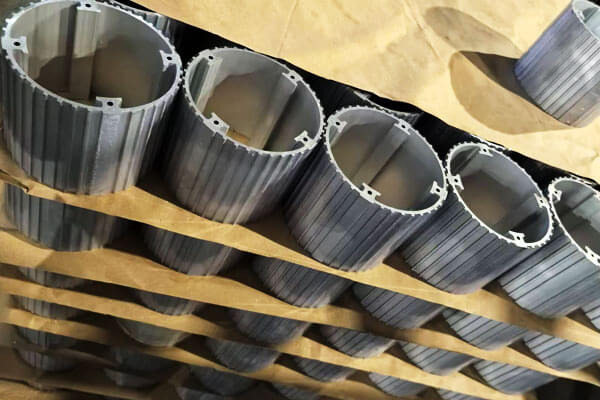
Aluminum or copper remains preferable in applications involving:
- High-power semiconductor devices.
- High heat flux concentrated in a small area.
- Direct thermal contact with high-temperature components.
- Continuous high-temperature operation.
- Large heat loads requiring rapid heat spreading.
- Long cooling paths where low thermal resistance is essential.
Copper offers even higher thermal conductivity than aluminum, although its greater density and cost limit its use in some applications.
A rule of thumb from my own practice: if the conduction path is short, the surface area is generous, the power is moderate, and insulation is required anyway, nylon is worth evaluating.
If heat must be pulled rapidly from a small area, stay with metal.
5. Do Not Choose a Material by One Number
One of the most common mistakes in selecting thermally conductive nylon is focusing exclusively on the highest advertised thermal conductivity.
In-Plane vs. Through-Plane Thermal Conductivity
One of the most important characteristics of thermally conductive nylon is anisotropic thermal conductivity, meaning that heat does not travel equally well in every direction.
This behavior is common in materials filled with graphite flakes, boron nitride platelets, and other particles with directional structures.
During injection molding, these fillers tend to align with the melt flow.
Bilang isang resulta, thermal conductivity parallel to the molded surface can be significantly higher than conductivity through the component thickness.
The distinction is critical when designing heat sinks. Halimbawa na lang, heat generated by an electronic component typically enters the heat sink through its base and then travels toward the fins, where it transfers to the surrounding air.
This heat path may require effective through-plane conductivity, not simply high in-plane conductivity.
A datasheet that reports only the higher in-plane value can therefore give an incomplete picture of actual heat-transfer performance.
Before selecting a grade, ask the material supplier to provide both measurements:
- In-plane thermal conductivity: Heat transfer parallel to the molded surface or principal melt-flow direction.
- Through-plane thermal conductivity: Heat transfer perpendicular to the molded surface or through the component thickness.
These values should be measured under comparable test conditions. Engineers should also consider the actual gate location, melt-flow direction, kapal ng pader, and filler orientation when interpreting the data.
For heat-sink applications, the through-plane value is particularly important whenever heat must travel from the mounting surface into the fins.
Electrical Insulation or Electrical Conductivity: Define the Requirement First
The electrical behavior of thermally conductive nylon must be established before selecting a filler system.
This is not merely a question of thermal performance; it directly affects product safety and electrical compliance.
Thermally conductive compounds generally fall into two categories:
| Uri ng Materyal | Typical Fillers | Electrical Characteristics | Suitable Applications |
| Electrically insulating grades | Aluminyo oksido (Al O), aluminum nitride (AlN), boron nitride (BN) | Designed to combine heat transfer with electrical insulation | LED modules, power electronics, mga electrical housings, insulated heat sinks |
| Electrically conductive grades | Graphite, carbon fiber, certain carbon-based fillers | Can conduct electricity and may provide electromagnetic shielding | EMI shielding components, grounding structures, electrically conductive housings |
For components located near energized circuits, high-voltage modules, or exposed electrical connections, electrically insulating grades are generally required.
Volume resistivity is one important parameter to evaluate. A value of 10¹⁴ Ω·cm or higher can serve as a reference target for certain applications, but it is not a universal acceptance criterion.
The actual requirement depends on voltage, operating conditions, material thickness, environmental exposure, and applicable safety standards.
Sa kabilang banda, grapayt- or carbon-fiber-filled compounds may be appropriate when electrical conductivity is required for grounding or electromagnetic interference (EMI) Kalasag.
Gayunpaman, these materials should not be treated as electrically insulating heat-transfer plastics.
Confusing these two material categories can create serious design and compliance problems.
Kaya nga, electrical requirements should be defined before comparing thermal conductivity or finalizing the material grade.
Why Higher Filler Content Is Not Always Better
Increasing the concentration of thermally conductive fillers generally improves heat transfer by creating more continuous pathways through the polymer matrix.
Gayunpaman, higher filler loading also changes the material’s mechanical properties and injection-molding behavior.
As filler content increases, several trade-offs may arise:
- Reduced toughness and impact strength: High filler loading can make the compound more brittle, increasing the risk of cracking during assembly, paghawak ng, or service.
- Lower melt flowability: The melt flow index generally decreases as filler concentration rises, making it more difficult to fill thin walls, narrow channels, and long flow paths.
- Greater equipment wear: Hard mineral fillers can accelerate abrasion of injection-molding screws, barrels, nozzles, and mold surfaces.
- Higher material and processing costs: More specialized fillers increase compound costs, while reduced flowability may require higher injection pressure or more demanding processing conditions.
- Reduced elongation: Increased filler content often limits polymer-chain mobility, reducing elongation at break and overall ductility.
The right grade is a balance between thermal performance, mekanikal na mga katangian, and moldability. The highest number on the datasheet is rarely the best production choice.
6. Flame Retardancy and Temperature Resistance: Requirements for Electrical Heat Sinks
Thermal performance alone does not determine whether a nylon compound is suitable for electrical heat sink applications.
Many lighting and power electronics components must also meet flame-retardancy and long-term temperature requirements.
UL 94 V-0 Flame Retardancy
For many electrical and electronic applications, designers specify UL 94 V-0 as a flame-retardancy target.
UL 94 is a plastics flammability classification system. The V-0 classification is determined under specified laboratory conditions and requires the material to meet defined burning-time and flaming-drip criteria.
Gayunpaman, a material grade’s UL 94 classification is dependent on specimen thickness and test conditions.
A V-0 rating at one thickness does not automatically guarantee the same performance in a thinner finished component.
When selecting thermally conductive nylon, confirm:
- The exact material grade and formulation.
- The certified UL 94 classification.
- The tested specimen thickness.
- Whether the flame-retardant formulation affects thermal conductivity or mechanical performance.
- Whether the final molded component meets the applicable product safety requirements.
Continuous Operating Temperature
Nylon’s temperature resistance varies according to its polymer type, filler system, moisture content, and stabilization package.
The material must withstand not only the normal operating temperature but also localized hot spots and repeated thermal cycling.
Important properties include:
- Heat deflection temperature (HDT).
- Continuous use temperature.
- Glass transition temperature (Tg), kung saan naaangkop.
- Melting temperature (Tm).
- Thermal aging resistance.
- Mechanical property retention after prolonged heat exposure.
A compound may demonstrate good short-term thermal performance but lose mechanical strength or dimensional stability after extended exposure to elevated temperatures.
Para sa kadahilanang ito, thermal aging and actual component testing should be included in the qualification process.
7. Thermally Conductive Nylon vs. Aluminyo: Which Is More Cost-Effective?
The initial material price is only one part of the total manufacturing cost.
Aluminum heat sinks may require extrusion, mamatay sa paghahagis, CNC machining, deburring, surface treatment, and additional electrical insulation components.
Thermally conductive nylon heat sinks can be produced through injection molding, potentially integrating several functions into one part.
Manufacturing Cost Comparison
| Kadahilanan ng Gastos | Thermally Conductive Nylon | Aluminyo |
| Raw material | Often higher than standard nylon due to thermal fillers | Generally competitive |
| Tooling | Injection mold required | Extrusion die or die-casting mold, depending on process |
| Production cycle | Suitable for automated high-volume molding | Efficient extrusion or die casting |
| Secondary machining | Often reduced through integrated molding | May require drilling, paggiling, or cutting |
| Surface treatment | May require painting or specialized coating | Anodizing or powder coating may be required |
| Electrical insulation | Can be integrated into the material | Additional insulation may be necessary |
| Design integration | Mataas na | Depends on manufacturing process |
| Equipment wear | Can be higher with abrasive fillers | Depends on machining and forming operations |
Thermally conductive nylon can become more economical when the design integrates several components, eliminates insulation parts, reduces assembly operations, and supports high-volume production.
Gayunpaman, the compound itself can be significantly more expensive than standard nylon, particularly when advanced fillers are used.
Aluminum may remain more cost-effective for large heat sinks requiring high thermal conductivity, especially when the geometry is relatively simple and extrusion or die casting is suitable.
The correct comparison should be based on total part cost and thermal performance, not raw material price alone.
8. Design Considerations When Switching from Aluminum to Nylon
If you are evaluating a conversion, these are the design changes that matter most.
Increase conduction path cross-section.
Because conductivity is lower, the part needs more material in the conduction path. Thicker walls near the heat source, or dedicated conduction ribs, compensate for the lower conductivity.
Maximize surface area.
Use dense fin arrays, pin fins, or textured surfaces. Injection molding makes complex fin geometry affordable.
Manage anisotropy.
Orient the gate and flow direction so that filler alignment supports the dominant heat flow path.
Where through-plane conductivity is critical, select a filler system with more isotropic behavior or design around the limitation.
Control the interface.
The contact resistance between the heat source and the housing can dominate the total thermal resistance.
Use a thermal pad, gap filler, or phase-change material, and specify a flat, clean mating surface.
Account for wall thickness limits.
Highly filled grades struggle to fill thin walls over long distances. Work with the molder on gate location, kapal ng pader, and processing window.
Design for assembly.
Integrated screw bosses, snap fits, and wire channels are major advantages of molded housings—use them, but reinforce them adequately in brittle high-filler grades.
Consider creep and temperature limits.
Nylon’s mechanical properties degrade with temperature and moisture absorption. Confirm the continuous service temperature and the effect of moisture on dimensions and strength.
9. Pangwakas na Salita
Can thermally conductive nylon replace aluminum for heat sinks? Sometimes yes, sometimes no—and the difference is decided by the application, not by the datasheet.
The most important practical advice is this: do not select a material by a single conductivity number. Ask for both in-plane and through-plane values.
Decide insulation versus conduction first. Balance filler loading against mechanical and processing requirements. And validate with real temperature measurements on a representative prototype.
Do not select a material simply because its thermal conductivity is higher. Select it because the complete component can dissipate the required heat reliably throughout its service life.
Mga FAQ
Is thermally conductive nylon better than aluminum for LED heat sinks?
Not necessarily. Aluminum generally provides much higher thermal conductivity and better heat spreading.
Gayunpaman, thermally conductive nylon can be suitable for low- and medium-power LED products where electrical insulation, magaan na konstruksiyon, complex fin geometry, and integrated molding provide advantages.
Can thermally conductive nylon really replace aluminum in heat sinks?
Sa ilang mga application, yes. For low-to-medium power LED housings, power modules, and charging enclosures where insulation is required and surface area can be increased through molding, filled nylon can be adequate.
For high power, high heat flux, or concentrated hot spots, aluminum or copper remains necessary.
What flame rating is required for heat-sink housings?
Many heat-sink housings must meet UL94 V0. Confirm the flame rating of the specific grade and verify it under the actual wall thickness used in the part.
What design changes are needed when converting from aluminum to nylon?
Increase the conduction path cross-section, maximize surface area with molded fins, manage filler orientation, control the thermal interface, and account for wall thickness limits and nylon’s temperature and moisture sensitivity.
Disclaimer: This article is a technical overview. The data cited are typical industry ranges.
UL94 flame ratings are determined under laboratory conditions, and actual performance depends on the specific grade, mga kagamitan, and operating conditions.
Material selection and validation must be carried out in accordance with current national standards and customer specifications.