

Panimula
Among the available manufacturing routes, pamumuhunan paghahagis occupies a special position for stainless steel pipe fittings.
It is not merely a way to shape metal; it is a precision manufacturing strategy that enables complex flow paths, accurate geometry, makinis na ibabaw, and efficient material use.
When properly engineered, investment-cast stainless steel fittings can deliver an excellent balance of performance, pagkakapare pareho, at halaga ng lifecycle.
To understand why this process is so widely used, it is necessary to examine the subject from several angles at once: mga materyales, process capability, design logic, production economics, and service performance.
1. What Are Investment Casting Stainless Steel Pipe Fittings?
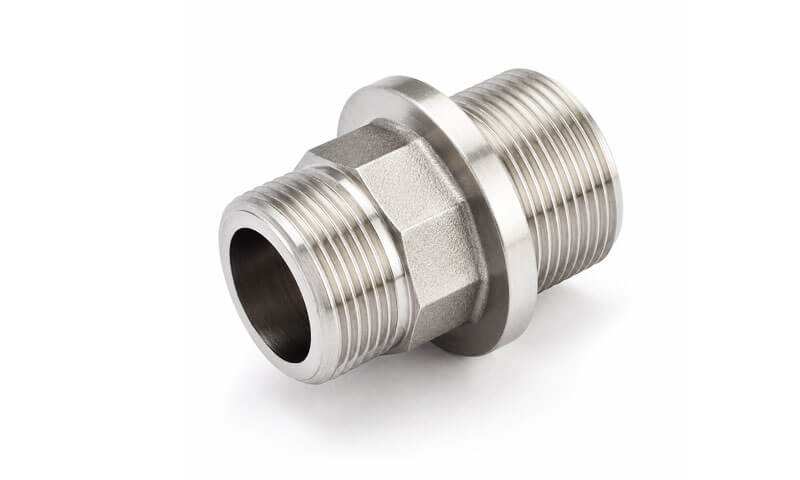
Investment casting stainless steel pipe fittings are pipe connection components produced by the lost-wax casting process using stainless steel alloys as the base material.
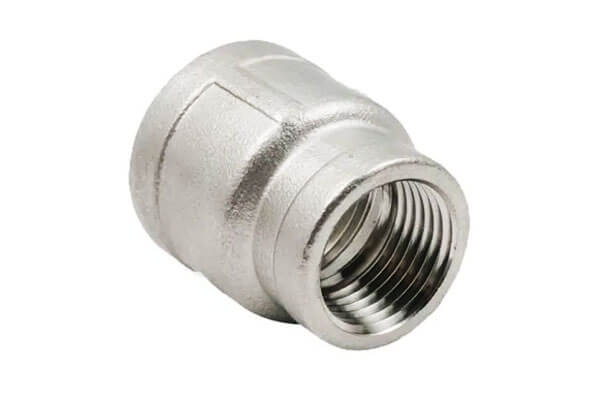
Typical examples include elbows, tees, reducers, Mga Pagkabit, unions, caps, adapters, and custom connector bodies.
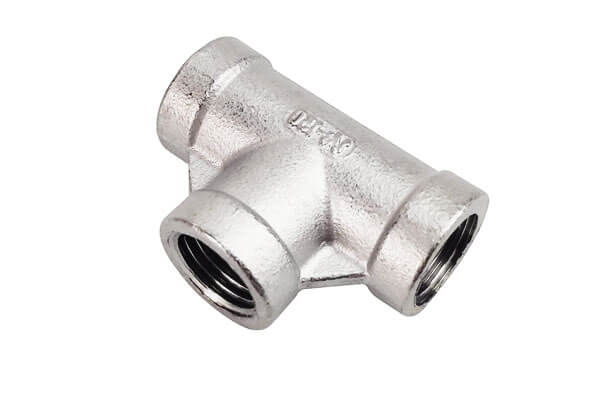
The process begins with a wax pattern that replicates the final shape of the fitting.
A ceramic shell is built around the pattern, Tinanggal na ang wax, and molten stainless steel is poured into the cavity.
After solidification, the shell is removed and the part is cleaned, hiwa, inspected, and machined if necessary.
The key characteristic of this approach is that the fitting can be manufactured in a Malapit sa hugis ng net condition.
This means the casting already closely approximates the final geometry, reducing machining requirements and making it possible to produce fittings with complex contours and tight dimensional intent.
Sa praktikal na mga termino, investment casting is especially useful when the fitting must combine:
- complex internal or external geometry,
- paglaban sa kaagnasan,
- pressure-bearing capability,
- repeatable dimensional accuracy,
- and acceptable manufacturing cost.
2. Why Stainless Steel Is a Preferred Material for Pipe Fittings
Hindi kinakalawang na asero is widely used for pipe fittings because it offers a strong balance of corrosion resistance, mekanikal na lakas, kalinisan ng katawan, and service durability.
The exact alloy choice depends on the operating environment, but the general advantages remain consistent.
Paglaban sa kaagnasan
Pipe fittings are often exposed to water, steam, mga asido, alkalis, salt spray, cleaning chemicals, or process fluids.
Stainless steel resists oxidation and many forms of chemical attack far better than carbon steel. This is essential because a fitting failure can compromise the entire piping system.
Mechanical reliability
A pipe fitting must withstand pressure fluctuations, thermal cycling, panginginig ng boses, and assembly loads.
Stainless steel has the strength and toughness required to maintain integrity under demanding service conditions.
Hygienic performance
In food, inumin, dairy, and pharmaceutical applications, stainless steel is favored because it can be cleaned effectively, resists contamination, and supports sanitary system design.
Longevity and lifecycle value
Although stainless steel fittings often cost more initially than lower-grade alternatives, their long service life, lower maintenance demand, and lower failure risk often make them more economical over time.
3. Graded Stainless Steel Alloy System for Cast Pipe Fittings
The performance of an investment-cast pipe fitting depends not only on its geometry, but also on the stainless steel grade selected for the service environment.
Sa pagsasanay, stainless castings are not chosen from a single universal material.
They are selected through a graded alloy system, where the alloy is matched to corrosion severity, temperatura, presyon, kakayahang linisin, and mechanical demand.
Graded alloy selection table
| Alloy Grade | Katumbas ng Cast / Common Identification | Mga Pangunahing Katangian | Typical Functional Position | Mga Karaniwang Aplikasyon |
| CF-3 / CF-8 | 304L / 304 cast grades | Good general corrosion resistance, mahusay na katatagan, stable mechanical behavior, matipid sa ekonomiya | Entry-level general-purpose stainless cast fittings | Water systems, general piping, non-severe industrial service |
| CF-3M / CF-8M | 316L / 316 cast grades | Better chloride resistance than 304-type grades, strong balance of corrosion resistance and cost | Mainstream industrial stainless fitting grade | Chemical piping, marine-adjacent systems, pagproseso ng pagkain, process equipment |
| CN7M | haluang metal 20 cast equivalent | Strong resistance to sulfuric acid and selected aggressive chemical media | Specialized corrosion-resistant grade | Mga halaman ng kemikal, acid service, corrosive transfer lines |
CD3MN |
Duplex stainless cast grade | Mas mataas na lakas, improved chloride stress corrosion resistance, mahusay na katigasan | High-performance industrial grade | Marine systems, offshore piping, demanding process lines |
| CD4MCuN / CD4MCu | Duplex / high-alloy cast grade | Excellent resistance to corrosion, erosion, and cavitation; strong mechanical performance | Severe-service fitting grade | Mga Pump, Mga balbula, offshore systems, aggressive fluids |
| CK3MCuN / Super duplex-type cast grades | High-alloy duplex family | Very high strength, outstanding resistance to pitting, kaagnasan ng bitak, and chloride-induced failure | Premium severe-service grade | Malayo sa pampang, desalination, high-chloride chemical systems |
4. Core Technical Advantages of Investment Casting for Pipe Fittings
Traditional stainless steel pipe fittings are commonly manufactured by forging, pag stamp ng, hinang, machining, or sand casting.
Each of these routes has its own use case, but each also introduces structural constraints, machining burden, surface limitations, or batch variation.
Investment casting addresses these limitations in a more integrated way.
High dimensional precision and near-net-shape capability
One of the most decisive advantages of investment casting is its ability to produce fittings with very tight dimensional control and minimal machining allowance.
Compared with sand casting, which typically offers coarser tolerances, investment casting can achieve a much higher level of dimensional fidelity, often in the range of CT4–CT6.
Sa praktikal na mga termino, this means the geometry of elbows, tees, reducers, Mga Pagkabit, and custom connector bodies can be formed very close to final specification.
This near-net-shape capability has several direct consequences:
- less secondary CNC machining,
- lower material waste,
- shorter processing time,
- and reduced overall production cost for complex parts.
For stainless steel pipe fittings, this is especially important because the material itself is relatively expensive and machining time is not trivial.
A process that preserves metal rather than removing it is inherently more economical.
Sa maraming mga kaso, material utilization can reach 85–95%, which is significantly higher than fabrication routes that depend heavily on stock removal.
One-piece structural integrity without weld seams
A major weakness of many conventional pipe fittings is the presence of joints.
Welded or assembled fittings may suffer from weld porosity, hindi kumpletong pagsasanib, local corrosion at the weld bead, and stress concentration at connection points.
These are not just manufacturing issues; they are service-life issues.
Investment casting solves this by forming the fitting as a single integral body. Mga kumplikadong geometriya tulad ng:
- curved flow channels,
- multi-branch tees,
- offset reducers,
- thick-to-thin wall transitions,
- and integrated bosses or connection features
can all be produced in one piece. There is no need for welding, splicing, or mechanical assembly in the primary load-bearing zone.
This structural continuity improves:
- pressure-bearing reliability,
- resistance to leak paths,
- uniformity of wall strength,
- and long-term durability under cyclic fluid loading.
From an engineering standpoint, removing weld seams from a pressure-retaining fitting is a major reliability gain.
Superior surface finish and hygienic performance
Pipe fittings are not judged only by strength. Their internal and external surfaces also matter because they affect flow resistance, pag-uugali ng kaagnasan, kakayahang linisin, and contamination risk.
Investment casting produces a relatively smooth as-cast surface through the ceramic shell process.
Typical as-cast roughness can be in the range of Ra 1.6–6.3 μm, which is already favorable for many industrial applications.
After passivation, buli na, O Electropolishing, the surface can be further refined to Ra 0.4–0.8 μm in demanding sanitary service.
This is especially valuable in:
- food and beverage pipelines,
- dairy systems,
- kagamitan sa parmasyutiko,
- biotechnology lines,
- and other hygienic applications.
A smoother, denser surface reduces residue retention, minimizes bacterial adhesion, and helps avoid crevices or dead zones where contamination could accumulate.
In sanitary systems, surface quality is not a cosmetic detail; it is part of process safety.
Excellent batch consistency and reproducibility
Industrial piping systems depend on interchangeability.
A fitting that matches once but not every time creates installation delays, inspection problems, and system risk.
Investment casting is strong in this respect because the process is inherently standardized.
Wax pattern replication, shell building, and pouring can all be tightly controlled, which gives the process high repeatability from batch to batch. That means:
- dimensional consistency is easier to maintain,
- wall thickness variation is reduced,
- internal geometry is more stable,
- and spare parts remain interchangeable across production lots.
Compared with manual welding or multi-step fabrication, investment casting greatly reduces human-induced variability.
For large-scale industrial supply chains, this is one of its most important strengths.
High adaptability to complex and nonstandard geometries
Pipe systems are often more complex than simple straight runs. Real industrial layouts require special fittings such as:
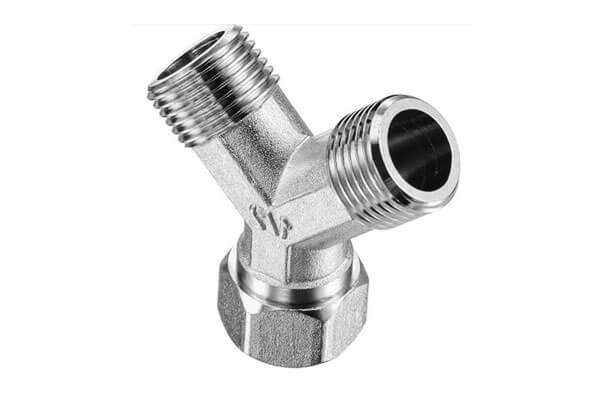
- Y-type tees,
- bent reducers,
- offset elbows,
- custom manifolds,
- multi-port flow distributors,
- and application-specific connector bodies.
These shapes are difficult to realize efficiently by forging or stamping, and they may require several welded or machined parts if produced conventionally.
Investment casting can generate these geometries directly and more freely.
This flexibility is important not only for shape creation but also for fluid-performance optimization.
Internal flow paths can be designed more smoothly, reducing turbulence, pressure loss, and dead zones. In fluid systems, better geometry often means better efficiency.
Balanced mechanical and corrosion performance
A well-executed investment casting process can preserve the mechanical and chemical performance expected from stainless steel.
Because the material solidifies under controlled conditions, the process can support a more uniform microstructure than some heavily welded or thermally distorted alternatives.
This matters because pipe fittings must often survive:
- alternating pressure,
- panginginig ng boses,
- thermal cycling,
- kinakaing unti-unti media,
- and long service periods.
Investment-cast fittings can maintain a good balance of:
- lakas ng loob,
- tigas na tigas,
- paglaban sa kaagnasan,
- at dimensional na katatagan.
Sa kabilang banda, welded systems may introduce local thermal effects, natitirang stress, or metallurgical discontinuities at joints.
Investment casting avoids many of these risks by delivering a more homogeneous finished component.
5. Manufacturing Process of Investment Casting Stainless Steel Pipe Fittings
The production of stainless steel pamumuhunan paghahagis pipe fittings involves strict multi-process control, uniquely optimized for stainless steel’s high melting point, easy oxidation, and carbide precipitation characteristics.
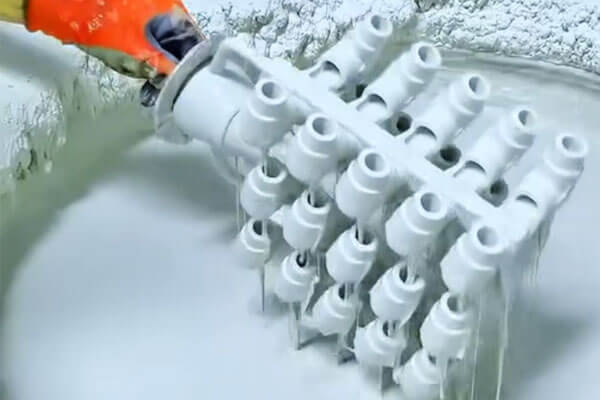
The complete industrial workflow is as follows:
Precision Wax Pattern Fabrication
Adopt high-precision injection molds to produce wax patterns matching pipe fitting profiles, ensuring accurate replication of complex internal runners and external assembly dimensions.
Batch wax patterns are inspected for dimensional consistency and surface defects to eliminate prototype errors at the source.
Multi-Layer Ceramic Shell Fabrication
Apply layered coating of colloidal silica binder and refractory powder (Fused silica, alumina mullite):
the surface layer uses fine powder to guarantee surface finish, while the backup layer uses coarse aggregate to enhance shell rigidity and high-temperature strength.
Strictly control the drying temperature and humidity of each layer to avoid residual drying stress and shell cracking.
Dewaxing and High-Temperature Shell Firing
Adopt gradient heating steam dewaxing technology to avoid instantaneous expansion damage to the ceramic shell by wax melting.
Complete shell firing at 1050–1150°C to fully remove residual wax, kahalumigmigan, and organic impurities, sintering the shell into a dense, high-temperature-resistant refractory structure to prevent sand inclusion and gas defects during pouring.
Vacuum Melting and Precision Pouring
Stainless steel is melted in a vacuum induction furnace to reduce oxidation, carbon segregation, and gas content.
Controlled low-turbulence pouring is adopted to ensure steady filling of complex pipe fitting runners, avoiding molten steel splashing, oxidation slag entrapment, and internal shrinkage porosity.
Heat Treatment Strengthening
Implement professional solution annealing and stabilizing treatment for austenitic and duplex stainless steel fittings to eliminate casting residual stress, homogenize microstructure, and prevent intergranular corrosion.
Precipitation hardening grades undergo aging treatment to achieve designed mechanical strength.
Post-Processing and Surface Strengthening
Remove gates and risers, perform precision grinding of assembly threads, flange surfaces, and sealing positions.
Conduct chemical passivation or electrolytic polishing to form a dense protective oxide film on the stainless steel surface, further improving corrosion resistance and surface hygiene.
6. Typical Product Forms and Functional Roles
Investment-cast stainless steel pipe fittings are not a single product category but a functional family of components designed to manage flow direction, pressure integrity, connection, and maintenance flexibility in piping systems.
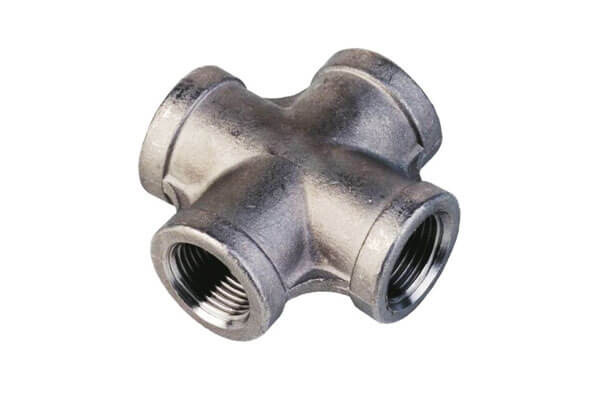
The table below summarises the most common product forms, their primary functions, representative alloys, and typical industrial use cases.
| Fitting Type | Pangunahing Tungkulin | Typical Alloy | Common Industries |
| Elbow (45°, 90°, 180°) | Change flow direction while controlling pressure loss and turbulence | CF-8 (304), CF-8M (316) | Pagproseso ng kemikal, langis & gas, paggamot ng tubig |
| Tee (straight / pagbabawas) | Split one flow into two paths or combine two flows into one line | CF-8M, CN-7M (haluang metal 20) | Petrochemical, pagproseso ng pagkain, process piping |
| Cross | Distribute flow in four directions within a compact layout | CF-8M | Fire protection, patubig, utility piping |
| Reducer (konsentriko / eccentric) | Transition between different pipe diameters while maintaining flow continuity | CF-8, CF-8M | General industrial piping, process systems |
Union |
Allow repeated connection and disconnection without cutting the line | CF-8M | Maintenance-intensive systems, utilities, instrumentation |
| Cap / Plug | Close or seal the end of a pipe or pressure line | CF-8, CF-3 (304L) | Mga Sistema ng Piping, pressure testing, line termination |
| Coupling (full / half) | Join two pipe sections securely in a compact configuration | CF-8, CF-8M | General piping, repair work, system extension |
| Valve Katawan | House internal flow-control elements and maintain pressure integrity | CF-8M, CN-7M, CD-3MN (Duplex) | Langis & gas, kemikal na, marine, corrosive service |
7. Design Considerations Specific to Pipe Fittings
Pipe fittings are functional components, so design quality matters as much as material quality.
Wall thickness balance
Uneven wall thickness can create stress concentration, shrinkage issues, and distortion. A good design keeps thickness transitions as smooth as possible.
Flow path smoothness
Sharp internal turns increase turbulence and pressure loss. Investment casting allows smoother geometry, but the design must still be optimized for flow.
Sealing and connection surfaces
The geometry at threaded, hinangin, or flanged interfaces must be precise enough to guarantee leak-free performance.
Machining allowance
Not every surface needs machining. The design should reserve stock only where final functional accuracy is required.
Alloy selection by service environment
A fitting for clean water is not the same as one for chloride-rich, acidic, or high-temperature service. The alloy must match the media.
Avoiding stress concentration
Junctions, branch points, and transitions should be radiused and balanced to improve crack resistance and pressure durability.
8. Advantages and limitations of investment casting stainless steel pipe fittings
Mga kalamangan
- Napakahusay na paglaban sa kaagnasan
- Kumplikadong kakayahan sa geometry
- Near-net-shape efficiency
- Good surface quality
- Broad alloy selection
- Strong lifecycle value
- Reduced assembly and weld dependence
Mga Limitasyon
- Higher process complexity than simple fabrication
- Tooling and shell-building time
- Not always the best choice for very simple shapes
- Dimensional precision may still require machining on critical surfaces
- Higher upfront cost than some low-spec alternatives
9. Major Industrial Applications of Stainless Steel Pipe Fittings
| Industriya ng Industriya | Specific uses | Alloy grade | Why investment cast? |
| Pagproseso ng kemikal | Acid transfer lines, reactor connections, mixing tees | CN‑7M, CF‑8M | Corrosion resistance to aggressive chemicals; complex internal shapes (Mga balbula, reducers). |
| Langis & gas | Offshore platform piping, Mga sari-sari sa ilalim ng dagat, wellhead connections | CD‑3MN (Duplex), CF‑3M | Mataas na lakas; chloride SCC resistance; leak‑tight joints. |
| Marine / desalination | Seawater intake piping, pump suction/discharge elbows | CD‑3MN, CE‑8MN | Pitting resistance; mataas na lakas; long service life in seawater. |
| Pagkain & inumin | Sanitary piping, processing lines, CIP systems | CF‑3 (304L), CF‑3M (316L) | Non‑toxic; easy clean; no corrosion from acidic foods; Maaaring hinangin (L grades). |
| Parmasyutiko | Clean steam lines, WFI (water for injection) mga sistema | CF‑3M (316L) | Makinis na ibabaw (electropolished); no crevice corrosion; meets FDA standards. |
Pagbuo ng kapangyarihan |
Cooling water circuits, steam condenser piping | CF‑8, CF‑8M | Corrosion resistance to cooling water; pressure integrity at temperature. |
| Pulp & papel na papel | Bleach lines, chemical recovery systems | CN‑7M, Duplex | Resistance to chlorine dioxide and alkaline pulping liquors. |
| Tubig & wastewater | Treatment plant piping, sludge lines, filter connections | CF‑8, CF‑8M | Corrosion resistance to untreated water, sewage, and treatment chemicals. |
| Fire protection | Sprinkler system fittings | CF‑8 | Pressure integrity; corrosion resistance in wet/dry systems. |
| Aerospace | Hydraulic and fuel system fittings | 17‑4PH (CB7Cu‑1), 304L | High strength‑to‑weight; non‑corrosive; leak‑tight. |
10. Pangwakas na Salita
Investment cast stainless steel pipe fittings represent the advanced manufacturing level of modern fluid pipeline components.
Breaking through the structural defects and precision limitations of traditional welded, huwad na, and sand-cast fittings, they integrate integral structural integrity, ultra-high dimensional precision, excellent surface hygiene, and customizable alloy performance.
Through standardized full-process process control, targeted defect suppression, and graded alloy matching,
investment casting technology perfectly meets the differentiated demands of sanitary, kinakaing unti-unti, mataas na presyon, and high-temperature industrial pipeline systems.
With the continuous upgrading of industrial fluid system safety and reliability standards, investment cast stainless steel pipe fittings will further replace traditional process products, becoming the core supporting component of high-end equipment in chemical engineering, Marine Engineering, biopharmaceuticals, and intelligent manufacturing.
Continuous optimization of material formulas and intelligent casting processes will further enhance the performance and cost competitiveness of precision cast stainless steel pipe fittings, driving the high-quality development of the global fluid pipeline component industry.
Mga FAQ
What is the difference between CF‑8 and CF‑8M?
CF‑8 is equivalent to 304 hindi kinakalawang na asero (no molybdenum).
CF‑8M is equivalent to 316 hindi kinakalawang na asero, containing 2‑3% molybdenum, which provides superior resistance to pitting and crevice corrosion in chloride environments.
Can investment cast stainless steel fittings be welded?
Oo nga. Low‑carbon grades (CF‑3, CF‑3M) are preferred for welding to avoid sensitization (chromium carbide precipitation) in the heat‑affected zone.
Are investment cast fittings pressure‑rated?
Oo nga. They are manufactured and tested per ASME B16.34, API 598, and other applicable codes. Pressure ratings depend on material grade, temperatura, and dimensional standards.
How do I specify the right alloy for my application?
Consider the media (komposisyon ng kemikal, temperatura, presyon), environment (indoor/outdoor, chloride presence), and welding requirements.
Consult a corrosion engineer or refer to NACE MR0175 / ISO 15156 for sour gas applications.
What is the typical lead time for investment cast stainless steel fittings?
8‑16 weeks for tooling and first production; 2‑4 weeks for repeat orders (after tooling exists). Emergency orders may be expedited at additional cost.
How do I inspect investment cast fittings for quality?
Use a combination of visual inspection, dimensional measurement, non‑destructive testing (Tinain na penetrant, radiographic), and pressure testing per applicable standards.

