Panimula
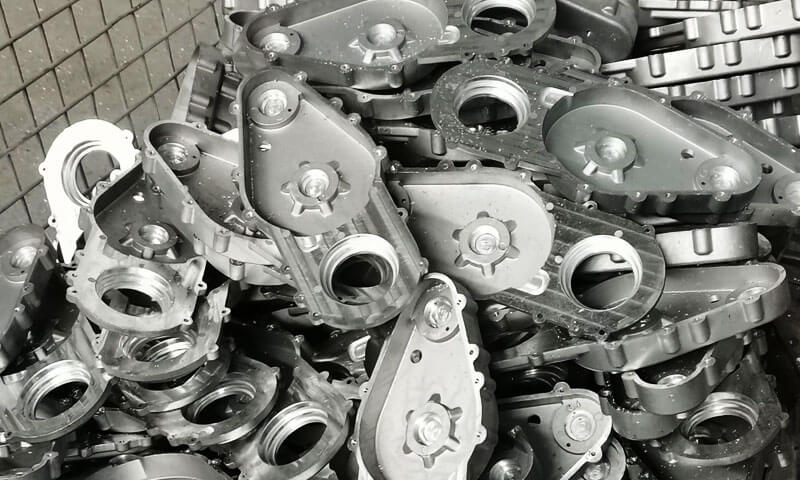
Among the family of precision casting processes, investment casting—often called “lost‑wax casting”—stands apart for its ability to produce near‑net‑shape metal components with exceptional surface finish, intricate geometry, and tight dimensional tolerances.
This article dissects the investment casting process from first principles to advanced applications.
We will explore its metallurgical foundations, detailed process flow, technology variants (baso ng tubig, silica sol, composite), defect mechanisms, comparative positioning against other manufacturing methods, and industrial use cases.
1. Ano ang Investment Casting?
Pamumuhunan sa paghahagis, also known as the lost-wax process, is a precision metal-forming method in which a disposable wax or fusible pattern is coated with a refractory ceramic shell, then removed to create a cavity that is filled with molten metal.
The process is designed to reproduce the original pattern with a high degree of fidelity, making it one of the most effective manufacturing routes for complex, near-net-shape metal parts.
Unlike conventional casting routes that are often optimized for simplicity or volume alone, investment casting is built around detail replication, dimensional control, and alloy flexibility.
It is used when a component must combine intricate geometry, functional accuracy, and reliable metallurgical quality in a single process chain.
That is why it is widely adopted in industries such as aerospace, enerhiya, automotive, mga kagamitang medikal, and precision industrial hardware.
Core Competitive Advantages of Investment Casting
Compared with other metal forming processes, investment casting offers six core advantages that give it a distinctive and enduring market position:
Superior dimensional accuracy and surface finish
Investment casting can achieve standard dimensional tolerances of CT4–CT7, significantly tighter than sand casting (CT9–CT14).
Surface roughness can typically be controlled at Ra 1.6–6.3 μm, which greatly reduces the need for extensive grinding, buli na, or secondary finishing on decorative and precision functional surfaces.
Exceptional capability for complex geometries
This process is especially well suited to parts with highly intricate features, kasama na ang panloob na lukab, mga undercuts, manipis na mga seksyon ng pader (pababa sa 0.5 mm), complex curved surfaces, and fine hole patterns.
It can reproduce nearly any geometry required for industrial precision components.
Malawak na pagiging tugma ng haluang metal
Investment casting is compatible with a very wide range of alloys, including common ferrous and non-ferrous metals as well as demanding high-performance materials.
It can be applied to stainless steels, mga carbon steels, aluminyo alloys, mga haluang metal ng tanso, mga superalloys na nakabase sa nickel, Mga haluang metal na nakabatay sa Cobalt, and even active alloys such as titanium.
This broad alloy tolerance gives engineers much more freedom in material selection than many other forming processes.
High metallurgical quality
The chemically inert ceramic shell minimizes contamination of the molten metal.
Bukod pa rito, controlled solidification and well-designed gating systems help reduce pag urong, porosity, and segregation, producing parts with a dense microstructure and stable mechanical performance.
High material efficiency
As a near-net-shape process, investment casting offers a material utilization rate of approximately 92%–98%, substantially reducing metal waste compared with subtractive machining processes.
Flexible production scale
Investment casting is highly adaptable, paggawa ng angkop para sa one-off custom prototypes, small-batch specialty parts, and large-volume production of standardized components.
2. Core Metallurgical and Process Principles
Investment casting is not only a shaping method. It is a tightly integrated metallurgical system in which pattern fidelity, shell behavior, thermal management, and alloy solidification all interact.
The quality of the final part is determined by how well these four factors are controlled together.
Geometric replication through pattern transfer
The process begins with a wax or fusible pattern that captures the final part geometry with high fidelity.
Because the ceramic mold is built directly around this pattern, the cavity reproduces the intended shape almost point for point.
That is what gives investment casting its advantage in producing:
- fine ribs,
- sharp transitions,
- mga grooves,
- small holes,
- panloob na mga talata,
- and complex surface features.
Sa madaling salita, investment casting does not “approximate” the geometry.
It transfers it from the pattern into the mold with very high detail retention. That is the foundation of its near-net-shape capability.
Ceramic shell as a precision thermal barrier
The ceramic shell is not just a container for molten metal. It is a precision refractory structure that must satisfy two conflicting requirements at the same time.
It must be strong enough to withstand:
- Pag-aalis ng Wax,
- shell firing,
- pagbuhos,
- metal pressure,
- and thermal shock.
Kasabay nito, it must remain dimensionally faithful so that the cavity does not distort the part geometry.
This balance between mekanikal na lakas at dimensional na katatagan is one of the central technical challenges of investment casting.
If the shell is too weak, it cracks or erodes. If it is poorly controlled, it distorts or loses fidelity.
The shell is therefore a critical engineering interface between the pattern and the final casting.
Solidification control as the metallurgical core
Once molten metal enters the shell cavity, the process becomes a question of how the alloy fills and solidifies.
This stage determines whether the part will be dense, sound, and dimensionally stable, or whether it will contain porosity, pag urong, malamig na mga shut, or structural imbalance.
Key control variables include:
- gating system design,
- riser placement,
- shell preheat temperature,
- pouring temperature,
- alloy fluidity,
- and solidification rate.
These factors shape the internal structure of the casting just as much as they shape the external form.
A part may look correct on the outside and still fail internally if solidification is not properly managed.
Why the process is metallurgical, not just geometric
Investment casting is often described as a precision forming process, but that description is incomplete.
It is also a metallurgical process, because the final properties of the part are built during melting, pagbuhos, filling, and solidification.
That means the foundry is not only reproducing shape. It is actively managing:
- istraktura ng butil,
- densidad,
- segregasyon,
- defect formation,
- and final mechanical behavior.
This is why investment casting occupies a special position among metal-forming technologies.
It combines shape replication kasama ang controlled metallurgical consolidation, and both are equally important.
3. Complete Full-Process Workflow of Investment Casting
Industrial investment casting is a tightly controlled process chain in which every stage affects the final casting quality.
Dimensional katumpakan, surface condition, panloob na kahusayan, and metallurgical performance are all determined by how well the process is managed from the wax pattern to final inspection.
Sa pagsasanay, investment casting is not a single operation but a sequence of interdependent manufacturing steps.
3.1 Wax Pattern Manufacturing and Material Selection
The wax pattern is the first physical representation of the final part, so its dimensional stability directly defines the accuracy ceiling of the casting.
Wax material selection
Industrial investment casting generally uses three wax categories:
- Low-temperature wax for simple, low-precision parts
- Medium-temperature wax for general-purpose production
- High-temperature wax for ultra-precision or special applications
Kabilang sa mga ito, medium-temperature wax is the most widely used. It offers low shrinkage, magandang likido, stable handling performance, and reliable reproduction of detail.
That makes it suitable for most steel, tanso haluang metal, and aluminum alloy castings.
Injection molding control
Wax injection must be controlled by:
- wax temperature,
- injection pressure,
- holding time,
- and part geometry.
If the wax is too cold, fillability deteriorates. If it is too hot, dimensional stability may suffer.
Holding pressure is also essential because internal shrinkage voids in the wax can later be inherited by the metal casting as defects.

Shrinkage compensation
The wax pattern must include a calculated shrinkage allowance based on the alloy to be cast.
Different alloys solidify with different shrinkage behavior, so compensation must be built into the tooling from the start.
Defect control
Wax patterns must be inspected for:
- bubbles,
- depressions,
- pagpapapangit,
- flash,
- and surface damage.
Any defective wax pattern should be rejected before entering shell production, because wax defects often become casting defects later in the process.
3.2 Pattern Assembly and Gating System Design
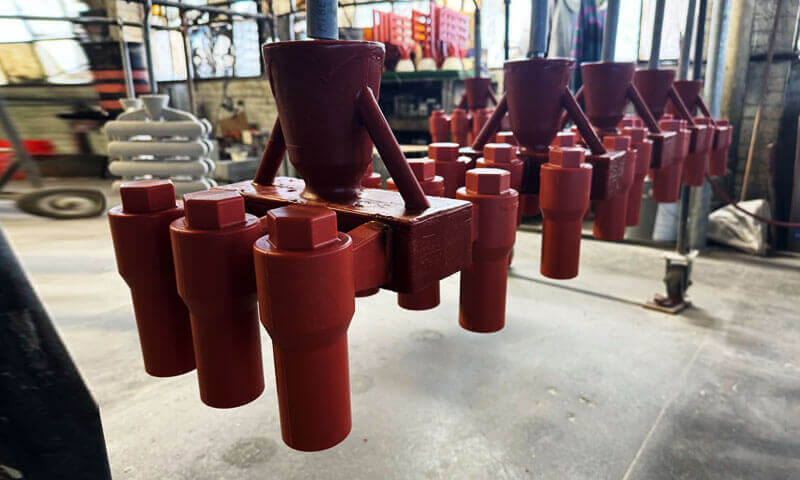
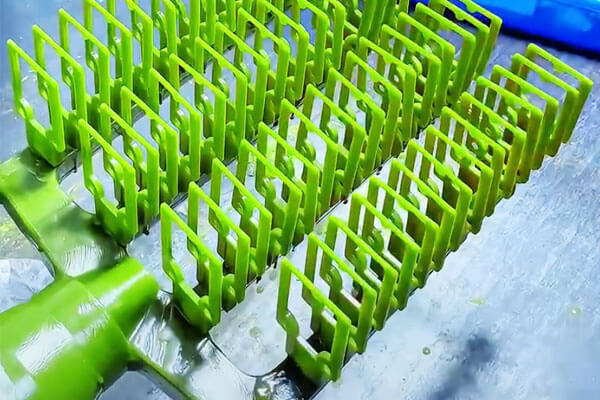
Individual Mga pattern ng waks are assembled into a cluster or tree, which improves production efficiency and allows multiple castings to be produced in one mold cycle.
Cluster layout
The spacing between patterns must be sufficient to prevent shell-interference during coating and drying.
The number of parts per cluster should also match the furnace capacity, pouring rhythm, and alloy solidification behavior.
Gating design
The gating system should support:
- smooth filling,
- mababang kaguluhan,
- and controlled metal flow.
Laminar flow is preferred because turbulence increases the risk of:
- air entrainment,
- oxide folding,
- and slag inclusion.
For more demanding alloys, especially high-alloy steels and superalloys, bottom-gating or stepped-runner arrangements are commonly used.
Slag traps or runner extensions may be added to intercept floating impurities before they enter the cavity.
Riser layout
Risers are positioned at hot spots and last-solidifying zones to provide feeding metal during solidification. This is essential for preventing:
- pag urong ng mga cavities,
- microporosity,
- and centerline shrinkage.
For alloys with a wide freezing range, multiple auxiliary risers may be required to maintain sound feeding behavior.
3.3 Ceramic Shell Fabrication (Core Process of Investment Casting)
Ceramic shell making is the most time-consuming and technically demanding procedure.
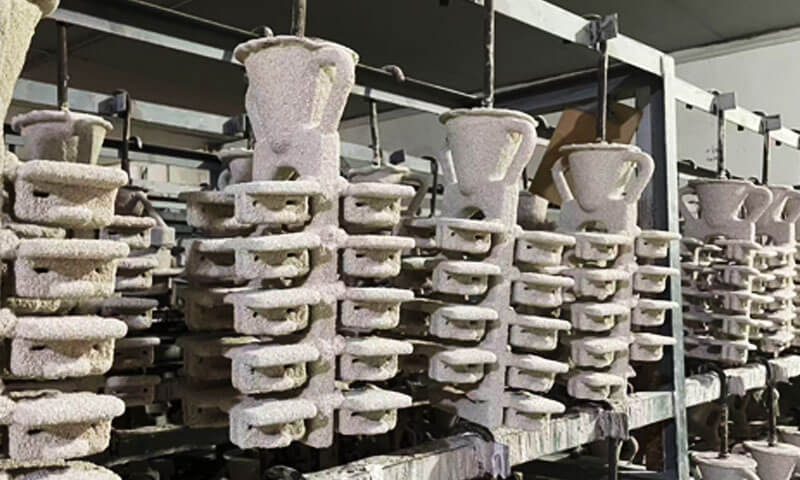
The shell is formed by repeated coating of refractory slurry and dry sand stucco, divided into face coat, transition coat and backup coat with differentiated refractory materials and functions.
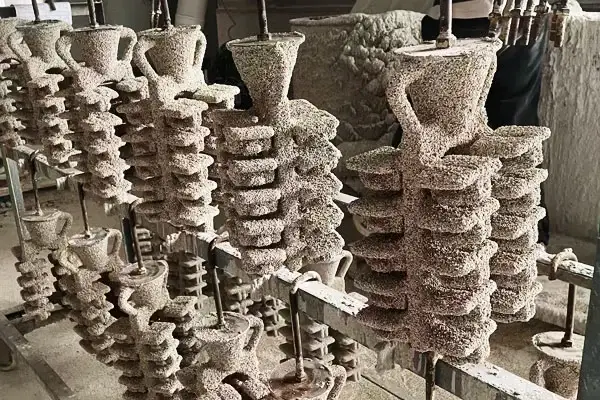
Layered structure and material matching
- Face coat (surface layer): Directly contacts high-temperature molten metal, requiring ultra-high refractoriness and chemical inertness.
For high-grade stainless steel and superalloys, high-purity zircon flour and zircon sand are adopted; for general carbon steel, fused alumina is commonly used.
This layer prevents metal penetration, sand sticking and chemical reaction between molten metal and refractory. - Transition coat: Enhances bonding strength between the face coat and backup coat to avoid shell delamination during firing and pouring.
- Backup coat (back layer): Uses low-cost quartz sand and mullite aggregate to improve the overall structural strength of the shell and reduce comprehensive material cost.
Drying control:
Each coated layer must undergo complete natural drying under constant temperature (22~26°C) and constant humidity (55%~65% RH).
Insufficient drying leaves residual free water inside the shell, which becomes a hydrogen source and causes pinhole porosity in castings.
The total number of shell layers ranges from 8 sa 12; thick-wall large castings require more than 12 layers for enhanced strength.
Binder differentiation:
The type of binder determines the shell’s refractoriness, impurity content and overall performance, which is also the basis for classifying major investment casting technical routes.
3.4 Dewaxing
Dewaxing removes the pattern material from the ceramic shell and creates the hollow cavity that will later be filled with molten metal.
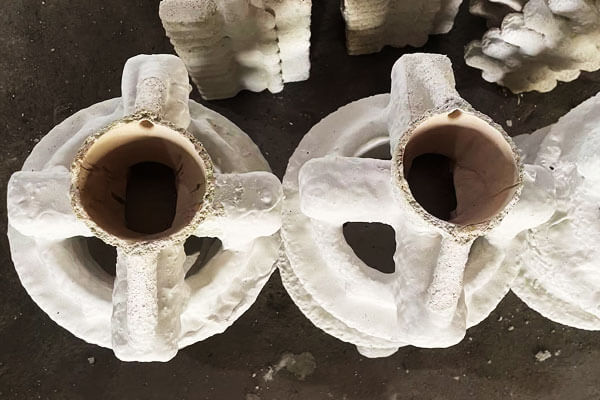
Standard industrial method
The preferred industrial method is high-pressure steam dewaxing. This is widely used because it removes wax quickly and reduces the risk of shell damage.
Process control
Steam dewaxing must be controlled carefully so that:
- the wax melts out completely,
- the shell is not cracked by thermal shock,
- and no residue remains inside the cavity.
Any leftover wax is a serious problem because it may decompose during later firing and produce carbon contamination, gas evolution, or surface defects in the final casting.
Material recovery
Recovered wax is usually collected, filtered, and recycled, which improves process economy and supports material reuse.
3.5 Shell Firing and Pre-Pouring Preheating
The hollow ceramic shell needs segmented high-temperature firing to fully remove organic residues, sinter refractory particles and stabilize the shell structure; preheating is conducted before pouring to adapt to molten metal temperature.
Segmented firing
Shell firing is usually carried out in stages:
- Low-temperature stage: removes residual organics and trace wax
- Medium-temperature stage: drives off bound moisture and decomposes remaining binder residues
- High-temperature stage: sinters the refractory shell and builds final strength
This staged heating prevents shell cracking and ensures the shell reaches a stable thermal and structural condition.
Preheating before pouring
The fired shell is then preheated to reduce the temperature gap between the mold and the molten metal. Preheating helps:
- improve filling,
- reduce misrun and cold shut risk,
- minimize thermal shock,
- and support thinner sections during filling.
The exact preheat range depends on the alloy, kapal ng seksyon, at bahagi ng pagiging kumplikado.
3.6 Natutunaw na, Atmosphere Control, and Pouring
This is the stage where metallurgical purity and mold filling are decided.
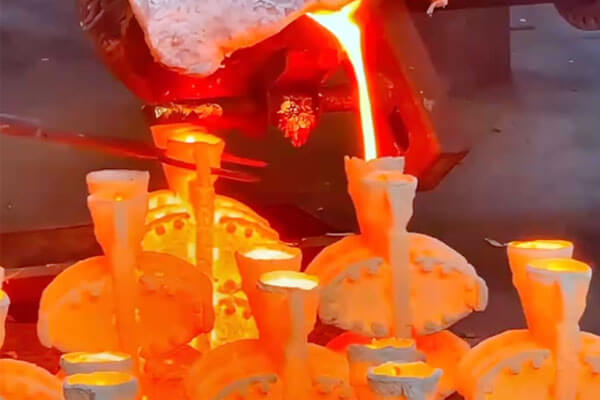
Melting equipment
The melting method must match the alloy family:
- Medium-frequency induction furnace for general industrial castings
- Vacuum induction melting (VIM) for nickel alloys, mga haluang metal na titan, and high-purity stainless steels
Atmosphere control
Atmosphere requirements depend on the alloy:
- ordinary carbon steels may be melted in air-based systems,
- stainless steels and copper alloys often require nitrogen or argon shielding,
- and reactive or high-performance alloys require vacuum or highly controlled atmospheres.
Pouring temperature control
Pouring temperature is one of the most sensitive variables in investment casting. If it is too high, segregation and microporosity risk increase.
If it is too low, fluidity drops and misrun or cold shut becomes likely.
The superheat must be matched to the alloy’s chemistry, pagkatubig, and solidification behavior.
Pouring mode
Gravity pouring is the most common method. Vacuum-assisted pouring may be used for ultra-thin or highly intricate parts.
Regardless of the method, the flow should remain steady and as laminar as possible.
3.7 Paglamig, Pag-iling, and Primary Cleaning
Pagkatapos ng pagbubuhos, the metal must solidify and cool under controlled conditions.
Cooling regime
Castings inside the ceramic shell adopt natural slow cooling.
For alloys prone to thermal cracking (such as high-alloy stainless steel and superalloys), forced rapid cooling is prohibited to release solidification stress gradually.
Pag-alis ng shell
Once the casting reaches room temperature, the ceramic shell is removed by:
- mekanikal na panginginig ng boses,
- high-pressure water,
- or abrasive cleaning methods such as shot blasting.
The goal is to remove all shell residue without damaging the casting surface.
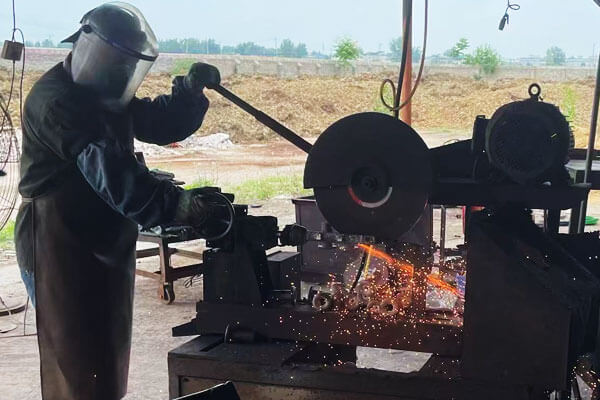
Primary trimming
Sa yugtong ito, the casting is separated from the runner and riser system.
Excess material is removed, and the first grinding or cleanup steps are performed on connector regions and cut-off points.
3.8 Post-Processing and Final Finishing
After the casting body is produced, additional operations are used to meet final dimensional, mekanikal, and surface requirements.
Common post-processing steps
- Precision grinding and deburring
- Lunas sa init
- Email Address *
- Katumpakan machining
- Nondestructive testing
- Final dimensional inspection
Lunas sa init
The heat-treatment route depends on the alloy:
- carbon steel may require normalizing, pagpapawi ng, at pagtitimpi,
- stainless steel may need solution annealing,
- precipitation-strengthened alloys may require solution plus aging.
This step is essential for stabilizing microstructure and achieving final mechanical properties.
Surface treatment
Depende sa application, the part may receive:
- pagsabog ng baril,
- Pag-aatsara,
- Passivation,
- pag anod ng,
- Email Address *,
- or protective coating.
Katumpakan machining
Critical surfaces such as:
- assembly faces,
- threaded holes,
- locating surfaces,
- and sealing areas
may require additional machining with small allowances.
Inspeksyon
The final quality check typically includes:
- Pagsubok sa Penetrant,
- Pagsusuri sa Radiographic,
- pagsusuri sa ultrasonic,
- and dimensional measurement.
Only parts that pass all required checks are classified, packaged, and delivered.
4. Classification of Mainstream Investment Casting Technologies
The most practical way to classify mainstream investment casting is by the binder system used to build the ceramic shell.
In current industrial practice, the three dominant routes are water glass investment casting, Silica Sol Investment Paghahagis, at composite investment casting.
This classification is widely used because the binder directly influences shell strength, katumpakan ng sukat, kalidad ng ibabaw, shell-making cycle, and the alloy families each route can support.
Paghahagis ng Pamumuhunan sa Salamin ng Tubig
Water-glass investment casting mga gamit na sosa silicate as the shell binder.
Industry descriptions characterize it as a process with a relatively short shell-making cycle and low cost, which makes it attractive for production where economics are important.
Kasabay nito, multiple sources note that water-glass shells generally give lower dimensional accuracy and higher surface roughness than silica-sol shells.
This route is therefore best understood as a cost-oriented precision casting method.
It is widely used for carbon steel, mababang-haluang metal na bakal, aluminyo haluang metal, and copper alloy castings, where the process balance favors productivity and price over the highest surface or tolerance level.
Silica Sol Investment Casting
Silica-sol investment casting mga gamit na colloidal silica bilang binder.
Technical sources consistently describe it as the higher-precision route: it offers better dimensional and geometrical tolerances, smoother surface quality, and stronger overall shell performance than water-glass casting.
It is also associated with longer shell-building time and higher cost, because precision is achieved through more controlled shell manufacture.
This route is generally the preferred choice for hindi kinakalawang na asero, heat-resistant steel, and high-performance alloy castings, especially where the part needs fine detail, reliable surface quality, and tighter tolerance control.
Sa pagsasanay, silica sol is the route most often linked with demanding industrial parts where process quality has to match alloy performance.
Composite Investment Casting
Composite investment casting is a hybrid approach that combines elements of both binder systems in order to balance precision, productivity, at gastos.
Foundry sources describe this type of route as a practical middle ground, where the shell design or binder selection is adjusted so that the process is not fully premium-cost like silica sol, but also not as cost-constrained as pure water-glass shelling.
In engineering terms, the composite route is used when the part needs better economics than full silica-sol casting but also needs better quality than pure water-glass casting.
The exact implementation varies by foundry, because composite systems depend heavily on how the face coat, backup coat, and binder chemistry are combined.
5. Typical Casting Defects: Root Causes and Targeted Remedial Measures
Pamumuhunan sa paghahagis, despite its precision, is susceptible to several defect types. The table below summarises common defects, their origins, and corrective actions.
| Depekto | Visual / NDT signature | Root cause | Remedial measures |
| Porosity ng gas | Round, smooth‑walled internal voids | Dissolved gases (H₂, N₂) in molten metal; low deoxidation | Vacuum melting; degas with inert gas; proper deoxidation practice |
| Pag-urong ng porosity | Jagged, irregular voids | Insufficient feeding; poor riser design | Increase riser size; add chills; modify gating to promote directional solidification |
| Hot tear | Crack with ragged, Mga gilid ng oxidized | Tensile stress during late solidification; mould constraint | Reduce shell rigidity; lower pouring temperature; modify alloy composition |
| Inclusion (slag, dumi) | Irregular non‑metallic particles | Turbulent pouring; dirty melt; eroded refractory | Use clean charge; ceramic filters; bottom pouring; gentle filling |
Pagkamagaspang sa ibabaw / veining |
Raised lines or “fins” on casting | Shell cracking during filling; low shell strength | Increase shell thickness; higher binder content; use stronger refractory |
| Misrun / cold shut | Incomplete filling; folded surface | Low pouring temperature; poor fluidity; thin section | Increase pour temperature; improve gating; evacuate mould (vacuum casting) |
| Core shift | Wall thickness variation | Core movement during shell building or pouring | Better core support (chaplets); slower shell drying; lower pour pressure |
6. Comparison with Sand Casting, mamatay paghahagis, and Forging
Engineers often compare investment casting with three alternative manufacturing routes. The table below provides a quantitative trade‑off.
| Evaluation criterion | Pamumuhunan sa Paghahagis | buhangin paghahagis | mamatay paghahagis (HPDC) | Pagbubuo ng mga |
| Email Address * (Ra, M) | 1.6–6.3 | 6.3–25 | 0.8–3.2 | 0.4–3.2 |
| Dimensional tolerance (mm / 25 mm) | ±0.1–0.3 | ±0.5–1.0 | ±0.1–0.3 | ±0.05–0.2 |
| Minimum practical section (mm) | 0.5–1.5 | 3–5 | 0.5–1.0 | 1–3 |
| Geometric complexity | Napakataas; mga undercuts, Mga Detalye ng Fine, Mga Panloob na Tampok | High with cores, but limited precision | Katamtaman; limited undercut capability | Mababa hanggang katamtaman; best for simpler shapes |
| Material utilization | 90–95% | 60–80% | 90–95% | 60–80% |
| Tooling cost | Katamtaman hanggang mataas | Mababa hanggang katamtaman | Mataas na | Napakataas |
| Per-part cost at high volume | Katamtaman | Mababa ang | Napakababa | Katamtaman |
| Per-part cost at low volume | High unless tooling is amortized | Mababa hanggang katamtaman | Impractical due to tooling burden | Napakataas |
| Typical maximum weight | Up to about 150 kg for steel castings | Napakalaki; sa paglipas ng 10,000 kg possible | Typically about 15 kg | Higit sa 500 kg possible |
| Alloy range | Almost all castable alloys | Almost all castable alloys | Mostly non-ferrous alloys | All metals, but geometry-limited |
7. Industrial Applications of Investment Casting
Investment casting is used in industries where geometric complexity, kalidad ng ibabaw, alloy performance, at kakayahang maulit matter more than the lowest possible manufacturing cost.
Aerospace and gas turbines
Aerospace is one of the most technically demanding application areas for investment casting.
Components such as mga blades ng turbine, vanes, Mga nozzle ng gasolina, diffuser cases, and other hot-section parts often require complex airfoil geometry, manipis na pader, precise internal passages, and excellent high-temperature strength.
Nickel-based superalloys and cobalt-based alloys are widely used because they can retain mechanical integrity under severe thermal and stress conditions.
Medical devices and implants
Medical applications place a different set of demands on the process.
Parts such as orthopaedic implants, Mga tangkay ng balakang, knee trays, kirurhiko instrumento, and precision anatomical hardware require biocompatibility, kalidad ng ibabaw, katumpakan ng sukat, and reliable mechanical performance.
Kabilang sa mga karaniwang materyales ang 316L hindi kinakalawang na asero, Co-Cr-Mo alloys, at titanium alloys tulad ng Ti-6Al-4V.
Automotive and transportation
Sa sektor ng automotive, investment casting is used for components such as turbocharger wheels, Mga manifolds ng tambutso, EGR-related components, shift forks, mga panaklaw, and other high-performance hardware.
These parts often require a balance of heat resistance, weight control, and geometric complexity.
Stainless steels and high-carbon or alloy steels are commonly used depending on the thermal and mechanical load case.
Oil and gas, pagproseso ng kemikal, and fluid handling
Oil and gas and chemical industries rely heavily on investment casting for mga katawan ng balbula, Mga Impeller ng Bomba, flow meter housings, mga angkop na bagay, and corrosion-resistant flow components.
Typical materials include CF-8M-type stainless steel, duplex hindi kinakalawang na asero, and nickel-based corrosion-resistant alloys.
Power generation and thermal equipment
Power generation places investment casting into some of its most severe service conditions.
Components such as combustion liners, transition pieces, nozzle rings, and other hot-gas hardware are exposed to oxidation, thermal cycling, and high-temperature gas flow.
Stainless steels such as 310 and nickel-based alloys such as Inconel 625 are commonly used because of their elevated-temperature capability.
10. Pangwakas na Salita
Investment casting is a mature, multi-branched and continuously evolving precision metal forming technology.
Its core value lies in breaking the structural limitations of traditional molds and realizing integrated near-net-shape forming of complex high-performance components.
The three mainstream binder-based technical routes form a clear hierarchical market: low-cost water glass investment casting dominates general industrial medium-precision parts,
while high-purity silica sol investment casting becomes the gold standard for high-end precision components in aerospace, medical and high-end energy fields.
The quality of investment castings depends on the full-chain precise control of wax pattern fabrication, shell making, Pag-aalis ng Wax, firing, melting and pouring.
Each process parameter and operational norm is interlocked, and any negligence will trigger cascading defects.
Although restricted by production cycle and cost in some scenarios, its unique advantages in complex structure forming, metallurgical quality and material adaptability ensure its irreplaceable status in high-end manufacturing.
Driven by intelligent manufacturing, green production and new material iteration, modern investment casting will further break through technical bottlenecks, improve production efficiency and reduce comprehensive costs.
As a foundational precision casting technology, it will continue to support the upgrading of global high-end equipment manufacturing and expand its application boundaries in emerging industries.
Mga FAQ
What is the main idea behind investment casting?
A disposable wax or plastic pattern is surrounded by a ceramic shell, the pattern is removed, and molten metal is poured into the cavity to create a near-net-shape part.
Why is investment casting chosen over sand casting?
Because it generally gives finer detail, mas mahusay na pagtatapos ng ibabaw, and tighter tolerances, which reduce finishing work.
Which binder system gives the highest precision?
Silica sol is generally used for the highest-precision, smooth-surface investment castings, while water-glass systems are more cost-oriented.
What are the most common defects?
Mga Pagsasama, porosity, Mga depekto sa pag-urong, misrun/cold shut, and shell cracking are among the most common casting problems.