1. Panimula
UNS C90300 is a widely used tin-bronze casting alloy that delivers a practical combination of good castability, paglaban sa kaagnasan (lalo na sa marine environments), bearing/wear behavior and satisfactory mechanical strength.
It is specified for bushings, mga bahagi ng pump, Mga balbula, gears and other components where service loading, sliding contact and corrosion resistance are primary drivers.
2. What is Bronze UNS C90300?
UNS C90300 is a cast tin tanso alloy in the UNS (Pinag-isang Sistema ng Pagbilang) family of copper alloys.
It is formulated for foundry use and is widely specified where a balance of pagiging castable, paglaban sa kaagnasan (particularly in marine and water-handling environments), good bearing/wear behavior and reasonable mechanical strength ay kailangan.
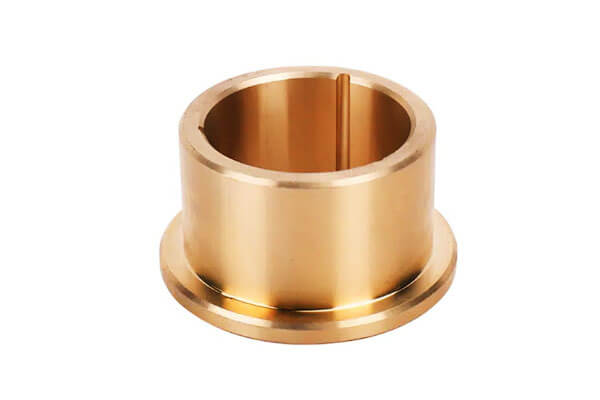
In practice C90300 is chosen for components such as bushings, Mga manggas, pump and valve parts, small gears and marine fittings where sliding contact, embedability and resistance to seawater or wet corrosion are important.
Key features and metallurgical character
- Mahusay na katatayuan. C90300 pours and fills molds predictably in sand, shell and investment processes, enabling reasonably thin sections and good surface detail when processed correctly.
- Tin-strengthened matrix. Tin acts as a substitutional alloying element in copper, raising hardness, wear resistance and strength relative to plain copper while preserving ductility sufficient for many bearing and structural uses.
- Bearing and tribological performance. The alloy exhibits conformability and embedability—it will accept small contaminant particles into the softer bronze matrix rather than score a harder mating shaft, making it suitable for plain bearings and bushings under boundary or mixed lubrication.
- Excellent wet-environment corrosion resistance. Tin bronzes resist general corrosion and perform well in seawater and many industrial aqueous environments; they are less prone to dezincification or rapid localized attack than many brasses.
- Not precipitation-hardening. Mechanical properties are established primarily by composition and solidification/microstructure; C90300 is not normally subject to strengthening by solution/aging treatments.
Stress-relief or annealing operations are used mainly for dimensional stability or ductility adjustments. - Katamtamang machinability. Tin improves chip formation and machinability relative to many high-strength copper alloys; carbide tooling and standard bronze machining practices are appropriate for production work.
3. Alloy identity and typical chemistry
Values are presented as typical weight-percent ranges used for design and procurement; always confirm exact limits with the foundry’s mill/certified analysis for any critical application.
| Item | Typical composition (wt%) | Function / effect |
| UNS designation | C90300 | Unified Numbering System identity for this cast tin-bronze. |
| Tanso (Cu) | Balanse (~86.0 – 89.0%) | Base metal; provides matrix, thermal/electrical properties and ductility. |
| Tin (Sn) | 7.5 – 9.0% | Principal strengthening and wear/corrosion-resistant element in the alloy. |
| Sink (Zn) | 3.0 – 5.0% | Nagpapabuti ng pagkalikido, castability and deoxidation of the melt. |
| Nikel (Ni) | 0 – 1.0% (typ.) | Opsyonal na; can improve corrosion resistance, strength and toughness. |
| Bakal na Bakal (Fe) | ≤ ~0.5% (typ.) | Controlled impurity or deliberate addition; affects strength and wear. |
Humantong sa (Pb) |
≤ ~0.2–0.25% (bakas) | May appear at trace levels in some castings; small amounts aid machinability but are not a defining element. |
| Silicon (Si Si) | ≤ ~0.5% (bakas) | Deoxidation/fluidity influence; normally controlled to low levels. |
| Posporus (P) | ≤ ~0.03% (bakas) | Deoxidizer/degasser residue; kept very low to avoid embrittlement. |
| Sulfur (S) | ≤ ~0.02% (bakas) | Impurity; low levels tolerated; excessive S is detrimental. |
| Aluminyo / Mga mangganeso / other | Each typically ≤ ~0.1–0.3% | Minor micro-alloying or tramp elements controlled to specification. |
4. Physical and mechanical properties
Below are representative as-cast values for C90300 drawn from typical supplier and material-data references.
Actual properties vary with casting process, kapal ng seksyon, gating strategy and melting practice — always validate with cast coupons from your foundry.
Physical properties
| Pag-aari | Typical value |
| Densidad ng katawan | ≈ 8.7–8.9 g/cm³ (≈ 0.318 lb/in³). |
| Solidus / Liquidus | ~854 °C (solidus) — ~1000 °C (liquidus) (guide to safe pouring and superheat). |
| Thermal kondaktibiti | ~70–75 W/m·K (depends on Sn/Zn content). |
| Kondaktibiti ng kuryente | ~10–12 % IACS (low compared with pure copper). |
| Coefficient of thermal expansion | ≈ 17 × 10⁻⁶ /°C (room to moderate temps). |
Mga katangian ng mekanikal (typical as-cast)
| Pag-aari | Typical range / value |
| Lakas ng paghatak (Mga UTS) | ~300–320 MPa (≈ 44–46 ksi) |
| Ani (0.5% Offset) | ~145–152 MPa (≈ 21–22 ksi) |
| Pagpapahaba (sa 50 mm) | ~18–30% depending on section and process |
| Brinell hardness (BHN) | ~70 HB (as-cast typical) |
| Modulus of elasticity | ~110–125 GPa |
5. Casting behavior and foundry practice
Suitable casting processes
C90300 is adaptable to the major casting methods used for bronzes:
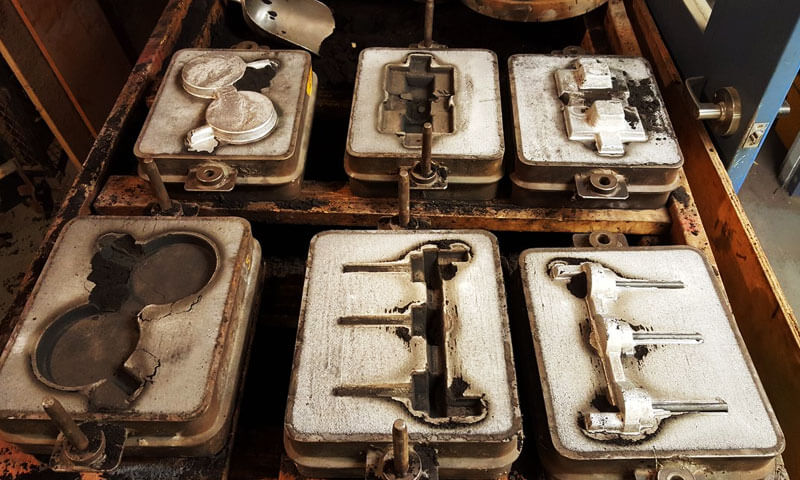
- Buhangin paghahagis — economical for large or heavy sections.
- Pamumuhunan sa paghahagis (Paghahagis ng Lost Wax) — best surface finish and dimensional accuracy for thinner, detailed parts.
- Shell molding and permanent-mold casting — intermediate options offering improved surface finish and tolerance.
- Continuous and centrifugal casting are also used for bars, rings and certain shapes.
Critical casting parameters
- Pagbuhos ng temperatura / superheat: respect the alloy liquidus and avoid excessive superheat;
Concast data indicate liquidus near ~1000 °C and solidus near ~854 °C — control within a narrow window to balance fluidity and avoid oxidation/dross. - Melt cleanliness: degassing and filtration are essential; tin bronzes are sensitive to hydrogen porosity and oxide inclusions — ceramic filters and rotary degassers reduce risks.
- Mga Tip sa Pag-install & feeding: design feeders to supply shrinkage in heavy sections and use gradual sectional transitions to avoid hot-spots and hot-tears.
Simulation (fill/solidification) is recommended for complex geometries. - Solidification control: directional solidification with chills or chills/risers helps reduce shrinkage defects and refines microstructure in thicker portions.
Post-casting init paggamot
C90300 is not a precipitation-hardening alloy; it does not respond to solution-age heat treatments to raise strength.
Typical thermal steps are stress-relief anneals (to remove casting stresses and improve machinability) or moderate anneals to improve ductility where required.
Practical foundry practice relies on casting control — not heat treatment — for most mechanical property objectives.
6. Machinability, joining & pagtatapos ng
Machinability
- Katamtamang machinability — tin content enhances chip formation and machinability relative to many high-strength copper alloys;
common machinability rating values place C90300 in a practical class for routine turning, milling and drilling with carbide tooling. - Recommended practice: use rigid fixturing, karbid tooling (coated grades for production), conservative feeds to avoid built-up edge, and light finishing passes for critical surfaces.
Sulfur and lead contents in other alloys (not C90300 lead-free variants) can alter chip control — verify composition before selecting cutting parameters.
Pagsali sa
- Brazing is the preferred joining method for bronze castings when required (filler metals and flux selected for bronze compatibility).
- Welding is generally avoided for large castings because bronze tends to suffer from thermal cracking and property changes; localized welding can be used with specialist procedures and post-weld stress relief where unavoidable.
Email Address *
- Polishing, pag plating (Ni, Ag), lacquering or patination are commonly applied depending on functional or aesthetic requirements.
For bearing surfaces, honing or lapping produces the required surface texture for lubricant film formation.
(Select finishing and joining processes in consultation with the foundry to avoid galvanic compatibility issues and finish adhesion problems.)
7. Corrosion, wear and tribological performance
- Paglaban sa kaagnasan: Tin bronzes such as C90300 exhibit excellent resistance in fresh and seawater environments and are commonly used for marine hardware and pump components.
Their tin content promotes a stable surface film and reduces susceptibility to certain localized corrosion mechanisms. - Tribology and bearing behavior: C90300 is valued for good conformability and embedability — under mixed or boundary lubrication it tends to accept small hard particles into the softer bronze matrix rather than scoring the harder shaft.
This makes it a favored material for bushings, plain bearings and sleeves running against hardened steel. Proper lubrication and surface finish are still necessary for long service life.
Design note: for high-load rotating bearings consider tested bearing geometry, lubrication regime and possible use of lined or composite bearings if duty exceeds bronze’s capability.
8. Typical applications of UNS C90300 alloy
Common service areas where UNS C90300 is specified:
- Mga Bushing, sleeves and plain bearings (hydraulic pumps, mga gearbox).
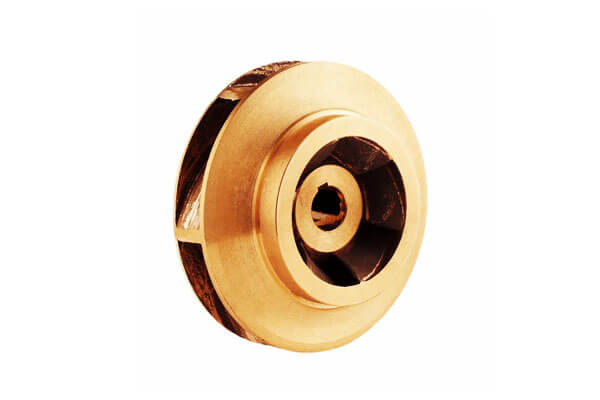
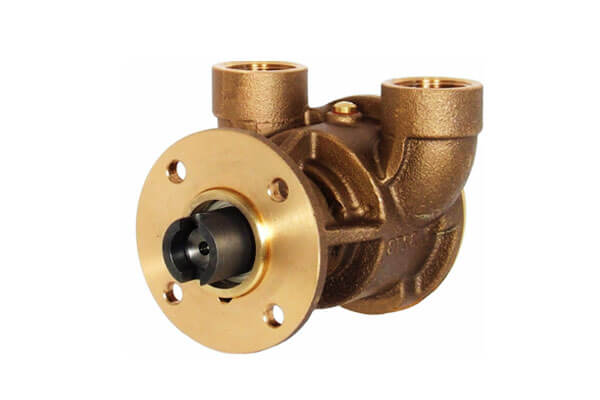
- Pump and valve components (mga impeller, mga katawan ng balbula, seats) — especially in marine and water-handling equipment.
- Mga Gear, worm wheels and small structural castings where castability and wear resistance are needed.
- Marine fittings and propeller components where seawater corrosion resistance is required.
- Decorative castings and architectural elements where patina and aesthetics matter.
| Comparison factor | C90300 (Tin bronze) | C51000 (Phosphor bronze) | C95400 (Aluminum bronze) | Leaded bronzes (hal., C93200, general) |
| Typical composition (wt%) | Cu ≈ 86–89; Sn ≈ 7.5–9; Zn ≈ 3–5; minor Fe/Ni | Cu ≈ 90–95; Sn ≈ 5–10; P ≈ 0.01–0.35 (bakas) | Cu ≈ 78–88; Al ≈ 5–11; Fe/Ni/C (minor) | Cu + Sn base with Pb additions ~1–4% (varies), small Zn/Sn |
| Primary strengthening mechanism | Solid solution & tin-rich phases from casting | Solid solution + phosphide dispersion (P) — good spring/fatigue | Solid solution + ordered phases; high strength via Al content | Solid solution; Pb acts as free-machining/soft phase for chip control |
| Typical as-cast UTS (MPa) | ~300–320 MPa | ~350–500 MPa (varies with alloy & treatment) | ~400–650 MPa (mas mataas na lakas) | ~220–350 MPa (depends on Pb, Sn content) |
Typical hardness (HB) |
~70–140 HB (process dependent) | ~80–160 HB | ~120–220 HB (mas mataas) | ~60–120 HB (softer due to Pb) |
| Wear & bearing performance | Good conformability & embedability; widely used for bushings | Excellent fatigue and spring performance; good bearing alloys available | Excellent wear and high-load bearing capability | Good lubricity/embeddability; excellent machinability for bearing inserts |
| Paglaban sa kaagnasan (tubig dagat / wet env.) | Napakahusay (marine service common) | Good to very good (depends on Sn) | Very good to excellent (aluminum bronzes outstanding in seawater) | Katamtaman; leaded alloys can corrode in some environments; not preferred for seawater |
Katatagan (foundry behavior) |
Very good — sand, shell, investment | Mabuti na lang; available as cast or wrought; phosphor bronze often wrought | Good to fair — higher pouring temp, picky on melt control | Napakahusay na katatagan; widely used for economical cast bearings/parts |
| Machinability | Moderate — improved by Sn for chip control | Mabuti na lang (phosphor bronzes can be challenging if hard) | Moderate to difficult — hard alloys wear tools | Napakahusay (lead dramatically improves free-cutting behavior) |
| Heat treatability / pagtigas ng ulo | Not precipitation-hardenable; anneal/stress relief only | Some variants respond to cold work; not classic age-hardening | Some alloys can be heat treated for strength (solution/aging) | Not age-hardening; properties controlled by composition and working |
Mga tipikal na aplikasyon |
Mga Bushing, mga bahagi ng pump, Mga balbula, mga fitting ng marine, worm wheels | Mga bearing, mga bukal, mga konektor ng kuryente, wear components | Mga mabibigat na tindig, mga propeller ng dagat, high-load components, mga gears | Economical bushings, mga angkop na bagay, low-cost machined parts, high-volume components |
| Relative cost | Moderate — tin is a premium element | Moderate–high (phosphor and high Sn increase cost) | Mas Mataas (Albronzes and alloying raise cost) | Mas mababa (leaded alloys are economical) |
| Key tradeoffs / selection note | Balanced choice for wear + kaagnasan + pagiging castable | Choose when fatigue / spring performance or electrical properties matter | Choose for highest strength & severe wear / cavitation resistance | Choose where machining cost dominates and corrosive service is not critical; restricted in potable/water use |
10. Pangwakas na Salita
UNS C90300 tin bronze is a Pagsubok sa Oras, high-value cast copper alloy that excels in balancing mechanical strength, Paglaban sa Pagsusuot, corrosion durability, at katatagan.
Its carefully engineered chemical composition and uniform microstructure deliver consistent performance in moderate-load, low-to-medium speed service environments, making it indispensable in marine, fluid handling, mechanical power transmission, and general engineering sectors.
Mga FAQ
What is the typical tin content in C90300?
Typical tin is ~7.5–9.0 wt% with copper as the balance; zinc is commonly present at ~3–5 wt%. Always check the mill certificate for the lot you receive.
Can C90300 be heat treated to increase strength?
No — C90300 is not a precipitation-hardening alloy.
Strength and ductility are primarily controlled through composition, section size and solidification rate; stress-relief anneals are used for dimensional stability.
Is UNS C90300 suitable for seawater service?
Yes — tin bronzes such as C90300 are routinely used in marine environments and pump components because of good seawater corrosion resistance and anti-fouling behavior relative to many steels.
What casting process should I specify?
Gamitin ang pamumuhunan paghahagis for thin, detailed parts and tight tolerances; sand or shell casting for larger or economy parts.
Specify desired surface finish, tolerance band and NDT requirements up front.