1. Panimula
Stainless steel investment casting, also known as precision casting or lost wax casting, is a highly precise and versatile manufacturing method used to produce complex, high-performance components with tight tolerances and excellent surface finishes.
It plays a critical role in modern industrial applications where dimensional accuracy, material integrity, and corrosion resistance are essential.
As demand for lightweight, matibay na matibay, and intricately shaped parts continues to grow in industries like aerospace, medikal na, petrochemical, at pagproseso ng pagkain, stainless steel investment casting has become increasingly valuable.
This process allows manufacturers to create near-net-shape stainless steel parts while minimizing machining, materyal na basura, and assembly complexity.
2. Ano ang Investment Casting?
Pamumuhunan sa paghahagis—also known as lost‑wax or precision casting—is a metal‑forming process in which a disposable wax pattern is surrounded by a multi‑layered ceramic shell.
Once the shell hardens, ang waks ay natunaw (“lost wax”), leaving a precise cavity into which molten metal is poured.
After solidification, the ceramic shell is broken away to reveal a metal part that faithfully replicates the original wax geometry.

3. Why Use Stainless Steel for Investment Casting?
Hindi kinakalawang na asero combines exceptional mechanical performance, paglaban sa kaagnasan, at mga katangiang aesthetic, making it one of the most versatile and reliable materials for precision investment casting.
Natitirang Paglaban sa Kaagnasan
- Passive Oxide Layer: All stainless steels form a thin, self‑healing chromium‑oxide surface layer that prevents rust and staining even in harsh environments.
- Paglaban sa Pagpipigil: Grades such as 316L and duplex 2205 exhibit high pitting resistance equivalent numbers (PREN) of ≥25, ensuring long service life in chloride‑rich media (hal., tubig dagat, brine).
- Chemical Compatibility: Resistant to a broad pH range (2–13), allowing use in chemical processing, food and beverage, and pharmaceutical applications without special coatings.
Mataas na Lakas at Tigas
- Wide Strength Spectrum:
-
- Mga marka ng Austenitic (304L, 316L): tensile strength 480–600 MPa; yield strength 200–300 MPa.
- Precipitation‑hardening alloys (17‑4PH): tensile strength up to 1,300 MPa after aging treatment.
- Martensitic grades (410, 420): can be heat‑treated to achieve yield strengths of 800 MPa or more.
- Excellent Toughness: Even in cryogenic or sub‑zero applications, austenitic stainless steels maintain impact toughness above 80 J at –196 °C.
Precision Casting Compatibility
- Fluidity and Melting Range: Stainless steels melt between 1,350 °C at 1,500 °C, providing a stable pouring window that works seamlessly with ceramic shell materials.
- Katumpakan ng Dimensyon: Achieves tolerances as tight as ±0.1 mm per 100 mm of nominal dimension, ideal for components requiring precise fits or intricate features.
- Tapos na sa ibabaw: Typical as‑cast finishes reach Ra 1.6–3.2 μm, reducing or eliminating the need for secondary polishing.
4. Step‑by‑Step Process of Stainless Steel Investment Casting
The investment‑casting workflow consists of six major stages, each carefully controlled to ensure dimensional accuracy, kalidad ng ibabaw, at integridad ng metalurhiko.
4.1 Paglikha ng Pattern ng Wax
Disenyo ng Mamatay & Gawa-gawa
- Precision steel dies are CNC‑milled to mirror the final part geometry, accounting for shrinkage (typically 1.5–2 % para sa hindi kinakalawang na asero).
Wax iniksyon
- Tinunaw na waks (paraffin blends with plasticizers) is injected under pressure (4–6 bar) into the die, filling cavities in under 2 Mga segundo.
- Target dimensional variation: ±0.03 mm per 25 mm.

Pattern Quality Check
- Visual inspection for voids, flash, or knit lines.
- Weight verification: each pattern’s mass is recorded to track yield and process consistency.
4.2 Assembly of Wax Patterns
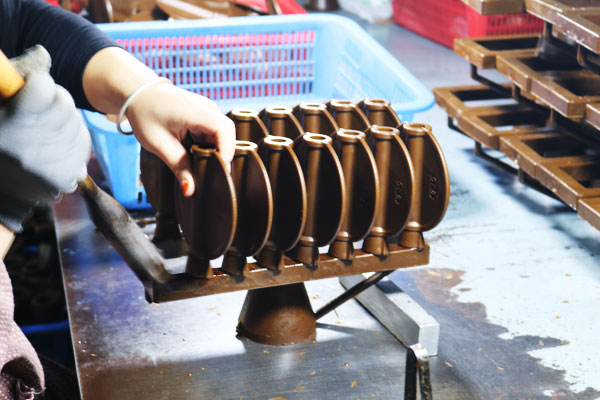
Pattern Treeing
- Individual wax patterns are “grafted” onto a central wax sprue bar to form a tree, optimizing metal feed and minimizing turbulence.
- Typical tree sizes: 10–50 patterns, depending on part size and furnace capacity.
Gate and Runner Design
- Gate cross‑sections sized to balance fill speed against turbulence (aiming for Reynolds numbers below 500).
- Hot‑tap gates or daily‑flared gates reduce turbulence and air entrapment.
4.3 Shell Building (Ceramic Slurry and Stucco)
First Dipping (Prime Coat)
- Fine refractory slurry (particle size 5–10 µm) coats the wax tree to capture fine detail.

Stucco Application
- Silica or zircon sand (40–80 µm) is stuccoed onto the wet prime coat for reinforcement.
Subsequent Coats
- Alternate slurry and stucco for 5–8 total layers, building shell thickness to 6–10 mm.
- Drying time between coats: 15–30 minutes at 20–25 °C and 40–60 % relative humidity.
Final Coating
- A coarser outer layer (150–250 µm particles) provides mechanical protection during handling and pouring.
4.4 Dewaxing (Lost‑Wax)
Autoclave Dewax
- Rapid steam cycle at 120–150 °C and 2–5 bar pressure for 1–2 minutes to melt out the bulk of wax.
Oven Bake‑out
- Shells are transferred to an oven at 200–250 °C for 2–4 hours to remove residual wax and moisture.
Pagbawi ng Waks
- Melted wax is collected, filtered, and recycled back into the wax injection system, achieving over 95% reuse.
4.5 Preheating and Pouring Molten Stainless Steel
Shell Preheating
- Shell assemblies are baked at 1,000–1,200 °C for 1–3 hours to sinter the ceramic, drive off moisture, and reduce thermal shock.
Melting Furnace
- Induction or electric‑arc furnaces melt stainless charge metal to 1,400–1,550 °C, depende sa alloy (hal., 316L at ~1,450 °C).
Pagbubuhos ng
- Gravity pour, vacuum assist, or low‑pressure techniques fill molds at controlled rates (20–50 cm/s mold velocity) to minimize turbulence.
- Typical pour weight per shell: 10–250 kg of molten metal.

4.6 Pagtanggal ng Shell, Pagtatapos
Once the stainless steel has fully solidified, the ceramic shell is removed through mechanical methods such as sandblasting, water jetting, or vibratory finishing.
Sa ilang mga kaso, chemical dissolution may be used for intricate geometries.
Pagkatapos ng pag-alis ng shell, the casting proceeds to finishing operations, which typically include removal of the sprue system, surface grinding, and polishing to achieve the desired surface quality.

Heat treatment may be applied to enhance mechanical properties such as strength, tigas na tigas, o paglaban sa kaagnasan, depending on the alloy used.
Precision CNC machining is then employed to meet tight dimensional tolerances, especially on critical surfaces or mating interfaces.
5. Technical Advantages of Stainless Steel Investment Casting
Stainless steel investment casting offers a unique combination of precision, pagganap, and economy. Below are its principal technical advantages:

Pambihirang Katumpakan ng Dimensional
- Typical tolerances of ±0.1 mm per 100 mm of nominal dimension enable net‑shape parts that require minimal or no secondary machining.
- Consistent pattern replication and controlled shell thickness ensure repeatability across production runs.
Tapos na ang Superior Surface
- As‑cast surface roughness in the range of Ra 1.6–3.2 μm yields smooth components ready for service or light polishing.
- Fine ceramic prime coats capture intricate details and sharp edges, reducing post‑cast grinding and buffing.
Kumplikadong Kakayahan sa Geometry
- Ability to produce thin walls down to 0.6 mm, panloob na lukab, mga undercuts, and negative drafts without cores.
- Facilitates consolidation of multiple parts or features into a single casting, reducing assembly steps and potential leak paths.
High Material Utilization and Yield
- Wax patterns and ceramic shells are fully reclaimable, with wax reuse rates exceeding 95 %.
- Typical metal yield of 85–95 % minimizes scrap compared to subtractive processes.
Malawak na Pagiging tugma ng haluang metal
- Successfully cast a wide spectrum of stainless grades—from 304/316 austenitics to 17‑4PH precipitation‑hardening and duplex 2205—each delivering tailored corrosion resistance, lakas ng loob, at tigas na tigas.
- Uniform microstructure and controlled cooling prevent segregation, ensuring consistent mechanical properties.
Cost‑Effectiveness in Medium to High Volumes
- Mga gastos sa tooling (wax dies and ceramic pattern tools) are amortized over production runs of hundreds to tens of thousands of parts, driving per‑part costs below those of machining from bar stock.
- Reduced secondary operations (hinang, pagtitipon, extensive machining) further lower total manufacturing expenses.
Shorter Lead Times for Complex Parts
- From CAD approval to first production castings in as little as 4–6 weeks, outpacing custom machining or forging for geometrically intricate components.
- Automated shell‑building and dewaxing systems support rapid, repeatable cycle times.
Enhanced Mechanical Performance
- Near‑net shape pouring minimizes stress concentrators and machining‑induced work hardening, improving fatigue life.
- Optionally combined with heat treatments (solusyon annealing, pagtanda) to fine‑tune hardness, magbunga ng lakas, at tigas na tigas.
6. Design Guidelines for Stainless Steel Investment Castings
When designing parts for stainless steel investment casting, following proven guidelines ensures reliable mold filling, sound metallurgy, and minimal post‑cast refinement.
| Design Feature | Rekomendasyon | Katwiran |
| kapal ng pader | 1.0 – 12 mm; maintain variation ≤ 2:1 ratio | Promotes uniform cooling, reduces porosity |
| Mga Anggulo ng Draft | ≥ 1° per side for vertical walls; ≥ 2° for fine detail | Eases shell removal, prevents damage |
| Fillet Radii | Internal ≥ 0.5 mm; external ≥ 1.0 mm | Enhances metal flow, reduces stress risers |
| Undercuts | Avoid when possible; otherwise use collapsible cores or removable inserts | Simplifies mold construction, reduces defects |
| Tolerance Grades | ISO 8062 CT5–CT7 for as‑cast features | CT5 (Ayos lang): ±0.05 mm; CT7 (standard): ±0.20 mm |
| Tapos na sa ibabaw | Ra 1.6–3.2 μm achievable; specify critical areas if finer finish is needed | Allows consolidation of finish and casting processes |
| Ribs & Bosses | Width ≤ 3× thickness; height ≤ 4× thickness; add radii at bases | Prevents hot spots and insufficient fill |
| Mga Tip sa Pag-install & Mga Riser | Place gates at thick sections; risers sized to feed shrinkage | Controls feed direction, avoids shrinkage porosity |
| Coring & Holes | Use ceramic cores for internal features; holes ≥ 3 mm | Ensures accuracy of internal passages |
| Direksyon ng Solidification | Design solidification paths toward risers | Minimizes trapped liquid and porosity |
7. Common Stainless Steel Grades in Investment Casting
Stainless steel investment casting supports a wide range of alloy grades to meet diverse application demands across industries.

Each grade offers a unique combination of mechanical properties, paglaban sa kaagnasan, and heat treatment capabilities.
| Grade | Equivalent Designation | Yield Lakas (MPa) | Lakas ng Paghatak (MPa) | Paglaban sa Pagpipigil (PREN) | Typical Uses |
| 304 | CF8 | 215 | 505 | 18 | Food equipment, arkitektura trim |
| 316 | CF8M | 205 | 515 | 24 | Mga katawan ng bomba, Mga balbula, mga bahagi ng dagat |
| 304L | CF3 | 215 | 505 | 18 | Pagproseso ng kemikal, low‑carbon applications |
| 316L | CF3M | 205 | 515 | 24 | Parmasyutiko, food‑grade equipment |
| 410 | — | 415 | 530 | 12 | Mga Valve, mga shaft, mga fastener |
| 420 | — | 450 | 655 | 14 | Cutlery, Mga Bahagi ng Pagsusuot, mga tooling |
| 17‑4PH | — | 1,035 (H900) | 1,150 | 20 | Aerospace fittings, high‑stress components |
| 2205 | — | 450 | 620 | 32 | Langis & gas fittings, pagproseso ng kemikal |
8. Post-Casting Processes and Finishing Options
Post-casting operations are essential in transforming a raw stainless steel investment casting into a high-performance, precision component.
These processes improve dimensional accuracy, kalidad ng ibabaw, mekanikal na mga katangian, and ensure that the casting meets functional and regulatory requirements.
Paggamot ng Heat
Heat treatment is often applied to stainless steel castings to improve strength, tigas na tigas, ductility, at paglaban sa kaagnasan. The specific treatment depends on the alloy type:
- Austenitic hindi kinakalawang na asero (hal., 304, 316):
-
- Solusyon sa Pagsusubo (1,040–1,120 °C): Dissolves chromium carbides, refines grain structure, and improves corrosion resistance.
- Mabilis na pag-quenching: Prevents sensitization and intergranular corrosion.
- Martensitic hindi kinakalawang na asero (hal., 410, 420):
-
- Hardening and Tempering (950–1,050 °C): Increases hardness and tensile strength.
- Paghina ng loob: Adjusts toughness and reduces brittleness after hardening.
- Precipitation-Hardening Steels (hal., 17-4PH):
-
- Paggamot sa Pag-iipon (hal., H900, H1025): Improves yield strength and hardness via controlled precipitation of copper-rich phases.
Mga Paggamot sa Ibabaw
Surface finishing enhances the appearance, cleanliness, and corrosion resistance of the casting. Common treatments include:
- Email Address *
-
- Removes surface oxides and scale using acid solutions (typically nitric and hydrofluoric acids).
- Prepares the casting for passivation or electropolishing.
- Passivation
-
- Enhances corrosion resistance by forming a stable chromium oxide layer.
- Typically done using nitric acid or citric acid baths.
-
- Anodic dissolution process that smooths and brightens the surface by removing micro-roughness.
- Ideal for sanitary, medikal na, and food-grade applications.
- Pagsabog ng Shot / Pagsabog ng Buhangin
-
- Mechanically removes ceramic shell residue, oksihenasyon, and surface defects.
- Commonly used as a pre-finish step before polishing or coating.
CNC Machining and Dimensional Finishing
Though investment casting achieves near-net-shape precision, some critical surfaces or tolerances may require post-machining.

- CNC paggiling / Turning
-
- Used to achieve tight tolerances (hal., ±0.01 mm) and precision surface finishes on threads, bores, or sealing faces.
- Especially important for mating parts or assemblies.
- Paggiling & Polishing
-
- Applied to improve aesthetics, patag, or prepare parts for plating or welding.
- Mirror or satin finishes can be achieved depending on requirements.
Inspeksyon at Kontrol sa Kalidad
After all finishing processes, castings undergo rigorous inspection to ensure conformance with specifications and reliability standards.
- Dimensional na Inspeksyon
-
- Mga tool: CMM (Coordinate Pagsukat Machine), digital calipers, Mga sukat
- Checks critical tolerances, sentrisiko, and geometry.
- Pagsubok na Hindi Nakasisira (NDT)
-
- Visual Inspection (VT): Surface flaws and defects
- Dye Penetrant Testing (PT): Surface cracks and porosity
- Pagsusuri sa Radiographic (RT): Internal voids and inclusions
- Ultrasonic pagsubok (UT): Subsurface flaws in thicker sections
- Magnetic Particle Testing (MT): For ferromagnetic martensitic grades
- Mechanical Property Testing (kung kinakailangan)
-
- Makunat, epekto nito, tigas na tigas, and elongation testing according to ASTM standards.
9. Applications of Stainless Steel Investment Castings
Stainless steel investment castings are used across a wide range of industries where precision, tibay ng katawan, and corrosion resistance are critical.
The ability to produce complex shapes with tight tolerances and excellent surface finish makes this process especially valuable for high-performance components.

Industriya ng Aerospace
- Mga blades ng turbine
- Engine housings
- Mga bahagi ng sistema ng gasolina
- Landing gear brackets
Why Investment Casting?
Stainless steel castings in aerospace must withstand high temperatures, mekanikal na stress, at kinakaing unti-unti na kapaligiran.
Investment casting enables the production of lightweight, complex geometries with minimal post-machining, crucial for performance and fuel efficiency.
Medical and Dental Industry
- Mga instrumento sa kirurhiko
- Orthopedic implants (Mga tangkay ng balakang, bone screws)
- Dental devices and brackets
- Diagnostic equipment parts
Why Stainless Steel Investment Casting?
Medical-grade stainless steels like 316L and 17-4PH provide biocompatibility and sterilization resistance.
Investment casting allows intricate, kalinisan, and repeatable parts required in medical settings.
Industriya ng Automotive
- Turbocharger impellers
- Exhaust manifolds
- Sensor housings
- Mga bahagi ng gearbox
Why Investment Casting?
In high-performance vehicles, precision-cast stainless steel parts offer weight savings, paglaban sa init, at lakas.
Investment casting is ideal for low to mid-volume production of complex drivetrain or engine parts.
Industriya ng Pagkain at Inumin
- Mga pabahay ng bomba
- Mga balbula ng sanitario
- Mga fitting ng pipe
- Mixer blades
Why Investment Casting Stainless Steel?
Mga grado tulad ng 304 and 316L are widely used due to their corrosion resistance and hygienic properties.
Investment casting produces smooth, crevice-free surfaces that are easy to clean and comply with food safety standards.
Mga Aplikasyon sa Marine at Offshore
- Propellers and impellers
- Couplings and flanges
- Mga katawan ng bomba
- Anchor brackets
Why Investment Casting?
Marine environments are highly corrosive, especially with saltwater exposure.
Stainless grades like 316 at duplex 2205 offer excellent resistance to pitting, kaagnasan ng bitak, at pag-crack ng kaagnasan ng stress.
Langis, Gas, and Chemical Processing
- Mga katawan ng balbula
- Sealing rings
- Mga bahagi ng bomba
- Heat exchanger parts
Why Investment Casting Stainless Steel?
Components in oil & gas or chemical plants must handle pressure, mga pagbabago ng temperatura, and aggressive media.
Duplex and precipitation-hardening stainless steels provide the required mechanical and corrosion resistance, while investment casting ensures dimensional accuracy and integrity.
Defense and Firearms
- Trigger components
- Barrel extensions
- Optics mounts
- Weapon housings
Why Stainless Steel Investment Casting?
Defense-grade components benefit from stainless steel’s strength and wear resistance. Investment casting supports the precision needed for moving parts and safety-critical assemblies.
10. Investment Casting vs. Other Stainless Steel Manufacturing Methods
While investment casting offers numerous advantages for producing high-quality stainless steel components, it’s important to understand how it compares with other common manufacturing methods.
★ = Poor / Low ★★★★★ = Excellent / Mataas na
| Pamantayan | Pamumuhunan sa Paghahagis | buhangin paghahagis | Pagbubuo ng mga | CNC Machining | mamatay paghahagis(mainly non-ferrous) |
| Katumpakan ng Dimensyon | ★★★★☆ (±0.1 mm) | ★★☆☆☆ (±1.0 mm) | ★★★★☆ (±0.3 mm) | ★★★★★ (±0.01 mm) | ★★★★☆ (±0.2 mm) |
| Tapos na sa ibabaw (Ra) | ★★★★☆ (1.6–3.2 μm) | ★★☆☆☆ (6.3-25 μm) | ★★☆☆☆ (3.2–12.5 μm) | ★★★★★ (<1.6 μm) | ★★★★☆ (1.6–3.2 μm) |
| Gastos sa Tooling | Katamtaman | Mababa ang | Mataas na | Napakababa (per unit) | Napakataas na |
| Kaangkupan ng Dami ng Produksyon | Katamtaman - Mataas | Mababa - Katamtaman | Katamtaman - Mataas | Mababa - Katamtaman | Napakataas na |
| Complex Geometry | ★★★★★ | ★★☆☆☆ | ★☆☆☆☆ | ★★★★★ | ★★★☆☆ |
| Material Yield | Katamtaman - Mataas | Mababa ang | Napakataas na | Mababa ang (high waste) | Mataas na |
| Part Size Flexibility | Small–Medium | Medium–Large | Small–Very Large | Small–Medium | Small–Medium |
| Strength of Final Part | Mataas na | Katamtaman | Napakataas na | Mataas na | Katamtaman |
| Lead Time | Katamtaman | Maikli | Matagal na | Katamtaman | Matagal na |
| Pinakamahusay Para sa | Katumpakan, kumplikadong mga bahagi | Malaki ang, Mga simpleng hugis | High-strength applications | Mga prototype, fine tolerances | Mass production of small components |
| Mga Karaniwang Aplikasyon | Aerospace, medikal na, Mga balbula | Mga pabahay ng bomba, mga frame | Mga shaft, mga gears, mga flanges | Mold bases, custom fixtures | Mga pabahay ng sasakyan, Mga Bahagi ng Appliance |
11. Challenges and Limitations of Investment Casting Stainless Steel
- Kontrol ng Porosity: Requires optimized gating and solidification.
- Mga Hadlang sa Laki: Generally up to 1 m sa dimensyon; larger parts may need segmentation.
- Lead Time: 4–6 weeks from tooling to finished parts—longer than some rapid prototyping methods.
- Cost of Tooling: Initial wax die investment (~USD 3,000–5,000 per cavity) can be prohibitive for very low volumes.
12. Choosing a Stainless Steel Investment Casting Supplier—LangHe Industry
When selecting a partner, Isaalang-alang:
- Technical Expertise: Experience with your required grades and tolerances.
- Quality Systems: ISO 9001, BILANG 9100 (aerospace), ISO 13485 (medikal na).
- Capacity & Scalability: Ability to ramp from prototypes to tens of thousands of parts.
- Supply Chain Transparency: Traceability of raw materials and certification.
- Value‑Added Services: In‑house machining, paggamot ng init, pagtatapos ng, at inspeksyon.
LangHe distinguishes itself with over 20 years in stainless steel investment casting, in‑house tool making, and full turnkey capabilities, ensuring single‑source accountability and rapid response from design to production.
13. Pangwakas na Salita
Stainless steel investment casting stands at the nexus of precision engineering and material science, offering unmatched freedom in design, mataas na katumpakan, and repeatable quality.
Whether you’re developing critical aerospace components or high‑precision medical instruments, the process delivers superior surface finish, mekanikal na pagganap, and cost efficiency at scale.
Mga FAQ
What is the tolerance of stainless steel investment castings?
Typically ±0.1 mm per 100 mm of nominal dimension (ISO 8062 CT5–CT7), with tighter tolerances achievable via post‑machining.
What is the difference between investment casting and sand casting?
Investment casting yields finer detail (Ra 1.6–3.2 μm vs. Ra 6.3–12.5 μm), mas mahigpit na mga pagpaparaya (±0.1 mm vs. ±0.5 mm), and supports more complex geometries, whereas sand casting is more economical for very large parts or low‑precision applications.
Can 316 stainless steel be investment cast?
Yes—grade 316L is one of the most common stainless alloys for investment casting, offering excellent corrosion resistance and good mechanical properties.
How does investment casting improve part performance?
By minimizing machining (reducing stress concentrators), Tinitiyak ang unipormeng microstructure, and achieving high surface finish, investment casting enhances fatigue life, dimensional na katatagan, at aesthetic appeal.