Panimula
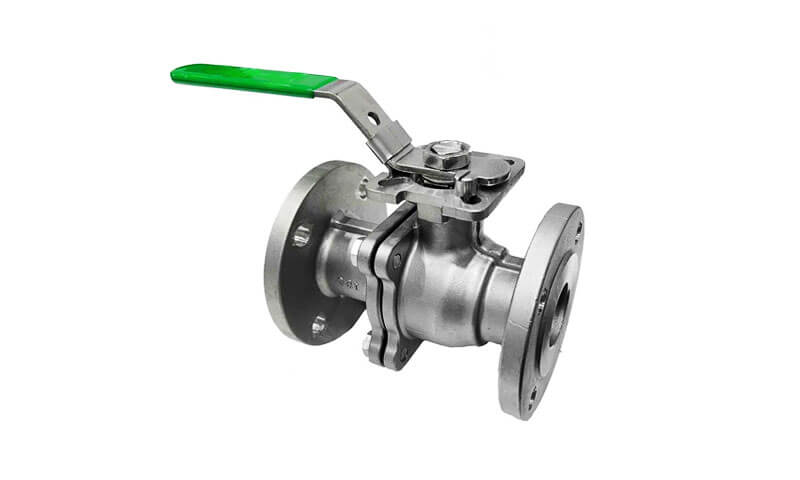
Stainless steel ball valves are among the most reliable and versatile flow control devices used in modern industrial piping systems.
Their simple quarter-turn operation, excellent sealing performance, high pressure resistance, and outstanding corrosion resistance make them the preferred choice for applications ranging from water treatment and chemical processing to oil and gas, mga parmasyutiko, pagproseso ng pagkain, and marine engineering.
The performance of a stainless steel ball valve depends not only on its design but also on the manufacturing process used to produce its critical components.
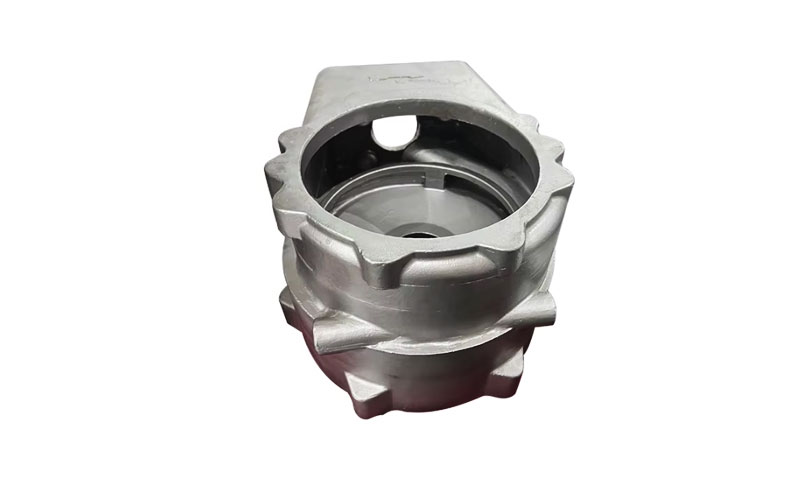
Among the various production methods available, pamumuhunan paghahagis, kilala rin bilang Nawala ang wax casting, has become the industry standard for manufacturing high-quality stainless steel valve bodies, bonnets, and other complex components.
Compared with sand casting or conventional machining, investment casting delivers superior dimensional accuracy, pambihirang pagtatapos ng ibabaw, excellent metallurgical integrity, and greater design flexibility, making it particularly suitable for precision valve manufacturing.
1. What Is a Stainless Steel Ball Valve?
A hindi kinakalawang na asero ball valve is a quarter-turn shut-off valve that controls fluid flow by rotating a spherical ball with a precision-machined bore through 90 degrees.
When the bore aligns with the pipeline, the valve is fully open, allowing unrestricted flow.
Rotating the ball perpendicular to the flow path completely blocks the medium, providing bubble-tight shutoff.
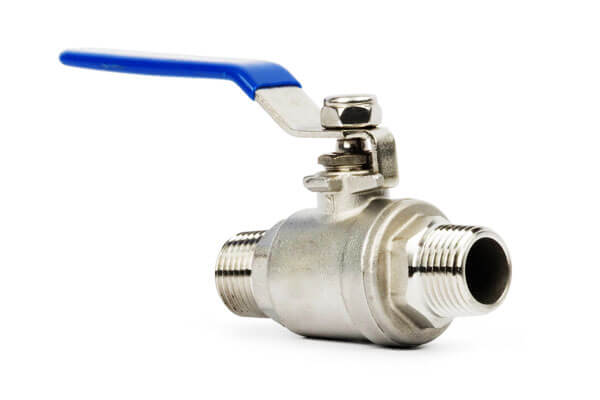
Because of their low operating torque, rapid opening and closing, and minimal pressure loss, stainless steel ball valves are widely used in systems requiring reliable isolation, frequent operation, at mahabang buhay ng serbisyo.
Unlike gate or globe valves that require multiple turns to operate, ball valves provide immediate flow control with a simple quarter-turn movement, making them ideal for automated systems using pneumatic, mga elektriko, or hydraulic actuators.
Main Components of a Stainless Steel Ball Valve
| Component | Function | Typical manufacturing method |
| Katawan | Pressure‑containing housing; contains the ball, seats, and stem. | Pamumuhunan sa paghahagis (pinaka-karaniwan), buhangin paghahagis, pagkukubli. |
| bola | Spherical closure member with a cylindrical bore. | Pamumuhunan sa paghahagis, huwad na, or machined from bar. |
| halamang singaw sa paa (shaft) | Transmits torque from actuator to ball. | Machined from bar (hindi kinakalawang na asero). |
| Seats | Provide sealing between ball and body; replaceable. | PTFE, reinforced PTFE, PEEK, o metal. |
| Actuator | Manual lever, handwheel, niyumatik, or electric. | Commercial components. |
| Bonnet / top flange | Houses the stem and provides mounting for actuator. | Investment casting or machining. |
| Mga Tatak / packing | Prevent leakage along the stem. | PTFE, grapayt. |
Common Types of Stainless Steel Ball Valves
| Valve type | Paglalarawan | Mga tipikal na aplikasyon |
| Full port (full bore) | Ball bore diameter equals pipe diameter; minimal pressure drop. | General‑purpose, where flow restriction is undesirable. |
| Reduced port (reduced bore) | Ball bore diameter is smaller than pipe diameter; mas mababang gastos. | Cost‑sensitive applications; moderate pressure drop acceptable. |
| 3‑way ball valve | L‑port or T‑port ball; diverts or mixes flow. | Fluid switching, mixing, and distribution. |
| Floating ball valve | Ball is not fixed; seats hold it in position. | Low to medium pressure (≤Class 600). |
| Trunnion‑mounted | Ball is supported by a trunnion (fixed shaft); seats are spring‑loaded. | High pressure (≥Class 600), large diameters. |
| Top‑entry | Body opens from the top; allows in‑line maintenance. | Pipeline applications requiring minimal disassembly. |
| Split‑body | Body assembled from two or three pieces. | General industrial; easier to assemble and maintain. |
2. Why Investment Casting Is the Preferred Manufacturing Method
Manufacturing technology plays a decisive role in the performance, pagiging maaasahan, and service life of stainless steel ball valves.
Among the various production methods available, pamumuhunan paghahagis has become the preferred choice for producing valve bodies and other complex components because it combines exceptional dimensional accuracy with excellent metallurgical quality and design flexibility.
Unlike sand casting, which often requires extensive machining, o pagkukubli, which is limited in geometric complexity,
investment casting enables manufacturers to produce near-net-shape components with intricate internal passages, makinis na ibabaw, and consistent wall thicknesses.
These characteristics are particularly important for ball valves, where sealing performance, pressure integrity, and flow efficiency depend heavily on the precision of the valve body.
The process is especially well suited for medium- sa mataas na dami ng produksyon, offering an optimal balance between manufacturing cost, material utilization, and product quality.
Key Advantages of Investment Casting for Ball Valves
| Advantage | Explanation |
| Near‑net shape | Parts are cast to near‑final dimensions, reducing machining and waste. |
| Kumplikadong panloob na heometriya | Internal flow passages, ports, and mounting features are cast integrally. |
| Napakahusay na pagtatapos sa ibabaw | As‑cast Ra 1.6‑6.3 µm reduces flow resistance and improves sealing. |
| Tight dimensional tolerances | Ensures ball‑to‑body clearance, seat alignment, and leak‑tight sealing. |
| Uniform microstructure | Fine‑grained cast structure provides consistent mechanical properties. |
Pressure integrity |
Sound castings with proper gating achieve pressure‑tight performance to Class 2500. |
| Alloy versatility | Casts almost any castable stainless steel: CF‑8, CF‑8M, CF‑3, CF‑3M, CN‑7M, Duplex, superduplex, and nickel alloys. |
| Cost‑effectiveness at medium volumes | 100‑10,000 parts/year; ideal for custom and standard valve sizes. |
| Reduced assembly | Integral casting of flanges, Mga Boss, and mounting features eliminates welding/bolting. |
3. Stainless Steel Material Selection for Investment Casting
Material selection is one of the most critical engineering decisions in the manufacture of investment-cast stainless steel ball valves.
The chosen alloy directly influences the valve’s mechanical strength, paglaban sa kaagnasan, pressure capability, weldability, machinability, and service life.
| ASTM Casting Grade | UNS Number | Equivalent Wrought Grade | Uri ng Materyal | Mga Pangunahing Katangian | Mga Karaniwang Aplikasyon |
| CF8 | J92600 | AISI 304 | Austenitic hindi kinakalawang na asero | Napakahusay na paglaban sa kaagnasan, mahusay na weldability, matipid sa ekonomiya | Water treatment, HVAC, pagproseso ng pagkain, general industrial service |
| CF8M | J92900 | AISI 316 | Austenitic hindi kinakalawang na asero | Superior resistance to chlorides and chemicals due to molybdenum addition | Pagproseso ng kemikal, Marine Engineering, offshore equipment |
| CF3 | J92500 | AISI 304L | Low-Carbon Austenitic Stainless Steel | Improved weldability and reduced risk of intergranular corrosion | Welded piping systems, pharmaceutical and sanitary applications |
CF3M |
J92800 | AISI 316L | Low-Carbon Austenitic Stainless Steel | Excellent corrosion resistance with enhanced weldability | Pagkain & inumin, parmasyutiko, desalination, mga halaman ng kemikal |
| CA15 | J91109 | AISI 410 | Martensitic hindi kinakalawang na asero | Mataas na lakas, tigas na tigas, at magsuot ng resistensya | Valve trim, stems, high-pressure components |
| CD4MCu | J93370 | Duplex hindi kinakalawang na asero | Duplex hindi kinakalawang na asero | Outstanding strength and resistance to pitting, kaagnasan ng bitak, at pag-crack ng kaagnasan ng stress | Mga platform sa malayo sa pampang, Mga Sistema ng Tubig sa Dagat, langis & gas |
4. Investment Casting Manufacturing Process for Stainless Steel Ball Valve
The performance and reliability of a stainless steel ball valve depend heavily on the precision and consistency of its manufacturing process.
Pamumuhunan sa paghahagis, also known as the lost wax casting process, is the preferred method for producing high-quality stainless steel valve bodies and complex structural components because it combines excellent dimensional accuracy, Higit na Mataas na Pagtatapos ng Ibabaw, and high metallurgical integrity.
The complete manufacturing process involves a series of carefully controlled stages.
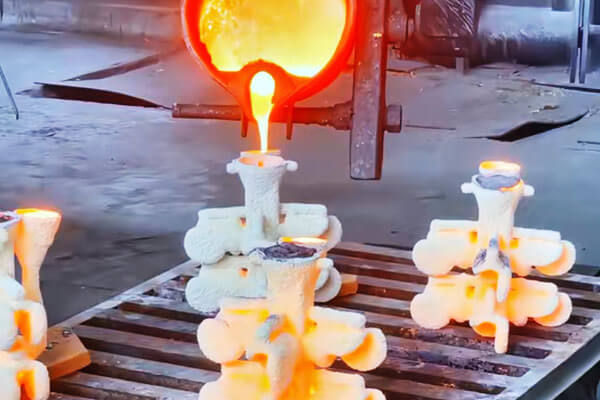
Manufacturing Process Flow
Engineering Design → Tooling → Wax Pattern → Wax Assembly → Ceramic Shell → Dewaxing → Shell Firing → Stainless Steel Pouring → Cooling → Shell Removal → Heat Treatment → CNC Machining → Surface Finishing → Inspection → Valve Assembly
Engineering Design and CAD Modeling
The process begins with detailed engineering design.
Engineers create a three-dimensional CAD model of the valve body and related components, taking into account:
- Pressure requirements
- Wall thickness distribution
- Machining allowances
- Casting shrinkage
- Flow characteristics
- Assembly interfaces
Modern manufacturers often perform casting simulation and solidification analysis before tooling is produced.
These simulations help identify potential defects such as shrinkage porosity, air entrapment, and uneven cooling, allowing optimization of the gating and feeding system in advance.
Tooling and Wax Pattern Production
Precision metal dies are manufactured for wax injection.
Molten wax is injected into the die under controlled pressure and temperature to create accurate wax replicas of the valve body.
Key control points include:
- Wax temperature
- Injection pressure
- Oras ng paglamig
- Dimensional na katatagan
- Kalidad ng ibabaw
Because the wax pattern directly determines the final casting geometry, pattern accuracy is essential for achieving tight tolerances.
Wax Assembly
Individual wax patterns are attached to a central wax runner system to form a casting tree.
The runner and gate arrangement must provide:
- Balanced metal flow
- Smooth cavity filling
- Adequate feeding
- Minimal turbulence
- High casting yield
Proper wax assembly is a critical factor in reducing casting defects.
Ceramic Shell Building
The wax assembly is repeatedly dipped into a ceramic slurry and coated with refractory sand.
Each layer is dried before the next layer is applied. Depending on the size and weight of the valve body, the shell typically consists of 6–10 ceramic layers.
The ceramic shell must provide:
- Mataas na lakas
- Good permeability
- Excellent refractoriness
- Thermal shock resistance
- Dimensional na katatagan
Dewaxing and Shell Firing
After shell construction, the wax is removed using high-pressure steam in an autoclave.
The shell is then fired at high temperature, typically 900–1,100°C, sa:
- Remove residual wax
- Increase shell strength
- Eliminate moisture
- Improve thermal stability
A properly fired shell is essential for defect-free stainless steel casting.
Stainless Steel Melting and Pouring
Stainless steel is melted in induction furnaces under carefully controlled conditions.
Chemical composition is monitored continuously to ensure compliance with ASTM specifications.
Critical pouring parameters include:
- Alloy composition
- Pagbuhos ng temperatura
- Superheat temperature
- Oxygen control
- Inclusion control
- Pouring rate
Because stainless steel is sensitive to oxidation, turbulence during pouring must be minimized.
Shell Removal and Cut-Off
Pagkatapos ng paglamig, the ceramic shell is mechanically removed.
The casting tree is then separated into individual components.
Typical operations include:
- Knockout
- Pagsabog ng baril
- Gate removal
- Paggiling
- Paglilinis ng ibabaw
Paggamot ng Heat
Heat treatment optimizes the microstructure and corrosion resistance of the casting.
Common treatments include:
| Paggamot ng Heat | Layunin |
| Solusyon sa Pagsusubo | Restore corrosion resistance |
| Nakakawala ng stress | Reduce residual stress |
| Pagpapawi & Paghina ng loob | Improve strength for specific grades |
Proper heat treatment is especially important for CF8M, CF3M, and duplex stainless steels.
CNC Precision Machining
Although investment casting provides near-net-shape components, critical surfaces still require precision machining.
Typical machining operations include:
- Flange face machining
- Thread machining
- Stem bore machining
- Seat pocket machining
- Actuator mounting surfaces
- Pressure-sealing interfaces
High-precision CNC equipment ensures excellent concentricity and sealing performance.
Pagtatapos ng Ibabaw
Depende sa application, the valve body may undergo:
- Email Address *
- Passivation
- Mekanikal na buli
- Electro-polishing
- Glass bead blasting
These treatments improve corrosion resistance and surface cleanliness.
Precision Inspection and Finishing
Complete dimensional calibration, ultrasonic nondestructive testing (UT), magnetic particle testing (MT), hydraulic pressure tightness test, and surface finishing to deliver qualified high-precision stainless steel ball valve castings.
5. Corrosion Resistance and Surface Treatment Solutions
One of the primary reasons for choosing stainless steel ball valves is their excellent corrosion resistance.
Gayunpaman, the final corrosion performance depends not only on alloy composition but also on surface condition, cleanliness, paggamot ng init, and finishing processes.
Why Stainless Steel Resists Corrosion
Stainless steel contains at least 10.5% kromo, which forms a thin, stable, and self-healing passive oxide layer on the surface.
This passive film:
- Prevents further oxidation
- Repairs itself when damaged
- Protects against many chemicals
- Improves long-term durability
Higher chromium, nikel, molibdenum, and nitrogen contents further enhance corrosion resistance.
Common Surface Treatment Technologies
| Paggamot sa ibabaw | Main Purpose | Typical Surface Condition | Mga Aplikasyon |
| Email Address * | Remove scale and oxides | Clean metallic surface | General industrial service |
| Passivation | Enhance passive film | Chemically stabilized surface | Chemical and sanitary industries |
| Electro-polishing | Reduce roughness and contamination | Parang salamin ang finish | Pharmaceutical and semiconductor |
| Mekanikal na Kinis | Improve appearance and cleanliness | Smooth polished finish | Food and beverage |
| Glass Bead Blasting | Uniform matte appearance | Satin finish | Marine and architectural |
| Pagsabog ng Shot | Remove surface residue | Clean textured surface | General industrial valves |
6. Common Investment Casting Defects and Engineering Solutions
Investment‑cast stainless steel ball valve components are susceptible to specific defect types. The table below lists them, their causes, and remedial measures.
| Depekto | Visual/NDT signature | Root cause | Prevention / remedy |
| Porosity ng gas | Round internal voids | Dissolved hydrogen/nitrogen; poor deoxidation. | Vacuum degassing; use clean charge; improve pouring practice. |
| Pag-urong ng porosity | Jagged internal voids | Insufficient feeding; poor riser design. | Optimise gating/risering; use chills; simulate solidification. |
| Mainit na pagpunit | Cracks with ragged edges | Tensile stress during solidification; shell constraint. | Reduce pouring temperature; improve shell collapsibility; modify alloy. |
| Mga Pagsasama (oxide/slag) | Irregular non‑metallic particles | Turbulent pouring; dirty melt; eroded shell. | Ceramic filters; bottom pouring; clean charge. |
Misrun / cold shut |
Incomplete filling; folded surface | Low pouring temperature; poor fluidity. | Increase pouring temperature; improve gating; evacuate mould. |
| Pagkamagaspang sa ibabaw / finning | Raised lines on surface | Shell cracking during filling; low shell strength. | Increase shell thickness; use stronger binder. |
| Carbide precipitation (sensitisation) | Intergranular attack (corrosion test) | Slow cooling through 450‑850°C; high carbon. | Use low‑carbon grade (CF‑3/CF‑3M); mabilis na pag-quench. |
| Dimensional deviation | Out‑of‑tolerance dimensions | Wax shrinkage variation; shell expansion; die wear. | Control wax injection; maintain die condition. |
Pagtiyak ng Kalidad
| QA element | Paraan | Acceptance criteria |
| Chemical analysis | Spectrometry | Meets ASTM A351/A743/A890 specification. |
| Pagsubok sa mekanikal | Makunat, tigas na tigas, epekto nito | Meets grade requirements. |
| NDT | Dye penetrant (PT), radiography (RT), ferrite measurement | No cracks, porosity exceeding specification; ferrite content 30‑60% for duplex. |
| Dimensional inspection | CMM, Mga sukat | Meets drawing tolerances. |
| Pagsubok sa presyon | Hydrostatic (1.5× rated pressure) | No leakage; no deformation. |
| Email Address * | Visual, profilometer | Ra ≤6.3 µm (or as specified). |
7. Advantages of Investment Casting Stainless Steel Ball Valves
Investment casting has become the preferred manufacturing process for stainless steel ball valves because it delivers an exceptional balance of precision, integridad ng istruktura, kahusayan sa produksyon, and long-term performance.
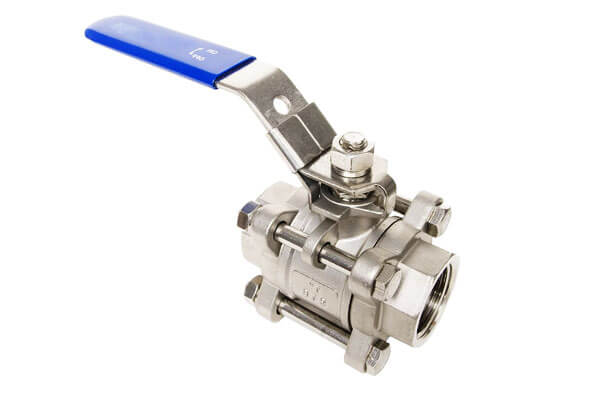
Pambihirang Katumpakan ng Dimensional
One of the greatest strengths of investment casting is its ability to produce near-net-shape components with outstanding dimensional precision.
Compared with traditional casting processes, investment casting offers:
- Tight dimensional tolerances
- Excellent repeatability
- Uniform wall thickness
- Accurate internal flow passages
- Reduced machining allowance
These characteristics are particularly important for ball valves because accurate body geometry directly affects seat alignment, stem positioning, sealing performance, and pressure integrity.
High dimensional consistency also simplifies assembly and ensures interchangeability of valve components in mass production.
Tapos na ang Superior Surface
Investment casting naturally produces a much smoother surface than conventional sand casting.
A smoother casting surface offers several engineering benefits:
- Lower machining costs
- Better sealing surfaces
- Reduced fluid resistance
- Improved coating and passivation quality
- Enhanced product appearance
For sanitary applications such as pharmaceutical or food processing, smooth surfaces also minimize bacterial adhesion and simplify cleaning procedures.
Complex Geometry without Extensive Machining
Ball valve bodies contain numerous complex features, kasama na ang:
- Internal flow passages
- Stem cavities
- Seat pockets
- Mounting bosses
- Flanged or threaded connections
Investment casting allows these intricate geometries to be produced in a single casting, significantly reducing secondary machining operations.
Compared with machining from forged blocks, pamumuhunan paghahagis:
- Reduces material waste
- Shortens production cycles
- Lowers tooling wear
- Improves manufacturing efficiency
Excellent Pressure Integrity
Pressure-containing components require a dense and homogeneous internal structure.
With properly designed gating systems, direksyon solidification, and controlled pouring conditions, investment-cast stainless steel valve bodies achieve:
- High structural integrity
- Uniform wall thickness
- Excellent pressure resistance
- Low internal defect rates
- Reliable sealing performance
After pressure testing and non-destructive inspection, these castings meet stringent industrial standards for pressure-retaining equipment.
Natitirang Paglaban sa Kaagnasan
The combination of premium stainless steel alloys and appropriate surface treatments provides exceptional resistance to:
- Atmospheric corrosion
- Freshwater corrosion
- Seawater exposure
- Chloride attack
- Organic chemicals
- Mild acids and alkalis
Mga grado tulad ng CF8M (316 hindi kinakalawang na asero) offer excellent resistance to chloride-induced pitting and crevice corrosion, making them ideal for marine, sa malayo sa pampang, and chemical processing applications.
Long Service Life and Low Maintenance
Stainless steel investment-cast ball valves are designed for decades of reliable operation.
Their advantages include:
- Napakahusay na paglaban sa pagsusuot
- Stable sealing performance
- Low operating torque
- Minimal corrosion-related maintenance
- High fatigue resistance
These characteristics significantly reduce maintenance frequency and operational downtime.
8. Industrial Applications of Stainless Steel Ball Valves
| Industriya ng Industriya | Mga tipikal na aplikasyon | Valve type | Alloy grade | Key requirements |
| Langis & gas | Pipeline isolation, wellhead, refinery, sa malayo sa pampang | Trunnion, floating, 3‑way | CF‑8M, CD‑3MN | High pressure, maasim na gas (H₂S), chloride SCC resistance. |
| Pagproseso ng kemikal | Acid handling, solvent transfer, reactor isolation | Flanged, full port | CN‑7M, CF‑8M | Acid resistance, leak‑tight shut‑off. |
| Marine / sa malayo sa pampang | Seawater cooling, mga sistema ng balagtasan, desalination | Flanged, lug | CF‑3M, CD‑3MN | Seawater corrosion, paglaban sa paglaban. |
| Pagkain & inumin | Sanitary processing, CIP systems, bottling | Sanitary, flanged | CF‑3M (316L) | FDA‑approved, electropolished, Madaling linisin. |
| Parmasyutiko | WFI systems, clean steam, sterile processing | Sanitary, flanged | CF‑3M (316L) | Ultra‑clean, non‑porous, sterilisable. |
Pagbuo ng kapangyarihan |
Cooling water, Mga linya ng singaw, condensate | Flanged, butt‑weld | CF‑8, CF‑8M | Mataas na temperatura, pressure cycling. |
| Tubig & wastewater | Treatment plants, pamamahagi, patubig | Wafer, flanged | CF‑8, CF‑8M | Paglaban sa kaagnasan, long service life. |
| Pulp & papel na papel | Chemical recovery, bleach lines, stock handling | Flanged, 3‑way | CN‑7M, Duplex | Chlorine dioxide resistance. |
| Semiconductor | Ultra‑pure water, chemical delivery | Compact, flanged | CF‑3M (316L) | Ultra‑clean, low particle generation. |
| Aerospace | haydroliko, fuel, and pneumatic systems | Compact, trunnion | 17‑4PH, 304L | Mataas na lakas, leak‑tight, magaan ang timbang. |
9. Stainless Steel Ball Valve vs. Carbon Steel Ball Valve
Both stainless steel and carbon steel ball valves are widely used in industrial piping systems.
Gayunpaman, each material offers distinct advantages depending on the operating environment, process medium, maintenance requirements, and budget considerations.
| Comparison Item | Stainless Steel Ball Valve | Carbon Steel Ball Valve |
| Mga Tipikal na Materyales | CF8, CF8M, CF3, CF3M, Duplex hindi kinakalawang na asero | WCB, WCC, LCB, LCC |
| Paglaban sa kaagnasan | Napakahusay; naturally resistant to rust, mga kemikal, and chlorides | Katamtaman; requires coatings or linings for corrosion protection |
| Lakas ng Mekanikal | High strength with excellent toughness | High strength and excellent structural rigidity |
| Temperature Capability | Suitable for cryogenic service and elevated temperatures (Depende sa grado) | Suitable for general industrial temperatures; special alloy grades required for extreme conditions |
| Pressure Capability | Excellent for medium- and high-pressure systems | Excellent for high-pressure industrial applications |
| Surface Protection | Generally requires only passivation or polishing | Typically requires epoxy coating, Pag-galvanize, or other protective coatings |
Maintenance Requirements |
Low maintenance due to inherent corrosion resistance | Periodic inspection and coating maintenance required |
| Manufacturing Cost | Higher material and machining costs | Lower manufacturing cost |
| Gastos sa Lifecycle | Lower over long-term operation because of durability and reduced maintenance | Lower initial investment but potentially higher maintenance costs |
| Mga Karaniwang Aplikasyon | Pagproseso ng kemikal, marine, pagkain, parmasyutiko, paggamot ng tubig | Langis & gas, pagbuo ng kapangyarihan, HVAC, municipal infrastructure, general industry |
| Pangunahing Mga Bentahe | Superior kaagnasan paglaban, kalinisan ng katawan, long service life | Epektibo ang gastos, mataas na lakas, excellent pressure resistance |
| Primary Limitations | Higher initial investment | Lower corrosion resistance without protective treatment |
10. Custom Investment Casting Stainless Steel Ball Valve from LangHe Foundry
Selecting the right manufacturing partner is just as important as choosing the appropriate valve material and design.
A reliable investment casting foundry not only produces high-quality castings but also provides engineering expertise, proseso ng pag optimize, katumpakan machining, and comprehensive quality assurance throughout the entire manufacturing cycle.
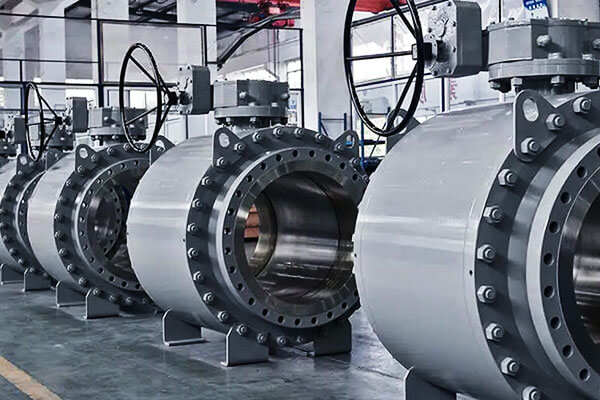
LangHe Foundry specializes in precision investment casting solutions for stainless steel ball valve components, offering integrated manufacturing services from product design and rapid prototyping to mass production.
With extensive experience in precision casting, CNC machining, paggamot ng init, at pagtatapos ng ibabaw,
LangHe delivers custom-engineered valve components that meet the demanding requirements of industries such as oil and gas, pagproseso ng kemikal, paggamot ng tubig, pagproseso ng pagkain, Marine Engineering, mga parmasyutiko, at pagbuo ng kapangyarihan.
Whether customers require standard valve bodies or highly customized castings with complex geometries, LangHe provides cost-effective, high-quality manufacturing solutions backed by strict quality control and international manufacturing standards.
OEM and ODM Manufacturing Services
| Capability | Mga Detalye |
| Mga haluang metal | CF‑8, CF‑8M, CF‑3, CF‑3M, CN‑7M, CD‑3MN, CE‑8MN, CB7Cu‑1 (17‑4PH). |
| Part weight | 0.05 kg to 100 kg. |
| Dimensions | Hanggang sa 600 mm diameter. |
| Mga pagpapaubaya | ±0.1‑0.3 mm (CT5‑CT7 per ISO 8062). |
| Email Address * | Ra 1.6‑6.3 µm as‑cast; electropolishing available. |
| Lunas sa init | Solusyon pagsusubo, pagtanda, pampawala ng stress. |
| Kalidad | ISO 9001:2015 sertipikado na; 100% NDT and pressure testing. |
| Lead time | 8‑12 weeks for tooling and first articles; 2‑4 weeks for repeat orders. |
| Mga Sertipikasyon | PED 2014/68/EU, NACE MR0175 / ISO 15156 (Duplex). |
11. Pangwakas na Salita
Stainless steel ball valves are key high-reliability components for high-end industrial fluid control, and investment casting has become the only high-efficiency, mataas na katumpakan, and high-reliability manufacturing solution for such products.
By overcoming the inherent defects of traditional sand casting, forging welding, and solid bar machining,
investment casting realizes integrated near-net-shape forming, high-purity dense metallurgical structure, ultra-precision spherical sealing surface, and excellent anti-corrosion performance of stainless steel ball valves.
As industrial equipment continues to evolve toward higher efficiency, greater automation, and more demanding service environments, precision investment casting will play an increasingly important role in valve manufacturing.
Advanced technologies such as casting simulation, Awtomatikong Pagbuo ng Shell, intelligent machining, digital quality control, and smart manufacturing systems are further improving product consistency and production efficiency.
By partnering with an experienced investment casting manufacturer such as LangHe Foundry, customers gain access to comprehensive engineering support, premium stainless steel materials, advanced manufacturing technologies, and strict quality assurance.
From prototype development to large-scale production, precision investment casting remains one of the most reliable and cost-effective solutions for manufacturing high-performance stainless steel ball valves that meet the highest international industry standards.
Mga FAQ
What is the most common stainless steel alloy for ball valve castings?
CF‑8M (316 equivalent) is the most common alloy for ball valve components due to its excellent corrosion resistance, magandang lakas, and moderate cost. CF‑3M (316L) is preferred when welding is required.
Can investment‑cast ball valves be used in seawater?
Oo nga. CF‑8M (316) offers good seawater resistance, pero Duplex Hindi kinakalawang na Asero (CD‑3MN / 2205) is preferred for long‑term seawater service due to its superior chloride pitting resistance and stress corrosion cracking resistance.
What surface finish is required for sanitary ball valves?
Sanitary ball valves typically require electropolished or mechanically polished surfaces with Ra ≤0.8 µm (and sometimes Ra ≤0.4 µm) to prevent bacterial adhesion and ensure cleanability.
What is the difference between full port and reduced port ball valves?
Full port valves have a ball bore equal to the pipe diameter, resulting in minimal pressure drop. Reduced port valves have a smaller bore, offering lower cost but higher pressure drop.
Investment casting can produce both types.