High-chromium cast iron (HCCI) is one of those materials that looks straightforward on a spec sheet but behaves like a stubborn, complex system in service.
I have spent decades working with wear-resistant alloys, and HCCI still teaches me new lessons. It is hard. It is wear-resistant. It has moderate corrosion resistance.
And it fails in ways that are not always obvious until you examine the corrosion-wear interface under a microscope.
This article examines HCCI from a corrosion-wear perspective.
1. What Is High-Chromium Cast Iron?
Composition and Microstructural Characteristics
High-chromium Litina is an iron-based wear-resistant alloy in which chromium and carbon are the primary alloying elements.
Its typical chromium content ranges from 12% na 30%, although the precise composition depends on the intended application and required balance between wear resistance, odolnost proti korozi, a houževnatost.
Během tuhnutí, carbon and chromium combine to form hard chromium-rich carbides.
The most characteristic carbide phase is M₇C₃, in which M represents metallic elements, primarily chromium and iron.
Depending on alloy composition and heat treatment, other carbide phases, including M₂₃C₆ and secondary carbides, may also occur.
A typical microstructure consists of:
- Chromium-rich carbides: Provide high hardness and resistance to abrasive cutting, poškrábání, and material removal.
- Martensitic matrix: Offers high hardness and load-bearing capability, improving resistance to deformation.
- Retained austenite: Can contribute to toughness and accommodate deformation, although excessive retained austenite may reduce hardness.
- Secondary carbides: Precipitate during heat treatment and can strengthen the matrix when their size and distribution are properly controlled.
The final performance depends not only on the volume fraction of carbides but also on their morphology, velikost, orientace, rozdělení, and bonding with the metallic matrix.
Například, a high carbide fraction may improve resistance to abrasive wear, but coarse, interconnected carbides can create brittle fracture paths.
A more refined and uniformly distributed carbide structure can provide better resistance to cracking and carbide pull-out.
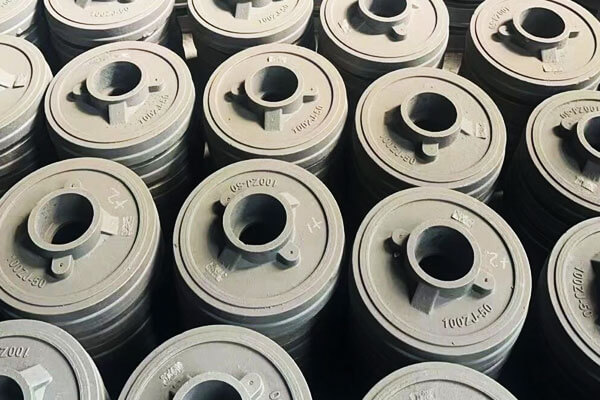
Typical Applications of High-Chromium Cast Iron
High-chromium cast iron is particularly suitable for components exposed to abrasive particles, mineral slurries, and repeated material contact.
Mining and mineral processing
Grinding balls, mill liners, komponenty drtiče, and wear plates exposed to hard mineral particles.
Slurry transportation
Oběžná kola čerpadla, Obaly, vložky, and protective plates exposed to abrasive and corrosive slurry.
Cement and power generation
Clinker crusher parts, grinding equipment components, and wear-resistant elements handling abrasive solids.
Metallurgical and crushing equipment
Crusher hammers, impact components, and other parts subject to severe abrasive contact.
The appropriate alloy and microstructure depend on the actual operating conditions.
A component exposed primarily to low-stress abrasion requires a different material balance from one subjected to high-impact loading or corrosive slurry.
Advantages and Inherent Limitations
High-chromium cast iron offers a combination of properties that makes it attractive for demanding wear applications.
| Vlastnictví | Hlavní výhoda | Engineering limitation |
| Vysoká tvrdost | Resists indentation, poškrábání, and abrasive cutting | Excessive hardness may increase brittleness |
| Vynikající odolnost proti oděru | Hard carbide phases resist material removal | Carbide fracture and pull-out can occur under impact |
| Mírná odolnost proti korozi | Chromium supports the formation of a protective passive film | Chlorides and other aggressive media can destabilize the film |
| High compressive strength | Performs well under compressive loading | Limited tolerance for tensile stress and impact |
| Carbide-reinforced structure | Provides strong resistance to severe abrasive wear | Coarse or continuous carbides may promote crack propagation |
The most important engineering challenge is balancing hardness, odolnost proti korozi, a houževnatost zlomeniny.
A material optimized only for hardness may perform poorly when impact loads or cyclic stresses are significant.
Naopak, increasing matrix toughness without maintaining adequate carbide reinforcement may reduce abrasion resistance.
The best material design is therefore application-specific rather than based on maximum hardness alone.
2. Corrosion and Wear Mechanisms of High-Chromium Cast Iron
Understanding how high-chromium cast iron deteriorates is essential before selecting an enhancement strategy.
Koroze, mechanické opotřebení, and their combined effects can produce different damage patterns, even when components operate in the same industrial environment.
2.1 Mechanismy koroze
The chromium content of high-chromium cast iron contributes to the formation of a thin, chromium-enriched passive film on the surface.
This film acts as a barrier between the metal and its surrounding environment, reducing the rate of general corrosion.
Však, passive-film protection is conditional. Its stability depends on chromium availability in the matrix, ph, teplota, koncentrace chloridů, dissolved oxygen, and the presence of other aggressive chemical species.
The main corrosion mechanisms include:
Passive-film formation and breakdown
Chromium promotes the formation of a protective oxide film, commonly described as a chromium-rich passive layer. When the film remains stable, it suppresses further electrochemical dissolution.
Však, Abrazivní částice, chemické reakce, or aggressive ions can damage or destabilize the film. Once exposed, the underlying metal may dissolve until the passive film reforms.
Koroze
Pitting is a localized form of corrosion that produces small but relatively deep cavities.
It often occurs when chloride ions or other aggressive species cause local breakdown of the passive film.
Pitting can be particularly damaging because localized penetration may continue even when the surrounding surface remains relatively intact.
Carbide–matrix interfaces and chemically depleted regions may also become preferential sites for localized attack.
Štěrbinová koroze
Crevice corrosion develops in narrow gaps, stíněné oblasti, and deposits where fluid circulation is restricted.
Oxygen depletion and the accumulation of aggressive chemical species can create localized electrochemical conditions that destabilize the passive film.
This is relevant to components with tight assembly gaps, vklady, klouby, and poorly flushed internal regions.
Intergranulární koroze
Intergranular corrosion preferentially attacks grain boundaries or adjacent regions.
In high-chromium cast iron, chromium-rich carbide precipitation at grain boundaries can consume chromium from the surrounding matrix.
If the local chromium concentration falls below the level required to maintain passivity, these depleted regions may become more susceptible to corrosion.
The extent of this risk depends on alloy chemistry, Chování tuhnutí, tepelné zpracování, and carbide distribution.
Praskání koroze (SCC)
Stress corrosion cracking results from the combined action of tensile stress and a specific corrosive environment.
Cracks initiate and propagate when the material is exposed to conditions that support both mechanical and electrochemical degradation.
Although SCC is not necessarily the dominant failure mode in every high-chromium cast iron application, it should be considered when components operate under sustained tensile stress, zbytkové napětí, and aggressive chemical exposure.
2.2 Wear Mechanisms
High-chromium cast iron is primarily designed to resist abrasive wear, but its actual service performance depends on the type of mechanical contact and loading.
Abrazivní opotřebení
Abrasive wear is the most prevalent and critical wear mechanism in typical HCCI applications.
It occurs when hard, sharp particles—such as ore, písek, or cement clinker—slide or roll across the material surface, causing scratching, řezání, and ploughing that remove material.
The effectiveness of HCCI against this mechanism depends directly on the hardness and volume fraction of its carbides.
Erosive Wear
Common in slurry pumps, potrubí, a čepele fanoušků, erosive wear is caused by the repeated impact of solid particles entrained in a fluid stream.
The impact angle, particle velocity, and particle characteristics (tvrdost, tvar) significantly influence the material loss rate.
At shallow impact angles, the mechanism resembles abrasion; at steep angles, it resembles impact fatigue.
Adhesive Wear
Adhesive wear occurs when two surfaces slide against each other under pressure, causing local adhesion and subsequent material transfer or detachment.
While less common as a primary failure mode in HCCI, it can contribute in certain high-friction contact scenarios, particularly where lubrication is inadequate.
Fatigue Wear
This mechanism involves the initiation and propagation of cracks under cyclic stress, ultimately leading to spalling or detachment of material.
It is relevant in components subjected to repeated loading, where the toughness and fatigue limit of the material are critical. HCCI’s low toughness makes it susceptible to fatigue wear in high-stress applications.
2.3 The Synergistic Effect of Corrosion and Wear
The interaction between mechanical wear and chemical corrosion is not merely additive—it is synergistic.
When the passive layer is continuously removed by wear, and corrosion weakens the surface, a vicious cycle forms that rapidly degrades the material.
This “corrosion-wear vicious cycle” is the root cause of premature failure in many HCCI applications.
The mechanism works like this:
- Corrosion weakens the surface, making it easier to wear away.
- Wear removes the passive film, exposing fresh metal to corrosion.
- The products of one degradation mechanism (NAPŘ., surface weakening from corrosion) become the input that accelerates the other mechanism (nosit).
- Wear removes the passive film, which accelerates corrosion, and so on.
The result is a feedback loop in which each process amplifies the other, causing material degradation at a rate that can be exponentially higher than that of wear or corrosion alone.
This is why effective enhancement strategies cannot address wear and corrosion in isolation.
The solution must aim to break this vicious cycle by simultaneously improving resistance to both mechanisms—or at least ensuring that improvement in one does not compromise the other.
This reinforces the need for a holistic and integrated approach to HCCI development.
2.4 Microstructural Weak Points: Where Damage Begins
From a materials engineering standpoint, corrosion-wear damage is often controlled by localized microstructural features rather than by the average hardness of the material.
Three regions deserve particular attention:
| Microstructural feature | Potential weakness | Possible consequence |
| Grain boundaries | Chromium depletion or carbide precipitation | Preferential corrosion and crack initiation |
| Carbide–matrix interfaces | Weak bonding or local chemical differences | Carbide detachment and interfacial attack |
| Odlévací vady | Pórovitost, Inkluze, Shrinkage dutiny, and microcracks | Localized corrosion and accelerated crack growth |
These regions act as potential initiation sites for degradation. Proto, reducing casting defects, refining the microstructure, and improving interface integrity are fundamental to long-term performance.
V praxi, alloy design and heat treatment should be evaluated together with casting process control.
A well-designed chemical composition cannot compensate fully for severe porosity, coarse carbides, or poorly bonded interfaces.
3. Performance Enhancement Strategies for High-Chromium Cast Iron
Improving the corrosion-wear resistance of high-chromium cast iron requires a coordinated approach to material composition, tuhnutí, mikrostruktura, tepelné zpracování, and surface engineering.
The following strategies represent important directions for improving high-chromium cast iron under complex wear and corrosion conditions.
3.1 Microstructure Optimization and Alloy Design
Control Carbide Type, Morphology, and Distribution
Chromium-rich carbides are the primary wear-resistant phase in high-chromium cast iron.
Their type, velikost, morfologie, and distribution have a direct influence on abrasion resistance and fracture behavior.
Hrubý, interconnected primary carbides can provide high resistance to abrasive penetration, but they may also create continuous brittle paths.
Under impact or cyclic loading, cracks can propagate along these carbide networks or through weak carbide–matrix interfaces.
A more refined and uniformly distributed carbide structure can improve the balance between wear resistance and toughness.
Several approaches can be used:
- Microalloying with V, NB, and Ti: These elements can promote the formation of stable MC-type carbides, provide additional nucleation sites, and help refine the solidification structure.
- Kontrolované chlazení: Adjusting the cooling rate and thermal gradient can influence primary carbide growth, carbide morphology, and matrix formation.
- Optimized heat treatment: Proper austenitizing and tempering conditions can promote secondary carbide precipitation and improve matrix properties.
- Carbide distribution control: Reducing coarse carbide clusters and unfavorable continuous networks can help limit crack propagation and carbide pull-out.
The target is not simply to maximize carbide content. It is to develop a microstructure in which hard carbides are sufficiently supported by the metallic matrix.
Develop Multi-Element Alloy Systems
Beyond the conventional Fe–Cr–C system, alloying elements such as Mo, V, Cu, NB, Z, and rare-earth elements can be introduced to modify corrosion resistance, matrix stability, tvorba karbidu, a houževnatost.
| Legující prvek | Main metallurgical function | Potential performance benefit |
| Mo | Influences matrix hardenability and corrosion behavior | May improve resistance to localized corrosion and strengthen the matrix |
| V | Stabilizes austenite and modifies matrix transformation behavior | Can improve toughness and corrosion resistance |
| Cu | Contributes to solid-solution strengthening and electrochemical behavior | May improve matrix corrosion performance under suitable conditions |
| NB | Forms stable NbC-type carbides | Refines the structure and helps control carbide growth |
| Z | Promotes TiC formation and heterogeneous nucleation | Refines primary carbides and strengthens the microstructure |
| Rare-earth elements | Modify inclusions and influence solidification behavior | May improve cleanliness and microstructural uniformity |
The effects of these elements are composition-dependent. Například, Mo and Ni may improve corrosion performance in some alloy systems, but their effectiveness depends on the actual matrix chemistry and the stability of the passive film.
Podobně, excessive microalloying can introduce unwanted carbide agglomeration or other brittle phases.
Z tohoto důvodu, alloy design should consider the combined effects of composition, tuhnutí, and heat treatment rather than evaluating individual elements in isolation.
Explore High-Entropy Alloy Design Concepts
High-entropy alloy design provides another research direction for high-chromium cast iron.
Instead of relying mainly on iron with chromium and carbon additions, a multi-principal-element Fe–Cr–Mo–Ni–C–V system can be explored to achieve solid-solution strengthening and more complex phase formation.
Potential design objectives include:
- Developing multiple carbide phases, such as M₂₃C₆ + M₆C + MC.
- Adjusting the matrix toward a dual-phase austenite–martensite structure.
- Improving the balance between hardness and fracture toughness.
- Increasing low-temperature impact resistance and resistance to crack propagation.
A dual-phase matrix may combine the hardness of martensite with the deformation accommodation capability of austenite.
Však, phase stability must be controlled carefully. Excessive austenite can reduce hardness, while an overly martensitic structure may increase brittleness.
High-entropy alloy concepts are therefore promising for material development, but their practical value must be demonstrated through controlled casting trials, phase characterization, corrosion testing, and wear evaluation.
3.2 Refinement and Directional Alignment of Primary Carbides
This direction aims to optimize the morphology and distribution of primary carbides in the HCCI microstructure to improve overall performance.
Modification treatment.
Modification promotes carbide nucleation by providing greater undercooling and heterogeneous nucleation sites.
Například, TiC and M₇C₃ carbides have a lattice mismatch of 10%, making TiC an effective heterogeneous nucleation site for refining primary carbides.
Future research directions include:
- Investigating the adsorption behavior of modifying elements on the preferred growth surfaces of carbides.
- Using mechanical ball milling to mix nanoscale modifier powders with micron-scale alloy powders to improve nucleation and refinement efficiency.
- Combining lattice matching principles with first-principles simulation to predict refined structures and study refinement mechanisms.
Suspension casting has also been proposed as a method for refining HCCI microstructure by increasing the alloy’s nucleation rate, hindering the growth of primary carbides, and promoting their uniform distribution.
Semi-solid processing.
Applying external stirring during solidification forms a uniform solid-liquid slurry.
Methods such as inclined plate cooling increase the undercooling of HCCI and raise the carbide nucleation rate, thereby refining primary carbides.
The friction, collision, and shear effects between the flowing slurry and the cooling plate also promote the fragmentation and refinement of primary carbides.
Laboratory work has already used the semi-solid slurry inclined plate cooling method to prepare HCCI, reducing primary carbide size from 109 μm do 20 μm.
Semi-solid forming offers advantages such as high alloy viscosity, low rheological stress, rapid forming of complex parts, and reduced gas inclusions in castings.
Však, its production process is complex, which increases raw material processing costs.
Pulse current treatment.
The mechanisms by which pulse current affects melt solidification include:
- Joule heating effect: Reduces undercooling between solid and liquid phases, promoting uniform solidification.
- Electric field force: Drives directional migration of metal ions, altering the solidified metal structure.
- Magnetic field: Generates instantaneous pressure, causing dendrite fragmentation and promoting carbide spheroidization.
- Liquid structure theory: Atomic clusters aggregate as nucleation sites, increasing the probability of equiaxed crystals.
Applying pulse current during HCCI solidification effectively reduces cracks and pores in primary carbides, reducing the average equivalent diameter of primary carbides from 150 μm do 65 μm and significantly increasing microhardness.
Applying assisted pulse current during HCCI heat treatment can lower the solid-state phase transformation temperature, increase the degree of transformation, raise the corrosion potential, and reduce the corrosion current density.
Directional carbide alignment.
Directional solidification can produce long rod-like carbide structures in HCCI that are parallel to each other and perpendicular to the chill surface.
When the wear surface is perpendicular to the carbide alignment direction, the material’s corrosion-wear resistance improves significantly.
Directionally aligned carbides are more fully enveloped by the matrix, improving their resistance to fracture and detachment during corrosion-wear testing.
3.3 Precision Heat Treatment: Balancing Martensite, Austenite, and Toughness
Heat treatment is a critical stage in controlling the performance of high-chromium cast iron.
It is essentially a form of phase-transformation engineering: temperature and time are used to control carbide dissolution and precipitation, austenite stability, and martensitic transformation.
The objective is to obtain a matrix that supports the hard carbide phase while retaining sufficient toughness to resist cracking and impact damage.
The Role of Martensite and Retained Austenite
A martensitic matrix generally provides high hardness and strong support for chromium-rich carbides.
Však, excessive martensitic transformation can increase internal stresses and reduce fracture toughness.
Retained austenite, although generally softer, can accommodate some deformation and may transform into martensite under mechanical loading. This is known as the transformation-induced plasticity (VÝLET) účinek.
When appropriately controlled, this transformation can absorb energy, redistribute stress, and help inhibit crack propagation.
The challenge is to maintain the correct balance:
- Too much retained austenite may reduce hardness and abrasive wear resistance.
- Too little retained austenite may reduce deformation accommodation and increase the risk of brittle failure.
- Excessively hard martensite can create a matrix that is insufficiently tolerant of impact and cyclic stress.
The ideal phase balance depends on alloy composition, geometrie součásti, podmínky chlazení, a provozní prostředí.
Optimizing Retained Austenite Stability
One proposed approach is to use controlled tempering to retain approximately 5–8% carbon-stabilized austenite.
The objective is to preserve a controlled amount of stable austenite that can gradually transform into martensite during service, absorbing deformation energy and helping resist crack growth.
Another proposed approach is cyclic cryogenic treatment between −196°C and −50°C, intended to promote retained-austenite transformation while avoiding an excessively concentrated formation of brittle martensite.
The supplied material reports a retained-austenite transformation rate of more than 98% under the proposed pulse cryogenic treatment.
These figures should be treated as reported process targets rather than universal heat-treatment specifications.
Actual transformation depends on austenite carbon content, slitinová chemie, initial phase distribution, Tloušťka sekce, and the cryogenic temperature–time cycle.
V některých případech, a transformation rate above 98% may leave insufficient retained austenite for the intended TRIP contribution.
Z tohoto důvodu, retained-austenite content should be measured using suitable phase-characterization methods, such as X-ray diffraction, rather than inferred solely from the heat-treatment schedule.
Refine and Uniformly Distribute Secondary Carbides
Secondary carbide precipitation can strengthen the matrix and improve resistance to localized deformation.
One proposed development direction is variable-temperature tempering, including controlled or gradient cooling, to promote secondary carbide refinement toward sizes below 100 nm.
This is an advanced microstructural target rather than a routine outcome of conventional heat treatment.
Achieving and verifying such a fine carbide distribution requires careful control of alloy chemistry, precipitation kinetics, a tepelnou historii.
Another proposed method is to introduce electromagnetic stirring during the austenitizing stage to promote partial dissolution at the edges of primary Cr₇C₃ carbides.
The supplied study reports a 30% reduction in primary carbide size through this approach, together with improved matrix continuity.
The engineering objective is to reduce coarse carbide features and improve the continuity of the supporting matrix without excessively dissolving the primary wear-resistant phase.
3.4 First-Principles Calculations for Alloy Design
Traditional alloy development often relies on repeated melting, obsazení, tepelné zpracování, and performance testing.
Although this experimental approach remains essential, it can be time-consuming when multiple alloying elements and complex phase transformations are involved.
First-principles calculations, based on quantum mechanics and electronic-structure theory, provide a complementary method for investigating the behavior of alloying elements at the atomic scale.
Unlike empirical approaches that depend heavily on fitted experimental parameters, first-principles methods can provide insights into atomic interactions, fázová stabilita, interfacial behavior, and electronic structure.
For high-chromium cast iron, this approach offers several potential research advantages.
- Atomic-scale mechanism analysis: Reveals the atomic interactions and electronic structure evolution of alloying elements such as Ti and Cu with the matrix or carbides, clarifying their effects on microstructural stability and performance.
- Prediction of phase transformation and precipitation mechanisms: Simulates austenite-to-martensite transformation and secondary carbide precipitation under different conditions, providing a theoretical basis for heat treatment optimization.
- Revelation of microscopic corrosion-wear mechanisms: Analyzes interface strength, diffusion paths, and corrosion product formation mechanisms at the atomic level, clarifying the essence of how elements improve performance.
- Complementing experimental limitations: Supplements experimental limitations in atomic-scale structural evolution and electronic behavior, providing key guidance for experimental design and mechanism verification.
Recent studies have found that in HCCI:
- Z promotes carbide nucleation and refines the microstructure.
- Cu provides solid-solution strengthening and improves electrode potential and passive film stability.
Combined with experimental research, atomic-level precision design of HCCI microstructure and properties is expected in the future.
By regulating the atomic behavior of key elements, high-performance materials with both wear resistance and corrosion resistance can be developed, providing theoretical foundations and design tools for extreme-condition applications.
3.5 Advanced Surface Modification Technologies
Even when the bulk material has excellent wear resistance, the surface may remain vulnerable to severe corrosion-wear conditions.
This is particularly important for components exposed to high-velocity slurry, localized erosion, chemický útok, a zvýšené teploty.
Surface modification provides a way to improve the performance of the working surface without changing the entire component composition.
Two representative technologies are laser cladding and thermal spraying.
Laser Cladding
Laser cladding uses a high-energy laser beam to melt alloy powder or other reinforcement materials while forming a metallurgical bond with the substrate.
Typical cladding materials include:
- Slitiny na bázi niklu.
- Cobalt-based alloys.
- Karbid wolframu (WC).
- Titanium carbide (Tic).
- Other wear- and corrosion-resistant alloy systems.
The rapid heating and solidification associated with laser cladding can produce a relatively fine microstructure.
Depending on the material system and process conditions, the coating may contain refined grains, fine carbides, or locally amorphous structures.
Its potential benefits include:
- Increased surface hardness.
- Improved resistance to abrasive and erosive wear.
- Better corrosion resistance through suitable coating chemistry.
- Strong metallurgical bonding with the substrate.
- Localized reinforcement of high-wear regions.
Však, laser cladding requires careful control of laser power, scanning speed, powder feed rate, překrytí, a podmínky chlazení.
Excessive heat input can cause dilution, carbide dissolution, tepelné zkreslení, a zbytkové napětí. Insufficient heat input may result in incomplete fusion or weak bonding.
For high-chromium cast iron, coating composition and thermal compatibility are especially important because the substrate’s high carbon and chromium contents can influence solidification behavior and crack susceptibility.
High-Velocity Oxy-Fuel and Plasma Spraying
Thermal spraying provides another route for depositing wear-resistant and corrosion-resistant surface layers.
Two widely used processes are:
- High-Velocity Oxy-Fuel (Hvof) stříkání: Accelerates heated powder particles toward the substrate at high velocity, producing dense coatings with relatively low porosity when properly controlled.
- Plasma spraying: Uses a high-temperature plasma jet to heat and accelerate coating materials, making it suitable for ceramic and other high-melting-point materials.
Compared with fusion-based surface processes, thermal spraying generally introduces less heat into the substrate.
This can reduce thermal distortion and limit the heat-affected zone, which is useful for complex components and materials sensitive to thermal cracking.
Common coating systems include WC-based cermets, chromium carbide-based coatings, and selected ceramic coatings.
| Surface modification process | Typical coating materials | Main engineering advantages |
| Laserové opláštění | Slitiny založené na Ni, Co-based alloys, WC, Tic | Metallurgical bonding, localized reinforcement, refined coating microstructure |
| HVOF spraying | WC-based cermets, chromium carbide coatings | Dense coatings, vysoká tvrdost, strong abrasion and erosion resistance |
| Plasma spraying | Al₂o₃, Cr₂o₃, ZrO₂ and other ceramics | Suitable for ceramic coatings and high-temperature applications |
The choice of process depends on component geometry, tloušťka povlaku, substrate condition, provozní teplota, and the relative importance of corrosion and wear resistance.
A coating with excellent dry-abrasion performance may not necessarily provide the best protection in corrosive slurry. Pórovitost, vady povlaku, and interfacial bonding must all be considered.
Optimization of Surface Microstructure and Stress State
Surface treatment can achieve microstructural control and introduce beneficial residual stresses, further enhancing surface performance.
- Microstructural evolution mechanisms: During laser cladding or rapid solidification, ultrafine grains, nanocrystals, or localized amorphous structures can form,
inducing high-density dislocations, martensitic transformation, and strengthening carbide phases, effectively improving hardness and strength-toughness. - Residual stress control: Thermal stresses generated by high temperature gradients and rapid cooling can create favorable compressive stress fields on the surface, inhibiting crack initiation and propagation, and improving fatigue life and crack resistance.
Process Controllability and Synergistic Performance Optimization
By adjusting key variables such as laser power, scanning speed, powder feed rate, and spraying parameters, the temperature history and solidification rate of the surface melt pool can be precisely controlled, achieving synergistic optimization of the target microstructure and performance.
Surface modification, as an effective means of improving the high-end performance of HCCI, has been widely validated in fields such as molds, hornictví, and thermal wear components.
Future integration with computational simulation and in-situ characterization is expected to achieve higher-level integrated optimization of structure-property-process design.
3.6 Hard-Alloy Reinforcement for High-Temperature Wear Resistance
Pure HCCI is prone to matrix softening, carbide coarsening, and surface oxidation at elevated temperatures, directly causing significant declines in wear and corrosion resistance and making it difficult to meet high-temperature service requirements.
To address this, hard alloy reinforcing phases can be introduced.
By using HCCI as the matrix and introducing hard alloys such as WC–Co or TiC–Ni as reinforcing phases (these materials have high melting points, vysoká tvrdost, a vynikající tepelná stabilita), high-temperature comprehensive performance can be effectively improved.
Reinforcement Mechanisms
- WC, Tic, and ZTA are typical superhard phases with excellent abrasive resistance.
- Co and Ni binder phases provide toughness and thermal shock resistance, improving the structural stability and service life of the composite under complex thermal-mechanical loads.
HCCI provides excellent overall mechanical support and corrosion resistance for the composite, while the hard alloy enhances surface hardness and high-temperature wear resistance, forming a “strong-tough” composite system that breaks through the performance limitations of a single material.
Reinforcement Principles
- Synergistic enhancement of wear and corrosion resistance: The addition of hard alloy significantly improves surface hardness and electrochemical stability.
Hard particles and the matrix may form stable interfaces, and hard phases such as TiC are inherently oxidation-resistant and chemically corrosion-resistant, forming a denser and more stable passive film in synergy with Cr, slowing the corrosion rate. - Structural stability assurance: The reinforcing phase dispersed in the matrix or on the surface can hinder abrasive cutting and reduce wear depth while maintaining high hot hardness and interface stability, improving service performance under thermal wear, thermal corrosion, or alternating load environments.
3.7 Ceramic-Reinforced High-Chromium Cast Iron Composites
Ceramic reinforcement is a particularly interesting development direction because ceramics can provide hardness and wear resistance beyond what a conventional metallic matrix can achieve.
High-chromium cast iron supplies the structural support and metallic matrix, while ceramic particles or inserts act as localized wear-resistant phases.
Common ceramic materials include:
| Ceramic material | Main characteristics | Potential application considerations |
| Al₂o₃ | Vysoká tvrdost, good chemical stability, a elektrická izolace | Abrasive wear applications |
| Zro₂ | High toughness relative to many conventional ceramics, depending on stabilization | Applications requiring improved crack resistance |
| WC | Very high hardness and excellent abrasion resistance | Silné abrazivní opotřebení |
| Tic | Vysoká tvrdost, dobrá tepelná stabilita, a opotřebení odporu | High-temperature and abrasive applications |
| Sic | Vysoká tvrdost, dobrá oxidační odolnost, and chemical stability in suitable environments | Abrasive and chemically demanding conditions |
Ceramic selection should be based on the actual particle impact conditions, working temperature, corrosive medium, mechanické zatížení, a výrobní náklady.
Ceramic–Metal Interface: The Key to Composite Performance
Ceramic particles do not chemically react with HCCI at high temperatures—they form only mechanical bonds.
By alloying the surface of ceramic particles, they can be firmly embedded in the HCCI during pouring.
This treatment significantly improves the bonding strength between the ceramic particles and the metal matrix, effectively inhibiting particle detachment during wear and enhancing the wear resistance of the composite.
Compared with the high-chromium metal matrix, the ceramic particles protrude significantly, and the bond between the two is tight with no obvious gaps.
During wear, the metal matrix between the ceramic particles is preferentially worn away, forming deeper grooves.
In the later stage of wear, the ceramic particles become the main load-bearing phase, effectively reducing the severe cutting wear on the metal matrix and creating a “shadow effect” that protects the matrix.
This effect causes the wear volume of the matrix to gradually decrease, so the wear resistance of the composite is significantly higher than that of the matrix material, and its absolute volume loss tends to decrease with increasing wear distance.
4. Závěr
High-chromium cast iron is a material of extraordinary potential and equally extraordinary challenges.
Its hardness and wear resistance are unmatched in many abrasive applications, but its brittleness and susceptibility to corrosion-wear synergy limit its service life in aggressive environments.
The key insight from decades of research and field experience is this: you cannot solve the corrosion-wear problem by addressing only one mechanism.
The vicious cycle—where corrosion weakens the surface, wear removes the passive film, and each accelerates the other—must be broken through integrated strategies.
The enhancement pathways reviewed in this article—carbide refinement and directional alignment, precision heat treatment, first-principles-guided alloy design, Modifikace povrchu, hard alloy reinforcement, and ceramic reinforcement—each offer distinct advantages.
V praxi, the most effective solutions combine several of these approaches.
Těšíme se, I believe the most promising directions are:
- Atomic-scale design guided by first-principles calculations to optimize alloying elements and interfaces.
- Microstructural engineering that refines and aligns carbides while optimizing the matrix for toughness and corrosion resistance.
- Povrchové inženýrství that creates functional layers with hardness, odolnost proti korozi, and beneficial residual stresses.
- Composite architectures that combine the wear resistance of hard phases with the toughness and corrosion resistance of the matrix.
High-chromium cast iron will remain a cornerstone material in mining, moc, cement, and metallurgy for the foreseeable future.
But its performance will increasingly depend not on the alloy alone, but on the precision of its processing and the intelligence of its microstructure design.