When discussing metal-cutting processes, soustružení, frézování, and grinding usually receive most of the attention. Však, not every machining problem is best solved by a rotating cutter.
For flat surfaces, straight grooves, klíčové, spline, and certain non-circular internal profiles, linear cutting processes remain highly useful.
The three important processes covered in this article are hoblování, tvarování, and broaching.
All three remove material through relative linear motion between the cutting tool and workpiece, but they differ fundamentally in machine configuration, cutting direction, nástroje, produktivita, applicable geometry, and economics.
Z pohledu výroby, the correct question is not simply which process is “better.” It is:
Which linear cutting process provides the required geometry, přesnost, povrchová úprava, produktivita, and cost for the specific part and production volume?
1. Hoblování: Reciprocating Cutting for Large Flat Surfaces
Hoblování is a traditional linear metal-cutting process in which the workpiece moves reciprocally against a fixed single-point cutting tool. Unlike turning, frézování, nebo broušení, planing does not rely on continuous rotary cutting.
Místo toho, material is removed during the forward stroke, while the return stroke is normally a non-cutting movement.
This straightforward cutting principle makes planing particularly suitable for large, těžký, and elongated workpieces with long flat or straight surfaces.
Although modern CNC frézování has replaced planing in many general-purpose applications, planing remains technically valuable where the size and weight of the workpiece make rotary machining less practical.
Large machine-tool beds, heavy bases, Strukturální odlitky, and long guide surfaces are representative examples.
Working Principle of Planing
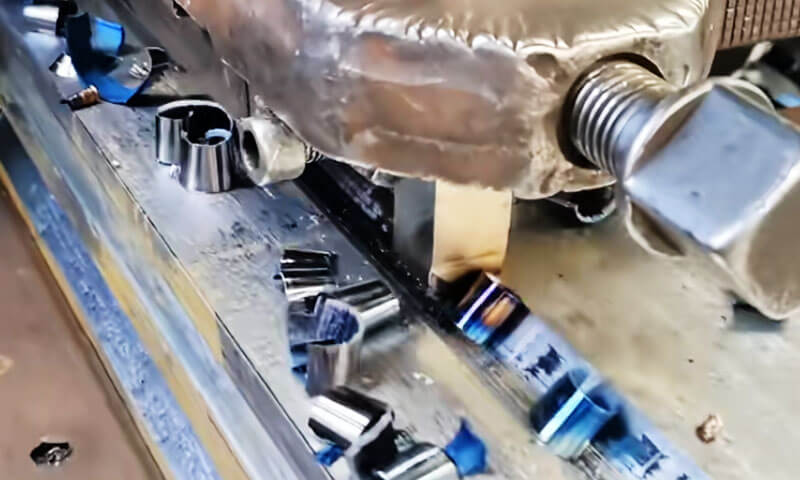
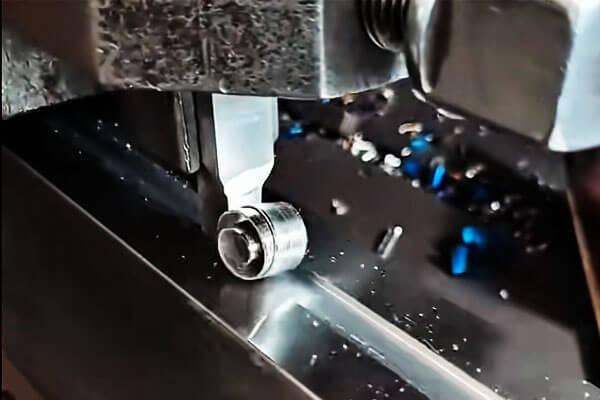
The cutting action of a planer is based on a repeated stroke cycle. During the forward stroke, the cutting edge engages the workpiece and removes a controlled layer of material.
The tool or table then completes its return movement, normally without cutting, before the next feed is applied.
The basic cycle is:
Cutting stroke → return stroke → feed → cutting stroke
The feed progressively shifts the cutting position so that the tool covers the required machining area.
By combining longitudinal table movement with transverse or vertical feed, a planer can generate horizontal, vertical, and inclined surfaces.
This reciprocating motion is the fundamental distinction between planing and most modern high-productivity machining processes.
Ve frézování, the cutter rotates continuously and multiple teeth engage the workpiece repeatedly. In planing, cutting is intermittent and normally performed with a single cutting edge.
Main Components of a Planer
A conventional planer consists of a large number of structural and motion-control components designed to support heavy workpieces and maintain cutting stability.
| Komponent | Main Function |
| Strojový postel | Supports the reciprocating table and absorbs cutting forces |
| Worktable | Carries the workpiece and provides the primary reciprocating motion |
| Columns/Housings | Support the cross rail and tool heads |
| Cross Rail | Carries and positions the tool heads |
| Tool Heads | Hold the cutting tools and provide feed adjustment |
| Feed Mechanism | Controls the incremental movement between cutting strokes |
| Drive System | Provides controlled table acceleration, řezná rychlost, and return speed |
The machine structure must be sufficiently rigid because planing is often applied to large castings and components with substantial cutting forces.
Any instability in the table, systém upínání obrobku, or tool head can appear directly as vibration, rozměrová variace, nebo špatná povrchová úprava.
Typical Applications of Planing
The strongest application area for planing is the production of velký, dlouho, relatively straight surfaces
Large machine-tool beds are a classic example. Their guideways and mounting surfaces may extend over substantial lengths and require accurate alignment along the full working envelope.
Similar requirements occur in large bases, rámy, Strukturální odlitky, a zařízení těžkého průmyslu.
Planing can also produce:
- Long horizontal planes
- Vertical surfaces
- Inclined surfaces
- Rovné drážky
- V-Grooves
- T-drážky
- Dovetail-type profiles
- Long guide surfaces
With appropriate tooling and machine configuration, more specialized profiles can also be generated.
Však, the process is most economical when the geometry remains fundamentally linear and accessible to the reciprocating tool.
Planing Tools and Cutting Strategy
Planing typically uses single-point cutting tools
For rough machining, a rigid tool with a strong cutting edge is normally preferred so that larger depths of cut can be taken without excessive vibration.
Finishing operations use tooling designed to produce a more stable cutting action and improved surface quality.
Tool overhang should be minimized because long tool projection reduces rigidity and can increase chatter.
This becomes particularly important when planing large castings because the workpiece itself may contain localized changes in stiffness.
A practical tool setup follows three basic principles:
Correct tool position + minimum overhang + secure clamping
The workpiece must also be firmly supported. Small components may be clamped in a vice or other fixture, while large castings and fabrications are generally secured with clamps, šrouby, support blocks, or dedicated fixtures.
Process Characteristics and Typical Accuracy
The main disadvantage of planing is its low material-removal efficiency compared with continuous milling, because the return stroke normally does not contribute to cutting.
Tool changes and reciprocating acceleration and deceleration also limit productivity.
Its strengths are flexibility, relatively simple tooling, and the ability to machine large or heavy components without the need for complex rotating cutters.
These characteristics make planing particularly useful in single-piece and small-batch production, opravárenské práce, and the machining of large flat components.
Typical achievable accuracy depends strongly on machine condition, geometrie nástroje, workpiece rigidity, a procesní parametry.
As a general reference, conventional planing may achieve approximately IT9–IT7 dimensional accuracy, with surface roughness commonly around Ra 12.5–1.6 μm.
Under favorable conditions and with appropriate wide finishing tools, precision planing can achieve approximately IT6, with surface roughness potentially reaching around Ra 0.8–0.2 μm.
These values are indicative rather than universal and should not replace process-specific capability validation.
| Parametr | Typical Planing Characteristics |
| Cutting method | Reciprocating single-point cutting |
| Primary application | Large flat and straight surfaces |
| Machinable features | Horizontální, vertical, inclined surfaces; straight grooves; simple formed profiles |
| Hlavní výhoda | Flexible and economical for large, Komponenty s nízkým objemem |
| Hlavní omezení | Idle return stroke reduces productivity |
| Typická přesnost | Approximately IT9–IT7 |
| Typická drsnost povrchu | Approximately Ra 12.5–1.6 μm |
| Precision finishing | Can approach IT6 and approximately Ra 0.8–0.2 μm under suitable conditions |
The fundamental value of planing lies in its ability to provide stable, flexible machining of large flat geometries with relatively simple tooling.
Although it has been largely replaced by high-productivity milling in many production environments, it remains a practical process for large components, heavy-duty machining, and low-volume manufacturing where flexibility and equipment simplicity are more important than maximum cycle speed.
2. Tvarování: Vertical Reciprocating Cutting for Internal and External Features
Veteran machinists often describe the slotter as a “vertical planer”, and the comparison is technically apt.
In shaping, the cutting direction is vertical rather than horizontal, and the process is primarily aimed at internal surfaces.
It can be regarded as the vertical extension of the planing process, sharing the same fundamental single-point, intermittent cutting action while extending its reach into bores, náboje, and other enclosed geometries that a planer or shaper cannot easily access.
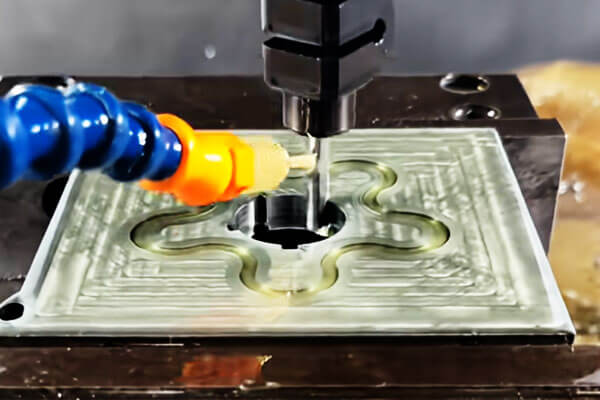
Core Equipment: The Slotting Machine
The slotting machine (slotter) consists of a bed, upper and lower slide carriages, a circular worktable, a ram, and a column.
The primary motion is the vertical linear reciprocation of the ram, which carries the slotting tool down through the workpiece and retracts it on the return stroke.
Feed motion is provided by the longitudinal and transverse movement of the upper and lower slides, while the rotary motion of the circular worktable enables angular indexing.
This combination allows the machine to perform not only straight internal cuts but also indexed features distributed around a bore.
Typical slotting machines handle strokes ranging from roughly 80 mm do 500 mm, with ram speeds commonly between 15 a 60 strokes per minute depending on stroke length and material.
Because cutting occurs only during the downward stroke, the process is inherently intermittent, and effective cutting time is approximately 40–50% of the total cycle.
Machining Scope and Practical Details
Slotting is overwhelmingly an “internal” operation. Its strengths include:
- Keyways in hubs, rychlostní stupně, and pulleys
- Square holes and rectangular bores
- Polygonal holes (šestiúhelníkový, octagonal, and similar profiles)
- Spline holes and internal splines
- Internal grooves, blind slots, and irregular internal profiles
Slotting tools fall into two broad categories. The pointed-edge tool is used for rough slotting and for machining polygonal holes, where it can negotiate corners and varying profiles.
The flat-edge tool is used for finishing operations and for cutting right-angled grooves, producing a cleaner side wall and a flatter bottom.
A critical detail arises when cutting splines. It is not enough to control the symmetry of each individual keyway; the angular spacing of all keyways around the circumference must also be held within tolerance.
This is achieved by using an indexing plate or dividing head in conjunction with the rotary worktable.
Because spline fit is determined by the cumulative position of every tooth, even a small indexing error can cause interference during assembly or unacceptable backlash in service.
V praxi, indexing accuracy is often held to within a few arc minutes, depending on the spline class and the mating component.
Process Characteristics and Accuracy
The slotter offers clear advantages in certain production contexts.
Its structure is relatively simple, setup is fast, and for single-piece or small-batch production of internal keyways and non-circular bores, it is often the most cost-effective option available.
It also requires less specialized tooling than broaching, which makes it attractive for job shops and maintenance departments.
The limitations are equally well established. On the return stroke, the tool rubs against the workpiece wall, accelerating tool wear and reducing tool life.
The tool holder or boring bar has limited rigidity, which restricts both the maximum slot length and the achievable depth-to-width ratio.
V důsledku toho, deep or narrow slots may require multiple passes, and deflection can affect dimensional consistency.
Za normálních podmínek, slotting achieves dimensional accuracy in the range of IT9 to IT7, s drsností povrchu obvykle mezi Ra 6.3 μm and Ra 1.6 μm.
Finer finishes generally require reduced feed, ostré nástroje, and sometimes a separate finishing pass. The table below summarizes the main process parameters.
| Parametr | Typical Shaping Characteristics |
| Cutting method | Vertical reciprocating single-point cutting |
| Primary applications | Internal keyways, sloty, spline grooves, square and polygonal holes |
| Additional applications | Selected gears, vačky, external profiles |
| Hlavní výhoda | Effective for internal features that are difficult to machine by conventional turning |
| Hlavní omezení | Lower productivity due to the non-cutting return stroke |
| Typická přesnost | Approximately IT9–IT7 |
| Typická drsnost povrchu | Approximately Ra 6.3–1.6 μm |
| Production suitability | Particularly economical for single-piece and small-batch work |
Beyond shaped holes, the slotter can also machine cylindrical gears, vačky, and other special components when suitable fixtures and indexing arrangements are used.
This versatility has earned it a reputation as the workshop’s “universal substitute”—a machine that may not be the first choice for high-volume production, but one that can reliably handle the odd, the internal, and the difficult when other processes cannot.
3. Broaching: High-Productivity Linear Cutting with a Multi-Tooth Tool
Broaching is a highly productive linear cutting process in which a specially designed tool called a broach moves linearly relative to the workpiece.
Unlike planing and shaping, which normally use a single cutting edge and remove material through repeated strokes, a broach contains multiple cutting teeth arranged progressively along the tool.
Each tooth removes a controlled amount of material, allowing roughing, semi-finishing, and finishing to be completed in a single continuous stroke.
This unique tool geometry makes broaching particularly effective for repetitive internal and external profiles, especially in medium- a produkce s vysokým objemem.
Typical examples include internal keyways, spline, square holes, polygonal holes, and selected gear-related profiles.
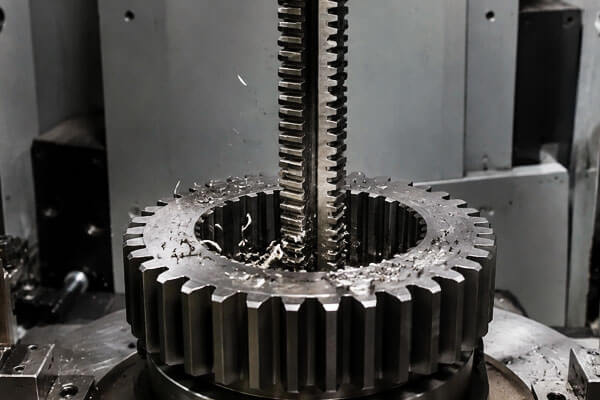
Core Equipment and Tooling
Broaching machines are available in two principal configurations: vertical and horizontal.
Modern machines are almost universally hydraulically driven, which provides smooth, stabilní, and consistent cutting motion throughout the stroke.
Stroke lengths vary widely with machine size, from roughly 500 mm on smaller vertical machines to several meters on large horizontal broaching machines.
The core of the process is the broaching tool, or broach. Its construction is highly engineered, with each section serving a distinct function:
- Shank: Transmits the pulling or pushing force from the machine.
- Front pilot: Centers and guides the broach as it enters the pre-machined hole.
- Cutting section: Contains multiple teeth arranged in a rising sequence, each tooth removing a controlled increment of material.
- Dokončení (dimenzování) sekce: The final teeth remove the last small increments to establish the final dimension and surface finish.
- Rear pilot: Supports and guides the broach as it exits the workpiece.
Because the teeth rise progressively, the broach performs roughing, semi-finishing, and finishing simultaneously. A single pass completes the entire operation.
The rise per tooth is typically in the range of 0.02 na 0.15 mm, depending on the material and the surface finish required.
Machining Scope and Practical Considerations
Broaching is divided into two categories: internal broaching and external (povrch) broaching.
Internal broaching is used to produce a wide variety of profiled holes:
- Round holes
- Square holes
- Spline holes
- Gear bores and other non-circular internal profiles
External broaching is used for flat surfaces, V-Grooves, and other external profiles.
It is common in the automotive and aerospace industries for machining components such as turbine discs and connecting rods.
Several practical points deserve attention. When broaching an internal hole, the workpiece generally does not need to be clamped.
It is supported on its end face, and the cutting force itself holds it in position. Však, the perpendicularity between the pre-machined hole and the supporting end face must meet specification.
If this perpendicularity is poor, a spherical seating washer can be used under the workpiece to allow self-alignment during the pass.
For external broaching, the cutting forces are asymmetric, so the workpiece must be positively clamped. A guide plate is also required to keep the broach on track.
Without proper guidance, the tool can drift, producing a misaligned or out-of-tolerance surface and potentially scrapping the part.
Process Characteristics and Accuracy
The principal advantage of broaching is its combination of high productivity and consistent accuracy.
Because the entire operation is completed in a single stroke, cycle times are short and repeatability is excellent.
This makes broaching ideal for high-volume production of parts requiring tight, uniform tolerances.
Za normálních podmínek, broaching achieves an economic accuracy of IT9 to IT7, with surface roughness between Ra 1.6 μm and Ra 0.4 μm.
In favorable conditions, accuracy can be held even tighter. Batch-to-batch consistency is one of the process’s strongest characteristics, since the tool geometry itself determines the final dimensions.
The limitations of broaching are equally clear:
- Dedicated tooling: One broach is designed for one specific size and profile. It cannot be adjusted to produce a different dimension.
- Geometry restrictions: Stepped holes, slepé díry, and very large holes cannot be broached internally.
- Thin-wall distortion: Thin-walled workpieces are prone to deformation under the heavy cutting forces involved.
- High tool cost: Broaches are expensive to design, výroba, a udržovat.
- Economic threshold: Broaching is only cost-effective in medium-to-high volume production, where the tool cost can be amortized over a large number of parts.
For single-piece or small-batch work, it is simply not economical.
The table below summarizes the main process parameters.
| Parametr | Typical Broaching Characteristics |
| Cutting method | Linear cutting with a progressive multi-tooth tool |
| Main equipment | Vertical or horizontal broaching machines |
| Primary applications | Klíčové, spline holes, square holes, polygonal holes, formed profiles |
| Hlavní výhoda | Very high productivity; roughing and finishing can often be completed in one stroke |
| Typická přesnost | Approximately IT9–IT7 |
| Typická drsnost povrchu | Approximately Ra 1.6–0.4 μm |
| Production suitability | Best suited to medium- a produkce s vysokým objemem |
| Hlavní omezení | Dedicated broach tooling is expensive and application-specific |
Broaching is therefore best understood as a process that converts high tooling investment into exceptional productivity and repeatability.
Where production volume justifies the tooling, it is one of the most efficient and reliable methods available for machining profiled holes and external surfaces.
Where volume is low or the geometry is unsuitable, alternative processes such as slotting, frézování, or EDM are more appropriate.
4. Planing vs. Shaping vs. Broaching: Core Differences
| Porovnávací položka | Hoblování | Tvarování | Broaching |
| Basic Principle | Reciprocating linear cutting, typically with the tool or workpiece moving horizontally | Reciprocating linear cutting, typically with the tool moving vertically | Linear cutting with a multi-tooth broach having progressively larger cutting teeth |
| Typical Machine | Planer | Shaper / slotting machine | Horizontal or vertical broaching machine |
| Nástroj | Single-point cutting tool | Single-point cutting tool | Multi-tooth dedicated broach |
| Primary Motion | Horizontal reciprocating motion | Vertical reciprocating motion | Continuous linear pulling or pushing stroke |
| Hlavní aplikace | Large flat surfaces, kroky, shoulders, V-Grooves, T-drážky | Internal keyways, sloty, square and polygonal holes, selected external profiles | Klíčové, spline holes, square holes, polygonal holes, external profiles |
Typical Workpiece Geometry |
Large and relatively long flat components | Internal or localized features, especially slots and profiles | Repetitive internal or external profiles with defined geometry |
| Odstranění materiálu | Incremental, generally one cutting edge per stroke | Incremental, generally one cutting edge per stroke | Progressive cutting by multiple teeth in a single pass |
| Produktivita | Nízký až střední | Nízký až střední | Vysoký až velmi vysoký |
| Typical Accuracy | Approximately IT9–IT7; finer finishing may approach IT6 under suitable conditions | Approximately IT9–IT7 | Approximately IT9–IT7, depending on tooling and process control |
| Typická drsnost povrchu | About Ra 12.5–1.6 μm; | About Ra 6.3–1.6 μm | About Ra 1.6–0.4 μm |
| Náklady na nástroje | Relativně nízké | Relativně nízké | High because broaches are specialized |
Flexibilita |
High for large, varied workpieces | High for small-batch internal features | Nízký; tooling is generally profile- and size-specific |
| Objem výroby | Best for single-piece and small-batch work | Best for single-piece and small-batch work | Nejlepší pro střední- a produkce s vysokým objemem |
| Hlavní výhoda | Economical machining of large flat surfaces with simple tooling | Effective machining of internal slots and profiles | Excellent productivity, rozměrová konzistence, a opakovatelnost |
| Hlavní omezení | Non-cutting return stroke reduces efficiency | Low rigidity and non-cutting return stroke limit productivity | High tooling cost and limited suitability for blind, stepped, or highly variable features |
| Key Process Consideration | Workpiece support, tool rigidity, and long-stroke stability | Tool overhang, internal accessibility, indexing, and groove accuracy | Broach design, workpiece guidance, pre-machined hole accuracy, and cutting-force control |
5. Závěr
Hoblování, tvarování, and broaching are three distinct linear cutting processes, each suited to a different range of manufacturing requirements.
Hoblování is well suited to large flat surfaces and straight grooves, particularly in single-piece and small-batch production where tooling flexibility and relatively low equipment cost are important.
Tvarování is especially effective for internal keyways, sloty, square holes, and other localized profiles, offering a practical solution when conventional milling is less suitable.
Broaching, naopak, uses a multi-tooth dedicated tool to complete many profiles in a single stroke, making it particularly effective for medium- and high-volume production where repeatability and productivity are critical.
Z pohledu procesního inženýrství, there is no universally superior method.
The appropriate choice should be based on part geometry, materiál, dimensional and surface requirements, Objem výroby, Investice do nástrojů, a celkové výrobní náklady.
Časté časté
What is the main difference between planing and shaping?
Planing uses horizontal reciprocating motion to machine external flat and grooved surfaces.
Shaping uses vertical reciprocating motion, primarily for internal bores, klíčové, and profiled holes. They share the same single-point cutting principle but differ in orientation and application focus.
Why is broaching only used for high-volume production?
Broaching requires dedicated, form-specific cutting tools that are expensive to manufacture and modify.
The high tooling cost can only be amortized over large production volumes. For small batches, the tooling cost per part makes broaching uneconomical.
Can standard broaching machine blind holes?
Generally no. Standard broaching requires a through hole for the tool to pass through.
Special blind broaching tools exist for limited depth applications, but they have significant limitations and are not standard industrial practice.
Which linear cutting process delivers the best surface finish?
Precision wide-tool planing can achieve the lowest surface roughness (down to Ra 0.2 μm), comparable to precision grinding.
Broaching delivers the most consistent finish in high-volume production. Standard shaping produces moderate surface quality.
Are these linear cutting processes still relevant with modern CNC milling?
Ano. For specific features like dovetail slots, klíčové, and low-volume flat surfaces, linear cutting processes often deliver lower cost, simpler setup, and comparable quality to CNC milling.
They remain staple processes in job shops, maintenance facilities, and high-volume form production.