

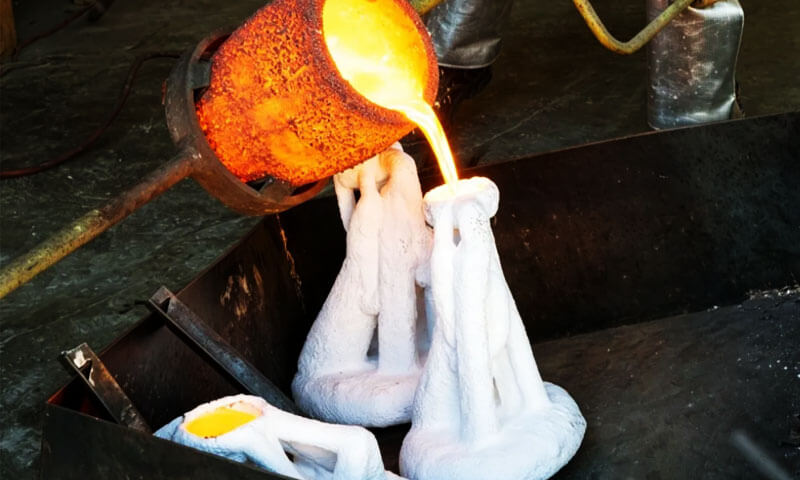
In superalloy pamumuhunan paghahagis, lowering the pouring temperature is not about cooling the metal until it barely flows.
It is about removing the excess, unnecessary superheat so that the liquid metal can still fill the mold completely and solidify in a stable, controlled manner.
For a superalloy blade, pouring temperature influences the melt state, the shell reaction, the solidification structure, and the formation of defects—all at once.
Masyadong mababa, and you get misruns, malamig na mga shut, and entrapped slag. Masyadong mataas, and you get interfacial reactions, element burn-off, abnormal grain structure, and dimensional distortion.
The objective is therefore not “as low as possible.” It is the lowest effective superheat that still achieves complete filling—what I call the minimum effective superheat.
This article explains why that target matters across eight distinct areas, using the mechanisms I have observed and the cases I have investigated in production.
1. What Does Lower Pouring Temperature Mean in Superalloy Investment Casting?
Before discussing the benefits, it is important to distinguish between pouring temperature and superheat.
Pagbuhos ng temperatura is the temperature of the molten alloy when it enters the ceramic mold.
Sobrang init is the temperature difference between the molten metal temperature and its liquidus temperature.
Halimbawa na lang, if a superalloy has a liquidus temperature of 1,350°C and is poured at 1,480°C, its nominal superheat is 130°C.
Reducing pouring temperature means reducing this excess thermal energy while keeping the molten alloy sufficiently fluid to fill the mold before premature solidification occurs.
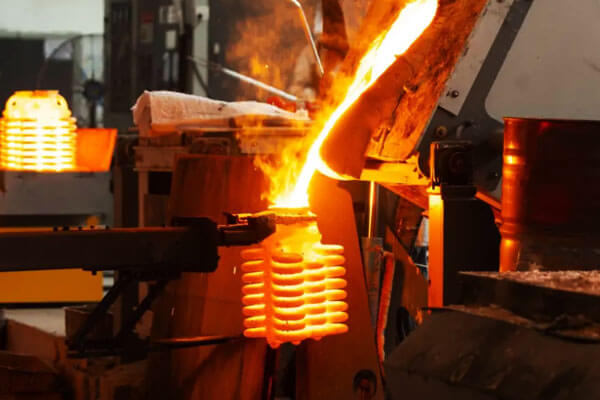
In investment casting, the actual filling and solidification behavior depends on several interacting factors:
- Alloy composition and liquidus temperature.
- Ceramic shell preheating temperature.
- Casting geometry and wall thickness.
- Gating system design and metal flow distance.
- Vacuum conditions and pouring method.
- Mold thermal properties and heat transfer.
- Pouring time and molten metal holding time.
For thin-walled turbine blades, halimbawa na lang, the molten alloy must travel through narrow airfoil sections and intricate internal geometries.
Excessive temperature can increase thermal damage to the mold and promote undesirable reactions, but insufficient superheat can cause misruns, malamig na mga shut, and incomplete filling.
Kaya nga, pouring temperature must be optimized together with shell temperature, gating design, and the overall thermal conditions of the casting process.
2. Reducing Dendrite Coarsening and Uneven Solidification Structure
Excessively high pouring temperatures introduce more thermal energy into the mold cavity, slowing local cooling and extending the solidification time, particularly in thicker sections of the casting.
This promotes dendrite coarsening, wider secondary dendrite arm spacing, and more pronounced alloying-element segregation.
Superalloys contain substantial amounts of refractory elements, making segregation control especially important.
Elemental redistribution during solidification can affect the effectiveness of subsequent homogenization heat treatment and the final mechanical properties.
Moderately reducing the pouring temperature helps limit excessive heat accumulation, maintain a more stable solidification front, and promote a finer, more uniform dendritic structure.
Para sa thin-wall turbine blades, gayunpaman, complete mold filling is often the primary constraint. Increasing superheat is not always the best solution.
When filling can be secured through higher shell preheat, improved gating design, and reduced heat loss along the metal flow path, the pouring temperature can be lowered without compromising casting integrity.
This also creates more favorable conditions for controlling dendrite structure.
The practical principle is straightforward: do not use excessive pouring temperature to compensate for inadequate mold-filling conditions when shell temperature and gating design can address the problem.
Higher shell preheat can improve metal fluidity during filling without introducing the same additional melt superheat.
3. Reduce the Risk of Stray Grains and Freckles in Directional Solidification
Directional solidification and single-crystal casting place extremely strict requirements on the solidification process.
Unlike conventional equiaxed castings, directionally solidified components require grains to grow along a controlled direction.
Single-crystal turbine blades go one step further: the entire blade must develop as a single continuous crystal without unwanted grain boundaries.
Excessive pouring temperature can complicate this process by increasing the initial thermal disturbance and changing the temperature field within the mold.
Stray Grain Formation
In single-crystal casting, the selector and seed region are designed to allow only the desired crystal orientation to propagate into the casting.
Gayunpaman, excessive local overheating, unstable thermal conditions, or unfavorable temperature gradients may create conditions for unintended nucleation.
These nuclei can develop into stray grains, disrupting the single-crystal structure.
Stray grains are particularly undesirable because grain boundaries can become potential weak locations under high-temperature creep and cyclic loading. They may reduce the reliability and service life of turbine blades.
Appropriate control of pouring superheat helps limit unnecessary thermal disturbance and supports a more stable solidification environment.
Gayunpaman, stray grain formation is also affected by shell temperature distribution, selector geometry, mold defects, withdrawal conditions, and the stability of the solidification interface.
Lowering pouring temperature alone cannot guarantee single-crystal integrity.
Freckle Formation
Freckles are another important defect in directionally solidified and single-crystal superalloy castings.
They are typically associated with solute-rich liquid movement within the mushy zone, where thermal and compositional differences can drive buoyancy-related convection.
Excessive thermal input may extend the period during which liquid remains in the mushy zone and alter the thermal and solutal conditions that influence liquid movement.
Gayunpaman, freckle formation is not simply a consequence of high pouring temperature. It is strongly affected by:
- Alloy density differences during solidification.
- Liquid density gradients caused by solute segregation.
- Thermal gradient and withdrawal rate.
- Mushy-zone permeability.
- Casting orientation and geometry.
Reducing excessive superheat can help establish more controlled initial thermal conditions, but effective freckle prevention requires a broader approach involving alloy selection, thermal-gradient control, disenyo ng amag, and directional solidification parameters.
For single-crystal turbine blades, pouring temperature should be treated as part of the overall solidification-control strategy, not as an isolated defect-prevention parameter.
4. Reducing Shell–Metal Reaction
Superalloy melts are highly reactive. The higher the pouring temperature, the more pronounced the thermal and chemical interaction between the liquid metal and the shell facecoat.
That reaction can introduce shell particles into the metal, forming inclusions or a surface reaction layer, and it can change the composition and roughness near the blade surface.
Lowering the pouring temperature reduces the degree of interfacial reaction and the risk of shell erosion and washout.
On thin-wall blade surfaces in particular, reaction products can form surface defects that are difficult to remove completely.
Lowering the pouring temperature, improving shell quality, and optimizing the facecoat material can improve surface integrity and the pass rate of subsequent fluorescent penetrant inspection.
But lowering temperature is not the only measure for interfacial reaction. Shell material, burnout conditions, pagkamatagusin, melt cleanliness, and vacuum level all interact with temperature.
If the shell itself contains residual volatiles, delamination, or local defects, pagkatapos ay even a lower pouring temperature may still produce porosity, mga inclusions, and surface roughness.
That is an important qualification. A lower pouring temperature reduces the driving force for reaction, but it cannot compensate for a defective shell.
5. Reducing Element Burn-Off and Melt Contamination
Superalloys contain reactive elements such as aluminum, titan, at kromo, which can readily oxidize or react with nitrogen under unsuitable melting conditions. Some alloying elements are also susceptible to volatilization loss.
Excessive melting and pouring temperatures, combined with prolonged holding times, increase the risk of oxidation, nitridation, and changes in chemical composition.
These composition changes can affect not only the melt condition but also the liquidus and solidus temperatures, metal fluidity, and subsequent solidification structure.
Significant variations in superheat between heats may therefore lead to inconsistent chemical and metallurgical results, even when the recorded average tapping temperature appears similar.
Moderately lowering the pouring temperature helps reduce high-temperature exposure and limits further oxidation and element loss.
Gayunpaman, this approach is effective only when melt purification has already been completed and the melt has a uniform composition and temperature. Simply reducing the temperature cannot remove existing inclusions.
Sa katunayan, if inclusions have not had sufficient time to float out, lower temperatures may increase the risk of retaining them in the casting.
The practical principle is clear: lowering the pouring temperature is a final control measure, not a replacement for proper degassing, slag removal, and melt purification.
6. Reducing Core Shift and Blade Dimensional Distortion
Higher pouring temperatures introduce more heat into the mold cavity, increasing the thermal load on both the ceramic shell and the core.
In hollow turbine blades, excessive thermal exposure can contribute to core softening, localized shell deformation, and uneven thermal expansion.
These effects may cause core shift, wall-thickness variations, and dimensional deviations in the airfoil.
Core displacement changes the geometry of the internal cooling passages and the distribution of blade wall thickness.
Dahil dito, it affects not only dimensional accuracy but also the blade’s heat-transfer performance and stress distribution during service.
Moderately lowering the pouring temperature reduces the thermal load on the shell and ceramic core, helping maintain the airfoil profile, kapal ng pader, and internal cavity dimensions.
Gayunpaman, core stability is also influenced by core material properties, core-print fixation, shell stiffness, pag-urong ng solidification, and withdrawal conditions.
Dimensional deviations cannot be attributed to pouring temperature alone. If core support and positioning are inadequate, simply lowering the pouring temperature may increase the risk of incomplete filling without resolving the core-shift problem.
7. Reducing Shrinkage Cavity, Mainit na pagpunit, and Residual Stress Risk
Excessively high pouring temperatures increase the total heat introduced into the mold, prolonging solidification and keeping thicker sections liquid for longer.
This can intensify local hot spots, increasing the risk of shrinkage cavities and hot tearing caused by uneven cooling and restricted contraction.
In turbine blades with significant wall-thickness variations, uniform superheat does not necessarily produce uniform solidification.
Thin sections may solidify while thicker regions are still undergoing feeding. If the ingate freezes prematurely, the remaining isolated liquid pool can no longer receive sufficient molten metal to compensate for solidification shrinkage.
Moderately reducing the pouring temperature helps limit local heat accumulation and can shorten the duration of high-temperature liquid regions, creating more favorable conditions for controlled solidification.
Gayunpaman, effective shrinkage and hot-tearing control still depends primarily on solidification sequence, feeding-channel continuity, gating and riser design, and withdrawal conditions.
Pouring temperature influences mushy-zone development and hot-spot duration, but it cannot replace a properly designed solidification and feeding system.
8. Reducing the Risk of Premature Freezing at the Thin-Wall Flow Front
Although lowering the pouring temperature may appear to increase the risk of premature freezing, effective temperature control is not simply about maintaining the highest possible superheat.
Excessive tapping temperatures cannot compensate for uneven shell preheating, inconsistent heat storage across the mold, or excessive heat loss along the flow path.
Sa ilalim ng mga kondisyong ito, thin-wall sections at the end of the filling path may still experience unstable filling, even when the initial melt temperature is high.
Moderately reducing unnecessary superheat helps establish a more controlled filling and solidification window. It also makes it easier to identify problems related to flow distance, shell-temperature variation, and premature ingate freezing.
The objective is not to lower the temperature regardless of filling conditions, but to avoid using excessive superheat to conceal weaknesses in the gating system, shell preheating, and heat-transfer conditions.
The minimum effective superheat must still be maintained to ensure complete filling.
This is the counterintuitive insight that takes years to appreciate. High superheat feels safe because it fills the mold.
But it also hides the fact that your gating system is marginal, your shell temperature is uneven, and your flow path is too long. Lowering the temperature exposes those problems so they can be fixed.
9. Reducing Batch-to-Batch Quality Variation
Excessively high pouring temperatures can make the casting process more sensitive to variations in temperature measurement, holding time, shell preheat, melt composition, and flow-path conditions.
Bilang isang resulta, the same recorded tapping temperature on different production days may represent different actual superheat conditions, leading to inconsistent thin-wall filling, istraktura ng butil, at kalidad ng ibabaw.
Controlling the pouring temperature within the minimum effective range required for complete filling helps reduce unnecessary thermal variation and establish a more stable process window.
Gayunpaman, consistent results depend on more than pouring temperature. Shell temperature, gating design, vacuum conditions, and melt purification must also remain under control.
If these basic conditions are unstable, simply lowering the pouring temperature may turn existing structural inconsistencies into filling defects.
Kaya nga, temperature reduction should follow the stabilization of the overall process, including temperature measurement, shell preheating, vacuum control, gating design, and melt purification.
10. Common Mistakes When Reducing Pouring Temperature
Although reducing excessive superheat can improve casting quality, poorly controlled temperature reduction may introduce new defects.
Several mistakes should be avoided.
| Common Mistake | Possible Consequence | Recommended Approach |
| Reducing temperature without checking filling capability | Misruns and cold shuts | Verify filling through simulation and production trials |
| Ignoring shell preheating temperature | Premature solidification or excessive thermal loading | Control shell temperature together with pouring temperature |
| Using the same pouring temperature for different alloys | Inconsistent fluidity and solidification behavior | Establish alloy-specific temperature windows |
| Extending holding time to compensate for lower temperature | Increased contamination and oxidation risk | Control holding time and melt temperature together |
| Focusing only on filling simulation | Hidden shrinkage and microstructural problems | Evaluate both filling and solidification behavior |
| Assuming lower temperature automatically prevents freckles or stray grains | Persistent crystallographic defects | Control thermal gradients, withdrawal conditions, at disenyo ng amag |
| Lowering temperature without checking melt cleanliness | Increased risk of retained inclusions | Complete melting, pagpipino, and melt-cleanliness controls |
One principle is particularly important: lower pouring temperature is a process optimization measure, not a universal defect-removal solution.
Its effectiveness depends on whether the entire investment casting process is properly controlled.
11. Why Choose LangHe Industry for Superalloy Investment Casting?
Producing high-quality superalloy castings requires more than controlling a single temperature parameter.
Alloy composition, melting conditions, ceramic shell quality, mold preheating, gating design, pag-uugali ng solidification, and inspection must work together.
Industriya ng LangHe provides precision manufacturing solutions with investment casting and CNC machining capabilities for demanding industrial applications.
For complex components requiring accurate geometry and reliable surface quality, process planning begins with an understanding of the part’s material, istraktura, and service conditions.
From casting process evaluation and mold design to precision machining and quality inspection, LangHe focuses on maintaining consistent manufacturing quality and meeting project-specific technical requirements.
Whether you require precision castings, complex industrial components, or customized metal parts, contact LangHe to discuss your drawings, alloy requirements, and manufacturing challenges.
12. Pangwakas na Salita
Reducing pouring temperature in superalloy investment casting is not simply a matter of using less heat. It is about controlling the thermal conditions of the entire casting process.
When excessive superheat is eliminated without compromising mold filling, manufacturers can improve control over several important aspects of casting quality:
- Microstructure: Reduce unnecessary heat accumulation and help control dendrite coarsening and segregation.
- Direksyon solidification: Establish more stable thermal conditions and reduce the risk of unwanted grain formation under suitable process conditions.
- Kalidad ng ibabaw: Limit excessive metal-shell reactions and ceramic erosion.
- Chemical stability: Reduce the potential for oxidation, nitridation, and element loss during high-temperature exposure.
- Dimensional katumpakan: Reduce thermal loading on ceramic shells and cores.
- Solidification quality: Help control hot spots, feeding behavior, and shrinkage formation.
- Process consistency: Establish a more stable operating window and reduce unnecessary temperature variation.
The best pouring temperature is not the highest temperature that guarantees fluidity or the lowest temperature that the alloy can tolerate.
It is the lowest effective superheat that consistently delivers complete filling, kinokontrol na pagpapatibay, and the required metallurgical quality.
Mga FAQ
Why lower the pouring temperature in superalloy investment casting?
To reduce the negative effects of excessive superheat—dendrite coarsening, stray grain formation, shell–metal reaction, element burn-off, core shift, shrinkage risk, and batch variation—while still achieving complete filling.
What are the preconditions for lowering the pouring temperature?
Accurate temperature measurement, controlled shell temperature, stable vacuum, optimized gating system, and completed melt purification.
Without these, lowering the temperature may convert structural problems into filling problems.
Is a lower pouring temperature always better?
Hindi. The optimum is the minimum effective superheat. Below that point, Mga Pagkakamali, malamig na mga shut, and slag entrapment become likely.
The goal is to remove unnecessary superheat, not to reduce temperature as far as possible.

