Sa pamumuhunan paghahagis, deoxidation is often treated as a routine step: add deoxidizers, skim the slag, pour the heat, and hope the casting comes out clean.
Yet in practice, when defects such as porosity, mga inclusions, veining-like surface reactions, or local hot spots appear, deoxidation is usually the first place engineers look.
That instinct is correct, but the concept itself is often understood too narrowly.
Deoxidation is not simply the act of “consuming oxygen.” In a metallurgical sense, it is a systematic control strategy aimed at reducing the amount of dissolved oxygen in the melt,
limiting the formation of oxide inclusions, and improving the cleanliness, pagkatubig, and interfacial behavior of the metal during pouring and solidification.
In investment casting, this matters even more than in many other processes, because the ceramic shell is thin, chemically active at high temperature, and highly sensitive to the oxidation state of the alloy stream.
A poorly deoxidized melt does not merely create internal defects; it can also intensify metal–mold reactions at the shell interface.
Para sa kadahilanang ito, it is more precise to speak of “melting” rather than “smelting” in the investment casting context.
The metal is not being refined in a full steelmaking sense; gayunpaman, the same physical and chemical principles of oxygen control still apply.
1. Where Does Oxygen in the Melt Come From?
Oxygen enters the molten metal through several routes:
The first is the charge itself. Scrap, returns, mga haluang metal, and ferroalloys may carry surface oxides, Scale, kalawang, or absorbed moisture.
The second is the atmosphere. During charging, Pagtunaw, skimming, sampling, and pouring, the melt surface is exposed to air and continuously exchanges gases with the environment.
The third is the furnace or crucible system. Refractory materials, slag remnants, and fluxes may contribute oxygen-bearing species, especially at high temperature or under repeated thermal cycling.
Sa madaling salita, the melt is never truly isolated. Oxygen is not an accidental impurity; it is an almost inevitable participant in the thermal history of the heat.
2. Two Forms of Oxygen in Molten Steel
In molten steel, oxygen generally exists in two forms.
The first is dissolved oxygen. This is oxygen present in atomic form within the liquid metal, sometimes described as active oxygen because it can readily participate in oxidation reactions.
It is the most dangerous form from the standpoint of deoxidation because it is chemically mobile and directly affects alloy consumption, inclusion formation, and gas-related defects during solidification.
The second is combined oxygen, which exists in the form of stable oxides or oxy-sulfide inclusions. Sa yugtong ito, oxygen is no longer “free,” but it has not disappeared.
It has been transferred into solid or semi-solid nonmetallic particles suspended in the melt or trapped in the solidified metal.
These inclusions may be relatively inert chemically, yet they remain harmful because they reduce cleanliness, weaken mechanical properties, and act as crack initiation sites.
So when we speak of oxygen content, we are really speaking about a system composed of both dissolved oxygen and chemically combined oxygen. Effective deoxidation must address both.
3. Why Oxygen Is Harmful
The hazards of oxygen are often underestimated because they are distributed across several stages of the process rather than appearing as a single dramatic failure.
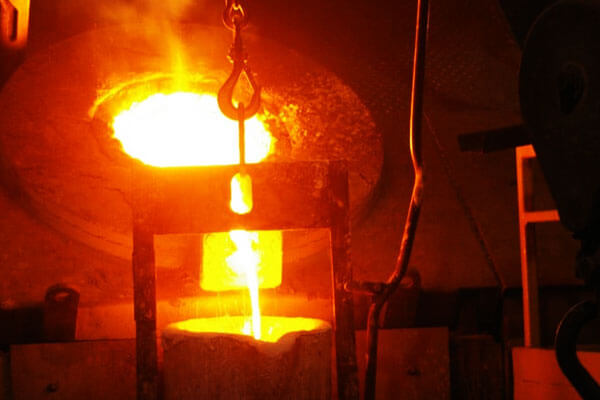
Harm During the Liquid State
Dissolved oxygen aggressively oxidizes alloying elements in the melt. This not only increases metal loss but also wastes expensive microalloying additions such as boron, zirconium, or rare earth elements.
In high-performance alloys, even trace oxygen can alter the effective chemistry enough to compromise target properties.
Just as important, oxygen promotes the formation of oxide inclusions. These inclusions are not merely defects in a cosmetic sense; they are hard, malutong na, and often angular.
They interfere with feeding, increase machining resistance, reduce fatigue life, and damage toughness.
In precision castings, where dimensional accuracy and surface integrity are both critical, even a small increase in inclusion population can produce a disproportionate increase in rejection rate.
Harm During Solidification
As the melt cools, the solubility of oxygen in liquid steel decreases. Oxygen that was stable in the liquid state becomes thermodynamically unstable and seeks a new form.
This transformation creates several problems.
Una
Dissolved oxygen can react with carbon to form carbon monoxide.
If this reaction occurs during solidification or in the final stages of pouring, the result is gas porosity, microshrinkage aggravated by gas evolution, or swelling at the sprue cup in severe cases.
In investment casting, this may be seen as a runner system that behaves abnormally, a pouring basin that bulges instead of settling, or castings that show internal porosity even when feeding seems adequate.
Pangalawa
Oxygen may combine with elements such as aluminum, titan, Silicon, and manganese to form new oxide inclusions as temperature drops.
These inclusions are usually more numerous than the original particles because the solidification front tends to trap them and the turbulent flow of pouring disperses them throughout the melt.
Third
Oxygen-derived oxides can react with sulfur to form low-melting eutectics at grain boundaries.
This promotes hot shortness and intergranular weakness. The result is not always a visible crack; sometimes it appears later as poor machinability, edge tearing, or reduced service life.
Fourth
From the standpoint of mold interaction, oxygen becomes especially dangerous when the melt wets the ceramic shell.
A clean steel melt does not readily wet refractory surfaces, but oxygen-rich metal can generate FeO and other low-melting oxide species at the interface.
These oxides can react with silica-bearing shell materials to form low-melting silicates such as fayalite-type compounds.
Once that happens, the melt can penetrate the shell surface, producing metal penetration, shell sticking, surface inclusions, or chemical bonding defects that are often misdiagnosed as ordinary slag inclusion.
This point is particularly important in investment casting because many shell systems contain reactive silica phases.
If the shell includes enough active SiO₂ or cristobalite, the oxygen-rich melt can react with the mold wall in a way that closely resembles classic sand-casting burn-on or metal penetration mechanisms. The scale is different, but the chemistry is fundamentally similar.
Harm in the Solid Metal
After solidification, oxygen remains trapped mainly as oxide and oxy-sulfide inclusions. Sa yugtong ito, it is no longer about gas evolution; it is about metallurgical cleanliness.
The size, morphology, dami na, and distribution of inclusions determine how damaging they will be.
Fine, rounded, sparsely distributed particles may be tolerable in some applications, while large, clustered, or angular inclusions can be disastrous.
They reduce ductility, impair fatigue performance, lower impact resistance, and create local stress concentration sites.
In precision castings, where the margin for error is narrow, inclusion control is often the hidden variable behind quality stability.
4. The Real Purpose of Deoxidation
The purpose of deoxidation is not merely to “kill” dissolved oxygen. It is to move oxygen out of the melt in a controlled and metallurgically useful way.
That means two things must happen simultaneously:
Una, dissolved oxygen must be reduced to a low enough level that alloying elements are protected, gas reactions are suppressed, and the melt behaves cleanly during pouring.
Pangalawa, the oxide products of deoxidation must be removed from the melt as efficiently as possible through slag flotation and clean metal practice.
A deoxidizer that forms large amounts of stubborn inclusions without allowing them to escape has only solved half the problem and may even worsen the casting outcome.
This is why deoxidation and slag removal should never be treated as separate, unrelated operations.
Sa pagsasanay, they are one coupled process: the chemistry of oxygen removal and the physical transport of reaction products.
5. Deoxidation Methods
Broadly speaking, deoxidation can be divided into two categories: chemical deoxidation and vacuum deoxidation.
In investment casting, chemical deoxidation is by far the most common.
Within chemical deoxidation, the practical routes are diffusion deoxidation, precipitation deoxidation, and combined deoxidation.
Diffusion Deoxidation
Diffusion deoxidation works by reducing the oxygen-bearing species in the slag so that oxygen migrates from the metal into the slag phase.
Fine deoxidizer particles are typically preheated and added to the melt surface, often together with a covering slag or flux.
The key idea is equilibrium. If the oxide concentration in the slag is lowered, the melt continuously transfers more oxygen-bearing species to restore balance. Sa paglipas ng panahon, the metal becomes cleaner.
This method is slower than direct precipitation deoxidation, but it has an important advantage: the reaction products are less likely to be re-entrained into the melt.
Para sa kadahilanang ito, diffusion deoxidation can produce a cleaner metal bath with fewer residual inclusions.
In induction melting, electromagnetic stirring complicates the idealized picture and actually helps the process.
The metal is in continuous circulation, which increases contact between the melt, deoxidizer, and slag.
Under the right conditions, this mixing can make diffusion deoxidation more effective than textbooks suggest.
Precipitation Deoxidation
Precipitation deoxidation, sometimes called direct deoxidation, involves adding deoxidizers directly into the molten metal so that oxygen is removed through immediate chemical reaction.
Common deoxidizers include silicon, mangganeso, aluminyo, and composite deoxidizers containing combinations of these elements.
This method is fast. That is its major strength. It is especially useful when the melt must be treated quickly before pouring.
Gayunpaman, the speed of the reaction is also its weakness. The products of deoxidation may form as very fine particles that do not have enough time to float out before pouring begins.
If the melt temperature is not sufficiently high, or if the holding time is too short, those particles remain suspended and are eventually trapped in the casting.
Kaya nga, precipitation deoxidation is effective only when coupled with proper time, temperatura, and slag practice. It should not be viewed as a standalone solution.
Combined Deoxidation
In real production, the most sensible approach is usually a combined process: preliminary deoxidation followed by final deoxidation.
This is the common practical logic in investment casting. The preliminary stage reduces the oxygen content gradually and stabilizes the melt.
The final stage adjusts the residual oxygen level immediately before pouring and ensures the bath is in a safe metallurgical condition.
In actual shop-floor practice, the final deoxidation method may resemble either precipitation deoxidation or diffusion deoxidation depending on the operator’s technique.
Some metallurgists add a very thin layer of covering flux, then apply composite deoxidizer, and finally re-cover the surface to force reaction at the slag–metal interface. In that case, the method behaves more like diffusion deoxidation.
Others insert deoxidizer deeper into the bath, which is closer to precipitation deoxidation. The boundary between the two is not always rigid.
That is why arguing over labels can be less productive than controlling outcomes.
The real question is not whether a particular step is “diffusion” or “precipitation” in a textbook sense, but whether the oxygen is sufficiently lowered and whether the products can be removed before pouring.
6. Deoxidation Is Not Complete Until the Products Leave the Melt
This is the point that is most often overlooked.
A melt can be chemically deoxidized and still be metallurgically dirty. Bakit? Because deoxidation products are themselves inclusions. If they remain suspended in the bath, they are simply a new defect source.
Kaya nga, a good deoxidation practice must answer three questions at once:
How much oxygen remains in solution?
What kind of oxide inclusions are being formed?
How will those inclusions be removed?
The best deoxidizer is not necessarily the one that reacts fastest. It is the one that produces inclusions with favorable size, morphology, and floatability, and one that works in harmony with slag removal and pouring practice.
In this sense, deoxidation should be understood as inclusion engineering, not just oxygen scavenging.
7. A Modern View: Oxygen Control as Melt Cleanliness Management
A more advanced way to think about deoxidation is to stop treating oxygen as a single-number problem. Oxygen content matters, but it is only one dimension of melt cleanliness.
A modern casting engineer should also consider:
the thermodynamic activity of oxygen,
the type and composition of inclusions formed,
the floatation kinetics of those inclusions,
the interaction between oxides and refractory shells,
the effect of electromagnetic stirring on reaction paths,
and the timing of deoxidizer addition relative to pouring.
This broader view is particularly valuable in investment casting, where defects often arise from multiple coupled mechanisms rather than one isolated cause.
A shell that is chemically active, a melt that is slightly over-oxidized, and a deoxidizer that is added too late can together create a defect that no single corrective action will fully solve.
8. Pangwakas na Salita
Sa katunayan, I once struggled with whether final deoxidation is precipitation deoxidation or diffusion deoxidation, but later I realized that this is just a conceptual distinction.
Bukod pa rito, the deoxidation forms are different for different steel types: halimbawa na lang, carbon steel uses aluminum wire insertion for deoxidation,
while stainless steel uses composite deoxidizer (such as silicon-aluminum-barium-calcium alloy) for deoxidation — some are precipitation deoxidation, some are diffusion deoxidation, and some even have both reactions at the same time.
What do you think about this? Bukod pa rito, with the development of investment casting technology, some new composite deoxidizers (such as calcium-silicon-manganese alloy) have the advantages of both rapid deoxidation and easy floating of products,
which has gradually become the mainstream choice in high-quality investment casting production, with an addition amount of generally 0.2%-0.4% of the molten steel weight.
It should be emphasized that vacuum deoxidation, as another deoxidation method, is mainly used in the production of high-end investment castings (such as aerospace engine components and medical implants).
It uses the principle that the solubility of oxygen in molten steel decreases significantly under vacuum conditions, making the dissolved oxygen in molten steel precipitate and escape in the form of gas.
Vacuum deoxidation can avoid the introduction of new inclusions by deoxidizers, and the deoxidation effect is more thorough,
but its equipment investment and operation cost are high, so it is not widely used in ordinary investment casting production.
In some advanced production lines, vacuum deoxidation is combined with deoxidizer deoxidation to achieve the best deoxidation effect, ensuring that the total oxygen content of the molten steel is reduced to below 0.002%.