1. Executive summary
Aluminyo mamatay sa paghahagis (principally high-pressure die casting, HPDC) is a mature, high-throughput manufacturing route that delivers near-net-shape, tumpak na sukat, lightweight parts with good surface finish for the automotive industry.
It is widely used for housings (transmission, gearbox, motor), structural brackets, housings for power electronics and pumps, and many accessory parts.
The main engineering tradeoffs are: per-part cost vs. dami, porosity control vs. productivity, at mechanical performance vs. process/post-process route.
Modern options (vacuum HPDC, squeeze, semi-solid, HIP and T6 heat treatments) let engineers match cast part integrity to demanding automotive requirements including safety-critical and fatigue-sensitive applications.
2. Market & engineering drivers for aluminum die-cast parts in automotive
- Lightweighting: switching from steel to aluminum can reduce part mass by ~40–50% for the same volume (Al density ≈ 2.68–2.71 g·cm⁻³ vs steel ≈ 7.85 g·cm⁻³).
Weight reductions directly improve fuel economy/EV range. - Pagsasama sama & parts consolidation: die casting enables complex geometries, integrated ribs, bossing and channels that reduce part count and assembly cost.
- Cost at volume: HPDC has low per-part cost at medium-to-high volumes (thousands to millions).
- Thermal & EMI needs: die-cast housings for e-motors and power electronics also act as heat sinks and electromagnetic shields.
- Shift to EVs: EV motors and inverters create new high-volume opportunities for precision aluminum cast housings.
- Tibay ng buhay & kaagnasan: appropriate alloys and coatings deliver automotive service life across climates.
3. Typical aluminum die-casting processes
A key choice is process family — each has different capability/cost:
- Mataas na Presyon ng Die Casting (HPDC, malamig na silid): the industry workhorse for Al automotive parts. Mabilis na oras ng pag-ikot, manipis na pader, napakahusay na repeatability. Best for A380/ADC12 family.
- Vacuum HPDC: adds a vacuum to reduce gas porosity and improve pressure tightness — used for hydraulic housings, oil sumps, safety parts.
- Squeeze / HPDC + Squeeze: applies static pressure during solidification to reduce shrinkage cavities and improve local density; useful for localized critical regions.
- Mababang presyon mamatay paghahagis (LPDC): bottom-fill with low pressure; gentler filling — better for larger/thicker parts but slower.
- Semi-solid / rheocasting (thixo): injects semi-solid slurry to reduce turbulence and porosity; higher complexity/cost but improves integrity.
- Post-process routes: paggamot ng init (T6), Mainit na Isostatic Pagpindot (HIP), machining and surface finishing are common to meet mechanical and fatigue specs.
4. Common Automotive Die-Casting Alloys
| haluang metal (Common Name) | Typical Chemistry (wt%) — Key Elements | Densidad ng katawan (g·cm⁻³) | Typical As-Cast Mechanical Range (Mga UTS, MPa) | Typical Elongation (Bilang Cast, %) | Typical Automotive Uses / Mga Tala |
| A380 (Al–Si–Cu family) | Si 8–10; Cu 2–4; Fe ≤1.3; minor Mn, Mg | 2.69–2.71 | 200–320 MPa | 1–6% | General-purpose alloy for housings, Mga pabalat, gearbox and transmission cases; excellent fluidity and die life. |
| ADC12 (Hapon) / A383 | Similar to A380 with regional spec variations | 2.69–2.71 | 200–320 MPa | 1–6% | Asian industry standard; widely used for electrical housings, engine covers, and structural brackets. |
| A356 / A360 (Al–Si–Mg family) | Si 7–10; Mg 0.3–0.6; very low Cu/Fe | 2.68–2.70 | 180–300 MPa | 2–8% | Selected for higher ductility, fatigue performance, at paglaban sa kaagnasan; often used for structural components and motor housings. |
A413 / High-Si variants |
Elevated Si; microstructure optimized for thick sections | 2.68–2.70 | 180–300 MPa | 1–6% | Suitable for thicker-wall castings and components exposed to higher operating temperatures; good stability. |
| Hypereutectic / High-Si (Mga Espesyal na Alloys) | Si Si >12–18% | 2.68–2.72 | Iba-iba ang; optimized for wear resistance | Mababa ang | Used for cylinder liner inserts, piston components, or wear-critical surfaces; higher die wear and lower ductility. |
| Proprietary Foundry HPDC Alloys | Tailored chemistries (modified Fe, Sr, Mg, grain refiners) | 2.68–2.71 | Foundry-specified | Application-dependent | Customized for improved fluidity, ductility, mechanical consistency, die life, or low-porosity casting performance. |
5. Typical Process Parameters & Practical Ranges (Automotive HPDC)
High-pressure die casting for automotive components depends on tight control of melt, die and injection variables.
Below are engineering-level practical ranges and the rationale behind each parameter (use them as starting points for shop trials; final settings must be validated for your alloy, die and geometry).
Metal preparation
Melt temperature for common Al–Si alloys typically sits between 660°C and 720°C.
Higher temperatures improve fluidity and help fill thin sections but increase die-soldering and intermetallic growth; lower temperatures reduce shrinkage but risk cold-laps.
Holding furnace setpoints are often 690–720°C to stabilize chemistry and reduce thermal swings.
Dissolved hydrogen must be controlled—target rotary-degassed levels of ≤0.12 mL H₂ /100 g Al (lower for pressure-tight or fatigue-critical parts).
Good skimming and fluxing keep dross low (industry targets commonly <0.3% sa pamamagitan ng timbang).
Die thermal control
Pre-shot die temperatures are generally in the 150-250 ° C window for automotive castings.
Die temperature uniformity is crucial—seek to keep thermal gradients small (halimbawa na lang, ≤30°C across critical cavities) to avoid localized hot spots, shrinkage or warpage.
Spray and cooling cycle timing (spray on/off and coolant flow rates) are tuned to maintain that balance; spray timing is often in the 1–3.5 s range per cycle depending on part mass.
Injection and shot profile
Modern HPDC uses a two-stage shot profile: a slow initial fill to avoid turbulence followed by a high-velocity second stage to complete filling before freezing begins.
Typical slow-stage speeds are 0.1–0.3 m/s, switching to second-stage velocities from 1.5 hanggang sa 4.5 m / s for most automotive thin-wall parts — very thin sections can see peak speeds up to about 6 m / s.
The switch-over point is commonly set at 40–70% of cavity fill; optimizing that point minimizes flash and short shots.
Pagpapaigting (or holding) pressures to consolidate metal into the mushy zone commonly range 70–160 MPa, with higher values (approaching 200 MPa) used for structural, pressure-tight or thin-walled castings.
Vacuum and air-management
Vacuum assistance is widely used for automotive structural castings.
Typical achievable cavity pressures are ≤50 mbar, and critical hydraulic or leak-tight components often use <10 mbar during filling.
Effective vacuum timing requires evacuation immediately prior to fill and maintaining vacuum through initial solidification; fill timing for vacuum HPDC is fast (fractions of a second) so vacuum systems must be capable of rapid cycling.
Pagpapatibay, clamping and cycle time
Solidification/cooling times vary with casting mass; small thin parts may cool in 3–6 s, while heavier housings need 8–12 s o higit pa.
Clamp or locking forces scale with projected area—automotive presses range from several hundred to several thousand tonnes depending on part size.
Typical cycle times for automotive HPDC run ~15–60 s overall (fill, solidify, open, eject), with thin-wall, small parts at the fast end.
6. Design for Die Casting (DFM rules for automotive parts)
Design drives producibility and cost. Key rules:
Kapal ng pader
- Target uniform wall thickness. Typical practical minimum 1–1.5 mm; 1.5–3 mm is common. Avoid sudden changes; use gradual transitions.
Ribs
- Ribs increase stiffness—keep rib thickness ≈ 0.4–0.6 × nominal wall thickness and avoid making ribs thicker than the wall. Use fillets to reduce stress concentrations.
Bosses
- Keep bosses supported by ribs, avoid heavy bosses causing hot spots; typical boss wall ≈ 1.5–2× nominal wall thickness but with small internal bosses need core support.
Draft & ejection
- Provide draft: 0.5°–2° depending on feature depth and texture. More draft for textured surfaces.
Mga Fillet & radii
- Avoid sharp corners; provide fillets (min 1.0-3.0 mm depending on scale) to reduce stress concentration and hot tearing.
Mga Tip sa Pag-install & overflows
- Design gates and overflows to promote directional solidification. Place gates to feed thick areas and locate vents to avoid trapped air.
Shrink & Mga Allowance sa Machining
- Linear shrinkage allowances typically 1.2–1.8%; specify machining allowances 0.5–2.0 mm depending on feature and finish requirement.
Pagpaparaya & critical features
- As-cast tolerances commonly ±0.2–1.0 mm; critical bearing bores or sealing faces are usually machined after casting.
7. Typical automotive parts & functional examples
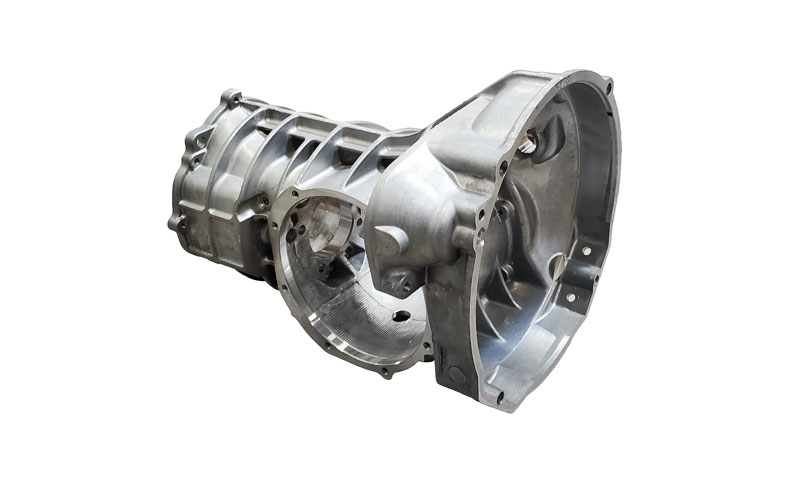
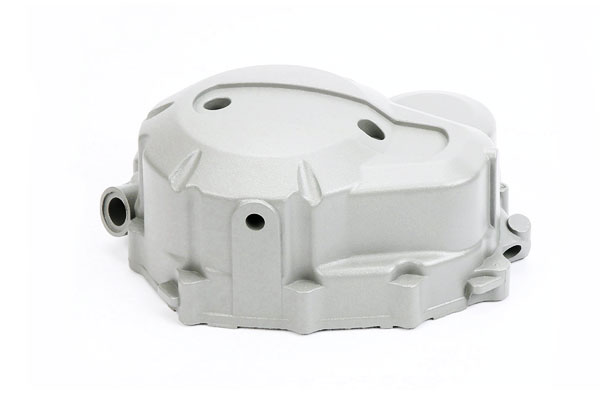
- Transmission / gearbox housings and covers — complex internal bosses, mounting locations; often vacuum HPDC for leak tightness.
- Mga bahagi ng engine (Mga pabalat, oil pumps) — thin walls, integrated bosses; require good surface finish.
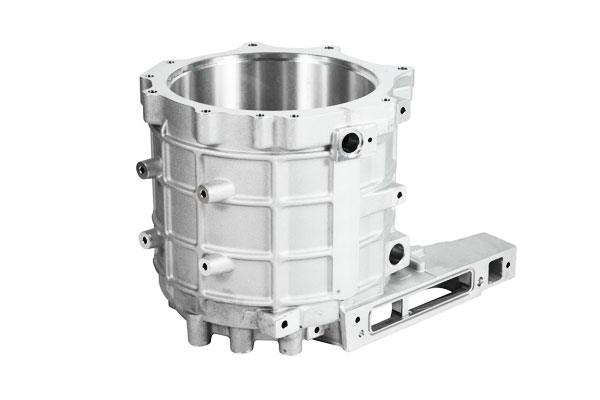
- E-motor housings / stator housings — act as structural element and heat sink; often A360/A356 variants and T6 after solution treatment to meet mechanical/thermal requirements.
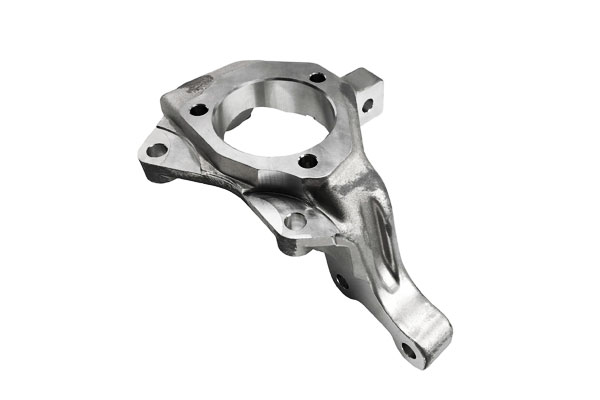
- Suspension brackets, Mga buko ng manibela (in some programs) — require high integrity; sometimes cast then heat treated / machined or replaced by forged components depending on fatigue needs.
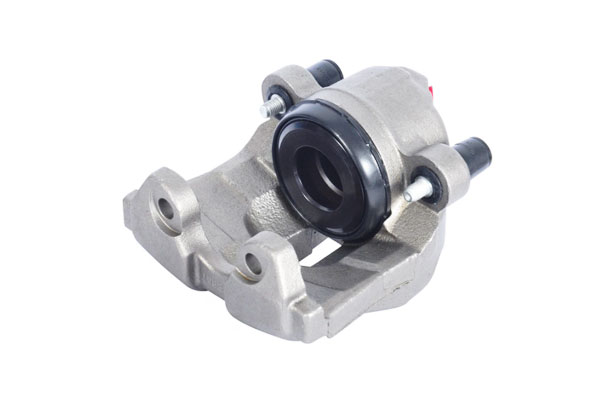
- Brake caliper housings (certain designs) — require high pressure tightness and fatigue performance; processes may combine HPDC with HIP or squeeze.
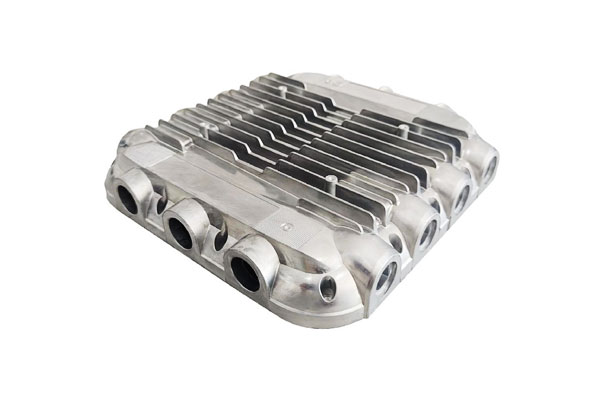
- Power electronics housings / inverter casings — require fine features, good thermal conduction and EMI shielding.
Case note: EV motor housings often combine thin fins for cooling, thick bosses for bearings, and require precise roundness on bores — design must account for differential solidification and machining sequences.
8. Microstructure, Mga Katangian ng Mekanikal & Pagkatapos ng Pagproseso
Aluminyo die-cast parts derive their performance from a tight interplay between (a) as-cast microstructure produced by rapid filling and die-cooling, (b) the alloy chemistry, (c) process-related defects (primarily porosity), at (d) the chosen post-processing route (paggamot ng init, HIP, machining, ibabaw ng paggamot).
Typical as-cast microstructure — what to expect
- Chilled skin / fine microstructure at the die face. Rapid solidification at the die interface produces a fine, thin “chill” layer (very fine dendrites, refined eutectic) that typically has higher hardness and tends to give good surface strength and wear resistance.
- Intermediate columnar to equiaxed zone. Beneath the chill layer the structure transitions to coarser equiaxed grains and primary aluminum dendrites with interdendritic eutectic (Al–Si) and intermetallics.
- Intermetallic phases. Fe-rich (Al–Fe–Si) platelets/needles and Cu- or Mg-containing precipitates form depending on chemistry; these phases are usually brittle and control ductility, fracture initiation and machinability.
- Silicon morphology. In Al–Si alloys, silicon appears as a eutectic phase; nito morphology (acicular/platelet vs. modified fibrous) strongly affects ductility.
Sr modification and controlled cooling produce a finer, more rounded silicon which improves toughness and elongation. - Dendrite arm spacing (SDAS). Faster cooling → finer SDAS → higher strength/ductility.
Thin sections solidify faster and therefore typically show better mechanical performance than thick bosses or webs.
Typical mechanical properties
Values below are representative shop-floor engineering targets; actual numbers depend on porosity, SDAS, heat treatment and testing coupon location relative to the casting.
- A380 (typical HPDC alloy)
-
- As-cast UTS: ~200–320 MPa
- Pagpapahaba: ~1–6%
- Brinell hardness (HB): ~70–95
- A356 / A360 (Al–Si–Mg family, often used when higher ductility/ageing is required)
-
- As-cast UTS: ~180–300 MPa
- T6 (Solusyon + artificial age) Mga UTS: ~250–360 MPa (common engineering range ~260–320 MPa)
- Yield strength (T6): ~200–260 MPa
- Pagpapahaba (T6): ~4–10% depending on porosity
- Ang katigasan ng ulo (HB, T6): ~85–120
- A413 / high-Si variants — similar UTS bands to A356 as-cast; designed for thicker sections and thermal stability.
Important caveat: porosity (gas + pag urong) is a dominant modifier.
Halimbawa na lang, even modest increases in average porosity (0.5 → 1.0 vol%) can reduce apparent tensile and, lalo na, fatigue performance substantially — typical fatigue strength reductions of 20–50% are common depending on pore size/position and test conditions.
Post-processing routes and their effects
Solution heat treatment & artipisyal na pagtanda (T6)
- Who uses it: primarily Al–Si–Mg alloys (A356/A360) to raise strength and ductility.
- Typical cycle (engineering guideline): solutionize ~520–540°C (≈ 6–8 h) depending on casting section size, quench rapidly (Tubig), pagkatapos ay edad sa 155–175°C for 4–8 h (time/temp optimized per alloy).
- Epekto: increases UTS and yield, Nagpapabuti ng ductility, but accentuates the mechanical consequence of any remaining porosity (i.e., pores become more damaging after T6 because matrix strength is higher).
- Design implication: low porosity must be achieved prior to T6 if fatigue is critical.
Mainit na Isostatic Pagpindot (HIP / densification)
- Layunin: close internal shrinkage porosity and microcavities to recover near-full density and improve fatigue life and toughness.
- Typical engineering HIP window for Al alloys:~450–540°C sa ~100–200 MPa for 1–4 hours (process and cycle chosen to avoid over-aging or detrimental microstructural coarsening).
- Epekto: can increase ductility and fatigue life dramatically; used selectively where cost justified (hal., safety-critical or aerospace-grade automotive components).
Squeeze / in-die pressure
- Epekto: applies static pressure during solidification to reduce shrinkage porosity, improving local density in thick regions without post-cast HIP.
Pagbaril ng peening / surface mechanical treatments
- Epekto: induces compressive residual stress near surface and improves high-cycle fatigue resistance; commonly used on critical fillets, bolt holes or machined faces.
Mga Coatings & ibabaw ng pagtatapos
- Pagpapahid ng langis, e-coats, mga pintura protect against corrosion and may mask small surface pores but do not repair structural porosity. Sealing of anodic films improves corrosion resistance in aggressive environments.
Stress relief anneals
- Light stress relief (hal., low-temp aging or stress relief at ~200–300°C) can reduce residual casting stresses from thermal gradients, improving dimensional stability and reducing SCC risk in susceptible alloys.
9. Common defects, Root causes & Remedies
| Depekto | Hitsura / Epekto | Common root causes | Remedies |
| Porosity ng gas | Spherical pores, lowers strength | Hydrogen pickup, turbulent fill, poor degassing | Melt degassing (umiikot), filtration, shot profile tuning, vacuum HPDC |
| Pag-urong ng porosity | Irregular cavities in last-solid areas, reduces fatigue | Poor feeding, insufficient intensification/holding | Re-design gates/runners, increase intensification, local chills or squeeze/HIP |
| Cold shut / lack of fusion | Surface line/weakness where flows meet | Low melt temp, mabagal na punan, poor gate location | Increase melt temp/velocity, redesign gate for flow |
| Hot tear / pag crack na | Cracks during solidification | High restraint, localized hot spots | Add fillets, modify gating/solidification path, add chills |
| Soldering (die stick) | Metal adheres to die, poor finish | Die temperature, Kimika, lubrication failure | Adjust die temp, mga patong na patong, better lubricant |
| Flash | Excess metal at parting line | Die wear, misalignment, excessive pressure | Die maintenance, tighten clamping, optimize pressure |
| Mga Pagsasama / slag | Non-metallic chunks inside casting | Melt contamination, filtration failure | Filtration, better melt skimming, furnace maintenance |
| Dimensional drift / warpage | Out-of-tolerance features | Thermal gradients, shrinkage not accounted | Die compensation, improved cooling, simulation |
10. Economics & program considerations
- Tooling cost: die cost ranges from tens to hundreds of thousands USD depending on complexity and inserts. Lead time weeks to months.
- Per-part cost drivers: alloy cost, Oras ng pag-ikot, scrap rate, machining, finishing and testing.
- Break-even volume: high tooling cost means die casting is economical from thousands to many tens/hundreds of thousands of parts—depends on part mass and machining needs.
- Supply chain considerations: secure raw alloy supply; heat treatment and machining capacity; NDT capability; risks for die revisions. Design for serviceability and manufacturing early.
11. Sustainability & pag recycle
- Aluminum recyclability: aluminum scrap is highly recyclable; recycled aluminum (secondary) uses roughly ~5% of the energy required for primary smelting (a long-standing engineering estimate).
Using recycled content reduces embodied energy substantially. - Material efficiency: near-net-shape casting reduces machining waste vs billet machining.
- Process energy: melting is energy-intensive; efficient melt practice, waste heat recovery and higher recycled content help lower footprint.
- End-of-life: die-cast parts are recyclable; scrap segregation (clean Al vs coated) aids recycling.
- Lightweighting lifecycle benefit: weight savings in vehicles reduce fuel/energy use across life cycle; quantify with LCA for program decisions.
12. Aluminum Die Casting vs. Alternative Automotive Materials
| Materyal / Route | Typical manufacturing routes | Densidad ng katawan (g·cm⁻³) | Typical tensile strength (MPa) | Typical automotive uses | Key advantages | Key limitations |
| Aluminum — HPDC (A380 / A356 family) | Mataas na presyon ng die casting (cold chamber), vacuum HPDC, squeeze | 2.68 – 2.71 | As-cast ~180–320; T6 (A356) ~250–360 | Transmission/gear housings, Mga pabahay ng motor, Mga Katawan ng Bomba, structural brackets, inverter housings | Magaan ang timbang, good castability for complex thin-wall parts, mahusay na ibabaw tapusin, magandang thermal kondaktibiti, pwede na ba mag recycle | Porosity sensitivity (fatigue/pressure), limited very-high-temp performance, high tooling cost for low volumes |
| Steel — stamped/forged (mababa ang- & mga bakal na may mataas na lakas) | Stamping, pagkukubli + machining, paghahagis ng mga | ~ 7.85 | ~300–1000+ (low-carbon → AHSS/forgings) | Chassis members, suspension arms, safety-critical structural parts | Very high strength & tigas na tigas, established manufacturing chain, cost-effective for many parts | Mas mabigat (mass penalty), corrosion protection often required, multi-process assembly vs integrated cast parts |
| Email Address * (gray/ductile) | Sand cast, shell mold | ~6.9 – 7.2 | ~150–350 (gray lower, ductile higher) | Mga bloke ng engine (legacy), brake drums, heavy housings | Napakahusay na paglaban sa pagsusuot, pag-damping, low cost for large parts | Malakas na, limited thin-wall capability, machining-heavy, poor for lightweighting |
| Magnesium — die casting | HPDC (magnesium dies), squeeze | ~1.74 – 1.85 | ~150–300 | Instrument panels, steering wheels, lightweight housings | Extremely low density (best weight savings), good stiffness-to-weight, good die-castability | Lower corrosion resistance (requires protection), flammability concerns in melting, higher material cost and lower ductility vs Al in many alloys |
Engineering thermoplastics (hal., PA66 GF, PPA, PPS) |
Pag iiniksyon paghubog | ~1.1 – 1.6 (glass-filled higher) | ~60–160 (glass-filled grades) | Interior trims, some housings, non-structural brackets, air ducts | Low cost for high volumes, excellent integration of clips/features, corrosion-free, mababang timbang | Temperature limits, lower stiffness/strength than metals, poor high-load fatigue performance, dimensional stability vs metals |
| Mga composite (CFRP / hybrid) | Layup, resin transfer molding (RTM), automated fiber placement | ~1.4 – 1.7 (system dependent) | ~600–1500 (fiber-direction) | High-end structural panels, crash structures, mga panel ng katawan (low-volume/EV) | Exceptional specific strength & tigas na tigas, excellent lightweighting potential | High cost, anisotropic properties, challenging reparability and joining, longer cycle times for many processes |
| Aluminum — sand / permanenteng paghahagis ng amag | Buhangin paghahagis, permanenteng amag | ~2.68 – 2.71 | ~150–300 | Large housings, brackets where thin walls not required | Lower tooling cost than die casting for low volumes, good large-part capability | Lower surface finish and accuracy than HPDC, heavier sections, more machining |
13. Pangwakas na Salita
Automotive aluminum die casting is a transformative technology that enables the lightweighting, electrification, and sustainability goals of the global automotive industry.
Its unique combination of high-volume efficiency, part integration, and cost competitiveness makes it irreplaceable for powertrain, istruktura, and EV-specific components.
As EV adoption accelerates and gigacasting scales, aluminum die casting will remain a cornerstone of automotive innovation—driving lighter, mas mahusay na, and sustainable vehicles for decades to come.
Mga FAQ
What alloy is best for an EV motor housing?
Common choices are A356/A360 (Al–Si–Mg) when T6 strength and thermal performance are needed; A380 is used for lower-stress housings.
Final choice depends on porosity tolerance, heat treatment capability and machining requirements.
How thin can walls be die cast?
Typical practical minimum is ~1.0–1.5 mm; achievable down to ~1 mm in optimized tooling and process, but expect stricter controls.
Does vacuum HPDC eliminate porosity?
It significantly reduces gas porosity and improves pressure tightness but does not fully eliminate shrinkage porosity; squeeze, HIP or improved gating may be needed for near-full density.
How long does a die last?
Die life varies widely—thousands to several hundred thousand shots—depending on alloy, die steel, mga patong na patong, cooling and maintenance.
Is die casting sustainable?
Yes—especially when high recycled aluminum content is used and near-net shape reduces machining waste.
However melting and die production consume energy; process optimization is essential for best lifecycle performance.