1. Introduction — Why Combine Butterfly Valves with Investment Casting
A Stainless steel butterfly valve is a critical flow-control device used in industries ranging from chemical processing, HVAC, paggamot ng tubig, Mga Sistema ng Dagat, to food and beverage.
Combining them with investment casting technology delivers exceptional dimensional accuracy, paglaban sa kaagnasan, and surface finish quality — attributes crucial for sealing performance and longevity in demanding service conditions.
Investment casting enables the production of complex, near-net-shape valve bodies and discs, minimizing machining, Bawasan ang basura ng materyal hanggang sa 30%, and ensuring tighter tolerances compared to sand casting.
This approach is particularly advantageous for high-value stainless steels, where scrap minimization directly improves cost efficiency.
2. Butterfly Valve Basics — Types, Mga Bahagi, and Performance Roles
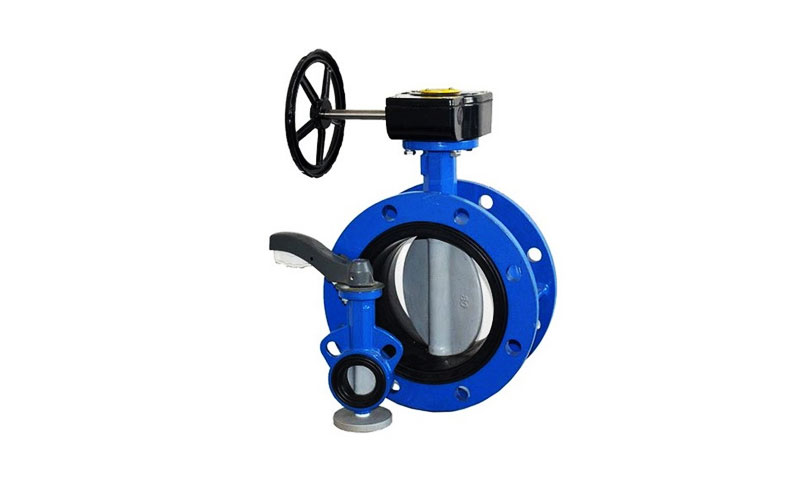
A balbula ng butterfly is a quarter-turn rotary valve that regulates, isolates, or throttles fluid flow by rotating a disc in the flow path.
Its compact design, fast actuation, and relatively low cost make it one of the most widely used valve types in industrial and municipal systems.

Main Types of Butterfly Valves
Butterfly valves are classified based on end connection at sealing geometry:
By Connection Type
| Uri ng | Paglalarawan | Common Use |
| Wafer Type | Fits between flanges, held in place by bolts running through both flanges | Space-constrained piping, low-pressure service |
| Lug Type | Threaded lugs on the valve body allow bolting to a single flange; supports dead-end service | Systems requiring frequent disconnection |
| Flanged Type | Integral flanges for bolting directly to pipe flanges | Heavy-duty industrial systems |
| Grooved End | Ends with grooves for mechanical couplings | Fire protection, HVAC |
By Sealing Mechanism
| Uri ng | Offset Design | Paglalapat |
| Concentric (Zero Offset) | Stem passes through the disc center; soft-seated | Low-pressure, general-purpose |
| Double Offset | Stem offset from disc center and valve body centerline; reduces seat wear | Medium/high-pressure, longer service life |
| Triple Offset | Conical sealing surface with triple eccentricity; metal-to-metal seat | High-temperature, mataas na presyon, zero-leakage service |
Mga Pangunahing Bahagi
A butterfly valve typically consists of the following parts:
- Katawan – Encases the internal components; stainless steel bodies (CF8M, CF3M) provide corrosion resistance in aggressive media.
- Disc – Rotating element that controls flow; often investment cast for optimal strength and aerodynamic profile.
- Stem/Shaft – Connects the actuator or handle to the disc; requires high torsional strength.
- Upuan – Provides sealing surface; materials include EPDM, NBR, PTFE, o metal, depending on temperature and chemical compatibility.
- Seals/Gaskets – Prevent leakage along the stem or between body and piping.
- Actuator/Handle – Manual lever, gear operator, niyumatik, mga elektriko, or hydraulic actuator.
3. The Role of Investment Casting in Stainless Steel Butterfly Valve
Why Investment Casting for Butterfly Valve Components?
Pamumuhunan sa paghahagis, kilala rin bilang Paghahagis ng Lost Wax, is a precision manufacturing process capable of producing near-net-shape stainless steel components with complex geometries and tight dimensional tolerances.
In butterfly valve production, it is particularly advantageous for critical flow-control parts tulad ng discs, bodies, and stems, where aerodynamic profiles, sealing integrity, and corrosion resistance are essential.

Key Advantages Over Other Methods
| Tampok | Investment Casting Benefit |
| Katumpakan ng Dimensyon | Typical tolerances of ±0.1–0.3 mm reduce the need for heavy machining. |
| Tapos na sa ibabaw | Ra 1.6–3.2 μm directly from casting, minimizing polishing on sealing surfaces. |
| Mga Komplikadong Hugis | Ability to form streamlined disc profiles to optimize Cv (flow coefficient). |
| Integridad ng Materyal | Uniform microstructure with minimal porosity; supports pressure ratings up to PN40 when paired with proper heat treatment. |
| Material Variety | Compatible with corrosion-resistant grades such as CF8M (316 SS), CF3M (low-carbon 316L), Duplex, and super duplex alloys. |
When It’s Appropriate
Investment casting is most suitable when:
- Medium-to-high production volumes justify the tooling cost.
- Precision sealing surfaces ay kinakailangan, reducing post-machining.
- Corrosion and hygiene requirements ay kritikal (hal., tubig dagat, grado ng pagkain, pagproseso ng kemikal).
- Streamlined flow profiles are necessary to reduce turbulence and cavitation.
When It’s Less Suitable
While highly versatile, investment casting may not be the best choice when:
- Very large diameters (>DN1200) make sand casting more cost-effective.
- Extreme impact loads demand forged components.
- Ultra-low-cost commodity valves cannot absorb the tooling cost.
Integration into Butterfly Valve Manufacturing
For stainless steel butterfly valve, investment casting often produces:
- Valve Disc – Optimized for smooth flow and minimal pressure drop; casting achieves complex aerodynamic cross-sections without welding.
- Valve Katawan – For smaller diameters (DN40–DN300), investment-cast bodies reduce weight and improve aesthetics; for larger diameters, body rings or critical sealing areas are cast and then welded into fabricated housings.
- Stem/Shaft – Where integrated features (mga splines, actuator coupling flats) ay kailangan.
4. Common Stainless Steel Grades Used in Butterfly Valve Casting
The choice of hindi kinakalawang na asero alloy for butterfly valve components is critical to performance, tibay ng katawan, and regulatory compliance.
| ASTM / EN Designation | Common Name | Tipikal na komposisyon (wt%) | Mga Pangunahing Katangian | Mga Karaniwang Aplikasyon |
| CF8M (ASTM A351) | 316 SS | 18Cr–10Ni–2Mo | Excellent resistance to chlorides, mga asido; good strength up to 425 °C | Seawater service, chemical process valves |
| CF3M (ASTM A351) | 316L SS | Mababang C, 18Cr–10Ni–2Mo | Same corrosion resistance as CF8M but improved weldability and resistance to sensitization | Pagkain & inumin, pharma-grade valves |
| CF8 (ASTM A351) | 304 SS | 18Cr–8Ni | Good corrosion resistance in mild environments; matipid sa gastos | HVAC, general water service |
| CD4MCu (ASTM A890 Grade 1A) | Duplex SS | 25Cr–5Ni–2Mo–Cu | Mataas na lakas, paglaban sa paglaban; PREN > 35 | Desalination, pulp & papel na papel |
| CE3MN (ASTM A890 Grade 5A) | Super Duplex SS | 25Cr–7Ni–3.5Mo–N | Exceptional seawater resistance; PREN > 40 | Malayo sa pampang, marine ballast control |
| CN7M (ASTM A744) | haluang metal 20 | 20Cr–29Ni–2.5Mo–Cu | Resistant to strong acids, Incl. sulpuriko | Pagproseso ng kemikal, acid transfer |
| 17-4 PH (ASTM A747 Grade CB7Cu-1) | Precipitation-Hardening SS | 16Cr–4Ni–4Cu–Nb | Very high strength (UTS 900–1100 MPa), magandang paglaban sa kaagnasan, heat-treatable to various hardness levels | High-pressure butterfly valve shafts, actuator stems |
5. Investment Casting process flow for valve components (step-by-step)

- CAD & pattern design — design for casting: shrink allowances, Mga anggulo ng draft, gating and runner layout adapted to wax assembly.
- Wax pattern production — injection molded or 3D printed waxes for complex/low-volume runs. 3D-printed wax enables rapid iteration and no tooling for prototypes.
- Assembly — wax patterns are assembled with runners and gating into tree assemblies.
- Shell building — dipping into ceramic slurry and stuccoing with sand; multiple coatings build a rigid shell (typical wall thickness depends on section size).
- Dewaxing (autoclave) — remove wax to leave a ceramic mold cavity.
- Preheat / shell burn-out — burn out residual organics; sinter the shell.
- Natutunaw na & ibuhos — alloy melt (induction/EAF); pour into preheated shell molds. For high-integrity parts consider vacuum or inert-gas pouring to reduce inclusions and porosity. Typical pouring temperatures for stainless grades ~1450–1600°C depending on alloy.
- Shell knockout & Paglilinis — removal of ceramic shell; shot-blast to remove adherent material.
- Pagputol & fettling — remove runners and gates, rough grinding.
- Lunas sa init (kung kinakailangan) — solution anneal, pampawala ng stress, o pawiin & temper depending on alloy and required properties. Austenitics commonly solution annealed and passivated.
- Machining — finish bores, sealing faces, stem bores, and hub bores to specified tolerances. Critical surfaces receive fine machining or lapping.
- Email Address * / buli na / Passivation / electropolish — especially for sanitary valves; Ra targets down to ≤0.8 μm for hygienic services.
- Assembly & Pagsubok — seat installation, stem assembly, pressure and leakage testing per standards.
- NDT & QA documentation — radiography/UT, PMI, tigas na tigas, MTRs, and traceability per customer requirements.
6. Design and foundry considerations specific to butterfly valves
- Disc geometry & balance: Invest cast discs must be designed so the center of gravity and hydrodynamic profile minimize required actuator torque and prevent vibration.
Investment casting can produce thin, contoured discs efficiently. - Stem bore integrity: Tight concentricity between disc bore and sealing face is critical; specify machining allowance and runout tolerances.
- Seat retention features: For molded elastomer seats, bodies often need precise grooves; investment casting can form accurate grooves with minimal machining.
- Wall thickness uniformity: Avoid abrupt section changes to reduce hot spots and shrinkage porosity. Use ribs or fillets for strength rather than sharp changes.
- Gating strategy for lost-wax: Use gating to ensure directional solidification; small, thin discs are sensitive to shrinkage; place gates to feed heavy sections (hub) first.
3D-printed gating or simulation (ProCAST, MAGMA) is strongly recommended. - Corrosion allowance & tapusin: Specify post-cast machining allowances for sacrificial surfaces and polishing depth.
7. Post-casting Processing: heat-treat, machining, finishing and assembly

Lunas sa init
- Austenitic stainless (CF8/CF8M): commonly solution annealed (hal., 1,040–1,120°C) then quenched to restore corrosion resistance and homogenize structure.
- Duplex alloys: may require controlled solution treatment and rapid cooling to obtain correct duplex phase balance.
- Stress relief after welding or heavy machining when distortion control matters.
Machining & critical surfaces
- Seat faces, stem bores, and flange faces require precision machining. Mga tipikal na tolerance: bores ±0.05–0.2 mm depending on diameter and function.
- Discs are often finish-machined and dynamically balanced to reduce actuator torque and vibration.
Email Address *
- Pagsabog ng baril for uniform appearance.
- Electropolishing / chemical passivation to enhance corrosion resistance and meet sanitary specifications.
- Polishing to Ra ≤0.8 μm for food, inumin, at mga sektor ng parmasyutiko.
Seal installation & Pagsubok
- Elastomer seats fitted with correct compression; metal seats lapped to achieve leakage class.
8. Kontrol sa kalidad, testing and standards
Material verification
- PMI / OES to confirm alloy chemistry. MTRs should accompany critical batches.
NDT
- Radiographic (RT) o Ultrasonic (UT) testing for internal porosity or shrinkage in critical castings.
- Dye-penetrant (PT) at magnetic particle (MT) for surface and near-surface defects.
- Hardness testing at metallography for microstructure checks (particularly duplex vs austenitic balance).
Presyon & leakage testing
- API 598, ISO 5208 or equivalent tests: shell test, seat test, and operational cycle tests.
- Define allowable leakage class (hal., bubble-tight for metal seats, ANSI/FCI Class VI for soft seats).
Dimensional inspection
- CMM checks for critical concentricities, flange faces, stem bore tolerances and seat profiles.
Mga Pamantayan & certifications to reference
- API 609 (butterfly valves — lug and wafer type for general industrial).
- MSS SP-67 (butterfly valves — cast iron).
- EN 593 at ISO 5752 / ISO 9969 for face-to-face and pressure-temperature ratings.
- ASTM A351 / A743 at ASTM A216/A217 for cast stainless and alloy materials (specify appropriate grade).
- Sanitary & potable water: 3-A, FDA, NSF/ANSI 61 when relevant.
- Offshore/sour service: NACE MR0175 / ISO 15156 compliance when applicable.
9. Typical Applications of Stainless Steel Butterfly Valve
Stainless steel butterfly valve—particularly those produced via pamumuhunan paghahagis—are used across industries where paglaban sa kaagnasan, flow efficiency, and compact actuation ay kritikal.
Their lightweight disc design, quick quarter-turn operation, and durability in harsh environments make them suitable for a wide spectrum of service conditions.

Pagkain & Beverage Processing
- Reason for Use: Meets sanitary requirements; stainless alloys resist acidic and alkaline washdowns.
- Typical Media: Juices, dairy, beer, syrups, at CIP (Malinis sa Lugar) fluids.
- Special Requirements: Hygienic design with Ra ≤0.8 μm surface finish; FDA-compliant elastomers; 3-A Sanitary certification.
Parmasyutiko & Biotech
- Reason for Use: Crevice-free internal geometry minimizes contamination risk; compatible with steam sterilization (SIP).
- Typical Media: Purified water, WFI (Water for Injection), buffer solutions.
- Special Requirements: ASME BPE compliance, electropolished internal surfaces, traceable material certificates.
Marine & Malayo sa pampang
- Reason for Use: Resistance to seawater corrosion; compact footprint suits confined spaces.
- Typical Media: Ballast water, cooling seawater, fuel, lubricating oil.
- Special Requirements: NACE MR0175 compliance for sour service, duplex stainless for higher chloride resistance.
Pagproseso ng Kemikal
- Reason for Use: Handles a wide pH range and corrosive media without significant degradation.
- Typical Media: Mga Acid, alkalis, Mga solvent, brine.
- Special Requirements: Alloy selection based on chemical compatibility; PTFE or Viton seats for chemical resistance.
Tubig & Paggamot ng Wastewater
- Reason for Use: Stainless alloys prevent rusting in potable water and wastewater environments.
- Typical Media: Potable water, raw water, treated effluent, sludge.
- Special Requirements: NSF/ANSI 61 certification for drinking water; ISO 5752 for face-to-face dimensions.
Langis & Gas (Onshore/Offshore)
- Reason for Use: Withstands corrosive and high-pressure service in compact piping layouts.
- Typical Media: Crude oil, produced water, process gas.
- Special Requirements: API 609 design compliance; fire-safe and anti-static features for hydrocarbon service.
HVAC and District Energy
- Reason for Use: Lightweight quarter-turn operation for large-diameter lines; low pressure drop.
- Typical Media: Chilled water, hot water, steam (mababang presyon).
- Special Requirements: ISO 5211 mounting pads for direct actuator coupling; EPDM seats for temperature range suitability.
Pulp & Paper Industry
- Reason for Use: Handles abrasive slurries and corrosive bleaching agents.
- Typical Media: Pulp slurry, bleaching chemicals, recovery boiler feedwater.
- Special Requirements: Hard-faced sealing edges; duplex stainless for abrasion plus corrosion resistance.
10. Quality Standards and Certification
Stainless steel butterfly valve produced via investment casting must comply with strict industry standards to guarantee reliable performance and safety:
- ASTM A351: Specifies the chemical composition and mechanical properties for cast austenitic stainless steels, including CF8 and CF8M grades, ensuring material quality and durability.
- API 609: Establishes design criteria for butterfly valves, including mandatory pressure testing at 1.5 times the rated pressure for 60 Mga segundo, and tight leakage limits adhering to ANSI Class VI standards (<0.0005 mL/min per inch of valve diameter).
- ISO 13709 / API 6D: Applicable for pipeline service valves, requiring rigorous nondestructive testing methods such as X-ray and ultrasonic inspection to detect internal flaws in critical components.
- 3-A Sanitary Standards: Applies to valves used in food and pharmaceutical processing, mandating smooth, crevice-free surfaces to prevent bacterial buildup and facilitate cleaning.
11. Mga Trend sa Hinaharap: Innovations in Investment Casting for Butterfly Valves
Continuous advancements in casting technology and materials are driving significant improvements in valve manufacturing:
- 3D-Printed Wax Patterns: The adoption of additive manufacturing for wax patterns has drastically shortened lead times from 6–8 weeks to as little as 1–2 weeks,
enabling faster prototyping and flexible design modifications without the need for expensive tooling. - Simulation-Driven Casting Design: Advanced software like ProCAST allows foundries to predict solidification behavior and optimize gating and riser systems,
reducing scrap rates dramatically—from typical losses of 15–20% down to under 5%. - Sustainable Manufacturing Practices: Modern foundries recycle up to 90% of wax and ceramic shell materials and increasingly use electric induction furnaces rather than gas-fired ones,
cutting carbon emissions by approximately 30% kumpara sa mga tradisyonal na pamamaraan. - Mataas na Pagganap ng Alloy Castings: Investment casting is expanding beyond conventional stainless steels to include superalloys like Hastelloy C-276,
enabling butterfly valves to operate reliably in more aggressive chemical environments and extreme conditions.
12. Pangwakas na Salita
Investment casting of stainless steel butterfly valves combines precise engineering with advanced materials to produce complex, hindi lumalaban sa kaagnasan, and cost-effective components.
The lost-wax process enables reliable valves suited for demanding applications—from marine to pharmaceutical—where performance is critical.
With ongoing innovations like 3D printing, simulation, at napapanatiling mga kasanayan, investment casting remains key to manufacturing high-quality butterfly valves that meet the evolving needs of modern industries.
Mga FAQ
What is the typical lead time for an investment-cast stainless steel butterfly valve?
For standard designs, 4–6 na linggo (including pattern making, paghahagis ng mga, at pagtatapos). Custom designs with 3D-printed patterns can be produced in 2–3 weeks.
How does investment casting affect the corrosion resistance of stainless steel?
When properly processed (vacuum melting, kinokontrol na paglamig), investment-cast stainless steel retains 90% of the corrosion resistance of wrought stainless steel, far exceeding sand-cast alternatives.
What is the maximum size of an investment-cast butterfly valve body?
Investment casting is practical for valve bodies up to 24 inches in diameter. Larger sizes (>24 pulgada) often use sand casting due to ceramic shell limitations.
Can investment-cast butterfly valves be repaired?
Oo nga, worn discs or stems can be replaced with new investment-cast components, extending the valve’s service life by 5–10 years.
What is the cost comparison between investment casting and forging for a 6-inch valve body?
Investment casting is 20–30% cheaper for volumes <10,000 Mga Yunit, as it avoids the high tooling costs of forging. For high volumes (>10,000), forging may become more economical.
Can investment casting be used for large butterfly valve bodies (hal., >300 mm)?
It can, but cost and yield penalties increase. For large diameters, sand casting or fabricated/forged bodies are typically more economical.
How tight are as-cast dimensions?
Investment casting offers tighter tolerances than sand casting — small feature tolerances can be ±0.1–0.5 mm, but critical sealing surfaces should be finish-machined.