1. Executive summary
Wax model assembly is the step that converts individually molded wax patterns into an engineered cluster (the “tree”) ready for shell building.
It is deceptively simple yet decisive: correct assembly ensures dimensional accuracy, consistent shell thickness, predictable metal flow, and reliable feeding during solidification.
Failures at this stage (poor joints, kontaminasyon, bad gating geometry, misaligned cores) lead to shell defects, Mga Pagkakamali, porosity, or scrap and expensive rework downstream.
Precision assembly therefore requires controlled materials, validated joining methods, environmental discipline, traceable inspection and—when justified—automation.
2. Why Wax Pattern assembly matters in investment casting
Wax pattern assembly is far more than “sticking patterns together.”
It is the engineered act of creating the metal flow network, the mechanical support structure and the thermal/feeding topology that determine whether a casting run will pass or fail.
Decisions made at assembly ripple through the entire investment-casting sequence (shelling → dewax → pour → solidification → finishing).
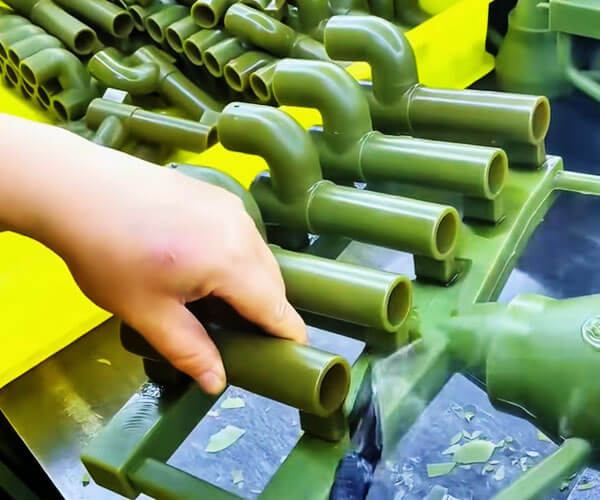
Functional roles of the assembled wax tree
- Define metal flow and feeding. Sprues, runners and risers created during assembly control filling velocity, kaguluhan, oxide entrainment, and where solidification feeding occurs.
Proper geometry encourages directional solidification and reduces shrinkage porosity. - Protect and support geometry. Fixtures and attachment points hold thin walls, overhangs and fine detail in correct relation so shell coats uniformly and cores remain undistorted.
- Set thermal mass balance. The relative mass of each limb affects cooling rates; balanced trees produce uniform thermal histories and consistent microstructure across parts.
- Enable venting and slurry access. Tree layout determines how slurry wets surfaces and how air escapes during dipping and drying. Good orientation prevents trapped air and dry spots.
- Provide handling robustness and traceability. Joints must withstand handling, dewax and shell stresses; consistent tree construction supports batch traceability and NDT/inspection plans.
3. Core objectives and technical requirements of wax-pattern assembly
The primary purpose of wax-pattern assembly is to produce a stable, fully defined wax tree that combines individual patterns into a single, castable module with accurate geometry, robust joints and an engineered metal-flow architecture.
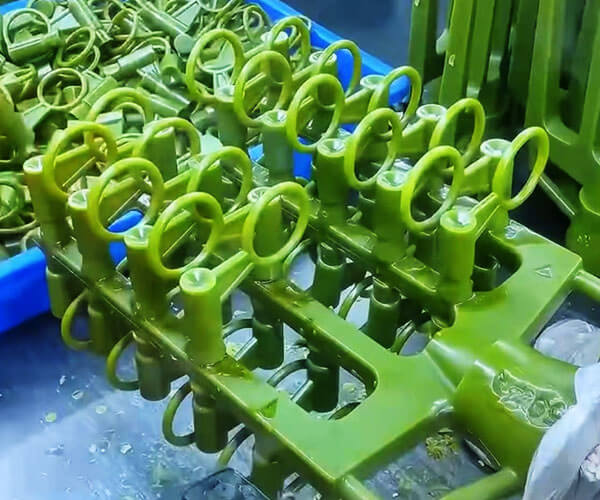
Integral forming of complex geometries.
Assembly must lock the relative positions of multiple functional units (mga blade, fins, mga panaklaw, internal bosses, atbp.) to produce one near-net-shape module.
This eliminates post-cast welding or mechanical joining and avoids seam-related stress concentrators.
To succeed the assembly operation must deliver repeatable positional tolerances (halimbawa na lang, frame internal dimensions maintained to ±0.2 mm or tighter where required), preserve thin-wall orientations, and prevent distortion during handling and shelling.
Precision fixturing, datum referencing and sequence control are essential to avoid accumulation of small errors that would exceed final machining allowances.
Production efficiency and scalability.
A wax tree is an economic device: many parts are shelled and poured in a single cycle. Assembly therefore must be optimized for throughput without sacrificing quality.
For low-mix, high-volume production this implies automated or robotic assembly with closed-loop position feedback and logged process parameters;
for small-batch, high-mix production it requires standardized manual procedures, calibrated tooling and operator qualification programs.
Process requirements include predictable cycle times, minimal rework rates, and material/fixture standardization to support rapid changeovers.
Optimized molten-metal filling behaviour.
Assembly defines the gating network and therefore controls fill sequence, flow velocity and turbulence.
The objective is laminar, progressive filling that avoids air entrapment, oxide folding and cold shuts.
Practical requirements include tapered, radiused gate transitions; smooth runner cross-sections; minimized abrupt sectional changes; and balanced thermal mass among tree limbs.
Where applicable, bottom-gating strategies should be employed to promote upward filling and venting of gases.
Filling optimization is validated by filling/solidification simulation and confirmed in cast trials.
Rational gating and riser arrangement for directional solidification.
Shrinkage during solidification must be supplied from properly located risers.
The assembly must position risers so they feed the largest hot-spots and thick sections, while avoiding excessive thermal mass on thin walls.
Riser design (laki ng, neck geometry and attachment) and firm mechanical connection to the part pattern are required so that risers survive dewax and pouring stresses.
Determination of riser count and location should be based on thermal simulation, solidification analysis and prior empirical data; the assembly process must reproducibly place and secure risers within defined tolerances.
To meet these objectives the wax-pattern assembly process must meet the following technical requirements:
- Dimensional control: Fixtures and placement tools must maintain critical feature tolerances and repeatability verified by measurement (Mga sukat, optical checks or CMM sampling).
- Joint integrity: Welds or adhesive bonds at gates, runners and risers must achieve a minimum mechanical strength and fatigue resistance to withstand handling, dewax steam pressure and molten-metal forces.
Process windows for tool temperature, dwell time and pressure must be documented and controlled. - Flow continuity: All transitions must be free of sharp steps or trapped volumes; surface finish of runners and sprues must be smooth to reduce oxide entrapment.
- Thermal mass management: Tree limb masses must be balanced within an acceptable band to ensure uniform cooling; excessive mass at joints that would create local hot spots must be avoided.
- Material compatibility and cleanliness: Pattern wax grades for parts, runners and risers must be specified (softening points, NVR) and parts cleaned of release agents and oils prior to joining to ensure slurry wetting and shell adhesion.
- Process validation: Use computational filling/solidification simulation, physical trials and inspection checkpoints to validate assembly designs before full production.
- Traceability and SOPs: Record wax lot, assembly parameters, operator/robot ID and inspection outcomes to support root-cause analysis and continuous improvement.
Sa maikling salita, wax-pattern assembly is not a simple adhesive operation but an engineered synthesis of geometry, metallurgy and process control.
When executed to these technical requirements it converts pattern accuracy into reliable castings with predictable filling, feeding and dimensional performance.
4. Quality Inspection Standards and Preparation of Individual Wax Patterns Prior to Assembly
The integrity of a wax assembly—and therefore the quality of the final pamumuhunan paghahagis—depends fundamentally on the condition of each individual wax pattern.
Defects or deviations that are not identified and corrected before assembly become amplified during shelling, dewaxing and pouring, often resulting in nonconforming castings or scrap.
Dahil dito, a disciplined pre-assembly inspection and preparation routine for single wax patterns is an essential quality gate.
Inspection focus: three primary dimensions
Pre-assembly inspection should evaluate each pattern against three interdependent criteria: katumpakan ng sukat, surface condition, at geometric integrity.
Each criterion has objective acceptance limits and prescribed measurement methods.
Dimensional katumpakan
- Measure all critical features to drawing tolerance using calibrated tools; for high-precision parts this must include full-size Coordinate Measuring Machine (CMM) verification.
- Halimbawa: a triple-blade component with a specified tolerance of ±0.1 mm must be verified;
any single pattern outside this band will introduce cumulative alignment error after shelling and must be rejected. - For hole systems or features requiring high coaxiality (hal., aero-engine mounting holes),
positional and coaxial errors must be controlled to micron levels with 100% inspection where required.
Surface finish and defect identification
Inspect for surface anomalies that compromise assembly, shell adhesion or burnout behaviour:
- Flash: Excess material from parting lines caused by overpressure or poor die fit. Flash prevents accurate mating and causes assembly misalignment.
- Flow marks and cold seams: Mahina, weld-line features produced by improper melt temperature or inconsistent flow;
these are structural weak points that may fail during welding/bonding. - Shrink depressions: Surface sink caused by insufficient injection pressure or inadequate hold time; depressions reduce local rigidity and may deform under assembly loads.
- Bubbles/voids: Entrapped gas or moisture in the mold that forms cavities; these become pinholes in the casting after dewaxing and must be eliminated at source.
Use visual inspection under suitable lighting and magnification; record and quarantine patterns with any of the above defects.
Geometric integrity
Confirm the pattern has a complete, undistorted outline:
- Underfilling / missing corners: Caused by low wax temperature, slow injection speed or cold mold surfaces; thin edges and corners must be fully formed.
- Deformation and residual stresses: Hidden distortions from premature mold opening, insufficient clamp time, excessive wax temperature, or handling forces.
Even small internal stresses can unwind during assembly heating and pressure, producing warped assemblies. - Practical control examples: insert temporary metal support rings during cooling to prevent inward collapse of thin claws; reject patterns showing subtle warpage or asymmetry.
Preparation after inspection
Only patterns that fully meet inspection criteria should proceed to preparation.
Preparation tasks are designed to ensure reliable joining, clean burnout, and traceability.
Cleaning and drying
- Remove release agents, handling oils, dust and perspiration residues using approved solvents and detergents; ultrasonic cleaning is recommended where appropriate.
- Banlawan (kung kinakailangan) with deionized water and dry thoroughly in a clean environment.
Complete drying is essential to prevent steam generation and potential shell damage during dewaxing.
Surface and joint preparation
- For welded assemblies: trim and square weld faces to eliminate burrs and create flat, uniform contact surfaces that promote consistent fusion during hot-melt welding.
- For adhesive bonding: lightly abrade bonding areas to increase surface roughness and promote adhesive wetting and mechanical interlock.
Use adhesive chemistries compatible with wax composition. - Ensure all tooling surfaces used for welding or fixturing are clean and dimensionally accurate.
Handling, identification and storage
- Number each pattern and record its assembly sequence to maintain traceability and avoid mix-ups.
- Store cleaned patterns in a dust-free, temperature-stable area and transfer directly to assembly or seal in containers to prevent re-contamination.
- Require operators to use clean gloves and dedicated, cleaned tools while handling prepared patterns.
Reject, rework and documentation policy
- Define clear reject criteria and rework procedures (hal., re-trim, re-clean, or remake). Rework steps must be controlled and recorded.
- Maintain a traceable inspection record for each pattern batch: measurement results, inspector ID, cleaning method, and disposition (accept/rework/reject).
This data is essential for root-cause analysis if downstream defects appear.
Concluding note
Pre-assembly inspection and preparation of single wax patterns are non-negotiable quality controls—an essential first line of defense in investment casting.
Rigorous measurement, consistent surface evaluation, controlled preparation, and disciplined handling practices prevent defect propagation, stabilize downstream processes, and protect final casting yield.
Operators and engineers must apply these checks with precision and document every action to ensure repeatable, auditable quality.
5. Main Assembly Methods: Manual Assembly and Automated Assembly
The choice between manual and automated wax-pattern assembly is primarily an economic and operational decision: it balances volume, paulit ulit na pag uulit, part complexity and flexibility.
Both approaches remain essential in modern precision-casting operations; each has distinct technical characteristics, benefits and constraints.
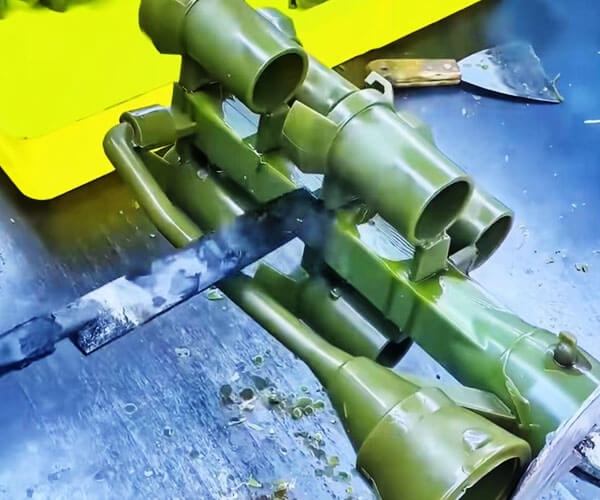
Manual assembly
Process and tools
Skilled technicians align and join individual wax patterns by hand using tools such as temperature-controlled soldering irons, hot-air guns, heated blades, ultrasonic welders, or wax-dispensing pens.
Common joining techniques include local hot-wax fusion, application of tack wax, and small-area adhesive bonding.
Fixtures and simple jigs are used to locate parts and protect thin sections during welding.
Mga kalakasan
- Extremely flexible: ideal for low-volume, many-variety production or frequent design changes (R&D, Mga prototype, bespoke medical or jewelry work).
- Low capital outlay: minimal equipment cost—primarily hand tools and fixtures.
- Immediate responsiveness: operators can adapt assembly sequences and joint geometry on the fly.
Limitations and risks
- Low throughput: a single operator typically completes only a few to a dozen joints per hour.
- Variable quality: assembly consistency depends on operator skill, pagkapagod, and ambient conditions (temperature/humidity).
- Rework and scrap risk: improper temperature control or pressure can cause under- or over-melting, misalignment or weak joints.
- Occupational hazards: prolonged exposure to heated wax, fumes and solvents requires controls (bentilasyon, PPE) to protect worker health.
Mga tipikal na aplikasyon
- Prototype builds, small batch luxury or medical parts, complex one-offs with frequent design iteration.
Awtomatikong (robotic) pagtitipon
System architecture and methods
Automated assembly integrates industrial robots or Cartesian gantries with vision/positioning systems, temperature-regulated welding heads, automatic wax feed systems and precision fixtures.
Programs control pick-and-place, pagkakahanay, dwell time, weld energy and dispensing volumes.
Inline inspection (vision, force or thermal sensors) and process logging enable closed-loop quality control.
Mga kalakasan
- Very high throughput: lines can perform dozens of repeatable joints per minute and run continuously.
- Excellent consistency and traceability: process parameters are controlled and recorded for each joint, enabling SPC and audit trails.
- Integration opportunity: online vision inspection, automated part handling and direct handover to downstream shelling equipment.
- Lower incremental labor cost per unit at scale.
Limitations and risks
- Mataas na paunang pamumuhunan: mga robot, mga fixtures, safety systems and PLC/software can be expensive.
- Low short-term flexibility: product changes often require new fixtures, reprogramming and validation, introducing downtime.
- Technical complexity: requires maintenance, skilled programmers and robust safety/quality infrastructure.
- Single-point failures: equipment downtime can halt high-volume production unless redundancy is planned.
Mga tipikal na aplikasyon
- Mataas na dami, standardized production such as automotive castings, HVAC components and mass-produced mechanical housings.
Paghahambing (summary table)
| Dimensyon | Manual Assembly | Robotic Automated Assembly |
| Typical scenarios | Small-batch, high-variation, R&D, highly complex nodes | Large-batch, standardized parts, high repetition |
| Email Address * | Mababa ang (few–dozen joints/hour) | Napakataas (dozens of joints/minute) |
| Katumpakan & pagkakapare pareho | Operator-dependent; variable | Mataas na; repeatable, programmable parameters |
| Kakayahang umangkop | Napakataas; immediate on-the-fly changes | Mababa ang; requires fixture/program changes |
Capital investment |
Minimal | Mataas na (significant upfront cost) |
| Operating cost | High labour/training cost per unit | Lower labour cost per unit; higher maintenance cost |
| Quality risks | Human error, inconsistent parameters | Equipment failure, programming errors |
| Typical uses | Aero blades, mga medikal na aparato, jewellery, Mga prototype | Mga bracket ng sasakyan, turbo housings, Mga balbula |
Hybrid Approach: Human–Robot Collaboration
Many modern facilities adopt a hybrid model that combines the strengths of both methods:
robots handle high-repetition, precision joints while skilled operators perform complex node assembly, adjustments, and final inspection.
This approach preserves flexibility for difficult features while maximizing throughput and consistency for routine connections.
6. Pangwakas na Salita
Wax pattern assembly is a technically critical operation that transforms design intent into a manufacturable casting system.
Its influence ranges from dimensional accuracy and surface quality to metal flow, solidification behavior and production economics.
Treat assembly as engineering: define materials and process windows, design tooling and joints for repeatability, and choose the assembly method that aligns with product mix and volume.
When executed with appropriate controls, wax pattern assembly is the keystone that enables high-precision, high-yield investment casting.