Producing high-quality aluminum extrusion feedstock and castings demands integrated control of alloy chemistry, melt cleanliness, thermal history and solidification behaviour.
Small amounts of impurities, inappropriate melting or degassing practice, or uncontrolled solidification can negate otherwise correct chemistries.
This paper synthesizes alloy-design principles (with emphasis on Al-Mg-Si / 6063), recommended smelting and refining practice, grain-refinement and casting parameters, homogenization strategy,
and troubleshooting measures to minimize typical defects (porosity, oxide entrapment, coarse grain, segregasyon).
1. Control philosophy: komposisyon at impurity budget
- Primary rule: a qualified alloy composition alone is necessary but not sufficient.
The total of trace impurities (hal., Fe, Cu, Zn, Mn, Ti, iba pa) and unintended elements must be controlled to limits that preserve surface finish, extrusion response and final mechanical properties. - Halimbawa (practical): although some standards allow Zn up to 0.10 wt% in certain wrought alloys,
production experience shows that Zn ≥ 0.05 wt% can produce white speckling on oxidized extrusion surfaces;
many producers therefore target Zn < 0.05 wt% for bright-finish profiles. - Impurities interact: the cumulative “impurity budget” is often more important than any single element’s compliance with a specification.
2. Alloy formulation: the Al–Mg–Si triad (6063 Pamilya)
- 6063 aluminum alloy nominal ranges (example, per GB/T and common practice): Si ≈ 0.2–0.6 wt%; Mg ≈ 0.45–0.9 wt%; Fe ≤ 0.35 wt%; other elements (Cu, Mn, Cr, Zr, Ti) Karaniwan < 0.10 wt%. (Consult final product spec for exact tolerances.)
- Strengthening phase: Mg₂Si is the principal hardening phase. Its effectiveness depends on the Mg:Si atomic/weight ratio — the Mg:Si weight ratio of Mg₂Si is ≈ 1.73.
To maximize age-hardening, maintain Mg:Si ≤ 1.73 (i.e. avoid Mg excess).
Excess Si has limited negative effect on Mg₂Si solubility; excess Mg reduces solubility and age response. - Solubility and heat/age behaviour (practical data): Mg₂Si shows strong temperature dependence; the pseudo-binary α(Al)–Mg₂Si eutectic forms near 595 °C.
Maximum Mg₂Si solubility cited in practice is ≈ 1.85 wt%, and at 500 °C solubility falls to ≈ 1.05 wt%.
Dahil dito, higher solution-treatment temperatures and adequate quench speed increase solute retention and raise aging strength — but practical limits exist to avoid incipient melting and excessive oxidation.
3. Smelting Technology of 6063 Aluminum Alloy
Smelting is the most critical process for producing high-quality aluminyo haluang metal Mga Billet.
Improper process control can lead to various casting defects, such as slag inclusions, porosity, coarse grains, and feathery crystals.
The following key technical points must be strictly implemented:
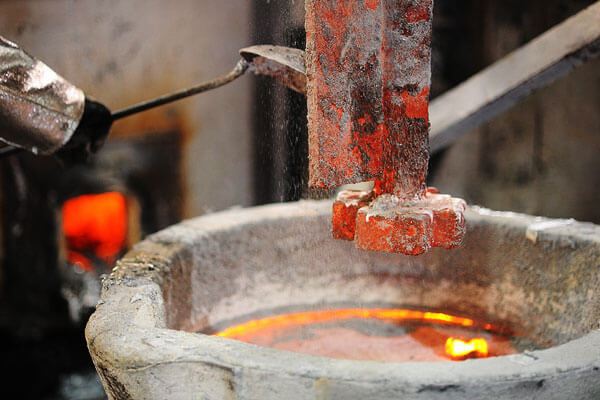
Precise Control of Smelting Temperature
The optimal smelting temperature for 6063 aluminum alloy is 750–760°C. Temperature control is critical for the following reasons:
- Low Temperature Risk: Temperatures below 750°C increase the viscosity of the aluminum melt, reducing the efficiency of slag separation and increasing the likelihood of slag inclusion defects in billets.
- High Temperature Risk: Temperatures above 760°C cause a sharp increase in hydrogen solubility in the aluminum melt.
Metallurgical research shows that hydrogen solubility in aluminum increases exponentially with temperature above 760°C.
Excessively high temperatures also accelerate the oxidation and nitridation of the melt, leading to increased burn loss of alloying elements, and directly induce defects such as coarse grains and feathery crystals.
Additional measures to reduce hydrogen absorption include:
- Preheating smelting furnaces and tools to 200–300°C to eliminate surface moisture.
- Using only dry, non-deteriorated raw materials and fluxes to avoid introducing moisture into the melt.
Selection of High-Quality Fluxes and Refining Process Optimization
Fluxes (including slag removers, refiners, and covering agents) are essential auxiliary materials for aluminum alloy smelting.
Most commercial fluxes consist of chlorides and fluorides, which are highly hygroscopic. Poor flux management is a major source of hydrogen contamination in the melt.
Flux Quality Control
- Raw materials for flux production must be thoroughly dried to remove moisture, and the finished flux must be hermetically packaged to prevent hygroscopic absorption during storage and transportation.
- Attention must be paid to the production date of the flux; expired fluxes tend to absorb moisture,
which reacts with the aluminum melt to produce hydrogen (2Al + 3H₂O → Al₂O₃ + 3H₂↑), leading to porosity defects in billets.
Optimization of Powder Injection Refining Process
Powder injection refining is the most widely used refining method for 6063 aluminyo haluang metal, as it enables full contact between the refining agent and the melt.
The core technical points of this process are:
- Nitrogen Pressure Control: The nitrogen pressure should be kept as low as possible, just sufficient to carry the refining agent into the melt.
High nitrogen pressure causes violent turbulence and splashing of the melt, increasing the formation of new oxide films and the risk of oxide inclusion defects. - Nitrogen Purity Requirements: High-purity nitrogen (≥99.99%) must be used for refining.
Impure nitrogen containing moisture will introduce additional hydrogen into the melt, counteracting the refining effect. - Refining Agent Dosage: The principle of more flux, less gas should be followed.
Increasing the dosage of the refining agent can enhance the degassing and slag removal effect, while reducing nitrogen usage can lower production costs and minimize melt turbulence.
The core process goal is to inject the maximum amount of refining agent into the melt using the minimum amount of nitrogen.
Grain Refinement Treatment
Grain refinement is one of the most effective measures to improve the quality of aluminum alloy billets and solve casting defects such as porosity, coarse grains, and feathery crystals.
The mechanism of grain refinement is as follows:
During non-equilibrium solidification, impurity elements (including alloying elements) tend to segregate at grain boundaries.
Finer grains increase the total grain boundary area, which reduces the concentration of impurity elements at each grain boundary.
For impurity elements, this reduces their harmful effects; for alloying elements, this improves their distribution uniformity and enhances their strengthening effect.
The effect of grain refinement can be illustrated by a simple calculation: assume two metal blocks of the same volume V, composed of cubic grains.
If the grain side length of block 1 is 2a and that of block 2 ay isang, the total grain boundary area of block 2 is twice that of block 1.
This means that reducing the grain size by half doubles the grain boundary area, and halves the impurity concentration per unit grain boundary area.
Para sa 6063 alloy used in frosted profiles, grain refinement is particularly important.
Finer, more uniform grains ensure that the profile surface is uniformly corroded during the frosting process, resulting in a consistent, high-quality frosted finish.
Common grain refiners for aluminum alloys include Al-Ti-B master alloys, which are typically added to the melt at a dosage of 0.1–0.3 wt.%.
4. Casting Technology of 6063 Aluminum Alloy
Casting is the process of converting the refined aluminum melt into solid billets of specified dimensions. Reasonable casting process parameters are essential for producing high-quality billets.
The following key technical points must be emphasized:
Selection of Optimal Casting Temperature
Para sa 6063 alloy melts treated with grain refiners, the optimal casting temperature is 720–740°C. This temperature range is determined by the following factors:
- The grain-refined melt has higher viscosity and faster solidification rates; a moderately elevated casting temperature ensures good fluidity of the melt and prevents cold shut defects.
- Sa panahon ng paghahagis, a liquid-solid two-phase zone forms at the solidification front of the billet.
A moderately high casting temperature narrows this two-phase zone, which facilitates the escape of gases generated during solidification and reduces porosity defects.
Gayunpaman, the casting temperature should not be excessively high, as high temperatures will shorten the effective time of the grain refiner and lead to coarse grain structures in the billet.
Preheating of Casting System
All components of the casting system, including launders, distributors, at mga hulma, must be fully preheated and dried to 200–300°C before casting.
This prevents the reaction between moisture on the surface of these components and the high-temperature aluminum melt, which is a major source of hydrogen contamination.
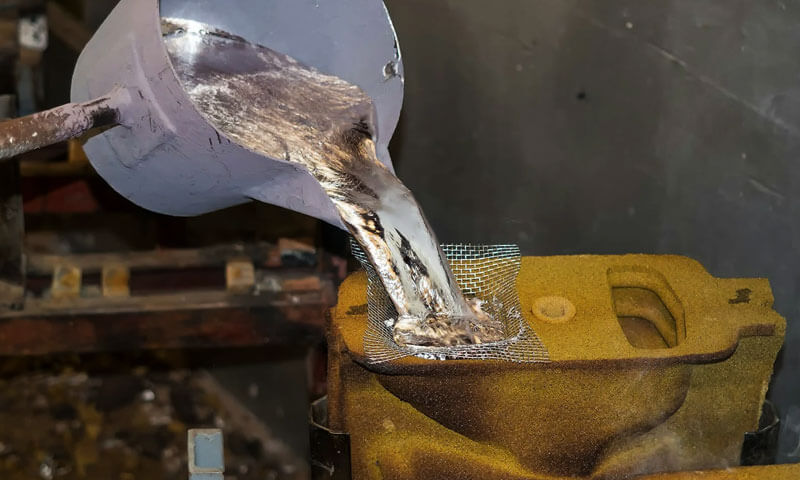
Prevention of Melt Turbulence and Oxide Inclusion
Sa panahon ng paghahagis, turbulence and splashing of the aluminum melt must be minimized. The following operational guidelines should be followed:
- Avoid stirring the melt in the launder or distributor with tools, as this will break the protective oxide film on the melt surface, leading to the formation of new oxides.
- Ensure that the melt flows smoothly into the mold under the protection of the oxide film.
Research shows that aluminum oxide films have strong hygroscopic properties, containing approximately 2 wt.% moisture.
If these oxide films are drawn into the melt, the moisture they contain will react with the aluminum to produce hydrogen and oxide inclusions, severely impairing billet quality.
Melt Filtration Treatment
Filtration is the most effective method for removing non-metallic inclusions from the aluminum melt.
Para sa 6063 alloy casting, two common filtration methods are widely used: multi-layer fiberglass cloth filtration and ceramic filter plate filtration.
Key operational points include:
- Before filtration, the surface slag of the melt must be removed. A slag baffle should be installed in the launder to separate the surface slag from the flowing melt, preventing the filter from clogging and ensuring smooth filtration.
- The filter should be preheated to the same temperature as the melt to avoid thermal shock to the filter and prevent the formation of cold shut defects in the melt.
5. Homogenization Treatment of 6063 Aluminum Alloy Billets
Non-Equilibrium Solidification and Its Effects
Sa panahon ng paghahagis, the aluminum melt solidifies rapidly, resulting in non-equilibrium solidification.
In a binary phase diagram composed of two elements A and B, when an alloy of composition F solidifies,
the equilibrium solid phase composition at temperature T1 should be G, but the actual solid phase composition is G’ due to rapid cooling.
This is because the diffusion rate of alloying elements in the solid phase is slower than the crystallization rate, leading to chemical composition inhomogeneity within the grains (i.e., segregasyon).
Non-equilibrium solidification of 6063 alloy billets results in two main problems:
- Residual casting stress exists between grains;
- Chemical composition inhomogeneity within grains due to segregation.
These problems increase the difficulty of subsequent extrusion processing and reduce the mechanical properties and surface treatment performance of the final profile.
Kaya nga, homogenization treatment is necessary for billets before extrusion.
Homogenization Treatment Process
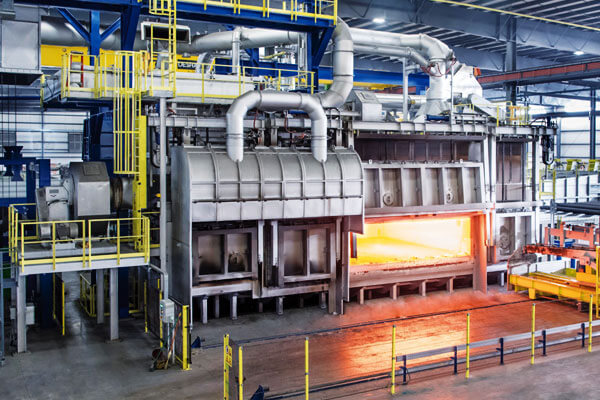
Homogenization treatment is a heat treatment process in which billets are held at a high temperature (below the overburning temperature) to eliminate casting stress and grain internal segregation.
Key technical parameters are as follows:
- Homogenization Temperature: The overburning temperature of the ideal Al-Mg-Si ternary system is 595°C,
but the actual 6063 alloy contains various impurity elements, making it a multi-component system.
Kaya nga, the actual overburning temperature is lower than 595°C.
The optimal homogenization temperature for 6063 alloy is 530–550°C. Higher temperatures within this range can shorten the holding time, save energy, and improve furnace productivity. - Holding Time: The holding time depends on the billet diameter and grain size.
Finer grains require shorter holding times because the diffusion distance of alloying elements from grain boundaries to grain interiors is shorter.
Energy-Saving Measures for Homogenization Treatment
Homogenization treatment requires high temperatures and long holding times, resulting in high energy consumption and processing costs, which is why many profile manufacturers skip this process.
Effective energy-saving measures include:
- Pagpipino ng Butil: As mentioned earlier, finer grains significantly shorten the required homogenization holding time, reducing energy consumption.
- Integrated Heating Process: Extend the billet heating furnace for extrusion, and implement segmented temperature control to meet both homogenization and extrusion temperature requirements.
This process has three main advantages:
-
- No additional homogenization furnace is required;
- The heat of the homogenized billet is fully utilized, avoiding repeated heating before extrusion;
- Long-term heating ensures uniform temperature distribution inside and outside the billet, which is beneficial for extrusion and subsequent heat treatment.
6. Quality assurance: metrics and inspection
Important acceptance checks prior to extrusion/casting release:
- Chemical analysis (full spectrochemical MTR): verify main alloying elements and trace impurities — especially Zn, Cu and Fe.
- Hydrogen analysis / porosity sampling: hydrogen content of melt (or porosity index on sample castings) and radiography/CT of representative billets.
- Inclusion level / filtration effectiveness: optical inspection of filter cakes, microscopical inclusion counts from lab coupons.
- Grain size and phase distribution: metallographic checks after sample solidification; ferrite/α grain size, secondary phases.
- Mechanical checks: tensile and hardness on coupons to confirm solution and alloy response.
7. Common casting defects — causes and remedies
| Depekto | Primary causes | Remedies / controls |
| Porosity (gas) | Excess hydrogen (high T, wet flux/tools), kaguluhan, kahalumigmigan | Keep melt <760 °C; dry flux/tools; low gas flow degassing; filtration; fine bubbles; proper pouring; reduce superheat |
| Oxide/slag inclusions | Surface film entrainment (kaguluhan), poor skimming, contaminated flux | Minimize turbulence; skimming; pre-filter; remove scum before filtration; seal flux packs |
Coarse grains / feather crystals |
Excessive superheat, exhausted grain refiner, poor inoculation | Use Al-Ti-B refiners; control melt superheat; maintain grain-refiner additions and melt chemistry |
| Non-uniform age response | Segregation, insufficient homogenization | Homogenize billets (530–550 °C) per cross-section; control solidification rate and grain size |
| Surface white spots after oxidation | Zn impurity or other segregating elements | Reduce Zn <0.05 wt%; control melt cleanliness and alloy chemistry |
8. Advanced and process-improvement techniques
- Ultrasonic degassing: generates cavitation for hydrogen removal and can break oxide films — effective in some shop implementations for small billets and high-value castings.
- Vacuum degassing / Mababang presyon ng paghahagis: reduces dissolved gas levels and can improve feeding; used in premium production.
- Electromagnetic stirring: when applied carefully, refines grain and homogenizes temperature; avoid excessive turbulence at the mold face.
- Automated dosing and melt records: precise master-alloy addition, AR/IR spectro control, and digital melt logs reduce human error and ensure traceability.
- Simulation tools: CFD to design low-turbulence gating, and solidification modelling to optimize thermal gradients and minimize hot spots.
9. Environmental, safety and economic considerations
- Flux handling hazards: chloride/fluoride salts are corrosive and hygroscopic; maintain sealed, dry storage. Provide PPE and fume control for flux use.
- Energy management: melting and homogenization are energy intensive; staged furnace systems,
waste heat recovery and process integration (pre-heat billets using exhaust heat) yield significant cost savings. - Scrap and recycling: segregate high-value alloy scrap vs contaminated material; implement melt practices to limit tramp elements and maintain alloy quality.
10. Pangwakas na Salita
High-quality aluminum alloy castings and extrusion feedstock are the product of disciplined alloy control, precise melt management and well-designed solidification practice.
For 6xxx series alloys such as 6063, success hinges on maintaining the correct Mg: Si balance, keeping impurity elements (especially Zn) below practical thresholds for surface quality,
avoiding excessive melt superheat, using effective refining (pulbos + controlled gas purge), achieving fine grain structure, and applying appropriate homogenization.
Implement these measures together — rather than in isolation — and the result will be predictable mechanical properties, robust surface quality and fewer costly scrap or rework events.
Mga FAQ
Why is Zn <0.05 recommended when many specs allow 0.10?
Practical shop experience shows Zn near 0.1 promotes white speckling after oxidation/anneal; reducing to <0.05 mitigates surface defects for bright/extruded profiles.
What is the single most sensitive melting parameter?
Melt temperature. Above about 760 °C dissolved hydrogen rises sharply and causes porosity and other defects; keep melt temperature controlled and residence time minimal.
Powder refining vs high gas flow — which is better?
Gamitin ang ample refining powder with minimal, controlled gas flow. Large gas flows make large bubbles with short residence: poor degassing and increased turbulence.
Does grain refinement increase casting temperature tolerance?
Yes — an effectively grain-refined melt tolerates slightly higher casting temperatures (typ. 720–740 °C) because the mushy zone narrows and feeding improves; but superheat should still be limited.
Can casting scrap be reused safely?
Oo nga, but monitor tramp elements and segregate by alloy family. Recycled material increases impurity burden and requires more refined melt practice and tighter MTR control.