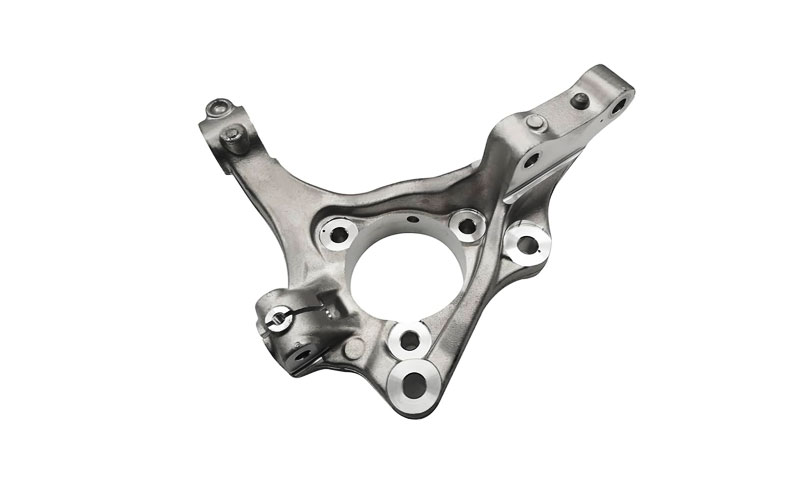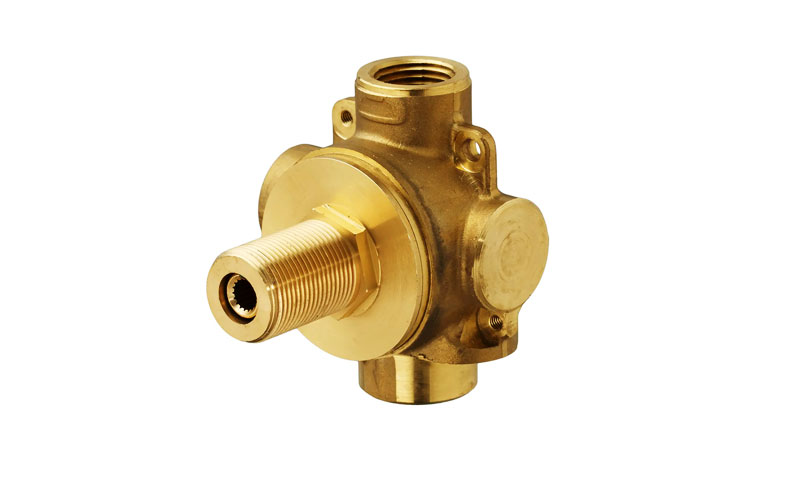
Las válvulas desviadoras son componentes esenciales en los sistemas de manejo de fluidos., Permitir la redirección del flujo de un camino a otro..
Estas válvulas son muy utilizadas en fontanería., calefacción, ventilación, aire acondicionado (HVAC), tratamiento de agua, y procesamiento industrial.
Entre los diversos materiales utilizados para las válvulas desviadoras., El latón destaca como la opción preferida debido a su excelente maquinabilidad., resistencia a la corrosión, propiedades antimicrobianas, y atractivo estético.
La fabricación de válvulas desviadoras de latón de alta calidad requiere una combinación de fundición de precisión y mecanizado CNC avanzado..
Casting de cera perdido (casting de inversión) es el método ideal para producir los complejos conductos internos y las intrincadas geometrías de los cuerpos de las válvulas desviadoras..
Cuando se combina con mecanizado CNC de precisión, este proceso proporciona válvulas con una precisión dimensional excepcional, acabados superficiales lisos, y rendimiento confiable.
1. ¿Qué es una válvula desviadora de latón??
A válvula desviadora de latón es un dispositivo de control de fluidos multipuerto diseñado para redirigir, seleccionar, o distribuir el flujo de fluido entre diferentes rutas de flujo.
A diferencia de una válvula de cierre convencional de dos vías, Una válvula desviadora utiliza múltiples puertos y un elemento móvil interno para determinar qué pasajes están conectados en una posición operativa determinada..
El cuerpo de la válvula es normalmente el componente que contiene la presión.. Incorpora los puertos de entrada y salida., pasajes de flujo interno, cámara de válvulas, interfaces de sellado, y características de conexión.
Un elemento interno, comúnmente una pelota., enchufar, cartucho, o mecanismo operado por husillo: cambia la ruta del flujo cuando la válvula se gira o se acciona.
Una válvula desviadora típica de tres vías, Por ejemplo, Puede operar en dos posiciones básicas.:
Posición A: Entrada → Salida A
Posición B: Entrada → Salida B
Las configuraciones más sofisticadas pueden combinar o aislar rutas de flujo según los requisitos del proceso..
El rendimiento de una válvula desviadora de latón depende de algo más que su capacidad para cambiar el flujo..
La válvula debe mantener la integridad de la presión., resistencia al flujo controlado, cierre confiable, estabilidad dimensional, y sellado repetible durante toda su vida útil prevista.
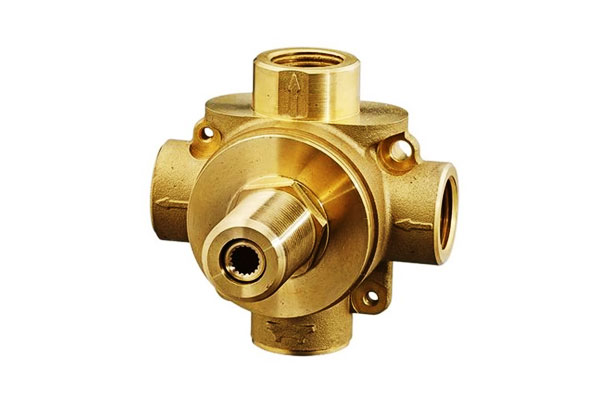
Tipos de válvulas desviadoras
| Tipo | Descripción | Aplicaciones típicas |
| 3-Válvula desviadora de vías | Una entrada, dos salidas (o viceversa). | Sistemas de ducha, válvulas mezcladoras, HVAC, control de procesos. |
| 4-Válvula desviadora de vías | Dos entradas, dos salidas. | Sistemas de calefacción, bombas de calor, aplicaciones de flujo inverso. |
| Válvula desviadora rotativa | Un elemento giratorio desvía el flujo entre los puertos.. | Transporte neumático, manipulación de polvo, procesamiento industrial. |
| Válvula desviadora deslizante | Una placa deslizante redirige el flujo. | Manipulación de materiales a granel, recolección de polvo. |
| Válvula desviadora de bola | Una bola con múltiples pasajes gira para dirigir el flujo.. | Plomería, procesamiento químico, distribución de gas. |
2. Aleaciones de latón comunes para la fundición de válvulas desviadoras
Seleccionando el correcto latón La aleación es fundamental para la integridad de la presión., resistencia a la corrosión, maquinabilidad, estabilidad dimensional, y vida útil de una válvula desviadora.
El latón no es un material único, sino una amplia familia de aleaciones a base de cobre con composiciones y características de rendimiento sustancialmente diferentes..
Para una válvula desviadora de fundición de precisión, La selección de la aleación debe considerar algo más que la resistencia mecánica..
El fabricante también debe evaluar el comportamiento de la fundición., requisitos de presión interna, química de fluidos, resistencia a la descincificación, requisitos de mecanizado, temperatura, exposición ambiental, y restricciones reglamentarias sobre los componentes de las aleaciones.
En particular, Las válvulas destinadas a agua potable u otras aplicaciones de contacto con fluidos regulados pueden requerir aleaciones con bajo contenido de plomo o sin plomo específicamente calificadas para ese servicio..
Por lo tanto, la "mejor" aleación de latón depende de la aplicación y no es universal.
Aleaciones de latón de uso común para la fundición de válvulas desviadoras
| Aleación (A NOSOTROS) | Propiedades clave | Aplicaciones típicas de válvulas |
| C84400 | Buena castabilidad y maquinabilidad.; latón semi-rojo con plomo tradicional | Cuerpos de válvulas fundidos, accesorios de fontanería, componentes generales de control de fluidos |
| C85700 | Latón naval con plomo; buena maquinabilidad y resistencia a la corrosión | Componentes fundidos que contienen presión., accesorios orientados a la marina |
| C87610 | Aleación de cobre y silicio con buena resistencia y resistencia a la corrosión.; bajo plomo | Componentes de servicio de agua y piezas fundidas resistentes a la corrosión cuando se especifique |
| C87800 | Latón al silicio; buena capacidad, fortaleza, resistencia a la corrosión, y características de bajo plomo | Cuerpos de válvulas de servicio de agua, accesorios de fontanería, componentes industriales |
C87850 |
Latón al silicio con buena maquinabilidad., estanqueidad a la presión, y resistencia a la corrosión | Cuerpos de válvula, grietas, cajas de medidores de agua, fontanería y componentes marinos |
| C89833 | Aleación que contiene bismuto sin plomo; buena maquinabilidad y resistencia a la corrosión | Componentes que contienen presión sin plomo., aplicaciones de plomería y válvulas orientadas a agua potable donde se especifique |
| C36000 | Excelentes características de mecanizado libre | Componentes de válvula mecanizados, tallos, guarniciones, adaptadores, Piezas de precisión pequeñas |
3. Válvula desviadora de latón Proceso de fundición a la cera perdida
El proceso de fundición a la cera perdida para válvulas desviadoras de latón está diseñado para convertir una geometría compleja del cuerpo de la válvula en una fundición de metal con forma casi neta con consistencia dimensional controlada e integridad estructural sólida..
Revisión y herramientas de CAD
El proceso comienza con el dibujo de la válvula o modelo CAD 3D.. Antes de producir las herramientas, Se revisa la geometría para determinar la viabilidad de la fundición y la estabilidad de la producción..
El fabricante establece el margen de contracción requerido., margen de mecanizado, transiciones de pared, filetes, ubicaciones de puertas, y orientación de la fundición.
Para una válvula desviadora, Se presta especial atención a las regiones que rodean los pasos de flujo que se cruzan porque los cambios repentinos en el espesor de la sección pueden influir en la alimentación y solidificación del metal..
Luego se fabrican las herramientas para reproducir la geometría del patrón de cera requerida..
Producción de patrones de cera
Se inyecta cera fundida en el troquel de precisión para crear el patrón de sacrificio del cuerpo de la válvula..
La calidad del patrón determina la base dimensional de la pieza fundida.. Temperatura de inyección, presión, tiempo de espera, enfriamiento, y la condición del dado debe ser controlada para minimizar la rebaba., distorsión, llenado incompleto, y variación dimensional.
El patrón de cera completo se inspecciona antes de proceder al montaje..
Ensamblaje de cera y compuerta
Los patrones de cera individuales están conectados a un sistema de bebedero central para formar un árbol de fundición..
En esta etapa, El sistema de compuerta se establece de manera que el latón fundido pueda llenar la cavidad de la válvula de manera controlada..
La posición de la puerta y las dimensiones de las correderas influyen en el tiempo de llenado, turbulencia, gradientes térmicos, y comportamiento alimentario.
Para válvulas desviadoras complejas, La puerta está diseñada alrededor del geometría de todo el cuerpo, en lugar de simplemente maximizar la velocidad de llenado.
Edificio de conchas de cerámica
El árbol de cera se sumerge repetidamente en lechada de cerámica y se recubre con estuco refractario.. Las capas sucesivas construyen una capa cerámica rígida alrededor del patrón..
La carcasa debe proporcionar suficiente resistencia para el desparafinado y el vertido de metal y al mismo tiempo reproducir el detalle de superficie requerido..
Los controles primarios del proceso son:
Viscosidad de lodo + tamaño de partícula refractaria + espesor de capa + condiciones de secado + fuerza de la cáscara
La preparación inconsistente de la cáscara puede provocar grietas., variación dimensional, mala calidad de la superficie, o falla de la cáscara durante el vertido.
Desparafinado y cocción de conchas
La carcasa de cerámica se calienta para eliminar el patrón de cera y crear la cavidad negativa del cuerpo de la válvula..
Después de rociar, La carcasa se cuece para eliminar el material orgánico residual y desarrollar la resistencia refractaria y la estabilidad térmica requeridas..
El molde cerámico resultante debe estar limpio., seco, y estructuralmente sano antes de introducir el latón fundido.
Control de aleación y fusión de latón
La aleación de latón seleccionada se funde en condiciones controladas..
El objetivo clave es garantizar que el metal fundido cumpla con los requisitos especificados. Requisitos de composición química y limpieza. Antes de verter.
Esto es particularmente importante para válvulas personalizadas donde las propiedades del material y los requisitos regulatorios pueden depender de un grado de aleación específico..
El control de procesos normalmente incluye:
- Materiales de carga verificados
- Monitoreo de la temperatura de fusión
- Análisis químico
- Control de escorias y óxidos.
- Identificación y trazabilidad del calor.
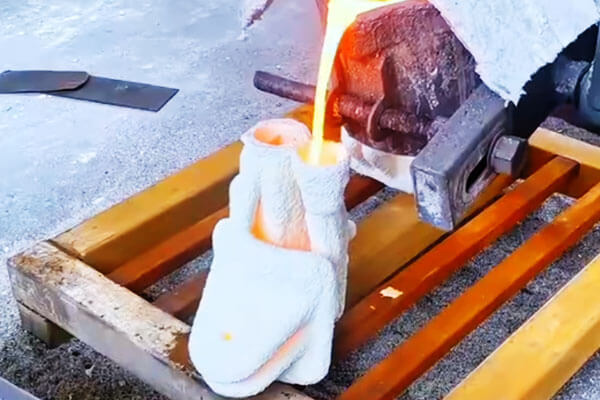
Vertido controlado
La carcasa de cerámica precalentada se llena con latón fundido a través del sistema de compuerta diseñado..
La temperatura de vertido y la velocidad de llenado deben adaptarse a la aleación y a la geometría de la válvula..
El metal debe permanecer lo suficientemente fluido como para llenar secciones delgadas y pasajes complejos sin turbulencias excesivas o solidificación prematura..
Una operación de vertido bien controlada busca lograr:
llenado completo + flujo estable + arrastre mínimo + condiciones térmicas controladas
Solidificación y alimentación
Después del llenado, el latón comienza a solidificarse. Porque el cuerpo de la válvula puede contener diferentes espesores de pared, jefe, y cruces de pasajes, diferentes áreas pueden enfriarse a diferentes velocidades.
Por lo tanto, el diseño de la fundición debe soportar una solidificación controlada y una alimentación adecuada del metal que se contrae..
Un control deficiente de la solidificación puede producir defectos como:
- Porosidad de contracción
- Cavidades de contracción
- Discontinuidades relacionadas con el gas
- Crujido caliente
Para cuerpos de válvulas complejos, La simulación de fundición se puede utilizar para predecir el comportamiento de llenado y solidificación y optimizar el sistema de entrada y alimentación antes de la producción..
Knockear
Una vez que la fundición se haya enfriado lo suficiente, la cubierta de cerámica se retira mecánicamente.
Vibración, separación mecánica, u otros métodos adecuados pueden usarse dependiendo del componente y del sistema de producción..
Se debe tener cuidado durante el knockout porque una fuerza mecánica excesiva puede dañar las secciones delgadas., características del puerto, o superficies fundidas.
Extracción de puerta y contrahuella
el bebedero, corredores, puertas, y los elevadores se cortan de la fundición de la válvula.
Las ubicaciones de corte se seleccionan de manera que la extracción no dañe las áreas funcionales ni deje material excesivo que complicaría el mecanizado posterior..
Esta etapa convierte el árbol de fundición de precisión en una fundición de cuerpo de válvula individual..
Acabado de fundición
La pieza fundida limpia se somete a molienda., voladura, u otras operaciones de acabado adecuadas para eliminar restos de cerámica., aletas, destello, y restos de puertas.
El objetivo es producir una pieza fundida limpia y estable apta para su inspección y posterior mecanizado..
En tono rimbombante, El acabado no debe utilizarse para ocultar discontinuidades inaceptables del moldeado.. Áreas que se convertirán en límites de presión, superficies de sellado, o puntos de referencia de mecanizado críticos requieren atención especial.
4. Mecanizado CNC de piezas fundidas de válvulas desviadoras de latón
La fundición a la cera perdida establece la geometría principal de una válvula desviadora de latón, pero normalmente no proporciona la precisión final requerida para interfaces críticas.
Mecanizado CNC es, por lo tanto, el puente entre una pieza fundida casi en forma y una válvula de precisión funcional.
El proceso de mecanizado no sólo debe alcanzar dimensiones individuales; debe mantener la relación geométrica entre puertos, pasajes de flujo, asientos de válvula, superficies de sellado, tallos, e interfaces de actuador.
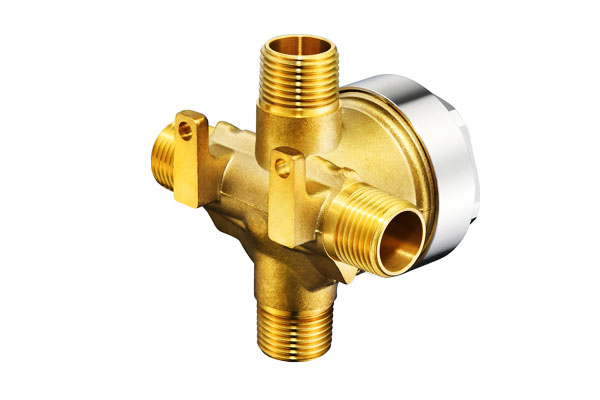
Una secuencia de producción típica es:
Inspección de fundición → Establecimiento de referencia → Mecanizado de desbaste → Mecanizado de orificio/puerto → Mecanizado de roscas → Mecanizado de asiento y ranura de sello → Mecanizado de interfaz del actuador → Desbarbado → Inspección dimensional
La secuencia exacta depende de la arquitectura de la válvula..
Mecanizado de los puertos de válvula y los orificios internos
Los puertos de entrada y salida establecen la conexión de la válvula con el sistema de fluido externo.. Dependiendo del diseño de la válvula, estas interfaces pueden utilizar:
- NPT u otras roscas de tubería cónicas
- Roscas BSP o BSPP/BSPT
- Hilos métricos o personalizados
- Interfaces de compresión
- Conexiones bridadas
- Soldadura fuerte o geometrías de conexión especializadas
La operación de mecanizado de puertos debe controlar tanto la dimensión como la posición..
Una rosca correctamente mecanizada aún puede crear problemas de ensamblaje si el eje del puerto está colocado incorrectamente en relación con el cuerpo de la válvula o los puertos adyacentes..
Para intersección de pasajes internos., El mecanizado puede implicar taladrar., aburrido, perforación cruzada, o una combinación de características fundidas y mecanizadas.
La transición entre estos pasajes debe examinarse cuidadosamente porque una brusquedad excesiva puede aumentar la pérdida de presión y la turbulencia..
En diseños personalizados, La fundición puede producir la mayor parte de la arquitectura de flujo, mientras que el mecanizado CNC termina las aberturas y las interfaces funcionales..
Mecanizado de precisión de asientos de válvulas
El asiento de la válvula se encuentra entre las características más críticas de una válvula desviadora porque forma la interfaz que limita las fugas de fluido no deseadas..
El rendimiento del asiento depende de varias características que trabajan juntas:
Concentricidad + Geometría de contacto + Acabado superficial + Planitud/Redondez + Compatibilidad de material
Un asiento de válvula que cumple con su diámetro nominal pero no es concéntrico con el elemento de válvula puede producir un contacto desigual..
Similarmente, una superficie excesivamente rugosa puede interferir con el sellado, mientras que una geometría de superficie incorrecta puede aumentar el par de operación.
Por lo tanto, la tolerancia del asiento y el acabado superficial apropiados deben especificarse de acuerdo con el diseño particular de la válvula., elemento de sellado, calificación de presión, y requisito de fuga.
Mecanizado de roscas
Las roscas son comunes en las válvulas desviadoras de latón porque proporcionan conexiones compactas y económicas..
El mecanizado CNC se puede utilizar tanto para roscas internas como externas.. Los parámetros críticos incluyen:
- Diámetro mayor
- Diámetro menor
- Paso
- Perfil de hilo
- Diámetro efectivo
- Profundidad del hilo
- Concentricidad
- Acabado superficial
Los calibres de rosca se utilizan a menudo para la verificación de la producción., mientras que la inspección dimensional puede confirmar la geometría subyacente.
Porque el latón es relativamente mecanizable, apoya la producción eficiente de hilo, pero la estrategia de corte aún debe adaptarse a la aleación particular.
Algunas aleaciones de latón sin plomo pueden comportarse de manera diferente a los grados tradicionales de mecanizado libre y pueden requerir herramientas y parámetros de corte optimizados..
Mecanizado de juntas tóricas y ranuras de sellado
Donde se utilizan sellos elastoméricos, la ranura de la junta tórica es una característica de precisión en lugar de un simple hueco.
Sus dimensiones determinan la compresión del sello y, por lo tanto, influyen en el rendimiento de fugas.. Ancho de ranura incorrecto, profundidad, geometría de esquina, o la condición de la superficie puede causar:
- Sellado insuficiente
- Compresión excesiva
- Extrusión de sello
- Dificultad de montaje
- Desgaste prematuro del sello
En consecuencia, el proceso de mecanizado debe mantener la geometría de ranura especificada y al mismo tiempo proteger la superficie de sellado circundante..
5. Opciones de acabado superficial para válvulas desviadoras de latón
Para componentes de válvulas personalizados, El acabado de la superficie debe seleccionarse junto con la aleación., proceso de mecanizado, tolerancias dimensionales, y entorno operativo.
No todos los procesos de acabado son adecuados para todas las superficies.
En particular, asientos de válvula, trapos, interfaces de sellado, y los pasajes mojados pueden requerir condiciones de acabado estrictamente controladas para evitar cambiar sus dimensiones funcionales..
Pulido mecánico
El pulido mecánico utiliza medios abrasivos progresivamente más finos para eliminar las marcas de mecanizado., irregularidades superficiales menores, e imperfecciones superficiales relacionadas con la fundición de la superficie de latón.
Dependiendo de la apariencia requerida, El proceso puede variar desde un acabado abrasivo básico hasta un pulido de alto brillo..
Ventajas:
- Produce una superficie de latón suave y atractiva.
- Mejora la apariencia visual.
- Reduce las marcas visibles de mecanizado y fundición.
- Proporciona un sustrato eficaz para el revestimiento posterior.
- Puede mejorar la uniformidad de la superficie en las superficies externas de las válvulas.
Níquel
El niquelado deposita una capa controlada de níquel sobre la superficie de latón preparada., normalmente a través de un proceso de galvanoplastia.
Un tratamiento previo adecuado es esencial para garantizar una buena adhesión entre el sustrato de latón y el revestimiento..
Ventajas:
- Mejora la resistencia a la corrosión
- Proporciona mayor dureza superficial que el latón sin tratar.
- Mejora la resistencia al desgaste
- Produce una apariencia metálica uniforme.
- Adecuado para componentes expuestos a la humedad y manipulación.
- Puede proporcionar una capa base para sistemas de acabado decorativos o funcionales.
Revestimiento
El cromado aplica una capa superficial a base de cromo sobre un sustrato adecuadamente preparado., a menudo sobre niquelado.
El proceso produce un duro, superficie brillante con buena resistencia al desgaste y al deslustre.
Ventajas:
- Excelente apariencia decorativa
- Alta dureza superficial
- Buena resistencia al desgaste
- Buena resistencia al deslustre y a la exposición atmosférica.
- Adecuado para componentes de válvulas expuestos y herrajes decorativos de plomería.
Recubrimiento de níquel electroales
El niquelado electrolítico deposita un recubrimiento de níquel-fósforo o una aleación de níquel relacionada a través de una reacción química autocatalítica en lugar de depender de una corriente eléctrica externa directa..
Esto permite un espesor de recubrimiento relativamente uniforme en geometrías complejas..
Ventajas:
- Espesor de recubrimiento más uniforme en superficies complejas
- Buena resistencia a la corrosión
- Buena resistencia al desgaste y a la abrasión
- Adecuado para geometrías empotradas e irregulares.
- Proporciona protección controlada de la superficie con una acumulación dimensional relativamente predecible.
- Útil para componentes de válvulas industriales que requieren protección y consistencia dimensional.
Acabado de superficie mecanizado con precisión
Para superficies funcionales como asientos de válvulas, orientación, trapos, y sellado de interfaces, el acabado requerido a menudo se produce directamente mediante mecanizado CNC controlado, torneado fino, aburrido, molienda, u otras operaciones de precisión en lugar de a través de un revestimiento decorativo.
Ventajas:
- Mantiene un control dimensional preciso
- Permite una geometría de sellado precisa
- Soporta rugosidad superficial controlada
- Evita la acumulación innecesaria de recubrimiento en interfaces críticas
- Proporciona ensamblaje y rendimiento funcional predecibles.
- Especialmente adecuado para asientos de válvulas., orientación, trapos, y superficies de contacto con el sello
6. Ventajas de la fundición a la cera perdida para válvulas desviadoras de latón
La fundición a la cera perdida ofrece ventajas únicas para la fabricación de válvulas desviadoras que no pueden igualarse con métodos alternativos de fundición o conformado..
Precisión dimensional inigualable & Repetibilidad
La fundición a la cera perdida alcanza ±0,05–0,1 mm por 25 mm tolerancia como fundición, con repetibilidad constante en altos volúmenes de producción.
Esto reduce el stock de mecanizado., minimiza la acumulación de tolerancia, y asegura un ensamblaje intercambiable.
Geometría interna compleja & Optimización del flujo
La cera perdida puede producir complejas geometrías de puertos internos, transiciones de flujo suaves, y pasajes contorneados que serían imposibles con fundición en arena o antieconómicos de mecanizar.
Las rutas de flujo internas optimizadas reducen la turbulencia, caída de presión, y ruido de flujo.
Acabado de superficie superior como fundición
La fina capa frontal de cerámica produce un acabado de superficie de fundición Ra de 1,6 a 3,2 μm., reduciendo el tiempo de mecanizado y mejorando el rendimiento de la superficie de sellado.
Las superficies lisas de fundición también reducen la erosión inducida por el flujo dentro de los conductos de fluidos..
Stock de mecanizado mínimo & Eficiencia de material
La fundición con forma casi neta requiere solo entre 0,8 y 1,5 mm de material de mecanizado por lado, en comparación con 3-6 mm para la fundición en arena.
Esto reduce el desperdicio de material entre un 40% y un 60% y reduce significativamente el tiempo de mecanizado..
Flexibilidad de aleación & Formulación personalizada
La fundición a la cera perdida funciona con prácticamente cualquier aleación de latón., permitiendo que la formulación de aleaciones personalizadas coincida con la corrosión específica, fortaleza, o requisitos reglamentarios sin cambios importantes en las herramientas.
Integridad de presión constante & Resistencia a fugas
Los cuerpos fundidos de una sola pieza eliminan las vías de fuga de las juntas ensambladas. La solidificación controlada minimiza la porosidad interna., asegurando un rendimiento hermético que supera la prueba de fugas de presión de trabajo 1,5x.
7. Fundición a la cera perdida vs.. Válvulas desviadoras de latón forjado
Tanto la fundición como la forja producen componentes de válvulas de latón., pero sirven para distintos escenarios de diseño y rendimiento..
| Dimensión de rendimiento | Válvulas de latón fundido a la cera perdida | Válvulas de latón forjado |
| Precisión dimensional | ±0,05 – ±0,1 mm/25 mm como fundición; más apretado después del mecanizado | ±0,02 – ±0,05 mm; muy consistente |
| Complejidad de la geometría interna | Muy alto: puertos complejos, pasajes contorneados, diseños multipuerto | Limitado: solo formas axiales simples; características internas profundas no factibles |
| Presión & Resistencia a la fatiga | Bueno para presión estándar; dependiente de la porosidad | Excelente; mayor resistencia a la fatiga y presión de estallido |
| Idoneidad del volumen de producción | 500 - 50,000 PCS/Año | 10,000 - 500,000+ PCS/Año |
| Costo de herramientas & Tiempo de entrega | Costo moderado de herramientas; 4–Plazo de entrega de 6 semanas | Alto costo de herramientas; 6–10 semanas de plazo de entrega |
| Costo unitario total | Medio-alto para volumen bajo; competitivo a volumen medio | Alto a bajo volumen; más bajo a un volumen muy alto |
| Escenarios de aplicación ideales | Carrocerías multipuerto complejas, caminos de flujo contorneados, volumen medio | Diseños axiales simples, presión alta, fatiga de ciclo alto, volumen muy alto |
8. Aplicaciones de las válvulas desviadoras de latón
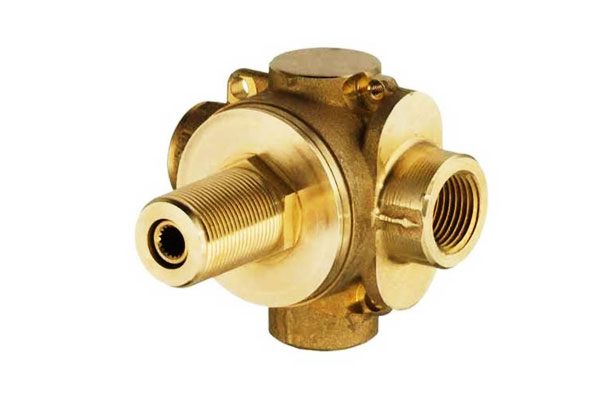
Fontanería y Distribución de Agua
Las válvulas desviadoras de latón se utilizan ampliamente en sistemas de plomería para redirigir el agua entre diferentes salidas., circuitos, o accesorios.
Su diseño compacto, resistencia a la corrosión, y su buena maquinabilidad los hacen adecuados para equipos de control de agua tanto residenciales como comerciales..
Las aplicaciones típicas incluyen:
- Sistemas de ducha
- Conjuntos de grifos
- Equipos de distribución de agua.
- Sistemas de mezcla y enrutamiento.
- Equipos de fontanería para el hogar.
HVAC y sistemas de calefacción
Las válvulas desviadoras de latón se utilizan comúnmente en sistemas HVAC y de calefacción hidrónica para controlar la dirección de circulación del agua y otros fluidos compatibles..
La válvula puede cambiar el flujo entre circuitos de calefacción., líneas de derivación, o bucles secundarios.
Las aplicaciones típicas incluyen:
- Sistemas de calefacción por radiadores.
- Sistemas de calefacción por suelo radiante
- Circuitos de circulación HVAC
- Sistemas de bomba de calor
- Equipos de calderas y calefacción.
Sistemas de riego
En equipos de riego, Las válvulas desviadoras de latón se pueden utilizar para dirigir el agua entre diferentes ramas o zonas..
Su resistencia a la corrosión y su construcción robusta los hacen adecuados para cambios de flujo repetidos en entornos exteriores..
Las aplicaciones típicas incluyen:
- Sistemas de riego agrícola
- Equipos de riego de jardines
- Sistemas de rociadores
- Riego de invernaderos
- Colectores de distribución de agua
Equipos de tratamiento de agua
Las válvulas desviadoras de latón se pueden integrar en sistemas compactos de tratamiento de agua donde es necesario seleccionar o aislar diferentes rutas de flujo..
La fundición de precisión es particularmente útil cuando el cuerpo de la válvula requiere pasajes internos personalizados..
Las aplicaciones típicas incluyen:
- Sistemas de filtración de agua.
- Equipos de purificación de agua.
- Sistemas de ablandamiento
- Conjuntos de bomba y filtración.
- Unidades de control de tratamiento de agua.
Electrodomésticos y Equipos Residenciales
Las válvulas desviadoras compactas de latón también se utilizan en aparatos donde se debe redirigir agua u otro fluido compatible entre diferentes circuitos internos..
Las aplicaciones típicas incluyen:
- Equipos de café y bebidas.
- Aparatos de lavado
- Calentadores de agua
- Equipo de limpieza
- Dispositivos residenciales de control de agua.
Equipos de control de fluidos industriales
Los equipos industriales pueden utilizar válvulas desviadoras de latón para enrutar el agua., aceite, aire, u otros fluidos compatibles donde la presión, temperatura, y el entorno químico están dentro de los límites de diseño del material y de la válvula..
Las aplicaciones típicas incluyen:
- Sistemas de bombeo
- Compresores y equipos auxiliares.
- Maquinaria de procesamiento de fluidos
- Sistemas de refrigeración industriales
- Montajes de equipos personalizados
Sistemas Comerciales y Especializados
Las válvulas desviadoras de latón personalizadas también son adecuadas para fabricantes de equipos que requieren un componente compacto de control de flujo multipuerto diseñado en torno a un conjunto o circuito de fluido específico..
Las aplicaciones típicas incluyen:
- Equipos de plomería comercial.
- Sistemas de circulación de agua.
- Colectores de equipos
- Conjuntos de control de fluidos OEM
- Maquinaria y equipos de proceso personalizados.
9. ¿Por qué elegir LangHe Industry para la fundición a la cera perdida de válvulas desviadoras de latón? & Mecanizado?
Para válvulas desviadoras de latón personalizadas, Seleccionar un fabricante no es simplemente una cuestión de encontrar un proveedor que pueda fundir latón..
El componente final depende de la coordinación de la ingeniería de fundición., selección de aleación, Mecanizado CNC, acabado superficial, control dimensional, y pruebas funcionales.
Industria de Langhe aborda la producción de válvulas desviadoras de latón personalizadas como un proyecto de fabricación integrado, permitiendo que las etapas de fundición y mecanizado se desarrollen juntas en torno a los requisitos funcionales del cliente..
| Capacidad | Detalles |
| Materiales | C84400, C85700, C87610, C87800, C87850, C89833, C36000. |
| proceso de fundición | Casting de cera perdido (casting de inversión). |
| Tolerancias | ± 0.1–0.3 mm (CT5-CT7 según ISO 8062). |
| Mecanizado CNC | CNC Turning, molienda, perforación, ritmo, aburrido, repente, enhebrado. |
| Calidad | ISO 9001:2015 certificado; 100% inspección; Cmm. |
| Tiempo de entrega | 6–12 semanas para herramientas; 2–4 semanas para pedidos repetidos. |
10. Conclusión
Una válvula desviadora de latón es un componente compacto, pero sus requisitos de fabricación están altamente interconectados.
El cuerpo de la válvula debe contener presión., proporcionar rutas de flujo precisas, acomodar el elemento de válvula interna, mantener las interfaces de sellado, y conectarse de manera confiable con tuberías o equipos externos.
Para diseños personalizados complejos, La fundición a la cera perdida proporciona una manera eficiente de establecer la geometría principal del cuerpo de la válvula., incluyendo puertos personalizados, jefe, transiciones, y arquitectura interna adecuada.
El mecanizado CNC luego trae hilos, orientación, asientos de válvula, ranuras de sellado, y las interfaces del actuador con la precisión requerida.
La selección del material es igualmente importante. Las diferentes aleaciones de latón ofrecen diferentes combinaciones de moldeabilidad., maquinabilidad, resistencia mecánica, resistencia a la corrosión, y adecuación regulatoria.
Por lo tanto, la elección correcta debe basarse en el fluido real y el entorno operativo..
LangHe Industry combina fundición de precisión de latón y mecanizado CNC para respaldar la producción de válvulas desviadoras personalizadas desde la revisión del diseño inicial hasta la inspección de los componentes terminados., Ayudar a los clientes OEM a convertir conceptos complejos de válvulas en productos fabricables y repetibles..
Preguntas frecuentes
¿Qué es una válvula desviadora de latón??
Una válvula desviadora de latón es un dispositivo de control de fluido de múltiples puertos que se utiliza para redirigir o distribuir selectivamente el fluido entre diferentes vías de flujo..
Su elemento de válvula interna determina qué puertos están conectados en cada posición operativa..
¿Por qué se usa comúnmente latón para válvulas desviadoras??
El latón proporciona una combinación útil de resistencia a la corrosión., maquinabilidad, resistencia mecánica, castigabilidad, y rentabilidad.
Estas propiedades lo hacen adecuado para muchos tipos de agua., HVAC, plomería, aparato, y aplicaciones de control de fluidos industriales.
¿Por qué utilizar fundición a la cera perdida para una válvula desviadora de latón??
La fundición a la cera perdida es particularmente útil cuando el cuerpo de la válvula contiene una geometría compleja., múltiples puertos, jefes integrados, o pasajes de flujo personalizados.
Produce un cuerpo con forma casi neta que posteriormente puede mecanizarse mediante CNC..
¿Se pueden utilizar válvulas desviadoras de latón para agua potable??
pueden ser, siempre que la construcción completa de la válvula cumpla con los requisitos aplicables para el servicio de agua potable.
La aleación de latón, contenido principal, componentes humedecidos, proceso de fabricación, y el cumplimiento requerido del producto, todos deben ser considerados.