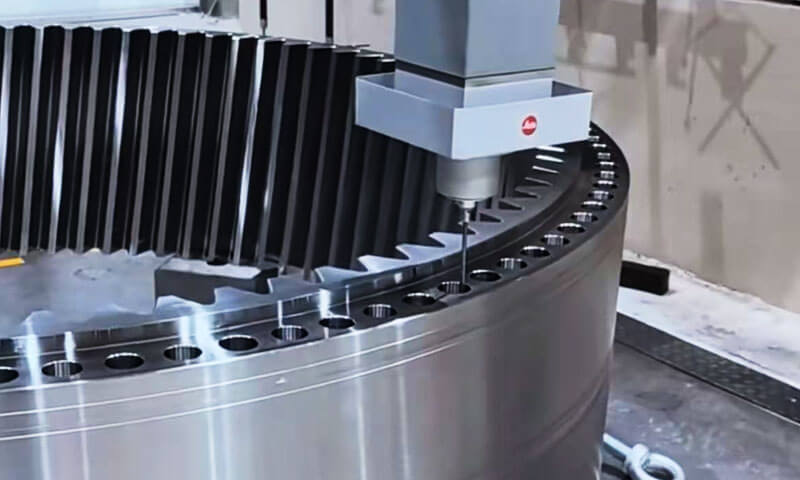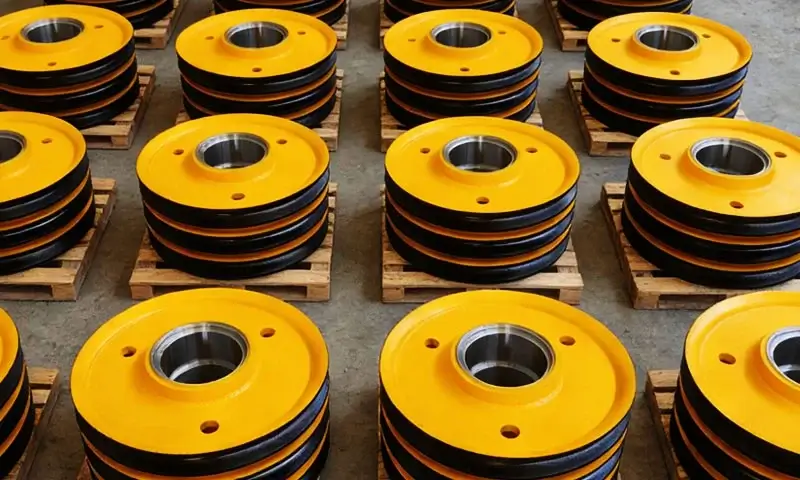
Precision casting provides an effective manufacturing route for custom crane sheaves because it can reproduce relatively complex metal geometries while maintaining controlled dimensional consistency and providing a near-net-shape starting point for subsequent machining.
When combined with appropriate alloy selection, controlled heat treatment, CNC machining, and non-destructive inspection, precision casting can produce sheaves tailored to specific wire-rope systems and lifting applications.
The engineering objective is not simply to produce a sheave that fits an assembly.
The objective is to manufacture a component whose casting integrity, mechanical properties, groove geometry, dimensional accuracy, and surface condition remain suitable throughout repeated service cycles.
This article examines precision casting crane sheaves from the perspective of component design, material engineering, foundry production, machining, quality control, and application performance.
1. What Is a Crane Sheave?
A crane sheave is a grooved wheel used to guide, redirect, support, or distribute a wire rope within a crane or other lifting mechanism.
The wire rope runs around the circumference of the sheave, while the sheave rotates around a shaft, pin, or bearing-supported hub.
Depending on the crane configuration, one or more sheaves can be installed in a sheave block, reeving system, boom head, trolley assembly, or other lifting mechanism.
The fundamental purpose of a sheave is straightforward: it changes the direction of the wire rope and allows the rope to move under load with reduced friction and controlled bending.
Its actual mechanical function, however, is considerably more demanding.
When a loaded wire rope passes over a sheave, the rope is repeatedly bent and unbent. The sheave groove supports the rope and distributes contact forces over a defined region.
At the same time, the sheave itself must withstand the forces transmitted through the rope without excessive deformation, cracking, wear, or loss of alignment.
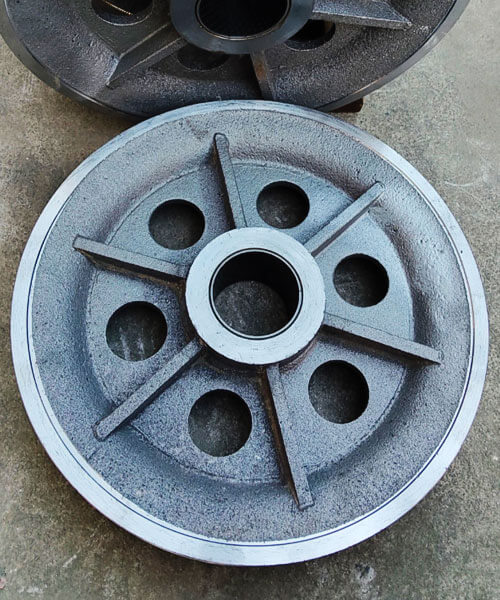
Basic Crane Sheave Structure
A conventional crane sheave generally consists of several functional areas:
| Component | Primary Function | Key Engineering Considerations |
| Sheave Body | Supports the rope and transmits load | Strength, stiffness, casting integrity |
| Rope Groove | Receives and guides the wire rope | Radius, depth, profile, surface finish |
| Hub | Connects the sheave to the rotating support | Load transmission, wall thickness |
| Bore | Accommodates shaft or bearing arrangement | Diameter, tolerance, concentricity |
| Flanges | Helps retain the wire rope | Height, rigidity, clearance |
| Bearing Seat | Supports the bearing where applicable | Dimensional accuracy, surface finish |
| Keyway / Mounting Features | Transfers torque or secures the assembly | Position, geometry, alignment |
2. Common Materials for Crane Sheaves
Material selection is one of the most important decisions in custom crane sheave manufacturing because the material influences strength, toughness, wear resistance, fatigue behavior, corrosion resistance, machinability, heat-treatment response, and casting performance.
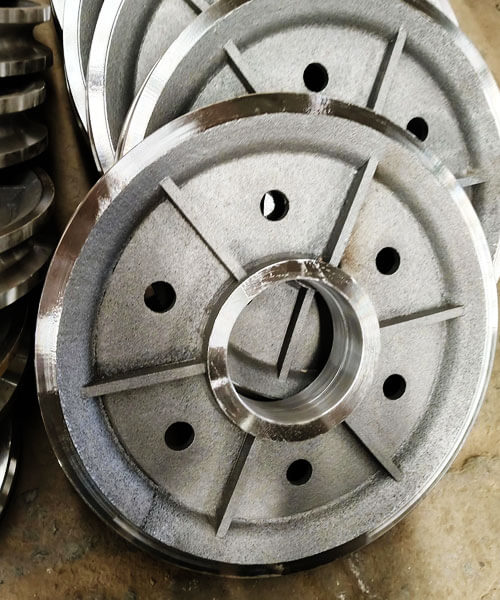
Carbon Steel Castings
Carbon steel is widely applicable to general industrial components because it provides a useful combination of strength, toughness, machinability, weldability, and cost efficiency.
For crane sheaves, carbon steel may be appropriate where the service conditions do not require the enhanced strength, hardenability, or corrosion resistance associated with more highly alloyed materials.
The exact steel grade should be selected according to the required mechanical properties, casting section size, heat-treatment condition, operating environment, and applicable technical specification.
Alloy Steel Castings
Alloy steels become attractive when the sheave is subjected to more demanding loading or when increased hardenability, toughness, strength, or wear resistance is required.
Alloying elements such as manganese, chromium, molybdenum, and nickel can be used in different combinations to modify the material’s response to heat treatment and service loading.
For heavy-duty crane sheaves, the benefit of alloy steel is not simply higher strength. Correct alloy design can help achieve a more balanced combination of:
Strength + toughness + fatigue resistance + hardenability + wear resistance
This balance is especially important when the sheave contains relatively thick sections where uniform heat-treatment response can become more difficult.
Stainless Steel
Stainless steel may be considered for specialized crane sheaves exposed to corrosive conditions, including marine, coastal, offshore, chemical, or washdown environments.
However, stainless steel should not automatically be considered the best option simply because it has superior corrosion resistance.
Material selection must consider mechanical loading, wear behavior, cost, machining requirements, and the actual corrosivity of the environment.
For many heavy-duty lifting applications, a properly engineered carbon or alloy steel with an appropriate protective system can be more practical than stainless steel.
Ductile Iron
Ductile iron can provide attractive casting characteristics together with useful strength, toughness, wear resistance, vibration damping, and dimensional stability.
Its applicability depends strongly on the design and load requirements.
It should not be selected solely because its castability is favorable; the complete mechanical loading and failure consequences of the application must be evaluated.
3. Precision Casting Process for Crane Sheaves
Precision casting is an effective manufacturing method for producing crane sheaves with complex profiles, integrated hubs, structural transitions, and other geometries that would be costly or inefficient to manufacture entirely by machining.
For customized crane sheaves, investment casting (lost-wax casting) is particularly valuable because the process can reproduce intricate geometries with relatively tight casting tolerances and a near-net-shape structure, while subsequent CNC machining establishes the critical functional dimensions.
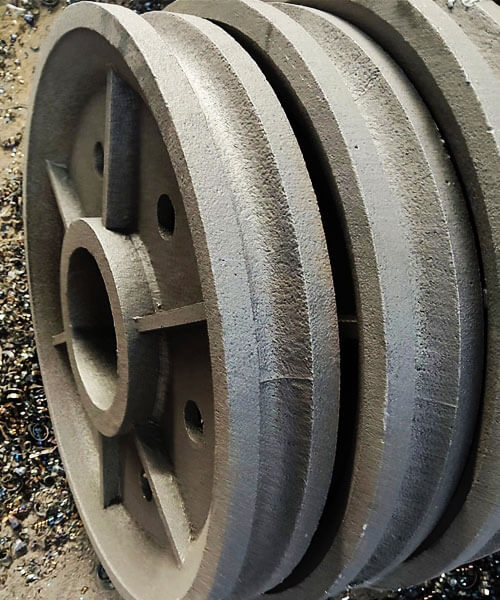
Investment Casting (Lost-Wax Casting) Process
| Stage | Process Step | Description | Key Controls |
| 1. Engineering & Tooling | DFM analysis | The 2D drawing or 3D CAD model is reviewed for casting feasibility, wall thickness, transitions, shrinkage, machining allowances, and gating requirements. | Casting simulation; dimensional requirements; draft; fillet radius; machining allowance |
| 2. Pattern Production | Wax injection | Wax is injected into a precision tool to produce an accurate sacrificial pattern representing the crane sheave geometry. | Wax temperature; injection pressure; holding pressure; cycle time; pattern dimensions |
| Pattern inspection | Wax patterns are checked for distortion, incomplete filling, flash, dimensional variation, and surface defects. | Pattern dimensions; visual inspection; dimensional consistency | |
| 3. Pattern Assembly | Tree assembly | Individual wax patterns are attached to a central sprue system with runners and gates designed to provide controlled metal flow. | Gating layout; pattern orientation; spacing; runner dimensions |
| 4. Shell Building | Slurry coating | The wax assembly is repeatedly dipped into ceramic slurry and covered with refractory stucco to create a multilayer ceramic shell. | Slurry viscosity; layer thickness; drying time; humidity; stucco particle size |
| Shell reinforcement | Additional ceramic layers are applied until the shell has sufficient strength and permeability for metal pouring. | Shell thickness; drying conditions; shell integrity | |
5. Dewaxing |
Autoclave / flash dewaxing | The assembled shell is heated to remove the wax pattern and leave a clean ceramic cavity. | Temperature; steam pressure; heating rate; dewaxing time |
| 6. Shell Firing | Ceramic firing | The ceramic shell is fired at elevated temperature to remove residual wax, strengthen the mold, and establish thermal stability. | Furnace temperature; heating rate; holding time; shell temperature |
| 7. Melting | Induction melting | The selected alloy is melted in a controlled furnace and brought to the required chemical composition and pouring condition. | Alloy chemistry; melt temperature; holding time; melt cleanliness |
| 8. Metal Verification | Chemical analysis | The molten metal is analyzed to verify that its composition meets the specified alloy grade before pouring. | Spectrometric analysis; charge-material control; heat number |
9. Pouring |
Gravity / controlled pouring | Molten metal is introduced into the preheated ceramic shell through the engineered gating system. | Pouring temperature; pouring rate; mold preheat; filling stability |
| 10. Solidification | Controlled cooling | The casting solidifies within the ceramic mold. Feeding and directional solidification are controlled to minimize shrinkage and other internal discontinuities. | Thermal gradients; riser efficiency; cooling rate; section thickness |
| 11. Knockout | Shell removal | After sufficient cooling, the ceramic shell is mechanically removed from the metal casting. | Vibration intensity; shell removal method; casting protection |
| 12. Cut-Off | Gate and riser removal | Sprues, runners, gates, and risers are separated from the crane sheave casting. | Cutting location; abrasive-saw parameters; part handling |
13. Casting Finishing |
Grinding / shot blasting | Residual gates, fins, flash, and adhering ceramic are removed and the surface is prepared for subsequent processing. | Abrasive type; blasting pressure; grinding allowance; surface condition |
| 14. Heat Treatment | Normalizing / Q&T / stress relief | The casting is heat-treated according to the alloy and required mechanical properties. | Furnace temperature; soak time; cooling rate; hardness |
| 15. CNC Machining | Turning / boring / groove machining | Functional features such as the bore, hub, bearing seat, rope groove, and mounting surfaces are machined to final dimensions. | Dimensional tolerance; concentricity; runout; surface roughness |
| 16. Final Inspection | Dimensional and NDT inspection | The finished sheave is inspected to verify geometry, mechanical properties, surface condition, and, where specified, internal integrity. | CMM; hardness; UT/MT/PT/RT as applicable; visual inspection |
4. Rope Groove Machining and Surface Finish
The rope groove is one of the most important functional features of a crane sheave because it establishes how the wire rope is supported, guided, and bent during operation.
Even when the casting body has excellent metallurgical integrity, an incorrectly machined groove can accelerate rope wear, increase local contact stress, promote uneven loading, and reduce the service life of both the rope and sheave.
Groove Machining After Casting
Investment casting or other precision casting processes can produce a near-net-shape sheave, but the final rope groove normally requires machining when controlled geometry and surface finish are critical.
The machining sequence may include:
Casting inspection → datum establishment → rough turning → groove machining → finish turning → dimensional verification
The sheave is first securely located using appropriate datums. The machining reference should be established from the functional centerline of the component rather than from an arbitrary as-cast surface.
This is particularly important for large or asymmetric sheaves because casting variation can otherwise transfer directly into the final groove position.
Groove Concentricity and Runout
The relationship between the rope groove and the sheave bore is critical.
If the groove is not concentric with the bore, the rope can experience a changing radial position as the sheave rotates.
Excessive runout can result in cyclic variation in rope contact and loading and may contribute to vibration or accelerated component wear.
For precision crane sheaves, manufacturers should therefore establish inspection criteria for:
- Groove-to-bore concentricity
- Radial runout
- Axial runout
- Bore diameter
- Groove diameter
- Groove profile
- Flange dimensions
The allowable values should come from the engineering drawing or applicable specification rather than being assigned universally.
Surface Finish of the Rope Groove
Surface finish must be sufficiently controlled to prevent unnecessary abrasion of the wire rope while maintaining the intended contact geometry.
A rough, torn, porous, or improperly ground groove can create localized asperities that act as stress concentrations or abrasive points.
Conversely, surface finishing should not be used to compensate for an incorrect groove profile.
The surface preparation sequence may involve:
- Rough machining
- Semi-finish machining
- Finish machining
- Deburring
- Controlled polishing or grinding where specified
- Final cleaning
The required surface roughness should be defined according to the rope and sheave specification.
A single numerical Ra value should not be treated as universally applicable because different rope constructions and service conditions can require different surface criteria.
5. Heat Treatment of Cast Crane Sheaves
Heat treatment is a critical stage in the manufacture of cast crane sheaves, particularly when carbon steel or alloy steel is used.
Casting establishes the component’s basic geometry, but the as-cast microstructure is not necessarily the optimum structure for demanding mechanical service.
A properly controlled heat-treatment process can modify the microstructure and improve the required combination of strength, hardness, toughness, fatigue resistance, and dimensional stability.
The appropriate heat-treatment route depends on the alloy chemistry, casting section size, required mechanical properties, and customer specification.
Common Heat-Treatment Processes
Normalizing
Normalizing involves heating the steel to an appropriate temperature range above its transformation temperature, holding it for sufficient time, and then cooling it in air.
For cast steels, normalizing can help refine and homogenize the microstructure and reduce some of the non-uniformity associated with casting.
It may be used when moderate-to-high strength combined with reasonable toughness and dimensional stability is required.
Annealing
Annealing generally involves heating followed by controlled cooling.
It can reduce hardness, improve machinability, relieve internal stresses, and produce a softer, more stable metallurgical condition.
Annealing may be useful as an intermediate process where subsequent machining requirements are particularly demanding.
Quenching and Tempering
For suitable alloy and carbon steels, quench-and-temper (Q&T) treatment can be used to obtain substantially increased strength and hardness together with controlled toughness.
The basic process is:
Austenitizing → Quenching → Tempering
The quenching step produces a harder microstructure, while tempering reduces excessive brittleness and adjusts the final balance of strength and toughness.
For heavily loaded crane components, the tempering stage is particularly important because maximum hardness is not necessarily equivalent to optimum service performance.
Stress Relieving
Stress-relief heat treatment can be used to reduce residual stresses generated during casting, welding, extensive machining, or previous thermal processing.
This can be particularly useful for large sheaves where dimensional stability is important.
6. Common Crane Sheave Casting Defects and Their Root Causes
Casting defects can significantly affect the structural reliability of crane sheaves.
Because a sheave is a cyclically loaded component, internal discontinuities that might be tolerated in a low-stress decorative casting can become important when the component is subjected to repeated lifting loads.
| Defect | Description | Root Cause | Preventive Measures |
| Shrinkage porosity | Internal voids | Insufficient feeding during solidification. | Optimise riser design; use chills; simulation. |
| Gas porosity | Small rounded voids | Gas entrapment; dissolved gases in the melt. | Degas melt; improve pouring practice; clean charge. |
| Hot tears | Cracks | Tensile stress during solidification. | Reduce pouring temperature; improve shell collapsibility. |
| Sand inclusions | Embedded sand | Erosion of the ceramic shell. | Improve shell strength; reduce turbulence. |
Misrun |
Incomplete filling | Low pouring temperature; insufficient metal. | Increase pouring temperature; improve gating. |
| Cold shuts | Surface laps | Two streams meeting without fusion. | Increase pouring temperature; improve gating. |
| Dimensional variation | Out-of-tolerance dimensions | Pattern wear; shell expansion. | Maintain tooling; control shell process. |
| Poor surface finish | Rough surface | Coarse ceramic; shell defects. | Use finer shell; improve shell process. |
7. Applications of Precision Casting Crane Sheaves
Precision casting crane sheaves are used across lifting systems where wire ropes must be redirected, supported, or reeved while maintaining controlled rope contact and mechanical reliability.
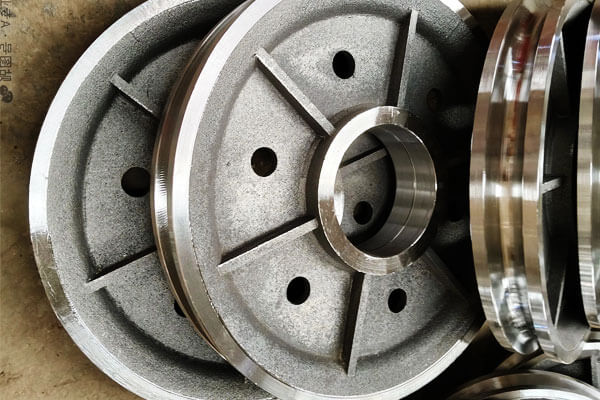
Overhead and EOT Cranes
Overhead cranes and electric overhead traveling (EOT) cranes commonly use sheaves in the hook block, hoisting mechanism, and reeving system.
These applications typically require:
- High resistance to repeated loading
- Accurate rope-groove geometry
- Good rotational balance
- Reliable bearing interfaces
- Controlled concentricity between bore and groove
- Adequate fatigue resistance
For frequently cycled production cranes, sheave durability can have a direct influence on maintenance intervals because groove wear and rope fatigue are closely related.
Custom cast sheaves are particularly useful when the crane manufacturer needs dimensions optimized for a particular drum, hook block, wire rope, or installation envelope.
Gantry and Portal Cranes
Gantry and portal cranes are widely used for container handling, shipyards, industrial yards, steel plants, and heavy material handling.
Their sheaves may experience relatively high rope tensions and dynamic loading.
In addition, outdoor installations expose components to rain, humidity, dust, temperature fluctuations, and potentially corrosive atmospheric conditions.
Material selection consequently becomes an important part of the design.
Carbon or alloy cast steel may be appropriate for general heavy-duty applications, while corrosion-resistant alloys or protective finishing systems can become more relevant in marine environments.
For large portal cranes, dimensional stability and structural casting integrity are particularly important because sheave dimensions can become substantial.
Tower Cranes
Tower cranes use sheaves in hoisting, trolleying, and luffing mechanisms. Space constraints, rope routing, and relatively high operating cycles make dimensional optimization important.
A custom sheave may need to satisfy several competing requirements:
Large enough to reduce severe rope bending, yet compact enough to fit within the crane’s mechanical envelope.
The groove profile must also correspond to the selected wire rope, while the hub and bearing arrangement must integrate with the crane’s existing components.
Precision casting can provide flexibility in developing complex hub and flange configurations without requiring the entire component to be machined from a large billet.
Port, Harbor, and Container Cranes
Port cranes operate under demanding combinations of:
- High lifting loads
- High utilization
- Continuous or semi-continuous duty
- Salt-laden atmospheres
- Dynamic loading
- Strict maintenance requirements
Sheaves used in these systems may therefore require a combination of mechanical strength, wear resistance, fatigue resistance, corrosion protection, and precise machining.
Where corrosion is severe, stainless or duplex stainless castings may be considered for certain components, although the selection must be based on the complete mechanical and environmental requirements rather than corrosion resistance alone.
Shipbuilding and Marine Cranes
Marine cranes commonly operate in humid, saltwater-containing environments where corrosion can significantly affect component life.
Precision cast crane sheaves may be used in:
- Shipboard lifting systems
- Shipyard cranes
- Deck cranes
- Marine handling systems
- Offshore support equipment
For these applications, the manufacturer must consider not only the bulk material but also the condition of machined surfaces, fasteners, bearings, protective coatings, drainage, and maintenance.
Localized corrosion at the groove, hub, or bearing interface can be particularly undesirable because these areas are functionally critical.
Offshore Cranes
Offshore lifting systems impose especially demanding service conditions because they combine high mechanical loads with marine corrosion, wind-induced movement, vibration, and potentially severe dynamic effects.
A precision cast crane sheave for offshore service may require:
- High fracture toughness
- Controlled chemical composition
- Qualified heat treatment
- Corrosion-resistant material or coating
- Extensive NDT
- Traceable material certification
- Tight dimensional control
For such applications, the engineering specification should define the required inspection and acceptance criteria in detail. Material grade alone is not enough to establish suitability.
Mining and Heavy Industrial Cranes
Mining facilities, steel mills, foundries, power plants, and heavy manufacturing operations often use cranes in environments characterized by dust, vibration, elevated temperatures, high utilization, and heavy loads.
Sheaves for these applications may require increased resistance to:
- Cyclic fatigue
- Mechanical impact
- Groove wear
- Contamination
- Elevated operating temperatures
- Abrasive environments
Alloy steel castings with appropriate heat treatment can provide a strong combination of mechanical properties where heavy-duty performance is required.
Construction and Material-Handling Equipment
Construction cranes, hoists, winches, and material-handling systems also use sheaves to redirect wire rope and maintain controlled reeving.
The requirements vary considerably. A relatively small hoist sheave may prioritize cost and compactness, while a high-capacity construction crane may require highly engineered groove and bearing interfaces.
This application diversity is one reason a capable custom manufacturer should be able to support multiple material and manufacturing routes instead of forcing every application into one standard design.
8. Advantages of Precision Casting for Crane Sheaves
| Advantage | Engineering Value |
| Near-net-shape capability | Reduces unnecessary machining |
| Complex geometry | Supports optimized hub, flange, and structural features |
| Material flexibility | Enables application-specific alloy selection |
| Integrated production | Casting and CNC machining can be designed together |
| Repeatability | Useful for OEM and replacement-part production |
| Reduced material waste | Less removal than machining from large stock |
| Design customization | Supports application-specific geometry |
| Scalable production | Suitable for repeat production when tooling is justified |
9. Precision Cast Crane Sheaves vs. Forged and Fabricated Sheaves
The choice among precision casting, forging, and fabrication should be based on the crane sheave’s actual engineering requirements rather than the assumption that one manufacturing process is universally superior.
Each method creates a different balance of geometry, material utilization, mechanical properties, production flexibility, machining requirements, and cost.
For custom crane sheaves, the central question is therefore not simply “Which process is stronger?” but rather:
Which manufacturing process can most efficiently deliver the required load capacity, fatigue performance, rope-groove accuracy, structural integrity, dimensions, production volume, and service reliability?
The following comparison focuses on the core engineering differences that matter when selecting a manufacturing route for crane sheaves.
| Key Difference | Precision Cast Crane Sheaves | Forged Crane Sheaves | Fabricated / Welded Sheaves |
| Best Fit | Complex, customized sheaves requiring near-net-shape geometry and repeat production | High-strength and fatigue-critical applications | Very large, low-volume, or highly customized sheaves |
| Geometry & Design Freedom | Excellent for complex hubs, flanges, ribs, and transitions | Moderate; geometry must be compatible with forging | Excellent through multi-part construction |
| Mechanical Performance | Excellent when casting quality and heat treatment are properly controlled | Excellent, particularly for high-strength and fatigue-demanding applications | Good, but strongly dependent on weld design and quality |
| Material Efficiency | High, with relatively little excess material | Moderate; machining allowance is generally required | Variable; depends on plate, ring, and component layout |
| Machining Requirement | Moderate; mainly critical functional surfaces | Moderate to high | Moderate to high |
| Large-Diameter Capability | Good, but depends on casting equipment and process | Limited by forging capacity and tooling | Excellent for very large structures |
Production Volume |
Well suited to repeat OEM production | Best suited to repeat production where tooling is justified | Well suited to low-volume or project-based production |
| Tooling Cost | Moderate | High | Relatively low |
| Main Quality Concern | Casting defects such as shrinkage, porosity, and inclusions | Material quality, forging integrity, and heat-treatment control | Weld defects, residual stress, and distortion |
| Main Advantage | Complex geometry + customization + near-net shape | High mechanical performance | Large size + structural flexibility |
| Main Limitation | Requires strict foundry and NDT control | Higher tooling and processing cost | More welding and dimensional-control challenges |
10. Why Choose LangHe Industry for Custom Precision Casting Crane Sheaves?
Selecting a crane-sheave supplier should go beyond comparing casting prices.
Because the component combines structural casting, heat treatment, precision machining, rope-contact geometry, and inspection, the supplier’s ability to control the complete manufacturing chain is often more important than the nominal casting process itself.
LangHe Industry can approach custom precision cast crane sheaves as an integrated manufacturing project, connecting engineering review, casting development, machining, finishing, and quality inspection.
| Capability | Details |
| Materials | Carbon steel (WCB), cast steel, ductile iron (60-40-18, 65-45-12, 80-55-06), stainless steel (CF-8, CF-8M, 17-4PH), alloy steel (4140, 4340) |
| Casting process | Investment casting, sand casting. |
| Part weight | 0.5 kg to 500 kg. |
| Tolerances | ±0.1–0.3 mm (CT5-CT7 per ISO 8062). |
| Quality | ISO 9001:2015 certified; 100% inspection; CMM; surface profilometer; NDT (X-ray, dye penetrant). |
| Lead time | 6–12 weeks for tooling; 2–4 weeks for repeat orders. |
11. Conclusion
A crane sheave is a relatively simple-looking component with a demanding mechanical function. It must guide and bend wire rope repeatedly while transmitting load through the hub, bearings, and supporting structure.
Consequently, groove geometry, material integrity, heat-treatment condition, machining accuracy, concentricity, and surface quality all contribute to real-world sheave performance.
Precision casting offers a compelling manufacturing route for custom crane sheaves when complex geometry, near-net-shape production, material flexibility, and repeatability are important.
It can reduce unnecessary machining while allowing engineers to integrate hubs, flanges, ribs, transitions, and other structural features into the casting.
LangHe Industry provides a custom manufacturing approach for precision cast crane sheaves, combining casting engineering, material selection, CNC machining, heat treatment, finishing, and inspection to support application-specific OEM requirements.
FAQ
What is a precision casting crane sheave?
A precision casting crane sheave is a wire-rope sheave manufactured using a controlled casting process, commonly investment or another precision-oriented casting method, followed by machining of critical functional surfaces.
The casting creates the primary geometry, while CNC machining establishes features such as the rope groove, bore, and bearing seats.
Why use precision casting instead of machining a crane sheave from solid steel?
Precision casting can produce much of the final geometry before machining.
This can reduce material removal, machining time, and material waste while allowing greater freedom for complex hubs, flanges, ribs, and structural transitions.
Is a cast crane sheave as strong as a forged sheave?
There is no universal answer. A properly designed and processed cast steel sheave can provide excellent mechanical performance,
but forging may offer advantages in applications where a highly consolidated wrought structure and specific fatigue properties are required.
Suitability depends on material, geometry, section size, heat treatment, loading, and inspection requirements.
What is the most important quality factor for a crane sheave?
There is no single parameter that determines quality. Casting integrity, mechanical properties, groove geometry, bore alignment, surface condition, and dimensional accuracy must work together.
For safety-critical applications, these characteristics should be verified against the approved engineering specification and inspection plan.
How can crane sheave service life be improved?
Service life can be improved through correct sheave-to-rope sizing, appropriate groove geometry, suitable material selection, proper lubrication and maintenance,
accurate alignment, controlled manufacturing quality, and timely replacement when groove wear or other damage exceeds the specified limit.