CNC turning stands as a pivotal process in modern manufacturing, delivering high-precision components with unmatched efficiency and repeatability.
As a computer-controlled, subtractive process, CNC turning shapes cylindrical and complex geometries using advanced lathes that transform raw materials into critical parts.
Today, industries such as aerospace, automotive, medical, and consumer electronics rely on CNC turning to achieve tight tolerances and superior surface finishes.
In this article, we explore the evolution, fundamentals, applications, and future of CNC turning, providing a comprehensive, data-driven analysis that is both professional and authoritative.
1. Introduction
CNC turning is a computer-controlled process that removes material from a rotating workpiece, producing parts with precise dimensions and intricate features.
Unlike manual turning, CNC turning leverages sophisticated CAD/CAM programming to achieve tolerances as tight as ±0.005 mm, ensuring consistency across every part.
This technology has revolutionized high-precision manufacturing by drastically reducing lead times and enhancing productivity.
For example, the global market for CNC machines reached $83.4 billion in 2022 and is projected to grow steadily in the coming years.
2. Historical Development and Evolution
Origins and Early Innovations
The journey of CNC turning began with manual lathes, where skilled machinists meticulously shaped metal by hand.
With the advent of numerical control in the mid-20th century, manufacturers transitioned to computer-controlled lathes that delivered consistent quality and precision.
This evolution laid the foundation for the sophisticated CNC systems we see today.

Technological Breakthroughs
Key milestones include the integration of CAD/CAM systems, which enabled the automation of tool paths and significantly improved machining accuracy.
The introduction of multi-axis turning and automated tool changers further revolutionized the field, reducing setup times and increasing production efficiency.
For instance, the advent of 5-axis CNC turning machines has reduced production cycle times by up to 40% compared to traditional methods.
Impact of Digitalization
Digital transformation has played a critical role in CNC turning.
The integration of real-time data analytics and IoT sensors allows manufacturers to monitor machine performance continuously, predict maintenance needs, and optimize cutting parameters dynamically.
This digital revolution has not only enhanced precision but also improved overall operational efficiency, making CNC turning indispensable in today’s competitive market.
3. Fundamentals of CNC Turning
Basic Principles
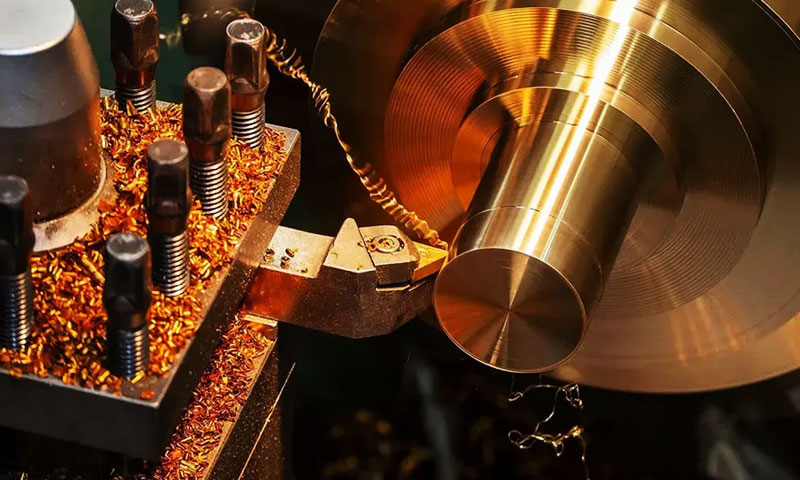
CNC turning operates by rotating a workpiece against a cutting tool, which removes material layer by layer.
This subtractive process follows detailed instructions derived from CAD/CAM software, ensuring every cut adheres to precise design specifications.
The continuous rotation of the workpiece allows for the creation of cylindrical, conical, or even complex geometries with remarkable consistency.
Key Components and Process Mechanics
At the heart of CNC turning lies a robust CNC lathe equipped with advanced control software, precision cutting tools, and effective workholding fixtures.
The process mechanics involve critical parameters such as tool paths, feed rates, spindle speeds, and coolant application.
For example, operators adjust the feed rate and spindle speed to optimize cutting forces and minimize tool wear, achieving excellent surface finishes and reducing cycle times by up to 30%.
CAD/CAM Integration
Digital design drives CNC turning precision. Engineers create detailed models in CAD software, which then convert into machine-readable G-code through CAM systems.
This integration allows for simulation of the entire machining process before production begins, thereby reducing errors and ensuring the final product meets stringent quality standards.
4. Types of CNC Turning Machines
CNC turning machines form the backbone of high-precision manufacturing, and their diverse configurations empower manufacturers to tackle a wide array of applications.
Horizontal CNC Lathes
Horizontal CNC lathes feature a spindle aligned horizontally, making them ideal for machining standard cylindrical components with high efficiency.
These machines have advanced computer numerical control systems that ensure repeatability and accuracy in high-volume production.
Key Attributes:
- High-Speed Performance:
-
- Capable of achieving cutting speeds that often range from 300 to 3,000 SFM, enabling rapid material removal without compromising precision.
- Versatility in Material Processing:
-
- Effective with a variety of materials, including aluminum, stainless steel, and composites, thereby catering to diverse industry needs.
- Cost Efficiency:
-
- Typically priced between $30,000 and $150,000 USD, making them accessible for small to medium-sized enterprises looking to scale production.
Applications:
Horizontal CNC lathes are extensively used in aerospace for fabricating engine mounts and turbine parts,
in automotive manufacturing for shafts and bushings, and in consumer electronics for creating precise housings.
Vertical CNC Lathes
Vertical CNC lathes distinguish themselves with a vertically oriented spindle, tailored for handling large, heavy, or complex workpieces.
Their robust design and enhanced chip management systems make them suitable for applications requiring high load capacity and stability.
Key Attributes:
- Heavy-Duty Machining:
-
- Engineered to support and machine bulky components such as large gears, flywheels, and industrial flanges.
- Enhanced Operator Ergonomics:
-
- The vertical setup simplifies handling, reducing physical strain and enhancing safety.
- Robust Construction:
-
- Offers superior rigidity and stability, crucial for deep cavity machining and precision tasks.
- Price Range:
-
- Generally falls between $40,000 and $200,000 USD, reflecting their advanced capabilities and robust build quality.
Applications:
Vertical CNC lathes are commonly employed in renewable energy for wind turbine components, in heavy machinery for large industrial parts, and in the marine sector for ship engine components.
Horizontal Turning Centers
Horizontal turning centers represent an evolution in CNC technology, combining traditional turning with integrated milling, drilling, and tapping operations.
These centers allow multiple machining processes to occur in one setup, which reduces handling errors and minimizes cycle times.

Key Attributes:
- Multi-Process Capability:
-
- Enables operations like milling and drilling alongside turning, making them ideal for complex parts with undercuts and intricate features.
- Reduced Setup Time:
-
- By consolidating processes, these machines can reduce setup time by up to 50%, thereby increasing overall productivity.
- High Productivity:
-
- They excel in both low-volume prototyping and high-volume production, with a typical price range of $50,000 to $250,000 USD.
Applications:
Horizontal turning centers are widely used in aerospace and defense for machining complex structural components,
in automotive industries for custom parts, and in industrial equipment manufacturing for precision tooling.
Vertical Turning Centers
Vertical turning centers extend the capabilities of conventional vertical lathes by integrating additional milling and drilling functionalities.
These systems excel in producing parts that demand intricate geometries and multi-directional machining in a single setup.
Key Attributes:
- Integrated Operations:
-
- Combine turning, milling, and drilling in one machine, thereby streamlining production and improving overall process efficiency.
- Precision in Complex Geometries:
-
- Deliver exceptional detail and accuracy in machining complex features, essential for high-end applications.
- Flexibility and Adaptability:
-
- Particularly suited for producing both prototypes and production parts in industries that demand high precision.
- Cost Considerations:
-
- While pricing varies with configuration, these centers offer a competitive solution for industries that require multi-functional machining capabilities.
Applications:
Vertical turning centers find use in aerospace for engine components, in medical device manufacturing for precision instruments,
and in research and development environments where experimental prototypes require detailed machining.
Comparative Overview
To summarize the distinctions between the various types of CNC turning machines, consider the following table:
| Machine Type | Orientation | Best For | Typical Price Range (USD) |
|---|---|---|---|
| Horizontal CNC Lathes | Horizontal | Standard cylindrical parts, high-volume production | $30,000 – $150,000 |
| Vertical CNC Lathes | Vertical | Heavy, large-diameter workpieces, industrial machinery | $40,000 – $200,000 |
| Horizontal Turning Centers | Horizontal | Multi-process operations, complex assemblies | $50,000 – $250,000 |
| Vertical Turning Centers | Vertical | Integrated turning/milling for intricate geometries | Varies with configuration |
5. Operations Performed in CNC Turning
With advancements in tooling and multi-axis capabilities, modern CNC lathes can perform a wide range of operations beyond simple turning.
This section explores the primary, specialized, and advanced finishing processes used in CNC turning, highlighting their significance in modern manufacturing.
Primary CNC Turning Operations
External Turning
External turning, also known as straight turning, involves removing material from the outer surface of the rotating workpiece to achieve a specified diameter and smooth finish.

- Applications: Used to manufacture shafts, rods, and cylindrical components.
- Typical Tolerances: ±0.005 mm for high-precision applications.
- Tools Used: Carbide or ceramic inserts for optimal cutting efficiency.
Facing
Facing is the process of cutting across the end of the workpiece to create a smooth, flat surface. This operation is typically performed before further machining or as a finishing step.
- Applications: Creating perfectly flat surfaces on flanges, gears, and bearings.
- Cutting Speed Considerations: Generally lower than straight turning to prevent tool chatter.
Grooving
Grooving involves cutting narrow channels along the workpiece’s outer or inner surface. Grooves may be used for seals, snap rings, or to improve assembly compatibility.
- Types: External grooving, internal grooving, and face grooving.
- Common Depths: 1 mm to 10 mm, depending on the application.
- Challenges: Managing chip evacuation and avoiding tool deflection.
Thread Cutting
CNC turning machines can produce both external and internal threads with high accuracy, eliminating the need for secondary threading operations.
- Thread Types: Metric, Unified, ACME, and custom-designed threads.
- Precision Level: ±0.02 mm thread pitch accuracy.
- Best Practices: Using thread-specific carbide inserts for clean, burr-free threads.
Taper Turning
Taper turning is the gradual reduction in diameter along the length of the workpiece, creating a conical shape. It is widely used in components that require mating fits.
- Applications: Tapered shafts, automotive axles, and pipe fittings.
- Control Method: Achieved using the compound slide, offset tailstock, or CNC programming.
Specialized CNC Turning Operations
Drilling
While primarily a milling operation, drilling can be performed on a CNC lathe using a stationary drill bit while the workpiece rotates. This allows precise hole placement.
- Hole Diameters: Typically 1 mm – 50 mm in standard applications.
- Challenges: Managing heat buildup and chip removal for deep hole drilling.
Boring
Boring enlarges existing holes and refines internal diameters with extreme precision. CNC boring bars with vibration-dampening technology enhance performance.
- Accuracy Level: ±0.003 mm for high-precision bores.
- Used For: Engine cylinders, bearing housings, and hydraulic components.
Reaming
Reaming improves the surface finish and dimensional accuracy of pre-drilled holes, ensuring a precise fit for mating parts.
- Tolerance Achievable: ±0.001 mm in aerospace-grade applications.
- Tooling Consideration: Carbide reamers for harder materials like stainless steel.
Knurling
Knurling is a non-cutting process that embosses a textured pattern onto the workpiece’s surface to enhance grip.
- Common Patterns: Straight, diamond, or cross-hatched designs.
- Applications: Handles, knobs, and industrial tool grips.
Parting (Cut-Off)
Parting involves cutting completely through the workpiece to separate the finished part from the stock material.
- Challenges: Preventing tool breakage, especially on hard metals.
- Best Practices: Using rigid tool holders and ensuring proper coolant application.
Advanced Finishing Processes in CNC Turning
Hard Turning
Hard turning is performed on materials with a hardness above 45 HRC, serving as an alternative to grinding.
- Applications: High-precision aerospace and automotive components.
- Advantages: Eliminates the need for secondary grinding operations.
- Tools Used: CBN (Cubic Boron Nitride) inserts for superior wear resistance.
Polishing & Superfinishing
After machining, parts may require polishing or superfinishing to achieve mirror-like surfaces.
- Surface Roughness Achievable: Down to Ra 0.1 µm for ultra-smooth finishes.
- Techniques: Lapping, buffing, and diamond polishing.
Burnishing
Burnishing is a cold working process that improves surface finish and enhances mechanical properties by work hardening the material.
- Advantages: Increases surface hardness and reduces friction.
- Common Applications: Bearing surfaces and hydraulic components.
Live Tooling Operations (For CNC Turning Centers)
Live tooling enables CNC lathes to perform milling, tapping, and slotting in addition to standard turning.
- Typical Configurations: Multi-axis turning centers with driven tooling.
- Advantages: Reduces setup time and eliminates secondary machining.
Comparison of CNC Turning Operations
| Operation Type | Material Removed? | Best For | Precision Level (Tolerance) |
|---|---|---|---|
| External Turning | ✅ Yes | Cylindrical parts, shafts, and rods | ±0.005 mm |
| Facing | ✅ Yes | Flat surfaces, end finishing | ±0.005 mm |
| Grooving | ✅ Yes | Seals, O-rings, snap rings | ±0.02 mm |
| Thread Cutting | ✅ Yes | Screws, bolts, threaded inserts | ±0.02 mm pitch accuracy |
| Taper Turning | ✅ Yes | Pipe fittings, automotive components | ±0.01 mm |
| Drilling | ✅ Yes | Precise hole placement | ±0.01 mm |
| Boring | ✅ Yes | Engine cylinders, bearing housings | ±0.003 mm |
| Reaming | ✅ Yes | High-precision hole finishing | ±0.001 mm |
| Knurling | ❌ No | Textured surfaces for grip enhancement | N/A |
| Parting (Cut-Off) | ✅ Yes | Separating finished parts | ±0.01 mm |
| Hard Turning | ✅ Yes | Hard metal finishing | ±0.002 mm |
| Polishing & Superfinishing | ❌ No | Mirror-like surface finishing | Ra 0.1 µm |
| Burnishing | ❌ No | Surface hardening, wear resistance | N/A |
| Live Tooling Operations | ✅ Yes | Complex parts with both turning & milling | ±0.005 mm |
6. Essential Components of a CNC Turning Machine
A CNC turning machine consists of multiple integrated components that work together to achieve high-precision machining.
These components are designed to provide stability, accuracy, and efficiency in cutting operations.
Understanding their functions is crucial for optimizing machining performance and ensuring long-term operational reliability.
Structural Components: The Foundation of Stability
A. Machine Bed
- The machine bed is the structural backbone of a CNC lathe, supporting all other components.
- It is typically made from cast iron or granite to minimize vibrations and ensure rigidity.
- Key Functions:
-
- Provides a stable base for the headstock, tailstock, and carriage.
- Absorbs cutting forces to maintain machining accuracy.
- Fact: Modern CNC lathes use precision-ground beds with hardened guideways to enhance longevity.
B. Guideways and Linear Rails
- Guideways ensure smooth and precise movement of the carriage, tool post, and tailstock.
- Types of guideways:
-
- Box Ways: More rigid, used for heavy-duty machining.
- Linear Rails: Offer lower friction, suitable for high-speed machining.
- Key Benefit: Reduces tool deflection and enhances positional accuracy.
Workholding Components: Securing the Workpiece
A. Spindle and Chuck System
- The spindle is the rotating axis that drives the workpiece during machining.
- Chucks hold and secure the workpiece, ensuring it remains fixed during cutting.
- Types of Chucks:
-
- Three-Jaw Chucks: Self-centering, ideal for round workpieces.
- Four-Jaw Chucks: Independently adjustable, used for irregularly shaped parts.
- Collet Chucks: Provide high concentricity for precision work.
- Hydraulic and Pneumatic Chucks: Enable automated loading and unloading in mass production.
- Spindle Speed Range: Typically 500 – 8,000 RPM, depending on material and machining needs.
B. Tailstock (for Long Workpieces)
- The tailstock provides additional support for long workpieces, preventing bending or vibration.
- Live Centers vs. Dead Centers:
-
- Live Centers rotate with the workpiece (used in high-speed machining).
- Dead Centers remain stationary (suitable for heavy loads).
- Used in: Aerospace shafts, precision rods, and automotive axles.
Motion and Control Systems: Achieving Precision
A. CNC Controller (Brain of the Machine)
- The CNC controller interprets digital instructions (G-code) and translates them into machine movements.
- Key Functions:
-
- Controls spindle speed, tool positioning, and cutting depth.
- Interfaces with sensors for real-time monitoring.
- Stores multiple machining programs for automation.
- Popular Brands: FANUC, Siemens, Heidenhain, Mitsubishi.
B. Servo Motors and Drive System
- Servo motors power the movement of tool slides and feed mechanisms.
- Closed-loop feedback system: Uses encoders to ensure precise tool positioning.
- Speed & Accuracy: High-end CNC lathes achieve repeatability within ±0.002 mm.
C. Ball Screws and Lead Screws
- Convert rotational motion into precise linear movement of the cutting tool.
- Ball Screws:
-
- Low friction, high accuracy.
- Common in precision CNC lathes.
- Lead Screws:
-
- Higher friction, mainly used in traditional lathes.
Cutting Tool and Tool Holding System
A. Tool Turret
- The tool turret holds multiple cutting tools and rotates to change tools automatically.
- Types of Turrets:
-
- Disc-Type Turret: Holds multiple tools in a circular arrangement.
- Live Tool Turret: Enables drilling and milling within a CNC lathe.
- Typical Tool Positions: 8, 12, or 24 tools per turret.
B. Tool Post
- The tool post securely holds the cutting tool and allows adjustments in orientation.
- Quick-Change Tool Posts: Reduce setup time in multi-tool operations.
Support and Auxiliary Systems
A. Coolant and Lubrication System
- Coolant System: Prevents overheating and prolongs tool life.
- Types of Coolants:
-
- Water-soluble coolants (general use).
- Synthetic coolants (for non-ferrous metals).
- Oil-based coolants (high-speed and precision machining).
- Lubrication System: Reduces friction in guideways and ball screws.
B. Chip Conveyor & Chip Management
- Chip Conveyor: Removes metal shavings (chips) from the machining area.
- Types of Chip Management Systems:
-
- Auger Systems: Small-scale applications.
- Magnetic Conveyors: Ideal for ferrous materials.
- Scraper Belt Systems: Handles large amounts of chips.
Safety and Automation Features
A. Enclosures and Guards
- CNC machines feature fully enclosed workspaces to prevent operator injury.
- Automatic Door Sensors: Ensure machine stops if opened during operation.
B. Probing & Measurement Systems
- In-Machine Probing: Measures dimensions in real-time, reducing errors.
- Optical and Laser Sensors: Used for tool wear detection.
C. Automatic Tool Changer (ATC)
- Reduces downtime by swapping tools automatically.
- Tool Change Speed: 1 – 3 seconds in high-speed CNC lathes.
7. Tooling in CNC Turning
Tooling in CNC turning plays a crucial role in achieving precision, efficiency, and high-quality surface finishes.
The choice of tools directly affects factors such as cutting speed, tool life, material removal rate, and final product accuracy.
This section explores the different types of CNC turning tools, their materials, coatings, and selection criteria based on machining requirements.

Categories of CNC Turning Tools
CNC turning tools can be broadly categorized based on their function in the machining process. These include cutting tools, hole-making tools, and specialized tooling for advanced applications.
A. Cutting Tools for External and Internal Machining
- Turning Tools (External)
-
- Used for removing material from the outer surface of a rotating workpiece.
- Common Variants: Rough turning tools (high material removal) and finish turning tools (smooth surface finish).
- Best For: Shafts, cylindrical components, and stepped features.
- Boring Tools (Internal)
-
- Designed for enlarging pre-drilled holes with high precision.
- Best For: Engine cylinders, bearing housings, and hydraulic components.
- Challenges: Chip evacuation and deflection in deep bores.
- Grooving & Parting Tools
-
- Grooving tools cut narrow channels, while parting tools separate finished parts from raw material.
- Best For: O-ring seats, sealing grooves, and cutoff operations.
- Thread Cutting Tools
-
- Used to create both internal and external threads with high precision.
- Best For: Screws, bolts, and threaded pipe fittings.
B. Hole-Making Tools
- Drill Bits
-
- Used for creating initial holes in CNC lathes equipped with drilling capabilities.
- Common Types: Twist drills, center drills, and step drills.
- Challenges: Preventing runout and ensuring concentricity with the workpiece axis.
- Reamers
-
- Used after drilling to refine hole size and improve surface finish.
- Tolerance Achievable: ±0.001 mm in precision applications.
- Best For: High-accuracy holes in aerospace and automotive parts.
- Boring Bars
-
- Extends machining capability for deeper and larger-diameter holes.
- Considerations: Vibration dampening is essential for deep boring applications.
C. Specialized Tooling (Advanced CNC Turning)
- Knurling Tools
-
- Used to create textured surfaces for improved grip.
- Common Patterns: Straight, diamond, and cross-hatched.
- Applications: Tool handles, industrial knobs, and fasteners.
- Chamfering Tools
-
- Designed to break sharp edges and create beveled features.
- Best For: Deburring and improving assembly compatibility.
- Multi-Function Tools (For CNC Turning Centers)
-
- Tools that combine turning, milling, and drilling operations in a single setup.
- Best For: Complex components requiring multi-axis machining.
- Examples: Driven (live) tooling, combination drill-turn tools.
Tool Materials: Strength, Wear Resistance, and Performance
Selecting the right tool material is essential for optimizing cutting performance and tool longevity. The most common tool materials include:
| Tool Material | Hardness (HRC) | Advantages | Common Applications |
|---|---|---|---|
| High-Speed Steel (HSS) | 55 – 65 | Good toughness, lower cost | General-purpose turning |
| Carbide (WC) | 75 – 85 | High wear resistance, faster speeds | High-precision machining |
| Ceramic | 80 – 90 | Heat resistance, suitable for hard metals | Hard turning, aerospace parts |
| Cubic Boron Nitride (CBN) | 90 – 95 | Extreme hardness, excellent in hardened steels | Hard finishing operations |
| Polycrystalline Diamond (PCD) | 95+ | Ultra-hard, best for non-metal materials | Machining composites, plastics |
Cutting Tool Coatings: Enhancing Performance and Tool Life
Modern CNC tools often feature advanced coatings that improve wear resistance, heat dissipation, and tool longevity.
| Coating Type | Properties | Best For |
|---|---|---|
| TiN (Titanium Nitride) | Increases tool life, reduces friction | General machining |
| TiCN (Titanium Carbonitride) | Improved hardness over TiN, better wear resistance | Harder metals like stainless steel |
| AlTiN (Aluminum Titanium Nitride) | High-temperature resistance, oxidation protection | High-speed machining |
| DLC (Diamond-Like Carbon) | Ultra-low friction, ideal for non-metals | Machining plastics, aluminum |
| CVD Diamond | Extreme hardness, long-lasting performance | Cutting composites, ceramics |
Tool Holders and Clamping Systems
Proper tool holding is critical for achieving precision in CNC turning.
A. Tool Holding Methods
- Quick-Change Tool Holders
-
- Minimize setup time and allow fast tool changes.
- Best for high-mix, low-volume production.
- Collet Chucks
-
- Provide high concentricity and grip strength.
- Common in small-diameter precision machining.
- Hydraulic & Pneumatic Tool Holders
-
- Offer superior vibration dampening and high-speed stability.
- Used in aerospace and medical machining applications.
B. Automatic Tool Changers (ATC)
- CNC turning centers often use turrets with ATCs to switch tools quickly.
- Improves efficiency in multi-tool operations (turning, milling, drilling).
Tool Selection Criteria: Matching Tools to Machining Requirements
When choosing CNC turning tools, several factors must be considered to achieve optimal performance:
A. Workpiece Material
- Soft metals (Aluminum, Brass): Use uncoated carbide or DLC-coated tools.
- Hardened Steel & Inconel: Requires CBN or ceramic inserts with rigid holders.
- Plastics & Composites: Diamond-coated tools prevent material buildup.
B. Cutting Speed & Feed Rate
- Carbide inserts: 150 – 300 m/min (steel), 500+ m/min (aluminum).
- CBN tools: Ideal for cutting hardened steel at lower feeds to reduce heat buildup.
C. Tool Life & Cost Considerations
- High-speed machining: Requires coated carbide tools for extended wear resistance.
- Low-cost general machining: HSS tools may be preferred, but require frequent replacement.
8. Key Parameters in CNC Turning
CNC turning is a precise and highly controlled machining process where multiple parameters must be carefully set to ensure efficiency, accuracy, and quality.
Cutting Speed (Vc) – The Velocity of Tool Engagement
Cutting speed refers to the linear velocity at which the cutting tool engages the workpiece surface. It is expressed in meters per minute (m/min) or feet per minute (ft/min).
Significance:
- Higher cutting speeds improve productivity but can cause excessive heat, leading to tool wear.
- Lower speeds prolong tool life but may slow down the process.
Feed Rate (f) – The Rate of Material Removal
The feed rate is the distance the cutting tool advances per revolution of the workpiece, typically measured in millimeters per revolution (mm/rev).
Significance:
- Higher feed rates remove material quickly but may reduce surface quality.
- Lower feed rates provide better finishes but increase machining time.
Depth of Cut (ap) – The Cutting Layer Thickness
The depth of cut is the thickness of material removed in a single pass, measured in millimeters (mm).
Significance:
- Larger depth of cut increases material removal rate but can cause higher tool load and vibration.
- Small depths of cut enhance surface finish and tool longevity.
Tool Geometry – The Shape and Edge Angles of Cutting Tools
Tool geometry refers to the angles, edges, and cutting points of a turning tool that affect chip formation, cutting forces, and heat dissipation.

Key Geometrical Factors:
- Rake Angle: Controls chip flow and cutting force.
- Clearance Angle: Prevents tool rubbing against the workpiece.
- Nose Radius: Affects surface finish and tool strength.
- Cutting Edge Angle: Influences tool engagement and cutting force distribution.
Material of the Workpiece – Machinability Considerations
The workpiece material directly influences tool selection, cutting speed, and feed rate.
Machining Behavior of Different Materials:
- Soft metals (Aluminum, Brass) → High cutting speeds, minimal tool wear.
- Hardened Steels, Titanium, Inconel → Require low cutting speeds, strong tools.
- Composites & Plastics → Specialized tooling needed to prevent delamination.
Coolant Flow – Temperature and Lubrication Control
Coolant is used to dissipate heat, reduce friction, and flush away chips.
Types of Coolants:
- Water-based coolants for general machining.
- Oil-based coolants for difficult materials (titanium, stainless steel).
- Dry machining (air blast) for environmentally friendly operations.
Spindle Speed (N) – Rotational Speed of the Workpiece
Spindle speed is measured in revolutions per minute (RPM) and influences surface finish, tool wear, and cutting efficiency.
Optimization Considerations:
- Higher RPM improves productivity but generates more heat.
- Lower RPM reduces tool wear for hard materials.
Chip Control – Managing Machining Debris
Effective chip control is crucial for process stability, surface quality, and tool life.
Challenges:
- Long, continuous chips can wrap around the tool and cause defects.
- Short, broken chips are ideal for efficient chip evacuation.
Machine Rigidity – Impact on Stability and Accuracy
Machine rigidity determines how well a CNC lathe resists vibrations and deflections during cutting.
Factors Affecting Rigidity:
- Machine bed construction (cast iron vs. aluminum).
- Spindle and tooling support.
- Proper workholding techniques.
Tolerance Levels – Precision and Accuracy Control
Tolerances define the allowable deviation in dimensions of machined parts.
Typical CNC Turning Tolerances:
- Standard precision: ±0.05 mm
- High precision: ±0.01 mm
- Ultra-precision: ±0.002 mm
9. Materials and Machining Considerations in CNC Turning
CNC turning is a versatile machining process capable of handling a wide range of materials, including metals, plastics, and composites.
However, each material presents unique machining challenges that require specific tooling, cutting parameters, and quality control measures.
Optimizing these factors ensures precision, efficiency, and cost-effectiveness.
9.1 Machining of Metals in CNC Turning
Metals are the most commonly machined materials in CNC turning, used across industries such as aerospace, automotive, medical, and industrial manufacturing.
Different metals have varying hardness, machinability, and thermal conductivity, requiring tailored approaches for efficient processing.
Machining Aluminum in CNC Turning
Aluminum alloys (e.g., 6061, 7075, 2024) are widely used due to their high machinability, lightweight properties, and excellent corrosion resistance.
Key Considerations:
- High cutting speeds (200–600 m/min) improve efficiency.
- Low cutting forces reduce tool wear.
- Coolant is optional, as aluminum dissipates heat well.
- Avoid built-up edge (BUE) formation by using sharp carbide tools.
Machining Stainless Steel in CNC Turning
Stainless steel (e.g., 304, 316, 431) is known for its strength, corrosion resistance, and toughness, making it essential for medical, aerospace, and food-processing applications.
Key Considerations:
- Lower cutting speeds (80–200 m/min) to prevent excessive heat.
- High feed rates and depth of cut minimize work-hardening.
- Coolant is necessary to control temperature and extend tool life.
- Use coated carbide or ceramic inserts to withstand high cutting forces.
Machining Titanium in CNC Turning
Titanium (e.g., Ti-6Al-4V) is valued for its high strength-to-weight ratio and biocompatibility,
but it is difficult to machine due to its low thermal conductivity and high work-hardening tendency.
Key Considerations:
- Low cutting speeds (30–90 m/min) prevent overheating.
- High-pressure coolant is required for heat dissipation.
- Sharp, wear-resistant carbide or ceramic tools should be used.
- Minimized tool engagement reduces tool deflection and wear.
Machining Carbon Steel in CNC Turning
Carbon steels (e.g., 1045, 4140, 1018) are widely used in industrial applications due to their strength, hardness, and affordability.
Key Considerations:
- Moderate cutting speeds (80–250 m/min) balance efficiency and tool wear.
- Use coated carbide tools to resist wear and oxidation.
- Coolants reduce heat buildup, especially in higher-carbon alloys.
- Higher hardness steels require lower feed rates and depth of cut.
9.2 Machining Non-Metallic Materials in CNC Turning
Plastics and composites have unique machining challenges, such as heat sensitivity, chip formation issues, and dimensional stability concerns.
Proper tool selection and cutting parameters are critical to achieving precision without damaging the material.
Machining Engineering Plastics
Plastics such as Delrin (POM), Nylon, PTFE (Teflon), and PEEK are commonly used in medical, aerospace, and consumer electronics applications.
Key Considerations:
- Higher spindle speeds (1500–6000 RPM) prevent tearing.
- Sharp tools with high rake angles reduce material deformation.
- Coolant is not always required, but air cooling prevents melting.
- Minimize tool pressure to avoid warping or dimensional instability.
Machining Composites (Carbon Fiber, G10, Fiberglass)
Composites are lightweight, high-strength materials, but they are challenging to machine due to fiber delamination and tool wear.
Key Considerations:
- Diamond-coated or PCD (polycrystalline diamond) tools prevent rapid wear.
- High spindle speeds (3000–8000 RPM) ensure clean cuts.
- Low feed rates reduce fiber pull-out and delamination.
- Dust extraction systems are necessary for safety and cleanliness.
9.3 Quality Control in CNC Turning
Ensuring high precision, tight tolerances, and surface finish quality is critical in CNC turning. Quality control techniques help detect defects early and improve overall process reliability.
A. Dimensional Accuracy and Tolerances
- Common tolerances: ±0.005 mm to ±0.025 mm, depending on the application.
- Inspection tools: Coordinate Measuring Machine (CMM), micrometers, and calipers.
B. Surface Finish Measurement
- Measured in Ra (Roughness Average) micrometers.
- Mirror-like finish (~0.1 Ra µm) for aerospace and medical applications.
- Standard machining finish (~1.6 Ra µm) for industrial components.
C. Defect Prevention Strategies
- Tool wear monitoring using automated inspection systems.
- Adaptive machining controls adjust cutting parameters in real time.
- Vibration analysis to minimize chatter and improve surface finish.
9.4 Post-Processing and Surface Treatments
After CNC turning, many parts undergo additional finishing processes to improve their durability, appearance, and performance.
A. Heat Treatments for Metals
- Annealing: Improves machinability and relieves stress.
- Quenching and Tempering: Enhances strength and hardness (common for steel and titanium).
B. Coatings and Plating
- Anodizing (for aluminum): Enhances corrosion resistance and aesthetic appeal.
- Nickel and Chrome Plating: Adds wear resistance and surface hardness.
C. Polishing and Buffing
- Used for medical implants, optical components, and luxury goods to achieve high-gloss finishes.
10. Advantages and Disadvantages of CNC Turning
Advantages
- High Precision and Repeatability: CNC turning consistently achieves tolerances as tight as ±0.005 mm, ensuring every part meets rigorous standards.
- Versatility in Material Handling: This process efficiently machines a wide array of materials, from metals to plastics and composites.
- Enhanced Automation: CNC turning reduces manual labor, cuts production times, and increases overall efficiency.
- Superior Quality Control: Digital integration and real-time monitoring ensure that every component adheres to exacting specifications.
Disadvantages
- High Initial Investment: Advanced CNC turning systems can require significant capital expenditure, sometimes ranging from $50,000 to $500,000.
- Complex Programming Requirements: Skilled operators and programmers are essential to manage the sophisticated software and multi-axis capabilities.
- Material Waste: As a subtractive process, CNC turning generates material waste, necessitating efficient recycling and waste management strategies.
- Limitations in Complex Geometries: While versatile, CNC turning may struggle with extremely intricate internal features without the use of hybrid processes.
Cost-Benefit Analysis: When Is CNC Turning Most Cost-Effective?
| Factor | When CNC Turning Is Ideal | When Alternative Methods May Be Better |
|---|---|---|
| Production Volume | High-volume production (e.g., automotive, aerospace) | Low-volume or custom one-off parts |
| Material Type | Metals, plastics, composites with rotational symmetry | Intricate, non-cylindrical geometries |
| Precision Requirement | Tight tolerances (±0.005 mm) necessary | Very complex internal geometries (EDM, 5-axis milling) |
| Cost Considerations | Justified for long-term production | High initial investment may not suit startups |
| Speed & Efficiency | Fast turnaround with minimal waste | Alternative processes needed for highly detailed work |
11. Industrial Applications of CNC Turning
CNC turning serves diverse industries, enabling the production of critical components:

- Aerospace & Defense: Produces engine components, turbine shafts, and structural parts with precision tolerances crucial for safety and performance.
- Automotive Manufacturing: Machines custom gears, engine parts, and drive shafts that contribute to vehicle efficiency and reliability.
- Medical & Healthcare: Fabricates implants, surgical instruments, and prosthetic components that demand high biocompatibility and precision.
- Consumer Electronics and Industrial Equipment: Delivers high-quality parts for electronic housings, connectors, and precision components critical for robust product performance.
12. Innovations and Emerging Trends in CNC Turning
The field of CNC turning continues to evolve with new technologies and innovations:
- AI and Machine Learning Integration: Adaptive machining and predictive maintenance systems, driven by AI, optimize cutting parameters in real time and reduce tool wear by 20–30%.
- Advancements in Multi-Axis Machining: The shift toward 5-axis and hybrid turning systems expands
the range of complex geometries that manufacturers can achieve, reducing setup times by up to 50%. - Industry 4.0 and IoT Integration: Cloud-based control systems and real-time monitoring enable remote management, predictive analytics,
and enhanced quality control, boosting overall equipment effectiveness (OEE) by 25%. - Hybrid Manufacturing Solutions: Combining CNC turning with additive manufacturing techniques allows for the production of parts with complex internal structures and improved material properties.
- Next-Generation Tooling and Materials: Continuous improvements in tool coatings and the development of
new alloy formulations further extend tool life and enhance machining performance, paving the way for ultra-precise production.
13. Conclusion
The integration of advanced digital technologies, multi-axis machining, and innovative tooling strategies has elevated CNC turning to new heights of efficiency and precision.
Despite challenges such as high initial investments and complex programming requirements,
the ongoing advancements in automation, AI, and hybrid manufacturing ensure that CNC turning will continue to be a critical technology in the future.
As we move toward a more digital and sustainable future, CNC turning will undoubtedly play a vital role in shaping the next generation of industrial innovation.
If you’re looking for high-quality CNC turning services, choosing LangHe is the perfect decision for your manufacturing needs.