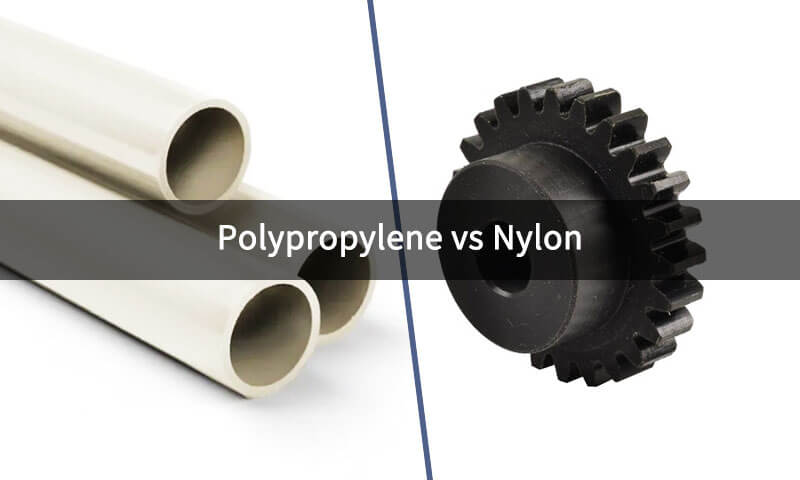
Polypropylene is a semi-crystalline polyolefin known for its low density, excellent moisture resistance, 耐化学性, 疲劳性抗性, and relatively easy processing.
尼龙, a family of polyamides, is generally recognized for its higher strength and stiffness, 出色的韧性, 低摩擦, 戴阻力, and better high-temperature performance.
It is also important to avoid treating either material as a single, fixed specification. PP and nylon are material families rather than individual grades.
PA6, PA66, 聚酰胺12, glass-filled nylon, PP homopolymer, PP copolymer, 矿物填充PP, and glass-reinforced PP can have substantially different properties.
所以, a meaningful polypropylene vs nylon comparison should consider not only strength and temperature resistance, but also moisture absorption, 化学兼容性, friction and wear, 电气性能, 维稳定性, injection molding behavior, 制造成本, and actual service conditions.
1. 什么是聚丙烯?
聚丙烯 (聚丙烯) is a widely used thermoplastic polymer belonging to the polyolefin family.
It is valued for its low density, 优异的耐化学性, very low moisture absorption, good fatigue performance, 电绝缘, and efficient processability.
Polypropylene is particularly attractive when plastic components need to combine low weight, chemical and moisture resistance, 良好的韧性, repeated flexing performance, 和具有成本效益的制造业.
Polypropylene differs fundamentally from nylon in its molecular chemistry. Its polymer backbone consists primarily of hydrocarbon chains with recurring methyl groups (-CH₃) attached to the carbon backbone.
Unlike nylon, PP does not contain polar amide groups capable of forming strong hydrogen bonds with water molecules.
This relatively non-polar molecular structure is responsible for many of polypropylene’s important engineering characteristics.
It contributes to its very low water absorption, excellent resistance to many chemicals, stable electrical insulation, 低密度, and good resistance to moisture-related dimensional changes.

Different formulations can be engineered for different applications.
Common polypropylene categories include:
- PP homopolymer
- PP random copolymer
- PP impact copolymer
- Glass-fiber-reinforced PP
- Mineral-filled PP
- Talc-filled PP
- UV-stabilized PP
- 阻燃PP
- Electrically modified PP
The ability to modify PP through copolymerization, 填充剂, 纤维, and additives allows manufacturers to balance stiffness, impact strength, 耐化学性, 外貌, processing behavior, 和成本.
Advantages and Limitations of Polypropylene
The major advantages of polypropylene include:
- 低密度: PP produces lightweight components.
- Excellent moisture resistance: Water absorption is extremely low.
- 良好的耐化学性: Particularly effective against many aqueous acids, 碱, 盐, and detergents.
- 极好的抗疲劳性: Suitable for repeated flexing and living hinges.
- 电绝缘性好: Useful for electrical housings and insulating components.
- Excellent injection molding characteristics: Low melt viscosity and good flow facilitate high-volume production.
- 材料成本低: PP is generally more economical than engineering-grade nylon.
- Good design flexibility: It can be produced in different colors, formulations, and surface appearances.
然而, polypropylene also has limitations.
Standard PP generally provides lower stiffness and high-temperature mechanical performance than nylon.
Under sustained mechanical loads, 特别是在高温下, PP can experience creep and deformation.
Its relatively high coefficient of thermal expansion can also be important in precision applications.
此外, unmodified PP can degrade under prolonged ultraviolet exposure, so outdoor applications may require UV stabilizers or other protective measures.
2. 什么是尼龙?
尼龙 is a family of engineering thermoplastics belonging to the 聚酰胺 (PA) group.
It is widely used when plastic components must provide a combination of high strength, 刚性, 韧性, 戴阻力, 低摩擦, 疲劳性能, and elevated-temperature capability.
Nylon differs fundamentally from polypropylene in its molecular chemistry.
The polymer backbone contains recurring amide groups (-CONH-), which create stronger intermolecular interactions than those present in the non-polar hydrocarbon structure of PP.
These amide groups are responsible for many of nylon’s desirable engineering properties.
They contribute to its mechanical strength, 刚性, 韧性, and ability to withstand repeated friction and loading.
同时, the polar nature of the amide groups causes nylon to absorb moisture. This is one of the most important considerations when comparing nylon vs polypropylene.

Nylon is not a single material. Several commercially important polyamide families exist,
包括:
- PA6
- PA66
- PA11
- 聚酰胺12
- 尼龙46
- Various glass-fiber-reinforced PA grades
- Mineral-filled PA grades
- Flame-retardant PA grades
- Heat-stabilized PA grades
其中, PA6 和 PA66 are particularly common in engineering applications.
Nylon is widely used for mechanical components because it can combine structural performance with relatively low friction.
Unlike many metals, it can also provide a lightweight alternative for gears, 衬套, 滚筒, 向导, and other moving components.
Advantages and Limitations of Nylon
Nylon’s principal advantages include:
- 高拉伸强度
- 高刚度
- 出色的韧性
- 良好的疲劳阻力
- 出色的耐磨性
- 低摩擦
- Good resistance to repeated mechanical loading
- Better high-temperature performance than standard PP
- Strong suitability for mechanical components
Its limitations include:
- Higher moisture absorption
- Moisture-related dimensional changes
- More demanding drying requirements
- Higher processing temperatures
- Greater sensitivity to processing conditions
- Higher material cost
- Potential property changes between dry and moisture-conditioned states
3. Polypropylene vs Nylon Strength
Higher Strength and Stiffness of Nylon
When comparing polypropylene vs nylon for mechanical strength, nylon generally provides higher tensile strength, 刚性, and load-bearing capability than unfilled polypropylene.
Typical unfilled PP grades have tensile strengths of approximately 25–40 MPa, while common PA6 and PA66 grades can typically reach around 50–90 MPA, depending on the specific grade and test conditions.
The difference is closely related to molecular structure. Polypropylene has a relatively non-polar hydrocarbon backbone, whereas nylon contains polar amide groups that create stronger intermolecular interactions and hydrogen bonding.
These interactions restrict molecular movement and allow nylon to resist deformation more effectively under mechanical loading.
Excellent Flexural Fatigue Performance of Polypropylene
Although nylon is generally stronger, polypropylene has an important mechanical advantage in repeated flexing.
PP can withstand extensive cyclic bending without cracking when the component is properly designed.
This makes it particularly suitable for living hinges, flexible closures, 卡扣配合功能, and repeatedly flexed components.
所以, higher tensile strength does not automatically make nylon the better material for every mechanical application.
The loading mode must be considered together with strength, 刚性, 疲劳, 影响, and creep requirements.
Improved Strength with Reinforcement
Both polymers can be reinforced to achieve substantially higher mechanical performance.
Glass-fiber-reinforced PP can reach tensile strengths of approximately 70–90 MPA in representative grades, 尽管 30% glass-fiber-reinforced PA6 can reach roughly 130–170 MPa, depending on formulation and testing conditions.
Reinforcement also increases stiffness and creep resistance, although it can introduce greater anisotropy, molding shrinkage differences, and processing considerations.
4. Polypropylene vs Nylon Temperature Resistance

Higher Temperature Resistance of Nylon
Nylon generally provides better temperature resistance than polypropylene, particularly when the material must maintain mechanical strength and stiffness at elevated temperatures.
Typical polypropylene grades have a melting temperature of approximately 160–170°C, while PA6 melts at around 220°C and PA66 at approximately 255°C.
然而, melting temperature should not be confused with continuous operating temperature.
Thermoplastic components usually lose stiffness and load-bearing capability well before reaching their melting point.
Nylon generally retains useful mechanical properties at higher temperatures.
Depending on the grade and reinforcement, nylon can provide significantly better heat-deflection performance and resistance to deformation.
Moderate Temperature Capability of Polypropylene
Polypropylene remains highly effective in many applications operating at moderate temperatures.
Its low cost, 耐化学性, and low moisture absorption can make it more economical than nylon when extreme temperature resistance is not required.
例如, PP is widely used for containers, 管道, 住房, 管道组件, and automotive interior parts where operating temperatures remain within the material’s practical range.
5. Polypropylene vs Nylon Moisture and Chemical Resistance

Superior Moisture Resistance of Polypropylene
Polypropylene has a major advantage over nylon in moisture resistance. Its molecular structure is predominantly non-polar, so water has very limited interaction with the polymer chains.
Typical polypropylene grades exhibit extremely low water absorption, 经常在周围 0.01% or less after 24 小时, depending on the grade and test method.
This low moisture absorption allows PP components to maintain relatively stable dimensions, 重量, 机械性能, and electrical characteristics in humid or wet environments.
Higher Moisture Absorption of Nylon
Nylon behaves differently because its molecular backbone contains polar amide groups.
These groups readily interact with water molecules, allowing nylon to absorb significantly more moisture.
Depending on the polyamide type and environmental conditions, nylon can absorb several percent of its weight in water at equilibrium.
PA6 and PA66 are particularly sensitive to moisture compared with polypropylene.
Moisture acts as a plasticizer in nylon. As water content increases, nylon generally becomes more ductile while its stiffness and strength decrease. 同时, dimensional expansion can occur.
This behavior is particularly important for precision components such as gears, 衬套, 连接器, and tight-tolerance housings.
Excellent Chemical Resistance of Polypropylene
Polypropylene also offers excellent resistance to many chemicals, 特别 稀酸, 碱, 盐, 洗涤剂, 和化学水溶液.
This combination of chemical resistance and low moisture absorption makes PP widely used for chemical containers, 坦克, 管道, 实验室设备, 衬里, and fluid-handling components.
Good but More Application-Dependent Chemical Resistance of Nylon
Nylon provides useful resistance to many oils, 燃料, 油脂, 和工业化学品. 然而, its chemical resistance is more dependent on the specific chemical and service conditions.
Certain strong acids and aggressive chemical environments can attack polyamide materials. Elevated temperature and mechanical stress can further influence chemical compatibility.
最后, nylon should not be selected solely on the basis of general chemical-resistance classifications.
The actual chemical concentration, 温度, exposure duration, stress level, and nylon grade should be evaluated.
6. Polypropylene vs Nylon Friction and Wear Resistance

Better Mechanical Wear Performance of Nylon
Nylon is widely recognized as a useful engineering material for applications involving friction, 滑动, 和重复的机械接触.
它的力量结合, 韧性, 刚性, and relatively low friction makes it suitable for gears, 衬套, 轴承, 滚筒, 耐磨条, and guide components.
Typical dry friction coefficients for nylon can fall in the approximate range of 0.2–0.4, depending strongly on the grade, counterface, 加载, 滑动速度, 表面饰面, 及测试方法.
The relatively high mechanical strength of nylon allows it to withstand contact stresses without excessive deformation, which is particularly important in loaded sliding components.
Low-Friction Characteristics of Polypropylene
Polypropylene can also exhibit relatively low friction and can perform well in selected sliding applications.
Certain PP grades are used where a lightweight, chemically resistant, and low-cost sliding material is required.
然而, friction coefficient and wear resistance are not identical properties.
A material may have a low coefficient of friction while still experiencing relatively high material loss under sustained mechanical contact.
For heavily loaded or continuously moving components, nylon often provides a more favorable combination of mechanical load capacity and wear resistance.
Specialized Compounds Can Improve Wear Resistance
Both materials can be modified for tribological applications.
Nylon compounds may incorporate PTFE, 石墨, molybdenum disulfide, silicone-based lubricants, or other additives to reduce friction and improve wear resistance.
Polypropylene can also be formulated with fillers and lubricating additives for specialized low-friction applications.
然而, reinforcement must be carefully selected. Glass fibers can significantly increase stiffness and load-bearing capacity, but they can also influence the wear mechanism and the behavior of the mating surface.
7. Polypropylene vs Nylon Electrical Properties
Excellent Electrical Insulation of Polypropylene
Polypropylene is an excellent electrical insulating material and is particularly valuable when stable dielectric performance is required.
Representative PP grades can have a dielectric constant of approximately 2.2–2.6 and volume resistivity on the order of 10¹⁶ Ω·cm, although values vary with frequency, 温度, 配方, and testing conditions.
Its combination of high electrical resistivity, 低介电常数, and extremely low moisture absorption makes polypropylene useful for electrical insulation, capacitor films, 电缆组件, electronic parts, and other dielectric applications.
Good Electrical Insulation of Nylon
Nylon is also an effective electrical insulator, particularly under dry conditions.
Representative nylon grades can have dielectric constants around 3.5–4.0, although the exact value depends strongly on the polymer type, 频率, 温度, and moisture content.
Nylon’s advantage is that it combines electrical insulation with substantially higher mechanical strength and toughness than conventional polypropylene.
This makes it useful for electrical connectors, 住房, cable-management components, and mechanically demanding insulating parts.
8. Polypropylene vs Nylon for Injection Molding
Excellent Injection Molding Processability of Polypropylene
Polypropylene is one of the most widely injection-molded thermoplastics because it combines good melt flow, relatively low processing requirements, low moisture sensitivity, and short cycle times.
Its relatively low melt viscosity allows molten PP to fill complex mold cavities efficiently, making it suitable for thin-wall components, 卡扣配合功能, 活动铰链, 容器, 住房, and other high-volume products.
A major processing advantage of PP is that the resin normally does not require the extensive pre-drying required by nylon.
Because polypropylene absorbs very little moisture, manufacturers can generally process properly stored PP directly or with relatively simple material conditioning procedures.
PP also has a relatively wide processing window.
Typical melt temperatures are often in the range of approximately 200–250°C, depending on grade and application, while mold temperatures are commonly controlled at considerably lower temperatures.
Exact conditions must be established from the resin manufacturer’s processing recommendations.
Higher Moisture Sensitivity of Nylon
Nylon is also highly suitable for 注入成型, but its processing requirements are more demanding.
Most nylon resins are hygroscopic and can absorb atmospheric moisture during storage.
Before molding, nylon generally needs to be properly dried to a specified moisture level.
If excessive moisture remains in the resin, the combination of water and high melt temperature can cause hydrolytic degradation, reducing molecular weight and potentially lowering the mechanical performance of the finished component.
This makes material handling particularly important when processing nylon.
Resin should be stored in moisture-resistant packaging, and drying conditions should be controlled according to the specific PA grade.
Higher Processing Temperatures for Nylon
Nylon generally requires higher melt temperatures than polypropylene.
PA6 is commonly processed at melt temperatures around 240–280°C, while PA66 can require approximately 260–300°C, depending on the grade and processing technology.
The higher processing temperature increases energy requirements and places greater demands on molding equipment, mold components, 和过程控制.
然而, nylon’s higher processing temperature also reflects its higher melting point and enables the production of components capable of delivering greater mechanical and thermal performance.
9. Polypropylene vs Nylon Dimensional Stability
| 方面 | 聚丙烯 | 尼龙 |
| 吸收水分 | 非常低 | 高的 |
| Dimensional change with humidity | 最小 | 重要的 |
| Mould shrinkage (%) | 1.0–2.5 | 0.5–2.0 |
| Post-moulding shrinkage | 一般 | 重要的 (moisture conditioning) |
| 蠕变阻力 | 一般 | 良好 |
Polypropylene’s hydrophobic nature gives it excellent dimensional stability in humid environments.
Nylon absorbs moisture, causing parts to swell and dimensions to change. 然而, nylon parts can be moisture-conditioned to achieve stable dimensions.
10. 聚丙烯与尼龙: Cost and Manufacturing Considerations
Material Cost
Polypropylene is generally more economical than nylon. Its low density also means that less material by weight may be required to produce a component of comparable volume.
For high-volume products, this can provide a significant cost advantage.
Nylon is typically more expensive because it is an engineering thermoplastic with higher mechanical and thermal performance.
然而, its greater strength and stiffness may allow designers to reduce wall thickness or component size, partially offsetting the higher resin cost.
制造考虑
| 因素 | 聚丙烯 | 尼龙 |
| 材料成本 | 通常较低 | 通常更高 |
| 密度 | 降低 | 更高 |
| 加工温度 | 降低 | 更高 |
| Drying requirement | 最小 | Usually critical |
| 注入成型 | Relatively easy | More process-sensitive |
| Cycle efficiency | 出色的 | 良好 |
| 湿度敏感性 | 非常低 | 高的 |
| Tooling/process complexity | 通常较低 | 通常更高 |
| Typical application economics | 高量, cost-sensitive parts | Performance-critical components |
Polypropylene is usually easier and less expensive to process.
Its low moisture sensitivity simplifies material handling, while its good flow characteristics support efficient injection molding and high production volumes.
Nylon requires more careful manufacturing control. Before injection molding, many nylon resins must be properly dried to prevent moisture-related degradation and molding defects.
模具温度, 熔体温度, residence time, and cooling conditions also require closer control.
11. Polypropylene vs Nylon Applications
The application range of 聚丙烯 (聚丙烯) and nylon (PA) overlaps in many areas, but each material is better suited to different operating conditions.

Polypropylene Applications
Polypropylene is widely used where 低密度, 低吸湿性, 耐化学性, 疲劳性抗性, and economical high-volume processing 很重要.
| 应用领域 | Typical PP Components | Why PP Is Selected |
| 包装 | 容器, bottle caps, 关闭, 托盘, 食物包装 | 低密度, 耐水性, 耐化学性, 加工性 |
| 汽车 | Bumpers, 内饰, door panels, 电池盒, fluid reservoirs | 轻的, impact performance, 耐化学性, 成本效率 |
| 管道 & Water Systems | 管道, 配件, 泵组件, irrigation parts | Low water absorption and resistance to many chemicals |
消费产品 |
Storage bins, 家具, 设备外壳, housewares | 轻的, 耐用的, 经济 |
| 电气 & 电子产品 | Insulating components, cable-related parts, capacitor films, 住房 | Good electrical insulation and low moisture sensitivity |
| 医疗的 & Laboratory Products | 容器, 托盘, syringes, 实验室设备 | 耐化学性, 低吸湿性, suitable grades available |
| 工业设备 | 坦克, 管道, 容器, 封面, 流体处理组件 | 耐化学性, 重量低, economical processing |
Nylon Applications
Nylon is primarily used where 力量, 刚性, 韧性, 低摩擦, 戴阻力, and elevated-temperature performance are more important than minimum material cost and moisture absorption.
| 应用领域 | Typical Nylon Components | Why Nylon Is Selected |
| 汽车 | 齿轮, 轴承, 衬套, 发动机组件, 连接器, 括号 | 高力量, 刚性, 戴阻力, 温度能力 |
| 电气 & 电子产品 | 连接器外壳, 接线端子, circuit-breaker components | 机械强度, 绝缘, dimensional performance |
| 工业机械 | 齿轮, 滚筒, bearing components, 穿盘子, 传送带零件 | 低摩擦, 戴阻力, load-bearing capability |
紧固件 & 硬件 |
Cable ties, 坚果, 剪辑, 紧固件, snap-fit components | 力量, 韧性, 疲劳性抗性 |
| 机械组件 | 衬套, 滑轮, 向导, 齿轮, 结构支架 | High stiffness and good tribological performance |
| Fibers & 纺织品 | Industrial fibers, tire cord, fishing line, brush filaments, technical textiles | 高拉伸强度, 韧性, 耐磨性 |
| 消费产品 | Zippers, buckles, tool housings, 机械部件 | 韧性, 力量, 戴阻力 |
聚丙烯与尼龙: Application Selection
The choice between PP and nylon can be simplified by identifying the dominant service requirement:
- Choose polypropylene when low weight, 耐水性, 耐化学性, 疲劳性能, and low manufacturing cost are the primary requirements.
- Choose nylon when high strength, 刚性, 戴阻力, 低摩擦, 韧性, or elevated-temperature performance is more important.
- Consider reinforced PP when lightweight construction is important but higher stiffness and strength are required.
- Consider reinforced nylon when the component must withstand high mechanical loads, continuous stress, or demanding thermal conditions.
12. 结论
Polypropylene and nylon are complementary engineering materials, not direct competitors.
Each occupies a distinct performance niche defined by its fundamental chemistry:
polypropylene delivers low cost, excellent dimensional stability and moisture insensitivity at the expense of lower strength and wear performance;
nylon delivers high strength, excellent wear resistance and oil tolerance at the expense of higher cost, moisture sensitivity and processing complexity.
Neither is universally superior. PP is the optimal choice for commodity components, precision parts in variable humidity, hot water applications and cost-sensitive products.
Nylon is the better choice for high-load structural components, 穿零件, oil-exposed under-hood components and high-temperature applications with glass reinforcement.
The most common selection mistake is specifying nylon when PP would perform adequately at 40–60% lower total cost, or specifying PP for high-load wear applications where premature failure will occur.
Systematic comparison against actual operating conditions — not defaulting to the familiar material — ensures optimal performance at minimum total cost.
常见问题解答
Can polypropylene and nylon be recycled?
是的, both materials are recyclable. Polypropylene is widely recycled (resin code #5). Nylon is recyclable but less commonly recycled than polypropylene.
Is nylon or polypropylene more brittle at low temperatures?
Polypropylene is more brittle at low temperatures. It has a glass transition temperature of –10 to 0°C, below which it becomes brittle. Nylon remains tough to –30 to –40°C.
Is polypropylene stronger than nylon?
一般来说, 不. Standard nylon typically has higher tensile strength, 刚性, and load-bearing capability than unfilled polypropylene. 然而, polypropylene has a lower density and excellent fatigue and moisture resistance.
Reinforced PP can also achieve substantially higher mechanical performance and may outperform unfilled nylon in specific applications.
Is polypropylene more heat resistant than nylon?
一般来说, nylon has better heat resistance than standard polypropylene.
Common nylon grades have higher melting temperatures and generally retain mechanical strength and stiffness better at elevated temperatures.
Reinforced grades can further improve the high-temperature performance of both materials.
Which absorbs more water, polypropylene or nylon?
Nylon absorbs significantly more water than polypropylene. Polypropylene has extremely low moisture absorption, while nylon is hygroscopic because of its polar amide groups.
Moisture absorption can affect nylon’s dimensions, 刚性, 韧性, 和电性能.
哪个更便宜, polypropylene or nylon?
Polypropylene is generally less expensive than nylon. PP also has a lower density, which can further reduce material consumption by component weight.
然而, the total cost should include processing, 工具, part design, 加强, 废料, 和服务寿命.
A more expensive nylon component may ultimately be more economical if it provides significantly longer service life or allows a smaller, stronger component design.
Which has better dimensional stability, polypropylene or nylon?
The answer depends on the environment.
Polypropylene has a major advantage in moisture-related dimensional stability because it absorbs very little water. Nylon can experience dimensional changes as it absorbs moisture.
然而, PP has relatively high thermal expansion, while reinforced nylon can provide excellent dimensional stability over temperature when properly formulated.
用于精确应用, engineers should evaluate both moisture-induced and temperature-induced dimensional changes.