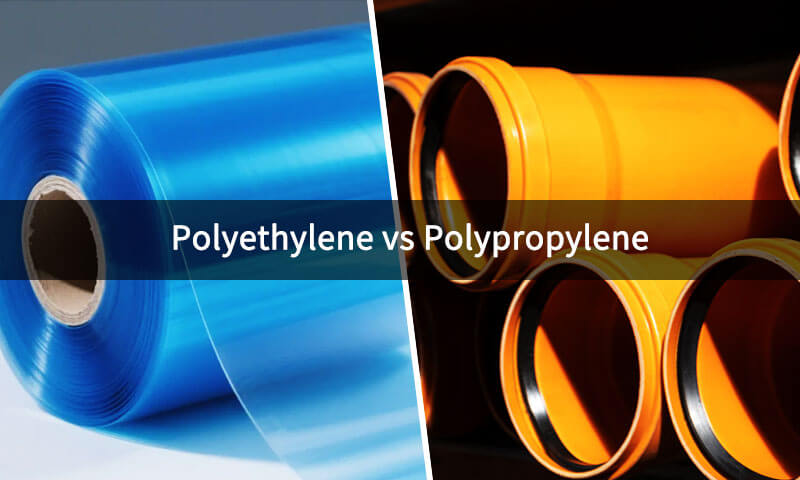
聚乙烯 (PE) and polypropylene (聚丙烯) are the two most widely produced commodity thermoplastics in the world, together accounting for over 50% of global plastic production.
They dominate packaging, 汽车, 建造, 医疗的, and consumer goods applications.
Despite their similarities—both are thermoplastic polyolefins derived from hydrocarbon feedstocks—they possess distinctly different properties that make one more suitable than the other for specific applications.
Selecting between PE and PP requires an in-depth understanding of how these chemical structures govern performance in engineering, 包装, and industrial processing.
1. 什么是聚乙烯?
聚乙烯 (PE) is a thermoplastic polymer produced through the polymerization of ethylene monomers.
It is one of the most widely used polymer families because its molecular structure can be modified to produce materials ranging from highly flexible films to rigid, high-strength engineering components.
The properties of polyethylene are strongly influenced by 分子量, chain branching, 结晶度, 密度, 及加工条件.
Increasing molecular linearity and crystallinity generally improves stiffness, 力量, 耐化学性, 和维稳定性, while higher branching tends to increase flexibility and reduce density.

Unlike many engineering plastics, PE has very low moisture absorption and excellent resistance to a broad range of chemicals.
It is also lightweight and relatively easy to process, making it attractive for both high-volume products and specialized industrial components.
| 性能特性 | 细节 |
| Chemical name | 聚乙烯 |
| 化学式 | (C₂H₄)ₙ |
| Polymer backbone | –CH₂–CH₂– |
| Monomer | Ethylene |
| CAS number | 9002-88-4 |
| Polymer type | 热塑性塑料 |
| Density range | 0.91–0.96 g/cm³ |
| 熔点 | 105–135°C |
Major Types of Polyethylene
Polyethylene is commonly classified according to density, 分子结构, and molecular weight.
| 类型 | 结构特点 | 典型性能 | 常见应用 |
| 低密度聚乙烯 | Highly branched, relatively low crystallinity | 灵活的, 艰难的, 良好的加工性能 | 电影, bags, 涂料, 电缆绝缘层 |
| 线性低密度聚乙烯 | Linear backbone with short-chain branching | Higher tensile and puncture resistance than LDPE while retaining flexibility | Packaging films, 衬里, 农用薄膜 |
| 中密度聚乙烯 | Intermediate density and crystallinity | Balanced stiffness, 韧性, and environmental stress-crack resistance | 管道, 容器, industrial products |
| 高密度聚乙烯 | More linear chains and higher crystallinity | 高刚度, 力量, 耐化学性, 并影响韧性 | 管道, 坦克, 容器, 汽车零部件 |
| 超高分子量聚乙烯 | Extremely high molecular weight with highly entangled chains | 出色的耐磨性, 影响韧性, 和低摩擦 | Wear liners, 轴承, 向导, 医疗组件 |
2. What Is Polypropylene?
聚丙烯 (聚丙烯) is a thermoplastic polymer produced by the polymerization of propylene monomers.
It belongs to the same polyolefin family as polyethylene but has a different molecular structure: 一个 methyl group is attached to the polymer backbone.
This structural difference affects chain mobility, 结晶度, 刚性, 热行为, 和疲劳性能.
因此, PP generally provides a particularly attractive combination of 低密度, 刚性, 耐化学性, 疲劳性抗性, 和加工性.

Polypropylene is extensively used in injection-molded components, 汽车系统, 包装, electrical products, 实验室设备, medical products, 和工业设备.
Its properties can also be tailored through copolymerization, 填充剂, 纤维, 抗冲改性剂, and other additives.
| 性能特性 | 细节 |
| Chemical name | 聚丙烯 |
| 化学式 | (C₃H₆)ₙ |
| Polymer backbone | –CH₂–CH(CH₃) - |
| Monomer | Propylene |
| CAS number | 9003-07-0 |
| Polymer type | 热塑性塑料 |
| Density range | 0.895–0.92 g/cm³ |
| 熔点 | 130–171°C |
Major Types of Polypropylene
Commercial polypropylene is primarily classified according to its molecular structure and comonomer content.
| 类型 | 结构特点 | 典型性能 | 常见应用 |
| PP Homopolymer | Primarily propylene repeating units | 高刚度, 优势, 良好的耐化学性, good temperature capability | 汽车零件, 容器, 电器, 工业组件 |
| PP Random Copolymer | Propylene combined with randomly distributed comonomer units | Improved flexibility, impact behavior, and often better optical clarity | 包装, medical products, transparent containers |
PP Block Copolymer |
Propylene matrix containing a dispersed rubber-rich phase | Enhanced impact resistance, particularly for demanding molded parts | 汽车组件, heavy-duty containers, 工业住房 |
| Reinforced PP | PP combined with glass fiber, 矿物填料, or other reinforcements | Increased stiffness, 维稳定性, 和承载能力 | Structural automotive parts, 机械组件, 电气外壳 |
3. 机械性能: Polyethylene vs. 聚丙烯
下面的值是 typical engineering ranges rather than universal material specifications.
Actual properties can vary according to resin supplier, grade designation, specimen preparation, 成型条件, 方向, and test standard.
For material selection, the supplier’s technical data sheet and the applicable ASTM/ISO test method should be used as the final reference.
| 机械性能 | 低密度聚乙烯 | 高密度聚乙烯 | PP Homopolymer | PP Block Copolymer |
| Tensile Strength at Yield | ~8–15 MPa | ~20–32 MPa | ~30–40 MPa | ~20–35 兆帕 |
| Tensile Strength at Break | ~8–25 MPa | ~25–40 MPa | ~25–45 MPa | ~20–40 MPa |
| 断裂伸长率 | ~100–600% | ~500–1,000%* | ~50–600%* | ~100–700%* |
| Tensile Modulus | ~150–300 兆帕 | ~700–1,500 MPa | ~1,000–1,800 MPa | ~700–1,500 MPa |
| Flexural Modulus | ~150–350 兆帕 | ~800–1,600 MPa | ~1,000–1,800 MPa | ~700–1,500 MPa |
| 硬度 | ~40–50 Shore D | ~60–70 Shore D | ~65–75 Shore D | ~55–70 Shore D |
| 蠕变阻力 | 低 - 中等 | 中等事物 | 中等事物 | 一般 |
| 疲劳性抗性 | 良好 | 良好 | 出色的 | 出色的 |
4. Thermal Properties and Temperature Resistance Comparison
Temperature resistance is an important differentiating factor between polyethylene and polypropylene.
Both are semicrystalline thermoplastics, but their molecular structures give them different melting behavior, 热稳定性, and low-temperature performance.

升高的性能
PP generally retains its stiffness and mechanical integrity at higher temperatures than LDPE and HDPE.
This makes PP homopolymer attractive for components exposed to warm fluids, engine compartments, 电器, 和工业设备.
LDPE has the lowest thermal rigidity among the grades considered. Its relatively flexible molecular structure causes it to soften and deform more readily as temperature increases.
HDPE performs better than LDPE, but prolonged exposure to elevated temperature can still result in creep and dimensional deformation.
PP block copolymer provides improved impact resistance but may have somewhat lower stiffness and heat resistance than PP homopolymer because of its rubber-modified structure.
低温性能
Polyethylene generally has an advantage in cold environments. HDPE and especially appropriately formulated PE grades can retain substantial impact toughness at low temperatures.
Conventional PP, by comparison, can become significantly more brittle as temperature decreases. This is particularly important for components exposed to sudden impact in cold climates.
PP block copolymer is specifically designed to improve this limitation. Its dispersed elastomeric phase absorbs impact energy and provides substantially better low-temperature toughness than standard PP homopolymer.
Thermal Expansion and Dimensional Stability
Both PE and PP have relatively high coefficients of thermal expansion compared with metals. Temperature changes can therefore produce noticeable dimensional movement, particularly in precision components with long dimensions or tight clearances.
5. Chemical Resistance Comparison: Polyethylene vs. 聚丙烯
Both polyethylene (PE) and polypropylene (聚丙烯) are widely recognized for their excellent resistance to water, 酸, 碱, 和许多工业化学品.
Their non-polar hydrocarbon structures give them an important advantage over many engineering plastics: chemical resistance is generally strong without relying on protective coatings.
Polyethylene Chemical Resistance
Polyethylene generally provides excellent resistance to aqueous chemicals.
高密度聚乙烯 is particularly widely used for chemical tanks, drums, 管道, 衬里, and containers because it combines chemical resistance with good toughness and relatively low permeability to many substances.
PE performs well against many:
- 稀酸
- Alkalis and bases
- Salts
- Alcohols
- Water and aqueous solutions
- Many detergents
然而, polyethylene is not resistant to every chemical environment.
Certain 强氧化剂, aromatic compounds, and hydrocarbon-based solvents can affect PE, particularly at elevated temperatures or under sustained mechanical stress.
The specific PE grade is therefore important when long-term chemical exposure is expected.
Polypropylene Chemical Resistance
Polypropylene offers similarly strong resistance to many acids, 碱, 盐, detergents, and aqueous chemical solutions.
它被广泛使用 化学处理设备, laboratory products, 储罐, 泵, 阀, 和管道系统.
A notable advantage of PP is its combination of chemical resistance and higher temperature capability than many conventional PE grades.
This makes PP particularly attractive when chemical exposure occurs under moderately elevated temperatures.
PP can nevertheless be affected by certain aromatic, 氯化, and hydrocarbon-based chemicals.
The risk generally increases with temperature, 专注, 接触时间, 和机械载荷.
最后, a chemical compatibility assessment should always be based on the actual service conditions rather than the polymer name alone.
PE vs. PP Chemical Resistance
| 化学 / 环境 | 聚乙烯 (PE) | 聚丙烯 (聚丙烯) |
| 水 | 出色的 | 出色的 |
| 稀酸 | 出色的 | 出色的 |
| Alkalis | 出色的 | 出色的 |
| Salts | 出色的 | 出色的 |
| 洗涤剂 | 出色的 | 出色的 |
| Alcohols | Generally good–excellent | Generally good–excellent |
| Hydrocarbons | 多变的 | 多变的 |
| Aromatic solvents | 有限的 | 有限的 |
| Strong oxidizers | 有限的 | 有限的 |
| High-temperature chemical service | Good for selected PE grades | Generally better |
6. 吸水率, Moisture and Dimensional Stability
One of the most useful similarities between PE and PP is their very low water absorption.
Unlike hygroscopic engineering plastics such as nylon or polyamide, neither material readily absorbs significant quantities of atmospheric moisture into its polymer structure.
This characteristic is important because moisture absorption can cause dimensional changes, altered mechanical properties, and processing difficulties in other thermoplastics. PE and PP largely avoid these problems.

Moisture Behavior
Polyethylene and polypropylene are both essentially hydrophobic, non-polar polymers. Water has little affinity for their molecular chains, so water uptake is very low under normal conditions.
因此, PE and PP parts generally maintain their dimensions and mechanical characteristics well in humid environments or during intermittent water exposure.
| 性能特性 | 聚乙烯 | 聚丙烯 | Practical Significance |
| 吸水率 | 非常低 | 非常低 | Good performance in humid and wet environments |
| Moisture sensitivity during processing | 低的 | 低的 | Usually no extensive pre-drying required |
| Dimensional change from moisture | Very small | Very small | Suitable for water-contact components |
| Hydrolytic stability | 一般优秀 | 一般优秀 | Useful for prolonged aqueous exposure |
| Moisture-related electrical insulation | 出色的 | 出色的 | Suitable for many electrical applications |
维稳定性: Moisture vs. 温度
Low moisture absorption does not mean that PE and PP are dimensionally stable under all environmental conditions.
用于精密零件, thermal expansion and creep are generally much more important considerations than moisture absorption.
Both polymers have considerably higher thermal expansion than metals. Temperature changes can therefore cause noticeable dimensional movement, particularly in large parts, 精密组件, and components with tight clearances.
Long-term mechanical loading introduces another concern: 蠕变. When PE or PP is continuously subjected to stress, gradual molecular movement can cause permanent dimensional changes.
The effect becomes more pronounced as temperature and applied stress increase.
所以, components such as bushings, 支持, 向导, 密封, and structural plastic parts should be evaluated for their complete service environment rather than their initial dimensions alone.
7. Processing and Manufacturing Comparison
PE and PP are highly versatile thermoplastics and can be transformed into finished products through a wide range of manufacturing processes.
Their processing flexibility is one of the main reasons they occupy such a large share of the plastics market.
注塑成型
注入成型 is particularly important for PP, where the material’s flow characteristics and relatively high stiffness make it suitable for producing complex, lightweight components at high production volumes.
汽车零件, 电气外壳, appliance components, 容器, and industrial products are frequently manufactured this way.
HDPE is also well suited to injection molding, particularly for rigid containers, 关闭, 工业组件, and structural plastic parts.
LDPE is generally selected when the final product requires greater flexibility rather than high rigidity.

挤压
Extrusion is a major processing route for both polymer families. PE has a particularly strong presence in extruded products, including pipes, 床单, 电影, 概况, 衬里, and cable insulation.
HDPE is widely used for pressure and non-pressure piping because its combination of toughness, 耐化学性, and weldability is well suited to fluid-handling systems.
PP is also extruded into pipes, 床单, 电影, 概况, and specialized industrial products where greater stiffness or temperature capability is beneficial.
Blow Molding and Rotational Molding
PE, especially HDPE, is extensively used for blow-molded bottles, drums, 坦克, 容器, and other hollow products.
Its toughness and processability make it particularly suitable for large or impact-resistant containers.
Rotational molding is another important PE process, especially for large tanks, 垃圾箱, 管道, and industrial containers.
PP can also be processed into hollow products, although its processing window and application profile differ from those of PE.
Thermoforming and Fabrication
Both PE and PP sheets can be thermoformed into covers, 托盘, 住房, 衬里, 和其他大型组件.
They can also be joined through 热焊接, butt fusion, extrusion welding, and mechanical fastening, allowing manufacturers to fabricate large structures without conventional molding tools.
This is particularly valuable for chemical tanks, ductwork, protective liners, and customized industrial equipment.
数控加工
PE and PP can also be 数控加工 when production volumes are too low to justify dedicated tooling or when exceptionally customized geometries are required.
Machining requires appropriate cutting conditions because both materials have relatively low stiffness and can deform under excessive clamping or cutting forces.
Among PE grades, UHMWPE presents additional machining challenges because of its high molecular weight, 弹性, and tendency to generate heat during cutting.
Proper tooling, 工件夹持, and thermal control are therefore important for achieving consistent dimensions.
8. Surface Characteristics and Appearance
Surface appearance is not usually the primary reason for selecting polyethylene or polypropylene, but it becomes important when the material is used for visible components, 消费产品, 住房, 包装, or parts requiring a specific tactile or aesthetic finish.
Polyethylene Surface Characteristics
The appearance of polyethylene depends strongly on its grade and crystallinity. LDPE tends to have a softer, more flexible appearance, while HDPE generally provides a more rigid and opaque surface.
HDPE commonly exhibits a smooth to slightly textured surface with a natural translucent-to-opaque appearance.
Its surface can be machined, 抛光, 有纹理的, or otherwise mechanically finished, although achieving a highly glossy decorative surface can be more challenging than with some other plastics.
Polypropylene Surface Characteristics
PP generally provides a 干净的, 光滑的, and relatively rigid surface, particularly in injection-molded components.
It can be produced in a wide range of colors and textures and is widely used where appearance and functional performance must coexist.
PP’s low surface energy can make conventional painting, 粘合, and printing difficult.
Surface treatment such as flame treatment, corona treatment, plasma treatment, or specialized primers may be required to improve adhesion.
9. 环境和可持续性考虑
| 方面 | 聚乙烯 | 聚丙烯 |
| 回收 | 出色的 (widely recycled) | 出色的 (increasingly recycled) |
| Recycled content available | 高的 | 一般 |
| 生物降解性 | Not biodegradable | Not biodegradable |
| Environmental persistence | 高的 (centuries) | 高的 (centuries) |
| Energy to produce (MJ/kg) | 70–90 | 70–85 |
| Carbon footprint (kg CO₂/kg) | 1.5–2.5 | 1.5–2.5 |
| Bio-based grades | Available (生物PE) | Available (bio-PP) |
| Microplastic contribution | 重要的 | 重要的 |
10. 应用领域: Polyethylene vs. 聚丙烯
PE and PP are used across an exceptionally broad range of industries, but their applications tend to reflect their different performance profiles.
Polyethylene Application Examples
包装行业
- LDPE stretch wrap film: Industrial pallet stretch wrap and food cling film use LDPE for its extreme elongation (200–600%), excellent puncture resistance and ability to self-adhere under tension.
LDPE’s low melting point also allows it to heat-seal cleanly on high-speed packaging lines. - HDPE milk jugs and detergent bottles: Blow-molded HDPE is the standard for rigid liquid containers because it provides good stiffness, excellent moisture barrier properties and impact resistance at low cost.
Its 125–135°C melting point withstands hot-fill processes for beverages and industrial chemicals. - LLDPE heavy-duty shipping sacks: Linear low-density polyethylene is used for industrial shipping sacks because it combines the flexibility of LDPE with higher tear strength and puncture resistance, standing up to rough handling in logistics chains.
Infrastructure and Construction
- HDPE municipal water and gas pipe: High-density polyethylene is the dominant material for buried potable water distribution and natural gas service lines.
Its excellent chemical resistance to soil constituents, zero corrosion and flexible joint systems reduce installation cost and leak risk compared to metal pipe. - HDPE geomembranes: 0.5–2.5 mm thick HDPE sheets line landfills, mining ponds and water reservoirs as impermeable barriers.
HDPE’s low water absorption, resistance to soil chemicals and ability to be thermally welded in the field make it the industry standard. - LDPE vapor barriers: Thin LDPE sheets are installed behind building walls as moisture and radon barriers, leveraging PE’s near-zero water vapor transmission rate.
Electrical and Cable
- LDPE wire and cable insulation: Low-density polyethylene is the standard primary insulation for low- and medium-voltage power cables and communication wiring.
Its excellent dielectric properties, flexibility and low processing cost make it ideal for high-speed extrusion coating of conductors. - HDPE cable jackets: 中等的- and high-voltage cables use HDPE outer jackets for higher mechanical protection, crush resistance and weather resistance for direct burial and overhead installations.
Cold Chain and Cryogenic
- LDPE frozen food packaging: Flexible LDPE film and bags dominate deep-freeze food packaging because LDPE remains flexible and impact-resistant down to -40°C and below, without becoming brittle like PP would.
- HDPE cryogenic storage containers: Rotationally molded HDPE tanks and containers store liquid nitrogen and other cryogenic fluids at temperatures as low as -196°C, where PP would shatter.
消费品
- HDPE plastic grocery bags and reusable totes: The combination of low cost, good strength and water resistance makes HDPE the standard for carry-out bags and reusable shopping bags.
- Flexible toys and squeeze bottles: LDPE is used for soft, squeezable children’s toys and dispensing bottles because of its extreme flexibility and rubbery feel.
Polypropylene Application Examples
Packaging and Food Service
- PP bottle caps and closures: Injection-molded PP homopolymer is the nearly universal material for screw-on beverage bottle caps.
Its high stiffness, good creep resistance and 160°C melting point ensure tight sealing without deformation during hot filling, pasteurization and shipping. - Microwave-safe food containers: PP is the standard for microwaveable meal trays and food storage containers because it withstands 100–120°C temperatures without softening, and is generally recognized as safe for food contact at elevated temperatures.
- Thermoformed disposable cups and lids: Thin-gauge PP sheet thermoforms into rigid disposable drinking cups and dome lids with sharper definition and better rigidity than comparable PE products.
汽车行业
- PP block copolymer bumper fascias: Automotive bumpers and body panels use impact-modified PP block copolymer.
The ethylene block segments improve low-temperature impact resistance so parts survive winter cold without cracking, while PP’s inherent stiffness maintains structural shape. - Battery housings and under-hood components: PP homopolymer with glass fiber reinforcement is used for automotive battery cases and engine compartment parts.
It resists oils, fuels and elevated under-hood temperatures better than PE. - Interior door panels and trim: Talc-filled PP forms lightweight, stiff interior door modules and instrument panel substrates, offering good dimensional stability and low cost.
Household and Appliance
- Dishwasher-safe cookware and storage: PP is the standard for food storage containers and kitchen utensils marketed as dishwasher-safe, because it survives repeated 60–70°C wash cycles without warping or degrading, unlike HDPE which softens.
- Washing machine tubs and appliance housings: Large injection-molded PP homopolymer forms washing machine drums and appliance casings, combining water resistance, stiffness and low cost.
Industrial and Engineering
- PP pipe for chemical processing: Polypropylene pipe systems handle aggressive chemical environments including acids, bases and salt solutions at higher temperatures than HDPE pipe can withstand.
- Plastic gears and bearings: Homopolymer PP is used for light- to medium-load gears and bushings in industrial machinery.
Its natural self-lubricating properties, wear resistance and dimensional stability make it suitable for low-speed motion applications.
Fibers and Textiles
- PP carpet fibers: Most synthetic residential and commercial carpet fiber is polypropylene. It resists staining, moisture and mildew better than nylon, at a lower cost.
- Geotextiles and industrial ropes: PP staple fiber and monofilament are used for road construction geotextiles, marine ropes and cargo nets, leveraging PP’s good chemical resistance and high strength-to-weight ratio.
11. 全面比较表: Polyethylene vs. 聚丙烯
| 性能特性 | 聚乙烯 (PE) | 聚丙烯 (聚丙烯) | Selection Consideration |
| 密度 | ~0.91–0.96 g/cm³ | ~0.895–0.92 g/cm³ | Both are lightweight; PP is generally slightly lighter |
| 刚性 | 低至中等, 取决于成绩 | 通常更高 | PP is preferable when greater stiffness is required |
| 冲击阻力 | 出色的, especially HDPE and UHMWPE | 良好; reduced at low temperatures | PE is often favored for impact-intensive applications |
| 抗拉强度 | 中度至高 | 中度至高 | Strongly dependent on grade and molecular structure |
| 灵活性 | 更高, particularly LDPE | 一般 | PE is better for flexible films, 管道, and liners |
| 耐热性 | 一般; varies significantly by grade | 通常更高 | PP is advantageous for elevated-temperature service |
| 低温性能 | 一般优秀 | More sensitive to low temperatures | PE is often preferred for cold environments |
| 耐化学性 | 出色的 | 出色的 | Both resist many acids, 碱, 盐, 和水性化学品 |
| 吸水率 | 非常低 | 非常低 | Both provide excellent moisture resistance |
| 蠕变阻力 | 一般; 随成绩而变化 | 一般 | Reinforcement or grade selection may be needed for sustained loads |
抗紫外线 |
Requires stabilization for long-term exposure | Requires stabilization for long-term exposure | UV-stabilized grades are recommended outdoors |
| 电绝缘 | 出色的 | 出色的 | Both are widely used as insulating materials |
| Typical Processing | 挤压, 吹塑, 注入成型, 滚塑成型 | 注入成型, 挤压, 吹塑, 热成型 | Selection depends on part geometry and production volume |
| 典型的成本 | Generally economical | Generally economical | Market price varies by grade and region |
| Best Known Advantage | 韧性, 耐化学性, 灵活性 | 刚性, 耐热性, 低密度 | Choose according to the dominant service requirement |
| 典型的应用 | 容器, 管道, 衬里, 电影, 坦克, 磨损部件 | 汽车零件, food containers, 实验室设备, 电器, 化学成分 | Both serve broad industrial and consumer markets |
12. Custom Polyethylene and Polypropylene Parts from LangHe Industry
LangHe Industry provides custom polymer component solutions for applications requiring lightweight construction, 耐化学性, 佩戴性能, 低吸湿性, and reliable dimensional control.
PE and PP components can be manufactured according to application requirements, 工程图纸, 3D models, or specified material grades.
| 能力 | 细节 |
| 材料 | 低密度聚乙烯, 高密度聚乙烯, 线性低密度聚乙烯, 超高分子量聚乙烯, 均聚聚丙烯, Random Copolymer PP, Block Copolymer PP. |
| 加工 | Injection moulding, 挤压, blow moulding, 热成型, 数控加工. |
| 零件重量 | 0.01 公斤到 50 公斤. |
| 质量 | ISO 9001:2015 经认证. |
| 交货时间 | 2–4 weeks for machining; 4–8 weeks for tooling and production. |
13. 结论
Polyethylene is generally the stronger choice when toughness, 灵活性, 耐化学性, low-temperature impact performance, or wear resistance is the primary requirement.
HDPE provides a useful balance of rigidity and toughness, while UHMWPE extends PE into demanding wear and low-friction applications.
Polypropylene is generally preferred when stiffness, 疲劳性抗性, 轻量级结构, 耐化学性, and relatively higher temperature capability are required.
PP homopolymer is suitable for rigid components, while PP block copolymer offers improved impact performance.
对于自定义组件, the question is not simply “PE or PP?透明 but rather “Which specific grade and manufacturing process will provide the required performance throughout the component’s service life?” That distinction is critical for reliable polymer engineering.
常见问题解答
更强大, polyethylene or polypropylene?
It depends on the specific grade. PP homopolymer generally provides higher stiffness and useful tensile strength, while HDPE offers an excellent combination of toughness and strength.
所以, stronger should be evaluated in terms of tensile strength, 刚性, 冲击阻力, or long-term load-bearing capability.
Which has better chemical resistance, PE or PP?
Both provide excellent resistance to many acids, 碱, 盐, detergents, 和水性化学品.
PP often has an advantage when chemical exposure occurs at elevated temperatures, while HDPE is widely used for general chemical storage and fluid handling.
Is polyethylene more flexible than polypropylene?
一般来说, 是的. LDPE is significantly more flexible than conventional PP.
HDPE is considerably more rigid, but PP commonly provides higher stiffness than LDPE and can be engineered for rigid structural applications.
Which is more flexible: polyethylene or polypropylene?
Polyethylene is generally more flexible than polypropylene. LDPE is particularly flexible; HDPE is more rigid.
Can polyethylene and polypropylene be recycled together?
不. PE and PP have different densities and properties and cannot be recycled together in most recycling streams.
Which has better clarity: PE or PP?
LDPE and LLDPE can have good clarity. Random copolymer PP also has good clarity. HDPE and homopolymer PP are opaque.