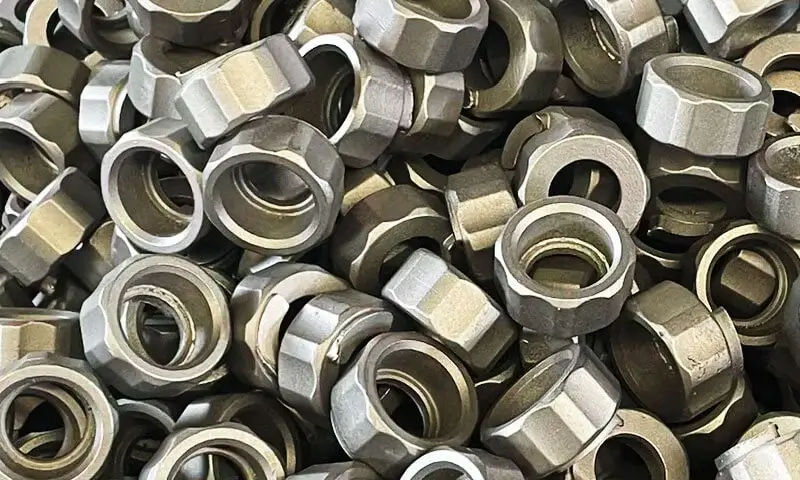
Threaded nuts are among the most fundamental and widely deployed fastening components across all industrial sectors, serving as the critical load-bearing interface for bolted joint assemblies.
For standard general-purpose applications, cold-headed carbon steel and stainless steel nuts dominate mass production.
然而, when applications demand corrosion resistance, 高温稳定性, non-standard dimensions or integrated functional features, conventional manufacturing processes reach clear technical and economic limits.
Among the available manufacturing technologies, 投资铸造 (失去蜡铸) offers a unique combination of design flexibility, 尺寸精度, 和物质多功能性.
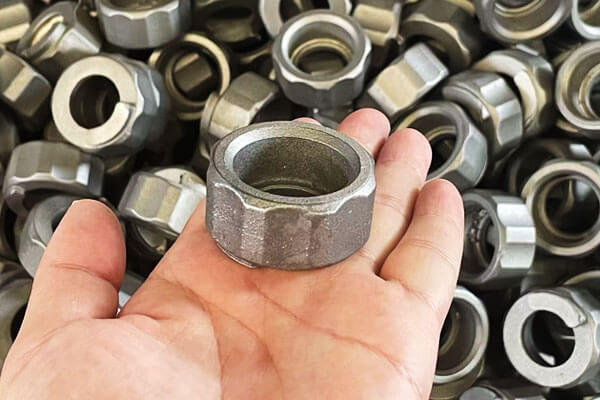
Unlike conventional forging or cold forming, investment casting enables manufacturers to produce complex nut geometries, integrated structural features, and near-net-shape components with minimal material waste and reduced machining requirements.
1. What Is a Custom Stainless Steel Nut?
一个 风俗 不锈钢 nut is a precision-engineered threaded fastening component specifically designed to meet unique mechanical, 尺寸, or environmental requirements that cannot be fully addressed by standard catalog products.
Unlike conventional nuts manufactured according to standardized specifications such as ISO, 从, 美国国家标准协会, or ASME, custom nuts are developed based on customer drawings, 申请要求, or specialized engineering standards.
Typically manufactured from corrosion-resistant stainless steel alloys, these nuts are designed to work in conjunction with bolts, 螺柱, or threaded shafts to create secure and durable mechanical joints.
Their primary function is to convert tightening torque into clamping force, maintaining the integrity of an assembled structure while resisting loosening caused by vibration, 热循环, or dynamic loading.
For industries operating under harsh service conditions, the design of a custom nut extends well beyond its external shape.
Engineers must carefully consider factors such as load distribution, thread engagement, stress concentration, 耐腐蚀性, manufacturing feasibility, and assembly efficiency.
最后, every custom stainless steel nut represents a balance between material performance, structural optimization, and production capability.

Standard Nuts vs. Custom Stainless Steel Nuts
Although standard fasteners are widely available and cost-effective for general applications, they cannot always satisfy the specialized requirements of modern industrial equipment.
Custom stainless steel nuts are developed to solve these engineering challenges by providing optimized geometry, 材料选择, 和制造精度.
| 特征 | Standard Stainless Steel Nut | Custom Stainless Steel Nut |
| 方面 | Standardized sizes | Fully customized dimensions and geometry |
| Thread Type | Standard metric or imperial threads | Standard or special thread profiles |
| 材料选择 | Limited standard grades | Wide range of stainless steels and specialty alloys |
| 机械性能 | General-purpose applications | Designed for specific load, 压力, 和环境要求 |
| 制造方法 | Cold forming or machining | Investment casting with precision machining |
| 典型的应用 | General fastening | Critical industrial equipment, 阀, 泵, 海洋系统, OEM assemblies |
Custom designs allow manufacturers to integrate features that improve installation, increase load-bearing capacity, reduce assembly time, or enhance compatibility with surrounding components.
Why Investment Casting Is Ideal for Custom Stainless Steel Nuts
Although stainless steel nuts can be produced through forging, 加工, or cold heading, 投资铸造 provides significant advantages when manufacturing customized components with complex geometries or non-standard configurations.
The investment casting process begins with a precision wax pattern that accurately reproduces the final component.
After multiple ceramic shell-building and firing operations, molten stainless steel is poured into the cavity to produce a near-net-shape casting with excellent dimensional accuracy and surface quality.
Critical threaded features and sealing surfaces are subsequently finished by CNC machining to achieve precise tolerances and thread accuracy.
Compared with conventional manufacturing processes, investment casting offers several important advantages:
- Exceptional design freedom for complex external profiles and integrated structural features.
- High dimensional accuracy that minimizes secondary machining.
- 出色的表面饰面, reducing polishing and finishing operations.
- Broad compatibility with stainless steel grades, including austenitic, 马氏体, 双工, and precipitation-hardening alloys.
- Improved material utilization and lower waste compared with subtractive machining.
- Cost-effective production for prototypes, 低量, and medium-volume custom components.
These advantages make investment casting particularly suitable for specialized fastening components used in pumps, 阀, 压力容器, pipeline systems, 离岸设备, and other demanding industrial applications.
Common Types of Nuts That Can Be Investment‑Cast
| Nut Type | 描述 | 典型的应用 |
| Hex nut | Six‑sided fastener; the most common type. | General fastening, structural joints. |
| Square nut | Four‑sided; used where hex tools are unavailable. | 家具, 机械, general fastening. |
| Flange nut | Nut with an integral wide flange; distributes load. | 汽车, 工业的, vibration‑resistant. |
| Lock nut | Nut with a locking feature (nylon insert, deformed thread, ETC。). | Vibration‑sensitive applications. |
| Coupling nut | Long nut for connecting two threaded rods. | Threaded rod assemblies, tensioning systems. |
Wing nut |
Nut with two wings for manual tightening. | Quick‑release applications, 消费产品. |
| T‑nut | Nut with a flanged base for T‑slot framing. | 自动化, modular framing systems. |
| Blind nut / rivet nut | Nut that can be installed from one side. | 钣金, 薄壁部分. |
| Cap nut | Nut with a domed top; covers protruding threads. | 装饰性的, 安全. |
| Self‑locking nut | Nut with a built‑in locking mechanism (例如。, prevailing torque). | High‑vibration and safety‑critical applications. |
Typical Customization Options
Custom stainless steel nuts can be engineered to satisfy a wide range of application-specific requirements.
Depending on the intended service environment and assembly conditions, manufacturers may customize nearly every aspect of the component.
Common customization options include:
- Non-standard dimensions and outer profiles
- 公制, 统一, bsp, Acme, trapezoidal, or proprietary thread forms
- 法兰, 正方形, 六边形, wing, or special-shaped nut configurations
- Integrated locating features or assembly aids
- Increased wall thickness or reinforced load-bearing sections
- Special corrosion-resistant or high-strength stainless steel alloys
- Surface treatments such as passivation, 电力, 射击, or mechanical polishing
- Customer-specific markings, identification numbers, or logos
These customized features enable the nut to perform reliably under conditions involving high loads, 积极的化学物质, 温度升高, cyclic fatigue, or severe vibration.
Engineered for Demanding Industrial Applications
Modern industrial fastening systems often operate in environments where failure is not an option.
Whether securing high-pressure valve assemblies, offshore pipeline equipment, 化学反应堆, or precision automation systems, custom stainless steel nuts must provide reliable performance under challenging operating conditions.
By combining optimized engineering design with precision investment casting and advanced machining technologies, manufacturers can produce fastening components that offer superior dimensional consistency, 优异的耐腐蚀性, and long-term mechanical reliability.
This ability to tailor every aspect of the component makes custom investment cast stainless steel nuts an indispensable solution for today’s high-performance industrial equipment.
2. Common Stainless Steel Grades for Investment Cast Nuts
Material selection is one of the most critical aspects of designing a custom investment cast stainless steel nut.
The selected alloy directly influences not only the component’s corrosion resistance and mechanical properties, but also its service life, manufacturing cost, and long-term reliability under specific operating conditions.
| Cast Grade | 等效 | Core Performance Attributes | Typical Service Applications |
| CF8 | 304 不锈钢 | 优质的一般耐腐蚀性, 良好的延展性, 经济解决方案 | 工业机械, 食品设备, 建筑硬件, general fastening |
| CF8M | 316 不锈钢 | Molybdenum-enhanced corrosion resistance with excellent resistance to chloride-induced pitting | 化学处理, 船舶设备, 制药系统, coastal infrastructure |
| CF3 / CF3M | 304l / 316L不锈钢 | Ultra-low carbon content minimizes sensitization and intergranular corrosion after welding | Welded assemblies, 压力容器, process piping, 卫生设备 |
CD3MN |
2205 双工不锈钢 | 大约是屈服强度的两倍 304 with excellent chloride stress corrosion cracking resistance | 离岸平台, 海水系统, 油 & 燃气设备, 淡化植物 |
| CD3MWCuN | 2507 超级双工不锈钢 | Outstanding resistance to pitting, 缝隙腐蚀, 侵蚀, and aggressive chloride environments | 深海设备, 矿业, offshore subsea hardware, 淡化设施 |
| CF10 | 310S Stainless Steel | Superior oxidation resistance and high-temperature strength up to approximately 1050°C | 炉具硬件, heat treatment fixtures, thermal processing equipment |
CF8C |
321 不锈钢 | Titanium-stabilized structure provides excellent resistance to sensitization at elevated temperatures | Boiler systems, 排气歧管, high-temperature piping, power generation equipment |
| CA15 | 410 不锈钢 | 高硬度, 良好的耐磨性, moderate corrosion resistance after heat treatment | Mechanical equipment, 阀成分, heavy-duty industrial fasteners |
| 17-4 ph | 17-4 pH不锈钢 | High strength through precipitation hardening while maintaining good corrosion resistance | 航天, defense equipment, high-strength structural fasteners |
3. Full Investment Casting Process Flow for Custom Stainless Steel Nuts
The manufacturing quality of a custom stainless steel nut depends not only on alloy selection, but also on the precision and consistency of every stage of the investment casting process.
与传统铸造方法相比, investment casting enables the production of near-net-shape components with intricate geometries, 出色的表面饰面, 和紧张的尺寸公差.
These advantages make it particularly suitable for custom fastening components that require accurate threads, consistent mechanical properties, 和耐腐蚀性.
在 Langhe Foundry, the manufacturing process integrates precision investment casting with CNC machining, 热处理, and rigorous quality inspection to ensure every custom nut meets customer specifications and international quality standards.
Engineering Design and DFM Analysis
Every project begins with a comprehensive engineering review.
Customer drawings, 3D CAD模型, or samples are analyzed to evaluate manufacturability, dimensional tolerances, 壁厚, thread requirements, and potential casting challenges before production begins.
During the Design for Manufacturability (DFM) stage, engineers optimize the component without compromising its functional performance.
Proper consideration is given to metal shrinkage, 草稿角, gating locations, 加工津贴, and solidification behavior to improve casting yield and minimize the risk of defects.
For custom nuts used in demanding industries such as oil and gas, 化学处理, or marine engineering, 有限元分析 (fea) or stress analysis may also be performed to verify structural integrity under service loads.
Precision Tooling and Wax Pattern Production
一旦设计最终确定, precision tooling is manufactured for 蜡模 注射.
Molten wax is injected into high-precision aluminum dies to produce dimensionally accurate wax replicas of the finished component.
Because the wax pattern defines the final casting geometry, maintaining strict dimensional consistency at this stage is essential.
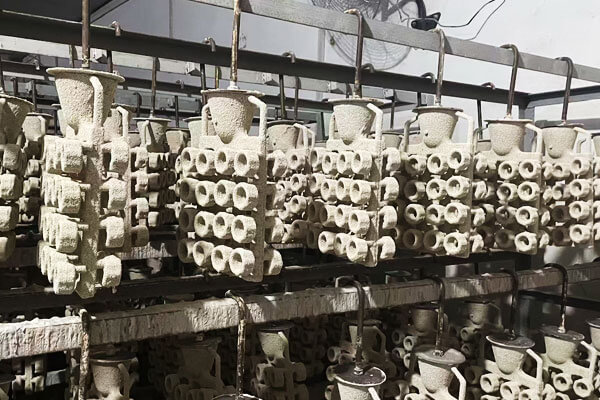
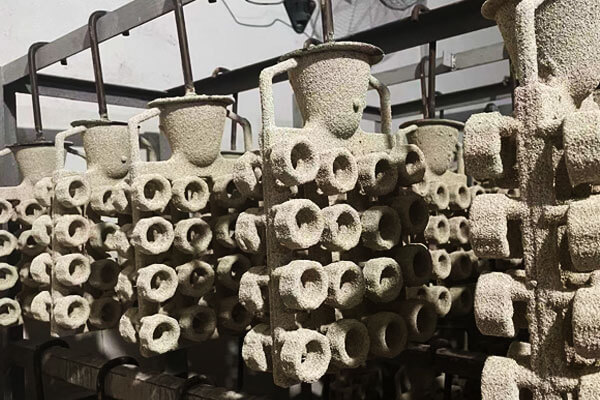
Multiple wax patterns are then assembled onto a central sprue to form a “casting tree”, enabling numerous parts to be produced in a single casting cycle while improving production efficiency.
陶瓷外壳建筑
The assembled wax tree undergoes repeated ceramic shell building to create a high-strength mold capable of withstanding molten stainless steel.

Each cycle consists of:
- Dipping the wax assembly into a ceramic slurry
- Applying refractory sand (灰泥)
- Controlled drying under monitored temperature and humidity
通常, six to ten ceramic layers are applied depending on part size and alloy type.
The finished shell must provide sufficient strength, 渗透性, and thermal stability to maintain dimensional accuracy during metal pouring.
脱水和炮弹射击
After the ceramic shell has fully cured, the wax is removed using high-pressure steam inside an autoclave.
This process completely eliminates the wax while preserving the internal cavity of the mold.
The empty ceramic shell is then fired at temperatures often exceeding 900°C, which serves several important purposes:
- Burns away residual wax.
- Increases shell strength.
- Removes moisture.
- Improves thermal stability.
- Preheats the mold to reduce thermal shock during pouring.
The result is a rigid, high-temperature ceramic mold capable of accurately reproducing complex geometries.
Stainless Steel Melting and Precision Pouring
Selected stainless steel alloys are melted in medium-frequency induction furnaces under carefully controlled conditions.
Throughout melting, the chemical composition is continuously monitored using spectrometric analysis to ensure compliance with ASTM, AISI, or customer specifications.
Once the desired pouring temperature is achieved, molten stainless steel is poured into the preheated ceramic shells under controlled conditions.
Proper pouring temperature and filling rate are critical for producing dense castings while minimizing turbulence, 收缩, and gas-related defects.
Controlled solidification allows the molten metal to accurately reproduce every detail of the mold, including complex external contours and internal features.
Shell Removal and Casting Cleaning
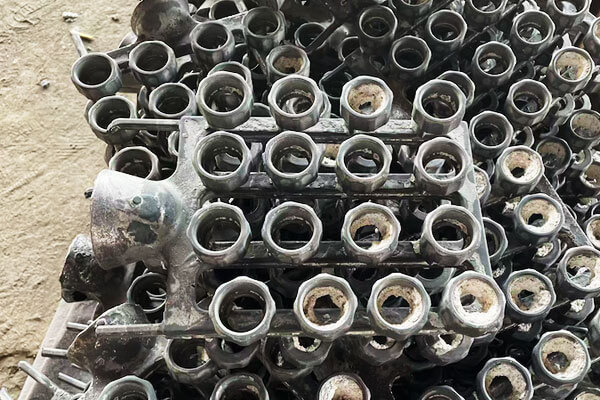
After solidification and cooling, the ceramic shell is mechanically broken away to reveal the cast components.
The individual nuts are separated from the casting tree through precision cutting operations, followed by cleaning processes that may include:
- 射击
- 研磨
- 浇口拆除
- 表面清洁
These operations remove residual ceramic material and prepare the casting for subsequent processing.

热处理
Many investment cast stainless steel nuts undergo 热处理 to optimize their microstructure and mechanical performance.
Depending on the alloy grade, heat treatment may include:
| 材料类型 | 典型的热处理 | 主要目的 |
| 奥氏体不锈钢 | 解决方案退火 | Restore corrosion resistance and eliminate residual stresses |
| 马氏体不锈钢 | 淬火和回火 | Increase hardness and wear resistance |
| 双工不锈钢 | 解决方案处理 | Balance ferrite and austenite phases for optimal strength and corrosion resistance |
| 17-4 pH不锈钢 | 解决方案处理 + 老化 | Achieve maximum strength through precipitation hardening |
Proper heat treatment enhances tensile strength, 韧性, 疲劳性抗性, and long-term dimensional stability.
精确的CNC加工
Although investment casting produces near-net-shape components, critical functional features generally require precision machining.
For custom stainless steel nuts, 数控加工 commonly includes:
- Internal thread machining
- Precision boring
- 面对
- Counterboring
- Chamfering
- Deburring
Advanced CNC machining ensures accurate thread geometry, excellent concentricity, and compliance with international thread standards such as ISO, UNC, 联合国, bsp, or customer-specific specifications.
Surface Finishing and Final Inspection
Following machining, the components receive appropriate surface finishing based on customer requirements and intended service conditions.
Each finished nut undergoes comprehensive quality inspection, including dimensional verification, thread measurement, 机械测试, material identification, and visual examination.
For critical industrial applications, additional non-destructive testing such as dye penetrant inspection, X射线射线照相, or ultrasonic testing may also be performed to verify internal soundness and casting integrity.
Only components that satisfy all specified quality criteria proceed to final packaging and shipment.
4. Surface Finishing Options for Investment Cast Stainless Steel Nuts
Surface finishing plays an important role in improving the performance, 外貌, and service life of investment cast stainless steel nuts.
Although stainless steel naturally forms a passive chromium oxide layer that provides corrosion resistance, 铸件, 热处理, and machining processes may introduce surface contaminants, 氧化物量表, or minor imperfections.
Appropriate surface treatments help restore corrosion resistance, improve cleanliness, enhance wear performance, and meet specific industry requirements.
| Surface Finishing Method | 过程说明 | 关键好处 | 典型的应用 |
| 腌制和钝化 | 酸洗去除氧化皮, 加热色调, and iron contamination from casting or heat treatment. Passivation chemically enhances the natural chromium oxide protective layer on stainless steel. | 改善耐腐蚀性, restores passive film, removes surface contaminants without changing dimensions. | 化学设备, 海洋组成部分, 压力容器, industrial piping, stainless steel fasteners |
| 电力 | An electrochemical process that removes microscopic surface peaks and produces an ultra-smooth metal surface. | Provides excellent surface cleanliness, reduces roughness, 改善耐腐蚀性, minimizes bacterial adhesion, and facilitates sterilization. | 药品设备, 食品加工机械, biotechnology systems, semiconductor equipment |
机械抛光 |
Uses abrasive tools and polishing compounds to smooth and refine the stainless steel surface. | 增强外观, reduces surface defects, improves surface smoothness, and provides decorative finishes. | 建筑硬件, precision equipment, decorative fasteners, 消费产品 |
| 射击 | High-speed abrasive particles are projected onto the casting surface to remove residues and create a uniform texture. | Removes ceramic shell residues, oxide layers, and surface impurities while producing a consistent matte finish. | 工业机械, 阀, 泵, heavy equipment components |
Glass Bead Blasting |
Fine glass beads are used to gently clean and texture the stainless steel surface without excessive material removal. | Creates a smooth satin appearance, maintains dimensional accuracy, and provides uniform surface texture. | 医疗设备, 精度组件, 仪器, high-quality industrial assemblies |
| 镜像抛光 | Multi-stage mechanical polishing produces a highly reflective surface with very low surface roughness. | Provides premium appearance, improves cleanability, and reduces surface contamination accumulation. | Decorative applications, 卫生设备, 建筑组件 |
CNC Machining and Deburring |
Precision machining removes excess material from functional areas such as threads, contact surfaces, and mounting features, followed by edge finishing. | Ensures dimensional accuracy, improves assembly performance, eliminates sharp edges, and enhances reliability. | Custom threaded nuts, precision mechanical assemblies, OEM components |
| 激光标记 | Permanent identification marks are created using laser engraving technology without affecting component performance. | Provides traceability, part identification, batch control, and compliance with industry requirements. | 航天, 汽车, 医疗设备, critical industrial components |
5. Key Properties of Investment Cast Stainless Steel Nuts
The performance of a custom stainless steel nut is determined by the combined effects of alloy composition, 铸造质量, 热处理, machining accuracy, 和表面饰面.
优异的耐腐蚀性
Corrosion resistance is one of the defining characteristics of stainless steel fasteners.
Chromium contained in the alloy reacts with oxygen to form a thin, stable passive oxide film that continuously protects the metal surface from further corrosion.
If the surface is mechanically damaged, this passive layer can naturally regenerate in the presence of oxygen, providing long-term protection without additional coatings.
Combined with proper passivation or electropolishing, investment cast stainless steel nuts can maintain excellent corrosion performance even after years of continuous service.
High Mechanical Strength and Load Capacity
Custom stainless steel nuts must withstand substantial clamping forces while maintaining thread integrity under static and dynamic loading.
Investment casting produces a refined and homogeneous microstructure that, together with appropriate heat treatment, provides excellent tensile strength, 产生强度, 和抗疲劳性.
Depending on the selected alloy, mechanical properties can be optimized for applications requiring high preload, 冲击阻力, or cyclic loading.
Duplex stainless steels and precipitation-hardening grades offer significantly higher yield strength than conventional austenitic alloys, allowing engineers to reduce component size while maintaining equivalent load-bearing capacity.
Precision Thread Accuracy
The effectiveness of any threaded fastener depends heavily on thread precision.
Although investment casting produces near-net-shape components, critical threaded features are typically finished through CNC machining to ensure compliance with international thread standards such as ISO Metric, UNC, 联合国, bsp, or customer-specific specifications.
Accurate thread geometry provides several important advantages:
- Uniform load distribution between mating threads
- Reduced installation torque variation
- Improved vibration resistance
- Lower risk of thread galling and premature wear
- Reliable assembly with standard fastening systems
High thread precision is especially important for pressure equipment, valve assemblies, and critical mechanical systems where fastening reliability directly affects operational safety.
Excellent Dimensional Consistency
Dimensional consistency is essential for custom components that must integrate seamlessly into complex assemblies.
Investment casting enables excellent repeatability by accurately reproducing wax patterns within precision ceramic molds.
Combined with CNC machining and strict process control, this results in consistent dimensions across production batches.
Stable dimensional accuracy reduces assembly variation, improves interchangeability, and minimizes the need for secondary fitting operations during equipment installation.
Fatigue and Vibration Resistance
Many industrial fasteners operate under repeated cyclic loading rather than constant static loads.
示例包括:
- Rotating machinery
- Pumps and compressors
- 风力涡轮机
- Railway equipment
- Heavy industrial machinery
Investment cast stainless steel nuts manufactured with sound internal structures and precision-machined threads exhibit excellent fatigue performance.
Proper heat treatment and optimized geometry further reduce stress concentrations, helping extend service life under repeated loading conditions.
温度性能
The operating temperature of industrial fastening systems varies significantly depending on the application.
Austenitic stainless steels maintain excellent toughness and corrosion resistance at both cryogenic and moderately elevated temperatures.
Heat-resistant grades such as 310s 和 321 不锈钢 continue to perform reliably under prolonged exposure to temperatures approaching 1000°C, making them suitable for furnace equipment, 排气系统, and thermal processing machinery.
At the opposite extreme, austenitic stainless steels retain outstanding toughness at cryogenic temperatures, making them ideal for LNG equipment, low-temperature storage systems, and cryogenic process piping.
Hygienic and Clean Surface Performance
Many industries require fastening components that are easy to clean and resistant to bacterial contamination.
After electropolishing or fine mechanical polishing, investment cast stainless steel nuts exhibit smooth surfaces with reduced roughness, minimizing the accumulation of contaminants and facilitating cleaning procedures.
Long Service Life and Low Maintenance
The combination of corrosion resistance, 机械耐用性, and dimensional stability gives investment cast stainless steel nuts an exceptionally long service life.
Unlike carbon steel fasteners, stainless steel nuts generally do not require protective coatings or frequent replacement due to rust.
Their resistance to environmental degradation significantly reduces maintenance costs and minimizes equipment downtime over the entire lifecycle of the assembly.
6. Advantages of Investment Cast Custom Stainless Steel Nuts
Compared with standard fasteners manufactured through cold heading or machining, investment cast custom stainless steel nuts provide significantly greater design flexibility while maintaining excellent mechanical performance and manufacturing precision.
Freedom to Manufacture Complex Designs
One of the greatest strengths of investment casting is its ability to produce geometries that are difficult, costly, or impossible to manufacture through conventional machining or forging.
Complex external profiles, integrated locating features, weight-reduction cavities, and customized structural reinforcements can all be incorporated directly into the casting.
This near-net-shape capability minimizes machining requirements while expanding engineering design possibilities.
较高的维度准确性
Investment casting consistently produces components with excellent dimensional precision and repeatability.
Because the ceramic mold accurately reproduces every detail of the wax pattern, the finished casting requires minimal secondary machining except for critical functional surfaces such as internal threads.
Improved dimensional consistency offers several practical benefits:
- Better interchangeability
- Simplified assembly
- Reduced machining costs
- Higher production efficiency
These advantages are particularly valuable for OEM equipment manufacturers requiring stable quality across large production batches.
广泛的材料选择
Investment casting is compatible with a wide variety of stainless steel alloys, allowing engineers to select materials according to application-specific performance requirements.
From economical 304 stainless steel to high-performance super duplex and precipitation-hardening alloys, manufacturers can optimize corrosion resistance, 力量, 戴阻力, or high-temperature performance without significant design limitations.
This material flexibility allows one manufacturing process to serve numerous industries with vastly different operating environments.
Excellent Surface Quality
Compared with conventional sand casting, investment casting produces significantly smoother surfaces due to the fine ceramic mold and precision wax patterns.
The superior surface finish offers several engineering benefits:
- 减少抛光要求
- Improved corrosion resistance
- Better appearance
- Lower friction during assembly
- Enhanced coating and passivation quality
For decorative or hygienic applications, the excellent casting surface also reduces the time and cost of subsequent finishing operations.
减少材料废物
Investment casting is a near-net-shape manufacturing process that closely matches the geometry of the finished component.
Unlike CNC machining, which removes substantial amounts of material, investment casting minimizes waste and improves material utilization—particularly when expensive stainless steel alloys are used.
This not only lowers raw material costs but also contributes to more sustainable manufacturing practices.
Cost-Effective Production for Custom Components
While cold heading remains highly economical for standard fasteners produced in extremely large quantities, investment casting offers significant economic advantages for custom or medium-volume production.
Manufacturers can economically produce:
- Prototype components
- Small production runs
- Complex OEM fasteners
- Non-standard geometries
- Application-specific designs
By reducing tooling complexity and machining time, investment casting achieves an excellent balance between manufacturing flexibility and production cost.
Reliable Quality and Process Consistency
Modern investment casting integrates digital engineering, 精确工具, 自动化的外壳建筑, controlled melting, 数控加工, and comprehensive quality inspection into a highly repeatable manufacturing process.
Strict process control ensures:
- Stable chemical composition
- Uniform mechanical properties
- Consistent dimensions
- Excellent casting integrity
- Reliable long-term performance
These characteristics are essential for fastening components used in critical industrial equipment where failure is unacceptable.
7. Applications of Custom Stainless Steel Nuts
Custom investment cast stainless steel nuts are used wherever standard commercial fasteners cannot satisfy specific engineering, 机械的, or environmental requirements.
Their combination of corrosion resistance, 结构可靠性, and design flexibility makes them suitable for numerous industries operating under demanding service conditions.

油气行业
Oil and gas equipment frequently operates under high pressure, 温度升高, 腐蚀性化学品, and marine exposure.
Custom stainless steel nuts are commonly used in:
- Wellhead equipment
- 管道系统
- 阀组件
- 压力容器
- Offshore drilling platforms
- 液化天然气设施
化学加工行业
Chemical plants require fastening systems capable of withstanding continuous exposure to acids, 碱, 溶剂, and aggressive process media.
Investment cast stainless steel nuts are widely applied in:
- 化学反应堆
- 热交换器
- 泵
- 储罐
- 处理管道系统
海洋和海上工程
Seawater is one of the most aggressive environments encountered by industrial fasteners.
Custom stainless steel nuts are used extensively in:
- 造船
- 离岸平台
- Port facilities
- 海洋泵
- 海水淡化设备
- Coastal infrastructure
Food and Pharmaceutical Equipment
Hygienic processing equipment requires fastening components that are corrosion-resistant, 易于清洁, and compliant with strict sanitary standards.
Investment cast stainless steel nuts are commonly installed in:
- Food processing machinery
- Dairy equipment
- Beverage production lines
- 药物反应堆
- Biotechnology systems
Power Generation and Renewable Energy
Power generation facilities demand reliable fastening systems capable of operating continuously under mechanical stress and varying temperatures.
申请包括:
- Steam turbines
- 热交换器
- Nuclear auxiliary equipment
- Wind turbine assemblies
- Solar mounting systems
- Hydroelectric facilities
工业机械和自动化
Modern manufacturing equipment increasingly incorporates customized fastening components to improve assembly efficiency and structural performance.
Investment cast stainless steel nuts are widely used in:
- CNC machine tools
- 工业机器人
- Conveyor systems
- Automation equipment
- Packaging machinery
- Material handling systems
建筑和基础设施
Architectural and civil engineering projects require fastening systems that combine structural integrity with long-term corrosion resistance.
Custom stainless steel nuts are employed in:
- Steel structures
- Bridge components
- 幕墙系统
- 建筑硬件
- Public infrastructure
- Transportation facilities
8. Why Choose Investment Casting for Stainless Steel Nuts Instead of Other Manufacturing Methods?
Selecting the right manufacturing process is a critical decision when producing custom stainless steel nuts.
Although traditional methods such as cold forming, 热锻造, 数控加工, and sand casting are widely used for fastener production, they each have limitations when dealing with complex geometries, specialized materials, or customized designs.
| 标准 | 熔模铸造 | 数控加工 | Hot Heading | 冷形成 |
| 几何复杂性 | 很高 (cast‑in threads, 凹槽) | 高的 | 低的 | 低的 |
| 材料利用率 | 85‑95% | 30‑60% | 80‑90% | 85‑95% |
| 维度的准确性 | ±0.1-0.3毫米 | ±0.01‑0.05 mm | ±0.1-0.3毫米 | ±0.1-0.3毫米 |
| 表面饰面 (RA) | 1.6‑6.3 µm | 0.4‑1.6 µm | 1.6‑6.3 µm | 1.6‑6.3 µm |
| 工具成本 | 中高 | 低的 | 高的 | 高的 |
| 每个零件的成本 (100‑1,000/year) | Low‑moderate | 中高 | 很高 | 很高 |
| 每个零件的成本 (>5,000/year) | 低的 | 高的 | 非常低 | 非常低 |
| 合金灵活性 | 很宽 | 宽的 | 有限的 (锻) | 有限的 (锻) |
| Thread precision | 良好 (或机加工) | 出色的 | 良好 | 良好 |
| Small batch suitability | 出色的 | 出色的 | 贫穷的 | 贫穷的 |
| Tooling lead time | 6‑12 weeks | 1‑2 weeks | 12‑24 weeks | 12‑24 weeks |
9. Custom Investment Casting Solutions from LangHe Foundry
LangHe Foundry specialises in precision investment casting of custom stainless steel nuts and other fasteners.
| 能力 | 细节 |
| 材料 | CF-8 (304), CF-8M (316), CF-3 (304l), CF-3M (316l), CN‑7M (合金 20), CD-3MN (2205 双工), CB7Cu‑1 (17-4ph). |
| 零件重量 | 0.01 公斤到 5 公斤. |
| 方面 | 到 100 毫米直径; custom sizes available. |
| 公差 | ±0.1-0.3毫米 (CT5-CT7 符合 ISO 8062). |
| 表面饰面 | Ra 1.6‑6.3 µm 铸态; electropolishing and passivation available. |
| 热处理 | 解决方案退火, 老化. |
| 线程 | Cast‑in or machined; ISO, 从, 美国国家标准协会, custom threads. |
| 质量 | ISO 9001:2015 经认证; 100% NDT and dimensional inspection. |
| 交货时间 | 6‑12 weeks for tooling and first articles; 2重复订单需要 4 周. |
OEM and Custom Manufacturing Services
LangHe supports global OEM customers with flexible manufacturing solutions, 包括:
- Prototype development
- Small-batch production
- Medium-volume manufacturing
- Custom alloy selection
- Surface treatment solutions
- Packaging and delivery support
From a single prototype to continuous production orders, LangHe provides reliable investment casting solutions tailored to each customer’s technical requirements.
联系我们 for custom precision stainless steel castings.
10. 结论
Custom stainless steel nuts produced via investment casting represent a high-value solution for applications where standard cold-headed fasteners cannot meet geometric, material or performance requirements.
By combining near-net-shape precision, unlimited design flexibility, broad alloy compatibility and cost-effective small-to-medium batch production, investment casting solves many long-standing limitations of conventional nut manufacturing.
The key to consistent quality lies in rigorous process control — from wax pattern tooling calibration and gating optimization to proper solution heat treatment and final thread finishing.
When properly executed, investment cast stainless steel nuts deliver equivalent or better mechanical and corrosion performance than wrought fasteners, with far greater design freedom and much lower tooling investment for custom geometries.
As industrial equipment continues toward greater specialization and higher performance demands, investment cast custom stainless steel fasteners will continue to grow in adoption, enabling engineers to design application-optimized fastening solutions that were previously uneconomical or technically impossible to produce.
常见问题解答
Can threads be cast directly in investment‑cast nuts?
是的, coarse threads can be cast directly using wax patterns and ceramic cores. For fine threads or high‑precision applications, thread tapping is recommended after casting.
What is the difference between CF‑8 and CF‑8M?
CF‑8 is equivalent to 304 不锈钢 (no molybdenum). CF‑8M is equivalent to 316 不锈钢, containing 2‑3% molybdenum for improved chloride pitting resistance.
Are investment‑cast nuts suitable for high‑temperature applications?
是的. Austenitic grades can be used up to 800‑850°C. 对于更高的温度, 考虑 310 stainless steel or nickel‑based alloys.
How do I specify a custom nut?
Provide the required dimensions (outside diameter, 高度, thread size/pitch), 形状 (hex, 正方形, 法兰, ETC。), material grade, 数量, 表面饰面,
and any special features (locking mechanism, identification marks). A drawing (2D or 3D) 建议.
Are investment cast stainless steel nuts stronger than machined nuts?
Strength depends on material grade, 设计, 和制造质量. Investment cast nuts can achieve excellent mechanical properties through proper alloy selection and heat treatment while offering greater design flexibility than machined components.