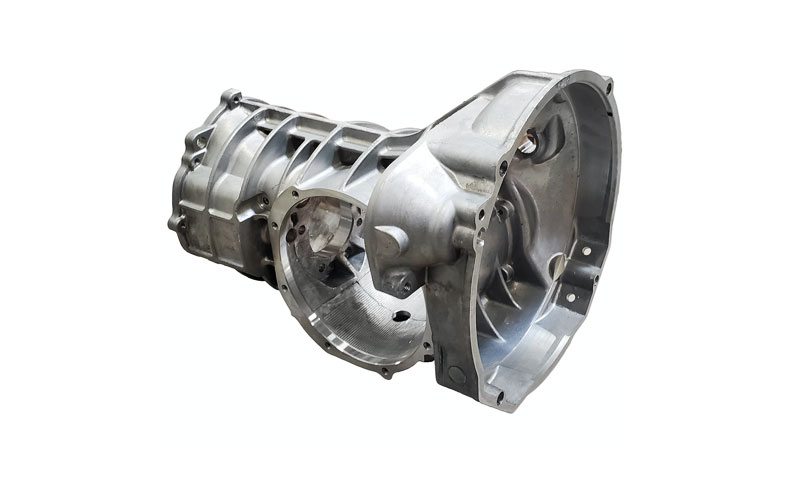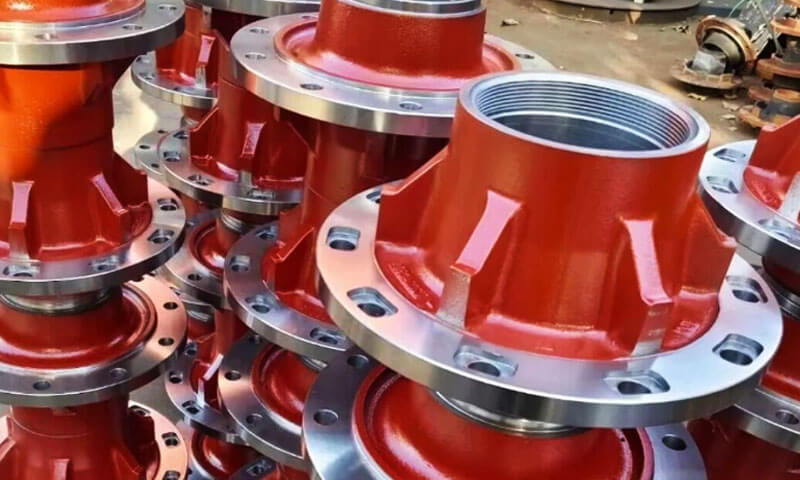
Wheel hubs are the critical interface between a heavy-duty truck or semi-trailer and its wheels.
They carry the full vehicle load, transmit driving and braking torque, and endure relentless vibration, 震惊, and fatigue.
A hub failure at highway speed is catastrophic—not just a breakdown, but a safety hazard. For decades, heavy sand castings dominated the market.
But as payloads increase and fleet operators demand longer service life with less maintenance, the manufacturing technology has evolved toward precision casting processes that deliver higher strength-to-weight ratios and superior fatigue performance.
This article examines the engineering, 材料, 过程, and quality controls behind custom wheel hub castings for heavy-duty applications.
1. What Is a Wheel Hub Casting?
A wheel hub casting is a near-net-shape metal component produced by pouring molten metal into a prepared mold and allowing it to solidify into the required geometry.
The casting is subsequently cleaned, 检查过的, and machined to obtain the dimensions and surface characteristics needed for assembly.
Unlike a finished wheel hub, an as-cast component is not necessarily ready for installation.
轴承座, 安装面, 螺栓孔, seal-contact surfaces, and other critical features typically require machining to meet the engineering drawing.
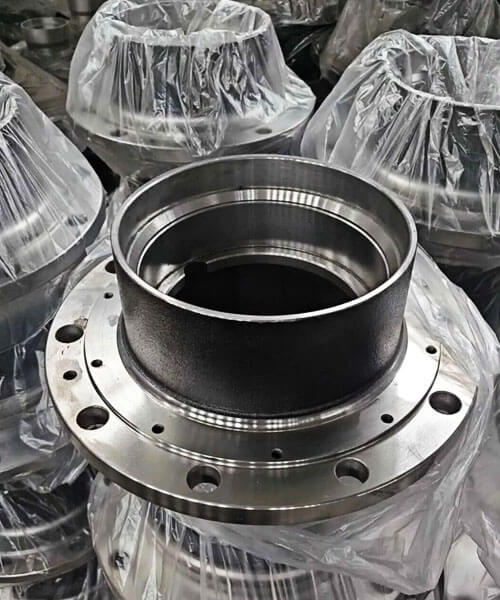
The Role of a Wheel Hub in a Heavy-Duty Vehicle
A wheel hub forms part of the wheel-end assembly, but its precise function depends on the vehicle architecture.
A driven hub may interface with a drive axle, while a non-driven hub may rotate on a spindle.
Some designs integrate wheel-mounting features with brake components; others use separate brake drums or discs.
The hub must transfer the loads imposed by the wheel and vehicle while maintaining the alignment required by the bearing system.
服务期间, it may experience a combination of:
- Radial loadsgenerated by vehicle weight and road contact.
- Lateral loadsduring cornering and lane changes.
- Longitudinal forcesassociated with acceleration and braking.
- Repeated cyclic loadingthat can initiate and propagate fatigue cracks.
- Vibration and impact loadingcaused by road irregularities.
- Environmental exposureto water, road contaminants, de-icing salts, and temperature changes.
These conditions make wheel hub design a structural and manufacturing problem rather than simply a matter of reproducing an external shape.
2. Manufacturing Evolution: From Traditional Sand Casting to More Controlled Technologies
The evolution of wheel hub casting is not simply a transition from an old process to a universally superior new one.
It is a shift toward selecting the most suitable manufacturing route and controlling material, 几何学, and solidification more precisely.
Traditional sand casting remains useful for heavy, 复杂的, and relatively low-volume components.
More advanced molding methods can improve dimensional consistency or surface quality, while modern ductile iron processing can improve the repeatability of mechanical properties.
The benefit depends on how well the technology matches the component.
Traditional Sand Casting: Flexibility for Heavy Components
Sand casting uses a mold formed from prepared sand and a binder system. The mold can accommodate complex shapes, 大部分, and a wide range of ferrous alloys.
For heavy-duty wheel hubs, its advantages include:
- Flexibility in component size and geometry.
- Suitability for complex flanges, 老板, and internal contours.
- Relatively adaptable tooling for customized or lower-volume production.
- Compatibility with gray iron, 延性铁, and various cast steels, subject to process design.
Its limitations may include greater surface roughness, wider as-cast dimensional variation, and increased machining requirements compared with more precise molding processes.
The most important challenge is controlling solidification. 厚的部分, abrupt wall-thickness transitions, and poorly designed feeding systems can lead to shrinkage defects or internal discontinuities.
Better mold design, gating and riser engineering, 温度控制, and process simulation can improve consistency without abandoning sand casting.
外壳成型: Improved Surface and Dimensional Control
Shell molding uses resin-coated sand applied to a heated pattern to form a relatively thin, rigid mold shell.
Compared with conventional sand molding, it can provide better surface finish and dimensional control for suitable component sizes and production volumes.
Its tooling and operating costs, 然而, may be higher.
For wheel hub castings, potential benefits include:
- More consistent as-cast geometry.
- Reduced surface irregularities in suitable areas.
- Improved repeatability between production batches.
- Potentially lower finishing and machining allowances.
Shell molding does not automatically eliminate casting defects. 收缩, gas-related porosity, 包含, and microstructural variation remain possible if melt quality, 霉菌准备, 浇注, or solidification are not controlled.
It is most appropriate when the hub’s size, 几何学, required quality, and production volume justify the process.
Gravity Casting and Other Precision Casting Routes
重力铸造, also known as permanent-mold casting, uses gravity to fill a reusable mold, generally made from metal.
It can provide good repeatability and surface quality for suitable alloys and component geometries.
然而, gravity die casting should not be treated as a direct replacement for conventional iron or steel hub casting.
Permanent metal molds are used predominantly for nonferrous alloys, 特别是铝, because the melting and pouring temperatures of iron and steel create different tooling and thermal challenges.
For a heavy-duty wheel hub, a precision gravity-cast aluminum design may be considered only if the complete wheel-end engineering requirements support that material and manufacturing route.
A cast iron hub and a cast aluminum hub cannot be treated as equivalent simply because both can be produced using casting technology.
同样地, 高压铸造, 投资铸造, and other precision routes have their own material, 尺寸, 成本, and structural limitations.
Their suitability must be evaluated against the actual hub design.
Advanced Nodular Iron Processing: Controlling the Microstructure
For ductile iron wheel hub castings, one of the most significant developments is improved control of the molten iron and graphite morphology.
Ductile iron is produced by treating molten iron so that graphite solidifies predominantly in nodular or spheroidal form rather than as the flakes found in gray iron.
This morphology generally provides a more favorable combination of strength and ductility.
Important controls include:
- Chemical composition: Establishing suitable carbon, 硅, and alloying-element levels for the specified grade.
- Nodularizing treatment: Using an appropriate treatment, commonly involving magnesium, to promote spheroidal graphite.
- 接种: Controlling graphite nucleation and reducing the risk of undesirable microstructures.
- Treatment timing and temperature: Managing the process to maintain consistent metal quality through pouring.
- Microstructural verification: Checking graphite shape, 矩阵结构, and other specified characteristics.
These controls matter because nominal material grade alone does not guarantee uniform properties throughout a complex casting.
断面厚度, 冷却速率, and local solidification conditions can influence the final microstructure.
ASTM A536 specifies requirements for ductile iron castings and explicitly recognizes that properties can vary between locations in a casting and between a casting and its test specimen.
3. Material Selection for Heavy-Duty Wheel Hub Castings
For many cast hub designs, 65-45-12 和 80-55-06 延性铁 are useful starting points for material evaluation.
Higher-strength ductile iron or ADI may be considered when the design requires different mechanical properties, but neither should be selected solely because its strength figures are higher.
The final material must be qualified for the hub geometry, production process, 和服务条件.
材料比较
| 材料 | 抗拉强度 (MPA) | 屈服强度 (MPA) | 典型的硬度 (HBW) | 相对成本 |
| 公爵 铁 65-45-12 | ≥448 | ≥310 | 156–217 | 低 - 中等 |
| 公爵 铁 80-55-06 | ≥552 | ≥379 | 187–255 | 一般 |
| 公爵 铁 100-70-03 | ≥689 | ≥483 | 241–302 | 中高 |
| Austempered 公爵 铁 (阿迪), 等级 1–3 | ≥900–1,200 | ≥650–850 | 269–444 | 高的 |
| 投掷 钢, 例如。, ASTM A216 WCB | ≥485 | ≥250 | 年级- and condition-dependent | 中高 |
| 铝 合金 A356-T6 | Process-dependent; commonly around 230–310 | Process-dependent; commonly around 150–230 | Commonly around 70–90 | Generally higher material/process cost |
4. The Wheel Hub Casting Manufacturing Process Selection
Selecting the right casting process for a heavy-duty wheel hub depends on component size, 材料, 生产量, 维度要求, and machining needs.
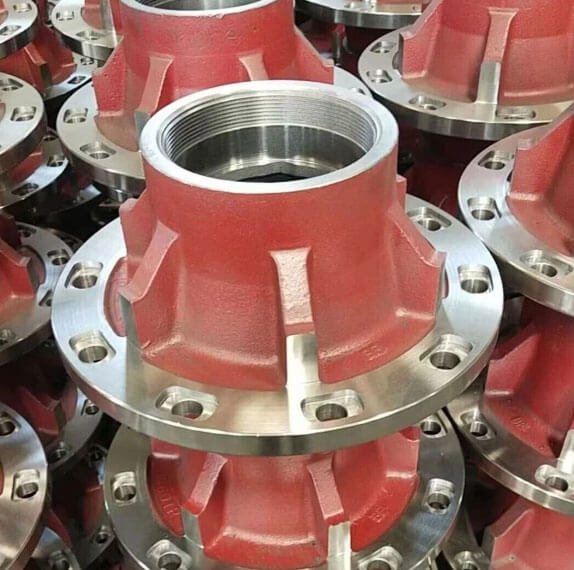
For most cast iron and cast steel wheel hubs, sand casting remains a practical solution because it accommodates complex geometries, relatively large components, and a wide range of ferrous alloys.
Comparison of Common Casting Processes
| 铸造过程 | 典型尺寸公差* | Part Weight / 尺寸 | Production Suitability | As-Cast Surface | 最佳应用 |
| 绿色的 沙 铸件 | Approximately ±0.8–1.5 mm for selected dimensions | 5–500 kg; 取决于设计 | High-volume production with suitable tooling | 公平的 | Standard truck and semi-trailer hubs; cost-effective ferrous castings |
| 壳 模具 铸件 | Approximately ±0.5–1.0 mm for suitable features and component sizes | Commonly small-to-medium castings; varies by design | Medium-to-high volume where tooling investment is justified | 好到非常好 | Hubs requiring improved surface finish and dimensional consistency |
Precision Gravity Casting |
Approximately ±0.5–1.0 mm for selected dimensions and suitable designs | Generally small-to-medium components; highly alloy- and geometry-dependent | Medium-volume production where reusable tooling is economical | 好到非常好 | Selected aluminum-alloy hub designs and lightweight applications |
| 投资 铸件 | Approximately ±0.1–0.3 mm for suitable dimensions and geometries | Generally small-to-medium components | Low-to-medium volume, 取决于复杂性 | 出色的 | 小的, complex precision components where tighter as-cast detail is valuable |
5. Common Wheel Hub Failure Modes
Understanding how hubs fail is the key to designing and sourcing them correctly.
| 故障模式 | 外貌 | 根本原因 | 预防 |
| Bearing bore wear / ovality | Bore out-of-round; bearing spins in hub | Soft casting wall, 热处理不良, 振动 | Proper material grade; 受控的热处理; adequate wall thickness |
| Stud hole cracking | Cracks radiating from stud holes | Stress concentration; over-torque; poor fillet radii | Generous fillet design; controlled torque specification |
| Shrinkage porosity at hub center | Visible or internal voids near bearing bore | Inadequate riser feeding; thick-to-thin transition | Optimized riser design; 方向固化 |
Wheel face runout |
振动, brake pulsation, uneven tire wear | Casting distortion; poor machining datum control | Stress relief after casting; controlled machining fixture |
| Thermal cracking near brake flange | Fine cracks near brake mounting surface | Heat checking from braking heat; poor ductility | Ductile iron with adequate toughness; thermal cycling analysis |
| Corrosion pitting | Surface rust, pitting on untreated surfaces | Road salt, no coating, improper casting surface | Zinc-rich primer + 粉末涂层; corrosion-resistant material |
这 #1 Hidden Killer: Shrinkage Porosity at the Bearing Bore
I have seen hundreds of failed hubs come back from the field. The most common internal defect is shrinkage porosity right at the bearing seat — invisible on the surface, but enough to cause bearing fretting, 过热, and eventual seizure.
This is almost always a riser design problem: the thick bearing section solidifies last without proper feeding.
Good foundries X-ray or ultrasonically inspect the bearing zone of every hub. Cheap foundries don’t — and you find out six months later on the side of the highway.
6. Precision CNC Machining for Finished Wheel Hubs
Casting establishes the basic shape of a wheel hub, but precision machining creates the interfaces that determine how the component fits and functions within the wheel-end assembly.
轴承座, 安装面, 螺栓孔, seal-contact surfaces, and other specified features may require tight dimensional and geometric controls.
These requirements must be defined by the engineering drawing and the associated assembly design.
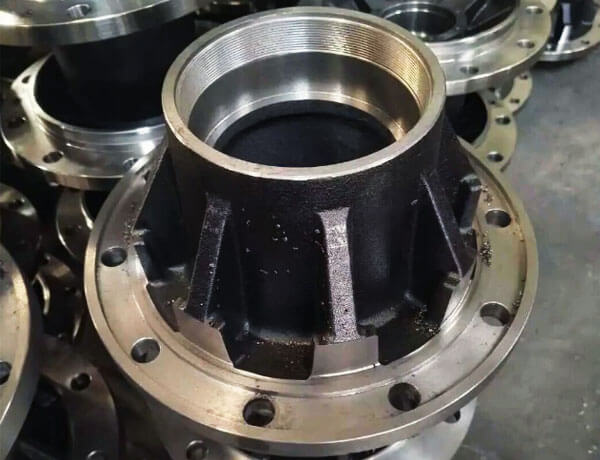
Machining Critical Interfaces
Several features deserve particular attention during machining.
Bearing bores and seats: These features must meet the specified diameter, 圆度, 圆柱体, 表面饰面, and fit requirements.
Incorrect dimensions can affect bearing installation, operating clearance or preload, depending on the bearing arrangement, and load distribution.
Wheel mounting faces: The mounting face establishes the interface between the hub and wheel.
平坦, 垂直度, and runout requirements should be defined as appropriate to the design because deviations may affect mounting accuracy and rotating behavior.
Bolt holes and bolt circles: 孔径, 位置, 间距, and specified seating geometry must match the wheel attachment system.
Positional errors can complicate assembly or produce uneven contact conditions.
Seal-contact surfaces: Where the hub accommodates a seal, 表面饰面, 几何学, and dimensional accuracy must be compatible with the specified seal design and operating conditions.
Control Datum References and Machining Allowances
A consistent machining strategy begins with selecting suitable datums and establishing how the component will be located and clamped.
If the initial setup references an unsuitable surface, machining can reproduce dimensional errors between the bore, 法兰, and other critical features.
Sufficient and consistent machining allowance is also important: insufficient stock may leave portions of the casting unmachined, while excessive stock increases cycle time and tool wear.
For complex hubs, process planning should establish the machining sequence, workholding method, and inspection points before production begins.
同心, Runout, 和表面饰面
The geometric relationship between the bearing interface, rotational axis, and wheel mounting face can influence the finished hub’s operation.
Depending on the drawing, inspection may include:
- Bore diameter and geometric accuracy.
- Radial and axial runout.
- Perpendicularity of mounting faces to the specified datum axis.
- Bolt-hole position and mounting geometry.
- Surface finish on bearing and sealing interfaces.
These measurements should be performed using suitable fixtures, 精密仪器, or coordinate-measuring equipment as required.
It is important not to apply one universal tolerance to all wheel hubs. The correct values depend on the bearing system, wheel-end design, 元件尺寸, and applicable engineering requirements.
How Machining Affects Total Manufacturing Cost
Machining cost is influenced by the casting’s dimensional consistency, material machinability, 加工余量, workholding complexity, 工具寿命, and required inspection frequency.
A well-designed casting can reduce unnecessary material removal and simplify machining setups.
然而, minimizing machining stock at the expense of reliable surface cleanup can increase rejection rates.
The goal is to establish a stable relationship between casting accuracy and machining capability so that critical features can be produced consistently.
7. Quality Control and Testing for Safety-Critical Hub Components
Safety-critical hubs demand a rigorous quality program. Typical tests include:
| 测试 | 目的 | 标准 / 方法 |
| 化学分析 | Verify material composition | 光谱法 |
| 机械测试 | 拉伸, 屈服, 伸长, 硬度 | ASTM E8, E10 |
| Microstructure evaluation | Nodularity, 矩阵, graphite size | ASTM A247 |
| 维度检查 | 轴承孔, 法兰, stud holes | CMM, 仪表 |
| 射线照相检查 | 内部孔隙率, 收缩 | ASTM E94 / E505 |
| 超声测试 | Internal defects in critical sections | ASTM A609 |
| 磁粉探伤 | 表面裂纹 | ASTM E709 |
| Dynamic fatigue test | Simulated road load | SAE J1095 or OEM specification |
| Proof load test | 结构完整性 | Axle manufacturer specification |
| Runout check | Flange and bearing bore runout | Dial indicator / CMM |
| 压力 / 泄漏测试 | Oil seal integrity (适用的地方) | - |
8. Applications of Custom Wheel Hub Castings
Custom wheel hub castings are used in various commercial vehicle and industrial transport applications.
Each application presents different loading conditions, dimensional constraints, 和环境要求.
Heavy-Duty Highway Trucks
Truck hubs must accommodate the specified bearing system, wheel attachment, and axle configuration while withstanding repeated road loads, cornering forces, and braking-related service conditions.
材料特性, mounting geometry, 疲劳性能, and machining accuracy are key considerations.
Semi-Trailers and Freight Transport
Trailer hubs operate under repeated loading during long-distance service.
Their specifications depend on axle design, wheel configuration, bearing arrangement, 负载要求, and the expected operating environment.
Corrosion exposure and serviceability may also influence the design and finishing requirements.
Construction and Off-Highway Vehicles
Certain construction and specialized transport vehicles encounter higher impact loads, uneven terrain, 灰尘, and contamination.
Their hubs require application-specific assessment of loads, material toughness, structural geometry, 密封接口, 及维护条件.
OEM Production and Aftermarket Replacement
OEM projects may require controlled revisions, 可重复生产, documented material requirements, and planned validation.
Replacement components introduce additional challenges when original drawings or material specifications are incomplete, making dimensional verification and application compatibility especially important.
9. Custom Wheel Hub Casting Solutions from LangHe Industry
LangHe Industry provides custom wheel hub casting solutions for heavy-duty trucks and semi-trailers, supporting projects that require application-specific materials, casting designs, 精确加工, 和质量检查.
Our manufacturing capabilities cover key stages of production, 包括:
- 铸造过程: Green sand casting and shell mold casting for suitable ferrous wheel hub designs.
Precision gravity casting may be considered for compatible nonferrous applications, depending on component requirements. - 材料选择: Ductile iron grades such as ASTM A536 65-45-12, 80-55-06, 和 100-70-03, as well as austempered ductile iron (阿迪) and other specified grades, subject to design and manufacturing feasibility.
- Casting Simulation: Mold-filling and solidification analysis to help optimize gating and riser design and reduce the risk of casting defects.
- 数控加工: 转身, 无聊的, 钻孔, 窃听, and other specified machining operations. Balancing can be arranged where required by the component design and operating conditions.
- 质量控制: 维度检查, 材料验证, and applicable non-destructive testing (NDT) according to agreed specifications.
Quality management and automotive-specific requirements should be confirmed for each project. - 可追溯性: Material documentation, production-batch identification, and inspection reports as specified.
We work with OEMs and other industrial customers to develop wheel hub castings suited to their specified load requirements, duty cycles, dimensional constraints, and weight targets.
Our engineering support includes design-for-manufacturability (DFM) review, material selection guidance, and prototype evaluation where required.
联系朗和实业 to discuss your custom wheel hub casting project.
Providing a technical drawing or sample, 材料要求, 预计产量, and inspection criteria will help us evaluate the appropriate manufacturing route.
10. 结论
Custom wheel hub castings are among the most safety-critical components in heavy-duty truck and semi-trailer systems.
They look like simple round castings from the outside, but every feature — bearing bore, wheel face, stud holes, brake mounting surface — must be precision-engineered and cast to exacting standards.
The difference between a hub that lasts 700,000 km and one that fails at 200,000 km comes down to three things: right material, right heat treatment, and right casting process control.
Ductile iron with proper normalization delivers the strength, 减震, and wear resistance that heavy-duty service demands.
Directional solidification engineering eliminates shrinkage porosity at the bearing bore. Rigorous NDT and dimensional verification catch defects before they reach the road.
For fleet operators, trailer manufacturers, and axle OEMs, the message is clear: wheel hubs are not a commodity to source on price alone.
They are safety components. Partner with a foundry that understands wheel hub failure modes, controls every process step, and stands behind every casting with full traceability. That is how you get hubs that stay on the road, not on the side of it.
常见问题解答
What materials are commonly used for heavy-duty truck wheel hub castings?
Ductile iron is one candidate for cast wheel hubs because it can offer a useful combination of strength, 延性, and casting flexibility. Cast steel may also be considered for specific designs.
The appropriate material depends on the hub geometry, required fatigue performance, 负载, 运行环境, and applicable specifications.
Why does a wheel hub casting require CNC machining?
CNC machining produces the precise bearing seats, 安装面, 螺栓孔, and other interfaces required for assembly.
The casting provides the basic shape, while machining establishes the final dimensions and surface characteristics specified on the engineering drawing.
Can an existing wheel hub be reverse-engineered for custom casting?
是的, an existing component can provide a starting point for dimensional analysis and design reconstruction.
然而, reverse engineering should also establish material requirements, 关键接口, 加工公差, and relevant performance criteria.
External dimensions alone are insufficient to confirm that a replacement hub is suitable for safety-critical service.
What information is needed for a custom wheel hub casting quotation?
Provide a technical drawing or sample, 材料规格, 关键维度, application details, expected quantity, 加工要求, and quality documentation needs.
Any required NDT, fatigue testing, or other validation should also be stated at the quotation stage so the manufacturing route and cost can be evaluated accurately.