Outdoor lighting is one of the most demanding applications for an enclosure.
A streetlight, floodlight, wall pack, or landscape fixture must survive rain, snow, salt fog, 紫外线辐射, 热循环, wind loading, 振动, and the occasional impact—often for a decade or more with minimal maintenance.
Inside that enclosure, the driver, LED array, and wiring generate heat that must be dissipated without allowing water or dust to reach sensitive electronics.
Custom die-cast aluminum housings have become the default solution for this challenge.
Aluminum offers an exceptional combination of thermal conductivity, 强度与重量比, 耐腐蚀性, and design freedom.
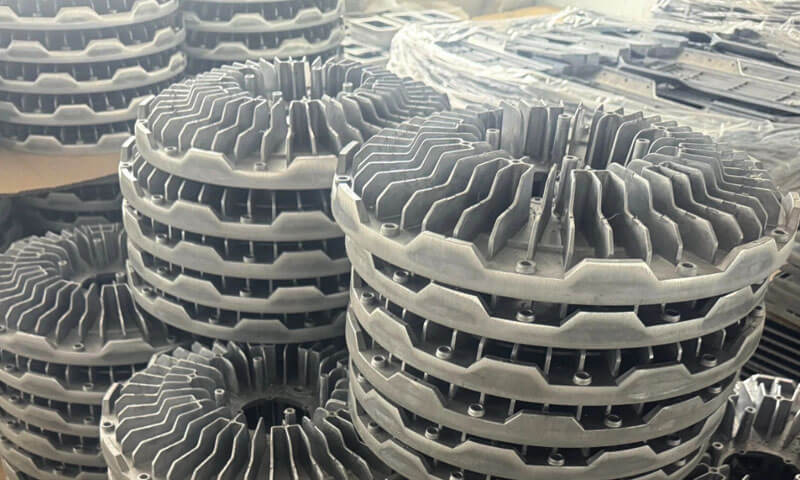
Die casting allows complex geometries—cooling fins, 垫片凹槽, 安装凸台, and optical chambers—to be produced as a single, near-net-shape part at high volume and with excellent repeatability.
This article examines the engineering principles, 材料选择, 制造过程, and quality requirements involved in producing custom die-cast aluminum housings for outdoor lighting.
1. What Are Custom Die-Cast Aluminum Housings for Outdoor Lighting?
A custom die-cast aluminum lighting housing is a metal enclosure manufactured by injecting molten aluminum alloy into a precision steel die under high pressure.
一旦金属固化, the casting is ejected, 修剪过的, and processed to meet the component’s dimensional, 功能性的, and cosmetic requirements.
Unlike a generic enclosure adapted from an existing product, a custom housing is developed around the specific geometry and performance requirements of a luminaire.
Its dimensions, 安装接口, cooling features, sealing structures, and surface finish can be tailored to the LED module, optical assembly, driver, and installation environment.
Main Functions of a Lighting Housing
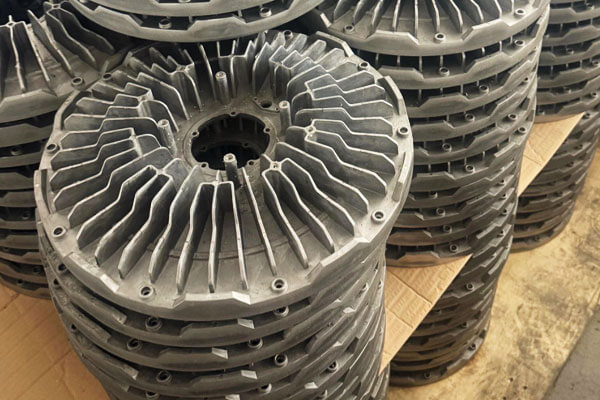
The housing is a structural and thermal component of the lighting system. Its principal functions include:
- Mechanical protection: Supports the LED board, driver, 镜片, reflector, and mounting hardware while resisting installation loads, 振动, and accidental impact.
- 热管理: Conducts heat away from the LED module and transfers it to the surrounding environment through the housing surface and cooling fins.
- 环境保护: Provides the structural interfaces needed for gaskets, 封面, 电缆接头, and fasteners that help prevent water and dust ingress.
- 尺寸稳定性: Maintains the relative positions of the LED module, 光学组件, and mounting interfaces.
- Corrosion and appearance protection: Provides a suitable substrate for protective coatings and decorative finishes.
- Assembly integration: Consolidates features such as screw bosses, 括号, 电缆通道, and driver compartments to reduce part count and assembly complexity.
2. Common Applications of Die-Cast Aluminum Lighting Housings
Outdoor lighting products differ considerably in power density, installation method, 运行环境, 和维护要求.
Housing design should therefore begin with the application’s actual operating conditions rather than a standard shape or nominal wattage.
LED Streetlights and Roadway Luminaires
Streetlight housings must withstand outdoor exposure, wind loading, 振动, and repeated thermal cycling.
They also need to support the LED module and optical assembly in a stable position.
Common design priorities include:
- Integrated cooling fins sized for the thermal load and available airflow.
- Strong pole-mounting or adjustable-angle interfaces.
- Sealed electrical compartments with accessible maintenance covers.
- Corrosion-resistant surface treatment for long-term outdoor exposure.
- Geometry that minimizes water accumulation and simplifies cleaning.
For large roadway luminaires, weight is also an important consideration because it affects mounting hardware, installation procedures, and loads on supporting structures.
LED Floodlights and High-Power Spotlights
Floodlights may operate at relatively high power densities and are frequently installed in exposed locations.
Their housings must balance heat dissipation with structural strength and weather resistance.
The casting may incorporate cooling fins, mounting trunnions, aiming brackets, and reinforced screw bosses.
Where the LED module is mounted directly to the housing, the contact surface should be designed to support consistent thermal transfer. Any subsequent machining must preserve the intended interface geometry.
Architectural and Facade Lighting
Architectural luminaires often have demanding cosmetic requirements because their housings are visible on buildings, 桥梁, and public structures.
Design considerations include slim cross-sections, concealed fasteners, 均匀的涂层, consistent parting-line placement, and resistance to discoloration or corrosion.
The housing must also accommodate optical components and maintain alignment without creating unnecessary bulk.
Garden, Pathway, and Landscape Lighting
Landscape lighting may be exposed to irrigation, wet soil, 肥料, 清洁化学品, and repeated handling during installation or maintenance.
The housing design should account for water pathways, cable entries, fastener corrosion, and compatibility between the aluminum alloy and adjacent materials.
Where dissimilar metals contact each other in a wet environment, galvanic corrosion should be considered and mitigated through suitable material selection, 涂料, isolation washers, or other design measures.
Tunnel, Parking, and Industrial Outdoor Lighting
These applications can involve elevated ambient temperatures, airborne contaminants, 振动, and frequent operating cycles.
In tunnels and industrial facilities, access for maintenance may also be restricted.
The housing should be designed around the expected thermal load, mounting conditions, cleaning procedures, 和环境暴露.
For demanding installations, the complete luminaire may require additional ingress protection, 冲击阻力, or corrosion testing.
3. Why Choose Aluminum Die Casting for Outdoor Lighting Housings?
Aluminum die casting is not the only way to make a lighting housing. Housings can also be produced from extruded aluminum, stamped steel, injection-molded plastic, or sand-cast aluminum.
Each has advantages, but die casting offers a distinctive combination for outdoor lighting.
导热率.
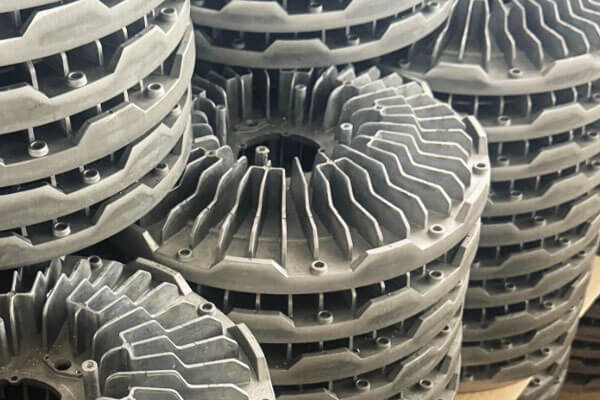
Aluminum has a thermal conductivity of approximately 96–121 W/m·K for common die-cast alloys such as A380 and A360.
This allows the housing itself to act as a heat sink, spreading heat from the LED board and dissipating it to the air. Plastics require separate metal heat sinks; steel is a poor conductor.
Low Weight with Useful Structural Strength
Aluminum alloys have a relatively low density, 通常在周围 2.7 g/cm³, making them substantially lighter than steel.
This is beneficial for pole-mounted streetlights, wall-mounted luminaires, and large floodlights where component weight affects handling and support loads.
设计自由.
Die casting can produce complex three-dimensional shapes with integrated fins, 老板, 肋骨, 垫片凹槽, 和安装特点. 这减少了零件计数, assembly time, and potential leak paths.
Strength and durability.
Die-cast aluminum offers good stiffness and impact resistance. It can withstand wind loading, 振动, and accidental impact better than most plastics.
耐腐蚀性.
铝自然形成保护性氧化物层. With appropriate alloy selection and surface finishing, it can survive coastal and industrial environments for many years.
Dimensional accuracy and repeatability.
High-pressure die casting produces parts with excellent dimensional consistency, which is critical for gasket sealing and lens fit. Tolerances of ±0.1 mm or better are achievable on critical features.
High-volume economics.
Once the die is produced, per-part cost is low at volume. Cycle times are short, and the process is highly automated.
回收.
铝很高可回收, which supports sustainability goals and end-of-life material recovery.
4. Selecting the Right Aluminum Alloy for Outdoor Lighting Housings
Alloy selection affects castability, 机械强度, 热行为, 腐蚀性能, finishing quality, 和制造成本.
There is no single alloy that is best for every outdoor lighting housing.
Common Aluminum Die Casting Alloys
The following comparison is intended as a practical screening guide. Alloy designations and chemical limits vary by national standard, and similar designations are not always interchangeable.
| Alloy or designation | General characteristics | Potential suitability for lighting housings |
| ADC12 | Common Japanese-designated Al-Si-Cu die casting alloy with good castability and dimensional stability | General-purpose LED housings, 封面, and complex enclosures |
| A380 | Widely used North American Al-Si-Cu die casting alloy with a useful balance of castability and mechanical properties | 结构外壳, 括号, and components with integrated features |
| A383 | Al-Si-Cu alloy often selected for complex castings and challenging filling conditions | Thin-wall or geometrically complex housing designs where the grade is available and qualified |
| Al-Si-Mg die casting grades | Some grades offer favorable corrosion behavior or potential for specialized property combinations | Applications requiring a particular balance of strength, 耐腐蚀性, or finishing performance |
5. Thermal Management and Heat Dissipation
Thermal management is the single most important performance factor in an outdoor LED lighting housing.
LEDs convert only a portion of their input power into light; the remainder becomes heat.
If that heat is not removed, the LED junction temperature rises, causing reduced light output, color shift, 和过早失败. The housing is the primary heat sink.
Thermal path design.
Heat must travel from the LED board through the thermal interface material, into the housing, and out to the air through the fins.
Every interface in this path adds thermal resistance. The housing should provide:
- A flat, machined LED mounting surface to minimize interface resistance.
- Sufficient cross-section between the LED area and the fins.
- Fins with adequate surface area and spacing for natural or forced convection.
- A design that avoids hot spots and thermal bottlenecks.
Fin geometry.
Fin height, 厚度, 间距, and orientation determine heat dissipation. For natural convection, fin spacing should be wide enough to allow air to flow between fins—typically 8–12 mm for outdoor fixtures.
For forced convection, tighter spacing is acceptable. Fins should be oriented vertically where possible to promote chimney effect.
Wall thickness and mass.
A thicker wall spreads heat more effectively but adds weight and cost. The optimal wall thickness depends on the LED power and the housing size.
Typical die-cast lighting housings use wall thicknesses of 2–4 mm, with thicker sections near the LED mounting area.
Simulation and validation.
Thermal simulation (参见) is used to predict junction temperatures and optimize fin geometry before tooling is cut.
Physical validation is performed with thermal imaging and thermocouple measurements on prototypes.
Thermal interface materials.
The interface between the LED board and the housing must be controlled.
Thermal pads, 粘贴, or phase-change materials are used to minimize contact resistance. The housing surface must be flat and clean.
Ingress protection and thermal performance.
Sealing the housing to IP66 or IP67 reduces airflow and can trap heat. The design must balance sealing requirements with thermal performance.
Venting membranes or breathable vents may be used to equalize pressure without allowing water ingress.
6. Weatherproofing, 耐腐蚀性, 和表面饰面
Outdoor lighting housings must withstand environmental exposure while maintaining the integrity of the assembled enclosure.
Rain, 缩合, 灰尘, ultraviolet radiation, salt deposits, and temperature cycling can all affect long-term performance.
The aluminum casting provides the structural foundation, but reliable protection depends on the combined performance of the alloy, 表面处理, 密封系统, 紧固件, cable entries, and assembly process.
入口保护 (知识产权) ratings.
Most outdoor lighting housings target IP65, IP66, or IP67.
The gasket groove must be machined or cast to precise dimensions, and the gasket material must be compatible with the expected temperature range and environmental exposure. Silicone gaskets are common for high-temperature and UV-exposed applications.
Gasket design.
The gasket groove should be designed to compress the gasket by 20–30% when the cover is tightened.
The groove depth and width must be consistent around the perimeter. Machined gasket grooves provide better sealing than as-cast grooves.
Cable entry and sealing.
Cable entries must be sealed with cable glands or potted connectors. Threaded entries should be machined to standard thread specifications and sealed with O-rings or gaskets.
Pressure equalization.
Sealed housings can draw in water through seals during thermal cycling due to pressure changes. Breathable vents (例如。, Gore vents) allow pressure equalization while blocking liquid water.
耐腐蚀性.
Aluminum is naturally corrosion-resistant, but outdoor exposure—especially in coastal and industrial environments—requires additional protection. Surface finishing is essential.
表面处理选项:
- 粉末涂料: 提供了耐用的, colored finish with good weather resistance. Typical thickness is 60–120 μm. Proper pretreatment (脱脂, 转化涂层) is critical for adhesion.
- 阳极氧化: Creates a protective oxide layer. Type II sulfuric anodizing at 10–25 μm is common; Type III hard anodizing at 25–50 μm offers better wear resistance.
- Wet painting: Used for specific colors or cost-sensitive applications. Less durable than powder coating.
- 电子涂层: Provides uniform coverage and good corrosion resistance, often used as a primer.
- 转化涂层: Chromate or phosphate coatings improve paint adhesion and provide some corrosion protection.
The ADC12 Anodizing Problem
As I covered in detail in our previous article (Can You Anodize Die-Cast Aluminum?), ADC12 die cast aluminum does not anodize well due to its high silicon content (9–12%).
Standard anodizing produces splotchy, smutty results. For outdoor lighting housings, powder coating is the standard finish, not anodizing.
If anodizing is required for aesthetic reasons, specify a low-silicon alloy (YL102 / Alsi9mg) and budget for desiliconizing pre-treatment.
Salt spray testing.
Powder-coated or painted housings are often tested per ASTM B117 for 500–1,000 hours to verify corrosion resistance. The acceptance criteria depend on the specification and the environment.
紫外线阻力.
Outdoor housings must resist UV degradation. Powder coatings and anodized finishes are inherently UV-stable. Plastic components such as lenses and gaskets must also be UV-stabilized.
7. Custom Aluminum Die Casting Manufacturing Process
The production of a custom outdoor lighting housing involves a sequence of interdependent operations.
Decisions made during product design and mold development influence casting quality, 加工要求, finishing performance, and production cost.
步 1: Design and DFM review.
The customer’s 3D model and requirements are reviewed for castability.
The foundry suggests changes to wall thickness, 草稿角, 半径, 门控, and ejector pin locations. Flow simulation (例如。, MAGMA or Flow-3D) predicts filling and solidification behavior.
步 2: Die design and fabrication.
A steel die (usually H13) is machined with the cavity, 核, 跑步者, 大门, 溢流井, 和冷却通道.
Die design is critical for filling, 冷却, 和部分弹射. Typical die life is 50,000–150,000 shots, depending on alloy and maintenance.
步 3: Melting and dosing.
The selected alloy is melted and held at the correct temperature. Automated dosing furnaces deliver precise shot weights to the die-casting machine.
步 4: 高压铸造.
Molten aluminum is injected into the die at high velocity and pressure (typically 700–1,400 bar).
The metal fills the cavity, solidifies under pressure, and is ejected as a casting. Cycle times are typically 30–90 seconds, 取决于零件尺寸和壁厚.
步 5: Trimming and deburring.
大门, 跑步者, and overflow are trimmed in a trim die or by sawing and grinding. Edges are deburred.
步 6: Shot blasting and surface preparation.
Castings are shot blasted to remove flash, 氧化物, 和表面污染, and to prepare the surface for finishing.
步 7: 数控加工.
Critical features—gasket grooves, LED mounting surfaces, 螺纹孔, cable entries, and mounting interfaces—are machined to final dimensions.
步 8: 表面饰面.
粉末涂料, 阳极氧化, 绘画, or e-coating is applied as specified.
步 9: Assembly and testing.
垫圈, 镜片, 电缆接头, and other components are assembled. 泄漏测试, IP testing, and functional testing are performed.
步 10: Inspection and packaging.
Final inspection verifies dimensions, 结束, 和功能. Parts are packaged to prevent damage during shipping.
8. Ordering Aluminum Lighting Housings from LangHe Industry
Langhe行业 manufactures custom aluminum die-cast components to customer drawings, supporting projects from single prototypes to production batches.
For outdoor lighting housings, we provide high-pressure die casting, 数控加工, 表面饰面, and dimensional inspection to meet specific design and application requirements.
Manufacturing Capabilities
Our capabilities cover a range of aluminum lighting housings, from compact enclosures to larger structural components.
| 范围 | 能力 |
| 死 铸件 过程 | 高压铸造 (HPDC), including cold-chamber and hot-chamber processes where suitable |
| 成分 重量 | 0.05–50 kg per piece |
| Typical as-cast tolerance | ±0.1 to ±0.3 mm, depending on dimensions and casting design |
| Available alloys | ADC12, A380, EN AC-46000 (alsi9cu3), 和AC-44300 (ALSI12), EN AC-43400 (Alsi10mg), and other alloys on request |
| 表面 精加工 | 阳极氧化, 粉末涂料, 电子涂层, chromating, 喷砂, 和抛光 |
| 检查 | CMM尺寸检测, 材料认证, and leak testing where applicable |
| Quality management | ISO 9001:2015 |
From Prototype to Production
狼河 supports short runs starting from a single prototype, as well as repeat production.
Each project is assessed against the supplied drawings, 材料规格, surface-finish requirements, 和预期的申请.
For outdoor lighting components, 我们注重尺寸精度, 铸造完整性, machining quality, and coating consistency.
材料证书, dimensional reports, and coating thickness records are available according to the agreed documentation requirements, including for small batches.
To request a quotation, please provide your 2D drawings or 3D CAD files, preferred aluminum alloy, 表面处理, required quantity, and critical technical specifications.
This information allows us to assess manufacturability and recommend a suitable production route for your custom aluminum lighting housings.
9. 结论
Custom die-cast aluminum housings are the backbone of modern outdoor lighting.
They combine thermal performance, 机械耐用性, 耐腐蚀性, and design freedom in a way that few other materials and processes can match.
The housing is not a passive box—it is an engineered thermal, 密封, and structural system.
LangHe Industry offers the engineering support, die-casting capability, 加工, 精加工, and quality systems needed to produce custom aluminum lighting housings that meet the demands of outdoor environments.
Whether the application is a streetlight, floodlight, landscape fixture, or high-mast installation, the right housing design and manufacturing partner make the difference between a product that lasts and one that fails.
常见问题解答
Which aluminum alloy is best for outdoor lighting housings?
ADC12 and A380 are common starting points for high-pressure die-cast aluminum housings because of their castability and useful mechanical properties.
The best choice depends on the housing geometry, 热要求, 腐蚀暴露, 表面饰面, and applicable material specification.
Coastal or chemically aggressive environments may require additional evaluation of the alloy and protective coating system.
Can die-cast aluminum housings be used for high-power LED lighting?
是的. Die-cast aluminum is widely suitable for high-power LED housings because it can combine a thermal mounting surface with integrated cooling fins and structural features.
然而, actual cooling performance depends on the alloy, fin geometry, LED interface, thermal materials, airflow, 环境温度, and luminaire orientation.
Thermal analysis should be followed by testing of the assembled product.
Can a custom die-cast aluminum housing achieve IP65, IP66, or IP67?
It can be designed as part of an enclosure intended to meet these ratings, but the rating is not an inherent property of the casting.
The complete assembly must meet the applicable test requirements, including the performance of its gaskets, 封面, 紧固件, 电缆接头, 连接器, and assembly procedure.
Is powder coating suitable for outdoor aluminum lighting housings?
Powder coating is a common choice for outdoor lighting housings because it offers a wide range of colors and can provide useful corrosion protection when the alloy, pretreatment, 涂层, and curing process are properly controlled.
Coating specifications should address adhesion, 厚度, 环境暴露, and masking of critical interfaces.
Why choose LangHe Industry for custom lighting housings?
LangHe offers design support, 合金选择, 压铸, 数控加工, 表面饰面, 集会, and testing under one roof.
The company maintains a documented quality system and has experience serving lighting and industrial customers.