Executive summary
Refractory materials constitute the lion’s share (>90% by dry weight) of an investment-casting shell and therefore govern almost every performance attribute of the shell:
surface finish, green and fired strength, permeability, thermal stability and the shell’s chemical resistance to molten metal.
Choosing the right refractory (type, purity, particle size distribution and morphology) and matching it to slurry formulation and thermal schedules is one of the highest-leverage actions a foundry can take to prevent defects and raise yield.
This article explains the functional roles of refractory powders and stucco, compares common refractory types,
describes how particle properties affect slurry and shell behaviour, and gives practical guidance for selection, testing, process control and troubleshooting.
1. Roles of refractory materials in shell systems
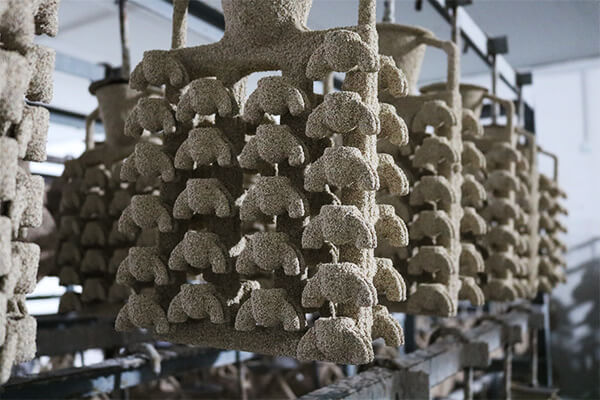
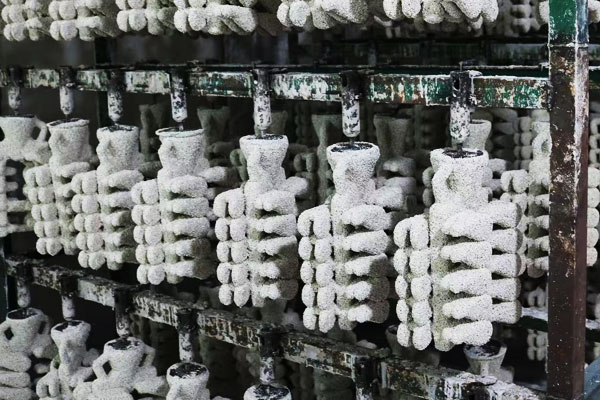
Investment-casting shells are built from repeated cycles of coating (facecoat/backer slurry) and stuccoing (sand buildup). Refractories serve two distinct but complementary roles:

- Facecoat (binder + fine refractory powder) — the thin layer that contacts the wax pattern.
It sets surface fidelity, controls thermochemical interaction with the molten alloy and provides the first line of protection against chemical penetration.
Requirements: very fine, chemically inert, high fired density, low reactivity with the alloy, suitable thermal expansion and controlled permeability. - Backer / stucco (coarse particles) — successive coarser layers that add thickness, strength and permeability.
Requirements: coarser graded particles to create porosity for venting, good thermal shock resistance and mechanical support under pour loads.
Because refractories make up most of the shell mass, their mineralogy, impurity levels and particle morphology dominate shell behaviour.
Strategic Importance
The reason refractory materials dominate more than 90% of the dried shell’s weight is their irreplaceable role in every stage of shell making and casting:
- Structural Support: They form the “skeleton” of the shell, ensuring the shell maintains its shape during wax removal, roasting, and molten metal pouring.
- High-Temperature Resistance: They withstand the intense thermal shock and erosion of molten metal (typically 1400–1700℃ for stainless steel, 1500–1800℃ for high-alloy steel), preventing shell softening, melting, or deformation.
- Surface Quality Guarantee: Surface-layer refractory powders directly replicate the texture of the wax pattern, determining the casting’s surface finish and detail replication.
- Defect Prevention: Good refractory materials with excellent permeability and thermal shock resistance avoid common defects such as shell cracking (during dewaxing/roasting), sand sticking (during pouring), and pinholes (due to poor gas emission).
2. Core Performance Requirements for Shell-Making Refractory Materials
To ensure the shell meets the strict requirements of investment casting, refractory materials (both powders and stucco sands) must possess a comprehensive set of performance characteristics, balancing high-temperature performance, processability, and stability:
Mechanical Strength (Room and High Temperature)
- Room-Temperature Strength: The shell must have sufficient dry strength to resist damage during handling, wax removal, and transfer.
Refractory materials with good particle shape and size distribution form a dense coating, enhancing the shell’s cohesion with the binder. - High-Temperature Strength: Critical for withstanding the impact of molten metal and avoiding shell collapse or deformation during pouring.
Refractory materials must maintain structural integrity at temperatures 100–200℃ higher than the pouring temperature.
High-Temperature Stability and Refractoriness
- Refractoriness: The minimum temperature at which the refractory material begins to soften and deform under load, which must be significantly higher than the pouring temperature of the molten metal.
For most investment casting applications, refractory materials with a refractoriness above 1700℃ are preferred. - Thermal Shock Resistance: The ability to withstand rapid temperature changes (e.g., from room temperature to 950–1050℃ during roasting, or from roasting temperature to molten metal temperature during pouring) without cracking.
This is determined by the material’s thermal expansion coefficient and toughness—lower expansion coefficients generally indicate better thermal shock resistance.
Physical and Chemical Stability
- Low Thermal Expansion Coefficient: A small thermal expansion coefficient (preferably ≤80×10⁻⁷/℃, 0–1200℃) reduces thermal stress during temperature changes, minimizing the risk of shell cracking.
- Good Chemical Stability: Resistant to chemical reactions with molten metal, slag, and binder decomposition products.
This prevents the formation of low-melting-point compounds (which cause shell softening) and avoids chemical adhesion between the shell and casting (which affects decoating). - Good Permeability: Allows gases (from wax decomposition, binder pyrolysis, and air trapped in the shell) to escape smoothly during roasting and pouring, preventing casting defects such as pinholes and blowholes.
Process Compatibility and Quality Stability
- Suitable Particle Size and Distribution: For refractory powders, a reasonable particle size distribution (e.g., D50 = 3–5 μm for surface-layer zircon powder) ensures good coating fluidity, adhesion, and compactness.
For stucco sands, uniform particle size ensures consistent shell thickness and permeability. - Compatibility with Binders: Refractory materials must be compatible with silica sol (the most commonly used binder) to maintain coating stability, avoiding premature gelation or sedimentation.
- Long-Term Quality Stability: Batch-to-batch consistency is critical for stable casting quality.
Foundries typically lack the equipment and expertise to detect refractory material quality, so relying on reliable suppliers is essential to avoid recurring defects caused by inconsistent material quality.
3. Common Refractory Materials for Silica Sol Shells: Performance Comparison and Application Characteristics
In silica sol-based investment casting (the dominant process for high-precision castings),
zircon sand/powder, calcined kaolin (commercially called “mullite sand/powder”), and white corundum sand/powder are the most widely used refractory materials.

The following table summarizes their key performance parameters, and detailed application characteristics are discussed below:
| Refractory Material | Refractoriness (℃) | Thermal Expansion Coefficient (×10⁻⁷/℃, 0–1200℃) | Core Characteristics | Typical Application |
| Zircon (Zirconium Silicate, ZrSiO₄) | >2000 | 46 | High refractoriness, low expansion coefficient, excellent chemical stability, good surface replication | Surface layer (powders) and surface stucco (sands); critical for high-surface-quality castings |
| Quartz | 1680 | 123 | Low cost, high permeability, but high expansion coefficient (poor thermal shock resistance) | Rarely used for silica sol shells; limited to low-precision, low-temperature castings |
| Fused Silica | 1700 | 5 | Extremely low expansion coefficient (excellent thermal shock resistance), but lower refractoriness | Special applications requiring high thermal shock resistance (e.g., thin-walled castings) |
Refractory Clay |
>1580 | — | Low cost, good processability, but poor high-temperature strength | Low-grade back-layer coatings; rarely used for high-precision castings |
| Kaolinite | 1700–1900 | 50 | Good compatibility with silica sol, moderate cost; forms mullite phase after calcination | Calcined into “mullite powder/sand” for back layers |
| Bauxite | ≥1770 | 50–80 | High alumina content, good high-temperature strength, moderate cost | Back-layer stucco sands and powders |
| Fused Corundum (Al₂O₃) | 2000 | 86 | High hardness, excellent wear resistance, good high-temperature strength | High-alloy castings requiring resistance to molten metal erosion; surface/back layers |
Key Note on Refractoriness
It is important to clarify that refractoriness is not equivalent to melting point. Refractory materials are heterogeneous systems composed of multiple minerals and inevitable impurities (e.g., iron oxides, calcium oxides).
The temperature at which a liquid phase forms in the system (the actual softening temperature) differs significantly from the melting point of pure minerals.
Thus, while refractoriness must be higher than the pouring temperature, it only serves as a reference indicator.
In practice, low-melting-point compounds formed by impurities in refractory materials, combined with the impact of high-temperature molten metal and oxide erosion,
may still cause shell softening or chemical reactions—highlighting the importance of material purity and quality control.
4. Zircon Sand / Powder — the preferred facecoat refractory for high-quality shells
Zircon (zirconium silicate, ZrSiO₄) is the industry workhorse for investment-casting facecoats when the priorities are surface fidelity, chemical inertness and resistance to molten-metal attack.
Because the facecoat directly contacts the wax pattern and the first thermal/chemical load during pour,
the choice and quality of zircon powder have an outsized effect on as-cast surface finish, chemical penetration behaviour and the frequency of sand-sticking defects.
Below is a practical, engineering-level treatment of why zircon is preferred, which material attributes matter in production, how to evaluate incoming lots, and how to apply zircon powders reliably in silica-sol shell systems.
Why zircon is chosen for facecoats
- Thermochemical inertness. Zircon is much less prone than silica to form low-melting silicates with iron and nickel alloys. That reduces chemical penetration and “sand-sticking” or glassy reaction layers on the casting surface.
- High refractoriness. Zircon retains structural integrity at temperatures well above common pouring temperatures for stainless and high-alloy steels.
- Good surface replication. With a properly controlled particle size distribution (PSD) and slurry formulation, zircon produces a dense fired facecoat that faithfully reproduces fine pattern detail and yields low Ra as-cast.
- Balanced thermal expansion. Zircon’s expansion coefficient is moderate and compatible with many binder/backer systems, helping control thermal stress during dewaxing, roast and pour.
Key material attributes to specify and control
| Attribute | Why it matters | Typical target / guidance |
| ZrO₂ content (purity) | Higher ZrO₂ reduces reactive impurity phases; improves softening resistance | Aim for ≥65% ZrO₂ as a practical minimum for surface work; higher purity improves margin versus molten-metal attack |
| Impurities (Fe₂O₃, TiO₂, alkalis) | Iron and alkali oxides promote low-melting compounds and chemical penetration | Keep Fe₂O₃ and alkalis as low as possible; specify maximum impurity limits in procurement |
| Particle size distribution (PSD) | Controls packing, slurry viscosity, wet film behaviour and fired density | D50 ~ 3–5 μm is a common starting point for surface powders; adjust fine/coarse fractions by application |
Particle shape & morphology |
Spherical particles improve flow; angular give interlock in fired shell | Prefer rounded to sub-rounded for flowability; angular fines can increase slurry yield stress |
| Surface condition / agglomeration | Agglomerates cause poor dispersion, streaks or roughness | Powder should disperse cleanly in the binder without persistent lumps |
| Bulk / tap density | Helps control powder:liquid (P/L) by volume → mass conversion | Record and control in recipes; use density to calculate P/L precisely |
| White / ceramic grade designation | “Ceramic” grades are higher-purity and more tightly controlled than “ordinary” grades | For critical facecoats, use certified ceramic-grade or premium zircon lots |
Key Quality Factors Affecting Casting Performance
The quality of zircon sand/powder directly determines the surface quality of castings, with two critical factors: purity and particle size distribution.
Purity
Higher ZrO₂ content (≥65%) ensures better high-temperature stability and chemical resistance, reducing the risk of reactions with molten metal and slag.
Impurities (e.g., Fe₂O₃, TiO₂) form low-melting-point compounds at high temperatures, causing shell softening and sand sticking defects.
Particle Size and Distribution
Particle size distribution is critical for coating performance, directly affecting fluidity, adhesion, and compactness.
As discussed in previous technical articles, improper particle size distribution leads to two typical coating defects:
- Excessive Fluidity, Insufficient Adhesion
- Insufficient Fluidity, Difficult Slurry Control: The coating is thick and sticky, making it hard to control slurry thickness during dipping.
After dipping, the wax pattern surface is covered with wrinkles, leading to uneven shell thickness and surface defects.
Simple On-Site Detection Method: Precipitation Method
For foundries lacking professional detection equipment, a simple precipitation method (widely recommended by industry experts
such as Engineer Lu in live technical broadcasts) can be used to initially evaluate the quality of zircon powder (and mullite powder):
- Take equal weights of the tested powder and a standard powder.
- Add equal volumes of deionized water to two identical containers, then add the powders and stir uniformly.
- Let the mixtures stand for the same period (e.g., 30 minutes) and observe the precipitation rate and clarity of the supernatant.
- High-quality zircon powder precipitates uniformly, with a clear supernatant and no obvious sediment stratification.
Poor-quality powder (with impurities or uneven particle size) shows slow precipitation, turbid supernatant, or obvious stratification.
This method is simple, low-cost, and suitable for on-site rapid screening, helping foundries avoid using severely substandard materials.
5. Calcined Kaolin (“Mullite Sand/Powder”): The Dominant Back-Layer Refractory Material
It is critical to clarify a common misunderstanding in the industry: the “mullite sand/powder” widely used in current production is not pure mullite (3Al₂O₃·2SiO₂), but calcined kaolin.
Kaolin-based refractory materials undergo high-temperature calcination (typically 1200–1400℃), during which kaolinite (Al₂O₃·2SiO₂·2H₂O) decomposes and transforms to form a certain amount of mullite phase.
The mullite phase is the key to ensuring shell strength and high-temperature stability—it enhances the shell’s mechanical strength and resistance to thermal shock.
Quality Evaluation and On-Site Problems
The quality of calcined kaolin (commercially called “mullite sand/powder”) varies significantly in the market, with large differences in mullite phase content, purity, and particle size distribution.
These differences directly lead to casting defects, which are often misattributed to other processes:
- Common Misjudgment: For stainless steel castings with surface defects (e.g., uneven texture, pinholes, or scaling),
on-site personnel often initially attribute the problem to smelting (e.g., impurity content in molten metal) or shell making (e.g., insufficient drying).
However, on-site verification has shown that most of these defects are caused by substandard calcined kaolin—such as insufficient mullite phase content, high impurity levels, or uneven particle size. - Visual Quality Comparison: High-quality calcined kaolin has a uniform off-white color, fine and smooth texture, and no obvious agglomeration.
Poor-quality products are often grayish or yellowish, with rough texture and visible impurities.
Industry experts (e.g., Engineer Lu) often display side-by-side comparisons of high- and low-quality products in technical exchanges to help foundries make visual judgments.
Unresolved Technical Issues
While calcined kaolin is widely used, in-depth research on its performance is still insufficient in the industry:
- There is a lack of clear data on how mullite phase content is affected by calcination temperature and time (e.g., what temperature and holding time are required to achieve a specific mullite phase content).
- The quantitative relationship between mullite phase content and shell performance (e.g., strength, thermal shock resistance) has not been fully established.
These gaps require further exploration and research by foundry engineers and material scientists to optimize the application of calcined kaolin and improve shell quality stability.
6. Practical Application Challenges and Optimization Suggestions
In actual production, foundries often face challenges related to refractory materials, especially when producing a wide range of castings with significant differences in size and structure.
Below are key challenges and actionable suggestions:
Challenge: One-Size-Fits-All Coating Formulation
Many foundries use a single refractory powder and coating formulation for all castings, regardless of size, structure, or surface requirements.
This is impractical because:
- Large Castings: Slurry control and recovery are more difficult than for small parts, requiring coatings with higher viscosity and adhesion to avoid sagging.
- Small, High-Precision Castings: Require coatings with excellent fluidity and fine particle size to ensure detail replication.
- Components with Narrow Flow Channels (e.g., Impellers): Need coatings with high fluidity to ensure uniform coverage in confined spaces without blockages.
Suggestion: Tailored Coating Formulations
There is no universal coating formulation—foundries must optimize refractory powder selection and coating parameters based on their specific product characteristics:
- Conduct comparative tests using different refractory powders (e.g., zircon powder with different particle sizes, calcined kaolin from different suppliers) to determine the optimal formulation for each product type.
- For critical castings, test and adjust the powder-liquid ratio, viscosity, and dipping time to balance fluidity and adhesion.
- Document test results and establish a formulation database to ensure consistency.
Challenge: Inconsistent Refractory Material Quality
As mentioned earlier, most foundries lack professional detection equipment for refractory materials, leading to batch-to-batch quality inconsistencies.
This causes recurring casting defects, wastes manpower and material resources, and makes root-cause analysis difficult.
Suggestion: Reliable Supplier Collaboration
- Supplier Qualification Evaluation: Choose suppliers with a good industry reputation, stable production capacity, and quality control systems.
Request test reports (e.g., purity, particle size distribution) for each batch of materials. - Long-Term Cooperation: Establish long-term partnerships with 1–2 reliable suppliers to ensure consistent material quality and timely technical support.
- On-Site Verification: Use simple detection methods (e.g., precipitation method, visual inspection) to screen materials upon arrival, rejecting severely substandard batches.
Challenge: Application of Non-Mainstream and Alternative Materials
With the development of the industry, non-mainstream refractory materials and zircon sand alternatives (e.g., fused silica powder, alumina-zirconia-silica powder) are emerging.
While these materials may offer cost or performance advantages, they also carry risks.
Suggestion: Cautious Evaluation Before Application
- Before using non-mainstream materials, conduct comprehensive tests to verify their compatibility with silica sol, high-temperature performance, and impact on casting quality.
- Evaluate their cost-effectiveness—some alternatives may have lower upfront costs but lead to higher defect rates and increased total production costs.
- Start with small-batch trials, monitor casting quality closely, and scale up only if performance meets requirements.
7. Common production problems linked to refractory materials (symptoms → root causes → remedies)
| Symptom | Likely refractory root cause | Corrective actions |
| Rough / matte surface finish | Coarse facecoat PSD, reactive impurities, incomplete facecoat packing | Use finer zircon with controlled PSD; increase P/L or adjust wetting; improve slurry coverage & drying |
| Chemical penetration / sand sticking | Reactive silica or impurity-rich powders forming low-melting phases | Switch to higher-purity zircon or alumina; lower pour superheat; ensure complete roast and clean melt |
| Pinholes & gas defects | Over-densified facecoat / reduced permeability from fine powders or over-roasting | Decrease facecoat P/L; coarsen backer stucco; optimize roast to preserve porosity |
Shell softening or erosion on pour |
Low melting phases from impurities; fluxing by oxides in melt | Analyze refractory chemistry (XRF); upgrade to purer powder; control melt chemistry and slag removal |
| Uneven slurry flow / wrinkles on parts | Improper PSD or particle agglomeration | Re-blend powders, improve dispersion, control wetting agent dosing and mixing protocol |
| Batch-to-batch variability | Inconsistent supplier quality (PSD, impurities) | Qualify suppliers, require certificates, run small-batch trials on new lots |
8. Conclusion
Refractory materials are the structural heart of investment-casting shells. Their mineralogy, purity, particle size distribution and morphology profoundly affect slurry behaviour, shell integrity, permeability and interaction with molten metal.
Controlling refractory selection, procuring from qualified vendors, and implementing a tight testing and process-control regime are essential to minimize defects and produce repeatable, high-quality castings.
For any foundry, investing time in characterizing and standardizing refractory inputs delivers outsized returns in yield, surface quality and process stability.