Introducción
Entre la familia de procesos de fundición de precisión., La fundición a la cera perdida, a menudo llamada “fundición a la cera perdida”, se destaca por su capacidad para producir componentes metálicos casi en forma neta con un acabado superficial excepcional., geometría intrincada, y tolerancias dimensionales ajustadas.
Este artículo analiza el proceso de fundición a la cera perdida desde los primeros principios hasta las aplicaciones avanzadas..
Exploraremos sus fundamentos metalúrgicos., flujo de proceso detallado, variantes tecnológicas (vidrio de agua, Sola de sílice, compuesto), mecanismos de defecto, Posicionamiento comparativo frente a otros métodos de fabricación., y casos de uso industrial.
1. ¿Qué es el casting de inversión??
Fundición a la cera perdida, también conocido como el proceso de cera perdido, Es un método de formación de metales de precisión en el que una cera desechable o un patrón fusible se recubre con una cubierta de cerámica refractaria., luego se retira para crear una cavidad que se llena con metal fundido.
El proceso está diseñado para reproducir el patrón original con un alto grado de fidelidad., convirtiéndola en una de las rutas de fabricación más efectivas para complejos, piezas metálicas con forma casi neta.
A diferencia de las rutas de fundición convencionales que a menudo se optimizan solo por simplicidad o volumen., El casting de inversión se basa en replicación detallada, control dimensional, y flexibilidad de aleación.
Se utiliza cuando un componente debe combinar una geometría compleja., exactitud funcional, y calidad metalúrgica confiable en una sola cadena de proceso.
Por eso se adopta ampliamente en industrias como la aeroespacial., energía, automotor, equipo médico, y hardware industrial de precisión.
Principales ventajas competitivas de la fundición a la cera perdida
Comparado con otros procesos de conformado de metales., La fundición a la cera perdida ofrece seis ventajas principales que le otorgan una posición de mercado distintiva y duradera.:
Precisión dimensional y acabado superficial superiores
La fundición a la cera perdida puede alcanzar tolerancias dimensionales estándar de CT4-CT7, significativamente más apretado que la fundición en arena (CT9-CT14).
La rugosidad de la superficie normalmente se puede controlar a Ra 1,6–6,3 µm, lo que reduce en gran medida la necesidad de un rectificado extenso, pulido, o acabado secundario en superficies funcionales decorativas y de precisión.
Capacidad excepcional para geometrías complejas
Este proceso es especialmente adecuado para piezas con características muy complejas., incluido cavidades internas, subvenciones, secciones de pared delgada (hacia abajo 0.5 mm), superficies curvas complejas, y patrones de agujeros finos.
Puede reproducir casi cualquier geometría requerida para componentes industriales de precisión..
Compatibilidad de aleación amplia
La fundición a la cera perdida es compatible con una amplia gama de aleaciones., incluyendo metales ferrosos y no ferrosos comunes, así como materiales exigentes de alto rendimiento.
Se puede aplicar a aceros inoxidables., aceros al carbono, aleaciones de aluminio, aleaciones de cobre, Superalloys basados en níquel, aleaciones a base de cobalto, e incluso aleaciones activas como el titanio.
Esta amplia tolerancia de aleación brinda a los ingenieros mucha más libertad en la selección de materiales que muchos otros procesos de conformado..
Alta calidad metalúrgica
La carcasa cerámica químicamente inerte minimiza la contaminación del metal fundido..
Además, La solidificación controlada y los sistemas de compuertas bien diseñados ayudan a reducir contracción, porosidad, y segregación, producir piezas con una microestructura densa y un rendimiento mecánico estable.
Alta eficiencia de material
Como un proceso casi en forma neta, La fundición a la cera perdida ofrece una tasa de utilización del material de aproximadamente 92%–98%, Reducir sustancialmente el desperdicio de metal en comparación con los procesos de mecanizado sustractivo..
Escala de producción flexible
El casting de inversión es altamente adaptable, haciéndolo adecuado para prototipos personalizados únicos, piezas especiales en lotes pequeños, y producción en gran volumen de componentes estandarizados.
2. Principios metalúrgicos y de procesos básicos
El microcasting no es sólo un método de modelado. Es un grupo estrechamente integrado sistema metalúrgico en qué patrón de fidelidad, comportamiento del caparazón, gestión térmica, y la solidificación de la aleación interactúan.
La calidad de la parte final está determinada por qué tan bien se controlan juntos estos cuatro factores..
Replicación geométrica mediante transferencia de patrones.
El proceso comienza con un patrón de cera o fusible que captura la geometría de la pieza final con alta fidelidad..
Porque el molde cerámico se construye directamente alrededor de este patrón., la cavidad reproduce la forma prevista casi punto por punto.
Esto es lo que da a la inversión su ventaja a la hora de producir:
- costillas,
- transiciones bruscas,
- surcos,
- pequeños agujeros,
- pasajes internos,
- y características superficiales complejas.
En otras palabras, La fundición a la cera perdida no se “aproxima” a la geometría..
Lo transfiere del patrón al molde con muy alta retención de detalles.. Esa es la base de su capacidad casi neta..
Carcasa cerámica como barrera térmica de precisión.
La carcasa de cerámica no es sólo un recipiente para el metal fundido. es un estructura refractaria de precisión que debe satisfacer dos requisitos en conflicto al mismo tiempo.
Debe ser lo suficientemente fuerte para soportar:
- rocío,
- disparo de concha,
- torrencial,
- presión del metal,
- y choque térmico.
Al mismo tiempo, debe permanecer dimensionalmente fiel para que la cavidad no distorsione la geometría de la pieza.
Este equilibrio entre resistencia mecánica y estabilidad dimensional Es uno de los desafíos técnicos centrales de la fundición a la cera perdida..
Si el caparazón es demasiado débil, se agrieta o erosiona. Si está mal controlado, se distorsiona o pierde fidelidad.
Por lo tanto, la carcasa es una interfaz de ingeniería crítica entre el patrón y la pieza final..
Control de solidificación como núcleo metalúrgico.
Una vez que el metal fundido ingresa a la cavidad de la carcasa, el proceso se convierte en una cuestión de cómo se llena y solidifica la aleación.
Esta etapa determina si la pieza será densa., sonido, y dimensionalmente estable, o si contendrá porosidad, contracción, Cierre frío, o desequilibrio estructural.
Las variables de control clave incluyen:
- diseño del sistema de compuertas,
- colocación del elevador,
- temperatura de precalentamiento de la cáscara,
- temperatura de vertido,
- fluidez de la aleación,
- y tasa de solidificación.
Estos factores dan forma a la estructura interna de la pieza fundida tanto como dan forma a la forma externa..
Una pieza puede verse correcta por fuera y aun así fallar internamente si la solidificación no se gestiona adecuadamente..
¿Por qué el proceso es metalúrgico?, no solo geométrico
La fundición a la cera perdida a menudo se describe como un proceso de conformado de precisión., pero esa descripción está incompleta.
También es un proceso metalúrgico, porque las propiedades finales de la pieza se construyen durante la fusión., torrencial, relleno, y solidificación.
Esto significa que la fundición no sólo reproduce formas. Está gestionando activamente:
- estructura de grano,
- densidad,
- segregación,
- formación de defectos,
- y comportamiento mecánico final.
Por este motivo, la fundición a la cera perdida ocupa una posición especial entre las tecnologías de conformado de metales..
combina replicación de formas con consolidación metalúrgica controlada, y ambos son igualmente importantes.
3. Flujo de trabajo completo del proceso completo de fundición a la cera perdida
La fundición a la cera perdida industrial es una cadena de proceso estrictamente controlada en la que cada etapa afecta la calidad final de la fundición..
Precisión dimensional, condición de la superficie, solidez interna, y el rendimiento metalúrgico están determinados por qué tan bien se gestiona el proceso desde el patrón de cera hasta la inspección final..
En la práctica, La fundición a la cera perdida no es una operación única sino una secuencia de pasos de fabricación interdependientes..
3.1 Fabricación de patrones de cera y selección de materiales.
El patrón de cera es la primera representación física de la pieza final., por lo que su estabilidad dimensional define directamente el techo de precisión de la pieza fundida..
Selección de material de cera
La fundición a la cera perdida industrial generalmente utiliza tres categorías de cera.:
- Cera de baja temperatura por sencillo, piezas de baja precisión
- Cera de temperatura media para producción de uso general
- Cera de alta temperatura para aplicaciones especiales o de ultraprecisión
Entre estos, cera de temperatura media es el más utilizado. Ofrece baja contracción., buena fluidez, rendimiento de manejo estable, y reproducción fiable de detalles.
Eso lo hace adecuado para la mayoría de los aceros., aleación de cobre, y piezas fundidas de aleación de aluminio.
Control de moldeo por inyección
La inyección de cera debe ser controlada por:
- temperatura de la cera,
- presión de inyección,
- tiempo de espera,
- y geometría de la pieza.
Si la cera está demasiado fría, la capacidad de llenado se deteriora. Si hace demasiado calor, La estabilidad dimensional puede verse afectada..
Mantener la presión también es esencial porque los huecos de contracción internos en la cera pueden luego ser heredados por la fundición de metal como defectos..

Compensación de contracción
El patrón de cera debe incluir un margen de contracción calculado en función de la aleación que se va a fundir..
Diferentes aleaciones solidifican con diferente comportamiento de contracción., por lo que la compensación debe incorporarse en las herramientas desde el principio..
Control de defectos
Se deben inspeccionar los patrones de cera para:
- burbujas,
- depresiones,
- deformación,
- destello,
- y daños en la superficie.
Cualquier patrón de cera defectuoso debe rechazarse antes de ingresar a la producción de cáscaras., porque los defectos de cera a menudo se convierten en defectos de fundición más adelante en el proceso.
3.2 Diseño de sistema de compuerta y ensamblaje de patrones
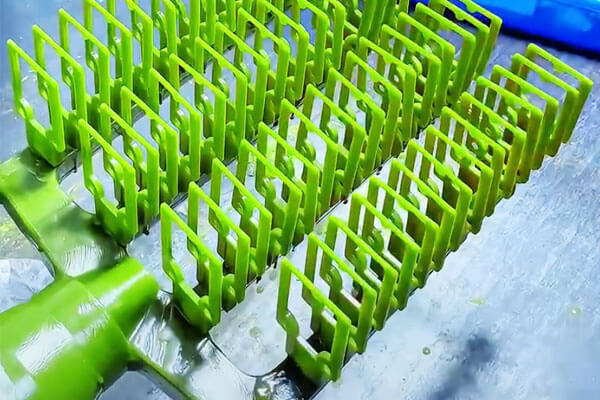
Individual Patrones de cera se ensamblan en un racimo o árbol, lo que mejora la eficiencia de producción y permite que se produzcan múltiples piezas fundidas en un ciclo de molde.
Diseño del grupo
El espacio entre patrones debe ser suficiente para evitar la interferencia de la cáscara durante el recubrimiento y el secado..
El número de piezas por grupo también debe coincidir con la capacidad del horno., ritmo vertiginoso, y comportamiento de solidificación de la aleación..
Diseño de puertas
El sistema de compuerta debe soportar:
- relleno suave,
- baja turbulencia,
- y flujo de metal controlado.
Se prefiere el flujo laminar porque la turbulencia aumenta el riesgo de:
- entretenimiento aéreo,
- plegado de óxido,
- e inclusión de escoria.
Para aleaciones más exigentes, especialmente aceros de alta aleación y superaleaciones, Se utilizan comúnmente disposiciones de compuerta inferior o de corredor escalonado..
Se pueden agregar trampas de escoria o extensiones de canal para interceptar las impurezas flotantes antes de que ingresen a la cavidad..
Diseño de contrahuella
Los elevadores están ubicados en puntos calientes y zonas de última solidificación para proporcionar alimentación de metal durante la solidificación.. Esto es esencial para prevenir:
- cavidades de contracción,
- microporosidad,
- y contracción de la línea central.
Para aleaciones con un amplio rango de congelación, Es posible que se requieran múltiples elevadores auxiliares para mantener un buen comportamiento de alimentación..
3.3 Fabricación de carcasas de cerámica (Proceso central de fundición a la cera perdida)
La fabricación de conchas cerámicas es el procedimiento más laborioso y técnicamente más exigente.
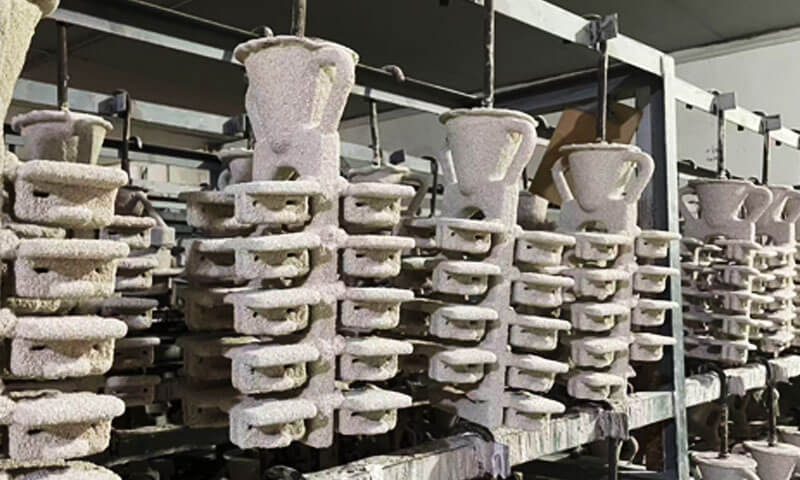
La cáscara se forma mediante recubrimientos repetidos de lechada refractaria y estuco de arena seca., dividido en capa facial, capa de transición y capa de respaldo con materiales refractarios y funciones diferenciadas.
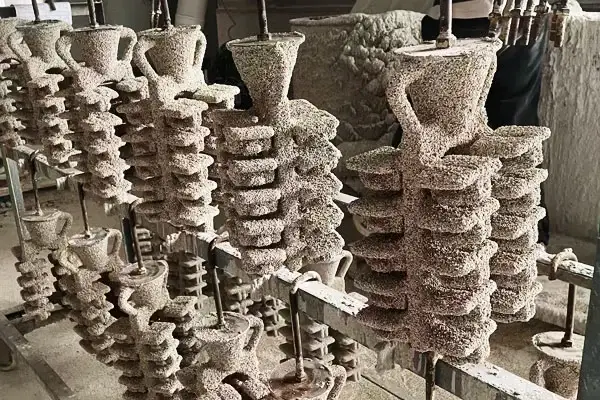
Estructura en capas y combinación de materiales.
- capa de cara (capa superficial): Contacta directamente con metal fundido a alta temperatura., que requieren refractariedad ultra alta e inercia química.
Para acero inoxidable de alta calidad y superaleaciones, Se adoptan harina de circón de alta pureza y arena de circón.; para acero al carbono en general, La alúmina fundida se utiliza comúnmente..
Esta capa evita la penetración del metal., Pegado de arena y reacción química entre el metal fundido y el refractario.. - abrigo de transición: Mejora la fuerza de unión entre la capa frontal y la capa de respaldo para evitar la delaminación de la cáscara durante la cocción y el vertido..
- capa de respaldo (capa trasera): Utiliza arena de cuarzo y agregados de mullita de bajo costo para mejorar la resistencia estructural general de la carcasa y reducir el costo integral del material..
control de secado:
Cada capa recubierta debe someterse a un secado natural completo a temperatura constante. (22~26°C) y humedad constante (55%~65 % de humedad relativa).
Un secado insuficiente deja agua libre residual dentro de la cáscara, que se convierte en una fuente de hidrógeno y causa porosidad estenopeica en las piezas fundidas..
El número total de capas de concha oscila entre 8 a 12; Las piezas fundidas grandes de paredes gruesas requieren más de 12 capas para mayor resistencia.
Diferenciación de aglutinantes:
El tipo de aglutinante determina la refractariedad de la cáscara., Contenido de impurezas y rendimiento general., que también es la base para clasificar las principales rutas técnicas de fundición a la cera perdida.
3.4 Rocío
La desparafinación elimina el material del patrón de la carcasa de cerámica y crea la cavidad hueca que luego se llenará con metal fundido..
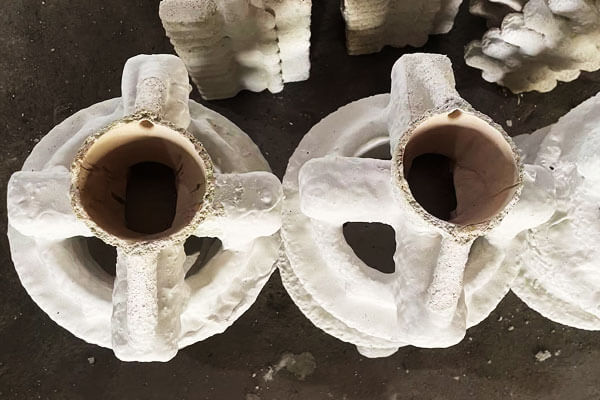
Método industrial estándar
El método industrial preferido es desparafinado con vapor a alta presión. Esto se usa ampliamente porque elimina la cera rápidamente y reduce el riesgo de dañar la cáscara..
control de procesos
La desparafinación con vapor debe controlarse cuidadosamente para que:
- la cera se derrite por completo,
- la cáscara no se agrieta por el choque térmico,
- y no quedan residuos dentro de la cavidad.
Cualquier resto de cera es un problema grave porque puede descomponerse durante la cocción posterior y producir contaminación por carbón., evolución de gas, o defectos superficiales en la pieza final.
Recuperación de materiales
La cera recuperada generalmente se recoge, filtrado, y reciclado, que mejora la economía del proceso y apoya la reutilización de materiales.
3.5 Cocción de proyectiles y precalentamiento previo al vertido
La carcasa de cerámica hueca necesita cocción segmentada a alta temperatura para eliminar completamente los residuos orgánicos., sinterizar partículas refractarias y estabilizar la estructura de la carcasa; El precalentamiento se realiza antes del vertido para adaptarse a la temperatura del metal fundido..
Cocción segmentada
El disparo de proyectiles suele realizarse por etapas.:
- Etapa de baja temperatura: Elimina residuos orgánicos y restos de cera.
- Etapa de temperatura media: Elimina la humedad adherida y descompone los restos de aglutinante.
- Etapa de alta temperatura: Sinteriza la cubierta refractaria y genera resistencia final.
Este calentamiento por etapas previene el agrietamiento de la carcasa y garantiza que ésta alcance una condición térmica y estructural estable..
Precalentar antes de verter
Luego, la carcasa cocida se precalienta para reducir la diferencia de temperatura entre el molde y el metal fundido.. El precalentamiento ayuda:
- mejorar el llenado,
- Reduzca el riesgo de funcionamiento incorrecto y cierre en frío.,
- minimizar el choque térmico,
- y soportar secciones más delgadas durante el llenado.
El rango exacto de precalentamiento depende de la aleación., espesor de sección, y parte complejidad.
3.6 Fusión, Control de atmósfera, y vertiendo
Esta es la etapa donde se decide la pureza metalúrgica y el llenado del molde..
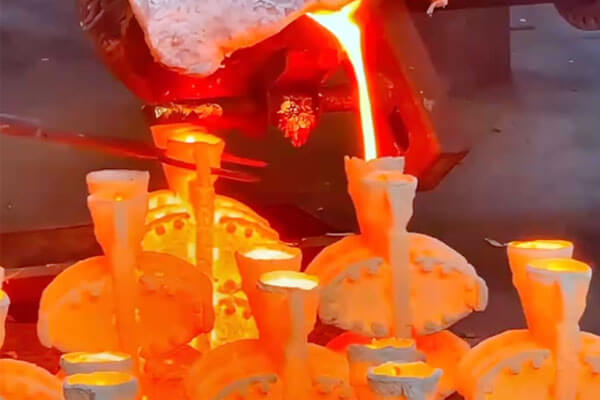
Equipo de fusión
El método de fusión debe coincidir con la familia de aleaciones.:
- Horno de inducción de media frecuencia para fundiciones industriales en general
- Fusión por inducción al vacío (EMPUJE) para aleaciones de níquel, aleaciones de titanio, y aceros inoxidables de alta pureza
Control de atmósfera
Los requisitos atmosféricos dependen de la aleación.:
- Los aceros al carbono ordinarios pueden fundirse en sistemas basados en aire.,
- Los aceros inoxidables y las aleaciones de cobre a menudo requieren protección con nitrógeno o argón.,
- y las aleaciones reactivas o de alto rendimiento requieren vacío o atmósferas altamente controladas.
Control de temperatura de vertido
La temperatura de vertido es una de las variables más sensibles en la fundición a la cera perdida.. Si es demasiado alto, Aumento del riesgo de segregación y microporosidad..
Si es demasiado bajo, la fluidez cae y es probable que se produzca un mal funcionamiento o un cierre en frío.
El sobrecalentamiento debe coincidir con la química de la aleación., fluidez, y comportamiento de solidificación.
Modo de vertido
El vertido por gravedad es el método más común.. El vertido asistido por vacío se puede utilizar para piezas ultrafinas o muy complejas..
Independientemente del método, El flujo debe permanecer estable y lo más laminar posible..
3.7 Enfriamiento, Sacudida, y Limpieza Primaria
Después de verter, El metal debe solidificarse y enfriarse en condiciones controladas..
Régimen de enfriamiento
Las piezas fundidas dentro de la carcasa de cerámica adoptan un enfriamiento lento natural..
Para aleaciones propensas al agrietamiento térmico (como acero inoxidable de alta aleación y superaleaciones), Se prohíbe el enfriamiento rápido forzado para liberar gradualmente el estrés de solidificación..
Eliminación de concha
Una vez que la fundición alcance la temperatura ambiente., la cubierta de cerámica se retira:
- vibración mecánica,
- agua a alta presion,
- o métodos de limpieza abrasivos como el granallado..
El objetivo es eliminar todos los residuos del armazón sin dañar la superficie del molde..
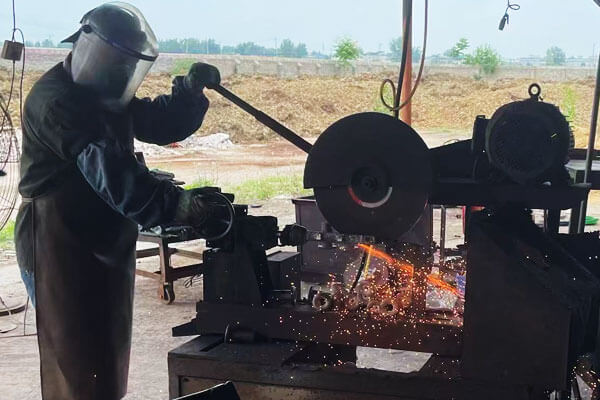
Recorte primario
En esta etapa, la fundición está separada del sistema de corredor y elevador.
Se elimina el exceso de material, y los primeros pasos de pulido o limpieza se realizan en las regiones del conector y los puntos de corte..
3.8 Postprocesamiento y Acabado Final
Después de producir el cuerpo de fundición, Se utilizan operaciones adicionales para cumplir con las dimensiones finales., mecánico, y requisitos de superficie.
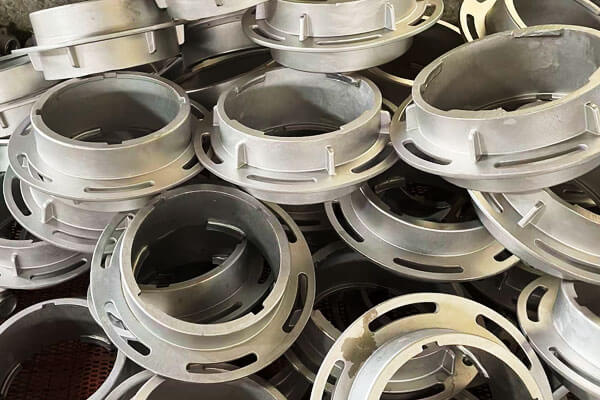
Pasos comunes de posprocesamiento
- Rectificado y desbarbado de precisión
- Tratamiento térmico
- Acabado superficial
- Mecanizado de precisión
- Pruebas no destructivas
- Inspección dimensional final
Tratamiento térmico
La ruta del tratamiento térmico depende de la aleación.:
- El acero al carbono puede requerir normalización., temple, y templado,
- El acero inoxidable puede necesitar recocido por solución.,
- Las aleaciones reforzadas por precipitación pueden requerir solución más envejecimiento..
Este paso es esencial para estabilizar la microestructura y lograr las propiedades mecánicas finales..
Tratamiento superficial
Dependiendo de la aplicación, la parte puede recibir:
- disparo,
- encurtido,
- pasivación,
- Anodizante,
- electro Excripción,
- o revestimiento protector.
Mecanizado de precisión
Superficies críticas como:
- caras de montaje,
- agujeros roscados,
- localizar superficies,
- y áreas de sellado
puede requerir mecanizado adicional con pequeñas tolerancias.
Inspección
El control de calidad final normalmente incluye:
- prueba de penetración,
- prueba radiográfica,
- prueba ultrasónica,
- y medición dimensional.
Sólo se clasifican las piezas que pasan todas las comprobaciones requeridas., empaquetado, y entregado.
4. Clasificación de las principales tecnologías de fundición a la cera perdida
La forma más práctica de clasificar el casting de inversión convencional es mediante el Sistema aglutinante utilizado para construir la carcasa cerámica..
En la práctica industrial actual, Las tres rutas dominantes son fundición a la cera perdida de vidrio soluble, Casting de inversión de Silica Sol, y fundición de inversión compuesta.
Esta clasificación se usa ampliamente porque el aglutinante influye directamente en la resistencia de la cáscara., precisión dimensional, calidad de la superficie, ciclo de fabricación de conchas, y las familias de aleaciones que cada ruta puede soportar.
Casting de inversión en vidrio de agua
Fundición a la cera perdida en vidrio soluble usos silicato de sodio como aglutinante de cáscara.
Las descripciones de la industria lo caracterizan como un proceso con un ciclo de formación de cáscaras relativamente corto y de bajo costo., lo que lo hace atractivo para la producción donde la economía es importante.
Al mismo tiempo, Múltiples fuentes señalan que las conchas de vidrio soluble generalmente dan Menor precisión dimensional y mayor rugosidad superficial. que las cáscaras de sol de sílice.
Por lo tanto, esta ruta se entiende mejor como una método de fundición de precisión orientado a los costes.
Es ampliamente utilizado para acero al carbono., acero de baja aleación, aleación de aluminio, y piezas fundidas de aleaciones de cobre, donde el equilibrio del proceso favorece la productividad y el precio sobre la superficie más alta o el nivel de tolerancia.
Casting de inversión de Silica Sol
Fundición de inversión de sol de sílice usos sílice coloidal Como la carpeta.
Fuentes técnicas la describen consistentemente como la ruta de mayor precisión.: Ofrece mejores tolerancias dimensionales y geométricas., calidad de superficie más suave, y un rendimiento general de la carcasa más fuerte que la fundición de vidrio soluble.
También se asocia con un mayor tiempo de construcción del caparazón y un mayor costo., porque la precisión se logra mediante una fabricación de carcasas más controlada.
Esta ruta es generalmente la opción preferida para acero inoxidable, acero resistente al calor, y piezas fundidas de aleaciones de alto rendimiento, especialmente cuando la pieza necesita detalles finos, calidad superficial confiable, y un control de tolerancia más estricto.
En la práctica, El sol de sílice es la ruta más frecuentemente relacionada con piezas industriales exigentes donde la calidad del proceso debe coincidir con el rendimiento de la aleación..
Fundición de inversión compuesta
La fundición a la cera perdida compuesta es una enfoque híbrido que combina elementos de ambos sistemas aglutinantes para equilibrar la precisión, productividad, y costo.
Fuentes de la fundición describen este tipo de ruta como un práctico punto medio., donde el diseño de la carcasa o la selección del aglutinante se ajustan para que el proceso no sea totalmente costoso como el sol de sílice, pero tampoco tan económico como el descascarado puro de vidrio soluble.
En términos de ingeniería, La ruta compuesta se utiliza cuando la pieza necesita Mejor economía que la fundición completa con sol de sílice. pero también necesita mejor calidad que la fundición de vidrio soluble puro.
La implementación exacta varía según la fundición., porque los sistemas compuestos dependen en gran medida de cómo se aplica la capa facial., abrigo de respaldo, y la química del aglutinante se combinan.
5. Defectos típicos de fundición: Causas fundamentales y medidas correctivas específicas
Fundición a la cera perdida, a pesar de su precisión, es susceptible a varios tipos de defectos. La siguiente tabla resume los defectos comunes., sus orígenes, y acciones correctivas.
| Defecto | Visual / firma de END | Causa principal | Medidas correctivas |
| Porosidad de gas | Redondo, huecos internos de paredes lisas | Gases disueltos (H₂, N₂) en metal fundido; baja desoxidación | Fusión al vacío; desgasificar con gas inerte; práctica adecuada de desoxidación |
| Porosidad de contracción | Dentado, huecos irregulares | Alimentación insuficiente; mal diseño del elevador | Aumentar el tamaño del elevador; agregar escalofríos; Modificar la entrada para promover la solidificación direccional. |
| lágrima caliente | Grieta con irregular, bordes oxidados | Esfuerzo de tracción durante la solidificación tardía.; restricción de molde | Reducir la rigidez de la carcasa; temperatura de vertido más baja; Modificar la composición de aleación |
| Inclusión (escoria, escoria) | Partículas no metálicas irregulares | vertido turbulento; derretimiento sucio; refractario erosionado | Usar carga limpia; filtros cerámicos; vertido de fondo; relleno suave |
Aspereza de la superficie / veteado |
Líneas elevadas o “aletas” en el lance | Agrietamiento de la cáscara durante el llenado; baja resistencia de la cáscara | Aumentar el espesor de la cáscara; mayor contenido de aglutinante; usar refractario más fuerte |
| Egipto / cierre en frio | Llenado incompleto; superficie plegada | Baja temperatura de vertido; mala fluidez; sección delgada | Aumentar la temperatura de vertido; mejorar la entrada; evacuar el moho (colocación de aspiradoras) |
| Cambio de núcleo | Variación del espesor de la pared | Movimiento del núcleo durante la construcción o el vertido de la cáscara. | Mejor soporte central (coronillas); secado más lento de la cáscara; menor presión de vertido |
6. Comparación con la fundición en arena, Fundición, y Forja
Los ingenieros suelen comparar la fundición a la cera perdida con tres rutas de fabricación alternativas.. La siguiente tabla proporciona una compensación cuantitativa..
| Criterio de evaluación | Casting de inversión | Fundición de arena | Fundición (HPDC) | Forja |
| Acabado superficial (Real academia de bellas artes, µm) | 1.6–6.3 | 6.3–25 | 0.8–3.2 | 0.4–3.2 |
| Tolerancia dimensional (mm / 25 mm) | ±0,1–0,3 | ±0,5–1,0 | ±0,1–0,3 | ±0,05–0,2 |
| Apartado práctico mínimo (mm) | 0.5–1.5 | 3–5 | 0.5–1.0 | 1–3 |
| Complejidad geométrica | Muy alto; subvenciones, Detalles finos, características internas | Alto con núcleos, pero precisión limitada | Moderado; capacidad limitada de socavado | Bajo a moderado; mejor para formas más simples |
| Utilización de material | 90–95% | 60–80% | 90–95% | 60–80% |
| Costo de herramientas | Moderado a alto | Bajo a moderado | Alto | Muy alto |
| Costo por pieza en gran volumen | Moderado | Bajo | Muy bajo | Moderado |
| Costo por pieza a bajo volumen | Alto a menos que se amorticen las herramientas | Bajo a moderado | Poco práctico debido a la carga de herramientas | Muy alto |
| Peso máximo típico | Hasta aproximadamente 150 kg para piezas fundidas de acero | Muy grande; encima 10,000 kg posibles | Normalmente sobre 15 kg | Encima 500 kg posibles |
| Gama de aleaciones | Casi todas las aleaciones moldeables. | Casi todas las aleaciones moldeables. | Principalmente aleaciones no ferrosas | Todos los metales, pero limitado por la geometría |
7. Aplicaciones industriales de la fundición a la cera perdida
La fundición a la cera perdida se utiliza en industrias donde complejidad geométrica, calidad de la superficie, rendimiento de la aleación, y repetibilidad importa más que el menor coste de fabricación posible.
Turbinas aeroespaciales y de gas
El sector aeroespacial es una de las áreas de aplicación técnicamente más exigentes para la fundición a la cera perdida.
Componentes como hojas de turbina, bandear, boquillas de combustible, casos de difusor, y otras piezas de sección caliente A menudo requieren una geometría compleja del perfil aerodinámico., paredes delgadas, pasajes internos precisos, y excelente resistencia a altas temperaturas.
Las superaleaciones a base de níquel y las aleaciones a base de cobalto se utilizan ampliamente porque pueden conservar la integridad mecánica en condiciones térmicas y de estrés severas..
Dispositivos médicos e implantes.
Las aplicaciones médicas imponen un conjunto diferente de exigencias al proceso..
Partes como implantes ortopédicos, tallos de cadera, bandejas de rodilla, instrumentos quirúrgicos, y hardware anatómico de precisión requieren biocompatibilidad, calidad de la superficie, precisión dimensional, y rendimiento mecánico confiable.
Los materiales comunes incluyen 316L de acero inoxidable, Aleaciones de Co-Cr-Mo, y aleaciones de titanio como Ti-6al-4V.
Automoción y transporte
En el sector automotriz, La fundición a la cera perdida se utiliza para componentes como ruedas turbocompresor, múltiples de escape, Componentes relacionados con EGR, horquillas de cambio, corchetes, y otro hardware de alto rendimiento.
Estas piezas a menudo requieren un equilibrio de resistencia al calor., control de peso, y complejidad geométrica.
Los aceros inoxidables y los aceros con alto contenido de carbono o aleados se utilizan comúnmente dependiendo del caso de carga térmica y mecánica..
Petróleo y gas, procesamiento químico, y manejo de fluidos
Las industrias química y de petróleo y gas dependen en gran medida de la fundición a la cera perdida para cuerpos de válvula, impulsores de la bomba, carcasas de medidores de flujo, guarniciones, y componentes de flujo resistentes a la corrosión.
Los materiales típicos incluyen Acero inoxidable tipo CF-8M, aceros inoxidables dúplex, y aleaciones resistentes a la corrosión a base de níquel.
Generación de energía y equipos térmicos.
La generación de energía coloca la inversión en algunas de sus condiciones de servicio más severas.
Componentes como revestimientos de combustión, piezas de transición, anillos de boquilla, y otro hardware de gas caliente están expuestos a la oxidación, ciclismo térmico, y flujo de gas a alta temperatura.
Aceros inoxidables como 310 y aleaciones a base de níquel como Incomparar 625 Se utilizan comúnmente debido a su capacidad de temperatura elevada..
10. Conclusión
El casting de inversión es un maduro., tecnología de conformado de metales de precisión, multirramificada y en continua evolución.
Su valor principal radica en romper las limitaciones estructurales de los moldes tradicionales y lograr una formación integrada casi neta de componentes complejos de alto rendimiento..
Las tres principales rutas técnicas basadas en aglutinantes forman un mercado jerárquico claro.: La fundición a la cera perdida de vidrio soluble de bajo costo domina las piezas industriales generales de precisión media.,
mientras que la fundición a la cera perdida con sol de sílice de alta pureza se convierte en el estándar de oro para componentes de precisión de alta gama en el sector aeroespacial., campos de energía médica y de alta gama.
La calidad de las piezas de fundición depende del control preciso de toda la cadena de fabricación de patrones de cera., fabricación de conchas, rocío, disparo, derritiendo y vertiendo.
Cada parámetro de proceso y norma operativa está interconectado, y cualquier negligencia provocará defectos en cascada.
Aunque restringido por el ciclo de producción y el costo en algunos escenarios, sus ventajas únicas en la formación de estructuras complejas, La calidad metalúrgica y la adaptabilidad del material garantizan su estatus insustituible en la fabricación de alta gama..
Impulsado por la fabricación inteligente, producción verde e iteración de nuevos materiales, La fundición a la cera perdida moderna superará aún más los obstáculos técnicos., mejorar la eficiencia de la producción y reducir los costos integrales.
Como tecnología fundamental de fundición de precisión, Continuará apoyando la mejora de la fabricación global de equipos de alta gama y ampliará sus límites de aplicación en industrias emergentes..
Preguntas frecuentes
¿Cuál es la idea principal detrás del casting de inversión??
Un patrón de cera o plástico desechable está rodeado por una carcasa de cerámica., el patrón se elimina, y se vierte metal fundido en la cavidad para crear una pieza con forma casi neta.
¿Por qué se elige la fundición a la cera perdida en lugar de la fundición en arena??
Porque generalmente proporciona detalles más finos., mejor acabado superficial, y tolerancias más estrictas, que reducen el trabajo de acabado.
¿Qué sistema de encuadernación ofrece la mayor precisión??
El sol de sílice se utiliza generalmente para la mayor precisión., piezas de fundición de superficie lisa, mientras que los sistemas de vidrio soluble están más orientados a los costos.
¿Cuáles son los defectos más comunes??
Inclusiones, porosidad, defectos de contracción, mal funcionamiento/cierre en frío, y el agrietamiento de la cáscara se encuentran entre los problemas más comunes de fundición..