

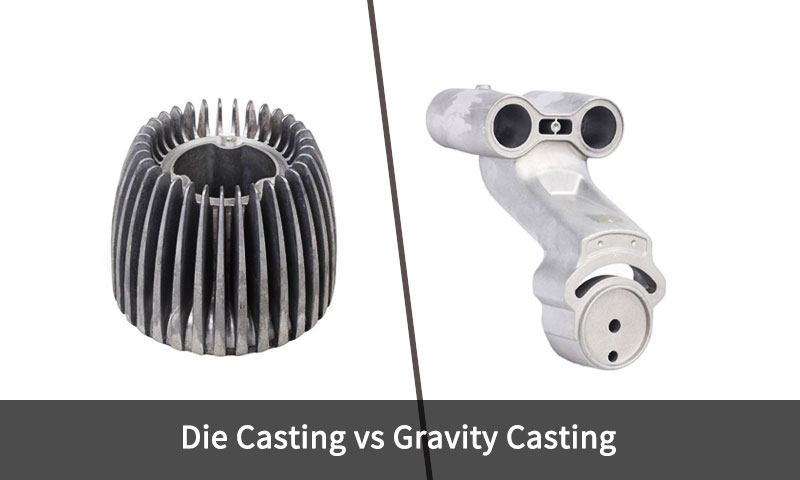
Aluminum casting technology offers multiple manufacturing routes, with die casting vs gravity casting representing two of the most widely adopted methods.
Both processes transform molten aluminum into precise, functional shapes, but they differ significantly in pressure application, mold design, metallurgical outcomes, production speed, and economic suitability.
Die casting typically excels at producing thin-walled, high-volume, and intricately detailed components with excellent surface finish and dimensional consistency.
Gravity casting—whether permanent mold or sand casting—generally produces parts with lower porosity, better heat-treatable microstructures, and improved mechanical performance for structural or pressure-containing applications.
1. What Is Die Casting for Aluminum Components
Die casting is a high-pressure manufacturing process in which molten aluminum—typically heated to 650–700 °C—is injected into a reusable steel mold (die) under intense pressure, generally 10–175 MPa (1,500–25,000 psi).
The applied pressure forces the molten metal into intricate mold cavities, ensuring rapid filling within 0.01–0.5 seconds and highly accurate replication of fine details.
Once the metal solidifies—typically within 5–60 seconds, depending on wall thickness—the die opens, and the part is ejected.
This combination of rapid filling and controlled cooling enables the production of components with tight tolerances, thin walls, and excellent surface finishes.

Process Variants:
- Hot-Chamber Die Casting – Uses a submerged nozzle to inject low-melting alloys (such as zinc or magnesium). Rarely applied to aluminum because aluminum’s high melting point can damage the injection system.
- Cold-Chamber Die Casting – The standard for aluminum. Molten metal is ladled into a separate, unheated injection cylinder before being forced into the die under high pressure.
This protects the machine components from thermal degradation while allowing precise control over shot volume and pressure.
Common Alloys:
Die casting typically uses aluminum alloys formulated for high fluidity, minimal shrinkage, and good mechanical properties. Popular choices include:
- A380 – The most widely used aluminum die-casting alloy, offering excellent combination of strength, corrosion resistance, and dimensional stability.
- A383 – Similar to A380 but with improved corrosion resistance and better flow for complex shapes.
- ADC12 – A Japanese equivalent to A383, with good mechanical properties and superior machinability.
- AlSi9Cu3 – Common in European applications; good wear resistance and high thermal conductivity.
2. What Is Gravity Casting for Aluminum Components
Gravity casting is a metal casting process in which molten aluminum is poured into a permanent mold or sand mold under the force of gravity alone, without external pressure.
The mold is typically preheated to 150–250 °C to ensure proper metal flow and reduce thermal shock.
Filling times are slower than in die casting—often 2–20 seconds—allowing the molten metal to feed naturally into the cavity and solidify under atmospheric pressure.
The slower cooling rate, compared to high-pressure methods, generally produces a denser grain structure with fewer trapped gas pores, which improves mechanical properties and heat treatability.

Process Variants:
- Permanent Mold Gravity Casting – Uses a reusable steel or iron mold; suitable for medium to high production volumes with consistent dimensions and surface finish.
- Sand Gravity Casting – Uses expendable sand molds for larger, complex, or low-volume parts; offers design flexibility but requires secondary machining for accuracy.
- Tilt Pour Gravity Casting – The mold is tilted during pouring to control metal flow and reduce turbulence, minimizing oxidation and gas entrapment.
Common Alloys:
Gravity casting often employs aluminum alloys optimized for strength, ductility, and corrosion resistance, many of which are heat-treatable:
- AlSi7Mg (A356) – Excellent corrosion resistance, high ductility, and ideal for T6 heat treatment; widely used in aerospace and automotive components.
- AlSi9Mg – Good fluidity and mechanical properties; suitable for medium-strength structural applications.
- AlSi12 – High silicon content for excellent wear resistance and fluidity; commonly used for complex geometries.
- AlCu4TiMg (206) – High-strength, heat-treatable alloy for demanding aerospace and military parts.
3. Metallurgical Properties: Die Casting vs. Gravity Casting

Porosity and Density
- Die Casting – High injection pressures can entrap gases (air, hydrogen), creating dispersed porosity levels typically 3–8% by volume, often concentrated near thick sections or surface layers.
While acceptable for many structural uses, this porosity can compromise leak-tightness in hydraulic or pneumatic systems. - Gravity Casting – Slow, pressure-free filling significantly reduces gas entrapment, achieving porosity levels of <2% by volume.
Controlled solidification promotes directional grain growth and higher overall density, making these parts well-suited for pressure-retaining applications such as cylinder heads, engine blocks, and fuel housings.
Mechanical Strength
- Die Casting – Rapid cooling produces a fine-grained microstructure, delivering high as-cast tensile strengths of 200–300 MPa.
However, inherent porosity limits ductility (elongation 2–8%) and impact resistance, making the parts more prone to fatigue cracking in dynamic loads. - Gravity Casting – As-cast tensile strength is generally lower (180–250 MPa), but heat treatments such as T6 can raise tensile strength to ~240 MPa and elongation to 10–12%, surpassing die-cast alloys in overall toughness and fatigue resistance.
Weldability and Machinability
- Die Casting – Common alloys like A380 have high silicon content, which, combined with porosity, reduces weld reliability due to gas expansion during heating.
Machinability is excellent, with tool wear rates 10–15% lower than in gravity-cast components due to the fine, uniform microstructure. - Gravity Casting – Low porosity and suitable alloy choices enable strong, reliable welds—often retaining 80–90% of base metal strength.
Machinability is good but requires sharper cutting tools and optimized feeds to manage coarser grain structures.
4. Geometric Capability & Design Rules

Part Complexity
- Die Casting – Capable of producing highly intricate geometries with wall thicknesses as low as 0.5–6 mm, incorporating fine features such as 0.5 mm ribs or 1 mm holes, as well as complex undercuts.
High injection pressure ensures complete filling of thin and detailed sections, making it the preferred choice for precision components such as valve bodies with internal passages, electronic housings, and intricate brackets. - Gravity Casting – Constrained by slower, pressure-free metal flow, making it challenging to fill thin (<3 mm) or highly complex sections.
Best suited for moderate complexity and thick-walled parts (3–50 mm), such as pump casings, gearbox housings, or engine brackets.
Size Capability
- Die Casting – Limited by press capacity; optimal for components weighing 5 g–10 kg.
Producing very large parts (e.g., 50 kg automotive subframes) becomes economically and technically challenging due to tooling mass and injection force requirements. - Gravity Casting – Well-suited for large, heavy components up to 100 kg or more.
Commonly used for industrial machinery housings, marine propeller hubs, and large structural castings where size outweighs fine-detail requirements.
5. Dimensional Accuracy & Surface Finish

Dimensional Tolerances
- Die Casting – Achieves superior dimensional precision thanks to rigid steel dies, stable thermal conditions, and controlled solidification.
Typical tolerances are ±0.02–0.1 mm per 100 mm, even for complex geometries.
This level of accuracy allows many features (threads, sealing grooves, locating bosses) to be produced net-shape, reducing or eliminating post-machining. - Gravity Casting – Exhibits looser tolerances of ±0.1–0.5 mm per 100 mm, mainly due to sand or permanent mold expansion/contraction during heating and cooling.
Dimensional variation increases with larger, thicker sections. Machining is often required for functional surfaces to meet assembly and sealing requirements.
Surface Finish
- Die Casting – Produces smooth, high-quality surfaces with typical roughness values of Ra 1.6–3.2 μm directly from the mold.
Fine textures, logos, and decorative details can be integrated into the die, making it ideal for visible or cosmetic parts without additional finishing. - Gravity Casting – Surface finish depends heavily on mold type:
-
- Sand mold: Ra 6.3–12.5 μm (requires machining or shot blasting for cosmetic surfaces).
- Permanent mold: Ra 3.2–6.3 μm (better, but still not as smooth as die casting).
Surface porosity is generally lower than in die casting, which can improve coating adhesion for paints and anodizing.
6. Pressure-Tightness & Heat Treatment

Pressure-Tightness
- Die Casting – Due to gas entrapment during high-speed injection, as-cast die-cast aluminum parts often contain micro-porosity (3–8% by volume), which can compromise pressure integrity.
Standard die-cast parts may withstand up to 20–35 bar without leakage, but for higher pressures (e.g., hydraulic manifolds at >100 bar), impregnation with resins is often necessary.
Fully eliminating porosity is challenging without sacrificing cycle time or increasing scrap rates. - Gravity Casting – The slow, laminar filling process greatly reduces gas entrapment, resulting in porosity below 2%.
This makes gravity-cast components inherently more pressure-tight, with many designs capable of withstanding >150 bar in as-cast condition.
This characteristic is critical for engine blocks, cylinder heads, and fuel system components.
Heat Treatment Capability
- Die Casting – High silicon die-casting alloys (e.g., A380, ADC12) generally cannot be fully heat-treated to T6 due to the risk of blistering from trapped gases.
Some low-porosity die castings (using vacuum-assisted dies or squeeze casting) can be treated to T5 for moderate property improvements, but strength gains are limited (~10–15% increase). - Gravity Casting – Compatible with full T6 heat treatment, which involves solution treatment, quenching, and artificial aging.
For example, A356-T6 gravity castings can achieve 240–280 MPa tensile strength and 10–12% elongation, making them suitable for high-stress structural applications.
7. Tooling: Cost, Lifespan, and Flexibility
Tooling Cost and Complexity
- Die Casting Dies: High initial investment is required, typically $50,000–$500,000+ per die, depending on size and complexity.
Dies are precision-machined from hardened tool steel (e.g., H13) and incorporate cooling channels, ejector pins, and complex cavity features.
This high cost is justified primarily for high-volume production due to rapid cycle times and minimal post-machining requirements. - Gravity Casting Molds: Significantly less expensive, generally $10,000–$100,000, as they do not require high-pressure resistance or integrated cooling systems.
Molds are commonly made from cast iron or mild steel, which are easier to machine and modify. This makes gravity casting economically viable for low- to medium-volume production.
Lifespan and Maintenance
- Die Casting Dies: Extremely durable, with 100,000–1,000,000 cycles achievable for aluminum parts.
However, maintaining dimensional accuracy requires regular polishing, replacement of ejector pins, and repair of cooling channels. High wear in thin or intricate sections can increase maintenance frequency. - Gravity Casting Molds: Shorter lifespan, typically 50,000–300,000 cycles, due to thermal fatigue from repeated heating and cooling.
They are, however, easier to repair—damaged areas can often be welded or re-machined—offering greater flexibility for design changes or iterations.
Lead Time for Tooling
- Die Casting Dies: Long lead times of 8–16 weeks due to the precision machining and complex design requirements, making die casting less suitable for rapid prototyping or small production runs.
- Gravity Casting Molds: Faster to produce, usually 4–8 weeks, which allows quicker time-to-market for low- to medium-volume components and facilitates design adjustments before full-scale production.
8. Quality Risks & Controls
Porosity and Shrinkage Defects
- Die Casting: High injection pressure can trap gases and create porosity, particularly near thin walls or corners.
Porosity levels typically range from 3–8% by volume, affecting pressure-tightness and fatigue resistance. Shrinkage cavities can also occur in thick sections if cooling is uneven. - Gravity Casting: Slow, pressure-free filling reduces gas entrapment, resulting in lower porosity (<2%).
However, shrinkage defects may appear in thick sections due to natural solidification, requiring risers and feeders for compensation.
Surface Defects
- Die Casting: Common issues include cold shuts, flow lines, and die soldering, usually caused by improper die temperature, injection speed, or metal temperature.
These defects affect surface finish and dimensional precision. - Gravity Casting: Typical defects are misruns, inclusions, and surface roughness due to incomplete mold filling or poor metal cleanliness.
These can often be corrected by machining or polishing, but critical surfaces may require secondary finishing.
Non-Destructive Testing (NDT) and Controls
- Die Casting: Advanced NDT methods, such as X-ray inspection, ultrasonic testing, and dye penetrant testing, are used to detect internal porosity and surface cracks.
Process controls include die temperature monitoring, metal degassing, and shot pressure optimization. - Gravity Casting: NDT methods like radiography, ultrasonic testing, and pressure testing ensure structural integrity.
Use of chills, risers, and controlled solidification helps minimize shrinkage and internal defects.
Process Controls
- Die Casting: Key parameters include metal temperature (650–700°C), injection speed, holding pressure, and die preheating.
Automated sensors and feedback systems help maintain consistency across large production runs. - Gravity Casting: Control focuses on pouring temperature, mold preheating, and gating design to ensure complete fill and uniform solidification.
Slower cooling rates allow for directional grain growth, improving mechanical integrity.
9. Application of Aluminum Components: Die Casting vs. Gravity Casting
Die Casting Applications
Die casting is ideal for components requiring high precision, complex geometry, and smooth surface finishes.
Its high-pressure injection allows for thin walls, tight tolerances, and intricate features, making it suitable for:

Automotive Industry
- Engine components: valve covers, intake manifolds, brackets
- Transmission housings: lightweight, high-strength, and dimensionally precise
- Electric vehicle parts: battery housings and motor housings
Electronics and Consumer Products
- Smartphone and laptop housings
- Camera bodies
- Heat sinks for electronic devices
Industrial and Hydraulic Components
- Valve bodies, pump housings, hydraulic manifolds
- Pneumatic and fluid control systems
Gravity Casting Applications
Gravity casting is better suited for large, thick-walled, and structurally demanding components.
It’s slow, pressure-free filling produces low porosity, dense microstructures, and reliable mechanical performance, ideal for:

Automotive and Heavy Machinery
- Engine blocks and cylinder heads
- Transmission housings for trucks and construction vehicles
- Pump housings and gearbox cases
Aerospace and Marine Applications
- Aircraft structural components
- Marine propeller hubs and casings
Energy and Industrial Equipment
- Hydraulic and pneumatic cylinder housings
- Industrial machinery frames and structural supports
10. Selection Matrix: Die Casting vs. Gravity Casting
| Criteria | Die Casting | Gravity Casting | Notes / Guidance |
| Part Size & Weight | Small to medium (5 g – 10 kg) | Medium to large (10–100+ kg) | Choose gravity casting for heavy or oversized parts |
| Wall Thickness | Thin (0.5–6 mm) | Thick (3–50 mm) | Die casting excels at thin, intricate features |
| Complexity | High, intricate shapes, undercuts | Moderate, simpler shapes | High-detail parts favor die casting |
| Dimensional Accuracy | ±0.02–0.1 mm | ±0.1–0.5 mm | Tight tolerance parts require die casting |
| Surface Finish | Ra 0.8–3.2 μm | Ra 3.2–12.5 μm | Die casting reduces post-machining cost |
| Mechanical Strength (As-Cast) | 200–300 MPa | 180–250 MPa (can reach 240 MPa after T6) | Gravity-cast parts offer better toughness after heat treatment |
| Porosity | 3–8% | <2% | Low porosity critical for pressure-tight components |
Production Volume |
High (mass production) | Low to medium | High tooling cost favors large volumes |
| Tooling Cost | $50,000–$500,000+ | $10,000–$100,000 | Die casting amortized over high-volume production |
| Lead Time for Tooling | 8–16 weeks | 4–8 weeks | Gravity casting enables faster prototyping |
| Cost Break-Even Example | ~5,000–10,000 parts | <5,000 parts | Based on tooling amortization and cycle time; volumes below break-even favor gravity casting |
| Application Fit | Electronics, automotive brackets, hydraulic manifolds | Engine blocks, pump housings, industrial machinery | Select based on size, complexity, and production volume |
11. Conclusion
Die casting vs gravity casting are complementary processes, each excelling in specific scenarios.
Die casting dominates high-volume, intricate applications where tight tolerances and low per-part costs are critical, despite higher porosity.
Gravity casting is superior for low-to-medium volumes, thick-walled components, and applications demanding pressure-tightness, weldability, or heat treatability.
By aligning process capabilities with part requirements—volume, complexity, mechanical needs, and budget—manufacturers can optimize performance and cost.
FAQs
What is the main difference between die casting vs gravity casting?
Die casting uses high-pressure injection to fill a steel mold, producing precise, thin-walled, complex parts.
Gravity casting relies on the natural flow of molten aluminum into a mold, producing thicker, larger, and structurally robust components with lower tooling cost.
Can die-cast aluminum components be heat-treated?
Yes, die-cast aluminum can undergo T5 or T6 heat treatment to improve strength.
Gravity-cast components generally respond better to heat treatment due to lower porosity and coarser microstructure.
Which process allows for more complex geometries?
Die casting excels at complex geometries, including thin walls, fine ribs, and intricate undercuts. Gravity casting is better suited for moderately complex, thick-walled structural parts.
Which process is more suitable for welding?
Gravity-cast aluminum is more suitable for welding because of its lower porosity and higher ductility.
Die-cast parts, especially those with high silicon content, are more prone to cracking and require careful welding procedures.
Can both processes be used for large aluminum components?
Gravity casting handles large components (up to 100 kg or more) effectively.
Die casting is generally limited to smaller components (typically under 10 kg) due to machine and die constraints.

