1. Introduction
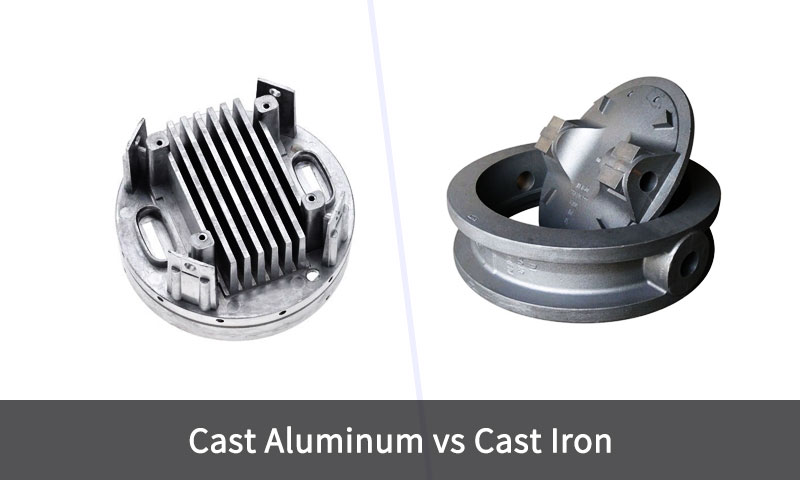
Cast aluminum and cast iron are two of the most widely used casting materials in industry.
Both offer routes to produce complex net-shape components, but they differ fundamentally in density, stiffness, strength modes, thermal behavior, casting methods, corrosion resistance and lifecycle cost.
Selecting between them is a trade-off among weight, stiffness, wear resistance, machinability, cost and operating environment.
This article compares the two across technical axes and provides actionable data and selection guidance.
2. What is cast aluminum?
Cast aluminum refers to components produced by pouring molten aluminum (or aluminum alloy) into a mould and letting it solidify into the final or near-final geometry.
Because aluminum has a relatively low melting point, good fluidity in alloyed form, and a low density, cast aluminum is a preferred choice where complex geometry, light weight, thermal conductivity or corrosion resistance are important.
Casting routes for aluminum include high-pressure die casting, low-pressure and gravity permanent-mold casting, sand casting, and investment (lost-wax) casting; each route gives different limits on wall thickness, surface finish, dimensional accuracy and mechanical properties.

Features
- Lightweight: density ≈ 2.6–2.8 g/cm³ (typically 2.70 g/cm³).
- Low elastic modulus: Young’s modulus ≈ 69–72 GPa (≈ 69 GPa typical).
- Good thermal conductivity: alloys vary but often 100–200 W·m⁻¹·K⁻¹; pure aluminium is ~237 W·m⁻¹·K⁻¹.
- Good corrosion resistance: forms a stable oxide film; behaviour improved with anodizing or coatings.
- Ductile fracture behavior: many cast Al alloys are reasonably ductile (depending on alloy and heat treatment).
- Easily machined: comparatively low cutting forces and good machinability for many alloys.
- Recyclable: aluminium is highly recyclable with relatively low energy to remelt versus primary production.
Common aluminum alloys (typical cast families)
| Alloy family (typical name) | Representative grades / trade names | Key alloying elements (wt%) | Heat-treatable? | Typical applications |
| Al–Si (general-purpose) | A356 / AlSi7 | Si ≈ 6–8; Mg ≈ 0.2–0.5 | Often (T6 available) | Structural housings, pump bodies, general automotive castings |
| Al–Si–Mg (structural, heat-treatable) | A356-T6, A357 | Si ≈ 6–7; Mg ≈ 0.3–0.6 | Yes (T5/T6) | Suspension components, wheels, transmission housings |
| Die-casting Al–Si–Cu / Al–Si | A380, ADC12, A383 | Si ≈ 8–13; Cu ≈ 1–4; Fe controlled | Limited (mostly as-cast or semi-aged) | Thin-wall housings, connectors, consumer enclosures |
Al–Si–Cu (engine & elevated-T alloys) |
Alloy 319 | Si ~6–8; Cu ~3–4; Mg small | Yes (solution + aging) | Cylinder heads, pistons (with liners), engine hardware |
| High-Si / hypereutectic alloys | Al–Si (10–20% Si) | Si 10–20; minor Mg/Cu | Somewhat (limited) | Pistons, wear surfaces, low-expansion components |
| Al–Si–Sn / bearing alloys | Al–Si–Sn bearing variants | Si moderate; Sn (±Pb) as solid lubricants | Typically no (soft as-cast) | Plain bearings, bushings, sliding surfaces |
| Specialty high-strength cast Al | Al–Zn–Mg variants (limited cast use) | Zn, Mg, small Cu additions | Yes (age-hardenable) | High-strength structural parts (niche/aerospace) |
3. What is cast iron?
Cast iron is a family of iron-carbon alloys produced by pouring molten metal into molds and allowing it to solidify.
What distinguishes cast irons from steels is their relatively high carbon content (typically >2.0 wt% C) and the presence of graphitic carbon in the as-cast microstructure.
The carbon commonly occurs as graphite (in several morphologies) or as iron carbide (cementite) depending on alloy chemistry and solidification conditions.
That graphite — and the matrix that surrounds it — controls the mechanical behavior, machinability and application space of the various cast-iron types.
Cast irons are the workhorses of heavy, wear-resistant and vibration-sensitive applications because they are economical to cast in large or complex shapes, offer excellent damping, and can be tailored through chemistry and post-casting heat treatment (e.g., austempering) to a wide range of properties.

Key features
- Graphite morphology controls properties. The shape, size and distribution of graphite (flake, spheroidal, compacted) dominate tensile ductility, toughness, stiffness and machinability:
-
- Flaky (gray) graphite produces good machinability and damping but lower tensile strength and notch sensitivity.
- Spheroidal (nodular/ductile) graphite yields much higher tensile strength and ductility.
- Compacted graphite (CGI) is intermediate — better strength and thermal fatigue resistance than gray iron while retaining good damping.
- Excellent vibration damping. Graphite nodules/flakes interrupt elastic wave propagation, so cast irons are preferred for machine-tool frames, engine blocks and housings where damping suppresses noise and vibration.
- Good compressive strength and wear resistance. Especially in pearlitic and white irons; suitable for heavy-duty bearings, rollers and wear parts.
- Relatively brittle in tension (some grades). Gray iron is notch sensitive and shows low elongation; ductile iron improves toughness significantly but still behaves differently from steels.
- Economical for large/complex castings. Sand casting and shell molding are well established; shrinkage, feeding and directional solidification are managed with standard foundry techniques.
- Wide design envelope via post-solidification treatment. Through heat treatments (normalizing, anneal, austempering) and alloying (Ni, Cr, Mo),
cast irons can be tailored from very hard wear grades to tough structural grades (e.g., ADI—Austempered Ductile Iron). - Good thermal stability in many grades. Some cast irons preserve dimensional stability and strength at elevated temperatures better than aluminum alloys.
Common cast-iron types
Below is a practical summary of the major cast-iron families, typical chemistry trends, microstructure and representative properties / applications.
| Type | Typical composition (approx. wt%) | Key microstructure feature | Representative mechanical behavior | Typical applications |
| Gray cast iron (GJL / Classed per ASTM A48) | C ~3.0–3.8; Si ~1.5–3.0; Mn ≤0.5; S & P controlled | Graphite flakes in ferrite/pearlite matrix | Tensile strength broadly ~150–350 MPa (varies by class); low elongation (<1–3%); excellent damping; moderate hardness | Engine blocks, brake drums, pump housings, machine bases |
| Ductile (nodular) iron (GJS / ASTM A536) | C ~3.2–3.8; Si ~1.8–2.8; Mg ~0.03–0.06 (nodularizing), trace Ce/RE | Spheroidal graphite nodules in ferrite/pearlite | High tensile strength and ductility; common grades like 60–40–18 (60 ksi UTS ≈ 414 MPa, 40 ksi YS ≈ 276 MPa, 18% elongation) | Gear housings, crankshafts, safety-critical structural castings |
| Compacted graphite iron (CGI) (GJV) | C ~3.2–3.6; Si ~1.8–2.6; trace Mg/RE | Compact (vermicular) graphite — intermediate between flakes and spheroids | Better tensile strength and thermal fatigue resistance than gray iron, with good damping; UTS in intermediate range | Diesel engine blocks, exhaust components, heavy-duty cylinder blocks |
| White iron | C ~2.6–3.6; Si low (<1.0); high cooling rates | Cementite / ledeburite (carbide) — essentially no graphite | Very high hardness (often HB several hundred), excellent abrasive wear resistance; low toughness | Crushers, wear plates, shot-blast liners, severe abrasion environments |
Malleable iron |
Initially white iron composition; heat-treated | Cast as white iron then annealed to temper carbon into irregular aggregates (temper carbon) | Combines improved ductility/toughness vs. gray iron; moderate strength | Small castings requiring ductility (fittings, brackets) |
| Austempered Ductile Iron (ADI) | Ductile iron base + controlled austempering heat treatment | Spheroidal graphite in ausferritic matrix (bainitic ferrite + stabilized austenite) | Exceptional strength-to-ductility ratio: UTS from ~600 to >1000 MPa with useful elongation (3–10% depending on grade); excellent fatigue resistance | High-performance drivetrain, suspension components, heavy machinery |
| Alloyed cast irons (e.g., Ni-resist, high-Cr irons) | Base with significant Ni, Cr, Mo additions | Matrix tailored to resist heat/corrosion; graphite may be present or suppressed | Specialized corrosion/oxidation resistance, or high-temperature strength | Pump components for corrosive fluids, valve bodies, high-temp wear parts |
4. Mechanical Properties Comparison
Numbers are presented as practical, foundry-level typical ranges (not guaranteed minima/maxima) because actual values depend strongly on exact chemistry, casting route, section size, and heat treatment.
Typical mechanical property ranges — representative cast aluminum vs cast iron grades
| Material / Grade (typical designation) | Density (g·cm⁻³) | Young’s modulus (GPa) | Tensile strength, UTS (MPa) | Yield strength (MPa) | Elongation (A, %) | Hardness (Brinell, HB) | Typical applications |
| A356-T6 (Al–Si–Mg, heat-treated cast aluminum) | 2.68–2.72 | 68–72 | 200 – 320 | 150 – 260 | 5 – 12 | 60 – 110 | Structural housings, wheel hubs, transmission housings |
| A380 / ADC12 (common die-casting Al–Si family, as-cast) | 2.70–2.78 | 68–72 | 160 – 280 | 100 – 220 | 1 – 6 | 70 – 130 | Thin-wall housings, consumer parts, connectors (die casting) |
| Hypereutectic Al–Si (piston / low-expansion alloys) | 2.70–2.78 | 68–72 | 150 – 260 | 100 – 220 | 1 – 6 | 80 – 140 | Pistons, sliding components, low-expansion parts |
| Gray cast iron (typical ASTM A48 Class 30) | 6.9–7.3 | 100–140 | ≈207 (≈30 ksi) | — (no distinct yield) | <1 – 3 | 140 – 260 | Engine blocks, machine frames, brake drums |
| Gray cast iron (ASTM A48 Class 40) | 6.9–7.3 | 100–140 | ≈276 (≈40 ksi) | — | <1 – 3 | 160 – 260 | Heavier duty housings, pump bodies |
| Ductile (nodular) iron — 60–40–18 (ASTM A536) | 7.0–7.3 | 160–180 | ≈414 (60 ksi) | ≈276 (40 ksi) | ~18 | 160 – 260 | Gear housings, crank components, structural castings |
| Compacted Graphite Iron (CGI) (typical range) | 7.0–7.3 | 140–170 | 350 – 500 | 200 – 380 | 2 – 8 | 180 – 300 | Diesel engine blocks, exhaust components (high thermal fatigue resistance) |
| White / high-Cr wear iron (wear grades) | 7.0–7.3 | 160–200 | low tensile / brittle | — | <1 – 2 | >300 – 700 | Crushers, wear liners, shot-blast components |
5. Thermal and Casting Process Considerations
Melting and solidification behavior
- Melting point / liquidus: aluminium alloys melt in the ~550–650 °C range (pure aluminium 660.3 °C).
Cast iron solidifies at higher temperatures (~1150–1250 °C depending on composition) and forms graphite or cementite based on composition and cooling rate. - Thermal conductivity: aluminum alloys typically conduct heat significantly better than cast iron (often 2–4× higher), which affects mold cooling, solidification speed and chill behavior.
- Solidification shrinkage: typical linear shrinkage for aluminum alloys ~1.3–1.6%; gray cast iron shrinkage is smaller (~0.5–1.0%), though micro- and macro-shrinkage depend on section thickness and feeding.
Casting methods & typical use
- Cast aluminum: commonly produced by die casting (high-pressure), permanent mold, low-pressure, and sand casting.
Die casting yields excellent surface finish and thin-wall capability; sand casting handles large, heavy, or complex parts with lower tooling cost. - Cast iron: typically sand casting (green-sand, shell) and lost-foam/shell for complex shapes.
Ductile iron castings are commonly sand-cast. Cast iron tolerates large sections and heavy castings well.
Dimensional tolerances & surface finish
- Die-cast aluminum: best dimensional capability of cast routes — typical tolerances in the range ±0.1–0.5 mm for many dimensions (depends on size), surface finish Ra often 0.8–3.2 µm as-cast.
- Permanent-mold aluminum: tolerances ±0.25–1.0 mm, surface finish better than sand casting.
- Sand-cast iron: coarser tolerances, typically ±0.5–3.0 mm depending on size and finish; surface finish rougher, Ra often 6–25 µm as-cast unless machined.
- Wall thickness capability: die-cast aluminum can produce thin walls (<2 mm) economically;
cast iron typically requires thicker sections to avoid defects and to feed shrinkage, though modern molding can achieve moderate thin sections for small parts.
Machinability and secondary operations
- Aluminum machines easily at higher speeds and lower forces; tooling life is good; machining allowances are modest for die-cast parts.
- Cast iron machines differently — gray iron is relatively easy to machine due to graphite acting as chip breaker and lubricant;
ductile iron is harder and requires different tooling; cast iron cutting often results in brittle chips and requires appropriate tool grades.
6. Corrosion Resistance and Operating Environments
- Cast aluminum: naturally corrosion-resistant due to stable oxide film; performs well in atmospheric, mildly corrosive and marine environments if appropriate alloy/coating is chosen.
Anodizing and paint systems further improve surface durability and appearance. - Cast iron: ferrous material prone to rust (oxidation) in wet environments; requires protective coatings (paints, plating), cathodic protection or alloying for corrosion resistance.
In some applications (engine blocks), cast iron performs acceptably because of oil protection and controlled environments. - High-temperature performance: cast iron (especially gray and ductile) retains strength at elevated temperatures better than aluminum.
Aluminum’s strength drops rapidly as temperature increases above ~150–200 °C, limiting its use in hot-engine or exhaust-exposed components unless special alloys or cooling are used.
7. Advantages of Cast Aluminum vs Cast Iron
Cast aluminum advantages
- Weight savings: ~62.5% lighter for equivalent volume than cast iron — critical in transportation for fuel economy.
- High thermal conductivity: better heat dissipation (helpful for heat exchangers, cylinder heads in automotive after appropriate design).
- Good corrosion resistance as-cast; optionally anodizable for enhanced protection and aesthetics.
- Thin-wall and complex thin-feature capability (especially die casting) — enables consolidated parts and cost savings upstream.
- Favorable recyclability and lower mass-related shipping costs.
Cast iron advantages
- Higher stiffness and damping: good for structures requiring rigidity and vibration control (machine tool bases, pump housings).
- Superior wear resistance and tribological properties: pearlitic and white irons excel in abrasive/wear environments.
- Higher compressive strength and thermal stability at elevated temperatures — used for heavy-duty engine blocks, cylinder liners, and brake rotors.
- Typically lower raw material cost per kg and robust casting behavior for very large sections.
8. Limitations of Cast Aluminum vs Cast Iron
Cast aluminum limitations
- Lower stiffness: requires larger cross-sections or ribs to achieve equivalent stiffness — can reduce some weight advantages.
- Lower high-temperature strength: aluminum loses yield strength at elevated temperatures faster than iron.
- Less wear resistance: plain cast aluminum is softer; requires surface treatments (hard anodize, coatings) for wear-critical surfaces.
- Porosity and gas-related defects: aluminium is prone to gas porosity and shrinkage defects if melt and casting practice are not controlled.
Cast iron limitations
- Heavy: higher density increases part mass — negative for weight-sensitive applications.
- Brittle tensile behavior: gray iron shows low tensile ductility and is prone to brittle fracture under impact; design must account for notch sensitivity.
- Corrodes if unprotected: requires coatings or corrosion management.
- Lower thermal conductivity than Al (slower heat dissipation); may require cooling design adjustments.
9. Cast Aluminum vs Cast Iron: Differences Comparison
| Attribute | Cast Aluminum (e.g., A356-T6, A380) | Cast Iron (gray, ductile) | Practical implication |
| Density | ~2.6–2.8 g·cm⁻³ | ~6.8–7.3 g·cm⁻³ | Aluminum is ~60–63% lighter — huge benefit for weight-sensitive designs. |
| Elastic modulus (E) | ≈ 69–72 GPa | ≈ 100–170 GPa | Iron is 1.5–2.5× stiffer; aluminum needs more material/ ribs to match stiffness. |
| Tensile strength (typical) | A356-T6: ~200–320 MPa; A380: ~160–280 MPa | Gray: ~150–300 MPa; Ductile: ~350–700 MPa | Ductile iron outperforms Al in strength and ductility; some Al alloys approach lower-end iron strengths. |
| Yield strength | ~150–260 MPa (A356-T6) | Gray: no clear yield; ductile: ~200–300 MPa | Use ductile iron when distinct yield behavior and higher static strength needed. |
| Elongation (ductility) | ~5–12% (A356-T6) or 1–6% (die-cast) | Gray: <1–3%; Ductile: ~10–20% | Ductile iron and heat-treated Al offer good ductility; gray iron is brittle in tension. |
| Hardness / wear | HB ≈ 60–130 (alloy dependent) | HB ≈ 140–260 (gray); >300 (white/pearlitic) | Iron, especially pearlitic/white grades, best for abrasive wear. Aluminum requires coatings/inserts for wear. |
| Thermal conductivity | ~80–180 W·m⁻¹·K⁻¹ (alloy dependent) | ~30–60 W·m⁻¹·K⁻¹ | Aluminum preferred for heat-dissipation parts (heat sinks, housings). |
| Thermal stability / high-T strength | Strength drops quickly above ~150–200 °C | Better high-temperature strength retention | Use iron for elevated-temperature load bearing. |
| Damping / vibration | Moderate | Excellent (especially gray iron) | Iron preferred for machine frames, bases and components where vibration damping matters. |
| Castability / thin-wall capability | Excellent (die casting; thin walls <2 mm possible) | Limited — better for thicker sections | Aluminum enables consolidated, lightweight thin-walled parts; iron better for heavy sections. |
Surface finish & tolerances (as-cast) |
Die cast: fine finish, tight tolerances | Sand cast: rougher, wider tolerances | Die casting lowers post-machining; sand cast iron often requires more machining. |
| Machinability | Easy, high removal rates; low tool wear | Gray iron machines well (graphite aids chip formation); ductile iron harder on tools | Aluminum reduces machining cycle times; iron may need tougher tooling but gray irons cut cleanly. |
| Corrosion resistance | Good (protective oxide); further improved by anodize/coatings | Poor in wet/chloride environments without protection | Aluminum often needs less corrosion protection; iron must be painted/plated or alloyed. |
| Recyclability | Excellent; remelting energy lower per kg than primary | Excellent; highly recyclable | Both have strong scrap value; aluminum energy savings per kg large vs primary production. |
| Typical cost considerations | Higher $/kg but lower mass may reduce system cost; die-casting tooling high | Lower $/kg; sand casting tooling low for low volumes | Select based on part mass, volume and required finishing. |
| Typical applications | Automotive housings, heat sinks, lightweight structural parts | Engine blocks, machine bases, wear parts, heavy housings | Match material to functional priorities — weight vs stiffness/wear. |
Selection guidance (practical rules of thumb)
- Choose cast aluminum when: mass reduction, thermal dissipation, corrosion resistance and thin-wall feature consolidation are primary drivers (e.g., automotive body components, heat sinks, lightweight housings).
Use aluminum die casting for high volumes and thin-walled, feature-rich parts; use A356-T6 when higher structural performance and post-heat treatment are required. - Choose cast iron when: stiffness, damping, wear resistance or elevated service temperatures are paramount (e.g., machine tool bases, brake components, heavy duty housings, abrasive wear liners).
Select ductile iron for structural parts that require toughness and some tensile ductility.
Use gray iron when damping and machinability (for heavy machining operations) are important and tensile ductility is less critical. - When in doubt, evaluate system-level tradeoffs: a heavier iron part may be cheaper per kg but increase downstream costs (fuel consumption, handling, installation);
conversely, aluminum can reduce system mass but may require larger sections or inserts to achieve stiffness/wear life targets — run a part-level mass, stiffness and cost comparison.
10. Conclusion
Cast aluminum vs cast iron are complementary materials, each excelling in scenarios where their unique properties align with application requirements.
Aluminum castings dominates lightweight, high-efficiency sectors (automotive EVs, aerospace, consumer electronics) thanks to its strength-to-weight ratio, thermal conductivity, and complex castability. </span>
Cast iron remains irreplaceable in heavy-duty, cost-sensitive applications (machine tools, construction pipes, traditional engines) due to its wear resistance, vibration damping, and low cost.</span>
FAQs
How much lighter is a cast aluminum part than the same volume cast iron part?
Typical densities: aluminum ~2.7 g/cm³ vs cast iron ~7.2 g/cm³. For equal component volume, aluminum is about 62.5% lighter (i.e., same-volume aluminum mass = 37.5% of cast iron mass).
Can aluminum replace cast iron in engine blocks?
Aluminum is used extensively for modern engine blocks and cylinder heads to save weight.
Replacing iron requires careful design for stiffness, thermal expansion, cylinder liner strategies (e.g., cast-in liners, iron sleeves) and attention to fatigue and wear.
For high-load or high-temperature applications, cast iron or special aluminum alloys/designs may be preferred.
Which is cheaper: cast aluminum or cast iron?
On a per-kilogram basis, iron tends to be cheaper; on a per-part basis the answer depends on volume, tooling (die-casting dies are expensive), machining time, and the weight-driven system costs (e.g., fuel consumption in vehicles).
For high volumes, die-cast aluminum may be economical despite higher material cost.
Which material resists wear better?
Cast iron (particularly pearlitic or white iron) generally exhibits superior wear resistance compared with as-cast aluminum.
Aluminum can be surface-treated or coated for wear applications but rarely matches hardened iron without added processes.
Does cast aluminum rust?
Aluminum does not rust like iron; it forms an oxide layer that protects it from further corrosion. Under some conditions (chloride exposure, galvanic coupling) aluminum can corrode and may require coatings or cathodic protection.