1. Introduction
Cookware makers and home cooks choose materials for a mix of thermal performance, weight, durability, cost, and food safety.
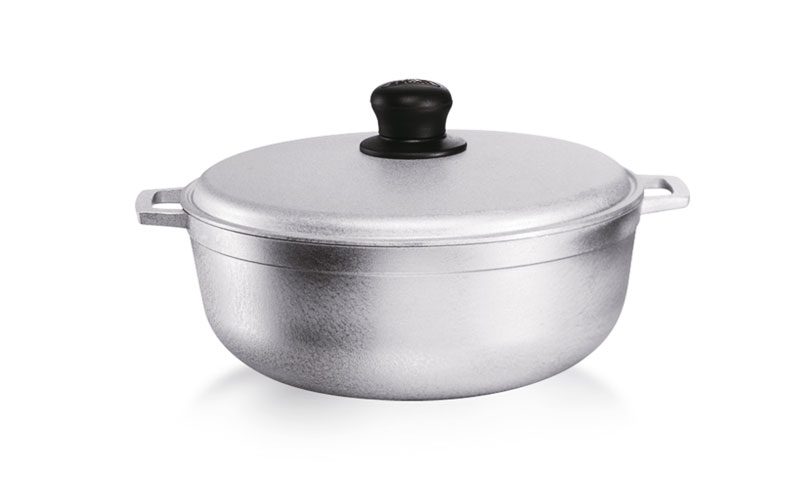
Cast aluminum is used for skillets, woks, saucepans, pressure-cooker bodies and many specialty pans because it is easy to cast into near-net shapes, provides excellent heat conduction, and keeps products light.
This article examines cast aluminum cookware from metallurgical, manufacturing, kitchen-use and environmental viewpoints, and supplies practical numbers and comparisons engineers, buyers, and chefs can use.
2. What does “cast aluminum cookware” mean?
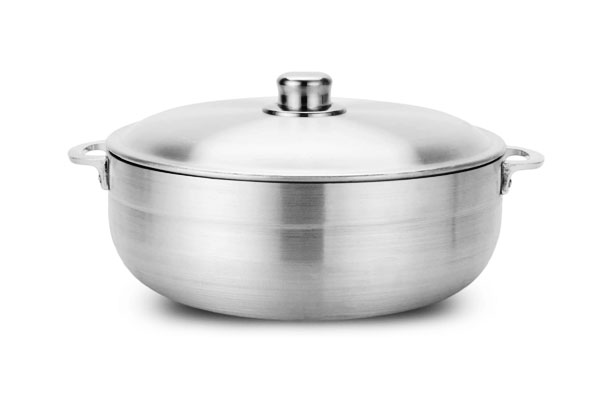
Cast aluminum cookware describes pots, pans, and related kitchen vessels whose main structural form — the body, walls, and base — are produced by pouring molten aluminum (or an aluminum alloy) into a mold and allowing it to solidify.
The finished casting is then cleaned, machined where needed (flat bases, sealing faces, mounting bores), surface-treated (anodized, coated, enamelled), and assembled with handles or lids.
Key elements of the definition
- Manufacturing method: the primary shaping step is casting (gravity casting, low-pressure casting, die-casting/HPDC, investment casting), not stamping, forging, or deep drawing.
- Material: typically aluminum alloys engineered for castability and kitchen performance (common examples: A356 / Al-Si-7Mg for heat-treatable castings; A380 / ADC12 for die-cast parts).
- Post-processing: cast bodies generally receive one or more of: machining (flat base, bore, flange), heat treatment (e.g., T6 for A356 where used), surface finishing (shot-blast, grinding), and food-contact surface treatment (hard anodize, PTFE/ceramic non-stick, enamel).
Why “cast” matters for cookware performance
- Near-net shape: casting lets manufacturers build ribs, pouring lips, shaped handles and integrated flanges directly into the part, reducing assembly and machining.
- Thermal behavior: aluminum alloys used in cast cookware retain the metal’s high thermal conductivity (≈205 W·m⁻¹·K⁻¹), giving rapid, even heating versus stamped steel or bare stainless.
- Mass & stiffness control: casting enables local thickening of bases for heat retention or stiffening ribs to control warping without the weight penalty of solid forged parts.
3. Typical Alloy Families used in Cast Cookware
| Alloy (commercial name) | Typical process | Key alloying elements (role) | Heat-treatable? | Representative tensile UTS (MPa) |
| A356 / Al-7Si-0.3Mg (AlSi7Mg) | Gravity cast, low-pressure, squeeze | Si ≈ 7% (fluidity, shrinkage control); Mg ≈ 0.2–0.4% (age hardening) | Yes (T6) | ~140–300 (as-cast → T6: ~260–320) |
| A380 / ADC12 (Al-Si-Cu family) | High-pressure die casting (HPDC) | Si 8–12% (fluidity); Cu 1–4% (strength), Fe controlled | Mostly no (as-cast) | ~160–320 (typical HPDC ~200–300) |
| A413 / Al-Si (higher Si) | Gravity / LPDC | Si ≈ 11–13% (excellent fluidity, less shrink) | Sometimes | ~160–280 |
| Special die-cast alloys (modified A380, proprietary) | HPDC with modified chemistries | small Mg additions or grain refiners to improve ductility/strength | Sometimes limited | ~200–350 (depending on variant) |
Practical alloy selection guidance (rule-of-thumb for product tiers)
- Premium / professional cookware: A356 (Al-7Si-0.3Mg), gravity/LPDC, T6 heat-treated where possible.
Thicker bases, hard-anodized surfaces, or ceramic/robust non-stick systems. Best balance of strength, thermal mass, and coating compatibility. - Mid-range / economy high-volume: A380 / ADC12 (HPDC) with rigorous melt & coating control and a high-quality multi-layer non-stick or hard-anodized finish. Good for lightweight pans and die-cast handles.
- Budget stamped or thin cookware (not true cast bodies): may use lower-grade castings or even stamped aluminum — performance and longevity are lower.
- Induction-compatible cast products: design a hybrid — cast Al body (A356 or A380) with a bonded/fitted magnetic stainless or steel plate on the base — alloy selection still matters for thermal conduction and distortion control.
4. How cast cookware is made — foundry and post-processing steps
Manufacturing routes:
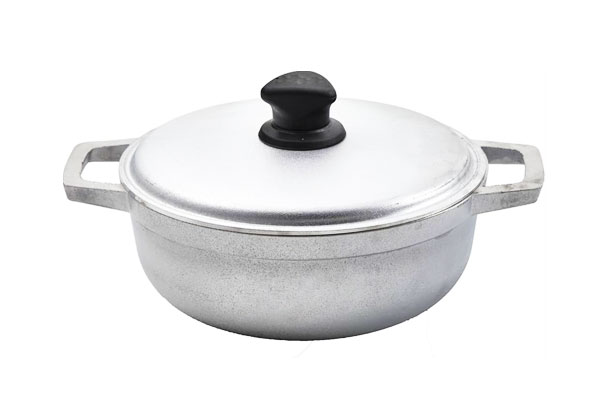
- Pattern & mold creation: sand or metal molds, cores for hollows or features.
- Melting & melt control: induction melting with charge control and degassing (argon rotary degassing) to minimize hydrogen porosity.
- Pouring / casting: gravity, low-pressure, or die casting depending on alloy and part design.
For high-integrity cookware, gravity or low-pressure die casting of A356 is common; high-pressure die casting(HPDC) is used for thin parts and high-volume components. - Heat treatment: some A356 castings are T6 (solution + aging) to increase strength and reduce distortion risks.
- Surface finishing & coating: shot blasting, machining of flat bases, hard anodizing, coating application (PTFE, ceramic), and final assembly (handles, lids).
- Quality control: dimensional inspection, base flatness, coating adhesion, leak/pressure checks for some products, and visual/CT checks in premium lines.
Foundry controls that matter for cookware: melt cleanliness, porosity control, base flatness, and residual stress management to avoid warping during finishing.
5. Thermal & Physical Performance of Cast Aluminum Cookware
| Property | Value / Units | Notes |
| Density (typical cast alloys) | 2.65 – 2.82 g·cm⁻³ | Use 2.70 g·cm⁻³ for most engineering calculations. |
| Thermal conductivity (k) | 120 – 205 W·m⁻¹·K⁻¹ | Pure Al ≈205; cast alloys typically 120–170 depending on Si/Cu content and porosity. |
| Specific heat capacity (cₚ) | 0.88 – 0.92 J·g⁻¹·K⁻¹ | Standard assumption ≈0.90 J·g⁻¹·K⁻¹. |
| Thermal diffusivity (α) | 5×10⁻⁵ – 9×10⁻⁵ m²·s⁻¹ | Cast alloys typically 6–8×10⁻⁵; indicates very fast thermal response. |
| Solidus / Liquidus | Solidus: 500–580 °C; Liquidus: 570–640 °C | Values vary by alloy (A356, A380, etc.); solidifies below pure Al (660 °C). |
Typical cookware base thickness |
2–8 mm | Professional bases often ≥6 mm for heat retention & warp resistance. |
| Mass example — 24 cm skillet, 4 mm average thickness | ≈0.489 kg | Based on 2700 kg·m⁻³ density; realistic for mid-weight cast pans. |
| Heat capacity of that skillet | ≈440 J·K⁻¹ | Heating by 100 K requires ≈44 kJ (idealized, no heat loss). |
| Thermal behavior | — | Fast heating/cooling; lower thermal mass vs. cast iron; thickness influences uniformity. |
| Effect of porosity / microstructure | — | Porosity lowers thermal conductivity and impacts coating adhesion & durability. |
6. Surface treatments & Non-stick systems
Surface treatment determines food release, durability, and safety.
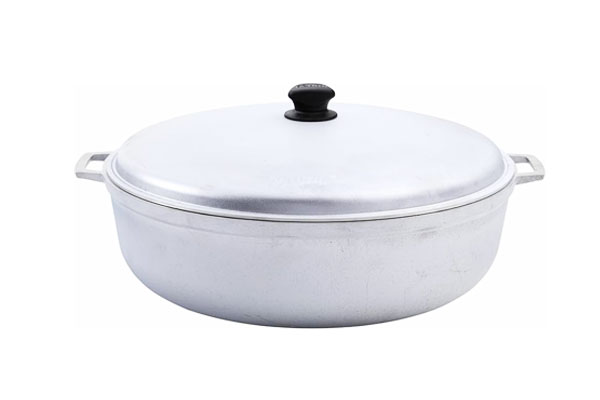
Hard Anodizing
- Process: electrochemical growth of aluminum oxide (Al₂O₃) on surface — converts surface into a hard, inert, ceramic-like layer.
- Benefits: abrasion resistant, chemically inert (reduces aluminum leaching), good for metal utensils if well-finished, good thermal contact if not too thick. Hard-anodized thickness commonly 20–100 µm depending on recipe.
- Limitations: anodize is brittle — edges can chip if abused; anodized surfaces still may be finished with a non-stick coating for release.
PTFE (Teflon) and Multi-Layer Non-stick Coatings
- Benefits: excellent release, easy cleaning, low oil required.
- Limitations: PTFE degrades at very high temperatures (>260–300 °C depending on system) and can scratch from metal utensils; quality varies by layer structure and baking protocol.
Ceramic coatings
- Benefits: marketed as “PTFE-free”, often able to tolerate higher surface temperatures and claimed to be more scratch-resistant.
- Limitations: long-term durability and adhesion over extensive thermal cycling varies between suppliers.
Seasoning (bare aluminum or cast-iron style)
- Some cast aluminum is supplied uncoated and intended to be seasoned (oil polymerization) — requires more maintenance but avoids coating failure concerns.
Key tradeoffs: hard anodizing + light nonstick topcoat gives best balance of durability, low leaching and release. Avoid inferior sprayed coatings or poorly cured PTFE systems.
7. Design considerations (thickness, geometry, bases, handles)
Design choices affect cooking performance and manufacturability.
- Thickness & thermal mass: thicker bases (3–6 mm or more in the base) increase heat retention and evenness; thin walls (≤2–3 mm) cook faster but may hotspot.
- Disc or layered bases: some pans use a heavy aluminum disc combined with a stainless or magnetic outer ring to improve flatness, induction compatibility and stiffness.
- Flatness: base runout should be minimized (typical spec ≤ 0.5 mm over diameter for stovetop pans) to ensure good contact with heating surface.
- Handles & attachments: die-cast or cast integrally, or bolted stainless steel handles. Bolted handles allow replacement — a safety benefit.
- Induction compatibility: pure aluminum is non-magnetic; induction requires a magnetic layer (stainless/steel disc or ferromagnetic plate) or separate induction plate.
- Lid fit & sealing: fitted lids improve heat & moisture control.
8. Durability, Wear Modes, and Repairability
Common wear/failure modes:
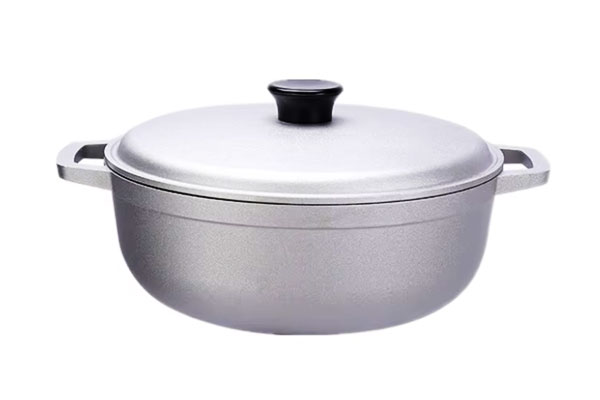
- Surface coating failure: scratching, blistering, delamination. Prevention: good coating process, soft utensils, correct cleaning.
- Warping: poor heat treatment or uneven heating may cause permanent distortion; minimize by stress relief and proper base thickness.
- Pitting/oxidation: damaged anodize or coated areas can expose aluminum — recoat or replace.
- Handle failure: bolted handles can loosen; design for serviceability.
Repairability: recoating (re-anodize or re-coat) is possible but often uneconomical for mass-market pans; replacing the pan is typical.
9. Health, Safety, and Food-contact considerations
- Aluminum reactivity: uncoated aluminum can react with acidic foods (tomato, vinegar), potentially increasing surface aluminum ions in food.
However, modern cookware is usually anodized or coated to prevent significant leaching. - Anodized surfaces: form an inert oxide barrier — effectively non-reactive and food safe if intact.
- Coatings & regulations: PTFE and other coatings used in cookware are subject to food-contact regulation (FDA in the U.S., EU food contact rules in Europe). Choose reputable brands and look for compliance statements.
- Safe temperature use: avoid overheating non-stick coatings above their recommended temperatures to prevent degradation.
- Alloy impurities: reputable manufacturers control melt chemistry and use degassing/filtration to minimize inclusions and heavy metallic contaminants.
If you are concerned about metal exposure, prefer hard-anodized or stainless-faced cookware and avoid using damaged, uncoated aluminum directly with very acidic foods.
10. Environmental, lifecycle & economic perspectives
- Recyclability: aluminum is highly recyclable — recycling requires a fraction of the energy of primary production.
Recycling rates for aluminum beverage cans exceed 60% in many regions; recycled aluminum in cookware lowers embodied energy significantly. - Weight & transport: lighter cookware reduces shipping energy and costs.
- Durability vs replacement: High-quality cast aluminum with durable surface treatment can last many years; cheap coated pans that fail quickly have worse lifecycle environmental impact.
- Cost: cast aluminum cookware is generally less expensive than stainless steel cookware of equivalent build (but higher than the cheapest stamped cookware); high-end anodized or T6-treated lines command premium prices.
11. Comparison: Cast Aluminum vs Cast Iron vs Stainless Steel
| Attribute | Cast Aluminum | Cast Iron | Stainless Steel (multi-layer) |
| Density / weight | Low (~2.7 g·cm⁻³) — lightweight | High (~7.2–7.8 g·cm⁻³) — heavy | Moderate to high |
| Thermal conductivity | Very high (~205 W/m·K) — fast & even | Moderate (~55 W/m·K) — slower spread | Low (~15–25 W/m·K) — needs cladding |
| Thermal mass | Low → heats/cools fast | High → great heat retention | Low → depends on construction (clad) |
| Responsiveness (control) | Excellent | Sluggish | Depends on clad core |
| Durability | Good if coated/anodized; susceptible to coating wear | Very durable; tolerates rough use | Very durable; resists corrosion |
| Maintenance | Easy (coated) | Needs seasoning or care | Easy to clean; no seasoning |
| Induction compatibility | No (unless magnetic base) | Yes | Yes (if magnetic or clad) |
| Food reactivity | Needs anodize/coating for acidic foods | Generally stable (seasoned surface) | Stable |
| Typical uses | Everyday, sautés, sauces, lightweight pans | High-heat searing, slow cooking | Versatile, professional cookware with clad core |
12. Is Cast Aluminum Cookware Safe?
Cast aluminum cookware is generally safe when produced with certified food-grade alloys and modern coatings.
Aluminum leaching is very low, especially because cast alloys form a stable oxide layer and most cookware is protected by nonstick, ceramic, or anodized surfaces.
Reputable foundries use controlled Al–Si casting alloys (such as A356 or AlSi10Mg), which are chemically stable, low in impurities, and approved for food-contact.
Safety is strongly linked to manufacturing quality. High-quality castings with low porosity, verified alloy chemistry, and durable coatings provide excellent long-term safety, while low-grade castings may corrode under coatings or release metals at a higher rate.
Cast aluminum is safe within normal cooking temperatures (<300°C). Only severe overheating can damage coatings or accelerate oxidation. For best durability—not safety alone—handwashing is recommended.
Overall, when properly manufactured and used, cast aluminum cookware is a safe, stable, and reliable option, widely validated by food-contact regulations and decades of consumer and industrial use.
13. Market Trends: What’s Shaping Cast Aluminum Cookware
The cast aluminum cookware market is evolving to meet consumer demands for health, convenience, and sustainability. Below are the top trends:
Rise of Non-Toxic, PFOA-Free Coatings
Consumers are avoiding PFOA (perfluorooctanoic acid, a former PTFE manufacturing chemical) and PFAS (per- and polyfluoroalkyl substances).
Brands now use PFOA-free PTFE or ceramic coatings—sales of PFOA-free cast aluminum cookware grew by 22% in 2025 (Nielsen data).
Induction Compatibility
With induction cooktops gaining market share (45% of European households, 20% of U.S. households), induction-compatible cast aluminum cookware is becoming standard.
Sustainability: Recycled Aluminum
Cast aluminum cookware is highly recyclable—70–80% of new cast aluminum cookware uses recycled aluminum (per the Aluminum Association).
This reduces carbon footprint by 65% vs. using primary aluminum (extracted from bauxite). Brands like GreenPan highlight recycled content to appeal to eco-conscious consumers.
Professional-Grade Home Cookware
Home cooks are seeking restaurant-quality tools—professional cast aluminum cookware (thicker walls, reinforced handles) is a fast-growing segment.
For example, All-Clad’s cast aluminum Dutch ovens (6 mm walls, 18/10 stainless steel lids) target this market, with a 30% price premium over standard cast aluminum.
14. Conclusion
Cast aluminum cookware combines excellent thermal conductivity and light weight with manufacturing flexibility.
When engineered with appropriate alloys (A356 or suitable die-cast grades), produced with good foundry practices, and finished with durable anodizing or high-quality non-stick systems, cast aluminum pans can be a high-performance choice for both home cooks and professional kitchens.
The right selection depends on the tradeoffs you accept: aluminum’s quick responsiveness vs. cast iron’s heat capacity, and the lifetime performance of coatings versus the maintenance burden of uncoated metals.
FAQs
Is cast aluminum safe for everyday cooking?
Yes — when surface-treated (hard-anodized or certified non-stick) it is broadly safe. Avoid using damaged, uncoated aluminum with highly acidic foods.
Can I use metal utensils on anodized cast aluminum?
Hard-anodized surfaces are more abrasion resistant, but metal utensils can still wear certain non-stick topcoats. Use wood/nylon/silicone for longevity.
Why do some cast aluminum pans warp?
Warping usually arises from thin sections, uneven heating, poor heat treatment, or thermal shocks. Choose pans with stiffer/heavier bases and proper manufacturing controls.
How does cast aluminum compare in energy efficiency?
Aluminum’s high thermal conductivity means faster heating and lower energy waste to reach cooking temperature; however, lower heat retention can require more energy during long, high-mass cooking.
Can cast aluminum cookware be re-anodized or recoated?
Technically possible, but often not economical for consumer pans. High-value or professional cookware may be refurbished by specialists.