1. Introduction
Thermal annealing refers to a controlled heat‑treatment process that alters a material’s microstructure to improve its physical and mechanical properties.
Originating in the early 19th century with rudimentary blacksmithing techniques, annealing has since evolved into a highly precise, scientifically governed method.
Today, industries ranging from aerospace to microelectronics rely on thermal annealing to ensure components meet stringent performance standards.
In this article, we will explore why thermal annealing matters, dissect its metallurgical underpinnings, examine its impact on material properties, and outline best practices for its implementation.
2. Why Castings Thermal Annealing?
The casting was produced using a pouring process, with molten metal or alloy delivered either from a single ladle or multiple ladles.
During solidification, different areas of the casting cool at varying rates, depending on their location and geometry.
This non-uniform cooling leads to differential contraction, which in turn introduces internal stresses—commonly referred to as residual stresses—within the casting.
To relieve these stresses, thermal annealing is often performed.
This involves heating the casting to a specific temperature, holding it for a prescribed time (depending on the wall thickness), and then cooling it at a controlled rate.
When this heat treatment ensures uniform cooling throughout the casting, the process is referred to as annealing, which helps reduce internal stress and improve dimensional stability.
3. Fundamental Metallurgical Principles
Thermodynamics of Recrystallization and Recovery
When heated above a critical temperature—typically 30–60% of a metal’s absolute melting point—atoms gain enough energy to reconfigure into lower‑energy grain structures.
During recovery, dislocation density decreases by up to 50%, while recrystallization replaces deformed grains with new, strain‑free ones.
Kinetics: Nucleation and Grain Growth
Nucleation begins at defects such as grain boundaries or inclusions.
In carbon steels, for instance, recrystallization occurs between 550 °C and 650 °C, with nucleation rates doubling for every 25 °C increase.
Once nuclei form, grain growth proceeds. Controlled growth yields grain sizes of ASTM 6–8, balancing strength and toughness.
Role of Diffusion at Elevated Temperatures
Diffusion accelerates exponentially with temperature, following Arrhenius behavior.
At 600 °C, vacancy diffusion in iron is approximately 10⁻¹³ m²/s—five orders of magnitude faster than at room temperature—enabling rapid microstructural change within minutes.
4. Mechanical Property Enhancement
Reduction of Residual Stresses and Distortion
Residual stresses in as‑worked metals can exceed 200 MPa.
By ramping up to annealing temperature (for example, 600 °C) and holding for one hour, tensile and compressive stresses converge toward zero, often falling below 20 MPa upon cool‑down.
This reduction prevents warping during subsequent machining or service.
Improvement of Ductility and Toughness
Annealed steels typically exhibit elongation at break of 30–40%, compared to 10–15% in their cold‑worked state.
Transitioning to a finer, equiaxed grain structure mitigates brittle fracture and elevates Charpy impact energy by as much as 50 J.
Balancing Hardness vs. Softness: Tailoring Mechanical Properties
Depending on cooling rate, annealed materials can achieve Rockwell hardness values between 70 HRB (soft) and 20 HRC (hard).
For instance, furnace cooling yields lower hardness (~80 HB), while rapid air‑cooling may retain moderate hardness (~100 HB), granting engineers flexibility in design.
5. Microstructural Transformations
Phase Changes
In eutectoid steels, annealing transforms lamellar pearlite into a mixture of ferrite and cementite.
A full‑anneal at 720 °C held for two hours typically converts 100% pearlite into spheroidized structures, enhancing machinability by up to 60%.
Grain Size Refinement
Smaller grains strengthen materials via the Hall–Petch relationship: σᵧ = σ₀ + k d⁻¹ᐟ². Reducing grain diameter from 50 µm to 10 µm can raise yield strength by 80 MPa.
Precipitation and Coarsening Phenomena
Alloys like aluminum‑copper develop fine precipitates (e.g., θ′) during annealing.
Holding at 350 °C for eight hours yields precipitate sizes of 10–20 nm, optimizing yield strength by 150 MPa before precipitate coarsening begins.
6. Process Variants & Parameters
Thermal annealing comes in several distinct flavors, each tailored to specific material requirements and production scales.
In what follows, we’ll examine four primary variants—full‑annealing, stress‑relief, spheroidizing, and process annealing—before turning to the critical parameters that govern successful outcomes.
Finally, we’ll compare batch and continuous furnaces and introduce cutting‑edge rapid‑annealing technologies.
Full Annealing, Stress‑Relief, Spheroidizing & Process Annealing
Full Annealing
First, full annealing heats the workpiece above its critical transformation temperature (e.g., 900 °C for many steels),
holds it long enough to achieve 100% recrystallization, and then cools it slowly—typically at 10–20 °C per hour—to room temperature.
As a result, you obtain a uniform, fine‑grained microstructure that maximizes ductility and minimizes hardness.
Stress‑Relief Annealing
In contrast, stress‑relief annealing targets only residual stresses.
By heating the material to a subcritical range (usually 450–650 °C for steels) and holding for 30–60 minutes, you relax internal stresses without inducing major phase changes.
Consequently, you reduce distortion during subsequent machining or welding.
Spheroidizing
Next, spheroidizing serves machining applications. Here, the material cycles around the lower critical temperature (e.g., 700–720 °C for eutectoid steel) for several hours.
This repeated cycling transforms lamellar carbides into spherical precipitates within a ferritic matrix, boosting machinability by up to 60%.
Process Annealing
Finally, process annealing operates at even lower temperatures (300–500 °C) to restore ductility after cold working.
Rather than fully recrystallizing the microstructure, it softens the material just enough to prevent cracking during further forming operations.
Key Variables: Temperature, Time, Heating/Cooling Rate & Atmosphere
Temperature Control
Precise control—within ±5 °C—is vital. Operators typically use type‑K thermocouples placed at multiple locations to verify that the entire load reaches the target temperature simultaneously.
Soak Time
Although thinner sections may only require 15–30 minutes of soak, thicker components often demand up to 12 hours to ensure uniform transformation throughout the cross‑section.
Heating and Cooling Rates
Moreover, heating rates of 5–20 °C/min and controlled cooling (furnace, air, or quench) directly influence grain size.
Faster cooling tends to preserve finer grains, whereas slower cooling produces coarser, more ductile grains.
Furnace Atmosphere
To prevent oxidation or decarburization, engineers select an atmosphere—vacuum, inert (argon/nitrogen), or reducing (hydrogen)—that matches the alloy chemistry and cost considerations.
Batch vs. Continuous Annealing Furnaces
- Batch Furnaces
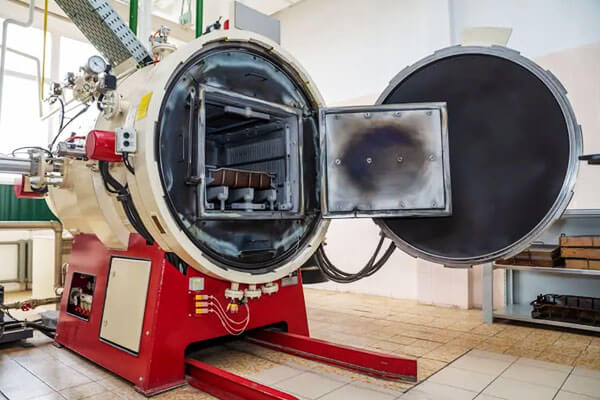
Batch furnaces excel in flexibility: you can process varied geometries and steels in loads up to 10 tonnes.
However, they incur higher per‑unit energy costs due to repeated heat‑up and cool‑down cycles. - Continuous Furnaces
By contrast, continuous furnaces run 24/7, moving material on conveyor systems through heating, soaking, and cooling zones.
They treat over 100 tonnes per day and slash energy use by 20–30% per tonne, although they require uniform part dimensions and steady production schedules.
Rapid Annealing Technologies
As industry pushes for greater throughput and material performance, several advanced annealing methods have emerged:
Rapid Thermal Annealing (RTA)
RTA exposes substrates (e.g., silicon wafers) to high‑intensity lamps, ramping temperature at up to 50 °C/s. It activates dopants and repairs implantation damage within seconds.
Pulsed Laser Annealing
Here, nanosecond‑scale laser pulses locally melt and re‑solidify the surface, refining grains to sub‑micron sizes while leaving the bulk unaffected.
This technique enhances hardness and wear resistance.
Electron Beam Annealing
By focusing a high‑energy electron beam (100–200 keV), you can selectively relieve stresses in thick components without heating the entire part, reducing cycle times and distortion.
Xenon Flash Lamp Annealing
Finally, xenon lamps deliver millisecond‑long, high‑intensity flashes that heat only the top few microns of a substrate.
Manufacturers leverage this for flexible electronics and thin‑film solar cells.
7. Quality Control & Standards
Monitoring
Engineers place thermocouples at the root, mid, and tip, achieving ±2 °C uniformity. Pyrometer mapping verifies surface temperatures, ensuring ±1 °C control.
Non-Destructive Evaluation (NDE)
- Ultrasonic Testing (UT): Detects internal cracks or voids in thick-section components (e.g., turbine blades).
- Magnetic Particle Inspection (MPI): Identifies surface-breaking defects in ferromagnetic materials.
- X-ray Diffraction (XRD): Quantifies residual stress and phase fractions in heat-treated alloys.
Industry Standards and Compliance
- GB/T 32541-2016 (China): Establishes a comprehensive quality control system for thermal processing, emphasizing risk management, personnel training, and equipment maintenance.
It mandates ±10°C temperature uniformity for critical heat treatments (e.g., vacuum carburizing). - ISO 20431:2023 (International): Focuses on systematic process control, including process validation, documented procedures, and traceability.
It introduces stricter requirements for lean metal thermocouples, limiting their use to 15 cycles at ≤980°C. - ASTM/ASME Standards: Govern heat treatment in critical industries.
For example, ASTM A484 specifies annealing cycles for stainless steels, requiring a heating rate of ≤50°C/hr and soak times of 1–2 hours.
8. Conclusion
Thermal annealing remains a linchpin of materials engineering, enabling the balance of performance, cost, and reliability across industries.
Its success hinges on rigorous process control, adherence to standards, and adaptation to emerging technologies like AI-driven furnace optimization.
FAQs
What is the main purpose of thermal annealing?
Thermal annealing primarily relieves internal stresses, refines the microstructure, and restores ductility in metals and alloys.
By heating a workpiece to a controlled temperature, holding it for a set time, and then cooling it under prescribed conditions,
you eliminate residual stresses from forming processes, improve toughness, and tailor hardness for downstream operations.
How do I choose between full annealing and stress‑relief annealing?
If your goal is complete recrystallization and maximum ductility (for example, before heavy forming or drawing), opt for full annealing, which heats above the critical transformation temperature.
Conversely, if you only need to alleviate machining or welding stresses without significant microstructural change, select stress‑relief annealing, conducted in a sub‑critical temperature range.
Can rapid annealing techniques match conventional furnace results?
Yes, when applied appropriately. Rapid Thermal Annealing (RTA), pulsed laser, and flash‑lamp methods achieve similar stress relief or dopant activation in seconds to minutes.
However, they typically affect only surface layers or thin substrates, so they complement rather than replace bulk furnace anneals.
How do I verify that an annealing cycle was successful?
Post‑anneal validation combines nondestructive and destructive methods:
- Ultrasonic stress measurements or X‑ray diffraction confirm residual stresses below target (often <20 MPa).
- Metallographic examination (optical or SEM) checks grain size, phase distribution, and precipitate morphology against ASTM or ISO standards.