在现代制造业中, 单一材料零件很少能满足性能的全部要求, 美学, 和功能.
当今的产品必须耐用且舒适, 防水又透气, and complex yet easy to assemble.
This has driven the widespread adoption of multi-material manufacturing processes. 其中, overmolding and insert molding are two of the most important and frequently compared techniques.
Although the two terms are sometimes used interchangeably, they describe different manufacturing approaches and solve different engineering problems.
Overmolding generally involves molding a second material over an existing substrate to create a multi-material component.
嵌件成型, 相比之下, places a preformed insert—often metal—inside an injection mold and encapsulates or partially surrounds it with plastic.
本文提供了全面的, side-by-side comparison of overmolding and insert molding.
1. 什么是包覆成型?
包覆成型 is an injection molding process in which one material is molded over an existing substrate or previously molded component to create an integrated multi-material part.
The first component is commonly referred to as the 基材, while the material applied during the secondary molding operation is the overmold material.
Depending on the product design, 基材可以是硬质热塑性塑料, 弹性体, metal component, or another suitable preformed part.
A typical overmolded component may combine a rigid structural material with a softer material.
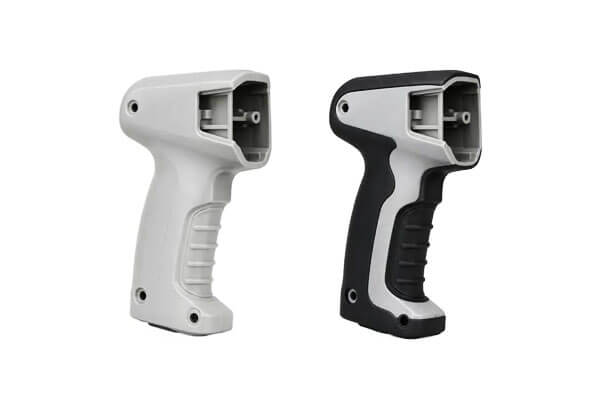
例如, a rigid ABS housing can receive a TPE overmold to provide a comfortable grip, 改善密封性, or create a protective exterior surface.
The objective is not simply to place one material on top of another. The interface between the two materials must provide adequate adhesion, 机械保持力, or a combination of both to withstand the product’s expected mechanical, 热的, 化学, 和环境条件.

How Overmolding Works
The overmolding process generally begins with production of the substrate.
This may involve a separate injection molding operation, machining process, stamping operation, 铸造过程, or another manufacturing method.
After the substrate is inspected, it is positioned inside a second mold. The mold is designed to expose the areas that need to receive the overmold material while accurately locating and supporting the substrate.
The secondary material is then heated to the appropriate processing temperature and injected into the mold cavity.
It flows around the designated substrate surfaces and forms the required outer geometry.
灌装包装后, the material cools and solidifies before the completed component is ejected.
A typical workflow is:
Substrate production → substrate inspection → mold loading → positioning → secondary material injection → packing → cooling → ejection → inspection
The quality of the final product depends heavily on interface design. If chemical adhesion is required, the substrate and overmold material must have sufficient compatibility.
If mechanical retention is the primary mechanism, the substrate may require grooves, 肋骨, 孔, 底切, or other features that allow the second material to lock into position.
Surface contamination is another important consideration. 油, 灰尘, 脱模剂, 氧化, 水分, or other contaminants can interfere with adhesion and lead to delamination or premature separation.
常见包覆成型材料
Overmolding can use a broad range of thermoplastics and elastomeric materials, but not every material combination is inherently compatible.
Material selection should consider melt temperature, 化学兼容性, 收缩, 热膨胀系数, 硬度, 灵活性, surface characteristics, and expected service conditions.
Common combinations include:
| 底物材料 | Overmold Material | Typical Purpose |
| ABS | 热塑性弹性体 | Soft-touch housings and grips |
| 个人电脑 | 热塑性弹性体 | Impact-resistant products with ergonomic surfaces |
| 尼龙 | TPE/TPU | Industrial grips and flexible interfaces |
| 聚丙烯 | 热塑性弹性体 | Consumer products and seals |
| 聚碳酸酯/ABS | 热塑性聚氨酯 | Protective and ergonomic surfaces |
| Rigid thermoplastic | LSR | Sealing and specialized flexible components |
典型的包覆成型应用
Overmolding is particularly useful when the product must combine structural performance with softness, 灵活性, 密封, 绝缘, or improved ergonomics.
Overmolding is commonly used for:
- Hand-tool grips
- Automotive switches and controls
- Consumer electronics housings
- 医疗器械零部件
- 可穿戴设备
- Cable and wire protection
- 密封组件
- Handles and ergonomic interfaces
- 防护罩
- Industrial equipment controls
2. 什么是嵌件成型?
嵌件成型 is an injection molding process in which a preformed component, known as an 插入, is positioned inside an injection mold and then partially or completely encapsulated by molten plastic.
The insert is often made from metal, although plastic, 陶瓷制品, 电子的, and other preformed components can also be used.
Unlike conventional single-material injection molding, insert molding combines an independently manufactured component with injected plastic during one molding operation.
The plastic solidifies around the insert, producing an integrated part that can eliminate subsequent assembly operations.
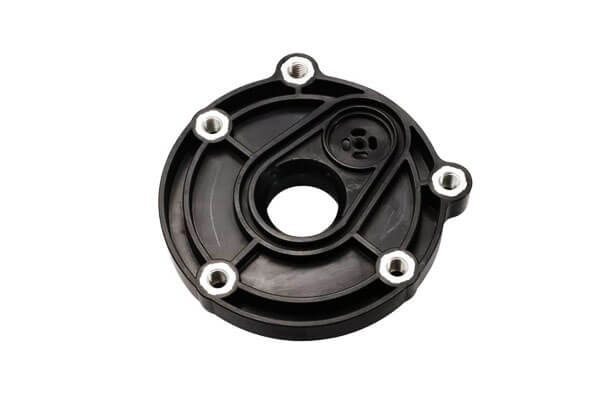
例如, a brass threaded insert can be positioned inside a mold and surrounded by nylon.
成型后, the resulting component contains a permanent threaded metal interface without requiring the threaded insert to be installed afterward.

How Insert Molding Works
Insert molding begins with manufacturing and inspecting the insert. Dimensional accuracy is particularly important because the insert must fit correctly within the mold and maintain its specified position throughout injection.
The insert is then placed into the mold manually, 半自动, or through an automated loading system.
专用夹具, 别针, 腔, or retention features may be used to prevent movement.
Once the mold closes, molten plastic is injected around the insert. Injection pressure can be substantial, so the mold must provide sufficient support to prevent the insert from shifting, deforming, or becoming misaligned.
The plastic then cools and solidifies around the insert. After ejection, the finished component is inspected for dimensional accuracy, insert position, 闪光, 空隙, 裂缝, 以及其他缺陷.
The basic sequence is:
Insert manufacturing → insert inspection → insert loading → positioning and retention → mold closing → plastic injection → cooling → ejection → inspection
For high-volume manufacturing, automated insert loading can be integrated into the molding cell. This can improve cycle consistency while reducing manual handling.
常见刀片材料
Metal is the most widely recognized insert material because it provides properties that plastics generally cannot reproduce, such as high electrical conductivity, thread durability, 刚性, 戴阻力, or localized mechanical strength.
Common insert materials include:
- 黄铜
- 不锈钢
- 碳钢
- 铝
- Copper and copper alloys
- Engineering plastics
- 陶瓷
- Electronic components
Typical Insert Molding Applications
Insert molding is commonly used when a product requires a metal or other preformed component to be permanently integrated into a plastic body.
典型的应用包括:
- Threaded bosses
- 电连接器
- Automotive terminals
- 传感器外壳
- 开关元件
- 医疗仪器
- Structural reinforcement components
- Cable connectors
- Electronic assemblies
- Precision mechanical components
3. 包覆成型与嵌件成型: What Is the Difference?
Although both technologies integrate multiple materials or components, their manufacturing logic is different.
The simplest distinction is:
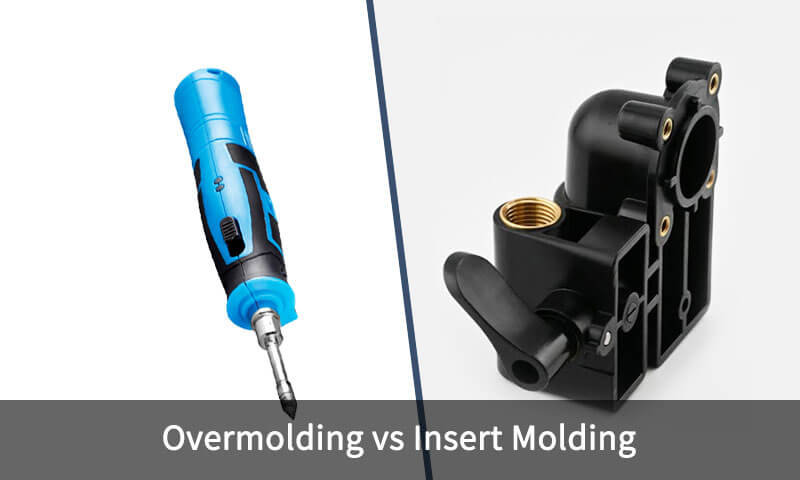
Overmolding adds a new material over an existing substrate, while insert molding encapsulates or surrounds a preformed insert with injection-molded plastic.
然而, the terminology can overlap. In some manufacturing contexts, insert molding may be discussed as a broader form of overmolding because both involve molding material around a preexisting component.
For engineering communication, 然而, it is useful to distinguish them based on the role of the preexisting component.
Overmolding vs Insert Molding Comparison
| 因素 | 包覆成型 | 嵌件成型 |
| Primary purpose | Combine different material properties | Integrate a preformed insert into plastic |
| Preexisting component | 基材 | 插入 |
| Common substrate/insert | 塑料, 弹性体, 金属 | 金属, 塑料, 陶瓷制品, electronic component |
| Typical combination | Rigid plastic + 弹性体 | 塑料 + 金属 |
| Main interface mechanism | 粘附, 机械联锁, 或两者兼而有之 | Encapsulation, 机械保持力, adhesion in some cases |
| Key design concern | 物质兼容性 | Insert positioning and retention |
| Typical application | Soft-touch grip | Threaded metal insert |
| Surface function | 紧握, 海豹, cushion, 保护 | 电气, 机械的, 结构, fastening |
| 自动化 | Highly automatable | Highly automatable, but insert loading is critical |
| Major risk | Delamination or poor bonding | Insert movement or misalignment |
4. 包覆成型与嵌件成型: 设计注意事项
The design requirements for overmolding and insert molding differ primarily because the two processes manage different interfaces.
Overmolding focuses on creating a reliable interface between the substrate and the overmolded material, while insert molding focuses on accurately positioning and securely encapsulating a preformed insert.
| Design Consideration | 包覆成型 | 嵌件成型 |
| 物质兼容性 | Select compatible substrate and overmolding materials based on adhesion, 熔化温度, 收缩, 硬度, 和热膨胀. | Ensure the insert can withstand molding temperature and pressure without deformation or dimensional instability. |
| 几何学 & 壁厚 | Maintain uniform overmold thickness and provide sufficient bonding area. Avoid abrupt thickness changes that can cause shrinkage, 经线, or weak bonding. | Provide sufficient plastic thickness around the insert for strength and use grooves, 咕噜声, 孔, or shoulders when additional retention is required. |
| 粘合 & 保留 | Design the interface for chemical adhesion, 机械联锁, 或两者兼而有之, depending on material compatibility. | Design mechanical retention and encapsulation features to resist pull-out and rotation. |
| 门 & Material Flow | Position gates to achieve balanced filling and minimize weld lines, 滞留空气, and excessive stress at the interface. | Control material flow carefully to prevent insert displacement, 封装不完整, or excessive pressure on the insert. |
插入 / Substrate Positioning |
The substrate must be accurately located and securely held during injection. | Precise insert positioning is critical; 定位销, 口袋, 固定装置, or automated placement may be required. |
| 收缩 & 热膨胀 | Consider differences in shrinkage and thermal expansion between the substrate and overmold to prevent warpage, 残余应力, 和分层. | Consider thermal expansion differences between the insert and polymer, particularly in metal-to-plastic applications, to prevent dimensional variation and internal stress. |
| 草稿 & 弹射 | Provide adequate draft and properly positioned ejectors to release the part without damaging the overmold or interface. | Design draft and ejection carefully to prevent insert movement, 形变, or loosening during demolding. |
公差 |
Account for substrate dimensions, 包覆成型厚度, 材料收缩, and possible interface movement. | Account for insert dimensions, positioning accuracy, polymer shrinkage, and final insert location. |
| DFM & Mold Flow | Evaluate bonding area, material flow, 壁厚, gate location, and differential shrinkage before tooling. | Evaluate insert retention, 定位, polymer flow, 热行为, and potential insert displacement before tooling. |
| 质量控制 | Focus on bonding strength, 包覆成型厚度, 闪光, 分层, 经线, 和尺寸准确性. | Focus on insert position, retention strength, 封装, 闪光, 空隙, 和尺寸准确性. |
5. Custom Overmolding and Insert Molding Services From LangHe Industry
Langhe行业 provides customized injection molding solutions for applications that require overmolding, 嵌件成型, and other integrated molding technologies.
Our manufacturing approach can support projects from initial product development and tooling through production and quality inspection.
| 能力 | 细节 |
| Overmolding Types | Two-shot (2k) 过量, 取放包覆成型. |
| 嵌件成型 | Metal inserts (黄铜, 钢, 铜), 陶瓷插入物, electronic inserts (PCB, 传感器). |
| 材料 (基材) | ABS, 个人电脑, 尼龙 (PA6, PA66), 聚丙烯, 聚对苯二甲酸丁二醇酯. |
| 材料 (包覆成型) | 热塑性弹性体, 热塑性聚氨酯, LSR, 增值税, 硅酮. |
| 工具 | In-house tooling design and manufacturing. |
| 质量 | ISO 9001:2015 经认证; 100% 检查. |
| 交货时间 | 2– 原型需要 4 周; 4–8 weeks for production tooling. |
6. 结论
Overmolding vs insert molding is not a matter of determining which process is universally better. Both are highly effective injection molding technologies, but they address different product-development requirements.
Overmolding is primarily suited to products that need to combine different material characteristics within one integrated component.
It is particularly valuable for soft-touch surfaces, ergonomic grips, flexible seals, 缓冲, 绝缘, and protective layers.
Its success depends heavily on material compatibility, interface design, 粘附, 机械联锁, and differential shrinkage control.
嵌件成型, 相比之下, is especially effective when a preformed component—often a metal insert—must be permanently integrated into a plastic structure.
It is widely suited to threaded interfaces, 电端子, 加固组件, 传感器, 连接器, and other applications where plastic and another material perform complementary functions.
最终, process selection should be based on the entire manufacturing system, including material behavior, 产品几何形状, 工具, bonding or retention strategy, 生产量, 自动化, 检查, 和生命周期成本.
常见问题解答
What is the difference between insert molding and two-shot molding?
Insert molding uses a 预制嵌件 that is placed into the mold before plastic injection.
Two-shot molding typically produces two materials sequentially using specialized tooling and multiple injection stages, often without manually loading a separately manufactured substrate between shots.
Which process is faster: overmolding or insert molding?
Insert molding is generally faster because it uses a single injection shot. Overmolding requires two shots or a multi-step process.
Which process has lower tooling costs?
Insert molding has lower tooling costs because it only requires a single mold cavity. Overmolding requires two separate molds or a complex two-shot mold.
When should I use overmolding?
Use overmolding when you need soft-touch grips, waterproof sealing, 振动阻尼, or improved aesthetics.
When should I use insert molding?
Use insert molding when you need high-strength threaded connections, 电导率, or structural reinforcement in plastic parts.
Can overmolding and insert molding be used together?
是的. Some complex parts combine both processes—for example, an insert-molded metal thread with an overmolded soft-touch grip on the same component.
Is insert molding a type of overmolding?
The terminology can overlap because both processes mold material around a preexisting component.
然而, in practical manufacturing terminology, 过量 usually emphasizes adding another material layer or material system, 尽管 嵌件成型 specifically emphasizes embedding a preformed insert into the molded component.
Can metal be used in overmolding?
是的. Metal substrates can be overmolded with suitable plastics or elastomers.
然而, the process must account for surface preparation, 热膨胀, 粘附, 机械保持力, and differential shrinkage.