Традиционална ЦНЦ обрада је окосница прецизне производње. Уклања материјал са чврстог бланка све док део не одговара цртежу, and when the part is simple and the material is free-cutting, nothing beats it for accuracy, флексибилност, and predictability.
But the parts I am asked to quote today look nothing like the parts I quoted ten years ago.
In intelligent computing liquid cooling, new energy vehicles, humanoid robotics, ваздухопловство, и нуклеарна снага, components are becoming structurally integrated, internally complex, and metallurgically demanding.
They have internal cooling channels, irregular flow passages, intersecting bores, and alloy grades that were once considered exotic.
Those parts expose exactly where CNC machining struggles. The tool cannot reach inside a closed cavity. The material removal ratio exceeds 60 или 70 проценат.
The stainless steel work-hardens, the chips string, the insert wears, and the cycle time climbs.
And when the design cannot be machined as one piece, it gets split into several parts and welded—which adds joints, adds leak paths, and adds the very quality risk the designer was trying to avoid.
This is where investment casting enters the conversation. Not as a replacement for machining, but as a blank-making strategy that changes the economics of the whole part.
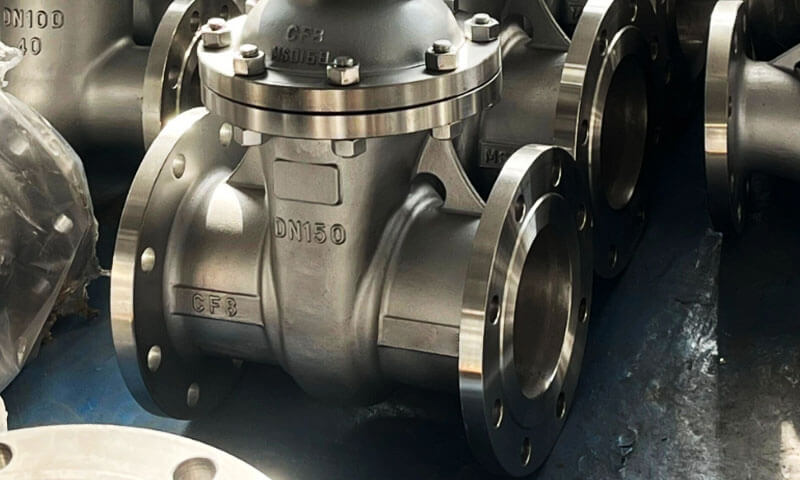
У Лангхе индустрија, we routinely produce investment castings for intelligent computing liquid cooling CDU pump bodies, кућишта мотора, подметач, manifold water distributors, cabinet structural parts, and pipe connectors.
When customers switch from pure machining to a cast-then-machine route, the typical results are:
- Part count reduced by more than 50% through structural integration.
- Leak risk at flow passages and sealing faces substantially reduced because the joints disappear.
- Machining operations reduced by about 70%.
- Overall delivery lead time shortened by more than 40%.
This article explains the cost logic behind those numbers, the two dimensions where the savings actually come from, the real case data, and—equally important—the cases where you should not make the switch.
1. Инвестиционо ливење вс. ЦНЦ обрада: Understanding the Cost Difference
The fundamental difference between ЦНЦ обрада и Инвестициони ливење lies in how each process creates the component.
CNC machining uses a subtractive manufacturing principle. A cutting tool removes material from a solid workpiece until the required geometry is achieved.
This provides excellent dimensional control, but the process becomes increasingly expensive when the component has complex features or requires extensive material removal.
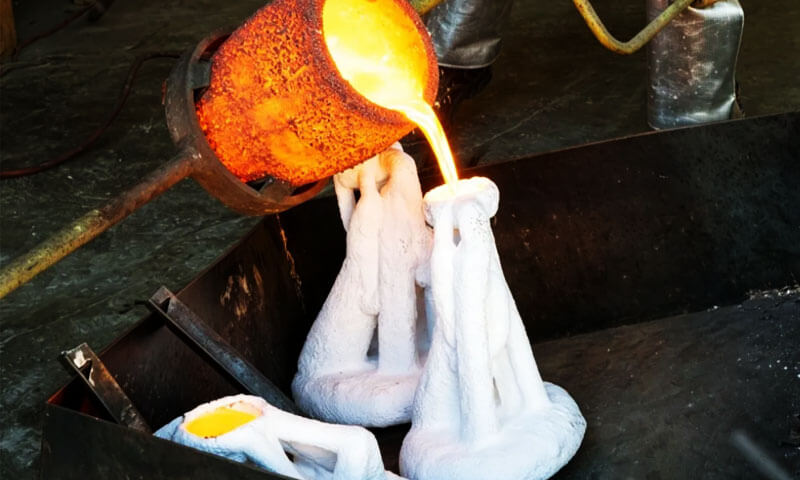
Investment casting uses a near-net-shape manufacturing principle. A wax pattern is produced from a die, assembled into a tree, coated with refractory ceramic slurry and sand, and then dewaxed and fired to create a ceramic shell.
Molten metal is poured into the shell to reproduce the component’s geometry. После учвршћивања, шкољка се уклања, and the casting undergoes cutting, чишћење, топлотни третман, инспекција, and any necessary precision machining.
The two processes therefore have different cost structures.
| Cost factor | ЦНЦ обрада | Инвестициони ливење |
| Сировина | Often requires oversized solid stock or forgings | Uses metal close to the final component geometry |
| Употреба материјала | Can be low for complex parts with extensive material removal | Generally higher due to near-net-shape production |
| Инвестиција алата | Usually low for simple parts; fixtures and special tools may be required | Requires pattern tooling, wax injection dies, and casting process development |
| Machining time | Can be high for complex geometries | Usually lower when casting provides most of the required geometry |
Complex internal cavities |
Limited by tool access and cutting direction | Can reproduce complex internal and external features through appropriate core design |
| Assembly requirements | May require multiple machined parts and welding | Can integrate several features into one casting |
| Димензионална тачност | Excellent for precision features | Depends on casting process, геометрија, и димензионалне захтеве; critical areas may require machining |
| Production economics | Attractive for simple parts and low-volume production | Often attractive for complex parts and repeat production |
From an investment casting engineer’s perspective, the most important question is not whether casting can replace every machining operation. It is whether the casting process can eliminate unnecessary material removal and simplify the component’s manufacturing route while retaining machining where precision is essential.
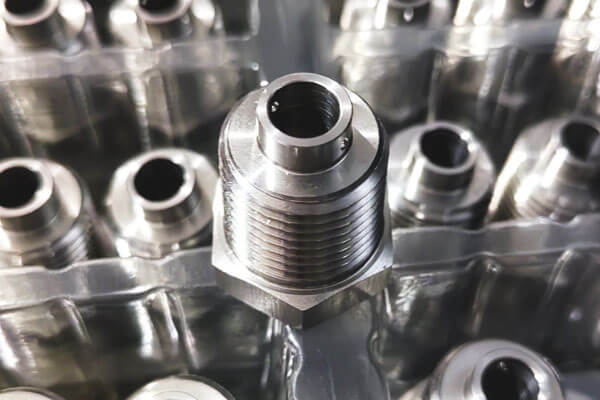
A well-designed investment casting is rarely a completely machining-free component. Уместо тога, the most economical solution is often a near-net-shape casting with CNC machining concentrated on critical interfaces, such as bearing seats, рупе са навојем, Лица за заптивање, лоцирање површина, and precision bores.
2. Reduce Material Waste: How Near-Net-Shape Casting Improves Material Utilization
Кључни поремећај: Investment casting can significantly reduce material removal by producing a blank close to the final component geometry.
For suitable complex parts, material utilization can exceed 85%, compared with approximately 30%–50% in conventional machining-intensive production.
Why CNC Machining Generates Significant Material Waste
Traditional CNC machining typically starts with solid bar stock, билекат, or a forged blank.
The machining center removes material through milling, окретање, бушење, досадан, and other cutting operations until the component reaches its final dimensions.
За једноставне компоненте, this approach is efficient. Међутим, the material utilization rate can decrease sharply when the part contains:
- Deep pockets and large internal cavities.
- Thin walls surrounding bulky structural sections.
- Multiple intersecting passages and irregular flow channels.
- Complex curved surfaces and weight-reduction features.
- Large differences between the initial blank size and final component volume.
За сложене индустријске компоненте, material utilization commonly falls within the 30%–50% range, and certain highly irregular parts can fall below 30%.
This means that more than half of the purchased material may eventually become chips.
Material waste also creates secondary costs. More cutting operations mean longer machine occupancy, greater tool consumption, increased coolant usage, and additional handling of chips.
When expensive stainless steel or duplex stainless steel is involved, the cost of discarded material becomes particularly significant.
How Investment Casting Improves Material Utilization
Investment casting forms the component close to its final geometry rather than cutting the entire shape from a solid blank.
Through wax pattern design, ceramic shell preparation, and controlled metal pouring, the process can reproduce complex surfaces, ребра, шефови, закривљени одломци, и интегрисане структурне карактеристике.
Only selected areas need machining allowances for dimensional correction and functional interfaces.
LangHe Industry’s investment castings can achieve material utilization rates of over 85% у одговарајућим апликацијама, potentially more than twice the utilization of machining-intensive manufacturing routes.
Consider a complex stainless steel pump housing. If the component is machined from a solid billet, large internal cavities and external contours require extensive material removal.
With investment casting, much of this geometry can be formed directly during solidification.
The subsequent CNC process only needs to finish the sealing surfaces, монтажни интерфејси, Прецизне сурове, and other critical dimensions.
This reduces both raw material consumption and machining time.
3. Reduce Machining Time and Tooling Costs: Why Investment Casting Is Effective for Stainless Steel
Кључни поремећај: For suitable stainless steel components, investment casting can reduce subsequent machining volume by more than 60%.
In one representative 316L stainless steel control valve application, the integrated manufacturing cost decreased by approximately 25%.
Why Stainless Steel Is Expensive to Machine
Stainless steel offers corrosion resistance, механичка чврстоћа, and good service performance, but these properties can make machining more demanding.
Аустенитни нехрђајући челици као што су 304 and 316L have relatively high ductility and a strong tendency to work-harden.
Their thermal conductivity is also relatively low compared with ordinary carbon steel.
Током сечења, heat concentrates near the cutting edge, while the material may adhere to the tool and form built-up edges.
Common machining difficulties include:
- Отврдњавање: The machined surface becomes harder during cutting, making subsequent tool engagement more difficult.
- High cutting temperatures: Poorer heat dissipation increases thermal loading on the cutting edge.
- Хабање алата: Лепак, абразија, and thermal stress can shorten tool life.
- Chip control problems: Дугачак, continuous chips can interfere with machining and damage finished surfaces.
- Lower cutting efficiency: Conservative cutting parameters may be necessary to maintain tool life and dimensional stability.
For complex stainless steel components, these problems can significantly increase machining time and tooling expenses.
Under certain conditions, machining time per component can be two to three times that required for comparable carbon steel parts, although the actual difference depends on grade, геометрија, Резање параметара, и опреме.
When the manufacturing route involves extensive roughing, deep-pocket milling, and multiple finishing operations, cutting tools and labor can become major cost drivers.
How Investment Casting Reduces Machining Requirements
Investment casting addresses these challenges by forming most of the component geometry before CNC machining begins.
Instead of removing large volumes of stainless steel, the casting process produces the main structural shape, leaving controlled machining allowances on selected surfaces.
На пример, LangHe Industry’s stainless steel investment castings can achieve dimensional accuracy in the CT4–CT6 range under suitable process and geometry conditions.
This can significantly reduce the machining allowance compared with manufacturing the same component from oversized bar stock.
The actual achievable casting tolerance depends on part size, геометрија, дебљина зида, легура, и контрола процеса.
Critical functional dimensions should still be specified separately and finished by machining when necessary.
The main savings come from three areas:
- Reduced cutting volume: Less material needs to be removed, shortening roughing and finishing cycles.
- Lower tool consumption: Fewer cutting passes reduce tool wear and replacement frequency.
- Simplified machining routes: Near-net-shape geometry can eliminate unnecessary setups, deep milling, and complicated tool paths.
Пример: 316L Stainless Steel Control Valve Component
Consider a 316Л нехрђајући челик control valve component originally manufactured entirely through CNC machining.
The traditional route requires a relatively large blank to accommodate the component’s external shape, Унутрашње одломаке, и карактеристике монтаже.
Machining must remove substantial material to create the final geometry, while the stainless steel’s work-hardening behavior increases cutting difficulty.
After evaluating the component geometry, the manufacturing route is changed to investment casting followed by precision CNC machining.
The revised process uses investment casting to form the main body, Интерна геометрија, и структурне карактеристике.
CNC machining is retained for critical sealing surfaces, connection interfaces, and precision dimensions.
The reported improvements in this application include:
| Cost and production indicator | Result after adopting investment casting |
| Machining volume | Reduced by approximately 65% |
| Cutting tool costs | Reduced by approximately 50% |
| Overall manufacturing cost | Reduced by approximately 25% |
These figures represent a specific application rather than guaranteed savings for every 316L component.
The actual result depends on casting yield, амортизација алата, Додаци за обраду, Захтеви за инспекцију, и обим производње.
For more expensive materials such as duplex and super duplex stainless steel, the economic advantage may become even more significant because both raw material and machining costs are higher.
4. Integrate Multiple Components into One Casting: Reduce Assembly and Leakage Risks
One of the most overlooked cost advantages of investment casting is its ability to consolidate multiple components into a single structure.
CNC machining is highly effective at producing individual precision parts.
Међутим, when a product contains complex internal channels, intersecting passages, or multiple structural sections, manufacturing it entirely through machining may require several separate components.
These parts must then be assembled through welding, лемљење, вијати, or other joining processes.
Each additional component and connection introduces costs and potential failure points.
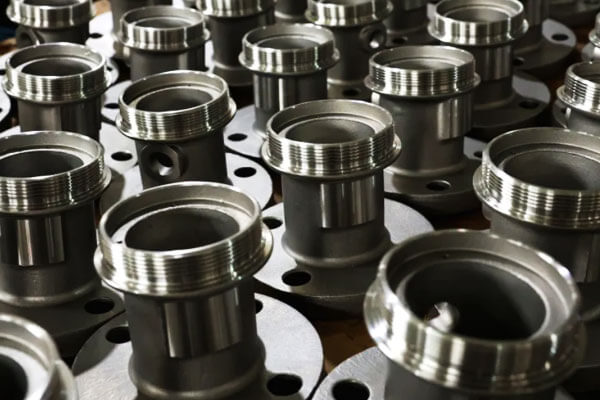
Why Multi-Part Machined Assemblies Increase Total Cost
A multi-component assembly can generate expenses beyond the machining cost of individual parts:
- Additional material procurement and inventory management.
- More CNC setups and machining operations.
- Welding or other joining processes.
- Post-weld machining and surface treatment.
- Dimensional alignment and assembly fixtures.
- Additional inspection and pressure testing.
- Potential leakage, деформација, or joint failure.
For fluid-handling equipment, these issues are particularly important. A manifold assembled from multiple machined sections may contain several welded joints or sealing interfaces. Each connection creates a potential leakage path.
Investment Casting Enables Structural Integration
Investment casting can produce complex geometries in a single component, provided that the internal passages and ceramic core design are technically feasible.
На пример, a liquid cooling manifold used in an AI data center may contain multiple distribution channels and connection ports.
A conventional machining route may require several blocks or plates to be machined separately and then joined.
An investment casting solution can integrate much of the manifold structure into one casting.
The main flow passages, connecting sections, and external mounting features can be formed together, with machining reserved for ports, Лица за заптивање, and threaded connections.
This can reduce the number of individual parts by more than 50% in suitable redesign projects.
The benefits extend beyond assembly cost:
- Fewer welded joints and mechanical connections.
- Reduced potential leakage points.
- Improved structural continuity.
- Less assembly labor and fewer alignment operations.
- Simplified inventory and production management.
Међутим, internal passage geometry must be evaluated carefully. Ceramic cores need sufficient strength during shell preparation and pouring, while core positioning, метални проток, and core removal must remain controllable.
Very narrow or inaccessible passages may still require alternative manufacturing methods.
Typical Applications in Liquid Cooling and Industrial Equipment
Investment casting is particularly attractive for components that combine structural complexity with fluid-handling functions.
| Компонента | Potential benefit of investment casting |
| CDU pump housing | Integrates complex housing geometry and reduces machining volume |
| Motor housing | Forms ribs, Структуре монтирања, and complex external contours |
| Pump impeller | Produces curved blades and complex flow geometry |
| Manifold distributor | Integrates multiple flow paths and connection features |
| Pipe connectors | Reduces the need for multi-part fabrication and welding |
| Тела вентила | Forms complex internal cavities and external structural features |
За ове апликације, the key design objective is to reduce the number of separately manufactured parts without compromising pressure integrity, flow performance, or maintainability.
5. Shorten Production Lead Time: Reduce Machining Operations and Manufacturing Complexity
Manufacturing cost is not limited to material and labor. Production lead time also affects equipment utilization, inventory, delivery reliability, and project costs.
A complex component machined from solid stock may require multiple operations, including rough milling, бушење, досадан, окретање, полузавршна обрада, завршњак, и инспекција.
If the geometry requires multiple setups or specialized fixtures, the production schedule becomes even more complicated.
Investment casting can simplify this route by producing the main component geometry in a single forming process.
Why Machining-Intensive Production Takes Longer
Several factors can extend CNC machining lead times:
- Large material removal volumes.
- Multiple machining setups and repositioning operations.
- Long cutting cycles for difficult-to-machine alloys.
- Special tool development for deep or irregular features.
- Additional welding and assembly operations.
- Repeated inspection after critical machining stages.
When several parts must be produced and assembled, delays in one component can affect the entire delivery schedule.
How Investment Casting Simplifies the Production Route
Investment casting replaces many cutting operations with a forming process.
Once the pattern tooling and casting process have been established, multiple complex features can be reproduced in each production cycle.
A typical manufacturing route includes:
- Component design review and casting feasibility analysis.
- Wax pattern tooling and pattern production.
- Ceramic shell building and dewaxing.
- Испаљивање граната, metal melting, и сипа.
- Уклањање љуске, сечење, and casting cleaning.
- Heat treatment and dimensional inspection.
- CNC finishing of critical interfaces.
- Final inspection and delivery.
Although investment casting introduces additional steps such as tooling manufacture and ceramic shell preparation, it can reduce the total number of downstream machining and assembly operations.
In representative Лангхе индустрија апликације, replacing a machining-intensive route with investment casting has reduced machining operations by approximately 70% and shortened overall delivery time by more than 40%.
These improvements are particularly valuable for complex components produced in recurring batches.
For a first-time project, међутим, tooling development and process qualification must be included in the schedule comparison.
6. Where Investment Casting Is Suitable for Replacing CNC Machining
Not every CNC-machined component should be redesigned as an investment casting. The most successful applications are those where casting can solve a genuine geometric or economic problem.
The following selection criteria can help manufacturers evaluate whether investment casting is a suitable alternative.
Applications That Are Strong Candidates for Investment Casting
Components with complex internal cavities and flow channels
Investment casting is worth considering when a part contains curved passages, intersecting channels, or irregular internal cavities that are difficult to machine directly.
Examples include pump housings, Тела вентила, liquid cooling manifolds, and fluid distribution components.
Components with high material removal rates
When CNC machining removes more than half of the original blank, near-net-shape casting may offer a substantial material cost advantage.
This is especially relevant to high-value stainless steel, Дуплек нерђајући челик, and nickel-based alloy components.
Complex stainless steel components made from difficult-to-machine grades
316Л, дуплекс, and other corrosion-resistant alloys can be expensive to machine. Investment casting can reduce the amount of material that must pass through cutting operations.
Components that require multiple machined parts and welded assemblies
If a product can be redesigned as one casting, the manufacturer may reduce welding, поравнање, скупштина, and leakage-related risks.
Мали- and medium-sized production runs with recurring demand
Investment casting can be economically attractive when the component is sufficiently complex and the production volume is large enough to amortize pattern tooling.
It is also useful when the same component will be manufactured repeatedly over several years.
Applications Where CNC Machining Should Be Retained
Investment casting is not always the most economical option.
Simple components with straightforward geometry
Standard shafts, рукаве, прирубница, and simple blocks can often be machined efficiently from bar stock or standard blanks. Introducing casting tooling may add unnecessary cost.
Very high-volume standard components
For simple parts manufactured in extremely large quantities, automated machining, хладно формирање, ковање, or other dedicated processes may offer better economics.
Components requiring forging-specific mechanical properties
Certain highly stressed safety-critical components require the mechanical properties and structural characteristics associated with wrought or forged materials.
У овим апликацијама, machining from qualified forged stock may be necessary.
Components with extremely tight tolerances across many surfaces
Investment casting can achieve good dimensional accuracy, but it does not eliminate the need for machining where extremely tight tolerances, precise fits, or superior surface finishes are required.
Components with unsuitable internal geometry
Very narrow passages, inaccessible cavities, or fragile core configurations may make investment casting difficult or uneconomical.
The feasibility of ceramic core production and removal must be assessed before selecting the process.
7. Engineering Considerations When Replacing CNC Machining with Investment Casting
Cost reduction should never come at the expense of dimensional accuracy, структурни интегритет, or service performance.
Before replacing CNC machining, the component must undergo a design-for-manufacturability review.
Redesign the Part for Casting, Not Just Copy the Machined Geometry
A component designed for machining is not automatically suitable for investment casting.
Machined parts often contain sharp internal corners, нагли прелази дебљине зида, and features that are easy to produce through cutting but difficult to cast consistently.
A casting-oriented redesign should consider:
- More uniform wall thickness where practical.
- Smooth transitions between thick and thin sections.
- Appropriate internal and external radii.
- Feasible ceramic core geometry.
- Adequate draft and pattern extraction requirements.
- Suitable machining allowances on functional surfaces.
The objective is to create a geometry that fills reliably, solidifies predictably, and can be cleaned and inspected effectively.
Define Machining Allowances on Critical Surfaces
Investment casting should form as much of the final geometry as practical, but certain surfaces still require precision machining.
Типични примери укључују:
- Valve sealing faces.
- Pump bearing seats.
- Motor mounting interfaces.
- Threaded connection ports.
- Precision locating holes.
- Интерфејси осовине и спојнице.
Machining allowances should be determined according to component size, легура, геометрија, casting process capability, and the required final tolerance.
Too little allowance may leave insufficient material for correcting casting deviations. Too much allowance increases machining time and eliminates part of the economic advantage.
A practical approach is to identify critical dimensions on the drawing and distinguish them from non-critical as-cast features.
Control Shrinkage, Порозност, and Internal Casting Quality
За разлику од ЦНЦ обраде, investment casting involves molten metal flow and solidification.
The final component quality therefore depends on alloy chemistry, температура калупа, услови изливања, дизајн храњења, и понашање учвршћивања.
For complex stainless steel components, particular attention should be given to:
- Shrinkage porosity in heavy sections and hot spots.
- Gas and oxide inclusions caused by melting and pouring conditions.
- Incomplete filling in thin walls and narrow passages.
- Ceramic core displacement or breakage.
- Dimensional distortion during solidification and heat treatment.
Gating and feeding systems should be designed to promote stable filling and directional solidification where appropriate.
For components with internal passages, core support and metal flow around the cores require additional consideration.
Inspection methods should match the component’s function. Depending on service requirements, manufacturers may need dimensional inspection, Пенетрант тестирање, радиографски тестирање, Испитивање притиска, or other specified examinations.
Retain CNC Machining for Functional Precision
The most effective manufacturing strategy is often not to eliminate CNC machining, but to reduce it to the operations where it adds real value.
На пример, a stainless steel pump housing can be investment cast to form the main body, проточни пролази, ребра, and mounting structures.
CNC machining can then finish the bearing bore, flange face, sealing interface, and connection ports.
This hybrid route combines the geometric flexibility of investment casting with the dimensional precision of CNC machining.
8. Why Choose LangHe Industry for Investment Casting and Precision Machining?
Replacing CNC machining with investment casting requires more than changing the source of the metal blank.
It requires coordinated engineering across component design, wax pattern development, ceramic shell preparation, metal melting, casting quality control, топлотни третман, and final machining.
Лангхе индустрија provides integrated investment casting and precision machining solutions for complex stainless steel and industrial metal components.
From initial design review to finished-part delivery, our engineering team evaluates component geometry, материјални захтеви, толеранције димензија, and production volume to determine whether an investment-casting-based manufacturing route can reduce total cost.
Our capabilities support the production of pump housings, Тела вентила, подметач, раздјелнике, кућишта мотора, конектори за цеви, and other precision industrial components.
By combining near-net-shape casting with CNC finishing, Лангхе helps customers reduce unnecessary material removal, simplify component structures, improve manufacturing efficiency, and maintain the precision required at critical interfaces.
If your current CNC-machined components involve high material waste, complex internal structures, long machining cycles, or expensive multi-part assemblies, contact LangHe Industry.
Our team can review your drawings or 3D models and evaluate the technical feasibility, expected cost benefits, and production requirements of replacing machining-intensive manufacturing with investment casting.
9. Закључак
The decision to replace CNC machining with investment casting is not a decision about which process is better. It is a decision about which process fits the part.
For complex stainless steel components with internal cavities, irregular flow passages, Уклањање високог материјала, and corrosion requirements, the casting route changes the economics in three ways at once:
- Material utilization rises from 30–50 percent to above 85 проценат.
- Machining volume drops by 60–65 percent, and tool cost drops by about 50 проценат, delivering roughly a 25 percent comprehensive cost reduction—with the 316L regulating valve as the reference case.
- Part integration removes joints, путеви цурења, и монтажне операције, reducing part count by more than 50 percent and machining operations by about 70 проценат.
За једноставно, high-volume standard parts and for core load-bearing safety components, machining or forging remains the correct choice.
The value of a casting partner is not in converting everything—it is in knowing which parts should be converted and which should not.
LangHe Industry works across the full chain, from process development and blank production to supporting precision machining.
That means we can evaluate a part on its working conditions and cost targets, and recommend the route that actually makes sense—whether that route is casting, обрада, or a combination of the two.
Често постављана питања
What is the comprehensive cost reduction?
The 316L regulating valve case showed approximately a 25 percent reduction in comprehensive manufacturing cost.
For higher-cost grades such as duplex stainless steel, the advantage is more pronounced.
What dimensional accuracy can investment castings achieve?
ЦТ4 - ЦТ6, with machining allowance only one-quarter to one-fifth of that required for bar stock machining. Critical features such as sealing faces, носећи промет, and threads are still machined.
Why does stainless steel benefit more than carbon steel?
Because stainless steel has high toughness, ниска топлотна проводљивост, and a strong work-hardening tendency.
Machining time is typically two to three times that of carbon steel, and tool wear and machining labor often exceed 55 percent of total machining cost.
What are the benefits of part integration?
Complex parts that cannot be machined as one piece are usually split and welded.
Casting produces the internal passages and sealing faces in a single piece, removing joints, путеви цурења, corrosion sites, и монтажне операције.
Part count can drop by more than 50 percent and machining operations by about 70 проценат.
What is required to make a conversion successful?
Дизајн за ливење, agreement on which features are cast to tolerance and which are machined, проверу материјала, a casting inspection plan, and machining process development for the new allowance and fixturing.