

Introduzzjoni
Powder metallurgy is one of the most important near-net-shape manufacturing technologies in modern industry.
It is used when a component must combine effiċjenza tal-materjal, konsistenza dimensjonali, Ġeometrija kumplessa, and repeatable mass production.
Unlike conventional methods that begin with a fully molten metal or a large wrought stock, powder metallurgy starts from Trab tal-metall and builds the part through controlled compaction and thermal consolidation.
That difference is fundamental. Powder metallurgy is not simply a “different way to make metal parts.”
It is a distinct engineering route that gives manufacturers access to properties and geometries that are often difficult, għalja, or impossible to achieve through casting, Forġa, or machining alone.
Because of that, powder metallurgy has become deeply embedded in industries such as automotive, aerospazjali, elettronika, apparat mediku, għodda, energy systems, and high-performance consumer products.
1. What is Powder Metallurgy?
Powder metallurgy is a manufacturing process in which metal powders are formed into a desired shape and then consolidated by heat, pressjoni, jew it-tnejn.
The goal is to create a solid part whose internal structure, densità, and mechanical performance are controlled from the earliest stages of production.
The two essential steps:
- Kompattazzjoni – Metal powder is placed in a rigid die and compressed by a punch, typically at pressures of 200‑800 MPa (30‑120 ksi).
The result is a “green compact” with sufficient mechanical integrity for handling. - Sinterizzazzjoni – The green compact is heated in a controlled atmosphere furnace to a temperature typically 70‑90% of the metal’s absolute melting point.
Atoms diffuse across particle contacts, forming necks that grow and eventually eliminate pores, producing a strong, dense part.
Optional secondary operations include sizing, coining, trattament tas-sħana, magni, and infiltration (filling pores with a lower‑melting metal).
This makes powder metallurgy especially useful for:
- forom kumplessi,
- high-volume precision parts,
- materials that are difficult to machine,
- controlled porosity applications,
- and alloys that are difficult to process by conventional melt-based methods.
2. A Brief History of Powder Metallurgy
The origins of powder metallurgy are ancient. Egyptians used iron powder in the 3rd millennium BCE to make implements. The modern era began in the early 20th century:
- 1909 – Coolidge developed the process for tungsten lamp filaments (incandescent bulbs), still a hallmark powder metallurgy application.
- 1920s‑1930s – Porous bronze bearings (oil‑impregnated “self‑lubricating” bearings) entered mass production for automotive and industrial machinery.
- 1940s – The war effort demanded high‑volume production of iron, azzar, and tungsten carbide parts for tanks, ajruplan, and ammunition.
- 1960s – The invention of hot isostatic pressing (Ġenbejn) and the development of superalloy powders enabled jet engine discs.
- 1990s‑present – Metal injection moulding (Mim) u manifattura addittiva (laser powder bed fusion) have expanded powder metallurgy into complex, Komponenti ta 'valur għoli.
Illum, the global powder metallurgy market exceeds $20 billion annually, with the automotive industry consuming more than 70% of all ferrous PM parts.
3. The Core Logic Behind Powder Metallurgy
Powder metallurgy is fundamentally a solid-state materials engineering route.
Its defining logic is not to melt the metal and recast it, but to transform loose powder into a coherent component through kompattazzjoni, diffusion, and sintering below the base-metal melting point.
The metallurgical essence of powder metallurgy
Fil-qalba tagħha, powder metallurgy relies on the controlled conversion of a porous powder compact into a dense and functional metallic body.
After compaction, the powder particles are only mechanically interlocked.
They touch at discrete points, but the part is still a green compact with limited strength and significant porosity.
The decisive transformation happens during sintering.
As temperature rises, atomic mobility increases and atoms begin to diffuse across particle surfaces, fruntieri tal-qamħ, and lattice defects.
This creates local bonding zones at the particle contacts, magħruf bħala sintering necks.
With continued heat exposure, these necks grow, adjacent pores shrink, and the individual powder particles gradually merge into a continuous metallic matrix.
This diffusion-driven consolidation is what distinguishes powder metallurgy from casting and forging:
- Tidwib depends on liquid metal solidification.
- Forġa depends on bulk plastic deformation.
- Metallurġija tat-trab jiddependi fuq inter-particle diffusion bonding in the solid state.
That difference is not merely procedural. It defines the microstructure, densità, and property envelope of the finished part.
From green compact to fully sintered part
The evolution of a powder metallurgy component can be understood in four distinct stages.
Green compact state
After pressing or molding, the powder particles are held together mainly by mechanical friction and contact pressure.
The part has the desired shape, but its internal structure remains open and porous.
F'dan l-istadju, the component is fragile and cannot yet deliver service-level mechanical performance.
Neck formation and diffusion bonding
During sintering, heat activates atomic movement. The particles begin to bond at contact points, forming necks that bridge the gaps between them.
This is the first true metallurgical step, because the part begins to behave as a continuous material rather than a collection of discrete particles.
Densification and pore shrinkage
As diffusion continues, irregular voids between particles shrink and become more rounded or isolated.
The internal structure becomes denser, and the mechanical properties improve sharply.
This densification step is central to powder metallurgy quality because it determines strength, Reżistenza għall-għeja, ilbes imġieba, u stabbiltà dimensjonali.
Grain growth and stabilization
With sufficient thermal exposure, the microstructure stabilizes.
Fine grains may grow moderately, residual stress is relieved, and the final part develops a stable balance of strength and toughness.
The control of time and temperature here is critical: too little sintering leaves the part weak; too much can cause excessive grain growth and loss of properties.
Controllable residual porosity: a unique powder metallurgy feature
One of the most important advantages of powder metallurgy is that porosity is not always a defect.
Unlike wrought or cast metals, PM parts can be designed with intentional residual porosity.
Meta kkontrollati sew, these microscopic pores can provide useful functional behavior such as:
- self-lubrication,
- sound absorption,
- permeabilità,
- filtration capability,
- u tnaqqis fil-piż.
This is a distinctive engineering advantage. In many other metal-forming routes, porosity is something to eliminate.
In powder metallurgy, porosity can be iddisinjat, managed, and used as a function.
Two major sintering modes
Powder metallurgy is built around two main sintering mechanisms, each suited to different alloy systems and performance goals.
Solid-phase sintering
This is the dominant route for most iron-based, copper-based, and aluminum-based powder metallurgy parts. No liquid phase appears during the sintering stage.
Bonding occurs entirely through solid-state diffusion, which gives the process strong dimensional control and relatively low distortion.
Solid-phase sintering is preferred when:
- shape accuracy is important,
- deformation must be minimized,
- and the alloy system can consolidate effectively without partial melting.
Liquid-phase sintering
In liquid-phase sintering, a low-melting constituent melts during heat treatment and helps accelerate densification by filling inter-particle gaps.
This method is widely used in composite systems and hard materials such as WC-CO.
Liquid-phase sintering is especially useful when:
- high densification is required,
- rapid pore filling is beneficial,
- and the material system is designed to tolerate a transient liquid phase.
4. Complete Industrial Process Flow of Powder Metallurgy
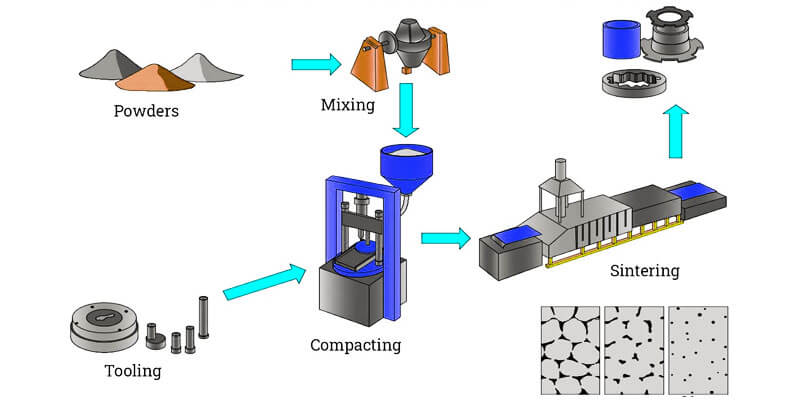
A standardized powder metallurgy production line is built around a tightly controlled sequence of operations.
Each stage affects the final density, eżattezza dimensjonali, mikrostruttura, and service performance of the component.
Powder Preparation and Pretreatment
The starting point of any powder metallurgy process is the powder itself.
Powder quality determines whether the later stages can produce a stable, repeatable, high-performance part.
Powder production routes
| Metodu | Deskrizzjoni | Eżempji |
| Water atomisation | High‑pressure water jets break a stream of molten metal. Irregular, angular particles (good green strength). | Ħadid, azzar, ram |
| Gas atomisation | Gass inert (N₂, Ar) produces spherical particles (good flowability). | Azzar li ma jissaddadx, SuperAlloys, titanju |
| Electrolysis | Electrochemical deposition produces very fine, high‑purity powders. | Ram, Nickel |
| Chemical reduction | Metal oxide is reduced with hydrogen or carbon monoxide. | Ħadid, Tungstenu, molibdenu |
| Mechanical comminution | Crushing and milling of brittle metals. | Ferroalloys, some titanium |
Fost dawn, gas atomization generally produces more spherical particles, better flowability, lower oxidation tendency, and higher suitability for precision or high-density components.
Water-atomized powders are typically more irregular in shape, lower in cost, and widely used for general structural parts where absolute particle regularity is less critical.
Pretreatment operations
Before forming, powders often undergo:
- grading by particle size,
- impurity removal,
- omoġenizzazzjoni,
- alloy blending,
- and lubricant or binder addition.
This pretreatment stage is critical because it improves powder flow, reduces segregation, improves die filling, and lowers wear on tooling during compaction.
For alloy systems made from mixed elemental powders, uniform blending is especially important;
even small segregation errors can lead to density variation, inconsistent shrinkage, or uneven mechanical performance after sintering.
Precision Compaction and Green Forming
Wara trattament minn qabel, the powder is shaped into a “green” compact through precision pressing.
Compaction principle
The powder is placed into a rigid die and compressed under high pressure, typically within a broad industrial range depending on material and part geometry.
This pressure converts the loose powder into a near-net-shape body with sufficient cohesion for handling.
Green compact characteristics
The green part already has the correct geometry, but it is still only a partially bonded structure.
Its strength comes mainly from particle contact, frizzjoni, and mechanical interlocking rather than true metallurgical bonding.
That means the part must be strong enough for:
- ejection from the die,
- transfer to the furnace,
- and handling during subsequent steps,
mingħajr cracking, edge breakout, or dimensional distortion.
Atmosphere-Controlled Sintering
Sintering is the central metallurgical step in powder metallurgy.
It is the stage where the part is transformed from a mechanically compacted powder body into a true metallic component.
Protective atmosphere
Sintering is normally carried out in a sealed furnace with a controlled atmosphere such as:
- Nitroġenu,
- idroġenu,
- dissociated ammonia,
- or inert gas.
This environment is essential because elevated temperature makes the powder highly sensitive to oxidation, dekarburizzazzjoni, and surface contamination.
Without a protective atmosphere, the part may lose density, kwalità tal-wiċċ, u prestazzjoni mekkanika.
Sintering mechanism
During sintering:
- atomic diffusion begins across particle contacts,
- sintering necks grow between adjacent particles,
- pores shrink and become more rounded,
- and the entire structure develops metallurgical continuity.
The temperature, holding time, and heating/cooling rate are all alloy-dependent.
Iron-based systems, copper-based systems, aluminum-based systems, and high-temperature materials each require different thermal schedules.
The goal is always the same: maximize bonding and densification while preserving geometry and controlling grain growth.
Post-Sintering Finishing and Property Enhancement
Once the part has been sintered, additional operations are often used to refine its performance or bring it to final specification.
- Densification treatment: Sizing, coining and hot isostatic pressing (Ġenbejn) to eliminate residual pores and improve density;
- Performance modification: Oil impregnation for self-lubricating parts, trattament tas-sħana (Tkessiħ u ttemprar) for strength enhancement, surface carburizing for wear resistance;
- Precision processing: Fine turning, grinding and deburring to meet high-precision assembly tolerances;
- Trattament tal-wiċċ: Shot Blasting, plating and oxidation resistance coating to improve surface aesthetics and corrosion resistance.
Quality Inspection and Product Classification
100% Spezzjoni dimensjonali, density testing, hardness testing and microscopic metallographic analysis are implemented for finished products.
Key functional parts undergo fatigue testing, wear resistance testing and nondestructive flaw detection to comply with MPIF and ISO quality standards.
5. Types of Powder Metallurgy
Powder metallurgy is not a single process but a family of manufacturing routes built around metal powders, iffurmar, and consolidation below or around the melting point of the base metal.
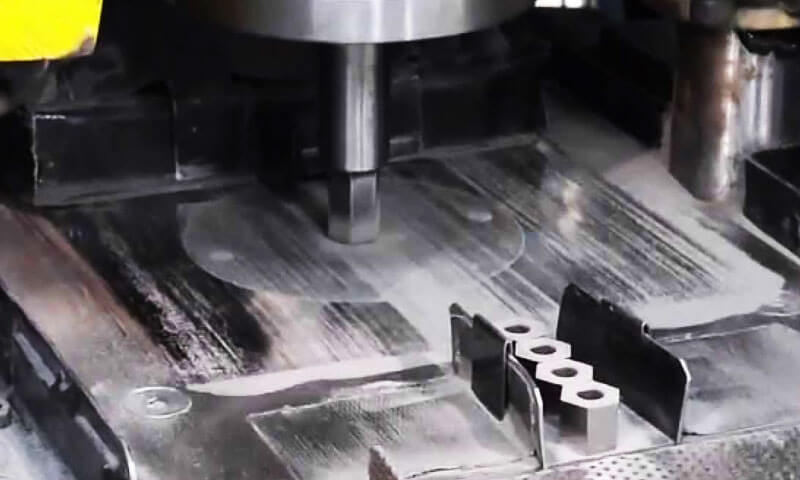
Conventional press-and-sinter
This is the classic and still most widely recognized powder metallurgy route. Metal powder is blended, compacted in a rigid die at room temperature, and then sintered in a controlled atmosphere.
Typical characteristics
Press-and-sinter is best suited to high-volume production of small to medium parts with relatively simple geometry.
It is widely used for gears, boxxli, structural small parts, and other repeatable components where die cost can be amortized across large production runs.
Its key strength is cost-effective near-net-shape production.
Molding tal-injezzjoni tal-metall (Mim)
Metal injection molding combines fine metal powder with a binder system to create a feedstock that can be injection-molded into very complex shapes.
After molding, the binder is removed and the part is sintered.
MIM is one of the core powder metallurgy technologies, and industry references commonly position it as the route for very intricate small parts.
Typical characteristics
MIM is especially valuable when the part is:
- żgħir,
- highly detailed,
- Diffikultà għall-magna,
- and produced in large quantities.
Because the powder is very fine and the molded geometry can be highly complex,
MIM is often used for precision hardware, medical components, electronics parts, and miniature mechanical assemblies.
Isostatic pressing
Isostatic pressing applies pressure uniformly from all directions to a powder-filled container.
This can be done at room temperature as cold isostatic pressing (CIP) or at elevated temperature as L-ippressar isostatiku sħun (Ġenbejn).
HIP uses high pressure and elevated temperature to densify powders or cast-and-sinter parts, and that it can provide very high densification and isotropic properties.
Typical characteristics
Isostatic pressing is used when uniform density is critical.
Compared with uniaxial die pressing, it produces more even compaction and is especially valuable for high-performance parts, difficult materials, and shapes that are not ideal for conventional die compaction.
Powder forging and powder rolling
Powder forging is a hybrid route in which a powder-pressed preform is sintered and then forged to reach higher density and better mechanical performance.
Powder rolling applies a similar idea through rolling rather than forging.
These methods are used when the shape efficiency of PM is needed, but the final part also requires mechanical strength approaching that of wrought material.
Industry overviews of powder metallurgy process families commonly include powder forging as one of the established routes.
Typical characteristics
This route is attractive for structural parts that need:
- Densità ogħla,
- improved fatigue performance,
- and stronger load-bearing capability than simple press-and-sinter parts.
Liquid-phase sintering
Liquid-phase sintering is a powder metallurgy route in which a liquid forms during sintering and helps accelerate densification.
A classic review defines it as a process for forming high-performance multi-phase components from powders under conditions where solid grains coexist with a wetting liquid.
This route is widely used for composite systems and hard materials such as WC-Co.
Typical characteristics
Liquid-phase sintering is selected when:
- very high densification is needed,
- the alloy system benefits from liquid-assisted particle rearrangement,
- and the final component is intended to be a high-performance multi-phase material.
Additive Powder Metallurgy (3D Metal Printing)
An emerging innovative branch including selective laser melting (SLM) u t-tidwib tar-raġġ tal-elettroni (EBM).
It realizes arbitrary complex structural forming of metal powders, breaking through the shape limitations of traditional die-based powder metallurgy processes, and becoming a core technology for customized high-end equipment parts.
Typical characteristics
This route is best for:
- Ġeometriji interni kumplessi,
- low-volume or custom parts,
- Iterazzjoni rapida tad-disinn,
- and structures that would be difficult to make by conventional tooling.
6. Advantages of Powder Metallurgy
| Vantaġġ | Spjegazzjoni |
| Near‑net shape | Minimal scrap (typical material utilisation >95%, compared to 60‑80% for machining from bar). |
| Eliminates or reduces machining | Ġeometriji kumplessi (passi, splines, keyways, toqob) are formed directly. |
| Controlled porosity | Can produce porous parts (filtri, bearings) or fully dense parts (via HIP or sintering + infiltrazzjoni). |
| Tailored microstructures | Alloying elements can be blended without melting, allowing unique compositions (E.g., copper‑iron‑graphite). |
Multa, Struttura uniformi tal-qamħ |
L-ebda difetti fl-ikkastjar (jinxtorob, Segregazzjoni, Porożità tal-gass). |
| Rati ta 'produzzjoni għolja | Automated presses can produce 10‑60 parts per minute per cavity; multiple cavities per die. |
| Versatilità materjali | Can combine immiscible metals (E.g., copper‑tungsten), Ċeramika (cermets), and solid lubricants (MoS₂, grafita). |
| Energy efficient | Lower energy than melting and casting (no melting required for most steps). |
7. Limitazzjonijiet u sfidi
| Limitazzjoni | Spjegazzjoni |
| Size and shape constraints | Pressing is limited by press capacity (tipikament <10 kg part weight). Long thin parts are difficult to compact uniformly. |
| Lower mechanical properties (compared to wrought) | Remaining porosity (even after sintering) reduces tensile strength and ductility. Fatigue strength is particularly sensitive to pore shape. |
| Spiża ogħla ta 'għodda | Precision dies can be expensive ($5,000‑50,000+), making PM uneconomical for very small volumes (<1000 partijiet). |
Limited section thickness variation |
Pressing produces uniform thickness; thick‑thin transitions are difficult. |
| Flowability limitations | Complex undercuts or re‑entrant angles cannot be pressed without special tooling (E.g., split dies). |
| Residual porosity | Even high‑density powder metallurgy parts (95‑98% dense) have lower ductility and impact toughness than wrought equivalents. |
8. Materials Used in Powder Metallurgy
Powder metallurgy can process a much broader range of materials than many people assume.
Fil-prattika industrijali, the common powder families include iron and steel, azzar li ma jissaddadx, ram, aluminju, landa, manjesju, titanju, tungsten and tungsten carbide, molibdenu, u metalli prezzjużi.
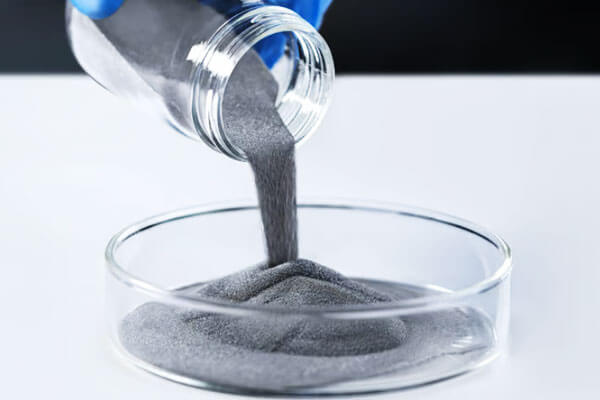
Ferrous powders: ħadid, azzar, and low-alloy steel
Ferrous powders are the backbone of conventional powder metallurgy.
Iron and azzar among the most common metals available in powder form, and standard PM production has long used iron-based powders for gears, partijiet strutturali, and other high-volume mechanical components.
Fil-prattika, many powder metallurgy steel parts are made by blending elemental iron with graphite or by using prealloyed powders, depending on the property target and process route.
These materials are favored because they combine:
- strong mechanical performance,
- good cost efficiency,
- mature process standards,
- and excellent suitability for press-and-sinter production.
Stainless steel powders
Azzar li ma jissaddadx is one of the most important powder metallurgy families when corrosion resistance is required.
Industry references list stainless steel as a standard PM material family, and stainless PM parts are widely used where ordinary ferrous materials would corrode too quickly.
Powder metallurgy stainless steels are selected when the part must balance:
- Reżistenza għall-korrużjoni,
- dimensional repeatability,
- and moderate-to-high mechanical performance.
Common PM stainless applications include hardware, valvi, medical and dental components, and corrosion-exposed mechanical parts.
Copper and copper-base powders
Ram is one of the most widely used non-ferrous powder metallurgy materials.
Ram and copper-base alloys among the common powder materials, and copper-base PM parts are widely used in electrical, termali, and functional hardware.
Copper-base powders can also be supplied as bronze or brass systems. Copper PM is preferred when the part needs:
- Konduttività elettrika għolja,
- Konduttività termali,
- anti-friction or bearing performance,
- or controlled porosity for oil impregnation.
Aluminum powders
Aluminju powders are used when low weight becomes a priority.
Aluminju is among the common powder metallurgy metals, and aluminum PM can be used for lightweight structural or functional parts when the process and oxidation control are carefully managed.
Aluminum powder metallurgy is attractive because it offers:
- Densità baxxa,
- useful strength-to-weight performance,
- and potential for specialized lightweight component design.
Titanium powders
Titanju is a major powder metallurgy material family for advanced applications.
Titanju is among the common powder metals available for PM processing, and it is valued because the powder route can support difficult-to-process titanium compositions and high-value components.
Titanium powder metallurgy is typically selected for:
- Qawwa speċifika għolja,
- Reżistenza għall-korrużjoni,
- piż baxx,
- and advanced aerospace or medical parts.
Nickel and nickel-cobalt superalloy powders
Nickel and nickel-cobalt superalloys are listed as available PM materials and are part of the specialty powder metallurgy product landscape.
They are used when the part must survive severe temperature, korrużjoni, or mechanical conditions.
These powders are important in:
- high-temperature structural parts,
- turbine-related applications,
- and specialty components that need strong oxidation resistance and high-temperature durability.
Tungstenu, molibdenu, tantalum, and other refractory metals
Refractory metals are a distinctive powder metallurgy category because they are difficult to process by conventional melt-based routes.
Tungstenu, molibdenu, and tantalum among the common refractory powder metals.
PM is especially important here because it enables:
- high-temperature materials,
- dense refractory parts,
- and products that would be impractical to make economically by ordinary melting and casting.
Karbur tat-tungstenu, cermets, and hard materials
Powder metallurgy is one of the most important routes for hard materials.
Tungsten carbide cutting tools and wear parts as specialty PM products.
The powder route is ideal here because it supports the formation of very hard, reżistenti għall-ilbies, multi-phase structures.
These materials are used in:
- Għodda tal-Qtugħ,
- wear inserts,
- mining and drilling parts,
- imut,
- and other abrasion-critical applications.
Precious metals and specialty functional materials
Powder metallurgy can also be used for deheb, fidda, platinu, and other precious-metal systems, as well as functional materials such as magnetic powder cores, ferrites, friction materials, and porous products.
These are not always structural materials. F'ħafna każijiet, their value lies in:
- imġieba elettrika,
- magnetic performance,
- ilbes imġieba,
- permeabilità,
- or specialty functional performance.
9. Comparison with Casting and Machining
Powder metallurgy is most competitive when the part needs Forma kważi-net, controlled material use, ripetibilità, and the option for engineered porosity.
| Comparison dimension | Metallurġija tat-trab | Ikkastjar ta 'preċiżjoni | Makkinar CNC |
| Dimensional precision | High near-net accuracy and good repeatability after compaction and sintering. | Moderat; casting precision is generally lower than that of machining, and secondary finishing is often needed. | Highest precision; machining is the best route for tight tolerances and final-fit features. |
| Finitura tal-wiċċ | Good to moderate depending on powder size, għodda, u wara l-ipproċessar; often better than rough cast surfaces but usually not as fine as final machining. | Varjabbli; can be smooth in precision casting, but casting generally needs cleanup and may show surface defects or roughness. | Best surface finish of the four when stable cutting conditions are used. |
| Kumplessità tal-Ġeometrija | Very good for small to medium near-net parts and intricate features; especially strong in MIM and powder-based additive routes. | Excellent for complex internal cavities and large intricate shapes because the part is cast in a mold. | Flexible in geometry but limited by tool access, setups, and the fact that material is removed from a solid block. |
Użu tal-materjal |
Għoli ħafna; PM is a near-net-shape route and is widely described as minimizing waste compared with subtractive methods. | Better than machining, but still needs gating, Risers, and cleanup material. | Lowest material utilization of the four because it removes material from a solid block. |
| Internal density / soundness | Can be highly dense, but many PM parts retain some controlled porosity unless further densified by HIP or similar methods. | Can be dense, but is susceptible to shrinkage, porożità, and inclusion defects if process control is weak. | Density is inherited from the base stock; no melt or sintering porosity is introduced by the machining operation itself. |
| Prestazzjoni mekkanika | Strong for its weight and cost class, but standard sintered PM parts may not match forged material unless densified. | Tajjeb, but mechanical performance depends heavily on defect control and alloy system. | Mechanical performance depends on the starting stock; the machining process does not improve grain flow or eliminate stock-specific defects. |
Controlled porosity / functional porosity |
Unique advantage; porosity can be intentionally retained for self-lubrication, permeabilità, sound absorption, and filtration. | Not a normal design feature; porosity is usually a defect to avoid. | Mhux applikabbli; machining does not create engineered porosity as a process benefit. |
| Skala ta 'produzzjoni tipika | Excellent for medium-to-high volume manufacturing once tooling and process are stable. | Good for low-to-high volume depending on casting route and part size. | L-aħjar għal volum baxx, prototype, drawwa, or tight-tolerance work where flexibility is more important than material efficiency. |
| Għodda / setup burden | Moderate to high at the start, but efficient at scale. | Moderat; mold and gating design matter, but complexity is usually lower than PM die systems for high-volume precision parts. | Lower tooling complexity, but higher cycle time and labor per part. |
| Best-fit role | High-volume near-net parts, functional porosity, and materials that benefit from powder processing. | Complex cast shapes and internal cavities. | Final precision parts, prototipi, and low-volume custom work. |
10. Applications of Powder Metallurgy by Industry
| Industrija | Partijiet tipiċi | Materjal |
| Automotive | Transmission gears, engine sprockets, oil pump rotors, valve guides, ABS sensor rings, synchroniser hubs | Fe‑Cu‑C, Fe‑Ni‑Mo steel |
| Għodda tal-enerġija | Bearings, boxxli, gerijiet, clutch plates | Ħadid, bronż, Fe‑C |
| Makkinarju Industrijali | Cams, chain sprockets, housings, filtri | Bronż, azzar li ma jissaddadx, ħadid |
Aerospazjali |
Turbine seals, Mounts tal-magna, Żennuni tal-fjuwil (Mim), titanium brackets | SuperAlloys (Inconel), Ti-6al -4v |
| Mediku | Strumenti kirurġiċi, orthopaedic implants (hip cups), Għodod dentali | 316L stainless, Ti-6al -4v |
| Elettriku | Contacts, commutators, Sinkijiet tas-sħana, magnetic cores | Ram, silver‑tungsten, soft magnetic alloys |
| Oġġetti għall-konsumatur | Lock components, watch cases, zipper parts, golf club head weights | Azzar li ma jissaddadx, Brass, tungsten alloy |
11. Konklużjoni
Powder metallurgy is a highly strategic manufacturing technology because it turns metal powder into engineered parts with controlled geometry, tailored properties, and efficient production economics.
Its value lies not only in making parts, but in making parts that are difficult, costly, or inefficient to produce by other methods.
As additive manufacturing and advanced sintering technologies blur the lines between traditional powder metallurgy and 3D printing, the future of powder metallurgy will see even greater design freedom, new material combinations, and higher performance parts.
Understanding the fundamentals of powder production, kompattazzjoni, and sintering allows engineers to exploit PM’s unique capabilities and avoid its pitfalls.
LangHe offers custom powder metallurgy services
Backed by strong capabilities in powder selection, blending, kompattazzjoni, sinterizzazzjoni, magni sekondarji, trattament tas-sħana, u l-irfinar tal-wiċċ,
LangHe delivers powder metallurgy parts with complex geometries, excellent dimensional consistency, stable mechanical performance, and a clean, professional appearance.
From prototype validation to small-batch orders and large-scale production, LangHe supports near-net-shape manufacturing, effiċjenza tal-materjal, efficient component integration, Ħinijiet ta 'ċomb veloċi, and consistent repeatability across demanding project requirements.
FAQs
Is powder metallurgy the same as 3D printing metal?
Nru. Both use metal powder, but conventional PM compacts powder in a die (2D pressing), while 3D printing (laser powder bed fusion) builds parts layer by layer using a laser to melt powder. MIM is a separate hybrid.
What is the maximum size of a powder metallurgy part?
Typical presses handle parts up to 10‑20 kg and diameters up to 300‑400 mm. Larger parts can be made by isostatic pressing or HIP, but cost increases rapidly.
Why are powder metallurgy parts sometimes weaker than forged parts?
Remaining porosity (even after sintering) reduces effective load‑bearing cross‑section and acts as stress concentration sites.
High‑density PM (>98%) approaches wrought properties, but porosity below that limits ductility and fatigue strength.
Can powder metallurgy produce threaded holes?
Internal threads cannot be pressed directly. They must be machined after sintering or press‑fit with threaded inserts.
Are powder metallurgy parts porous?
It depends on the application. Structural PM parts are sintered to 85‑95% density, leaving some interconnected or closed pores.
Self‑lubricating bearings specifically use 15‑20% open porosity to hold oil. Fully dense parts (E.g., by HIP) have no visible porosity.

