

Introduzzjoni
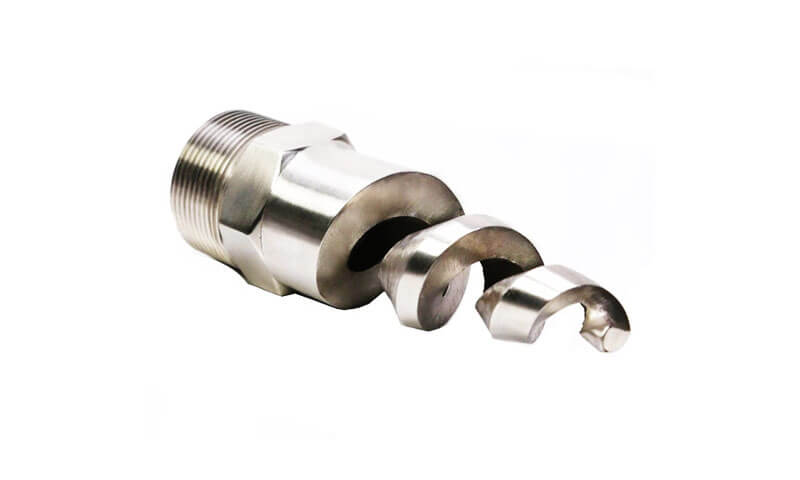
Stainless steel spiral nozzles are among the most efficient and reliable spray components used across modern industrial systems.
Unlike conventional spray nozzles that rely on complex internal vanes or precision-drilled passages, spiral nozzles generate highly uniform spray patterns through an open helical geometry.
This unique design provides excellent atomization, wide spray coverage, superior clogging resistance, and low pressure loss, making spiral nozzles ideal for applications involving contaminated liquids, ilma li jkessaħ, chemical solutions, drenaġġ, and slurry.
Ikkastjar ta 'investiment, magħruf ukoll bħala Tidwib tax-xama 'mitluf, has therefore become one of the preferred manufacturing processes for stainless steel spiral nozzles.
The process enables manufacturers to produce complex near-net-shape components with excellent dimensional accuracy, smooth surface quality, and minimal machining.
Combined with corrosion-resistant stainless steel alloys such as CF‑3(304L), CF‑8M(316), and CF‑3M(316L), investment-cast spiral nozzles deliver long service life even in aggressive industrial environments.
1. What Is a Stainless Steel Spiral Nozzle?
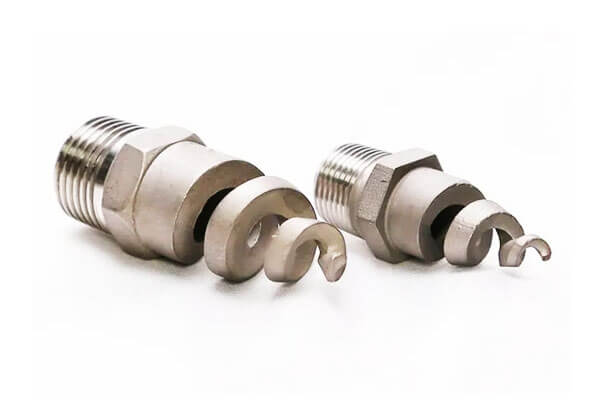
A stainless steel Żennuna spirali is a specialized spray nozzle designed with one or more continuous helical vanes that force liquid into a controlled spiral motion as it exits the nozzle.
This open-flow design produces either a Full-Cone jew Hollow-Cone
Compared with conventional spray nozzles, spiral nozzles are particularly valued for their ability to handle liquids containing suspended solids or particulate matter while maintaining consistent spray performance.
Their self-cleaning characteristics and low clogging tendency make them widely used in demanding industrial environments where reliability and minimal maintenance are essential.
Definizzjoni
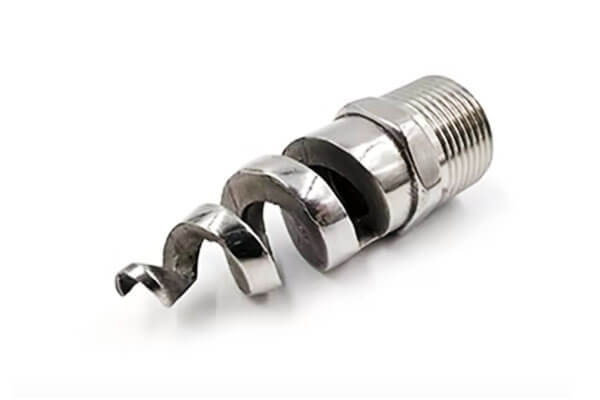
A spiral nozzle is a one-piece precision component consisting of a threaded body and an external or internal helical vane.
As liquid passes through the spiral structure, it accelerates outward under centrifugal force, forming a uniform conical spray pattern.
Unlike pressure atomizing nozzles with enclosed swirl chambers, the spiral nozzle features an open-channel design that minimizes flow restriction and significantly reduces the likelihood of blockage.
Typical design characteristics include:
- Open spiral flow path
- Uniform liquid distribution
- Low pressure loss
- Large free-flow passage
- Excellent anti-clogging capability
- One-piece stainless steel construction
- Wide range of spray angles (typically 60°–170°)
Because of these features, spiral nozzles are commonly selected for continuous industrial service where reliability is more important than producing extremely fine atomization.
How a Spiral Nozzle Works
The operating principle of a spiral nozzle is based on centrifugal acceleration and controlled fluid dynamics rather than mechanical atomization devices.
The spray generation process can be summarized as follows:
- Liquid enters the threaded inlet under system pressure.
- The fluid flows through the precisely designed spiral vane.
- The helical geometry forces the liquid into a rotational motion.
- Centrifugal force spreads the liquid radially outward.
- As the liquid exits the nozzle, it forms a stable conical spray.
- The liquid sheet breaks into droplets due to surface tension instability and aerodynamic forces.
Depending on the spiral geometry, nozzle size, and operating pressure, the nozzle may produce:
- Full cone spray
- Hollow cone spray
- Multi-layer conical spray
- Uniform circular coverage
Because the flow passage remains completely open, suspended particles can pass through the nozzle with minimal risk of clogging.
Main Structural Components
Although spiral nozzles appear simple, every structural element influences hydraulic performance and spray quality.
| Komponent | Funzjoni |
| Threaded connection | Connects the nozzle to pipelines, manifolds, or spray headers. Common standards include BSPT, BSPP, Npt, and metric threads. |
| Nozzle body | Provides structural strength and supports the spiral vane. |
| Spiral vane | Generates centrifugal flow and determines spray angle, flow distribution, and droplet formation. |
| Flow channel | Directs liquid through the spiral while minimizing pressure loss. |
| Discharge outlet | Controls the final spray geometry and exit velocity. |
| Thread sealing surface | Ensures leak-free installation under operating pressure. |
The entire component is typically manufactured as a single casting, eliminating welded joints and improving both mechanical integrity and corrosion resistance.
2. Why Choose Stainless Steel for Spiral Nozzles?
Material selection is one of the most critical factors affecting the performance, affidabilità, and service life of industrial spray nozzles.
Spiral nozzles often operate under harsh conditions involving corrosive chemicals, temperaturi għoljin, demel likwidu li joborxu, ilma baħar, drenaġġ, or continuous high-pressure spraying.
Bħala riżultat, the nozzle material must provide an optimal balance of corrosion resistance, Qawwa mekkanika, Reżistenza għall-ilbies, u l-manifattura.
Reżistenza eċċellenti għall-korrużjoni
The most significant advantage of azzar li ma jissaddadx is its ability to resist corrosion in aggressive environments.
| Ambjent | Stainless Steel Performance | Għaliex hija importanti |
| Ipproċessar kimiku | Excellent resistance to acids, Alkali, u solventi. | Nozzles maintain precision; no contamination; ħajja twila ta 'servizz. |
| Ilma baħar / Marine | 316L resists pitting and crevice corrosion. | Critical for desalination, Offshore, and shipboard applications. |
| Ipproċessar tal-ikel | FDA-approved grades (304L, 316L) resist food acids and sanitizers. | Iġjene; no metallic taste; complies with food safety regulations. |
Temperatura għolja |
Austenitic grades maintain strength to 800°C. | Essential for steam cleaning, Skambjaturi tas-sħana, and hot gas applications. |
| Aċiduż / midja aggressiva | 316L, 904L, and duplex grades offer resistance to sulfuric, idrokloriku, and other acids. | Prevents nozzle degradation; maintains spray performance. |
Qawwa mekkanika għolja
Industrial spray systems may operate continuously at pressures ranging from 0.2 MPa to more than 2.5 MPA, while high-pressure cleaning systems can exceed 10 MPA
Typical mechanical advantages include:
- High structural rigidity
- Reżistenza eċċellenti għall-għeja
- Resistance to deformation under pressure
- Long service life under cyclic loading
Outstanding Temperature Resistance
Many industrial processes involve elevated operating temperatures.
Depending on the stainless steel grade, spiral nozzles can withstand temperatures ranging from cryogenic conditions to approximately 800–900 ° C.
Applikazzjonijiet tipiċi jinkludu:
- Furnace cooling
- Desulfurizzazzjoni tal-gass taċ-ċumnija
- Continuous casting cooling
- Steel rolling mills
- Boiler systems
- Reatturi kimiċi
Reżistenza eċċellenti għall-ilbies
Liquids containing suspended solids, sand particles, or mineral slurries can gradually erode nozzle surfaces.
Although stainless steel is not as hard as certain wear-resistant alloys, investment-cast stainless steel nozzles exhibit good resistance to:
- Slurry erosion
- Water jet wear
- Particle impingement
- Cavitation damage
For particularly abrasive environments, martensitic stainless steels or surface-hardening treatments may further improve service life.
Superior Hygienic Properties
- Non-porous surface jipprevjeni t-tkabbir tal-batterja.
- Faċli biex tnaddaf (CIP/SIP compatible).
- No coating or plating required—eliminates flaking or chipping.
3. Why Investment Casting Is Ideal for Spiral Nozzles
Manufacturing a stainless steel spiral nozzle is considerably more demanding than producing ordinary pipe fittings or simple spray components.
Its performance depends on the precise formation of three-dimensional helical vanes, smooth internal flow passages, Taqsimiet b'ħajt irqiq, and accurate threaded connections.
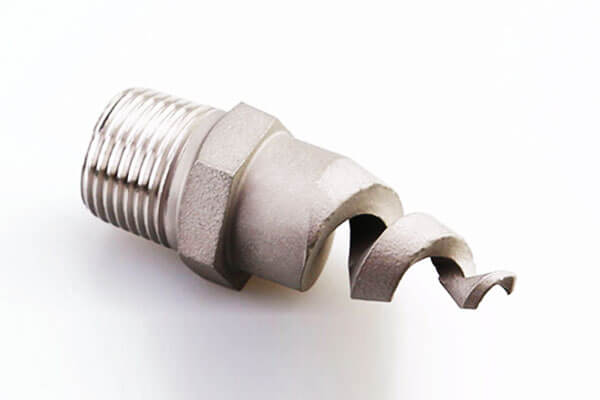
Even slight deviations in geometry can alter spray angle, rata tal-fluss, droplet distribution, and pressure characteristics.
Among the available manufacturing methods, ikkastjar ta 'investiment (Tidwib tax-xama 'mitluf) offers the best balance of geometric freedom, Preċiżjoni dimensjonali, material utilization, u l-effiċjenza tal-produzzjoni.
Manufacturing Process Comparison
Each manufacturing process has unique strengths and limitations.
| Kriterju | Casting ta' Investiment | Makkinar CNC | Ikkastjar tar-ramel |
| Internal flow path complexity | Eċċellenti (complex helical passages achievable) | Limited by cutting tool accessibility | Moderat |
| Eżattezza dimensjonali | ± 0.10–0.30 mm | ± 0.01–0.05 mm | ±0.50–1.00 mm |
| Typical surface roughness (Ra) | 1.6–6.3 μm | 0.4–3.2 μm | 6.3–25 μm |
| Użu tal-materjal | 85–95% | 30–60% | 60–80% |
| Investiment ta 'għodda | Moderat - għoli | Baxx | Moderat baxx |
| Kost unitarju (100–1,000 pcs/year) | Moderat baxx | Moderat - għoli | Baxx |
| Internal core capability | Eċċellenti (ceramic cores) | Not feasible | Limitat |
| Flessibilità tal-liga | Very wide | Wiesa ' | Wiesa ' |
4. Investment Casting Manufacturing Process
Producing a high-quality stainless steel spiral nozzle requires rigorous control throughout every stage of the investment casting process.
Because spray performance depends on dimensional accuracy and internal geometry, each manufacturing step directly influences the final product’s hydraulic characteristics and mechanical integrity.
The complete production workflow typically includes the following stages.
| Stadju | Pass | Key Detail |
| 1 | Pattern production | Wax injection into precision die replicating nozzle geometry (including spiral vane core). |
| 2 | Core assembly | Ceramic or soluble wax cores inserted for internal helical passages. |
| 3 | Tree assembly | Multiple wax patterns attached to central sprue. |
| 4 | Bini tal-qoxra | 6‑10 layers of ceramic slurry (Sol tas-Silika) + stucco (zircon/alumina). |
| 5 | Dewaxing | Steam autoclave melts wax; shell remains hollow. |
| 6 | Shell firing | Fired at 900‑1100°C to strengthen ceramic and remove volatiles. |
7 |
Stainless steel melting | Induction melting at 1550‑1650°C. |
| 8 | Tferrigħ | Molten steel poured into pre-heated shell. |
| 9 | Tkessiħ & knockout | Tkessiħ ikkontrollat; shell removed by vibration or water jet. |
| 10 | Cut-off & irfinar | Gates and risers cut; tħin, Shot Blasting, Tumbling. |
| 11 | Trattament tas-sħana | Tnaqqis tas-soluzzjoni (1040‑1100°C) + Quench tal-ilma. |
| 12 | Spezzjoni & ittestjar | Viżwali, dimensjonali, Ndt (X-ray, żebgħa penetrant), flow testing. |
5. Surface Treatments and Finishing Options
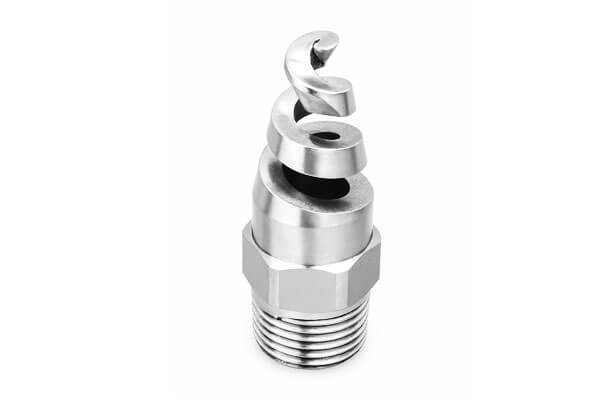
Although investment casting produces stainless steel spiral nozzles with excellent dimensional accuracy and an as-cast surface finish of Ra 1.6–6.3 μm, post-casting surface treatments are often applied to further improve corrosion resistance, Indafa, Ilbes il-prestazzjoni, u l-ħajja tas-servizz.
The optimal finishing process depends on the operating environment, fluid characteristics, and industry-specific requirements.
Pickling
Il-pickling ineħħi l-iskala tal-ossidu, lewn tas-sħana, and surface contamination generated during casting and heat treatment through controlled acid cleaning.
Typical Process
- Aċidu nitriku + hydrofluoric acid solution
- Treatment temperature: 20–60 ° C.
- Treatment time: 10–40 minutes
Benefiċċji
- Removes oxide scale and casting discoloration
- Restores clean metallic surface
- Ittejjeb ir-reżistenza għall-korrużjoni
- Provides an ideal surface for passivation
Applikazzjonijiet tipiċi
- Ipproċessar kimiku
- Tagħmir tal-baħar
- Industrial spray systems
- General-purpose stainless steel components
Passivazzjoni
Passivation is considered the standard finishing process for stainless steel spiral nozzles.
Instead of adding a coating, it chemically removes free iron contamination and enhances the chromium-rich passive oxide film.
Typical Process
- Aċidu nitriku (20–25%) or citric acid solution
- 40–60 ° C.
- 20–30 minuta
Benefiċċji
- Maximizes corrosion resistance
- Improves pitting resistance
- Reduces surface contamination
- Extends service life
Materjali xierqa
- CF8 / 304
- Cf8m / 316
- CF3
- Cf3m
- Azzar li ma jissaddadx duplex
Elettropolizzazzjoni
Electropolishing is an electrochemical polishing process that dissolves microscopic surface asperities, producing an ultra-smooth, highly passive surface.
Typical Material Removal
- 10–50 μm
Finitura tal-wiċċ tipika
- Ra <0.8 μm
- High-end sanitary applications may achieve Ra <0.4 μm
Benefiċċji
- Significantly reduces surface roughness
- Ittejjeb ir-reżistenza għall-korrużjoni
- Enhances cleanability
- Reduces bacterial adhesion
- Minimizes scaling and fouling
- Improves internal flow efficiency
Applikazzjonijiet tipiċi
- Tagħmir farmaċewtiku
- Ipproċessar tal-ikel
- Bijoteknoloġija
- Semiconductor manufacturing
- Ultra-clean chemical systems
Glass Bead Blasting
Glass bead blasting uses spherical glass media to clean and texture the casting surface without significantly removing base material.
Finitura tal-wiċċ tipika
- Ra 2.5–5.0 μm
Benefiċċji
- Produces a uniform satin appearance
- Removes minor surface imperfections
- Eliminates casting discoloration
- Maintains dimensional accuracy
Applikazzjonijiet tipiċi
- Żennuni tal-isprej industrijali
- Decorative stainless steel components
- Ħardwer arkitettoniku
Illustrar mekkaniku
Mechanical polishing employs abrasive belts, polishing wheels, and buffing compounds to improve both appearance and surface smoothness.
Finitura tal-wiċċ tipika
- RA 0.8-1.6 μm
Benefiċċji
- Bright metallic appearance
- Reduced surface roughness
- Improved cleanliness
- Suitable preparation for mirror polishing or electropolishing
Applikazzjonijiet tipiċi
- Tagħmir tal-ikel
- Decorative products
- High-end industrial equipment
Lustrar tal-mera
Mirror polishing produces an extremely smooth, reflective surface by progressively refining the polished finish.
Finitura tal-wiċċ tipika
- Ra ≤0.1 μm
Benefiċċji
- Outstanding aesthetic appearance
- Minimal particle adhesion
- Excellent hygienic performance
- Simplified cleaning and sterilization
Applikazzjonijiet tipiċi
- Tagħmir farmaċewtiku
- Laboratory instruments
- High-purity processing systems
- Premium sanitary spray nozzles
Kisi PTFE
Ptfe (Polytetrafluoroethylene) coating provides a low-friction, non-stick surface that significantly reduces material adhesion.
Ħxuna tipika tal-kisi
- 10–25 μm
Benefiċċji
- Extremely low coefficient of friction
- Excellent non-stick properties
- Reduces fouling and scaling
- Improves chemical resistance
- Facilitates easier cleaning
Applikazzjonijiet tipiċi
- Sticky liquids
- Demel likwidu
- Resin spraying
- Trattament tad-Drenaġġ
- Ipproċessar tal-ikel
Kisi PVD
Depożizzjoni tal-fwar fiżiku (PVD) deposits a dense ceramic-like coating onto the stainless steel surface under vacuum conditions.
Common coating materials include:
- Landa (Nitride tat-titanju)
- Ticn
- Crn
- Deheb
Ħxuna tipika tal-kisi
- 1–5 μm
Benefiċċji
- Extremely high surface hardness
- Reżistenza għall-ilbies superjuri
- Excellent erosion resistance
- Improved chemical stability
- Decorative metallic colors
Applikazzjonijiet tipiċi
- Abrasive media spraying
- High-pressure nozzles
- Mining equipment
- Industrial wear components
6. Common Manufacturing Challenges and Solutions
Manufacturing stainless steel spiral nozzles by investment casting requires much tighter process control than producing conventional cast components.
Il-kombinazzjoni ta ' thin spiral vanes, complex internal flow passages, small outlet diameters, threaded connections,
and strict hydraulic performance requirements means that even minor casting defects can significantly affect spray angle, rata tal-fluss, pressure distribution, u l-ħajja tas-servizz.
| Sfida | Root Cause | Soluzzjoni |
| Ċaqliq tal-qalba (spiral vane misalignment) | Core movement during pouring. | Improved core support; more precise core placement. |
| Porożità tal-gass | Dissolved gases; poor deoxidation. | Degassing bil-vakwu; use clean charge; improve pouring practice. |
| Jinxtorob il-porożità | Insufficient feeding; poor riser design. | Optimise gating/risering; use chills; simulate solidification. |
| Internal surface roughness | Qsim tal-qoxra; core surface finish. | Improve shell integrity; use finer primary coat; polish core. |
Dimensional deviation |
Wax shrinkage variation; shell expansion. | Controlled wax injection; maintain die condition. |
| Tiċrit jaħraq | Tensile stress during solidification; shell constraint. | Reduce pouring temperature; improve shell collapsibility. |
| Thread distortion | Casting shrinkage; handling damage. | Use thread inserts; machine threads post-casting. |
7. Material Selection for Investment Cast Spiral Nozzles
Selecting the appropriate stainless steel alloy is one of the most important engineering decisions in spiral nozzle design.
Material choice directly influences corrosion resistance, pressure capability, Reżistenza għall-ilbies, service temperature, fabrication cost, and expected service life.
| ASTM Cast Grade | Us | Equivalent Wrought Grade | Mikrostruttura | Vantaġġi primarji | Applikazzjonijiet tipiċi |
| CF8 | J92600 | 304 | Austenitic | Reżistenza ġenerali eċċellenti għall-korrużjoni; Ekonomiku | Sistemi tal-ilma, HVAC, general industrial spraying |
| CF3 | J92500 | 304L | Low-carbon austenitic | Weldability superjuri; reduced sensitization | Ipproċessar tal-ikel, hygienic equipment |
| Cf8m | J92900 | 316 | Mo-bearing austenitic | Improved chloride and chemical resistance | Marine, Ipproċessar kimiku, Farmaċewtiku |
| Cf3m | J92800 | 316L | Low-carbon Mo-bearing austenitic | Excellent corrosion resistance after welding | Offshore equipment, Pjanti tad-desalinizzazzjoni |
Cn7m |
J95150 | Liga 20 | Ni-Cr-Mo-Cu austenitic | Outstanding resistance to sulfuric and phosphoric acids | Acid handling, fertilizzant, Petrokimiċi |
| CD3MN | J92205 | Duplex 2205 | Duplex (Austenite + Ferrite) | Saħħa għolja; excellent chloride SCC resistance | Sistemi tal-ilma baħar, pjattaformi barra mill-kosta |
| CB7CU-1 | J92180 | 17-4 PH | It-twebbis tal-preċipitazzjoni | Very high strength and good corrosion resistance | High-pressure spray systems, wear-resistant nozzles |
8. Industrial Applications of Stainless Steel Spiral Nozzles
Thanks to their uniform full-cone spray pattern, clog-resistant design, Reżistenza eċċellenti għall-korrużjoni, u ħajja twila ta 'servizz,
stainless steel spiral nozzles are widely used across industries requiring reliable liquid distribution, Tkessiħ, tindif, soppressjoni tat-trab, gas absorption, u bexx kimiku.
Industrija tal-Ipproċessar Kimiku
Chemical plants often handle aggressive media such as acids, Alkali, Solventi, and corrosive gases.
Spiral nozzles are widely employed for liquid distribution and gas-liquid contact processes.
Applikazzjonijiet tipiċi
- Acid dilution systems
- Reactor spraying
- Tank cleaning
- Chemical mixing
- Gas scrubbing towers
- Neutralization equipment
Recommended Materials
- Cf8m (Mitfugħa 316)
- Cf3m (Cast 316L)
- Cn7m (Liga 20)
Industrija tal-Ikel u x-Xorb
Food-grade spray systems require hygienic surfaces, tindif faċli, and compliance with sanitary regulations.
Investment-cast stainless steel nozzles can be electropolished to minimize bacterial adhesion and facilitate cleaning.
Applikazzjonijiet tipiċi
- CIP (Clean-in-Place) sistemi
- Bottle washing
- Conveyor cleaning
- Tnixxef bl-isprej
- Food coating
- Fruit and vegetable washing
Recommended Materials
- CF3 (304L)
- Cf3m (316L)
Pharmaceutical and Biotechnology
In pharmaceutical production, spray nozzles must maintain ultra-clean conditions while supporting sterilization and contamination control.
Applikazzjonijiet tipiċi
- Vessel cleaning
- Tablet coating
- Fluidized bed processing
- Tnixxef bl-isprej
- Sterile washing systems
Recommended Materials
- Cf3m (316L)
Inġinerija tal-Baħar u Offshore
Seawater is highly corrosive due to its chloride content, requiring materials with exceptional resistance to pitting and stress corrosion cracking.
Applikazzjonijiet tipiċi
- Seawater cooling
- Fire suppression systems
- Ballast water treatment
- Deck washing
- Offshore platform cleaning
Recommended Materials
- Cf8m (316)
- CD3MN (Duplex 2205)
Ġenerazzjoni tal-Enerġija
Power plants employ spiral nozzles in cooling, kontroll ambjentali, and steam conditioning systems where stable performance under elevated temperatures is essential.
Applikazzjonijiet tipiċi
- Torrijiet tat-Tkessiħ
- Desulfurizzazzjoni tal-gass taċ-ċumnija (FGD)
- Steam conditioning
- Boiler cleaning
- Soppressjoni tat-trab
Recommended Materials
- CF8
- Cf8m
Environmental Protection and Pollution Control
Modern environmental systems rely heavily on efficient spray technology to improve pollutant removal and process efficiency.
Applikazzjonijiet tipiċi
- Wet scrubbers
- Desulfurizzazzjoni tal-gass taċ-ċumnija
- Soppressjoni tat-trab
- Odor control
- Waste gas treatment
Recommended Materials
- Cf8m
- CD3MN (Duplex 2205)
Industrija tal-polpa u tal-karti
Paper mills expose spray equipment to highly corrosive bleaching chemicals and abrasive slurries.
Applikazzjonijiet tipiċi
- Bleach plants
- Chemical recovery
- Pulp washing
- Process cleaning
- Fiber washing
Recommended Materials
- Cn7m (Liga 20)
- Azzar li ma jissaddadx duplex
Trattament tal-Ilma u l-Ilma Mormi
Municipal and industrial water treatment facilities depend on reliable spray systems for aeration, disinfection, Doża kimika, u tindif.
Applikazzjonijiet tipiċi
- Aeration systems
- Filter cleaning
- Chemical dosing
- Tank washing
- Disinfection
Recommended Materials
- CF8
- Cf8m
Industrija taż-Żejt u tal-Gass
Oil and gas operations often involve high-pressure systems, fluwidi korrużivi, u kundizzjonijiet ambjentali ħorox.
Applikazzjonijiet tipiċi
- Tank cleaning
- Pipeline flushing
- Gas dehydration
- Sistemi ta 'tkessiħ
- Offshore processing
Recommended Materials
- Cf8m
- CD3MN (Duplex 2205)
Agrikoltura u irrigazzjoni
Spiral nozzles are also widely used in agricultural spraying because they produce large droplets with uniform coverage while minimizing clogging.
Applikazzjonijiet tipiċi
- Crop irrigation
- Greenhouse humidification
- Livestock cooling
- Fertilizer spraying
- Soppressjoni tat-trab
Recommended Materials
- CF8
9. Industrial Advantages of Investment-Cast Spiral Nozzles
| Vantaġġ | Spjegazzjoni |
| Superior spray performance | Precision‑cast internal geometry ensures consistent swirl, atomizzazzjoni, u l-angolu tal-isprej. |
| Long service life | Stainless steel construction resists corrosion, erożjoni, u ilbes. |
| Manutenzjoni baxxa | Large internal passages reduce clogging; self‑cleaning design. |
| Pressure integrity | Sound castings withstand high pressures (sa 100+ bar). |
| Reżistenza għat-temperatura | Austenitic grades withstand temperatures to 800°C. |
| Iġjene | Lixx, non‑porous surfaces; electropolishing option for ultra‑clean applications. |
| Flessibilità tal-liga | Cast in all common stainless steel and duplex grades. |
| Cost‑effectiveness | Investment casting reduces machining waste and production cost for complex geometries. |
| Customisation | Easy to produce custom spray angles, rati tal-fluss, and connection types. |
10. Stainless Steel Spiral Nozzle vs Other Spray Nozzles
Spray nozzle selection has a direct impact on process efficiency, fluid distribution quality, Konsum tal-enerġija, u rekwiżiti ta' manutenzjoni.
Although many nozzle designs are available—including hollow cone, konu sħiħ, and flat fan nozzles—stainless steel spiral nozzles manufactured by investment casting offer a unique combination of excellent atomization, wide flow capability, Reżistenza għall-imblukkar, and structural durability.
| Performance Criterion | Żennuna spirali | Żennuna tal-konu vojta | Żennuna sħiħa tal-kon | Żennuna tal-fann ċatt |
| Disinn tal-isprej | Konu sħiħ | Hollow cone | Konu sħiħ | Flat fan |
| Spray formation mechanism | Spiral turbulence and rotational flow | Tangential or internal swirl chamber | Internal vane or swirl mechanism | Narrow slit orifice |
| Atomization performance | Eċċellenti | Tajjeb | Tajjeb | Eċċellenti |
| Daqs tal-qtar | Fin għal medju | Medju | Medju | Multa |
| Clogging resistance | Eċċellenti | Moderat | Moderat | Baxx |
| Internal passage size | Kbir, open spiral channel | Medju | Medju | Small precision orifice |
| Qatra pressjoni | Moderat baxx | Moderat | Moderat | Għoli |
| Sprej uniformità | Tajjeb ħafna | Tajjeb | Tajjeb | Excellent along spray line |
| Flow rate range | Very wide | Moderat | Moderat | Wiesa ' |
| Coverage shape | Circular | Annular ring | Circular | Lineari |
| Self-cleaning capability | IVA | Nru | Nru | Nru |
| Moving parts | Xejn | Xejn | Xejn | Xejn |
| Maintenance requirement | Baxx | Medju | Medju | Għoli |
| Typical industries | Kimika, ikel, Marine, drenaġġ | Protezzjoni tan-nar, Tkessiħ | Ħasil, tindif, Kontroll tat-trab | Kisi, pittura, cutting fluids |
11. Custom Manufacturing Services
Investment casting provides exceptional flexibility for producing customized stainless steel spiral nozzles according to specific industrial requirements.
Unlike standard machined nozzles, investment casting enables the production of complex internal spiral flow channels, integrated structures, and precision geometries that are difficult or impossible to manufacture through conventional machining methods.
As a professional investment casting manufacturer, LangHe provides complete OEM and custom manufacturing solutions for stainless steel spiral nozzles,
supporting customers from initial design optimization and material selection to prototype development, ikkastjar ta 'preċiżjoni, Irfinar tal-wiċċ, Spezzjoni, and mass production.
With advanced investment casting capabilities and extensive experience in stainless steel alloys, LangHe helps customers develop nozzles that achieve optimized spray performance, ħajja twila ta 'servizz, and reliable operation in demanding environments.
LangHe Customized Stainless Steel Spiral Nozzle Solutions
| Customization Item | Available Options / Dettalji |
| Angolu tal-isprej | 30°–180° (common designs: 60°, 90°, 120°) |
| Rata tal-fluss | 0.1–200+ L/min depending on orifice size and pressure |
| Connection type | Npt, BSP, BSPT, BSPP, metric threads, flanged connections, custom fittings |
| Material grades | CF‑8(304), CF‑3(304L), CF‑8M(316), CF‑3M(316L), 904L, Duplex 2205, Super Duplex, 17-4PH, Liga 20 |
| Finitura tal-wiċċ | Kif mitfugħa, imnaddfin, passivat, elettropolizzat, mechanically polished, PVD coated |
Disinn tal-isprej |
Konu sħiħ, customized cone angle, special distribution patterns |
| Internal geometry | Customized spiral vane design, optimized flow channels |
| Wear protection | Kisi iebes, wear-resistant inserts, special alloys |
| Anti-clogging features | Enlarged passages, integrated filters, optimized spiral structures |
| Connection design | Custom mounting threads, special adapters, OEM interfaces |
12. Konklużjoni
Stainless steel spiral nozzles are key core components for industrial environmental protection, energy and chemical spray systems, and investment casting has become the most reliable, high-precision and cost-effective manufacturing solution for such products.
By overcoming the inherent defects of traditional sand casting, machining assembly and welding processes, investment casting realizes integrated near-net-shape forming, high-purity dense metallurgical structure, ultra-smooth spiral flow channel and excellent corrosion resistance of stainless steel spiral nozzles.
Through standardized process control, targeted defect prevention and professional material heat treatment optimization, investment-cast stainless steel spiral nozzles achieve accurate spray performance, long service life and stable batch quality,
fully meeting the strict working condition requirements of desulfurization, dust removal, cooling and gas purification fields.
With the continuous upgrading of intelligent casting technology and new alloy materials, investment casting will further break through the technical bottleneck of complex spiral precision forming,
continuously improve the comprehensive performance of nozzle products, and become the mainstream manufacturing process for global high-end industrial spray nozzles, empowering the high-quality development of modern environmental protection and industrial fluid systems.
FAQs
Why is investment casting the best process for stainless steel spiral nozzles?
A: Spiral nozzles require an integral complex three-dimensional spiral flow channel, smooth internal surface and high dimensional accuracy.
Investment casting achieves seamless one-piece forming, ultra-smooth flow channel surfaces and CT4–CT6 precision, avoiding weld corrosion, assembly leakage and rough surface defects of traditional processes.
No other mass production process can match its combination of quality and economy.
What is the difference between a spiral nozzle and a conventional full cone nozzle?
A spiral nozzle uses a helical internal flow path to impart swirling motion, producing finer atomization and more uniform spray distribution.
Conventional full cone nozzles use a simpler internal design and may produce coarser droplets.
Can investment‑cast spiral nozzles be used for abrasive fluids?
IVA, especially when made from hardened stainless steel grades (17--4ph) or with wear‑resistant coatings. The large internal passages also reduce clogging from suspended solids.
How do I clean a spiral nozzle?
The self‑cleaning design reduces maintenance. For occasional cleaning, soak in a suitable solvent or use ultrasonic cleaning. Avoid mechanical cleaning that could damage the internal flow path.
Can the spray angle be customised?
IVA. Spray angles from 30° to 180° are available through custom tooling.

