In modern fluid handling systems, nozzle design plays a decisive role in controlling flow characteristics, improving discharge efficiency, and ensuring long-term operational reliability.
Among various industrial nozzle designs, il stainless steel duckbill nozzle has become a preferred solution for demanding applications requiring excellent corrosion resistance, Qawwa mekkanika għolja, and precise fluid distribution.
Unlike conventional machined or fabricated nozzles, investment-cast stainless steel duckbill nozzles enable manufacturers to produce complex internal flow passages, transizzjonijiet bla xkiel, and near-net-shape geometries with exceptional dimensional accuracy.
The process minimizes machining requirements while improving structural integrity and reducing production costs for medium- and high-volume manufacturing.
1. What Is a Stainless Steel Duckbill Nozzle?
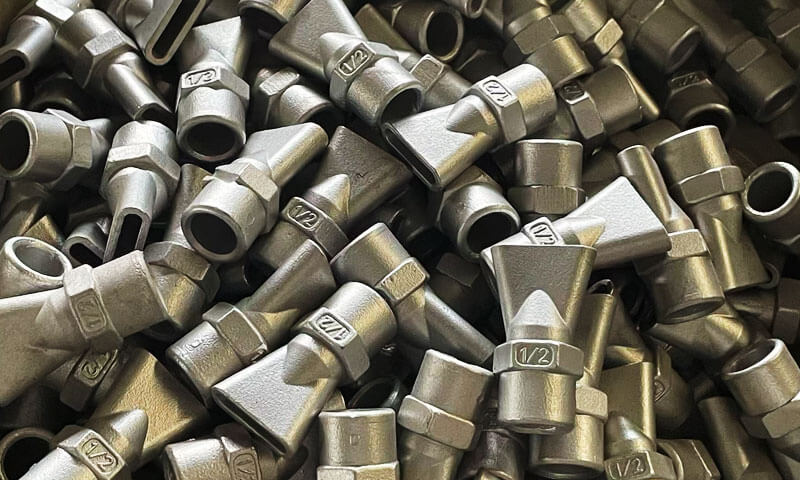
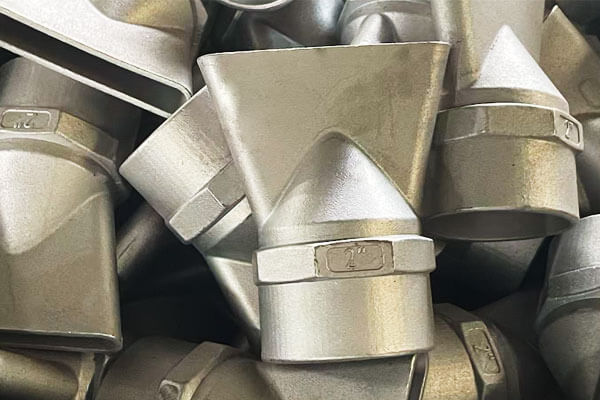
A stainless steel duckbill Żennuna is a precision-engineered fluid outlet component characterized by a flattened, tapered discharge opening resembling the shape of a duck’s bill.
This distinctive geometry is specifically designed to control the velocity, direzzjoni, and distribution of liquids or gases while minimizing turbulence and pressure loss.
Compared with conventional round nozzles, duckbill nozzles produce a wider and more uniform spray or discharge pattern, making them highly effective in applications that require controlled fluid dispersion.
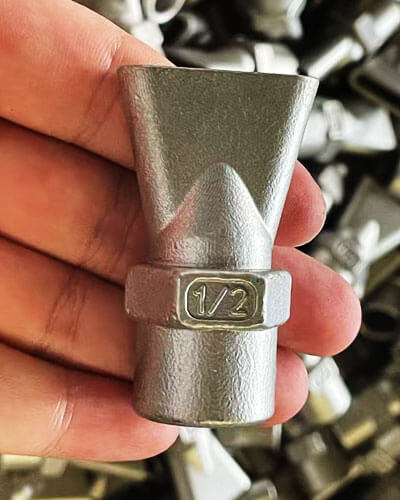
Unlike flexible rubber duckbill valves that function as one-way check valves, stainless steel duckbill nozzles are rigid metallic components manufactured for high-strength industrial environments.
They are commonly produced by ikkastjar ta 'investiment, followed by precision CNC machining to achieve tight dimensional tolerances and excellent sealing or connection accuracy.
The internal flow passage is carefully engineered to provide a smooth transition from the inlet to the outlet.
This streamlined design reduces hydraulic resistance, suppresses flow separation, and improves energy efficiency.
Jiddependi fuq l-applikazzjoni, the nozzle may be designed to generate fan-shaped, flat-sheet, or directional flow patterns while maintaining stable discharge characteristics.
Stainless steel duckbill nozzles are available in various configurations, including threaded, flanged, sokit-weldjatura, and custom connection types.
Their geometry can also be optimized according to flow rate, pressjoni operattiva, installation space, and media characteristics, making them suitable for both standard and highly specialized industrial systems.
2. Why Choose Stainless Steel for Duckbill Nozzles?
Material selection is one of the most important engineering decisions in duckbill nozzle design.
Since the nozzle is continuously exposed to flowing media, Fluttwazzjonijiet tal-pressjoni, temperature changes, and often corrosive environments, the material must provide an optimal balance of strength, Reżistenza għall-korrużjoni, manifattura, u l-ħajja tas-servizz.
Among numerous engineering materials, stainless steel has become the industry standard because of its outstanding overall performance.
Reżistenza eċċellenti għall-korrużjoni
The primary advantage of stainless steel is its ability to resist corrosion in a wide variety of operating environments.
Chromium in the alloy forms a thin, self-healing passive oxide film that protects the surface from oxidation and chemical attack.
Qawwa mekkanika għolja
Industrial nozzles frequently operate under elevated pressures and continuous fluid impact.
Stainless steel provides excellent tensile strength, saħħa tar-rendiment, u reżistenza għall-għeja, enabling the nozzle to maintain dimensional stability even after prolonged service.
The combination of strength and toughness minimizes deformation, qsim, and mechanical failure under demanding operating conditions.
Excellent Wear and Erosion Resistance
Many process fluids contain suspended particles that gradually erode internal flow passages.
Stainless steel exhibits excellent resistance to abrasion and erosion, allowing the nozzle to maintain its designed flow characteristics for extended periods.
This is particularly valuable in mining, immaniġġjar tad-demel likwidu, Trattament tad-Drenaġġ, and industrial cleaning applications.
Wide Operating Temperature Range
Stainless steel maintains stable mechanical properties across a broad temperature range.
Austenitic grades retain excellent toughness at low temperatures while offering good oxidation resistance at elevated temperatures.
This versatility enables stainless steel duckbill nozzles to serve applications involving hot water, fwar, process fluids, or outdoor installations exposed to varying climates.
Hygienic and Easy-to-Clean Surface
The smooth, dense surface of stainless steel minimizes contamination and facilitates cleaning.
When combined with passivation or electropolishing, the surface becomes even more resistant to bacterial adhesion and product buildup, making stainless steel the preferred material for sanitary industries such as food processing, Farmaċewtiċi, and biotechnology.
Excellent Fabrication Characteristics
Stainless steel is highly compatible with investment casting, Magni ta 'preċiżjoni, iwweldjar, illustrar, and surface finishing processes.
This manufacturing flexibility allows engineers to design complex nozzle geometries without compromising structural integrity or dimensional accuracy.
3. Material Selection for Stainless Steel Duckbill Nozzles
Selecting the appropriate stainless steel grade requires a thorough evaluation of operating conditions, including the process medium, chloride concentration, temperatura, pressjoni, veloċità tal-fluss, and expected service life.
No single alloy is suitable for every application, and the optimal choice depends on balancing performance requirements with manufacturing cost.
| Material Grade | Ekwivalenti | Main Characteristics | Applikazzjonijiet tipiċi |
| CF8 | Mitfugħa 304 Stainless Steel | Reżistenza ġenerali għall-korrużjoni, Makkinabilità eċċellenti, Ekonomiku | Trattament tal-ilma, HVAC, Tagħmir industrijali |
| Cf8m | Mitfugħa 316 Stainless Steel | Superior chloride and chemical corrosion resistance due to molybdenum | Inġinerija tal-Baħar, Ipproċessar kimiku, desalinizzazzjoni |
| CF3 | Cast 304L Stainless Steel | Kontenut baxx ta 'karbonju, Weldabilità eċċellenti, reduced intergranular corrosion | Ipproċessar tal-ikel, Tagħmir farmaċewtiku |
Cf3m |
Cast 316L Stainless Steel | Low-carbon version of CF8M with enhanced corrosion resistance after welding | High-purity process systems, Bijoteknoloġija |
| Azzar li ma jissaddadx duplex | ASTM A890 Grad 4A (2205) | High strength and excellent resistance to pitting and stress corrosion cracking | Pjattaformi barra mill-kosta, Sistemi tal-ilma baħar, żejt & gass |
| Azzar Stainless Super Duplex | ASTM A890 Grade 5A/6A (2507) | Exceptional corrosion resistance and superior mechanical strength | Highly aggressive marine and chemical environments |
4. Why Investment Casting Is Ideal for Duckbill Nozzles
Superior Design Freedom
Duckbill nozzles often feature streamlined internal passages, tapered outlets, and irregular external geometries that are difficult to manufacture using conventional machining alone.
Investment casting enables these complex shapes to be formed directly, allowing engineers to optimize flow paths while reducing design constraints.
Eżattezza dimensjonali għolja
Investment casting produces near-net-shape components with excellent dimensional consistency and tight tolerances.
Critical features such as sealing surfaces, mounting interfaces, and connection areas require minimal finish machining, improving assembly precision and reducing manufacturing costs.
Finish tal-wiċċ lixx
The investment casting process delivers a much finer surface finish than conventional sand casting.
Smooth internal flow channels reduce flow resistance, jimminimizzaw it-taqlib, and improve fluid distribution efficiency, while also lowering the amount of post-processing required.
Versatilità tal-Materjal
Investment casting supports a wide range of stainless steel alloys, inkluż CF8, Cf8m, CF3, Cf3m, duplex, and super duplex stainless steels.
Manufacturers can therefore select the most appropriate material according to corrosion resistance, operating temperature, pressure requirements, u l-kundizzjonijiet tas-servizz.
Skart ta 'materjal imnaqqas
Because investment casting produces components close to their final dimensions, significantly less material must be removed during machining.
This improves material utilization, lowers production costs, and is particularly beneficial when manufacturing high-value stainless steel alloys.
Cost-Effective Manufacturing Solution
For medium- u produzzjoni ta 'volum għoli, investment casting provides an excellent balance between design flexibility, manufacturing efficiency, and overall cost.
By minimizing machining operations, reducing scrap, and producing complex components in a single casting, it offers an economical solution for custom stainless steel duckbill nozzles without compromising performance or quality.
Analiżi Komparattiva
| Kriterju | Casting ta' Investiment | Makkinar CNC | Ikkastjar tar-ramel |
| Internal flow path complexity | Għoli ħafna | Limitat (tool access) | Moderat |
| Eżattezza dimensjonali | ±0.1‑0.3 mm | ±0.01‑0.05 mm | ±0.5‑1.0 mm |
| Finitura tal-wiċċ (Ra) | 1.6‑6.3 µm | 0.4‑3.2 µm | 6.3‑25 µm |
| Material yield | 85‑95% | 30‑60% | 60‑80% |
| L-ispiża tal-għodda | Moderate‑high | Baxx | Low‑moderate |
| Spiża għal kull parti (100‑1,000/year) | Low‑moderate | Moderat | Baxx |
| Internal core complexity | Eċċellenti (ceramic cores) | Not possible | Moderat |
| Flessibilità tal-liga | Very wide | Wiesa ' | Wiesa ' |
5. Investment Casting Manufacturing Process
Producing a high-performance stainless steel duckbill nozzle requires more than selecting the appropriate alloy.
The manufacturing process must ensure dimensional precision, metallurgical integrity, and consistent quality throughout production.
Ikkastjar ta 'investiment is particularly suited to this purpose because it combines precision forming with excellent material utilization, making it ideal for complex fluid-control components.
Pattern Design and Tooling
The process begins with engineering drawings or 3D CAD models that define the nozzle’s geometry, internal flow passage, connection type, and critical tolerances.
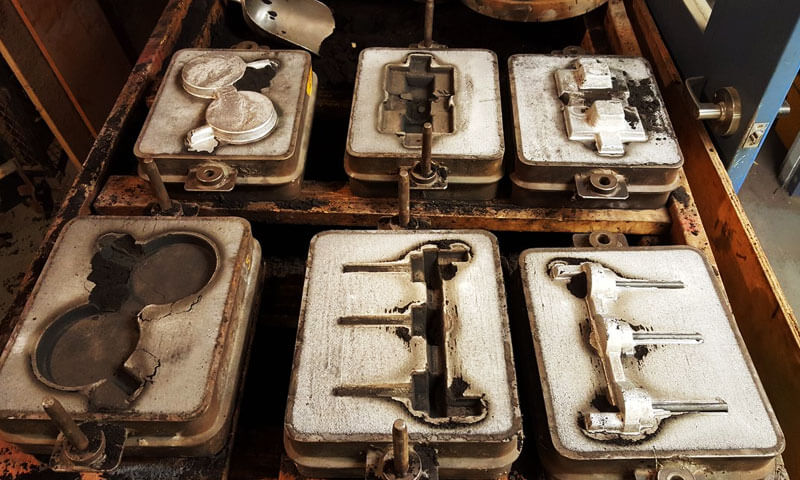
Based on these designs, precision metal tooling is manufactured for wax pattern injection.
Proper tooling design is essential because it determines casting accuracy, dimensional repeatability, and production efficiency throughout the product lifecycle.
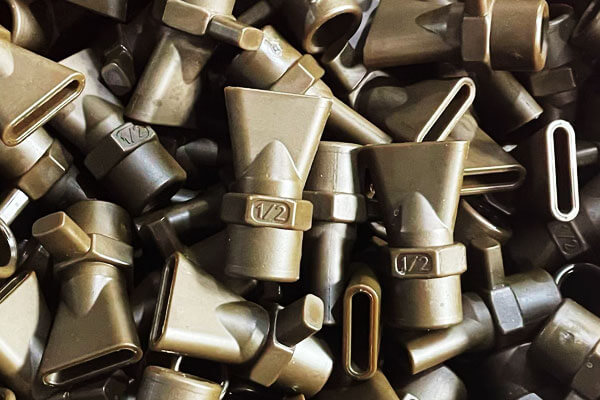
Produzzjoni tal-mudell tax-xama '
Molten wax is injected into the tooling to produce an accurate replica of the final nozzle.
Multiple wax patterns are assembled onto a central runner system to form a casting tree, allowing numerous components to be produced in a single casting cycle.
The high dimensional consistency of wax patterns ensures uniformity between production batches and minimizes variation during subsequent processing.
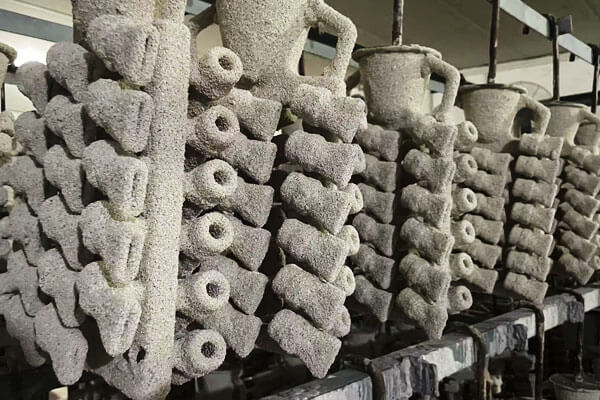
Bini tal-qoxra taċ-ċeramika
The wax assembly is repeatedly coated with refractory slurry and fine ceramic sand.
Each coating layer is dried before the next is applied until a strong ceramic shell of sufficient thickness is formed.
The ceramic shell must withstand molten stainless steel temperatures exceeding 1,600°C while maintaining dimensional stability throughout pouring and solidification.
Dewaxing u Shell Earing
After shell preparation, the wax is removed using high-pressure steam or autoclave dewaxing, leaving a hollow ceramic mold.
The shell is then fired at high temperature to:
- Eliminate residual wax
- Increase ceramic strength
- Improve thermal stability
- Reduce gas generation during pouring
Proper shell firing contributes directly to casting quality and surface finish.
Tidwib u tferrigħ
Selected stainless steel alloys are melted in medium-frequency induction furnaces under carefully controlled conditions.
Chemical composition and pouring temperature are closely monitored to ensure compliance with international material standards.
Molten metal is poured into the preheated ceramic shell, filling even thin-wall sections and complex internal passages with excellent precision.
Solidification and Knockout
Controlled cooling allows the molten metal to solidify into the final nozzle geometry.
Ladarba mkessaħ, the ceramic shell is mechanically removed, and individual castings are separated from the runner system.
Proper solidification control minimizes shrinkage defects, porożità interna, u stress residwu.
Trattament tas-sħana
Depending on the alloy and service requirements, castings may undergo solution annealing, L-istress li jtaffi, or other heat treatments to optimize corrosion resistance, duttilità, u prestazzjoni mekkanika.
Duplex stainless steels require particularly precise heat treatment to maintain the desired balance between ferrite and austenite phases.
Preċiżjoni tal-magni CNC
Although investment casting produces near-net-shape components, critical features still require finish machining.
Typical machining operations include:
- Thread machining
- Flange facing
- Sealing surface finishing
- Bore machining
- Connection interface machining
Modern CNC machining ensures excellent dimensional accuracy and assembly compatibility.
Inspection and Quality Assurance
Every production batch undergoes comprehensive quality inspection before delivery.
Common inspection procedures include:
- Chemical composition analysis
- Spezzjoni dimensjonali
- Surface defect inspection
- Ittestjar tal-pressjoni
- Ittestjar tal-penetrant taż-żebgħa (Pt)
- Ittestjar radjografiku (RT)
- Ittestjar ultrasoniku (Ut)
- Ittestjar tal-Propjetà Mekkanika
Strict quality control ensures every duckbill nozzle satisfies customer specifications and applicable international standards.
6. Surface Treatments and Finishing Options
Surface finishing significantly influences the corrosion resistance, dehra, Indafa, and service life of stainless steel duckbill nozzles.
Selecting an appropriate finish depends on the operating environment, hygienic requirements, and aesthetic expectations.
| Finitura tal-wiċċ | Karatteristiċi | Applikazzjonijiet tipiċi |
| Kif imfittex | Economical with minimal processing | General industrial equipment |
| Shot Blasting | Removes oxide scale and improves surface uniformity | Makkinarju Industrijali |
| Glass Bead Blasting | Produces a smooth satin finish | Architectural and decorative applications |
| Pickling & Passivazzjoni | Removes free iron and restores the chromium-rich passive layer | Ipproċessar kimiku, marine equipment |
| Illustrar mekkaniku | Improves smoothness and reduces surface roughness | Tagħmir għall-ipproċessar tal-ikel |
| Elettropolizzazzjoni | Produces an ultra-smooth, highly corrosion-resistant surface | Pharmaceutical and semiconductor industries |
| Lustrar tal-mera | High-gloss finish with excellent cleanability | Sanitary and decorative applications |
7. Common Sizes for Stainless Steel Duckbill Nozzle
The size selection of stainless steel duckbill nozzles depends mainly on flow rate requirements, pressjoni operattiva, spray coverage, installation space, and application conditions.
Industrial duckbill nozzles are commonly manufactured in a wide range of inlet sizes, with customization available for specific hydraulic performance requirements.
The following table summarizes typical industrial size ranges.
| Nozzle Size (Inlet Connection) | Approximate Flow Range* | Typical Spray Pattern | Common Operating Pressure | Applikazzjonijiet tipiċi |
|---|---|---|---|---|
| 1/4 pulzier | 1–10 l / min | Narrow flat jet | 0.5–5 bar | Laboratory equipment, small cooling systems, precision cleaning |
| 3/8 pulzier | 5–20 l / min | Flat fan-shaped stream | 1–6 bar | Small industrial washing, lubrikazzjoni, cooling applications |
| 1/2 pulzier | 10–50 l / min | Medium-width flat spray | 1–10 bar | Ipproċessar kimiku, equipment cleaning, water circulation systems |
| 3/4 pulzier | 30–100 l / min | Wide flat jet | 2–12 bar | Industrial cooling, descaling, Trattament tad-Drenaġġ |
| 1 pulzier | 50–200 l / min | High-volume flat spray | 2–15 bar | Steel processing, mining equipment washing, industrial flushing |
| 1-1/4 pulzier | 100–350 L/min | Large-area flat discharge | 3–20 bar | Heavy-duty cooling systems, metallurgical applications |
| 1-1/2 pulzier | 150–500 L/min | High-flow flat jet | 3–25 bar | Large-scale process cooling, Sistemi ta 'trattament ta' l-ilma |
| 2 pulzier | 300–800 L/min | Wide and powerful flat stream | 5–30 bar | Heavy industrial cleaning, large cooling installations |
| 2-1/2 inch and above | 500+ L / min | Customized high-volume spray | Application dependent | Large industrial systems, special-purpose equipment |
*Flow rates are approximate values and vary depending on nozzle geometry, outlet opening design, materjal, and operating pressure.
8. Industrial Applications of Stainless Steel Duckbill Nozzles
| Industrija | Applikazzjonijiet | Grad tal-liga | Rekwiżiti ewlenin |
| Ipproċessar kimiku | Acid dosing, tank cleaning, injection of catalysts, waste neutralisation. | CF‑8M, CN‑7M | Reżistenza għall-korrużjoni; Kontroll tal-fluss preċiż; no backflow. |
| Trattament tad-Drenaġġ | Aeration, injezzjoni kimika, sludge handling, effluent discharge. | CF‑8, CF‑8M | Corrosion resistance to aggressive fluids; ħajja twila ta 'servizz. |
| Marine / Offshore | Seawater intake, ballast water treatment, bilge pumping, desalinizzazzjoni. | CF‑8M, CD‑3MN | Seawater corrosion; Pitting Resistance; saħħa għolja. |
| Ikel & xorb | Sanitary dosing, tindif (CIP), transfer of food fluids. | CF‑3 (304L) | FDA-approved; Iġjeniku; faċli biex tnaddaf. |
| Farmaċewtiku | Precise liquid dosing, sterile processing, WFI systems. | CF‑3M (316L) | Ultra-clean; sterilisable; mhux poruż; elettropolizzat. |
Ġenerazzjoni tal-Enerġija |
Cooling water injection, boiler feedwater, Doża kimika. | CF‑8, CF‑8M | Temperatura għolja; pressure integrity; Reżistenza għall-korrużjoni. |
| Żejt & gass | Wellhead injection, pipeline pigging, injezzjoni kimika. | CF‑8M, CD‑3MN | Pressjoni għolja; sour gas resistance; Durabilità. |
| Apparat mediku | Fluid delivery systems, Tagħmir dijanjostiku, sterilisation. | CF‑3M (316L) | Bijokompatibilità; tindif; Preċiżjoni. |
| Agrikoltura | Crop spraying, irrigazzjoni, livestock misting, injezzjoni kimika. | CF‑8 | Kosteffikaċi; reżistenti għall-korrużjoni; Kopertura wiesgħa. |
| Minjieri | Immaniġġjar tad-demel likwidu, injezzjoni kimika, soppressjoni tat-trab. | CF‑8M, duplex | Abrasion resistance; Reżistenza għall-korrużjoni. |
9. Industrial Advantages of Investment-Cast Duckbill Nozzles
| Vantaġġ | Spjegazzjoni |
| Superior flow control | Precision‑cast internal geometry ensures consistent cracking pressure and flow characteristics. |
| Long service life | Stainless steel construction resists corrosion, erożjoni, u ilbes. |
| Manutenzjoni baxxa | No moving parts; self‑cleaning design; no mechanical wear. |
| Pressure integrity | Sound castings withstand high pressures (sa 100+ bar). |
| Reżistenza għat-temperatura | Austenitic grades withstand temperatures to 800°C. |
Iġjene |
Lixx, non‑porous surfaces; electropolishing option for ultra‑clean applications. |
| Flessibilità tal-liga | Cast in all common stainless steel and duplex grades. |
| Cost‑effectiveness | Investment casting reduces machining waste and production cost for complex geometries. |
| Customisation | Easy to produce custom cracking pressures, rati tal-fluss, and connection types. |
| Disinn kompatt | Duckbill nozzle design requires less space than traditional check valves. |
10. Stainless Steel Duckbill Nozzle vs Other Flow Control Devices
Selecting the right flow control device depends on the operating medium, flow pattern, pressure conditions, contamination level, and maintenance strategy.
While stainless steel duckbill nozzles are widely recognized for producing flat or fan-shaped spray patterns, they differ significantly from conventional nozzles, orifices, and valves in terms of hydraulic performance, Durabilità, and application flexibility.
| Comparison Item | Stainless Steel Duckbill Nozzle | Żennuna spirali | Round Spray Nozzle | Żennuna tal-fann ċatt | Valv tal-ballun (Kontroll tal-fluss) |
| Funzjoni primarja | Directs liquid into a flat, controlled stream | Produces a wide-angle hollow or full-cone spray | Produces circular spray pattern | Produces flat spray pattern | Regulates or shuts off flow |
| Typical Flow Pattern | Flat jet | Spiral full cone or hollow cone | Full cone or hollow cone | Flat fan | Variable depending on valve opening |
| Spray Coverage | Lineari, concentrated | Wide-area, three-dimensional | Circular | Lineari | Xejn |
| Spray Uniformity | Eċċellenti | Eċċellenti | Moderat | Eċċellenti | Mhux applikabbli |
| Flow Distribution | Highly uniform across width | Uniform over a large coverage area | Circular distribution | Linear distribution | No spray distribution |
Atomization Capability |
Baxx | Moderat għal għoli | Moderat għal għoli | Moderat | Xejn |
| Telf ta 'pressjoni | Baxx għal moderat | Baxx | Moderat | Moderat | Low when fully open |
| Anti-Clogging Performance | Eċċellenti | Eċċellenti (large open passages) | Moderat | Moderat | Tajjeb |
| Reżistenza għall-ilbies | Eċċellenti | Eċċellenti | Tajjeb | Tajjeb | Eċċellenti |
| Reżistenza għall-korrużjoni | Eċċellenti (depending on alloy grade) | Eċċellenti (depending on alloy grade) | Depends on material | Depends on material | Depends on material |
| Kapaċità ta 'Temperatura Għolja | Eċċellenti | Eċċellenti | Tajjeb | Tajjeb | Eċċellenti |
| Eżattezza dimensjonali | Għoli ħafna (ikkastjar ta 'investiment + magni) | Għoli | Għoli | Għoli | Għoli |
| Suitable for Abrasive Media | Tajjeb | Eċċellenti | Moderat | Moderat | Tajjeb |
| Maintenance Requirement | Baxx | Baxx ħafna | Moderat | Moderat | Moderat |
Flow Adjustment Capability |
Fixed geometry | Fixed geometry | Fixed geometry | Fixed geometry | Fully adjustable |
| Kumplessità tal-manifattura | Medju għal għoli | Medju | Medju | Medju | Għoli |
| Typical Industries | Steelmaking, Ipproċessar kimiku, Minjieri, environmental engineering, Sistemi ta 'tkessiħ | Desulfurizzazzjoni tal-gass taċ-ċumnija (FGD), Scrubbing tal-gass, Ipproċessar kimiku, Torrijiet tat-Tkessiħ, Protezzjoni tan-nar | Agrikoltura, tindif, Tkessiħ | Kisi, ħasil, descaling | Process piping, żejt & gass, pjanti kimiċi |
11. Why Choose LangHe for Custom Investment Cast Stainless Steel Duckbill Nozzles?
Selecting the right manufacturing partner is just as important as selecting the appropriate material.
Fi LangHe, we combine advanced investment casting technology, precision machining capabilities, and rigorous quality management to deliver stainless steel duckbill nozzles that meet the highest standards of performance and reliability.
Extensive Material Expertise
LangHe manufactures duckbill nozzles using a broad range of stainless steel alloys, inkluż CF8, Cf8m, CF3, Cf3m, duplex, and super duplex stainless steels.
Material recommendations are tailored to each customer’s operating environment, ensuring the optimal balance of corrosion resistance, saħħa, u spiża.
Advanced Investment Casting Capability
Our precision investment casting process enables the production of complex geometries with excellent dimensional accuracy, Finituri tal-wiċċ lixxi, and consistent metallurgical quality.
Near-net-shape manufacturing minimizes machining requirements while maintaining high production efficiency.
Integrated Precision Machining
In-house CNC machining ensures that critical features—including threads, Uċuħ tas-siġillar, bores, and mounting interfaces—meet demanding dimensional and geometric tolerances.
This integrated approach guarantees reliable assembly and long-term operational performance.
Custom Engineering Support
Our engineering team works closely with customers from concept development through production.
Whether optimizing flow channels, selecting suitable materials, or refining manufacturability, we provide practical solutions that enhance both product performance and manufacturing efficiency.
Reliable Global Manufacturing Partner
With extensive experience serving customers in water treatment, Ipproċessar kimiku, Inġinerija tal-Baħar, enerġija, Ipproċessar tal-ikel, and industrial equipment manufacturing, LangHe delivers consistent product quality, responsive technical support, and dependable global supply capabilities.
Ikkuntattjana for custom stainless steel duckbill nozzles.
12. Konklużjoni
Stainless steel duckbill nozzles have become indispensable components in modern fluid handling systems, offering an ideal combination of corrosion resistance, Qawwa mekkanika, and precise flow control.
Their unique geometry enables efficient fluid distribution while minimizing turbulence and pressure loss, making them suitable for applications ranging from wastewater treatment and chemical processing to marine engineering and hygienic manufacturing.
Investment casting further enhances these advantages by enabling complex near-net-shape geometries, Eżattezza dimensjonali superjuri, and excellent metallurgical integrity.
When combined with precision CNC machining and appropriate surface finishing, investment-cast duckbill nozzles deliver long service life, reduced maintenance requirements, and outstanding operational reliability.
For OEMs and industrial users seeking high-performance fluid control components, custom investment-cast stainless steel duckbill nozzles represent a reliable, Ekonomiku, and technically advanced solution.
FAQs
Why is investment casting the best process for stainless steel duckbill nozzles?
Duckbill nozzles require an integral narrow-slit flow channel, smooth internal surface and high dimensional accuracy.
Investment casting achieves seamless one-piece forming, ultra-smooth flow channel surfaces and CT4–CT6 precision, avoiding weld corrosion, assembly leakage and rough surface defects of traditional processes.
No other mass production process can match its combination of quality and economy.
What is the primary function of a stainless steel duckbill nozzle?
A stainless steel duckbill nozzle controls the direction, veloċità, and distribution of liquids or gases.
Its flattened outlet creates a wide, uniform discharge pattern while reducing turbulence and improving flow efficiency.
Can duckbill nozzles be customized?
IVA. Customization options include material grade, outlet geometry, connection type, dimensions, Ħxuna tal-ħajt, finitura tal-wiċċ, Karatteristiċi tal-fluss, and company markings. Investment casting offers excellent flexibility for OEM designs.
What surface treatments are commonly used?
Common finishing options include shot blasting, glass bead blasting, Pickling u passivazzjoni, mechanical polishing, Elettropolizzazzjoni, and mirror polishing.
The choice depends on the application’s corrosion resistance, Indafa, u rekwiżiti estetiċi.
How do I clean a duckbill nozzle?
The self‑cleaning design reduces maintenance. For occasional cleaning, soak in a suitable solvent or use ultrasonic cleaning. Avoid mechanical cleaning that could damage the duckbill lip.