1. Introduzzjoni
Industrial nozzles are far more than simple outlets for fluids. F'impjanti petrokimiċi, Sistemi Aerospazjali, linji tal-ipproċessar tal-ikel, marine equipment, hydraulic assemblies,
and precision spraying devices, nozzles play a decisive role in atomization, jet formation, regolazzjoni tal-fluss, Kontroll tal-pressjoni, and medium delivery.
Their performance is directly influenced by geometric accuracy, internal channel quality, Reżistenza għall-korrużjoni, Integrità mekkanika, and manufacturing consistency.
Because of these requirements, nozzle manufacturing is a classic engineering decision problem: should the part be produced by ikkastjar ta 'preċiżjoni or by Makkinar CNC?
2. What Makes Nozzle Manufacturing Technically Demanding?
A Żennuna is a flow-shaping component, which means its internal and external form has a direct functional impact.
Unlike many structural parts, a nozzle cannot be judged only by strength or appearance. Its geometry must support stable fluid behavior.
Key engineering requirements for nozzles
- Precise internal flow channels
- Smooth and consistent flow surfaces
- Accurate orifice size
- Stable sealing faces
- Good corrosion and wear resistance
- Resistance to vibration, pressure shock, and cavitation
- Repeatable performance across production batches
These demands create a narrow manufacturing window. Too much surface roughness can disturb flow. Dimensional deviation can alter spray pattern or discharge coefficient.
Internal defects may cause leakage, clogging, or local failure. Għal din ir-raġuni, the manufacturing process is inseparable from nozzle performance.
3. Fundamentali tal-Proċess
Precision Casting Nozzle
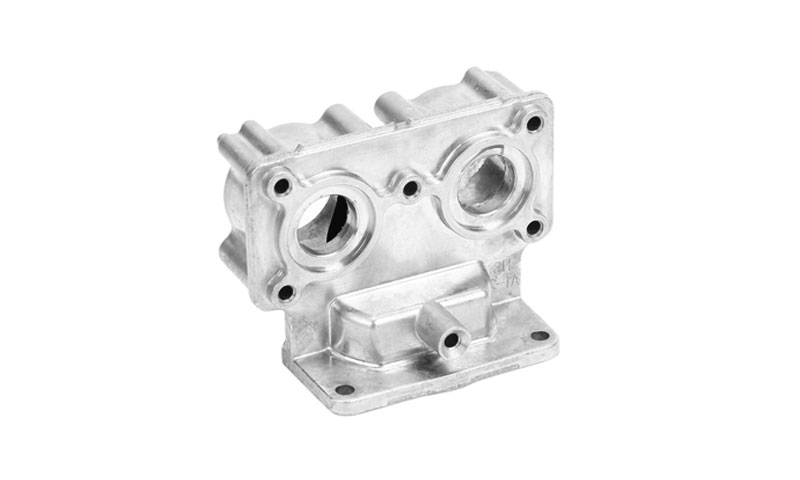
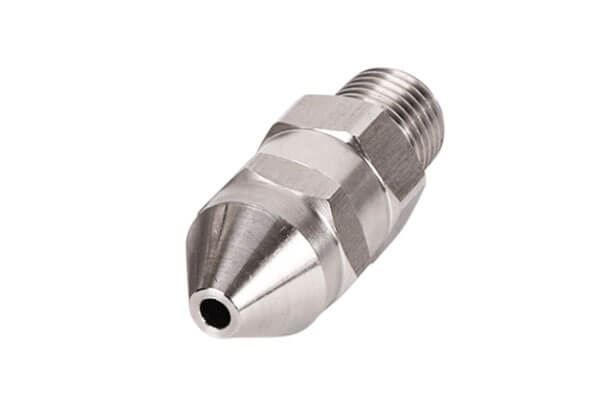
Ikkastjar ta 'preċiżjoni, spiss imsejħa bħala ikkastjar ta 'investiment jew ikkastjar tax-xama 'mitluf, is a near-net-shape process that is particularly suitable for parts with complex geometry.
The typical route includes wax pattern creation, Bini tal-qoxra taċ-ċeramika, Dewaxing, sparar tal-qoxra, tferrigħ tal-metall, Tkessiħ, Tneħħija tal-qoxra, u l-irfinar.
For nozzle production, this process allows molten stainless steel, Brass, or high-temperature alloy to be poured into a custom ceramic mold.
The result is a near-finished nozzle blank with integrated contours, kanali mgħawġa, and complex features that would be difficult or costly to machine from solid stock.
Karatteristiċi tal-qalba
- Strong geometric freedom
- Good suitability for integrated structures
- Reduced need for full-body machining
- Efficient for medium and high production volumes
- Suitable for complex, corrosion-resistant alloy parts
CNC Machined Nozzle
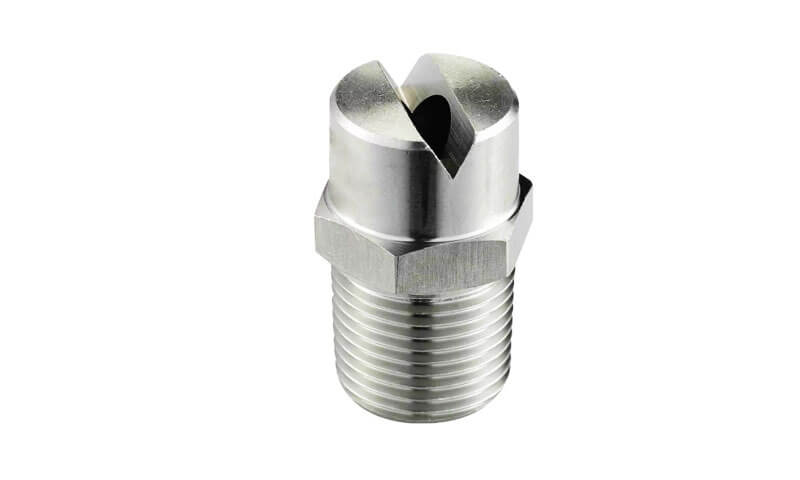
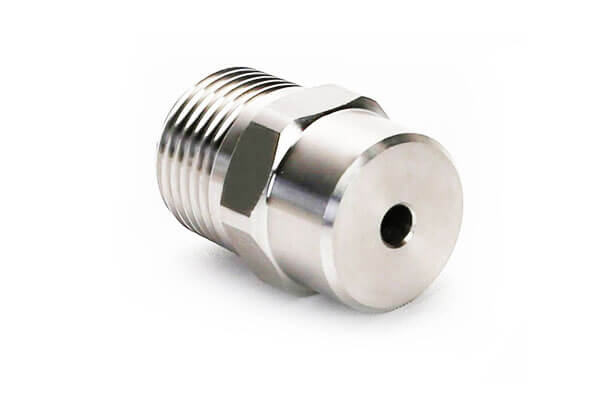
Makkinar CNC is a subtractive process that uses programmed tool paths to remove material from billets, bars, Forgings, or rolled stock.
It typically involves turning, tħin, tħaffir, Threading, deep-hole machining, u l-irfinar tal-preċiżjoni.
For nozzle production, CNC machining is particularly strong when the geometry is regular, the tolerances are tight, and the flow passages are accessible to tools.
It is widely used for high-precision nozzles with straight holes, concentric features, reliable sealing surfaces, and strict dimensional requirements.
Karatteristiċi tal-qalba
- Eżattezza dimensjonali eċċellenti
- Superior control over critical surfaces
- Rapid prototyping and design changes
- No mold investment
- High flexibility for small batches and custom work
4. Side-by-Side Engineering Comparison
Structural Adaptability and Design Complexity
| Aspett | Precision Casting Nozzle | CNC Machined Nozzle |
| Geometry freedom | Għoli ħafna | Moderat għal għoli, but tool-access dependent |
| Curved runners / spiral channels | Eċċellenti | Difficult and costly |
| Multi-branch internal passages | Eċċellenti | Usually inefficient |
| Thin-wall integrated structures | Tajjeb | Possibbli, but often more expensive |
| Sharp internal corners | Limitat minn castability | Easier to machine in accessible areas |
| One-piece formation | Strong advantage | Usually requires simpler geometry |
Precision casting is the stronger choice when the nozzle includes curved runners, asymmetrical cavities, multi-branch passages, or a complex integrated body.
It can produce near-net-shape components that reduce assembly steps and eliminate welded seams, which is especially valuable for leakage-sensitive fluid systems.
CNC machining is more suitable for regular, symmetric, and tool-accessible shapes. It excels at straight holes, concentric bores, ħjut, flat sealing faces, and standard taper geometries.
But when the design becomes highly complex internally, machining time and cost rise steeply.
Preċiżjoni dimensjonali u kwalità tal-wiċċ
| Performance Parameter | Precision Casting Nozzle | CNC Machined Nozzle |
| General dimensional tolerance | CT4 - CT6, roughly ±0.05 to ±0.15 mm | ±0.005 to ±0.02 mm |
| Minimum practical aperture | Madwar 0.5 mm | Madwar 0.1 mm |
| Surface roughness of raw form | Ra 1.6–6.3 μm | Ra 0.2–1.6 μm |
| Sealing face flatness | Usually needs secondary finishing | Can be formed directly with high precision |
| Inner channel smoothness | Tajjeb, but with cast texture | Eċċellenti |
CNC machining is clearly superior when the nozzle requires extremely tight tolerance control, especially in the orifice zone, sealing face, and concentric features.
It produces smoother surfaces and better control over critical dimensions.
Precision casting can achieve serviceable accuracy for many industrial nozzles, but the as-cast surface typically retains solidification texture.
That is not necessarily a problem in ordinary spray or jet applications, but the most functional surfaces usually require local machining or polishing.
Material Utilization and Microstructure
| Aspett | Precision Casting Nozzle | CNC Machined Nozzle |
| Material starting form | Metall imdewweb | Solid stock, Forġa, or bar |
| Użu tal-materjal | About 85%–92% | About 30%–55% |
| Scrap generation | Baxx għal moderat | High chip volume |
| Mikrostruttura | Cast dendritic structure | Wrought grain structure |
| Metal flow orientation | Not continuous like wrought stock | Preserved in base material, partly disturbed by cutting |
Precision casting is generally more material-efficient.
This matters especially when the nozzle is made from expensive alloys such as stainless steel, ligi tan-nikil, or titanium alloys. Less waste means lower effective cost and easier scaling.
CNC machining begins with a wrought material that already has a refined grain structure and strong mechanical continuity.
That gives the finished part high baseline strength and fatigue resistance. Madankollu, the cutting process generates chips and may locally alter the surface layer through heat and stress.
The difference is not simply academic. It affects cost, mechanical response, and corrosion behavior in service.
Mechanical Properties and Service Durability
| Mechanical Indicator | Precision Casting Nozzle | CNC Machined Nozzle |
| Qawwa tat-tensjoni | Slightly lower in typical stainless castings | Higher in wrought stock |
| Impatt ebusija | Moderat | Għoli |
| Reżistenza għall-għeja | Good for steady service | Stronger for cyclic loading |
| High-pressure resistance | Suitable for medium pressure | Better for very high pressure |
| Reżistenza għall-ilbies | Uniformi, stable wear pattern | Higher local hardness and abrasion resistance |
| Corrosive medium service | Tajjeb ħafna, especially after proper heat treatment | Tajjeb, but surface condition matters |
CNC machined nozzles are usually favored in high-pressure, vibration-prone, or fatigue-intensive environments.
Their base material tends to retain better mechanical continuity, which supports demanding service conditions.
Precision casting nozzles are often better suited to corrosive chemical media, humid high-temperature environments, and stable flow systems where geometry and material compatibility matter more than extreme pressure resistance.
When properly heat treated, cast stainless steel can deliver excellent corrosion performance.
Production Cycle and Batch Adaptability
| Aspett | Precision Casting Nozzle | CNC Machined Nozzle |
| Initial setup | Mold and process development required | No mold required |
| Prototype speed | Aktar bil-mod | Mgħaġġel ħafna |
| Produzzjoni tal-massa | Efficient once stabilized | Efficient only for simpler shapes |
| Best batch size | Baxx għal medju, often 50–10,000 pieces | Very small batches to moderate runs |
| Changeover flexibility | Inqas | Għoli ħafna |
Casting requires upfront tooling and process preparation, so the lead time is longer at the beginning. Once stabilized, Madankollu, it can become very efficient for repeated production.
That makes it attractive when the nozzle design is mature and expected to remain unchanged.
CNC machining is the opposite. It has almost no tooling barrier and is ideal for rapid prototyping, engineering trials, urgent delivery, and customized production.
The trade-off is that every part must be cut individually, which can make large-scale production slower and more expensive for complex geometries.
Comprehensive Cost Structure
| Fattur tal-kost | Precision Casting Nozzle | CNC Machining Nozzle |
| L-ispiża tal-għodda | Higher at start | Very low or none |
| Spiża tal-materjal | Lower effective waste | Higher scrap cost |
| Labor cost | Lower per part at scale | Higher per part for complex parts |
| Spiża ta' wara l-ipproċessar | Moderat | Baxx għal moderat |
| Best cost condition | Complex parts, moderate to high volume | Simple parts, Volum baxx, tibdil mgħaġġel |
For simple nozzle geometries, CNC machining can be the lower-cost route, especially when production volume is small and no tooling investment is justified.
For medium to high-complexity nozzle geometries, precision casting often reduces total cost by avoiding excessive multi-axis machining, repeated clamping, u operazzjonijiet ta 'assemblaġġ.
The material savings are especially important for expensive alloys.
5. Common Defects and Quality Control Challenges
Precision Casting Nozzle Defects
Precision casting offers many advantages, but it is not free of process risks.
| Common defect | Effett tipiku | Control method |
| Sand holes / inklużjonijiet | May block small passages or weaken local zones | Improve shell quality and filtration |
| Jinxtorob il-porożità | Reduces pressure-bearing capability | Optimize gating and solidification design |
| Dimensional shrinkage | Affects tolerances and sealing surfaces | Reserve machining allowance |
| Surface grain texture | Slightly roughens flow channels | Finish critical areas by machining or polishing |
The most important control strategy in casting nozzles is to leave machining allowance on critical faces and orifices.
Fil-prattika, sealing surfaces and tight-tolerance flow features should not rely entirely on as-cast accuracy.
CNC Machining Nozzle Defects
CNC machining is highly precise, but it has its own quality concerns.
| Common defect | Effett tipiku | Control method |
| Burrs | Disturbs flow and may cause clogging | Deburring, edge finishing |
| Clamping deviation | Creates concentricity error | Improve fixture design |
| Surface work hardening | Can affect corrosion and finishing quality | Use optimized cutting speed and coolant |
| Tool marks | Raise roughness in sensitive flow areas | Secondary polishing or finishing |
In nozzle applications, small burrs can be more harmful than they appear. Even tiny edge imperfections may cause turbulence, uneven spray, or contamination retention.
That is why post-machining deburring is not optional in critical nozzle production.
6. Application Selection: Which Process Fits Which Nozzle?
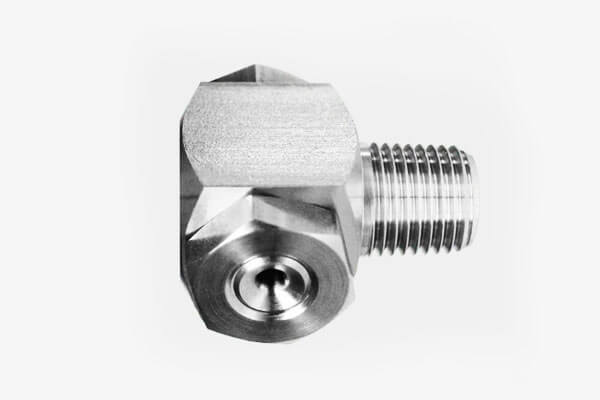
Precision Casting Nozzle is Best For
- Complex curved channels
- Multi-branch or irregular internal passages
- Large or integrated nozzle bodies
- Corrosive media and moderate pressure service
- Medium batch production
- High-value alloys where material savings matter
Typical industries
- Ipproċessar kimiku
- Marine desalination
- Seawater handling
- Food spraying and cleaning
- Medium-pressure industrial fluid delivery
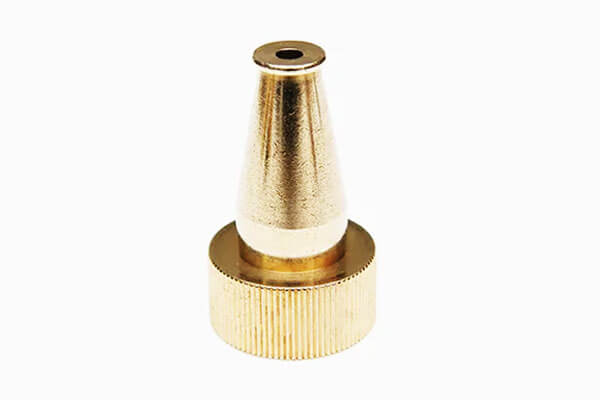
CNC Machining Nozzle is Best For
- Simple straight-hole nozzles
- Micro-aperture nozzles
- Uċuħ tas-siġillar ta 'preċiżjoni
- High-pressure or vibration-intensive service
- Rapid prototyping and custom parts
- Small-batch production with tight tolerances
Typical industries
- Aerospace fuel injection
- High-pressure cleaning equipment
- Sistemi idrawliċi
- Medical atomization devices
- Precision laboratory equipment
7. Composite Manufacturing: Casting Blank + CNC Finishing
In modern nozzle production, the most technically mature approach is often neither pure precision casting nor pure CNC machining, but a hybrid manufacturing route that combines the strengths of both.
This method begins with a precision-cast blank and ends with targeted CNC finishing on the functional surfaces.
For many industrial nozzles, especially those used in demanding fluid-control environments, this combined process offers the best balance among geometry complexity, eżattezza dimensjonali, kwalità tal-wiċċ, Effiċjenza fl-ispiża, and manufacturing stability.
Why the Hybrid Approach Matters
A nozzle is a function-driven component.
Its external shape may be relatively complex, but the most critical performance features are usually concentrated in specific zones: the orifice, sealing face, threaded connection, datum surfaces, and sometimes internal transition areas.
These are the locations where even a very small deviation can affect spray pattern, discharge consistency, pressure behavior, or leakage performance.
Precision casting is excellent at forming the overall body of the nozzle in a near-net-shape state.
It can produce curved contours, integrated passages, irregular outer geometries, and complex structural forms that would otherwise require extensive machining or multiple assembled parts.
Madankollu, casting alone usually cannot guarantee the extremely tight tolerances and surface smoothness required at the most critical functional interfaces.
That is where CNC finishing becomes indispensable.
By reserving machining allowance on the necessary areas, manufacturers can use CNC operations to refine only the important zones rather than machining the entire part from solid stock.
This approach preserves the geometric advantages of casting while achieving the precision level expected of high-end nozzles.
Process Logic: From Near-Net Shape to Functional Precision
The hybrid process begins with a casting design that is intentionally optimized for later machining.
Engineers do not design the part as a final finished casting; minflok, they design it as a casting blank with controlled allowances.
These allowances are usually left on the orifice region, thread zones, uċuħ tas-siġillar, and other datum surfaces that require tight dimensional control.
The remaining body, especially areas that do not influence the final fluid behavior directly, is left in its near-net-shape cast form.
After the casting stage, the nozzle blank is cleaned, inspected, and heat treated if necessary.
This intermediate component already contains the major structural features of the finished part.
CNC machining is then applied selectively and precisely, using fixtures and tool paths tailored to the critical surfaces.
Fil-prattika, this means that only a fraction of the total geometry is machined to final size, which reduces cycle time, Ilbies tal-għodda, and material waste compared with full-stock machining.
Engineering Advantages of the Composite Route
The most important advantage of casting plus CNC finishing is functional separation. The process allows each manufacturing method to do what it does best.
Casting handles shape creation and material economy. CNC machining handles precision, ripetibilità, and surface refinement.
By dividing the part this way, the manufacturer avoids forcing one process to solve all problems.
This is particularly valuable for nozzles with mixed requirements.
Pereżempju, the outer body may need to be large, contoured, and structurally integrated, while the internal jet seat or sealing cone may require micron-level control.
A fully machined part would be wasteful and time-consuming.
A fully cast part might not meet the precision requirement. A hybrid part solves both issues in a rational way.
Another major benefit is reduced machining burden. When the nozzle body is cast close to final shape, the amount of stock removed by machining is far lower than in billet machining.
This lowers raw material waste, shortens processing time, and reduces tool load.
The advantage becomes especially significant when the nozzle is made from expensive alloys such as stainless steel, ligi tan-nikil, or titanium alloys.
The hybrid process also improves Libertà tad-Disinn. Engineers can specify complex internal or external geometries without worrying that the entire part must be accessible to cutting tools.
As long as the critical finishing zones are machinable, the rest of the structure can remain cast.
This is highly useful in applications where fluid routing, mounting integration, and compact package design are all important.
Cost and Manufacturing Efficiency
From a production economics perspective, the composite route is often the most balanced solution for medium- to high-value nozzle products.
The casting stage absorbs the complexity of the shape, while the CNC stage is restricted to the smallest number of high-value surfaces.
This greatly improves the ratio between manufacturing effort and functional value.
Compared with machining the entire nozzle from solid bar stock, the hybrid method typically reduces material consumption and cutting time.
Compared with relying entirely on casting, it sharply improves final precision and consistency.
This makes it particularly attractive in industries where the cost of failure is high, where dimensional repeatability matters, and where the alloy itself is expensive enough to make waste a serious concern.
The process is also scalable. Once the casting tooling is stabilized and the CNC finishing program is validated, production can move into a repeatable and controlled workflow.
For moderate and large production runs, the unit cost often becomes highly competitive because the casting blank is efficient to form and the finishing operations remain localized.
Quality Control Considerations
The success of the hybrid method depends on good engineering discipline at both stages.
If the casting blank is poorly designed, the subsequent machining allowance may be uneven, excessive, or insufficient.
If the CNC finishing strategy is not carefully controlled, the critical nozzle features may lose concentricity, Integrità tas-siġillar, or flow accuracy.
Għal din ir-raġuni, the transition between casting and machining must be planned from the beginning.
The casting pattern should include well-defined allowances on the machined zones, and the post-cast inspection should confirm that the blank is suitable for secondary operations.
During CNC finishing, fixtures must maintain accurate datum control, especially when the nozzle requires coaxial or orthogonal relationships between the orifice, thread, and sealing faces.
Surface integrity is also important. The cast structure may contain minor grain texture or local roughness, but the final machined surfaces should eliminate these imperfections in the functional zones.
F'ħafna każijiet, a final deburring, illustrar, or cleaning step is added to ensure that no residual burrs or particles remain in the flow path.
Typical Industrial Use Cases
This combined manufacturing route is widely used in nozzles that serve demanding industrial environments.
It is especially common in petrochemical, Marine, aerospazjali, and high-end fluid-control systems.
These applications often demand a nozzle body that is structurally complex and corrosion resistant, but also require one or more surfaces with extremely precise dimensional control.
Examples include spray nozzles with integrated housings, high-performance atomizing nozzles, precision jetting components, and corrosion-resistant fluid distribution nozzles.
F'kull każ, the casting stage provides the structural platform, and the machining stage ensures the final functional performance.
Why It Has Become a Mainstream Solution
The growing adoption of the “casting blank + CNC finishing” model is not accidental.
It reflects a broader trend in advanced manufacturing: use the most efficient process for each feature rather than forcing a single process to do everything.
In nozzle production, that principle is especially compelling because the part contains both shape-dominant zones and precision-dominant zones.
Bħala riżultat, the hybrid route is now widely viewed as the preferred solution for high-end industrial nozzles.
It offers the geometric flexibility of casting, the precision of CNC machining, and a cost structure that is often more favorable than either fully cast or fully machined alternatives.
For manufacturers seeking reliable performance and competitive economics, it is frequently the most rational engineering choice.
8. Konklużjoni
The comparison between precision casting and CNC machining for nozzles is not a matter of which process is universally superior. It is a matter of engineering fit.
Ikkastjar ta 'preċiżjoni excels when the nozzle is structurally complex, material-efficient production matters, and the working condition is compatible with medium-precision near-net-shape manufacturing.
It is especially powerful for integrated, corrosion-resistant designs and cost-efficient medium-volume output.
Makkinar CNC excels when the nozzle requires extreme dimensional precision, Finitura tal-wiċċ eċċellenti, high pressure resistance, and rapid iteration.
It is the preferred choice for simple but highly critical flow components, prototipi, and small-batch custom production.
In modern industrial practice, the most mature solution is often the hybrid one: cast the shape, machine the function.
That strategy captures the best of both worlds and delivers the strongest balance of performance, spiża, u l-manifattura.
FAQs
Which nozzle has better corrosion resistance?
F'ħafna każijiet, precision cast stainless steel nozzles can offer excellent corrosion resistance, especially after proper heat treatment and surface finishing.
The final result depends on alloy selection, kwalità tal-wiċċ, u l-ambjent tas-servizz.
Can spiral or highly complex nozzles be made by CNC machining?
IVA, but usually only with multi-axis equipment and at a much higher cost. For highly complex internal structures, precision casting is usually more economical.
Which process is cheaper for mass production?
For complex nozzle designs, precision casting often becomes cheaper at scale. For simple nozzle designs, CNC machining may remain more economical, especially in low volumes.
Which process is better for very high pressure service?
CNC machined nozzles are generally better suited to ultra-high-pressure conditions because they typically use wrought stock with stronger mechanical continuity and tighter dimensional control.
Is post-machining necessary for cast nozzles?
For critical surfaces, IVA. Issiġillar uċuħ, threaded regions, and fine orifices are commonly machined after casting to ensure final precision and surface quality.