Butterfly vārsti ir vienas no visplašāk izmantotajām plūsmas kontroles ierīcēm rūpnieciskajās cauruļvadu sistēmās, valued for their compact design, viegls svars, rapid quarter‑turn operation, and cost‑effectiveness.
Tomēr, the performance, uzticamība, and service life of a butterfly valve depend critically on one fundamental decision: the choice of body and disc material.
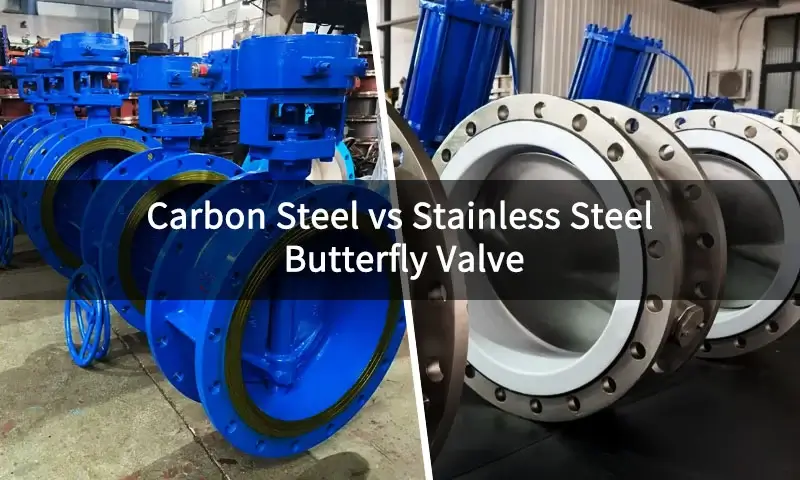
The two dominant material families for butterfly valves are oglekļa tērauds un nerūsējošais tērauds.
Carbon steel offers exceptional strength and cost‑effectiveness, making it the default choice for general industrial applications such as water, gaisa, tvaika, and oil services.
Nerūsējošais tērauds, with its superior corrosion resistance, higiēniskās īpašības, and high‑temperature capability, is the material of choice for aggressive media, jūras vide, pārtikas pārstrāde, un farmaceitiskās lietojumprogrammas.
Choosing between carbon steel and stainless steel butterfly valves is not merely a matter of cost—it is a strategic decision that affects equipment lifespan, maintenance requirements, normatīvo aktu ievērošana, un kopējās īpašumtiesību izmaksas.
1. What Is a Butterfly Valve?
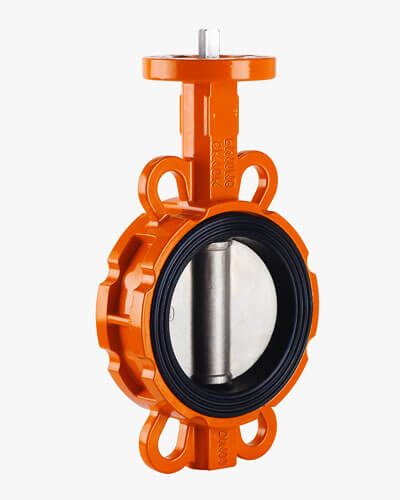
Izšķirt tauriņa vārsts ir a quarter-turn rotary motion valve that controls fluid flow by rotating a circular disc mounted on a central shaft.
When the handle, pārnesumkārba, pneumatic actuator, or electric actuator rotates the stem by 90 degrees, the disc turns simultaneously:
- Pilnībā atvērts (0°): The disc is parallel to the flow direction, allowing maximum flow with relatively low pressure loss.
- Partially Open: The disc partially obstructs the pipeline, regulating flow rate.
- Fully Closed (90°): The disc is perpendicular to the flow, sealing against the valve seat to stop fluid passage.
Unlike gate valves that require multiple turns to operate, butterfly valves provide extremely fast opening and closing, making them ideal for automated process control and emergency shut-off applications.
The performance of a butterfly valve depends not only on its structural design but also on the selection of body materials, disc materials, stem materials, sealing components, and manufacturing precision.
Among these factors, the body material—particularly carbon steel versus stainless steel—is often the primary determinant of durability, izturība pret koroziju, kalpošanas laiks, and overall lifecycle cost.
Common Butterfly Valve Types
| Butterfly Valve Type | Structural Characteristics | Tipiskas lietojumprogrammas |
| Vafeļu tauriņa vārsts | Installed between two pipe flanges and secured using flange bolts passing through the pipeline. Kompakts, viegls svars, and economical. | Water supply, HVAC sistēmas, apūdeņošana, saspiests gaiss, ugunsdrošība, and general industrial services. |
| Bag tauriņa vārsts | Equipped with threaded lugs on both sides of the valve body, allowing each flange to be bolted independently. | Procesa rūpniecība, ķīmiskie augi, pārtikas pārstrāde, pharmaceutical systems, and pipelines requiring frequent maintenance. |
| Double-Flanged Butterfly Valve | Features integral flanges on both sides of the valve body for direct bolted connection to mating flanges. Provides excellent structural rigidity and alignment. | Municipal water transmission, spēkstacijas, jūras inženierija, kalnrūpniecība, eļļas & gāzes cauruļvadi, and other heavy-duty industrial systems. |
Koncentrisks (Centerline) Tauriņa vārsts |
The disc and stem are positioned on the same centerline, with a resilient elastomer seat providing sealing throughout rotation. | Ūdens apstrāde, HVAC, cooling water, wastewater systems, and general-purpose industrial applications. |
| Double-Offset Butterfly Valve | The stem is offset from both the disc center and the valve body centerline, reducing friction between the disc and seat during operation. | Petrochemical plants, tvaika sistēmas, enerģijas ražošana, Jūras platformas, and medium-to-high pressure process pipelines. |
| Triple-Offset Butterfly Valve | Incorporates a third geometric offset, creating a conical metal-to-metal sealing mechanism that virtually eliminates rubbing during operation. | Oil refineries, LNG facilities, ķīmiskā apstrāde, high-temperature steam systems, offshore engineering, and other severe-service applications. |
Why Body Material Is Critical
The body material of a butterfly valve determines:
- Izturība pret koroziju: The ability to withstand the service fluid and environmental conditions.
- Temperature capability: The maximum and minimum service temperatures.
- Spiediena vērtējums: The maximum allowable working pressure.
- Mehāniskā izturība: The ability to withstand line stress, termiskā riteņbraukšana, un vibrācija.
- Maksāt: Material cost significantly impacts overall valve price.
- Compliance: Whether the valve meets regulatory requirements (pārtika, farmaceitisks, kodolieroču, utc).
2. Oglekļa tērauda droseļvārsts
Kas ir oglekļa tērauds?
Oglekļa tērauds is an iron-carbon alloy containing relatively small amounts of alloying elements.
Its strength is primarily achieved through carbon content and heat treatment rather than chromium or nickel additions.
Because it lacks the passive chromium oxide film found in stainless steel, carbon steel has limited inherent corrosion resistance but offers excellent mechanical strength, mašīnīgums, un izmaksu efektivitāte.
For butterfly valves, carbon steel remains one of the most widely used body materials in industries where corrosion is moderate and mechanical performance is the primary requirement.
Aizsardzības pārklājumi, oderējums, or painting systems are often applied to improve environmental durability.
Common Carbon Steel Grades for Butterfly Valves
The following grades are commonly specified in international valve standards:
| Pakāpe | Standarta | Tipisks pielietojums | Raksturojums |
| ASTM A216 WCB | Cast carbon steel | Vispārējie rūpniecības vārsti | Excellent strength and weldability |
| ASTM A216 WCC | Cast carbon steel | Pressure-containing equipment | Improved impact toughness |
| ASTM A352 LCB | Low-temperature cast steel | Cryogenic and low-temperature service | High notch toughness |
| ASTM A105 | Forged carbon steel | High-pressure forged valves | Superior mechanical strength |
| ASTM A350 LF2 | Forged low-temperature steel | Low-temperature pipelines | Excellent low-temperature toughness |
Starp šiem, ASTM A216 WCB is the industry standard for general-purpose carbon steel butterfly valves because it provides a balanced combination of mechanical properties, pieejamība, and manufacturing economy.
Characteristics of Carbon Steel Butterfly Valves
High Strength and Pressure Resistance
Carbon steel butterfly valves offer excellent mechanical strength and rigidity, making them suitable for high-pressure piping systems and large-diameter valves.
Common materials such as ASTM A216 WCB, A352 LCB, un A105 provide reliable structural performance under demanding operating conditions.
Wide Temperature Adaptability
Depending on the material grade, carbon steel valves can operate across a broad temperature range.
Standard WCB is commonly used for general industrial service, while LCB is designed for low-temperature applications, making carbon steel suitable for steam, eļļas, gāze, and utility systems.
Excellent Manufacturability
Carbon steel has good castability, mašīnīgums, un metināmība, allowing efficient production through casting, kalšana, CNC apstrāde, un metināšana. Its mature manufacturing process also helps reduce production costs.
Cost-Effective Solution
Compared with stainless steel, carbon steel is more economical while still providing excellent mechanical performance.
It is often the preferred choice for non-corrosive or mildly corrosive media where high corrosion resistance is unnecessary.
Ierobežota izturība pret koroziju
Carbon steel does not naturally resist corrosion and typically requires protective coatings such as epoxy, FBE, or zinc-rich coatings.
In aggressive environments, additional corrosion protection is essential to ensure long service life.
3. Nerūsējošā tērauda tauriņa vārsts
Kas ir nerūsējošais tērauds?
Nerūsējošais tērauds is an iron-based alloy containing a minimum of approximately 10.5% hroms, which forms a stable chromium oxide passive film on the surface.
This passive layer continuously regenerates when damaged, providing outstanding resistance to oxidation and corrosion without the need for additional protective coatings.
Depending on the alloy composition, stainless steels may also contain nickel, molibdēns, slāpeklis, mangāns, titāns, niobijs, or copper to enhance corrosion resistance, mehāniskā izturība, izturība, metināmība, or high-temperature performance.
For butterfly valves, stainless steel is the preferred material whenever long service life, izturība pret koroziju, product cleanliness, or hygienic performance is required.
It is extensively used in chemical processing, farmaceitiski, food and beverage production, offshore engineering, atsāļošanas augi, and high-purity fluid systems.
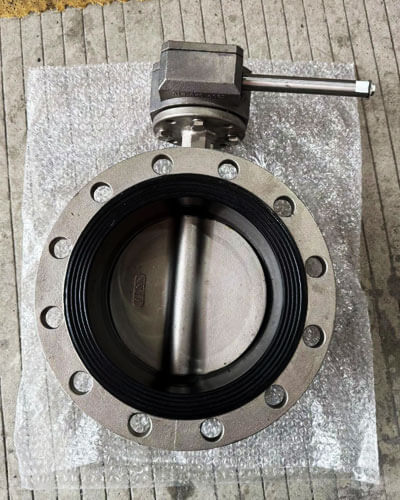
Common Stainless Steel Grades for Butterfly Valves
Different stainless steel grades are selected according to corrosion resistance, mehāniskā izturība, temperature capability, un pakalpojumu vide.
| Nerūsējošā tērauda pakāpe | Equivalent Material | Galvenās īpašības | Tipiskas lietojumprogrammas |
| CF8 | Atlaist 304 Nerūsējošais tērauds (Iekšā 1.4308) | Lieliska vispārēja izturība pret koroziju, laba izturība, Laba metināmība, ekonomisks | Ūdens apstrāde, HVAC, pārtikas pārstrāde, general chemical services |
| Cf8m | Atlaist 316 Nerūsējošais tērauds (Iekšā 1.4408) | Molybdenum-enhanced corrosion resistance, excellent resistance to chlorides and seawater | Ķīmiskā apstrāde, jūras inženierija, Jūras platformas, atsāšana |
| CF3 | Cast 304L Stainless Steel (Iekšā 1.4306) | Low carbon content minimizes carbide precipitation and improves weldability | Welded piping systems, farmaceitiskā iekārta, food and beverage industries |
CF3M |
Cast 316L Stainless Steel (Iekšā 1.4404) | Low-carbon version of CF8M with superior weld corrosion resistance | High-purity process systems, biotehnoloģija, pharmaceutical and chemical plants |
| Dupleksa nerūsējošā tērauda | ASTM A890 4.A pakāpe (2205) | Lielas izturības, Lieliska izturība pret bedres, plaisas korozija, un stresa korozijas plaisāšana | Offshore oil & gāze, seawater pipelines, mīkstums & papīrpapīrs, spiediena sistēmas |
| Super dupleksa nerūsējošā tērauda | ASTM A890 Grade 5A/6A (2507) | Izcila izturība pret koroziju, very high mechanical strength, exceptional seawater performance | Jūras platformas, zemūdens aprīkojums, atsāļošanas augi, aggressive chemical processing |
Characteristics of Stainless Steel Butterfly Valves
Lieliska izturība pret koroziju
The primary advantage of stainless steel butterfly valves is their outstanding resistance to corrosion.
The chromium-rich passive film protects the valve against rust, oksidācija, and many chemicals, making stainless steel suitable for harsh and corrosive environments.
Superior Chemical and Hygienic Performance
Tādas pakāpes kā Cf8m (316), divstāvu, and super duplex stainless steel provide enhanced resistance to chlorides, skābes, un jūras ūdens.
Their smooth, non-porous surface also makes them ideal for food processing, farmaceitiski, and other sanitary applications.
Reliable Performance at High Temperatures
Austenitic stainless steels maintain good strength and oxidation resistance at elevated temperatures, allowing stable operation in steam systems, ķīmiskie augi, and other high-temperature services.
Ilgs kalpošanas laiks
Because stainless steel resists corrosion, valkāt, un oksidācija, it generally requires less maintenance and offers a longer service life than carbon steel, particularly in demanding operating environments.
Augstākas sākotnējās izmaksas
Although stainless steel butterfly valves have a higher purchase price than carbon steel valves, their lower maintenance requirements and longer service life often result in a lower total life-cycle cost for corrosive applications.
4. Manufacturing and Machining of Butterfly Valves
The performance and service life of a butterfly valve depend not only on material selection but also on manufacturing quality.
From casting or forging the valve body to precision machining and final testing, every production stage directly influences dimensional accuracy, aizzīmogošana, pretestība spiedienam, un darbības uzticamība.
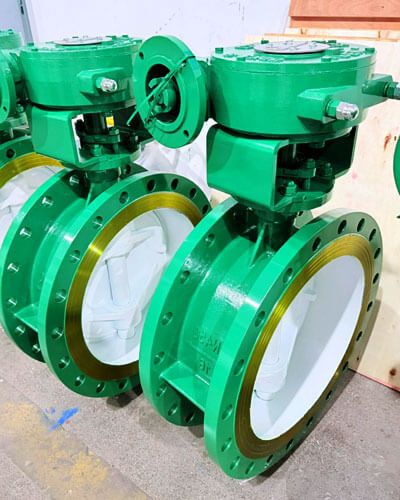
Precizitātes liešana
Carbon Steel Butterfly Valves
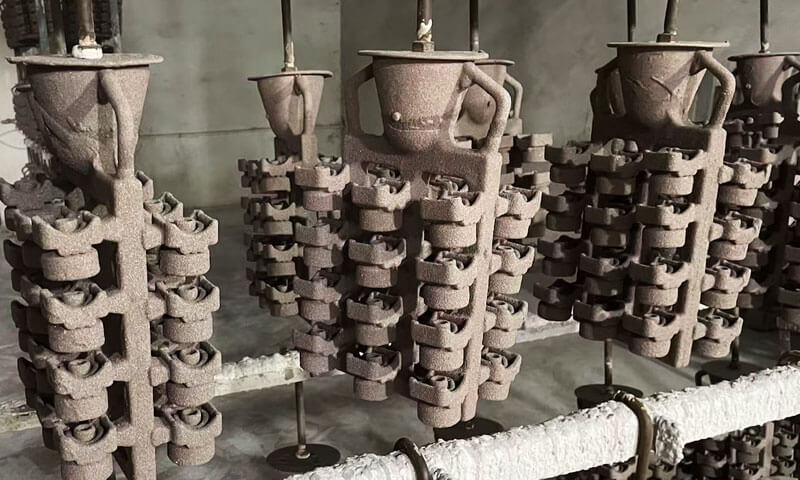
Vidējs- and large-size carbon steel butterfly valve bodies are commonly produced using smilšu liešana, including green sand and resin-bonded sand processes.
These technologies are well established for producing relatively large pressure-containing components and offer a favorable balance between production efficiency, casting yield, tooling cost, and dimensional requirements.
Carbon steel is generally easier to cast than highly alloyed stainless steels because its melting and pouring requirements are less demanding.
The relatively mature process also makes carbon steel attractive for high-volume industrial valve production.
For smaller or geometrically complex components, investīciju liešana may be employed where improved dimensional accuracy, virsmas kvalitāte, and reduced machining allowance are required.
Stainless Steel Butterfly Valves
Stainless steel butterfly valve components are manufactured using both investīciju liešana un smilšu liešana, with the appropriate method determined primarily by component size and geometry.
Investīciju liešana, Pazīstams arī kā zaudētās vaska process, is particularly suitable for small- to medium-sized components with complex geometries.
It can provide relatively precise dimensions and smooth surfaces, reducing subsequent machining requirements.
Large-bore stainless steel valve bodies are more commonly manufactured by sand casting because of the practical limitations of investment casting for very large components.
Precīza CNC apstrāde
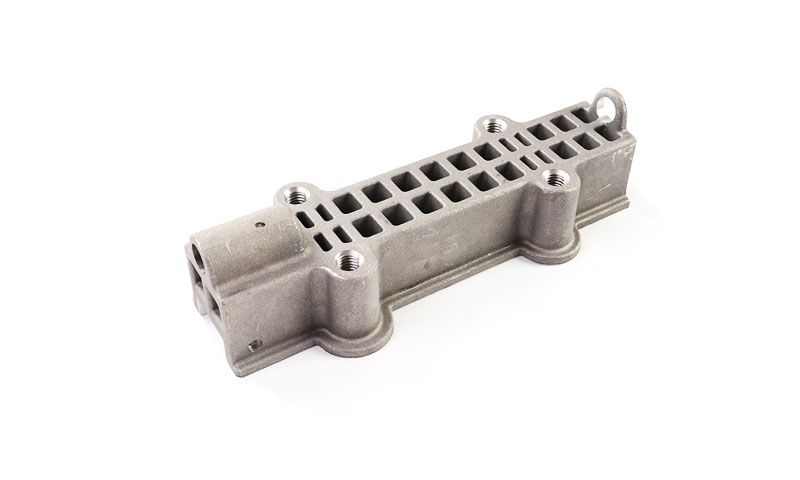
Once the raw casting or forging has been produced, CNC machining creates the precision features necessary for assembly and sealing performance.
Critical machining operations include:
- Machining flange faces to international standards (Asme, Iekšā, Iso)
- Boring the internal flow passage
- Precision machining of stem holes
- Machining disc sealing surfaces
- Processing bearing seats and bushing locations
- Thread machining for lug-type valves
- Surface finishing of sealing interfaces
Modern CNC machining centers routinely achieve tolerances within ±0.02–0.05 mm, ensuring excellent concentricity between the valve body, stumbrs, and disc.
High machining precision reduces operating torque, improves sealing reliability, and extends service life.
5. Mehānisko īpašību salīdzinājums: Carbon Steel vs Stainless Steel Butterfly Valve
Mechanical properties determine how a valve body and disc respond to internal pressure, external loads, temperature changes, and repeated operating cycles.
Tomēr, material properties alone do not establish the pressure rating of a butterfly valve.
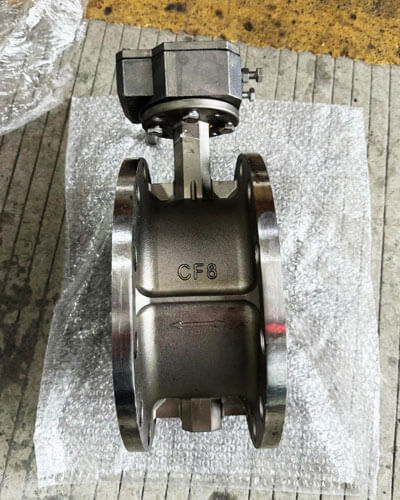
Actual pressure capability also depends on sienas biezums, valve geometry, diametrs, design standard, temperatūra, spiediena klase, disc configuration, and manufacturing quality.
The following table provides representative minimum or specified values for common cast valve materials.
Exact requirements should always be verified against the applicable material standard and edition.
| Īpašums | Carbon Steel A216 WCB | Stainless CF8 (304-veids) | Stainless CF8M (316-veids) | Duplex CD3MN (2205-veids) |
| 0.2% Peļņas izturība, minimāls. | ≥ 250 MPA | ≥ 205 MPA | ≥ 205 MPA | ≥ 450 MPA |
| Stiepes izturība | 485–655 MPa | ≥ 485 MPA | ≥ 485 MPA | ≥ 655 MPA |
| Pagarinājums pārtraukumā, minimāls. | ≥ 24% | ≥ 35% | ≥ 30% | ≥ 25% |
| Typical Hardness Range* | ~130–180 HB | ~140–190 HB | ~150–200 HB | ~220–280 HB |
| Elastības modulis | ~206 GPa | ~ 193 GPA | ~ 193 GPA | ~ 200 GPA |
*Hardness values are indicative rather than universal acceptance ranges and may vary according to heat treatment, product specification, and test condition.
6. Corrosion Resistance Comparison
Corrosion resistance is arguably the most important distinction between carbon steel and stainless steel butterfly valves.
A valve may retain adequate mechanical strength when new but gradually lose pressure-boundary integrity if corrosion reduces its effective wall thickness.
Līdz ar to, corrosion resistance can have a direct impact on long-term valve reliability.
| Service Environment | Carbon Steel WCB | CF8 / 304 Nerūsējošs | Cf8m / 316 Nerūsējošs |
| Dry air / inerta gāze | Acceptable | Lielisks | Lielisks |
| Clean fresh water | Requires corrosion control | Lielisks | Lielisks |
| Hot circulating water | Poor without protection | Good–Very Good | Very Good–Excellent |
| Jūras ūdens / concentrated brine | Nabadzīgs | High pitting risk | Labāks, but still application-dependent |
| Weak organic acids | Generally poor | Good for selected media | Better for many services |
| Strong mineral acids | Generally unsuitable without specialized protection | Ļoti atkarīgs no lietojumprogrammas | Ļoti atkarīgs no lietojumprogrammas |
| Outdoor coastal atmosphere | Requires coating and maintenance | Ļoti labs | Lielisks |
| Chloride-bearing process fluids | Nabadzīgs - vidējs | Moderate–High risk depending on conditions | Generally better than 304 |
7. Temperatūras veiktspēja: Carbon Steel vs Stainless Steel Butterfly Valve
Temperature is a critical factor in butterfly valve material selection because it directly affects peļņas izturība, stiepes izturība, ietekmēt izturību, šļūdes pretestība, termiskā izplešanās, oksidācijas uzvedība, aizzīmogošana, and pressure-temperature rating.
A material that performs well at ambient temperature may experience significant changes in mechanical properties as the operating temperature rises or falls.
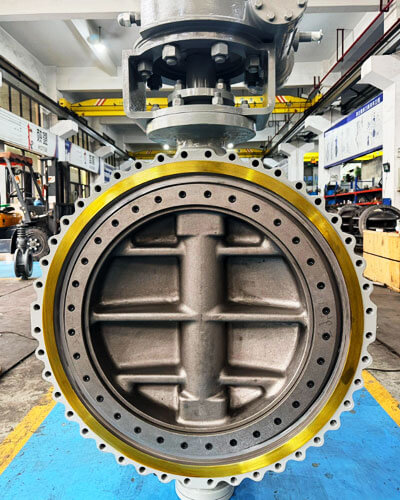
Typical Temperature Characteristics
| Materiāls | Typical Maximum Continuous Service Temperature* | Typical Minimum Service Temperature* | Termiskā trieciena izturība | Principal Temperature Limitation |
| Carbon Steel WCB | ~425°C | ~−29°C | Mērens | Strength reduction and oxidation at elevated temperature; limited low-temperature toughness |
| Low-Temperature Carbon Steel LCB | ~425°C | ~−46°C | Mērens | Better low-temperature toughness than WCB, but still subject to high-temperature strength limitations |
| Austenīta nerūsējošais tērauds 304 / 316 | ~800–850°C in selected high-temperature applications | Down to ~−196°C when properly qualified | Lielisks | Rāpot, oksidācija, and metallurgical changes become important at elevated temperatures |
Dupleksa nerūsējošā tērauda 2205 |
~300°C | ~−40°C, atkarībā no lietojumprogrammas | Labi | Embrittlement and undesirable phase precipitation after prolonged exposure to elevated temperatures |
| Super dupleksa nerūsējošā tērauda 2507 | ~300°C | ~−40°C, atkarībā no lietojumprogrammas | Labi | Similar high-temperature metallurgical limitations to duplex grades |
*These values are indicative material-service ranges, not universal butterfly-valve operating limits.
Actual allowable temperatures must be established from the applicable material specification, valve pressure-temperature rating, sēdekļa materiāls, sealing system, design standard, and manufacturer’s data.
8. Pressure Performance: Carbon Steel vs Stainless Steel Butterfly Valve
Pressure performance is governed by the interaction between material strength, component geometry, sienas biezums, temperatūra, spiediena klase, and design standard.
For industrial valves, ASME B16.34 is one of the key standards used for pressure-temperature ratings, dimensions, materiāli, pārbaude, and related requirements for covered valve constructions.
Pressure Performance: Practical Comparison
| Koeficients | Oglekļa tērauds | CF8 / CF8M Austenitic Stainless | Dupleksa nerūsējošā tērauda |
| Room-temperature yield strength | Augsts | Mērens | Ļoti augsts |
| Pressure containment | Lielisks | Lielisks | Lielisks |
| Strength-to-cost ratio | Lielisks | Mērens | Labi |
| Potential for lightweight design | Labi | Mērens | Lielisks |
| High-temperature strength retention | Mērens | Labi | Temperature-limited |
| Corrosion-related pressure loss | Higher risk | Lower risk | Very low in suitable environments |
| High-pressure suitability | Excellent with appropriate design | Labs - izcils | Lielisks |
| Typical engineering advantage | Economical structural strength | Izturība pret koroziju + izturība | Lielas izturības + izturība pret koroziju |
The Key Engineering Principle
The correct comparison is not:
Which material has the highest pressure rating?
Tā vietā, it should be:
Which material and valve design can maintain the required pressure boundary safely and economically throughout the intended service life?
That distinction is critical in industrial valve engineering.
A carbon steel butterfly valve may provide the most economical pressure boundary in a clean, non-corrosive service, while a stainless steel or duplex valve may provide superior long-term pressure integrity when corrosion is the dominant degradation mechanism.
9. Wear Resistance and Service Life
Wear resistance is an important consideration when selecting between carbon steel and stainless steel butterfly valves, particularly in applications involving frequent cycling, abrazīvas daļiņas, high flow velocity, or repeated throttling.
Tomēr, wear performance should not be judged solely by the body material.
In a butterfly valve, līdz disks, stumbrs, sēdeklis, nesošās virsmas, sealing edges, and internal coatings may experience very different wear mechanisms.
The actual service life is therefore determined by the interaction of materiāls, šķidrs, valve design, operating frequency, pressure differential, plūsmas ātrums, and maintenance conditions.
| Koeficients | Oglekļa tērauds | Nerūsējošais tērauds (Austenīts) | Dupleksa nerūsējošā tērauda |
| Abrasion resistance | Labi (harder grades) | Mērens | Good‑Excellent |
| Corrosion‑erosion | Nabadzīgs (coating dependent) | Labi | Lielisks |
| Galling resistance | Labi | Nabadzīgs (galling tendency) | Lielisks |
| Expected service life (kodīgs) | 5‑20 years (ar pārklājumu) | 30‑60+ years | 30‑60+ years |
| Maintenance frequency | Augsts (coating inspection) | Zems | Zems |
10. Fluid Compatibility and Hygienic Suitability
Fluid Compatibility
- Carbon steel valves are compatible with dry hydrocarbons, fuel oils, smērvielas, compressed air and inert gases.
They are generally unsuitable for aqueous solutions, skābes, alkalis and saline fluids without internal lining. - Stainless steel valves are compatible with a very broad range of chemicals, water-based fluids, food products and pharmaceutical process streams. Grade selection is based on chloride content, pH and temperature.
Hygienic and Sanitary Performance
This is an area of absolute advantage for stainless steel:
- Carbon steel cannot be used for direct food, beverage or pharmaceutical product contact.
Corrosion products and iron ions contaminate process streams, and even coated surfaces fail when the coating is damaged. - Stainless steel has a non-porous, chemically inert surface that resists biofilm formation and withstands repeated CIP (tīrs vietā) and SIP (sterilize-in-place) cikli.
Sanitary-grade stainless steel butterfly valves with polished internals meet 3-A, EHEDG and FDA food contact standards.
11. Cost Comparison: Carbon Steel vs Stainless Steel Butterfly Valve
Cost is often the deciding factor when the technical requirements of an application can be satisfied by more than one material.
Tomēr, comparing only the purchase price can lead to an incorrect decision.
The economically correct comparison is based on Kopējās īpašumtiesību izmaksas (TCO).
Kopējās īpašumtiesību izmaksas
TCO = Purchase Cost + Installation Cost + Uzturēšanas izmaksas + Korozijas aizsardzība + Downtime + Replacement Cost
Lifecycle Cost Comparison
| Izmaksu faktors | Oglekļa tērauds | 304 / CF8 | 316 / Cf8m | Divstāvu / Super duplekss |
| Initial material cost | Zems | Vidējs | Vidēja - auga | High–Very High |
| Manufacturing cost | Zems | Vidējs | Vidēja - auga | Augsts |
| Machining cost | Zems | Augstāks | Augstāks | Augstāks |
| Corrosion protection | Usually required | Usually minimal | Usually minimal | Usually minimal |
| Coating maintenance | Potentially significant | Zems | Zems | Zems |
| Corrosion-related replacement risk | Augstāks | Mērens | Zems vidējs | Low in suitable environments |
| Long-term cost in corrosive service | Potentially high | Mērens | Often favorable | Can be favorable |
| Best economic case | Non-corrosive / controlled environments | General corrosion-resistant service | Chloride / ķīmiskās vides | Severe corrosion + high mechanical demands |
12. Application Selection Guide: Carbon Steel vs Stainless Steel Butterfly Valve
There is no universally superior material. The correct selection depends on the interaction between fluid chemistry, temperatūra, spiediens, corrosion risk, mechanical loading, cleanliness requirements, and project economics.
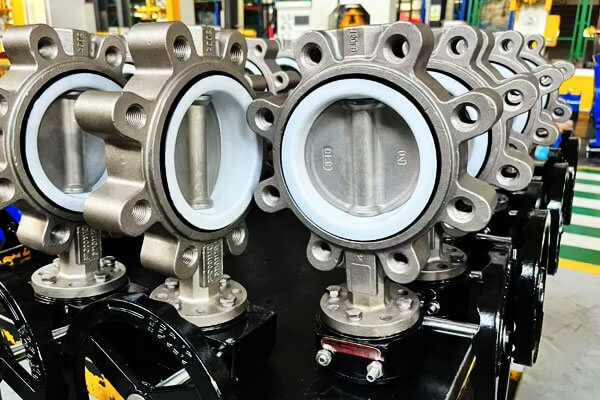
When Carbon Steel Is the Better Choice
Carbon steel butterfly valves are often the preferred solution when:
- The fluid is relatively non-corrosive
- Operating temperature is within the material’s qualified range
- The system is indoors or adequately protected
- Protective coatings can be maintained
- Initial capital cost is a major consideration
- Large valve sizes make stainless steel disproportionately expensive
- High mechanical strength is required at moderate temperatures
Tipiskas lietojumprogrammas ietver:
- HVAC sistēmas
- Firewater systems
- General water distribution
- Industrial cooling systems
- Compressed-air systems
- Oil and gas utilities
- General process piping
Kad 304 / CF8 Stainless Steel Is Appropriate
304-type stainless steel is commonly selected when moderate-to-high corrosion resistance is required but the environment is not severely chloride-rich.
Suitable applications may include:
- Food-processing equipment
- General chemical systems
- Ūdens apstrāde
- Clean industrial fluids
- Architectural and outdoor equipment
- General hygienic applications
It should be used cautiously in hot chloride environments because localized pitting and crevice corrosion can become significant.
Kad 316 / CF8M Stainless Steel Is Preferred
316-type stainless steel is often a better choice where chloride exposure, chemical contamination, or coastal environments are important.
Tipiskas lietojumprogrammas ietver:
- Marine systems
- Coastal process plants
- Ķīmiskā apstrāde
- Food and pharmaceutical processing
- High-purity water
- Pharmaceutical utilities
- Certain brine systems
The presence of molybdenum provides improved resistance to localized corrosion compared with 304-type stainless steel.
When Duplex Stainless Steel Is the Better Option
Duplex stainless steel is particularly attractive when both mechanical strength and corrosion resistance are important.
It is commonly considered for:
- Offshore systems
- Atsāšana
- Jūras ūdens pakalpojums
- High-pressure water systems
- Oil and gas production
- Chloride-rich process fluids
- Ķīmiskā apstrāde
Its higher yield strength can provide structural advantages, while its corrosion resistance can substantially improve service life in aggressive environments.
When Super Duplex Stainless Steel Is Justified
Super duplex is normally considered when the operating environment is too aggressive for conventional austenitic stainless steel or when high strength is simultaneously required.
Potential applications include:
- Severe seawater service
- Offshore oil and gas
- High-chloride brine
- Atsāšana
- Subsea systems
- High-pressure corrosive fluids
The higher material and manufacturing cost should be justified by the required service life and failure consequences.
13. Carbon Steel vs Stainless Steel Butterfly Valve: Visaptveroša salīdzināšanas tabula
The following table summarizes the major engineering differences between carbon steel and stainless steel butterfly valves, including duplex grades where relevant.
| Selection Factor | Carbon Steel WCB | 304 / CF8 Stainless | 316 / CF8M Stainless | Divstāvu 2205 | Super duplekss 2507 |
| Material family | Oglekļa tērauds | Austenīta nerūsējoša | Austenīta nerūsējoša | Duplekss nerūsējošs | Super duplex stainless |
| Tipiska tecēšanas robeža | ≥250 MPa | ≥205 MPa | ≥205 MPa | ~450 MPa minimum class | Generally very high |
| Stiepes izturība | 485–655 MPa | ≥485 MPa | ≥485 MPa | ≥655 MPa | Typically very high |
| Elastība | Labi | Lielisks | Lielisks | Labi | Labi |
| Low-temperature toughness | Limited for WCB | Lielisks | Lielisks | Grade-dependent | Grade-dependent |
| Typical low-temperature direction | WCB ~−29°C; LCB ~−46°C | Can be qualified for cryogenic service | Can be qualified for cryogenic service | Often limited to around −40°C depending on grade | Often limited to around −40°C depending on grade |
| Augstas temperatūras spēja | Mērens | Augsts | Augsts | More restricted | More restricted |
| High-temperature metallurgical concern | Strength loss, oksidācija, rāpot | Rāpot, oksidācija, phase-related effects | Rāpot, oksidācija, phase-related effects | Intermetallic phase precipitation | Intermetallic phase precipitation |
Vispārēja izturība pret koroziju |
Low without protection | Augsts | Ļoti augsts | Ļoti augsts | Lielisks |
| Chloride resistance | Nabadzīgs | Mērens | Labi | Ļoti labs | Lielisks |
| Seawater suitability | Poor without robust protection | Ierobežots | Better but application-dependent | Ļoti labs | Lielisks |
| Ķīmiska izturība | Ierobežots | Good for selected chemicals | Very Good for many applications | Ļoti labs | Excellent for selected severe environments |
| Nodilums pretestība | Labi; can be hardfaced | Mērens | Mērens | Labi | Labi |
| Mašīnīgums | Lielisks | Mērena - divkārša | Mērena - divkārša | Grūts | Grūts |
| Casting cost | Zems vidējs | Mērens - augsts | Augsts | Augsts | Ļoti augsts |
| Machining cost | Zems | Augstāks | Augstāks | Augsts | Augsts |
Virsmas aizsardzība |
Usually coating required | Usually no coating | Usually no coating | Usually no coating | Usually no coating |
| Passivation requirement | Ne | Often beneficial after fabrication | Often beneficial after fabrication | Important for corrosion performance | Important for corrosion performance |
| Hygienic suitability | Generally limited | Excellent when properly fabricated | Lielisks | Atkarīgs no lietojumprogrammas | Atkarīgs no lietojumprogrammas |
| Initial purchase cost | Zemākais | Mērens | Mērens - augsts | Augsts | Augstākais |
| Maintenance cost in corrosive service | Potentially high | Zems vidējs | Zems | Zems | Zems |
| Lifecycle economics | Excellent in non-corrosive service | Good in moderate corrosion | Excellent in chloride/chemical environments | Excellent in severe corrosion + lielas izturības | Justified for severe environments |
Tipiskas lietojumprogrammas |
Laistīt, HVAC, firewater, utilities, eļļas & gāze | Pārtika, laistīt, general chemical service | Jūras, pārtika, farmācija, ķīmisks | Jūrā, jūras ūdens, atsāšana, eļļas & gāze | Severe seawater, jūrā, zemūdens, sālījums |
| Primary advantage | Zemas izmaksas + labs spēks | Izturība pret koroziju + izturība | Uzlabota hlorīda izturība | Izturība + izturība pret koroziju | Maximum corrosion resistance among these options |
| Primary limitation | Korozija | Chloride pitting risk | Augstākas izmaksas nekā 304 | Temperatūras jutība + maksāt | Augstas izmaksas + temperature sensitivity |
14. How to Choose Between Carbon Steel and Stainless Steel Butterfly Valves
Follow this structured decision framework to select the optimal material for each application:
- Define full operating conditions Document fluid composition, ph, chloride content, temperatūra, spiediens, solids loading and cyclic duty. Do not rely on generic service descriptions.
- Establish required design life Define the target service life of the installation. For short-life temporary facilities, carbon steel is usually more economical.
For permanent 20+ year installations, stainless steel is almost always lower cost over time. - Calculate total lifecycle cost Include purchase, uzstādīšana, uzturēšana, replacement and expected downtime cost over the full design period. Avoid decisions based solely on upfront price.
- Evaluate compliance and safety requirements For food, farmaceitisks, potable water and cryogenic services, stainless steel is often mandatory by regulation or industry standard.
- Assess maintenance accessibility For buried, remote or hard-to-reach installations, prioritize long-life stainless steel to minimize costly maintenance interventions.
- Consider intermediate solutions for borderline cases For applications where full stainless steel is cost-prohibitive, consider carbon steel valves with stainless steel trim (disc and stem), or internally lined carbon steel bodies.
15. Why Choose LangHe for Butterfly Valve Components?
LangHe Foundry specialises in high‑quality precision castings for butterfly valve components, offering comprehensive solutions from material selection to finished components.
Contact us for custom butterfly valves.
| Spēja | Detaļa |
| Materiāli | Oglekļa tērauds (WCB, WCC, LCB), Nerūsējošais tērauds (CF‑8, CF‑8M, CF‑3, CF‑3M), Divstāvu (CD‑3MN, CE‑8MN). |
| Casting method | Investīciju liešana, smilšu liešana. |
| Part weight | 0.05 kg to 100 kg. |
| Pielaide | ±0.1‑0.3 mm (CT5‑CT7 per ISO 8062). |
| Virsmas apdare | Ra 1.6‑6.3 µm as‑cast; electropolishing available. |
| Termiskā apstrāde | Risinājumu rūdīšana, normalising, stresa mazināšana. |
| Kvalitāte | Iso 9001:2015 sertificēts; 100% NDT and pressure testing. |
| Sagatavošanās laiks | 8‑12 weeks for tooling; 2‑4 weeks for repeat orders. |
Why partner with LangHe?
- In‑house tooling: Wax dies and patterns designed and manufactured in‑house.
- Procesa simulācija: Solidification simulation for defect‑free castings.
- Automated shell building: Consistent shell quality and permeability.
- Vacuum melting: Available for high‑alloy grades.
- Full traceability: Material and process documentation for every batch.
- Inženierzinātņu atbalsts: Material selection and design optimisation assistance.
16. Secinājums
Carbon steel and stainless steel butterfly valves each serve distinct, well-defined roles in industrial fluid control, and neither is universally superior to the other.
Carbon steel valves deliver exceptional structural performance at low initial cost, making them the economical workhorse for dry, non-corrosive utility services where corrosion is not a limiting factor.
Stainless steel valves offer unmatched corrosion resistance, hygienic performance and long service life, justifying their higher upfront cost in corrosive, sanitary and maintenance-critical applications.
The most cost-effective selection is never determined by purchase price alone.
A systematic evaluation of fluid chemistry, darbības apstākļi, design life and total lifecycle cost will consistently yield the optimal material choice.
As industrial processes continue to demand higher reliability, longer service intervals and stricter regulatory compliance, stainless steel butterfly valves will continue to grow in market share, while carbon steel valves remain the indispensable baseline for general utility and hydrocarbon services.
FAQ
Which material is better for a butterfly valve, carbon steel or stainless steel?
Tas ir atkarīgs no pielietojuma. Carbon steel is better for non‑corrosive services where cost is the primary driver.
Stainless steel is better for corrosive environments, hygiene‑critical applications, and high‑temperature services.
There is no universally better material—only the right material for the specific application.
Are stainless steel butterfly valves more expensive than carbon steel?
Jā. Stainless steel valves typically cost 3‑5 times more than carbon steel valves.
Tomēr, the longer service life and lower maintenance costs often make stainless steel more cost‑effective over the total lifecycle.
What is the difference between CF‑8 and CF‑8M stainless steel?
CF‑8 is equivalent to 304 nerūsējošais tērauds (no molybdenum).
CF‑8M is equivalent to 316 nerūsējošais tērauds, containing 2‑3% molybdenum for improved chloride pitting resistance. CF‑8M is preferred for marine and chemical services.
Is stainless steel butterfly valve stronger than carbon steel?
Ne vienmēr.
Standard austenitic stainless steels such as CF8 and CF8M can have lower yield strength than A216 WCB carbon steel, although they generally offer greater ductility and excellent toughness.
Dupleksa nerūsējošā tērauda, turpretī, can have substantially higher yield strength than both WCB and conventional austenitic stainless steels.
Tāpēc, stainless steel should not be treated as a single mechanical category.