Introduzzjoni
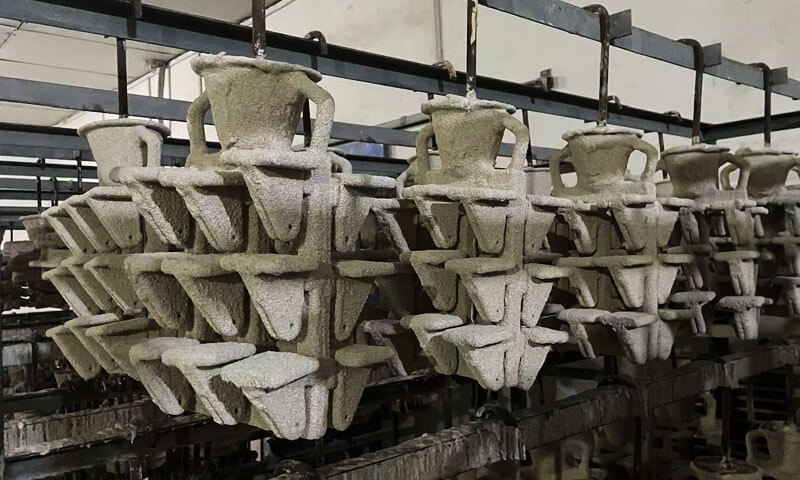
Fl-ikkastjar tal-investiment, il-qoxra taċ-ċeramika hija ferm aktar minn moffa li tintrema — hija sistema ta 'inġinerija ta' prestazzjoni għolja li tirregola direttament l-eżattezza dimensjonali, Integrità tal-wiċċ, Sensità interna, kwalità metallurġika, and production consistency.
Every stage of casting, from wax pattern replication to metal solidification, is influenced by the physical, termali, and chemical behavior of the shell.
Tradizzjonalment, shell evaluation focused primarily on room-temperature strength.
Modern research and industrial practice, Madankollu, show that casting quality depends on a comprehensive combination of shell properties, including mechanical strength, Stabbiltà termali, permeabilità, interfacial chemistry, collapse behavior, and heat-transfer characteristics.
Optimizing only one property often degrades another, making shell engineering a multidisciplinary balancing process rather than a single-parameter optimization.
1. Understanding the Performance System of Investment Casting Shells
The performance of an ikkastjar ta 'investiment shell can be divided into four interconnected categories, each affecting different aspects of casting quality.
| Performance Category | Propjetajiet ewlenin | Primary Influence on Castings |
| Room-temperature properties | Saħħa tal-flessjoni, Qawwa tat-tensjoni, ebusija tal-wiċċ, porożità | Shell integrity during shell making, dewaxing and handling |
| High-temperature properties | Hot strength, Reżistenza tal-creep, residual strength, thermal shock resistance | Eżattezza dimensjonali, deformation control, crack resistance |
| Interface properties | Ħruxija tal-wiċċ, wettability, reattività kimika | Finitura tal-wiċċ, metal penetration, reaction layer thickness |
| Process-adaptive properties | Gas evolution, collapsibility, Konduttività termali | Porożità, cleaning efficiency, imġieba ta 'solidifikazzjoni |
Each parameter independently regulates specific quality indicators of finished castings, including dimensional accuracy, finitura tal-wiċċ, internal metallurgical integrity, and post-processing yield.
Aktar importanti minn hekk, these performance parameters present complex interactive coupling relationships rather than isolated states.
Pereżempju, increasing binder content simultaneously improves ambient and high-temperature shell strength but drastically elevates gas generation propensity, triggering higher porosity defects in castings.
2. Influence of Shell Ambient-Temperature Properties on Casting Quality
The performance of an investment casting shell at ambient temperature establishes the foundation for every downstream manufacturing stage.
Before molten metal is poured, the shell must withstand repeated handling, tneħħija tax-xama ', trasport, assemblaġġ, and furnace loading without losing dimensional integrity or developing hidden damage.
Any mechanical deterioration during these preliminary operations can propagate through the casting process and ultimately appear as surface defects, dimensional deviations, or even catastrophic shell failure.
Ambient-temperature properties are therefore not merely indicators of shell robustness—they determine the shell’s ability to preserve cavity geometry and maintain process stability before exposure to high temperatures.
Four parameters are particularly important: bending strength, Qawwa tat-tensjoni, ebusija tal-wiċċ, u l-porożità.
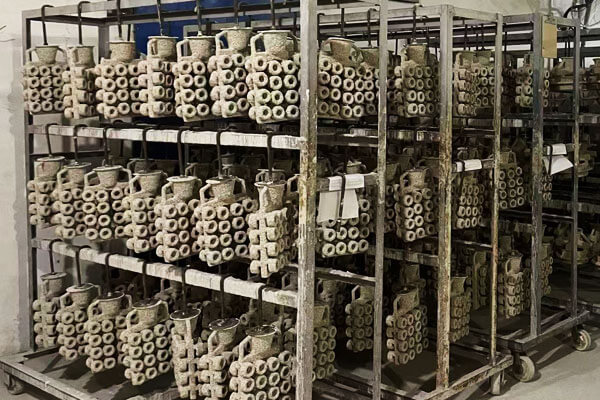
Ambient Bending & Qawwa tat-tensjoni
Ambient strength is the most widely concerned shell performance index, yet its influence on casting quality extends far beyond simple anti-fracture protection.
Different binder systems form distinct optimal strength windows: water-glass bonded shells maintain a standard ambient bending strength of 2.0–3.0 MPa, waqt Sol tas-Silika shells for high-precision castings require 3.0–5.0 MPa.
Insufficient ambient strength causes micro-cracks and inner-layer peeling under high-pressure steam impact during dewaxing.
These latent defects are filled by high-temperature molten metal during pouring, forming metal burrs and excess material defects on casting surfaces.
In gas turbine blade production, when the ambient bending strength of silica sol shells drops below 2.5 MPA, the excess material defect rate of precision blades surges from 1.2% biex 18.7%, causing irreversible damage to fine edge structures and dimensional non-compliance.
Bil-maqlub, excessive ambient strength triggered by over-dosed binder content induces two critical quality risks.
L-ewwel, residual shell strength increases sharply after casting solidification, severely deteriorating collapsibility.
Residual ceramic materials trapped in complex internal cavities cannot be cleaned completely, leading to mass scrappage of cavity-structured castings.
It-tieni, excessive binder precipitates abundant glassy phases during sintering, increasing shell brittleness and generating invisible latent micro-cracks during post-dewax transportation.
These micro-cracks expand under molten metal impact during pouring, resulting in casting deformation and cracking.
For high-temperature alloy complex blade castings, the optimal ambient bending strength window for silica sol shells is 3.5–4.5 MPa.
This balanced range avoids structural damage in pre-pouring procedures while eliminating subsequent collapsibility and brittleness defects.
Ebusija tal-wiċċ: Preserving Mold Surface Integrity
The shell’s surface hardness largely determines how well the prime coat preserves its original finish throughout shell construction.
During multiple dipping, Stuccoing, tnixxif, and handling operations, the prime coat is exposed to abrasion from refractory particles, equipment contact, and manual manipulation.
If surface hardness is inadequate, localized scratches, erożjoni, or coating damage may develop before firing.
Since investment casting faithfully reproduces mold surface features, these imperfections are directly transferred to the casting.
Increasing face-coat hardness through optimized refractory selection or nano-scale ceramic additives improves resistance to mechanical damage and helps maintain a smooth mold cavity.
The resulting benefits include:
- Lower casting surface roughness
- Improved dimensional definition of fine features
- Reduced polishing and machining allowance
- Better consistency between production batches
For aerospace, mediku, and precision engineering components, maintaining prime-coat integrity is essential for achieving superior surface quality.
Porożità: Optimizing Permeability Without Sacrificing Surface Quality
Shell porosity plays a dual role by simultaneously influencing gas evacuation and resistance to molten metal penetration.
Achieving the correct pore structure is therefore one of the most critical aspects of ceramic shell engineering.
When porosity is baxx wisq, gas permeability decreases significantly. Air and decomposition gases generated during pouring cannot escape efficiently, increasing the likelihood of:
- Porożità tal-gass
- Misruns
- Shuts Cold
- Incomplete filling of thin sections
- Poor edge definition
Bil-maqlub, excessive porosity creates interconnected pore networks that allow molten metal to infiltrate the ceramic shell. This may result in:
- Metal penetration
- Burn-on defects
- Ceramic adhesion
- Increased surface roughness
- Difficult shell removal after casting
Rather than maximizing or minimizing porosity, engineers aim to develop a controlled pore structure that provides sufficient venting while maintaining an effective barrier against liquid metal infiltration.
This balance becomes particularly important for high-temperature alloys, where both filling behavior and surface integrity are critical.
Interdependence of Ambient-Temperature Properties
The four ambient-temperature properties do not function independently. Adjusting one characteristic often influences several others simultaneously.
Pereżempju:
- Increasing binder content generally improves flexural strength but may reduce porosity and increase brittleness.
- Raising shell density enhances surface hardness while potentially decreasing gas permeability.
- Modifying refractory particle size distribution changes both mechanical strength and pore connectivity.
These interactions mean that optimizing shell performance requires a systems engineering approach, where mechanical properties, permeabilità, Durabilità tal-wiċċ, and manufacturing practicality are balanced simultaneously rather than optimized individually.
Fl-aħħar mill-aħħar, well-controlled ambient-temperature properties provide the mechanical foundation for stable shell processing, preserve cavity geometry throughout pre-pouring operations,
and create the conditions necessary for achieving high dimensional accuracy, Finitura tal-wiċċ eċċellenti, and consistent casting quality.
3. Influence of Shell High-Temperature Properties on Casting Dimensional and Metallurgical Quality
The performance of a ceramic shell at elevated temperatures ultimately determines whether the dimensional precision established during shell making can be preserved throughout pouring and solidification.
Once molten metal enters the mold cavity, the shell is subjected simultaneously to metallostatic pressure, thermal shock, creep loading, phase transformation, and thermal expansion mismatch.
Under these extreme conditions, shell behavior directly influences dimensional accuracy, Sensità interna, residual stress distribution, and casting integrity.
For high-performance investment castings—including aerospace components, Partijiet tat-turbina tal-gass,
and high-temperature alloy structural castings—many dimensional defects traditionally attributed to pouring parameters actually originate from inadequate high-temperature shell performance.
Four properties are particularly decisive: instantaneous hot strength, high-temperature creep resistance, residual strength, and thermal shock stability.
3.1 Instantaneous Hot Strength and High-Temperature Creep Resistance
Although these two properties are often evaluated separately, they control different stages of shell deformation during pouring and should be considered as complementary performance indicators.
Instantaneous Hot Strength: Resisting Immediate Metallostatic Loading
Instantaneous hot strength describes the shell’s ability to withstand the immediate mechanical loading generated when molten metal fills the mold cavity.
During pouring, molten alloys at temperatures above 1500° C. exert continuous metallostatic pressure on the ceramic shell.
For large thin-wall castings exceeding 300 mm in height, the hydrostatic pressure may exceed 0.1 MPA, while thermal expansion simultaneously introduces additional stresses within the shell structure.
If the shell lacks sufficient hot strength, localized expansion occurs before solidification begins.
Since the ceramic cavity defines the final casting geometry, even minor shell deformation can produce measurable dimensional deviations.
Industrial studies on large aero-engine casings have demonstrated that when shell instantaneous strength at 1480° C. falls below 1.5 MPA, radial dimensional deformation may exceed 0.8 mm, preventing the casting from meeting CT5 dimensional tolerance rekwiżiti.
These findings illustrate that hot strength establishes the initial dimensional stability of the mold immediately after metal filling.
High-Temperature Creep Resistance: Maintaining Dimensional Stability During Solidification
Unlike instantaneous strength, creep resistance governs the shell’s long-term dimensional stability while the casting remains at elevated temperature.
Large superalloy castings often require aktar minn 45 minuti to complete solidification.
Matul dan il-perjodu, the shell continuously supports the weight of molten metal while operating near its maximum service temperature.
Even when instantaneous strength is adequate, time-dependent ceramic deformation (creep) gradually alters cavity geometry.
This phenomenon is particularly critical for:
- Large aerospace structural castings
- Gas turbine casings
- Thick-wall superalloy components
- Thin-wall precision blades requiring extremely tight profile tolerances
Conventional silica-sol ceramic shells typically exhibit approximately 1.2% creep deformation after one hour at 1550°C.
While this level of deformation may appear modest, it is unacceptable for components requiring CT4-level dimensional precision because creep-induced distortion accumulates continuously throughout solidification.
Material optimization has demonstrated significant improvements.
By reinforcing silica-sol shell systems with mullite fibers, the one-hour creep deformation at 1550° C. jista 'jitnaqqas għal Hawn taħt 0.2%.
This six-fold reduction in creep enables casting dimensional accuracy to consistently reach CT4, while turbine blade profile deviations can be maintained within 0.1 mm.
These results indicate that, for long-solidification precision castings, high-temperature creep resistance frequently becomes a more important determinant of dimensional stability than pouring parameter optimization alone.
3.2 Residual Strength and Thermal Shock Stability
While hot strength and creep resistance govern shell behavior during pouring, residual strength and thermal shock resistance determine casting quality before and after solidification.
Residual Strength: Optimizing Post-Casting Shell Removal
Residual strength refers to the mechanical strength retained by the ceramic shell after the casting has cooled to room temperature.
Contrary to common assumptions, higher residual strength does not necessarily improve casting quality.
Minflok, excessive residual strength significantly increases shell removal difficulty, especially for components containing narrow internal passages.
A typical example is hollow turbine blades incorporating cooling channels with minimum diameters of only 0.8 mm.
When shell residual strength exceeds 10 MPA, ceramic residues become extremely difficult to remove without damaging the casting, often resulting in complete component rejection.
Engineering practice has shown that optimizing refractory aggregate gradation and introducing a controlled proportion of expandable quartz sand promotes the formation of uniformly distributed microcracks during cooling.
These microcracks reduce residual shell strength to Hawn taħt 3 MPA, while maintaining sufficient integrity during pouring.
The benefits are substantial:
- Internal cavity cleaning efficiency improves by aktar minn 80%.
- Cleaning-related rejection rates decrease from approximately 25% sa hawn taħt 2%.
- Less mechanical force is required during knockout, reducing the risk of damaging thin-wall structures.
These results demonstrate that residual strength should be carefully engineered rather than simply maximized.
Thermal Shock Stability: Preventing Shell Fracture During Pouring
Thermal shock resistance describes the shell’s ability to withstand rapid temperature changes without cracking.
During investment casting, molten metal approaching 1600° C. contacts a shell initially near room temperature.
The inner shell surface experiences almost instantaneous heating, while the outer layers remain comparatively cool, producing extremely steep thermal gradients and significant tensile stresses.
If thermal shock resistance is inadequate, several defects may occur:
- Surface cracking
- Through-wall fractures
- Molten metal leakage
- Mold failure
- Flash formation
- Complete casting scrap
One effective solution involves incorporating high-temperature ceramic short fibers into the backup shell layers. These fibers bridge developing microcracks, redistribute thermal stresses, and inhibit crack propagation.
Industrial applications have shown that this reinforcement strategy increases the shell’s effective thermal shock endurance from approximately 3–5 thermal cycles biex aktar minn 15 ċikli, virtually eliminating metal leakage defects during the production of large precision castings.
Engineering Perspective: Balancing High-Temperature Shell Properties
High-temperature shell properties should never be optimized independently because they exhibit strong interactions.
Pereżempju:
- Increasing ceramic densification generally improves hot strength but may reduce thermal shock resistance.
- Raising binder content can enhance creep resistance while increasing residual strength and making shell removal more difficult.
- Fiber reinforcement improves crack resistance but may alter thermal conductivity and shell permeability.
- Higher firing temperatures strengthen ceramic bonding yet can reduce collapsibility after casting.
Għalhekk, the objective is not to maximize any single property, but to establish an optimized balance that satisfies the entire casting process.
An ideal investment casting shell should:
- Maintain sufficient instantaneous hot strength to resist metallostatic pressure during mold filling.
- Exhibit excellent Reżistenza tal-creep to preserve cavity geometry throughout solidification.
- Retain only moderate residual strength, enabling efficient knockout and cleaning.
- Possess high thermal shock stability to survive rapid heating without cracking or metal leakage.
Only through coordinated optimization of these four high-temperature properties can investment casting consistently achieve superior dimensional accuracy, excellent metallurgical quality, high production yield, and stable batch-to-batch repeatability.
4. Influence of Shell Interface Properties on Casting Surface Quality
The interface between the ceramic shell and molten metal is where the final surface characteristics of an investment casting are established.
Unlike the structural properties of the shell, which primarily influence dimensional stability, interface properties determine surface integrity, metallurgical cleanliness, and the quality of the casting skin.
Every phenomenon occurring at this microscopic boundary—including metal wetting, trasferiment tas-sħana, chemical reactions, and liquid metal penetration—directly affects the finished component.
For high-value precision castings such as turbine blades, aerospace structural parts, Impjanti mediċi, and titanium components, the interface must not simply withstand molten metal;
it must actively regulate metal flow while minimizing undesirable physical and chemical interactions.
Three interface characteristics are particularly critical:
- Surface roughness of the shell face coat
- Wettability between molten metal and the ceramic surface
- Chemical reactivity at the shell-metal interface
Optimizing these properties simultaneously is essential for producing castings with excellent surface finish, minimal finishing requirements, and superior metallurgical quality.
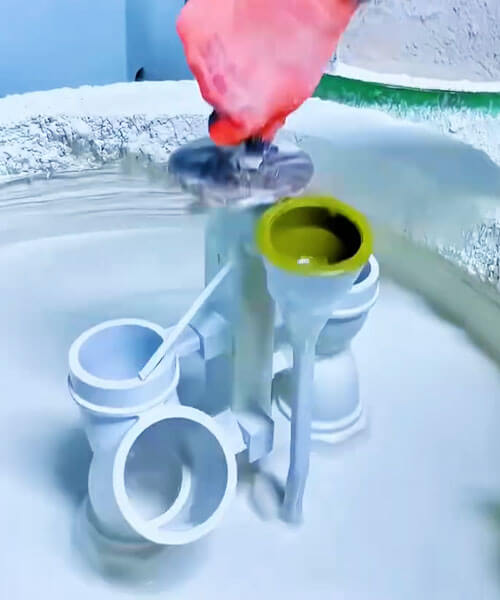
4.1 Surface Roughness and Wettability: Controlling Surface Replication and Metal Flow
The ceramic face coat serves as the mold surface that directly replicates the geometry and texture of the final casting.
Konsegwentement, its microtopography has a direct influence on surface finish.
Surface Roughness Determines Surface Replication Accuracy
One of the fundamental principles of investment casting is that the surface morphology of the shell is reproduced almost exactly on the casting.
Any microscopic irregularities in the ceramic face coat become corresponding features on the metal surface after solidification.
When the face coat is formulated using a single particle-size refractory flour, voids remain between individual particles, creating numerous microscopic depressions on the shell surface.
During pouring, molten metal fills these depressions, producing surface pitting, rough textures, and localized irregularities that often require additional machining or polishing.
A more effective approach is to employ a bimodal particle-size distribution, where fine refractory particles occupy the interstitial spaces between larger particles.
This produces a denser and more uniform ceramic surface.
Industrial studies have shown that this optimization can reduce shell surface roughness from approximately Ra 1.6 μm biex below Ra 0.4 μm, enabling finished castings to consistently achieve surface roughness values of approximately Ra 0.8 μm.
Such improvements significantly reduce post-casting finishing operations while enhancing dimensional fidelity for precision components.
Beyond aesthetics, a smoother shell surface also minimizes local turbulence during mold filling, reducing the likelihood of oxide entrapment and surface defects.
Wettability Must Balance Mold Filling and Metal Penetration
Surface roughness alone cannot guarantee high-quality castings.
The interaction between molten metal and the ceramic surface—commonly described by wettability—plays an equally important role.
Wettability determines how readily molten metal spreads across the shell surface and enters fine geometric features.
If wettability is baxx wisq, molten metal tends to contract into droplets rather than spread uniformly, reducing filling capability in thin-wall or intricate regions. This frequently causes:
- Misruns
- Incomplete filling
- Rounded edges
- Loss of fine details
These problems become particularly critical in components containing extremely thin sections, bħal 0.5 mm cooling passages in turbine blades, where complete mold filling depends on stable metal flow.
Bil-maqlub, excessive wettability creates a different challenge. Molten metal can penetrate interconnected pores in the ceramic surface, tipproduċi:
- Metal penetration
- Sand adhesion
- Surface contamination
- Difficult cleaning operations
Għalhekk, the objective is not maximum wettability but controlled wettability.
By carefully adjusting the chemistry of the face-coat slurry through specialized interface modifiers, manufacturers can regulate the contact angle between molten metal and the ceramic shell.
For high-temperature alloy castings, maintaining a contact angle within approximately 90°–110° has proven effective in balancing excellent filling performance with strong resistance to metal penetration.
This controlled interface behavior addresses one of the long-standing challenges in precision casting: achieving complete filling of complex thin-wall geometries without sacrificing surface cleanliness.
4.2 Shell-Metal Chemical Reactivity: Preserving Surface Metallurgy
While surface texture and wettability influence physical interaction, chemical compatibility between the shell and molten alloy determines the metallurgical quality of the casting surface.
At pouring temperatures approaching 1550° C., many engineering alloys become highly chemically active.
If the ceramic shell contains reactive constituents, interfacial reactions occur immediately after metal contact, producing reaction layers, inklużjonijiet, and localized compositional changes.
These reactions are particularly detrimental in aerospace superalloys and titanium alloys, where even minor surface contamination can significantly reduce component performance.
Chemical Reactions Can Alter Surface Composition
Traditional silica-based face coats may react with active alloying elements such as aluminum and titanium through reactions including:
[Al] + SiO₂ → Al₂O₃ + [U]
Such reactions consume beneficial alloying elements while generating oxide inclusions at the casting surface.
The consequences include:
- Formation of reaction layers tens of micrometers thick
- Surface sand adhesion
- Oxide inclusions
- Elemental depletion of Al and Ti
- Reduced oxidation resistance
- Lower fatigue performance
Experimental fatigue evaluations have demonstrated that turbine blades containing thick interfacial reaction layers may exhibit bejn wieħed u ieħor 40% lower high-temperature fatigue life than components produced with chemically stable shell systems.
For safety-critical aerospace components, such degradation is unacceptable.
Advanced Face-Coat Materials Minimize Interfacial Reactions
Modern investment casting increasingly relies on chemically inert materjali refrattarji to suppress interface reactions.
Instead of conventional silica-rich face coats, manufacturers frequently employ:
- Żirkonja (Zro₂)
- High-purity alumina (Al₂o₃)
- Fused corundum
- Specialized reaction inhibitors
These materials exhibit significantly lower chemical affinity for molten superalloys and effectively reduce interfacial reaction kinetics.
With optimized face-coat formulations, the thickness of the reaction layer can be controlled to Hawn taħt 5 μm, dramatically improving surface cleanliness and preserving the designed alloy composition.
Titanium Alloys Require Ultra-Inert Ceramic Systems
Titanium alloys present an even greater challenge because molten titanium reacts aggressively with nearly all conventional ceramic materials.
The formation of an oxygen-enriched alpha-case layer and severe chemical contamination can drastically impair fatigue strength, duttilità, u reżistenza għall-korrużjoni.
To address this issue, aerospace foundries commonly employ Ythia (Y₂o₃)-based face coats, whose exceptional chemical stability minimizes reactions with molten titanium.
Industrial practice has shown that yttria-based shell systems can limit the interfacial reaction layer to Hawn taħt 10 μm,
satisfying the stringent surface integrity requirements for aerospace titanium components while reducing subsequent machining needed to remove contaminated surface material.
Engineering Perspective: Interface Optimization Requires Multi-Property Balance
The shell-metal interface should be regarded as a carefully engineered functional system rather than a passive mold surface.
Optimal interface performance is achieved only when multiple characteristics are balanced simultaneously:
- Low surface roughness ensures accurate replication of the mold cavity and superior casting finish.
- Controlled wettability promotes complete filling of intricate geometries while preventing metal penetration into the shell.
- Minimal chemical reactivity preserves alloy composition, suppresses inclusion formation, and enhances long-term mechanical performance.
Rather than optimizing any single parameter in isolation, modern investment casting focuses on integrating ceramic material selection, particle-size engineering, interface chemistry, and slurry formulation into a unified surface engineering strategy.
This comprehensive approach enables the production of castings with outstanding surface quality, excellent metallurgical integrity, and the high reliability demanded by aerospace, enerġija, mediku, and other advanced engineering industries.
5. Influence of Shell Process Adaptability Properties on Casting Internal Quality
Beyond mechanical strength and interfacial stability, a ceramic shell must also function as an integrated process medium throughout pouring, solidifikazzjoni, Tkessiħ, and shell removal.
Its performance during these stages determines how effectively it accommodates molten metal behavior while facilitating post-casting operations.
This capability is referred to as shell process adaptability, which directly influences the formation of internal defects, solidification structure, u l-effiċjenza tal-manifattura.
Unlike conventional shell performance indicators, process adaptability focuses on the interaction between the shell and the entire casting process rather than on the shell material itself.
Three properties are particularly influential: gas evolution, collapsibility, u konduttività termali.
Flimkien, they regulate gas evacuation, solidification dynamics, residual stress development, and shell removal.
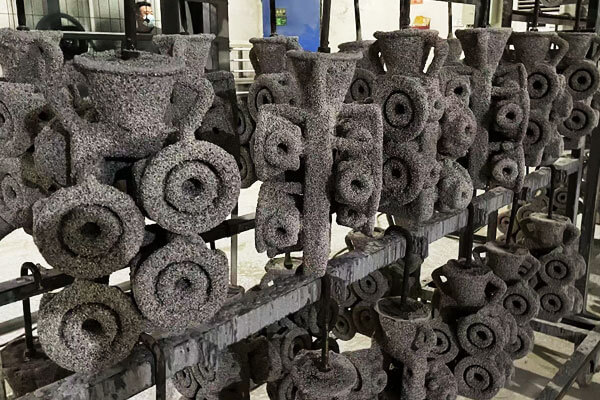
5.1 Shell Gas Evolution: A Critical Source of Internal Porosity
Gas generation from the ceramic shell is one of the most overlooked sources of internal porosity in investment casting.
During pouring, molten metal instantly heats the shell to temperatures well above the decomposition temperatures of any remaining moisture, chemically bound water, residual organics, or incompletely fired binders.
These substances rapidly decompose, generating gases that must escape through the shell’s pore network before the advancing solidification front traps them inside the casting.
If gas evolution exceeds the shell’s venting capacity, defects such as the following become increasingly likely:
- Porożità tal-gass
- Blowholes
- Subsurface pores
- Reduced pressure tightness
- Lower fatigue strength
The root cause is often inadequate shell firing. Insufficient burnout leaves residual binder phases and chemically bound water within the ceramic matrix, both of which decompose violently when exposed to molten metal.
Industrial production data clearly illustrate this relationship.
When the total gas evolution of silica-sol ceramic shells exceeds 15 mL/g, the internal porosity defect rate may increase dramatically from approximately 3% biex 27%.
This problem can be effectively controlled through optimized shell firing.
By introducing sufficient holding time at approximately 900° C., residual organic materials and volatile compounds can be almost completely removed before pouring.
Bħala riżultat, total shell gas evolution can be reduced to Hawn taħt 5 mL/g, lowering the internal porosity defect rate to inqas minn 1%.
Further improvements can be achieved by engineering the pore structure of the backup shell layers.
Designing interconnected venting channels enhances gas permeability, allowing decomposition gases to escape rapidly without entering the molten metal.
Konsegwentement, controlling shell gas evolution is not only a matter of shell chemistry but also of shell architecture and firing strategy.
5.2 Shell Collapsibility: Balancing Constraint and Stress Relief
An effective ceramic shell must provide sufficient rigidity during pouring while releasing the casting after solidification without imposing excessive mechanical restraint.
This balance is described by shell collapsibility.
If the shell remains excessively rigid during cooling, thermal contraction of the casting becomes constrained, producing significant residual stresses that may result in:
- Tiċrit jaħraq
- Cold cracking
- Distorsjoni dimensjonali
- Difficult shell removal
- Increased risk of damage during knockout
Bil-maqlub, a shell that collapses prematurely loses its ability to support the casting during the final stages of solidification, potentially causing dimensional instability or localized deformation.
Għalhekk, collapsibility should be regarded as a controlled engineering characteristic rather than a simple measure of shell weakness.
Modern shell systems achieve this balance by optimizing aggregate grading, ceramic bonding, and microstructural design so that the shell maintains adequate structural integrity during pouring while breaking down efficiently after solidification.
For complex castings containing internal passages or enclosed cavities, appropriate collapsibility significantly improves cleaning efficiency,
reduces mechanical finishing requirements, and minimizes the risk of damaging delicate features during shell removal.
5.3 Shell Thermal Conductivity: Regulating Solidification and Microstructure
The ceramic shell serves as the primary heat-transfer medium between molten metal and the surrounding environment.
Konsegwentement, its thermal conductivity has a direct influence on cooling rate, Gradjenti tat-temperatura, solidification sequence, and ultimately the microstructure and mechanical properties of the casting.
Unlike many shell properties that have a universally desirable direction, thermal conductivity must be tailored to the alloy system and casting process.
High-Temperature Alloy Directional Solidification
For directional solidification and single-crystal superalloy components, shell thermal conductivity is one of the most important parameters controlling thermal gradients.
When thermal conductivity is too low, heat extraction becomes insufficient, jikkawża:
- Reduced temperature gradients
- Coarser dendritic structures
- Increased stray grain formation
- Lower creep resistance
- Reduced high-temperature service life
Engineering studies have shown that incorporating graphite-based high-conductivity materials into the backup shell can approximately double shell thermal conductivity,
increasing the directional solidification temperature gradient from 50 K/cm biex 100 K/cm.
This enhanced heat transfer reduces the primary dendrite arm spacing from approximately 400 μm biex 200 μm,
resulting in a finer solidification structure and improving the high-temperature service life of turbine blades by aktar minn 30%.
These results demonstrate that shell thermal conductivity is a powerful tool for microstructural engineering rather than simply a heat-transfer parameter.
Aluminum Alloy Precision Castings
The optimal thermal conductivity is significantly different for aluminum alloys.
Thin-wall aluminum castings solidify rapidly because of aluminum’s high thermal conductivity.
If the ceramic shell also possesses excessively high thermal conductivity, heat extraction becomes too aggressive, tipproduċi:
- Large thermal gradients
- Elevated residual stresses
- Cold cracking
- Distorsjoni
- Increased dimensional variation
F’dawn l-applikazzjonijiet, shells incorporating low-conductivity porous refractory aggregates provide a more favorable cooling profile by moderating heat extraction and promoting stable sequential solidification.
Properly matched shell thermal conductivity reduces the likelihood of both shrinkage porosity and cold cracking while improving dimensional consistency.
Engineering Perspective: Process Adaptability Determines Internal Casting Quality
The process adaptability of a ceramic shell cannot be evaluated through a single performance indicator because gas evolution, collapsibility, and thermal conductivity are closely interconnected.
Pereżempju:
- Increasing shell density may reduce gas permeability while improving thermal conductivity.
- Lower residual strength enhances collapsibility but may reduce structural stability during pouring.
- Higher thermal conductivity can refine microstructures in superalloys but induce excessive thermal stress in aluminum alloys.
Konsegwentement, shell design should always be optimized according to the alloy system, casting geometry, and solidification strategy rather than pursuing universally higher or lower values.
An ideal investment casting shell should:
- Generate minimal gas during pouring to prevent internal porosity.
- Tipprovdi controlled collapsibility that relieves thermal stress while maintaining dimensional support.
- Twassal application-specific thermal conductivity that produces the desired cooling rate and solidification behavior.
Only by integrating these process adaptability properties into the overall shell design can manufacturers consistently achieve dense internal structures, stable solidification,
superior mechanical performance, and high production yields across a wide range of precision casting applications.
6. Modern Engineering Strategies for Optimizing Shell Performance
Modern investment casting no longer treats shell manufacturing as a sequence of isolated process steps.
Minflok, the ceramic shell is engineered as a multifunctional system whose mechanical, termali, interfacial, and process-adaptability properties must be optimized simultaneously.
Because shell performance parameters are highly interdependent, improving one property often influences several others.
Konsegwentement, today’s shell development focuses on multi-objective optimization rather than maximizing individual performance indicators.
Multi-Layer Shell Architecture Design
Modern ceramic shells are designed using a functional layer concept, where each layer performs a specific role rather than serving identical functions.
A typical shell structure consists of:
- Face coat, responsible for surface finish, Fidelità dimensjonali, u stabbiltà kimika.
- Intermediate layers, providing crack resistance and stress distribution.
- Saffi ta 'backup, supplying structural rigidity, permeabilità, and thermal management.
By tailoring refractory materials, binder composition, and particle size for each layer,
engineers can independently optimize surface quality, shell strength, and heat-transfer behavior without compromising overall performance.
This layered design philosophy has become the foundation of high-performance investment casting.
Advanced Slurry Engineering
Slurry characteristics directly determine coating uniformity, shell density, and microstructural consistency.
Modern slurry development focuses on controlling:
- Solid loading
- Particle-size distribution
- Rheological behavior
- Thixotropy
- Suspension stability
- Binder dispersion
Rather than simply increasing viscosity, optimized slurry formulations achieve uniform coating thickness across flat surfaces, kavitajiet fil-fond, kantunieri li jaqtgħu, and complex internal passages.
For high-precision castings, maintaining consistent slurry rheology significantly reduces shell thickness variation, minimizes residual stress during drying, and improves dimensional repeatability.
Optimized Particle Packing and Ceramic Microstructure
The internal structure of the ceramic shell largely determines its mechanical and thermal performance.
Instead of using single-size refractory powders, modern shell systems employ engineered multimodal particle-size distributions, allowing smaller particles to occupy the voids between larger particles.
The resulting microstructure offers several advantages:
- Higher packing density
- Reduced shrinkage during drying
- Qawwa mtejba
- More uniform porosity
- Better dimensional stability
- Finitura mtejba tal-wiċċ
Carefully controlling pore size distribution also improves gas permeability while preventing excessive molten metal penetration.
Reinforcement Through Advanced Ceramic Materials
To improve shell reliability under extreme thermal conditions, reinforcement technologies are increasingly incorporated into shell systems.
Common approaches include:
- Mullite fibers for improved high-temperature creep resistance
- Ceramic short fibers for enhanced thermal shock resistance
- Nano-alumina for increased face-coat hardness
- Zirconia-based refractories for chemical inertness
- Yttria face coats for titanium alloy casting
These reinforcement mechanisms increase fracture resistance while reducing shell deformation under metallostatic pressure and thermal loading.
For large aerospace castings and superalloy components, ceramic reinforcement has become an important strategy for improving shell durability without excessively increasing shell thickness.
Precision Drying and Controlled Sintering
Drying and firing are no longer viewed simply as shell preparation steps—they are critical processes for establishing the final ceramic microstructure.
Modern facilities employ controlled environments that regulate:
- Temperatura
- Relative humidity
- Airflow velocity
- Drying sequence
- Heating rate
- Holding time
- Cooling profile
Uniform drying minimizes differential shrinkage and residual stress, while optimized firing promotes complete binder decomposition, stable ceramic bonding, and controlled pore development.
For silica-sol shells, properly designed firing schedules around 900° C. effectively reduce residual volatile content and minimize shell gas evolution before pouring.
Interface Engineering for Advanced Alloys
As casting alloys become increasingly reactive, shell-metal interface engineering has become one of the fastest-growing areas of investment casting technology.
Modern face-coat systems are designed to:
- Minimize chemical reactions
- Control wettability
- Reduce oxide formation
- Suppress elemental depletion
- Prevent sand adhesion
Material selection is now tailored to specific alloy systems.
Pereżempju:
- Zirconia and fused alumina are widely used for nickel-based superalloys.
- Yttria-based face coats are preferred for titanium alloys due to their exceptional chemical stability.
- Specialized interface modifiers regulate wetting behavior and reduce reaction-layer thickness.
This alloy-specific approach significantly improves casting surface integrity and metallurgical cleanliness.
Digital Process Monitoring and Intelligent Quality Control
Digital manufacturing technologies are transforming shell production from experience-based operation into data-driven process control.
Modern investment foundries increasingly integrate:
- Automatic slurry viscosity monitoring
- Online shell thickness measurement
- Environmental sensors for drying rooms
- Real-time furnace temperature recording
- Kontroll tal-proċess statistiku (SPC)
- Digital traceability systems
These technologies enable continuous monitoring of critical shell-making variables and greatly reduce batch-to-batch variation.
Combined with predictive quality analysis and process simulation, digital monitoring improves process stability while reducing scrap rates and production costs.
Engineering Perspective
The future of investment casting lies not in developing the strongest ceramic shell, but in designing the most balanced shell system.
By integrating advanced materials, intelligent process control, interface engineering, and performance-based optimization,
modern shell technology is evolving from a passive mold-making process into a sophisticated engineering discipline that directly determines the quality, konsistenza, and competitiveness of precision castings.
7. Konklużjoni
Investment casting shell performance is a systematic engineering system that comprehensively governs the overall quality of precision castings.
Ambient-temperature properties ensure pre-pouring structural integrity and basic surface quality; high-temperature properties determine casting dimensional stability and high-temperature service performance;
interface properties dominate surface finish and interfacial metallurgical quality; process adaptability properties control internal microscopic defects and post-processing yield.
Each performance parameter has an independent defect generation mechanism, and their complex coupling relationships are the core bottleneck restricting high-end casting quality upgrading.
Only by abandoning single-index optimization thinking and building a full-dimensional synergistic regulation system of shell material formula, structural design, and process parameters can precise balance of 12 core shell properties be realized.
This provides reliable technical support for batch production of high-quality aerospace, new energy, and precision machinery investment castings, and promotes the high-end and intelligent upgrading of the precision casting industry.
Custom Investment Casting Services by LangHe
LangHe tipprovdi custom investment casting services for customers seeking high-precision, complex metal components across a wide range of industries.
Backed by extensive expertise in tooling design, wax pattern production, ceramic shell manufacturing, ikkastjar ta 'preċiżjoni, trattament tas-sħana, Makkinar CNC, Irfinar tal-wiċċ,
and comprehensive quality inspection, LangHe delivers castings with exceptional dimensional accuracy, superior surface quality, u prestazzjoni mekkanika affidabbli.
Whether producing stainless steel, azzar tal-karbonju, Azzar tal-liga, aluminju, Brass, bronż, or other specialty alloys, LangHe supports everything from rapid prototyping and low-volume production to high-volume manufacturing.
By combining advanced investment casting technology with strict process control and engineering support,
LangHe helps customers reduce machining costs, optimize component performance, shorten development cycles, and achieve consistent quality across every production batch.