

Perkenalan
Di antara keluarga proses pengecoran presisi, pengecoran investasi—sering disebut “pengecoran lilin yang hilang”—berbeda karena kemampuannya menghasilkan komponen logam berbentuk hampir bersih dengan permukaan akhir yang luar biasa, geometri yang rumit, dan toleransi dimensi yang ketat.
Artikel ini membedah proses pengecoran investasi dari prinsip pertama hingga penerapan tingkat lanjut.
Kami akan mengeksplorasi fondasi metalurginya, alur proses yang detail, varian teknologi (gelas air, Silica sol, gabungan), mekanisme cacat, posisi komparatif terhadap metode manufaktur lainnya, dan kasus penggunaan industri.
1. Apa itu Casting Investasi?
Pengecoran investasi, juga dikenal sebagai proses longgar, adalah metode pembentukan logam presisi di mana lilin sekali pakai atau pola yang dapat melebur dilapisi dengan cangkang keramik tahan api, kemudian dikeluarkan untuk membuat rongga yang berisi logam cair.
Proses ini dirancang untuk mereproduksi pola asli dengan tingkat ketelitian yang tinggi, menjadikannya salah satu jalur produksi paling efektif untuk kompleks, bagian logam berbentuk hampir jaring.
Berbeda dengan rute pengecoran konvensional yang sering kali dioptimalkan untuk kesederhanaan atau volume saja, pengecoran investasi dibangun replikasi detail, kontrol dimensi, dan fleksibilitas paduan.
Ini digunakan ketika suatu komponen harus menggabungkan geometri yang rumit, akurasi fungsional, dan kualitas metalurgi yang andal dalam satu rantai proses.
Itulah mengapa ini banyak diadopsi di industri seperti dirgantara, energi, otomotif, peralatan medis, dan perangkat keras industri presisi.
Keunggulan Kompetitif Inti dari Pengecoran Investasi
Dibandingkan dengan proses pembentukan logam lainnya, pengecoran investasi menawarkan enam keunggulan inti yang memberikan posisi pasar yang khas dan bertahan lama:
Akurasi dimensi dan permukaan akhir yang unggul
Pengecoran investasi dapat mencapai toleransi dimensi standar CT4–CT7, jauh lebih ketat daripada pengecoran pasir (CT9–CT14).
Kekasaran permukaan biasanya dapat dikontrol pada Ra 1,6–6,3 m, yang sangat mengurangi kebutuhan penggilingan ekstensif, pemolesan, atau finishing sekunder pada permukaan fungsional dekoratif dan presisi.
Kemampuan luar biasa untuk geometri kompleks
Proses ini sangat cocok untuk bagian-bagian dengan fitur yang sangat rumit, termasuk rongga internal, undercuts, bagian dinding tipis (turun ke 0.5 mm), permukaan melengkung yang rumit, dan pola lubang halus.
Ia dapat mereproduksi hampir semua geometri yang diperlukan untuk komponen presisi industri.
Kompatibilitas paduan luas
Pengecoran investasi kompatibel dengan berbagai macam paduan, termasuk logam besi dan non-besi biasa serta material berkinerja tinggi yang menuntut.
Hal ini dapat diterapkan pada baja tahan karat, Baja karbon, Paduan Aluminium, paduan tembaga, Superalloy berbasis nikel, paduan berbasis kobalt, dan bahkan paduan aktif seperti titanium.
Toleransi paduan yang luas ini memberi para insinyur lebih banyak kebebasan dalam pemilihan material dibandingkan banyak proses pembentukan lainnya.
Kualitas metalurgi tinggi
Cangkang keramik yang inert secara kimia meminimalkan kontaminasi logam cair.
Selain itu, solidifikasi yang terkendali dan sistem gating yang dirancang dengan baik membantu mengurangi penyusutan, porositas, dan segregasi, memproduksi suku cadang dengan struktur mikro padat dan kinerja mekanik yang stabil.
Efisiensi material yang tinggi
Sebagai proses yang bentuknya hampir bersih, pengecoran investasi menawarkan tingkat pemanfaatan material sekitar 92%–98%, secara substansial mengurangi limbah logam dibandingkan dengan proses pemesinan subtraktif.
Skala produksi fleksibel
Pengecoran investasi sangat mudah beradaptasi, membuatnya cocok untuk prototipe khusus satu kali, suku cadang khusus dalam jumlah kecil, dan produksi komponen standar dalam jumlah besar.
2. Prinsip Inti Metalurgi dan Proses
Pengecoran investasi bukan hanya metode pembentukan. Ini adalah integrasi yang erat sistem metalurgi di mana kesetiaan pola, perilaku cangkang, manajemen termal, dan pemadatan paduan semuanya berinteraksi.
Kualitas bagian akhir ditentukan oleh seberapa baik keempat faktor ini dikendalikan bersama-sama.
Replikasi geometris melalui transfer pola
Prosesnya dimulai dengan pola lilin atau fusibel yang menangkap geometri bagian akhir dengan ketelitian tinggi.
Pasalnya, cetakan keramik dibuat langsung di sekitar pola ini, rongga mereproduksi bentuk yang diinginkan hampir titik demi titik.
Hal itulah yang memberikan keuntungan bagi investasi dalam berproduksi:
- tulang rusuk halus,
- transisi yang tajam,
- alur,
- lubang kecil,
- bagian internal,
- dan fitur permukaan yang kompleks.
Dengan kata lain, pengecoran investasi tidak “memperkirakan” geometri.
Ini memindahkannya dari pola ke dalam cetakan dengan retensi detail yang sangat tinggi. Hal ini merupakan dasar dari kemampuan mendekati jaring (near-net-shape)..
Cangkang keramik sebagai penghalang termal presisi
Cangkang keramik bukan sekadar wadah penampung logam cair. Ini adalah sebuah struktur tahan api presisi yang harus memenuhi dua persyaratan yang saling bertentangan pada saat yang bersamaan.
Itu harus cukup kuat untuk menahannya:
- dewaxing,
- tembakan shell,
- penuangan,
- tekanan logam,
- dan kejutan termal.
Pada saat yang sama, dimensinya harus tetap sesuai sehingga rongga tidak merusak geometri bagian.
Keseimbangan ini antara kekuatan mekanis Dan stabilitas dimensi adalah salah satu tantangan teknis utama dalam pengecoran investasi.
Jika cangkangnya terlalu lemah, itu retak atau terkikis. Jika tidak dikontrol dengan baik, itu mendistorsi atau kehilangan kesetiaan.
Oleh karena itu, cangkang merupakan antarmuka teknik yang penting antara pola dan pengecoran akhir.
Kontrol solidifikasi sebagai inti metalurgi
Setelah logam cair memasuki rongga cangkang, prosesnya menjadi pertanyaan bagaimana paduan tersebut terisi dan mengeras.
Tahap ini menentukan apakah bagian tersebut akan padat, suara, dan stabil secara dimensi, atau apakah itu akan mengandung porositas, penyusutan, Dingin ditutup, atau ketidakseimbangan struktural.
Variabel kontrol utama meliputi:
- desain sistem gerbang,
- penempatan anak tangga,
- suhu pemanasan awal cangkang,
- Tuang suhu,
- fluiditas paduan,
- dan tingkat solidifikasi.
Faktor-faktor ini membentuk struktur internal pengecoran sama seperti faktor-faktor tersebut membentuk bentuk luarnya.
Suatu bagian mungkin terlihat benar dari luar namun tetap gagal secara internal jika pemadatan tidak dikelola dengan baik.
Mengapa prosesnya metalurgi, bukan hanya geometris
Pengecoran investasi sering digambarkan sebagai proses pembentukan yang presisi, tapi deskripsi itu tidak lengkap.
Ini juga merupakan sebuah proses metalurgi, karena sifat akhir dari bagian tersebut terbentuk selama peleburan, penuangan, isian, dan solidifikasi.
Artinya pengecoran tidak hanya mereproduksi bentuk. Ini secara aktif mengelola:
- struktur biji -bijian,
- kepadatan,
- pemisahan,
- Formasi Cacat,
- dan perilaku mekanis akhir.
Inilah sebabnya mengapa pengecoran investasi menempati posisi khusus di antara teknologi pembentuk logam.
Ini menggabungkan replikasi bentuk dengan konsolidasi metalurgi terkendali, dan keduanya sama pentingnya.
3. Selesaikan Alur Kerja Proses Penuh Pengecoran Investasi
Pengecoran investasi industri adalah rantai proses yang dikontrol ketat di mana setiap tahapan mempengaruhi kualitas pengecoran akhir.
Akurasi dimensi, kondisi permukaan, kesehatan internal, dan kinerja metalurgi semuanya ditentukan oleh seberapa baik proses dikelola mulai dari pola lilin hingga inspeksi akhir.
Dalam praktiknya, pengecoran investasi bukanlah operasi tunggal melainkan serangkaian langkah manufaktur yang saling bergantung.
3.1 Pembuatan Pola Lilin dan Pemilihan Bahan
Pola lilin adalah representasi fisik pertama dari bagian akhir, jadi stabilitas dimensinya secara langsung menentukan keakuratan langit-langit pengecoran.
Pemilihan bahan lilin
Pengecoran investasi industri umumnya menggunakan tiga kategori lilin:
- Lilin bersuhu rendah untuk sederhana, bagian dengan presisi rendah
- Lilin bersuhu sedang untuk produksi tujuan umum
- Lilin bersuhu tinggi untuk aplikasi ultra-presisi atau khusus
Di antaranya, lilin bersuhu sedang adalah yang paling banyak digunakan. Ini menawarkan penyusutan yang rendah, fluiditas yang baik, kinerja penanganan yang stabil, dan reproduksi detail yang andal.
Itu membuatnya cocok untuk sebagian besar baja, Paduan Tembaga, dan coran paduan aluminium.
Kontrol cetakan injeksi
Injeksi lilin harus dikontrol oleh:
- suhu lilin,
- tekanan injeksi,
- waktu penahanan,
- dan bagian geometri.
Jika lilinnya terlalu dingin, kemampuan pengisian memburuk. Jika terlalu panas, stabilitas dimensi mungkin terganggu.
Tekanan penahan juga penting karena rongga penyusutan internal pada lilin nantinya dapat diwariskan oleh pengecoran logam sebagai cacat.

Kompensasi penyusutan
Pola lilin harus mencakup tunjangan penyusutan yang dihitung berdasarkan paduan yang akan dicetak.
Paduan yang berbeda mengeras dengan perilaku penyusutan yang berbeda, jadi kompensasi harus dimasukkan ke dalam perangkat sejak awal.
Kontrol cacat
Pola lilin harus diperiksa:
- gelembung,
- depresi,
- deformasi,
- kilatan,
- dan kerusakan permukaan.
Setiap pola lilin yang rusak harus ditolak sebelum memasuki produksi cangkang, karena cacat lilin sering kali menjadi cacat pengecoran di kemudian hari dalam prosesnya.
3.2 Perakitan Pola dan Desain Sistem Gerbang
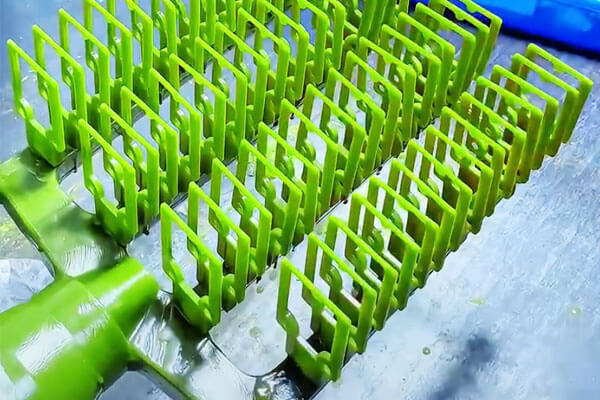
Individu pola lilin dirangkai menjadi a cluster atau pohon, yang meningkatkan efisiensi produksi dan memungkinkan banyak coran diproduksi dalam satu siklus cetakan.
Tata letak cluster
Jarak antar pola harus cukup untuk mencegah gangguan cangkang selama pelapisan dan pengeringan.
Jumlah komponen per cluster juga harus sesuai dengan kapasitas tungku, ritme penuangan, dan perilaku pemadatan paduan.
Desain gerbang
Sistem gating harus mendukung:
- isian halus,
- Turbulensi rendah,
- dan aliran logam terkendali.
Aliran laminar lebih disukai karena turbulensi meningkatkan risiko:
- Entrainment Udara,
- pelipatan oksida,
- dan inklusi terak.
Untuk paduan yang lebih menuntut, terutama baja paduan tinggi dan superalloy, pengaturan gerbang bawah atau pelari berundak biasanya digunakan.
Perangkap terak atau ekstensi pelari dapat ditambahkan untuk mencegah kotoran yang mengambang sebelum memasuki rongga.
Tata letak anak tangga
Riser diposisikan di titik panas dan zona pemadatan terakhir untuk menyediakan pasokan logam selama pemadatan. Hal ini penting untuk mencegah:
- Rongga penyusutan,
- mikroporositas,
- dan penyusutan garis tengah.
Untuk paduan dengan rentang pembekuan yang luas, beberapa anak tangga tambahan mungkin diperlukan untuk mempertahankan perilaku makan yang baik.
3.3 Fabrikasi Cangkang Keramik (Proses Inti Pengecoran Investasi)
Pembuatan cangkang keramik adalah prosedur yang paling memakan waktu dan menuntut secara teknis.
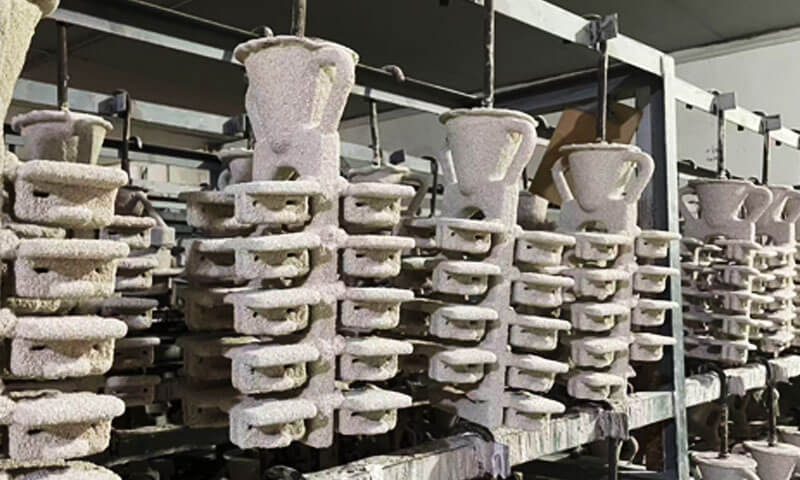
Cangkangnya dibentuk oleh pelapisan berulang dari bubur tahan api dan plesteran pasir kering, dibagi menjadi mantel wajah, lapisan transisi dan lapisan cadangan dengan bahan dan fungsi tahan api yang berbeda.
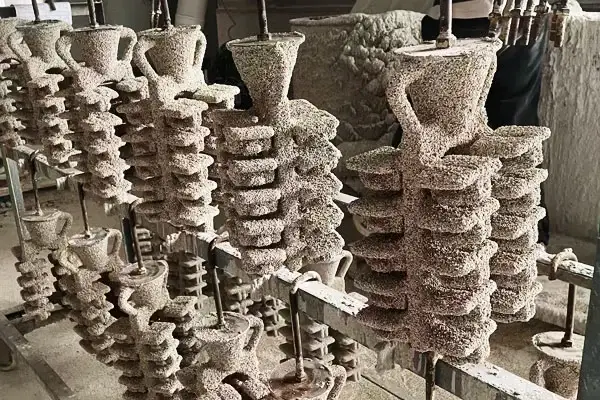
Struktur berlapis dan pencocokan material
- Mantel wajah (lapisan permukaan): Langsung bersentuhan dengan logam cair bersuhu tinggi, membutuhkan sifat refraktori dan kelembaman kimia yang sangat tinggi.
Untuk baja tahan karat bermutu tinggi dan superalloy, tepung zirkon dengan kemurnian tinggi dan pasir zirkon diadopsi; untuk baja karbon umum, alumina leburan umumnya digunakan.
Lapisan ini mencegah penetrasi logam, penempelan pasir dan reaksi kimia antara logam cair dan bahan tahan api. - Mantel transisi: Meningkatkan kekuatan ikatan antara lapisan muka dan lapisan cadangan untuk menghindari delaminasi cangkang selama pembakaran dan penuangan.
- Mantel cadangan (lapisan belakang): Menggunakan pasir kuarsa dan agregat mullite berbiaya rendah untuk meningkatkan kekuatan struktural keseluruhan cangkang dan mengurangi biaya material komprehensif.
Kontrol pengeringan:
Setiap lapisan yang dilapisi harus mengalami pengeringan alami sepenuhnya pada suhu konstan (22~26°C) dan kelembaban konstan (55%~65% RH).
Pengeringan yang kurang akan meninggalkan sisa air bebas di dalam cangkang, yang menjadi sumber hidrogen dan menyebabkan porositas lubang jarum pada coran.
Jumlah total lapisan cangkang berkisar antara 8 ke 12; pengecoran besar berdinding tebal membutuhkan lebih dari 12 lapisan untuk meningkatkan kekuatan.
Diferensiasi pengikat:
Jenis pengikat menentukan sifat tahan api cangkang, konten pengotor dan kinerja keseluruhan, yang juga menjadi dasar untuk mengklasifikasikan jalur teknis pengecoran investasi besar.
3.4 Dewaxing
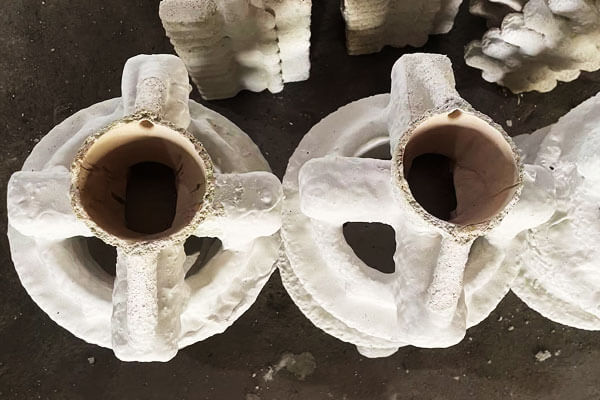
Dewaxing menghilangkan bahan pola dari cangkang keramik dan menciptakan rongga berlubang yang nantinya akan diisi dengan logam cair.
Metode industri standar
Metode industri yang disukai adalah dewaxing uap bertekanan tinggi. Ini banyak digunakan karena menghilangkan lilin dengan cepat dan mengurangi risiko kerusakan cangkang.
Kontrol proses
Dewaxing uap harus dikontrol dengan hati-hati agar:
- lilinnya meleleh seluruhnya,
- cangkangnya tidak retak karena sengatan panas,
- dan tidak ada residu yang tersisa di dalam rongga.
Sisa lilin merupakan masalah serius karena dapat terurai pada pembakaran selanjutnya dan menghasilkan kontaminasi karbon, evolusi gas, atau cacat permukaan pada pengecoran akhir.
Pemulihan materi
Lilin yang diperoleh kembali biasanya dikumpulkan, tersaring, dan didaur ulang, yang meningkatkan ekonomi proses dan mendukung penggunaan kembali material.
3.5 Penembakan Kerang dan Pemanasan Awal Penuangan
Cangkang keramik berongga memerlukan pembakaran suhu tinggi yang tersegmentasi untuk menghilangkan residu organik sepenuhnya, sinter partikel tahan api dan menstabilkan struktur cangkang; pemanasan awal dilakukan sebelum penuangan untuk menyesuaikan dengan suhu logam cair.
Penembakan tersegmentasi
Penembakan cangkang biasanya dilakukan secara bertahap:
- Tahap suhu rendah: menghilangkan sisa organik dan jejak lilin
- Tahap suhu sedang: menghilangkan kelembapan yang terikat dan menguraikan sisa residu pengikat
- Tahap suhu tinggi: menyinter cangkang tahan api dan membangun kekuatan akhir
Pemanasan bertahap ini mencegah retaknya cangkang dan memastikan cangkang mencapai kondisi termal dan struktural yang stabil.
Pemanasan awal sebelum dituang
Cangkang yang dibakar kemudian dipanaskan terlebih dahulu untuk mengurangi kesenjangan suhu antara cetakan dan logam cair. Pemanasan awal membantu:
- meningkatkan pengisian,
- mengurangi risiko misrun dan cold shut,
- meminimalkan kejutan termal,
- dan menopang bagian yang lebih tipis selama pengisian.
Kisaran pemanasan awal yang tepat tergantung pada paduannya, ketebalan bagian, dan bagian kompleksitas.
3.6 Meleleh, Kontrol Suasana, dan Menuangkan
Ini adalah tahap di mana kemurnian metalurgi dan pengisian cetakan ditentukan.
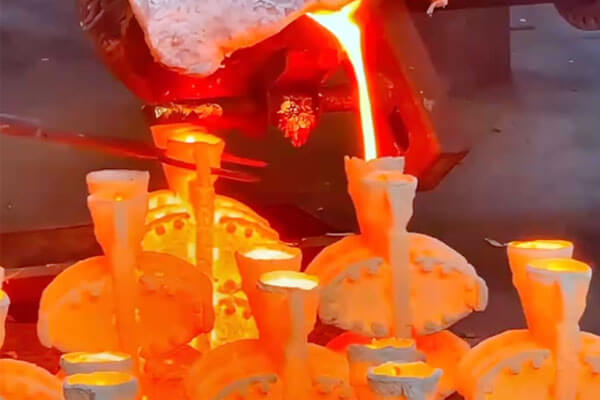
Peralatan peleburan
Metode peleburan harus sesuai dengan kelompok paduan:
- Tungku induksi frekuensi menengah untuk pengecoran industri umum
- Peleburan induksi vakum (Vim) untuk paduan nikel, paduan titanium, dan baja tahan karat dengan kemurnian tinggi
Kontrol atmosfer
Persyaratan atmosfer bergantung pada paduannya:
- baja karbon biasa dapat dicairkan dalam sistem berbasis udara,
- baja tahan karat dan paduan tembaga sering kali memerlukan pelindung nitrogen atau argon,
- dan paduan reaktif atau berkinerja tinggi memerlukan ruang hampa atau atmosfer yang sangat terkontrol.
Menuangkan kontrol suhu
Suhu penuangan adalah salah satu variabel paling sensitif dalam pengecoran investasi. Jika terlalu tinggi, peningkatan risiko segregasi dan mikroporositas.
Jika terlalu rendah, fluiditas turun dan kemungkinan terjadi kesalahan pengoperasian atau penutupan dingin.
Panas berlebih harus disesuaikan dengan sifat kimia paduannya, ketidakstabilan, dan perilaku solidifikasi.
Modus penuangan
Penuangan gravitasi adalah metode yang paling umum. Penuangan dengan bantuan vakum dapat digunakan untuk bagian yang sangat tipis atau sangat rumit.
Terlepas dari metodenya, alirannya harus tetap stabil dan laminar mungkin.
3.7 Pendinginan, Shakeout, dan Pembersihan Primer
Setelah menuangkan, logam harus mengeras dan mendingin dalam kondisi terkendali.
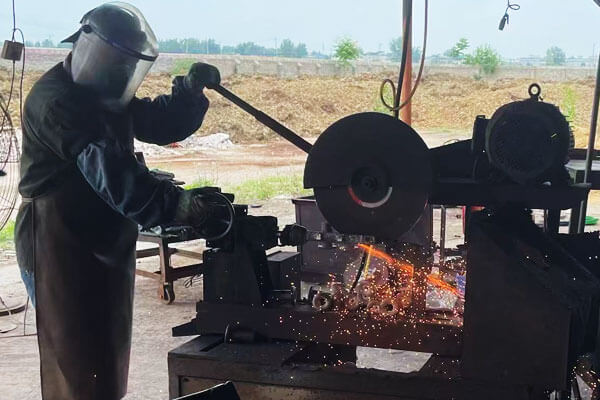
Rezim pendinginan
Coran di dalam cangkang keramik mengadopsi pendinginan lambat alami.
Untuk paduan yang rentan terhadap retak termal (seperti baja tahan karat paduan tinggi dan superalloy), pendinginan cepat paksa dilarang untuk melepaskan tegangan pemadatan secara bertahap.
Pelepasan shell
Setelah pengecoran mencapai suhu kamar, cangkang keramik dihilangkan:
- getaran mekanis,
- air bertekanan tinggi,
- atau metode pembersihan abrasif seperti shot blasting.
Tujuannya adalah untuk menghilangkan semua sisa cangkang tanpa merusak permukaan pengecoran.
Pemangkasan primer
Pada tahap ini, pengecoran dipisahkan dari sistem runner dan riser.
Bahan berlebih dihilangkan, dan langkah penggilingan atau pembersihan pertama dilakukan pada daerah konektor dan titik potong.
3.8 Pasca Pemrosesan dan Penyelesaian Akhir
Setelah badan casting diproduksi, operasi tambahan digunakan untuk memenuhi dimensi akhir, mekanis, dan persyaratan permukaan.
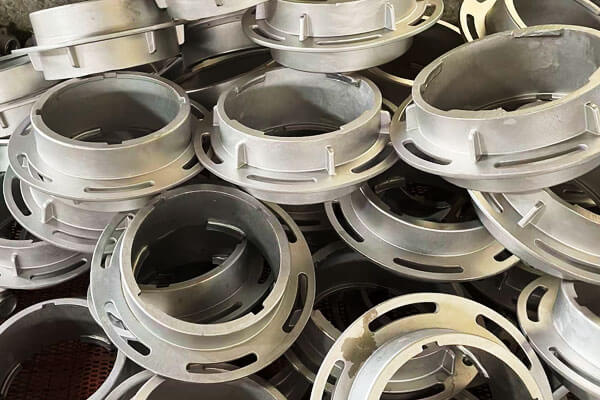
Langkah-langkah umum pasca-pemrosesan
- Penggilingan dan deburring yang presisi
- Perlakuan panas
- Finishing permukaan
- Pemesinan presisi
- Pengujian tidak merusak
- Inspeksi dimensi akhir
Perlakuan panas
Rute perlakuan panas tergantung pada paduannya:
- baja karbon mungkin memerlukan normalisasi, pendinginan, dan temper,
- baja tahan karat mungkin memerlukan larutan anil,
- paduan yang diperkuat dengan presipitasi mungkin memerlukan larutan ditambah penuaan.
Langkah ini penting untuk menstabilkan struktur mikro dan mencapai sifat mekanik akhir.
Perawatan permukaan
Tergantung pada aplikasinya, bagian itu mungkin menerima:
- tembakan peledakan,
- acar,
- Pasifan,
- Anodisasi,
- elektroplating,
- atau lapisan pelindung.
Pemesinan presisi
Permukaan kritis seperti:
- wajah perakitan,
- lubang berulir,
- menemukan permukaan,
- dan area penyegelan
mungkin memerlukan pemesinan tambahan dengan kelonggaran kecil.
Inspeksi
Pemeriksaan kualitas akhir biasanya mencakup:
- Pengujian Penetran,
- pengujian radiografi,
- Pengujian ultrasonik,
- dan pengukuran dimensi.
Hanya suku cadang yang lulus semua pemeriksaan wajib yang diklasifikasikan, dikemas, dan dikirimkan.
4. Klasifikasi Teknologi Pengecoran Investasi Arus Utama
Cara paling praktis untuk mengklasifikasikan investasi arus utama adalah dengan sistem pengikat yang digunakan untuk membangun cangkang keramik.
Dalam praktik industri saat ini, tiga rute yang dominan adalah pengecoran investasi gelas air, casting investasi silica sol, Dan pengecoran investasi komposit.
Klasifikasi ini banyak digunakan karena bahan pengikat mempengaruhi kekuatan cangkang secara langsung, akurasi dimensi, Kualitas Permukaan, siklus pembuatan cangkang, dan keluarga paduan yang dapat didukung oleh setiap rute.
Casting investasi gelas air
Pengecoran investasi gelas air kegunaan Sodium silikat sebagai pengikat cangkang.
Deskripsi industri mencirikannya sebagai proses dengan siklus pembuatan cangkang yang relatif singkat dan biaya rendah, yang membuatnya menarik untuk produksi di mana ekonomi penting.
Pada saat yang sama, berbagai sumber mencatat bahwa cangkang kaca air umumnya memberikan akurasi dimensi yang lebih rendah dan kekasaran permukaan yang lebih tinggi daripada cangkang silika-sol.
Oleh karena itu, rute ini paling baik dipahami sebagai a metode pengecoran presisi yang berorientasi pada biaya.
Ini banyak digunakan untuk baja karbon, Baja Alloy Rendah, Paduan Aluminium, dan coran paduan tembaga, dimana keseimbangan proses mengutamakan produktivitas dan harga dibandingkan permukaan tertinggi atau tingkat toleransi.
Casting investasi silica sol
Pengecoran investasi silika-sol kegunaan Silika koloid sebagai pengikat.
Sumber teknis secara konsisten menggambarkannya sebagai rute dengan presisi lebih tinggi: ia menawarkan toleransi dimensi dan geometri yang lebih baik, kualitas permukaan lebih halus, dan kinerja cangkang keseluruhan yang lebih kuat dibandingkan pengecoran kaca air.
Hal ini juga terkait dengan waktu pembuatan cangkang yang lebih lama dan biaya yang lebih tinggi, karena presisi dicapai melalui pembuatan cangkang yang lebih terkontrol.
Rute ini umumnya merupakan pilihan yang disukai baja tahan karat, baja tahan panas, dan coran paduan berkinerja tinggi, terutama jika bagian tersebut membutuhkan detail halus, kualitas permukaan yang dapat diandalkan, dan kontrol toleransi yang lebih ketat.
Dalam praktiknya, sol silika adalah rute yang paling sering dikaitkan dengan komponen industri yang menuntut di mana kualitas proses harus sesuai dengan kinerja paduannya.
Pengecoran Investasi Komposit
Pengecoran investasi komposit adalah a pendekatan hibrida yang menggabungkan elemen kedua sistem pengikat untuk menyeimbangkan presisi, produktivitas, dan biaya.
Sumber pengecoran menggambarkan jenis rute ini sebagai jalan tengah yang praktis, dimana desain shell atau pemilihan bahan pengikatnya disesuaikan agar pengerjaannya tidak sepenuhnya berbiaya premium seperti sol silika, tetapi juga tidak memiliki kendala biaya seperti penembakan kaca air murni.
Dalam istilah teknik, rute komposit digunakan ketika bagian tersebut membutuhkan ekonomis yang lebih baik daripada pengecoran silika-sol penuh tapi juga kebutuhan kualitas yang lebih baik daripada pengecoran kaca air murni.
Implementasi pastinya berbeda-beda di setiap pengecoran, karena sistem komposit sangat bergantung pada cara melapisi wajah, mantel cadangan, dan kimia pengikat digabungkan.
5. Cacat Pengecoran yang Khas: Akar Penyebab dan Tindakan Perbaikan yang Ditargetkan
Pengecoran investasi, meskipun presisi, rentan terhadap beberapa jenis cacat. Tabel di bawah ini merangkum cacat umum, asal usul mereka, dan tindakan korektif.
| Cacat | Visual / tanda tangan NDT | Akar penyebab | Tindakan perbaikan |
| Porositas gas | Bulat, rongga internal berdinding halus | Gas terlarut (H₂, N₂) dalam logam cair; deoksidasi rendah | Pencairan vakum; degas dengan gas inert; praktik deoksidasi yang tepat |
| Porositas penyusutan | Bergerigi, rongga yang tidak beraturan | Pemberian makan yang tidak mencukupi; desain riser yang buruk | Tingkatkan ukuran riser; tambah merinding; memodifikasi gating untuk mendorong solidifikasi terarah |
| Air mata panas | Retak dengan kasar, tepi teroksidasi | Tegangan tarik selama pemadatan lambat; kendala cetakan | Mengurangi kekakuan cangkang; suhu penuangan yang lebih rendah; Ubah komposisi paduan |
| Penyertaan (terak, sampah) | Partikel non-logam tidak beraturan | Menuangkan turbulen; lelehan kotor; refraktori yang terkikis | Gunakan muatan bersih; filter keramik; penuangan bagian bawah; isian yang lembut |
Kekasaran permukaan / urat |
Garis terangkat atau “sirip” pada pengecoran | Cangkangnya retak saat diisi; kekuatan cangkang rendah | Meningkatkan ketebalan cangkang; kandungan pengikat yang lebih tinggi; gunakan refraktori yang lebih kuat |
| Mesir / tutup dingin | Pengisian tidak lengkap; permukaan terlipat | Suhu penuangan rendah; fluiditas yang buruk; bagian tipis | Tingkatkan suhu tuang; meningkatkan gerbang; mengevakuasi cetakan (casting vakum) |
| Pergeseran inti | Variasi ketebalan dinding | Pergerakan inti selama pembentukan atau penuangan cangkang | Dukungan inti yang lebih baik (tasbih); pengeringan cangkang lebih lambat; tekanan tuang yang lebih rendah |
6. Perbandingan dengan Pengecoran Pasir, pengecoran mati, dan Penempaan
Insinyur sering membandingkan pengecoran investasi dengan tiga jalur produksi alternatif. Tabel di bawah ini memberikan trade-off kuantitatif.
| Kriteria evaluasi | Pengecoran Investasi | Casting pasir | pengecoran mati (HPDC) | Penempaan |
| Permukaan akhir (Ra, µm) | 1.6–6.3 | 6.3–25 | 0.8–3.2 | 0.4–3.2 |
| Toleransi dimensi (mm / 25 mm) | ±0,1–0,3 | ±0,5–1,0 | ±0,1–0,3 | ±0,05–0,2 |
| Bagian praktis minimal (mm) | 0.5–1.5 | 3–5 | 0.5–1.0 | 1–3 |
| Kompleksitas geometris | Sangat tinggi; undercuts, Detail yang bagus, fitur internal | Tinggi dengan inti, tetapi ketelitiannya terbatas | Sedang; kemampuan melemahkan yang terbatas | Rendah hingga sedang; terbaik untuk bentuk yang lebih sederhana |
| Pemanfaatan materi | 90–95% | 60–80% | 90–95% | 60–80% |
| Biaya perkakas | Sedang hingga tinggi | Rendah hingga sedang | Tinggi | Sangat tinggi |
| Biaya per bagian pada volume tinggi | Sedang | Rendah | Sangat rendah | Sedang |
| Biaya per bagian pada volume rendah | Tinggi kecuali perkakas diamortisasi | Rendah hingga sedang | Tidak praktis karena beban perkakas | Sangat tinggi |
| Berat maksimum tipikal | Hingga sekitar 150 kg untuk coran baja | Sangat besar; lebih 10,000 kg mungkin | Biasanya tentang 15 kg | Lebih 500 kg mungkin |
| Rentang paduan | Hampir semua paduan yang dapat dicor | Hampir semua paduan yang dapat dicor | Sebagian besar paduan non-ferrous | Semua logam, tetapi terbatas pada geometri |
7. Aplikasi Industri Pengecoran Investasi
Pengecoran investasi digunakan di industri di mana kompleksitas geometris, Kualitas Permukaan, kinerja paduan, dan pengulangan lebih penting daripada biaya produksi serendah mungkin.
Turbin luar angkasa dan gas
Dirgantara adalah salah satu bidang aplikasi yang paling menuntut secara teknis untuk pengecoran investasi.
Komponen seperti Bilah turbin, baling -baling, nozel bahan bakar, kasus diffuser, dan bagian bagian panas lainnya seringkali membutuhkan geometri airfoil yang kompleks, dinding tipis, bagian internal yang tepat, dan kekuatan suhu tinggi yang sangat baik.
Superalloy berbahan dasar nikel dan paduan berbahan dasar kobalt banyak digunakan karena dapat mempertahankan integritas mekanis pada kondisi termal dan tekanan yang parah..
Peralatan medis dan implan
Aplikasi medis memberikan tuntutan yang berbeda pada prosesnya.
Bagian seperti implan ortopedi, Batang pinggul, nampan lutut, Instrumen Bedah, dan perangkat keras anatomi yang presisi memerlukan biokompatibilitas, Kualitas Permukaan, akurasi dimensi, dan kinerja mekanik yang andal.
Bahan umum termasuk 316L stainless steel, Paduan Co-Cr-Mo, dan paduan titanium seperti TI-6AL-4V.
Otomotif dan transportasi
Di sektor otomotif, pengecoran investasi digunakan untuk komponen seperti Roda Turbocharger, manifold knalpot, Komponen terkait EGR, garpu geser, kurung, dan perangkat keras berkinerja tinggi lainnya.
Bagian-bagian ini seringkali memerlukan keseimbangan ketahanan panas, pengendalian berat badan, dan kompleksitas geometris.
Baja tahan karat dan baja karbon tinggi atau baja paduan biasanya digunakan tergantung pada kasus beban termal dan mekanis.
Minyak dan gas, Pemrosesan Kimia, dan penanganan cairan
Industri minyak dan gas serta kimia sangat bergantung pada investasi tubuh katup, impeler pompa, rumah pengukur aliran, perlengkapan, dan komponen aliran tahan korosi.
Bahan-bahan yang umum termasuk Baja tahan karat tipe CF-8M, baja tahan karat dupleks, dan paduan tahan korosi berbahan dasar nikel.
Pembangkit listrik dan peralatan termal
Pembangkit listrik menempatkan investasi pada kondisi layanan yang paling parah.
Komponen seperti liner pembakaran, potongan transisi, cincin nosel, dan perangkat keras gas panas lainnya terkena oksidasi, bersepeda termal, dan aliran gas bersuhu tinggi.
Baja tahan karat seperti 310 dan paduan berbasis nikel seperti Inconel 625 umumnya digunakan karena kemampuannya pada suhu tinggi.
10. Kesimpulan
Pengecoran investasi sudah matang, teknologi pembentukan logam presisi multi-cabang dan terus berkembang.
Nilai intinya terletak pada mendobrak batasan struktural cetakan tradisional dan mewujudkan pembentukan komponen berkinerja tinggi yang kompleks dan berbentuk hampir bersih..
Tiga jalur teknis berbasis pengikat utama membentuk pasar hierarki yang jelas: pengecoran investasi kaca air berbiaya rendah mendominasi suku cadang presisi menengah industri umum,
sementara pengecoran investasi sol silika dengan kemurnian tinggi menjadi standar emas untuk komponen presisi kelas atas di ruang angkasa, bidang energi medis dan canggih.
Kualitas coran investasi bergantung pada kontrol presisi rantai penuh atas fabrikasi pola lilin, pembuatan cangkang, dewaxing, penembakan, meleleh dan menuang.
Setiap parameter proses dan norma operasional saling bertautan, dan kelalaian apa pun akan memicu cacat berjenjang.
Meskipun dibatasi oleh siklus produksi dan biaya dalam beberapa skenario, keunggulan uniknya dalam pembentukan struktur kompleks, kualitas metalurgi dan kemampuan beradaptasi material memastikan statusnya yang tak tergantikan dalam manufaktur kelas atas.
Didorong oleh manufaktur cerdas, produksi ramah lingkungan dan iterasi material baru, pengecoran investasi modern akan semakin menembus hambatan teknis, meningkatkan efisiensi produksi dan mengurangi biaya komprehensif.
Sebagai dasar teknologi pengecoran presisi, pihaknya akan terus mendukung peningkatan manufaktur peralatan kelas atas global dan memperluas batasan penerapannya di industri-industri berkembang.
FAQ
Apa ide utama di balik casting investasi?
Pola lilin atau plastik sekali pakai dikelilingi oleh cangkang keramik, polanya dihilangkan, dan logam cair dituangkan ke dalam rongga untuk membuat bagian berbentuk hampir jaring.
Mengapa pengecoran investasi lebih dipilih daripada pengecoran pasir?
Karena umumnya memberikan detail yang lebih halus, permukaan akhir yang lebih baik, dan toleransi yang lebih ketat, yang mengurangi pekerjaan finishing.
Sistem pengikat mana yang memberikan presisi tertinggi?
Silica sol umumnya digunakan untuk presisi tertinggi, pengecoran investasi permukaan halus, sedangkan sistem kaca air lebih berorientasi pada biaya.
Cacat apa yang paling umum?
Inklusi, porositas, cacat penyusutan, salah berjalan/dingin ditutup, dan retaknya cangkang adalah salah satu masalah pengecoran yang paling umum.

