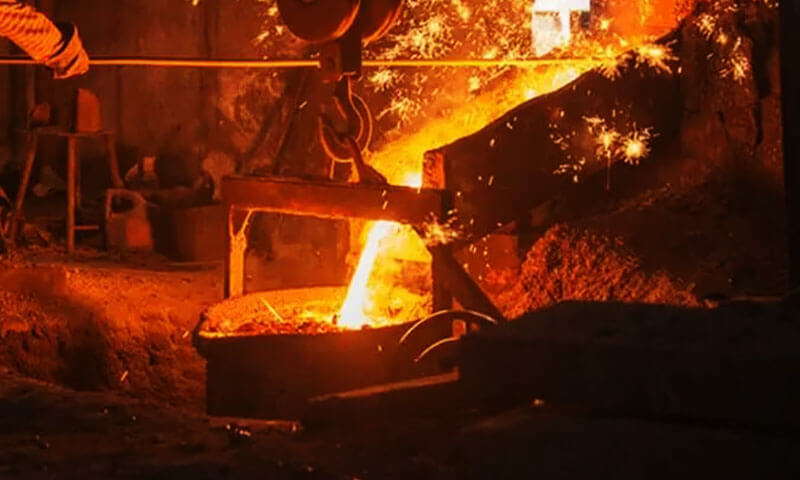
After years of producing ductile iron castings — from brake calipers and wheel hubs to valve bodies and heavy-duty gear blanks — I can tell you this: the quality of every ductile iron casting you ever pour starts with one decision nobody outside the foundry ever sees.
It starts with the nodulizing (szferoidizáció) method you choose.
Ductile iron is not just “better gray iron.” It is a completely different material, produced when magnesium reacts with molten iron to transform flake graphite into spherical nodules.
Those spherical nodules eliminate the stress-concentrating cracks that make gray iron brittle, and they give ductile iron its famous combination of steel-like strength and cast iron-like fluidity.
Get the nodulization wrong — too much magnesium, too little, uneven distribution, or excessive fade — and you end up with chunky graphite, karbidképzés, or a casting that looks fine but fails in service.
This guide breaks down all six methods from the shop floor: how they work, what they cost, how well magnesium is absorbed, and when to choose each.
It is the kind of knowledge you build through decades of troubleshooting faded nodules, cracked reactors, and dust-covered foundry floors.
1. Why Is Nodulizing Treatment Essential in Ductile Iron Casting?
Nodulizing treatment, also known as magnesium treatment or spheroidization, is the key metallurgical process that distinguishes csillapító vas from gray iron.
Without effective nodulizing, graphite tends to form flakes, which create stress concentrations and reduce ductility.
With proper treatment, graphite forms predominantly as spheroids, significantly improving the iron’s tensile strength, meghosszabbítás, és keménység.
Öntödei mérnök szemszögéből, graphite morphology is the foundation of ductile iron performance.
Nodulizing treatment must therefore be carefully controlled to ensure consistent casting quality and mechanical properties.
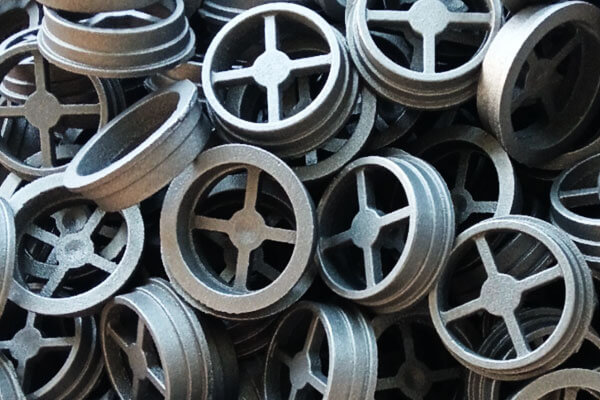
The Role of Graphite Morphology
In gray iron, flake graphite acts as internal notches, concentrating stress at the flake tips and promoting brittle fracture.
Képlékeny vasban, spheroidal graphite reduces stress concentration, allowing the metallic matrix to carry loads more effectively and undergo greater plastic deformation before fracture.
| Graphite morphology | Tipikus szakítószilárdság | Tipikus nyúlás | Engineering behavior |
| Pehely grafit (szürke vas) | 150–350 MPA | Less than 1% | Relatively brittle, korlátozott rugalmasság |
| Gömbszerű grafit (Hercegek vas) | 400–900 MPA | 2–18% | Higher strength and ductility, depending on grade and matrix structure |
These ranges are indicative rather than universal; actual properties depend on the iron grade, mátrix szerkezet, öntési szakasz vastagsága, and applicable testing standards.
Magnesium and Key Process Parameters
Magnesium is the principal nodulizing element used in commercial ductile iron production. It reacts with sulfur and oxygen while modifying graphite growth during solidification.
Effective treatment requires sufficient residual magnesium in the melt without excessive addition, which can increase dross formation and other casting risks.
Typical process reference values include:
| Paraméter | Typical target or range | Fontosság |
| Maradó magnézium | Approximately 0.03–0.05% | Supports graphite spheroidization; the target depends on iron chemistry and casting requirements |
| Grafit csomósság | Typically ≥85% for critical applications, ahol meg van adva | Indicates the effectiveness of spheroidization |
| Kén után kezelés | Approximately 0.01–0.02% | Excess sulfur consumes magnesium and can impair nodulizing |
| Kezelés hőmérséklet | Usually 1,450–1,550°C | Influences magnesium recovery, reakció intenzitása, and temperature loss |
| Treatment-to-pouring idő | As short as practical | Helps limit nodulizing fade and deterioration in graphite morphology |
The appropriate values must be validated against the casting grade, kezdeti kéntartalom, treatment alloy, and production conditions.
Insufficient residual magnesium can lead to degenerated graphite, while excessive magnesium may increase dross and slag formation and contribute to casting defects.
Because magnesium has a relatively low boiling point and reacts readily with molten iron, the choice of nodulizing method directly affects magnesium recovery, reaction stability, és a végső casting minőség.
Controlling alloy addition, treatment temperature, and pouring time is therefore essential for producing consistent ductile iron.
2. Pressure Magnesium Treatment
Working principle
Pressure magnesium treatment is based on the relationship between pressure and the boiling behavior of magnesium.
At atmospheric pressure, magnesium has a boiling point of approximately 1,107°C, substantially below the temperature of molten iron during nodulizing treatment.
When magnesium is added directly to a hot melt, it can vaporize rapidly, producing an intense reaction and reducing the proportion that is retained in the iron.
Increasing the pressure around magnesium raises its boiling temperature and suppresses excessive vaporization.
This principle allows the process to use metallic magnesium more efficiently than conventional open-ladle methods.
Two principal configurations have been used:
- Externally pressurized treatment: A ladle containing molten iron is placed inside a sealed pressure vessel. Compressed air or nitrogen establishes the required pressure.
- Self-pressurizing treatment: Metallic magnesium is introduced into a sealed treatment ladle. Magnesium vapor builds pressure inside the vessel, helping regulate further vaporization and absorption.
In the self-pressurizing arrangement, part of the magnesium vapor is absorbed by the iron, while the remainder establishes a pressure within the sealed space.
The resulting pressure limits uncontrolled magnesium boiling and helps stabilize the reaction.
Magnesium recovery and process advantages
Reported magnesium recovery can reach 70%–80%, making pressure treatment attractive where magnesium utilization is a major cost consideration.
The principal advantages include:
- High magnesium recovery and reduced nodulizer consumption.
- More effective use of metallic magnesium.
- Reduced visible smoke and magnesium flare when the equipment is properly sealed and operated.
- Potentially more controlled reaction behavior than open-ladle treatment.
Because the system relies on a sealed pressure vessel, viszont, its performance depends on equipment integrity, pressure-control accuracy, sealing reliability, and strict adherence to operating procedures.
Limitations and engineering considerations
Pressure magnesium treatment requires more sophisticated equipment and higher capital investment than conventional sandwich treatment.
The operating procedure is also more demanding, and treatment cycles can be relatively long.
Heat loss during handling and treatment must be considered, particularly when the foundry is working with thin-walled castings or a narrow pouring-temperature window.
The most important concern is safety. Magnesium vapor, molten iron, and a pressurized vessel create a combination of serious hazards if pressure is released unexpectedly or the equipment is improperly sealed.
Interlocks, pressure monitoring, preventive maintenance, operator training, and approved operating procedures are essential.
Mérnöki ajánlás: Pressure treatment is worth evaluating when high magnesium recovery and controlled reaction conditions justify the equipment cost.
It should not be selected solely because its reported recovery is high; total cycle time, karbantartási követelmények, energiafelhasználás, and safety management must also be assessed.
3. Sandwich Treatment
Working principle
Sandwich treatment is one of the most widely used nodulizing methods in ductile iron foundries because of its relatively simple equipment and flexible operation.
The method typically uses a treatment ladle with a raised dam or partition that separates the nodulizer chamber from the main iron-pouring area.
The geometry helps delay direct contact between the magnesium-bearing alloy and the incoming molten iron.
Before treatment, the nodulizer is placed in the designated chamber, usually covered with ferrosilicon and then with clean, suitable steel scrap, iron filings, or another approved covering material.
The cover reduces direct exposure and moderates the initial reaction.
The molten iron is then poured as continuously as practicable into the opposite side of the ladle. As the iron level rises, it reaches the nodulizer and initiates the reaction.
The sequence and pouring rate are important. If the iron is poured too slowly, too rapidly, or directly onto the alloy bed, the reaction may become less predictable.
Typical magnesium recovery: 30%–50%
The magnesium recovery of conventional sandwich treatment is generally around 30%–50%.
Although this is lower than the values associated with several covered or pressure-controlled methods, the process remains popular because the equipment is straightforward, operating costs are relatively low, and the treatment can accommodate a range of production volumes and casting types.
Előnyei közé tartozik:
- Simple ladle design and relatively low capital investment.
- Straightforward operation after appropriate process training.
- Flexibility for different casting batches and alloy requirements.
- Relatively easy integration into existing foundry production.
For foundries with limited capital budgets or frequent changes in casting specifications, these practical benefits can outweigh the lower magnesium recovery.
How to improve sandwich treatment
Several process adjustments can improve reaction stability and magnesium utilization.
Első, optimize the ladle geometry.
A suitable ladle height-to-diameter ratio helps maintain sufficient iron depth and provides better control over the contact between the molten iron and the nodulizer.
The exact ratio must be established for the actual ladle capacity and alloy system.
Második, select the nodulizer according to the iron chemistry.
Lower-magnesium treatment alloys are commonly used to moderate the reaction. The correct alloy depends on the initial sulfur level, required residual magnesium, and casting specification.
Harmadik, control the covering material.
The cover must be suitable for molten iron service, sufficiently clean and dry, and compatible with the treatment practice.
An inadequate cover can allow premature magnesium vaporization, while an unsuitable or excessive cover can complicate reaction control and slag management.
Negyedik, maintain a controlled pouring temperature and rate.
Excessively high temperatures can increase magnesium vaporization and oxidation, while temperatures that are too low can impair alloy dissolution and leave insufficient thermal capacity for subsequent pouring.
Korlátozások
The principal disadvantages are relatively low magnesium recovery and the potential for intense magnesium flare and fumes.
These conditions require effective ventilation, suitable ladle shielding, appropriate personal protective equipment, and disciplined operator practices.
The method also depends heavily on operator consistency. Variations in alloy placement, burkolat, öntési sebesség, or treatment temperature can produce fluctuations in residual magnesium and graphite nodularity.
Mérnöki ajánlás: Sandwich treatment remains a sensible choice for general-purpose ductile iron production.
Before investing in a new treatment system, a foundry should first establish whether improvements in ladle design, ötvözött választás, öntési gyakorlat, and process monitoring can deliver the required quality at lower cost.
4. Tundish-Cover Treatment
Working principle
Tundish-cover treatment, also known as the George Fischer transfer-ladle method in its established form, is a specialized process that uses a closed reaction chamber to control contact between molten iron and metallic magnesium.
The treatment ladle is initially positioned horizontally and charged with a measured quantity of molten iron.
Metallic magnesium is placed in a dedicated reaction chamber, after which the chamber is secured and the cover is fitted.
The ladle is then rotated into its operating position. Molten iron enters the reaction chamber through a small opening.
The flow rate depends on the opening area and the hydrostatic pressure of the iron in the ladle.
When magnesium is heated, it vaporizes and generates pressure inside the reaction chamber.
As the pressure rises above the local hydrostatic pressure of the iron, further iron entry is temporarily restricted.
The reaction chamber then cools as magnesium absorbs heat during vaporization, causing the vapor pressure to decrease. Molten iron can subsequently enter again.
This pressure-and-flow interaction creates a self-regulating reaction cycle that can moderate direct contact between magnesium and the bulk iron.
Recovery and metallurgical benefits
Magnesium recovery can reach 60%–80% under suitable operating conditions.
Compared with conventional open-ladle treatment, the method offers several advantages:
- Relatively high magnesium recovery through controlled reaction conditions.
- Reduced temperature loss in suitable process configurations.
- More gradual magnesium–iron interaction than uncontrolled direct addition.
- Potentially improved magnesium utilization when treating iron with comparatively high sulfur content.
The controlled reaction can be particularly useful when a foundry needs to manage magnesium consumption without relying on a large excess of nodulizer.
Common problems
Despite its metallurgical advantages, tundish-cover treatment has several practical limitations.
The small opening connecting the ladle and reaction chamber may become blocked by solidified iron or slag.
Deposits can also change the effective opening area, disrupting the intended flow and pressure balance.
Következésképpen, the reaction chamber requires careful inspection and maintenance.
The opening must remain within the specified dimensional tolerance, and accumulated slag must be removed using approved procedures.
The method also produces magnesium flare and fumes, so it should not be regarded as a smoke-free process.
Továbbá, its ladle configuration and operating sequence make it less convenient for continuous treatment of successive iron charges.
Mérnöki ajánlás: Tundish-cover treatment is most appropriate when a foundry has the technical capability to maintain the reaction chamber and benefits from controlled magnesium addition.
Its advantages can be lost if blockage, chamber wear, or inconsistent maintenance changes the reaction conditions.
5. Cored-Wire Feeding
Working principle
Cored-wire feeding was initially developed for steelmaking and subsequently adapted for ductile iron production.
It is now widely used in industrialized foundries where automated alloy addition and repeatable process control are priorities.
A cored wire consists of a metallic sheath filled with powdered magnesium-bearing alloy and, where required, other alloying additions.
The wire is fed continuously into molten iron at a controlled speed and depth.
Common wire diameters include 9 mm and 13 mm, while the internal powdered alloy commonly contains approximately 25%–30% magnesium.
Depending on the required metallurgical response, the core may also contain rare-earth elements (RE), kalcium (Kb.), bárium (BA), or other suitable constituents.
A feeding machine controls parameters such as:
- Wire feed speed.
- Total wire length or mass.
- Feeding depth and duration.
- Feeding sequence and operating mode.
- The relationship between wire addition and the measured mass of molten iron.
The sheath protects the core during feeding and helps deliver the alloy below the melt surface before the contents are released.
Properly controlled feeding reduces the likelihood of an uncontrolled, instantaneous magnesium reaction at the surface.
Why cored-wire feeding is attractive
The key advantage is the combination of controlled addition and automation.
When the wire specification, feeding equipment, and melt conditions are properly matched, the process can achieve relatively stable magnesium recovery and residual magnesium content.
Its principal benefits include:
Precise alloy addition.
Wire length and feed rate can be programmed according to the mass and chemistry of the iron charge, reducing variation associated with manual alloy weighing and placement.
Jobb folyamat ismételhetőség.
Automated feeding helps standardize treatment across different shifts and production batches.
Reduced visible magnesium flare and fumes.
Introducing the alloy below the surface and controlling the rate of release can reduce sudden magnesium vaporization, although suitable fume extraction and protective measures remain necessary.
Lower temperature loss in suitable configurations.
The process can be integrated into a controlled treatment sequence, reducing unnecessary handling and delays.
Potentially effective sulfur management.
Magnesium-bearing wire can contribute to desulfurization as well as nodulizing, depending on the base iron chemistry and the treatment design.
Factors that determine treatment success
Automation does not automatically guarantee good ductile iron. The quality of the wire and the operating conditions remain critical.
| Control factor | Engineering consideration |
| Wire composition | Magnesium content and any RE, Kb., or Ba additions must match the iron chemistry and product requirements. |
| Wire quality | Core filling consistency, sheath integrity, átmérő, and dimensional stability affect feeding reliability. |
| Feed speed | Excessively fast or slow feeding can alter the reaction and magnesium recovery. |
| Feed quantity | The wire length or mass must be based on the charge mass, initial sulfur level, and required residual magnesium. |
Feeding depth |
The release point must be appropriate for the ladle geometry and molten iron depth. |
| Iron temperature | Must be sufficient for reliable alloy release and dissolution while maintaining the required pouring temperature. |
| Ladle cover and sealing | Where a covered system is used, cover fit and gas-flow behavior affect treatment stability. |
| Treatment timing | Delays before pouring can reduce the effectiveness of nodulizing and inoculation. |
A frequent mistake is to adjust wire feed length without investigating the initial sulfur content or the actual residual magnesium.
If the base iron chemistry changes from batch to batch, a fixed wire quantity may no longer deliver the same metallurgical result.
Korlátozások
Cored-wire treatment requires dedicated feeding equipment, reliable wire supply, and trained personnel.
The wire itself must meet consistent quality standards, and the feeding parameters must be validated for the specific ladle and iron chemistry.
The method can be highly effective in repetitive production, but its economic advantage depends on equipment utilization, wire cost, labor savings, and the reduction in rejected castings.
Mérnöki ajánlás: Cored-wire feeding is a strong candidate for medium- és nagy volumenű termelés, especially when the foundry needs traceable alloy addition and consistent treatment from batch to batch.
The most effective implementation combines automated feeding with routine chemical analysis and metallographic verification.
6. Covered-Ladle Treatment
Working principle
Covered-ladle treatment was developed by the British Cast Iron Research Association and became widely adopted in ductile iron production.
The nodulizer is loaded into the treatment ladle in a manner similar to sandwich treatment.
The ladle is then fitted with a cover, and the joint between the cover and ladle is sealed as specified by the process design.
Molten iron is poured through an opening in the cover. The incoming stream should be directed away from the nodulizer bed so that the alloy is not exposed to an unnecessarily intense initial reaction.
The cover restricts the free exchange of gases between the ladle interior and the surrounding atmosphere.
This helps reduce magnesium oxidation and loss, improving magnesium recovery.
After the nodulizing reaction has finished, the cover is removed in accordance with the operating procedure.
Typical magnesium recovery: 60%–65% or higher
Covered-ladle treatment commonly achieves magnesium recovery of approximately 60%–65% or higher, depending on the equipment design and operating conditions.
Its principal advantages include:
- Improved magnesium recovery compared with conventional sandwich treatment.
- Reduced magnesium oxidation and loss.
- Better control of fumes and magnesium flare when the system is properly designed.
- A relatively straightforward treatment principle that builds on existing ladle-based production.
- Potential reductions in nodulizer consumption and variation in residual magnesium.
Sok öntöde számára, covered-ladle treatment provides a practical compromise between the simplicity of conventional sandwich treatment and the higher equipment requirements of more specialized methods.
The importance of the pouring opening
The diameter and position of the pouring opening are critical to the process.
If the opening is too large, the molten iron may enter too quickly, shortening the reaction period and reducing the intended control over magnesium addition.
If it is too small, the iron may enter too slowly, causing excessive treatment time and unnecessary temperature loss.
The opening must therefore be selected according to ladle capacity, the expected pouring rate, the nodulizer quantity, and the desired reaction duration.
Ideális esetben, the time required to transfer the molten iron into the covered ladle should be compatible with the treatment reaction time.
This relationship must be established through process trials rather than assumed from a general rule.
Korlátozások
Covered-ladle treatment introduces additional mechanical and operational requirements.
The cover may be heavy and difficult to lift, and the lifting mechanism must be designed for safe handling in a high-temperature foundry environment.
Accurate charge measurement can also be difficult when molten iron is supplied continuously from a cupola furnace or another continuous-tapping operation.
Variations in charge mass affect the nodulizer quantity and can undermine treatment consistency.
The sealing condition, cover opening, ladle geometry, and pouring technique must all be maintained within the established process window.
Mérnöki ajánlás: Covered-ladle treatment is an attractive upgrade for foundries seeking better magnesium recovery without replacing their entire treatment system.
It is particularly effective when the plant can standardize charge measurement, cover handling, and the iron-pouring sequence.
7. In-Mold Treatment
Working principle
In-mold treatment moves the nodulizing reaction from the treatment ladle into a specially designed reaction chamber within the mold’s gating system.
The nodulizer is positioned in a designated chamber, commonly within the runner system below the sprue.
As molten iron passes through the chamber during pouring, it contacts the nodulizing alloy and undergoes spheroidization before entering the casting cavity.
Because the treatment takes place during mold filling, the process can eliminate the need for a separate conventional nodulizing operation for the relevant iron stream.
It can also shorten the interval between nodulizing and solidification, helping reduce the risk of nodularization fading associated with extended holding times.
Viszont, in-mold treatment is not simply a matter of placing magnesium alloy in a runner.
The reaction chamber and gating system must be designed to provide the correct flow, reaction duration, alloy dissolution, and slag separation.
Magnesium recovery and production benefits
Reported magnesium recovery can reach 70%–80%.
The main advantages are:
- High magnesium recovery under properly controlled conditions.
- No direct magnesium flare at the treatment ladle during normal operation.
- Reduced visible smoke associated with open-ladle magnesium addition.
- Reduced nodulizing fade caused by excessive delay after treatment.
- Potential compatibility with mechanized molding and repetitive high-volume production.
- Opportunities to integrate treatment into the casting and mold-filling sequence.
For standardized castings produced in large quantities, these benefits can make in-mold treatment particularly attractive.
Why gating-system design is critical
In-mold treatment is more sensitive to process design than conventional ladle treatment.
Small variations in alloy composition, alloy particle size, reaction-chamber dimensions, or pouring conditions can change the amount of magnesium absorbed by the iron.
The foundry must control several interrelated factors:
Reaction-chamber dimensions.
The chamber must accommodate the required alloy quantity and provide sufficient contact between the molten iron and the nodulizer without creating excessive flow resistance.
Gating-system geometry.
A sprue, futók, chamber, and ingates must work together to maintain suitable filling conditions. Poorly designed transitions can cause turbulence, erózió, or premature solidification.
Nodulizer quantity and particle size.
The alloy must dissolve and react within the available filling time. The correct quantity depends on the iron mass, kémia, and required residual magnesium.
Pouring temperature and rate.
The iron must retain sufficient fluidity to pass through the treatment chamber and fill the mold without cold shuts or misruns.
Slag control.
Reaction products and slag can enter the casting if the gating system does not provide adequate separation or if the flow becomes unstable.
Common risks
The main limitation is the narrow process window. In-mold treatment is particularly sensitive to variations in the base iron, treatment alloy, és öntési feltételek.
A process that works reliably for one casting geometry may not transfer directly to another.
Slag inclusions are a recognized risk when reaction products are not effectively separated from the iron entering the cavity.
Inadequate alloy dissolution, incomplete treatment, or unstable mold filling can also compromise graphite morphology.
Ezért, in-mold treatment requires rigorous control of the gating system and stable upstream iron chemistry.
Mérnöki ajánlás: In-mold treatment is best suited to repeat production where casting geometry, forma tervezés, öntési körülmények, and base iron chemistry can be maintained within a validated process window.
For highly variable, kis volumenű gyártás, its tooling and process-development requirements may outweigh the benefits.
8. The Real Lesson: No Single Best Method
After years, I can tell you this: there is no universally “best” nodulizing method.
The right method depends on your iron chemistry, your production volume, your automation level, your environmental regulations, and your capital budget.
The mistake I see most often is foundries clinging to the sandwich method out of habit, even when their fume extraction costs, magnesium consumption, and inconsistent nodule quality are costing them more than a wire feeder would.
Egymással szemben, I’ve seen small jobbing shops buy expensive wire feeders they never fully use, because their part variety makes automation impractical.
The right approach is to evaluate each method against your actual production conditions:
- What is your base iron sulfur level?
- What is your daily tonnage?
- How strict are your environmental regulations?
- What is your tolerance for batch-to-batch variation?
- What is your capital budget?
Answer those questions honestly, and the right method usually becomes obvious.
9. Következtetés
The six typical nodulizing methods—pressure magnesium treatment, sandwich treatment, tundish-cover treatment, cored-wire feeding, covered-ladle treatment, and in-mold treatment—use different approaches to control the reaction between magnesium and molten iron.
From an experienced foundry engineer’s perspective, the decisive factor is not simply which method achieves the highest recovery.
It is whether the process can consistently produce the required graphite morphology and mechanical properties while maintaining acceptable production costs, pouring temperatures, and workplace safety.
The most reliable approach is to select the treatment method according to the actual casting and production requirements, validate it through controlled trials, and maintain strict control over iron chemistry, nodulizer addition, oltás, and treatment-to-pouring time.
This is how a foundry turns nodulizing from an isolated metallurgical operation into a stable, repeatable production process.
GYIK
Which method is best for a small jobbing foundry?
The sandwich method is the practical starting point — minimal equipment cost and maximum flexibility.
If working conditions or magnesium cost become a concern, upgrading to a cover ladle method is the lowest-cost improvement.
Why is cored wire feeding becoming the industry standard?
It combines high and stable absorption (60–75%), minimal fume, full automation, and relaxed requirements on base iron sulfur.
The capital investment in a wire feeder pays back through lower magnesium consumption and consistent nodule quality.
What causes poor nodulization even with the right method?
Common causes include high base iron sulfur, excessive magnesium fade (too long between treatment and pouring), low treatment temperature, contaminated nodulizer alloy, or poor ladle cover sealing.
Method choice is only one factor — process control is equally important.
Can in-mold nodulization be used for all casting sizes?
In-mold works best for small-to-medium castings on mechanized molding lines.
Large castings require too much iron flow through the reaction chamber, and slag inclusion risk increases. It is not suitable for variable, kis volumenű gyártás.