1. Uvod
3D tisak, Poznat i kao aditivna proizvodnja, has revolutionized modern production by enabling rapid prototyping, customization, i isplativa proizvodnja.
Unlike traditional subtractive manufacturing, which removes material from a solid block, 3D printing constructs objects layer by layer based on digital models.
Initially developed for prototyping, it has now expanded into large-scale industrial applications, ranging from aerospace to healthcare.
This article explores the fundamentals of 3D printing, key technologies, material options, industrijske prijave, prednosti, izazovi, and future innovations shaping this transformative technology.
2. Fundamentals of 3D Printing
3D tisak, Poznat i kao aditivna proizvodnja, has transformed the way products are designed, prototyped, and manufactured.
Unlike traditional subtractive manufacturing, where material is removed from a solid block, 3D printing builds objects layer by layer based on digital models.
This approach enables complex geometries, smanjuje materijalni otpad, and allows for on-demand production.
Što je 3D ispis?
3D printing is an additive manufacturing process that creates physical objects from digital designs by successively adding material in layers.
The process is guided by computer-controlled machines that follow instructions from a 3D model.
Basic Workflow of 3D Printing
The process of 3D printing follows a standardized workflow:
- 3D Modeliranje – The object is designed using CAD (Računalno oblikovani dizajn) softver.
- Slicing – The model is converted into layers and instructions using slicing software.
- Printing – The 3D printer follows the instructions to build the object.
- Naknadna obrada – The printed object undergoes cleaning, liječenje, or finishing treatments.
3. Core Technologies in 3D Printing
3D printing technologies have evolved significantly, offering diverse solutions for various industries.
Each method has distinct advantages in terms of precision, Kompatibilnost materijala, Brzina proizvodnje, and application scope.
The most widely used technologies include Spojeno modeliranje taloženja (FDM), Stereoilitammikromografija (Sl), Selektivni laserski sintering (SLS),
Izravni metalni laserski sintering (DMLS) / Rastojanje elektronske grede (Ebm), Binder Jetting, i Material Jetting.
Spojeno modeliranje taloženja (FDM) – Affordable and Versatile
Proces:
FDM, Poznat i kao Fused Filament Fabrication (FFF), extrudes thermoplastic filament through a heated nozzle, depositing material layer by layer to create an object.
The printer moves according to the sliced digital model, gradually building the structure.

Ključne značajke:
- Uobičajeni materijali: PLA, ABS, PETG, Najlon, TPU
- Razlučivost: 50–400 microns
- Jačine: Niskobudžetni, user-friendly, fast prototyping
- Ograničenja: Visible layer lines, limited surface quality, lower strength compared to industrial methods
Industrijski uvid:
According to market analysis, FDM accounts for over 50% of desktop 3D printing applications, making it the most widely used technique globally.
Stereoilitammikromografija (Sl) – High-Resolution Resin Printing
Proces:
SLA employs an ultraviolet (UV) laser to solidify liquid resin, forming precise layers. The laser selectively cures the photopolymer, gradually shaping the final object.

Ključne značajke:
- Uobičajeni materijali: Standard resins, tough resins, dental resins
- Razlučivost: 25–100 microns
- Jačine: Visoka preciznost, glatka površinska završna obrada, fini detalji
- Ograničenja: Zahtijeva post-obradu (pranje, liječenje), krhki materijali
Selektivni laserski sintering (SLS) – Strong and Durable Parts
Proces:
SLS uses a high-powered laser to fuse powdered material, tipično nylon or thermoplastics, into solid layers.
Since SLS does not require support structures, it enables the creation of complex geometries.

Ključne značajke:
- Uobičajeni materijali: Najlon, TPU, composite powders
- Razlučivost: 50–120 microns
- Jačine: Jak, durable parts with complex designs, no support structures needed
- Ograničenja: Expensive industrial-grade printers, gruba završna obrada površine
Industrijski uvid:
SLS is widely used for industrial applications, s Najlon 12 being the most commonly printed material due to its high tensile strength and flexibility.
Izravni metalni laserski sintering (DMLS) & Rastojanje elektronske grede (Ebm) – Metal 3D Printing for Industrial Applications
Proces:
DMLS and EBM are metal additive manufacturing technologies that use high-energy sources (lasers or electron beams) to fuse metal powders into solid parts.
The main difference is that DMLS uses a laser in an inert gas environment, dok EBM employs an electron beam in a vacuum chamber.

Ključne značajke:
- Uobičajeni materijali: Titanij, aluminij, nehrđajući čelik, kobalt-krom
- Razlučivost: 20–100 microns
- Jačine: High-strength metal parts, Izvrsna mehanička svojstva, Lagane strukture
- Ograničenja: Skup, slow printing speeds, extensive post-processing required
Industrijski uvid:
Po 2030, a metal 3D printing industry is projected to surpass $20 billion, driven by aerospace and medical advancements.
Binder Jetting – Fast and Scalable Manufacturing
Proces:
Binder jetting sprays a liquid binding agent onto layers of powdered material, bonding them together.
Unlike SLS or DMLS, binder jetting does not use lasers, čineći faster and more cost-effective Za proizvodnju velikog volumena.

Ključne značajke:
- Uobičajeni materijali: Metal, pijesak, keramika, full-color polymers
- Razlučivost: 50–200 microns
- Jačine: Fast production speeds, multi-material capabilities, full-color printing
- Ograničenja: Zahtijeva post-obradu (sintering, infiltracija), manja mehanička čvrstoća
Industrijski uvid:
Binder jetting is gaining traction for mass-producing metal parts, ponuda 50–100 times faster printing speeds than DMLS.
Material Jetting – Full-Color and Multi-Material Printing
Proces:
Material jetting deposits liquid droplets of photopolymer, which are then cured layer by layer using UV light.
This allows high-resolution printing with multiple colors and material combinations.

Ključne značajke:
- Uobičajeni materijali: Photopolymers, vosak, keramika
- Razlučivost: 16–50 microns
- Jačine: Visoka točnost, full-color capability, glatke površine
- Ograničenja: Skup, krhki materijali, limited strength
Industrijski uvid:
Material jetting enables multi-material printing with over 500,000 color variations, making it a leading choice for high-end product prototyping.
4. Materials Used in 3D Printing
The choice of materials is a crucial factor in 3D printing, influencing the mechanical properties, izdržljivost, koštati, and application scope of printed parts.
Široko, 3D printing materials can be categorized into polymers, metali, keramika, i kompoziti.
Each category has unique characteristics that make it suitable for specific applications.
4.1 Polymers – Versatile and Cost-Effective
Polymers are the most commonly used materials in 3D printing due to their affordability, Jednostavnost obrade, and wide application range. These materials are available in filament, smola, or powder form, depending on the 3D printing process.
Termoplastika (FDM, SLS)
Thermoplastics soften when heated and solidify upon cooling, čineći ih prikladnim za Spojeno modeliranje taloženja (FDM) i Selektivni laserski sintering (SLS).
| Materijal | Ključna svojstva | Uobičajene primjene |
|---|---|---|
| PLA (Polylactic Acid) | Biodegradable, easy to print, low warping | Prototipiranje, hobbyist models |
| ABS (Akrilonitril butadien stiren) | Tvrd, otporan na utjecaj, otporan na toplinu | Automobilski dijelovi, roba široke potrošnje |
| PETG (Polyethylene Terephthalate Glycol) | Jak, kemijski otporan, siguran za hranu | Medicinski uređaji, water bottles |
| Najlon (Poliamid) | Fleksibilan, otporan na habanje, izdržljiv | Zupčanici, mehanički dijelovi |
Photopolymers (Sl, DLP)
Photopolymers are light-sensitive resins upotrijebljen u Stereoilitammikromografija (Sl) i Digital Light Processing (DLP) printing.
Oni nude high resolution and smooth surface finishes, but tend to be brittle.
| Materijal | Ključna svojstva | Uobičajene primjene |
|---|---|---|
| Standard Resin | High detail, glatka završna obrada | Prototipovi, figurines |
| Tough Resin | Impact-resistant, stronger than standard resin | Functional parts |
| Flexible Resin | Rubber-like, elastic properties | Wearable devices, grips |
| Dental Resin | Biokompatibilan, precizan | Dental aligners, krune |
Polimeri visoke performanse (ZAVIRI, KRAJNJI)
Upotrijebljen u industrial and aerospace applications, high-performance polymers exhibit superior mechanical and thermal properties.
| Materijal | Ključna svojstva | Uobičajene primjene |
|---|---|---|
| ZAVIRI (Keton od polietera) | High heat & kemijska otpornost, jak | Aerospace, medicinski implantati |
| KRAJNJI (Polyetherimide – PEI) | Visoka snaga, flame-resistant | Aircraft interiors, automobilski |
4.2 Metals – High Strength and Industrial Applications
Metal 3D printing enables the creation of kompleks, Dijelovi visoke snage for demanding industries such as aerospace, medicinski, i automobilski.
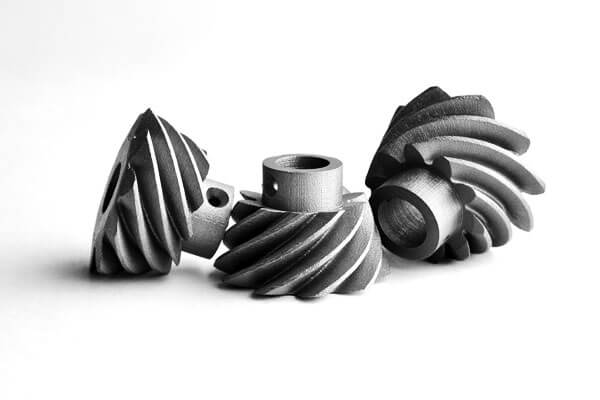
These materials are typically used in Izravni metalni laserski sintering (DMLS), Rastojanje elektronske grede (Ebm), and Binder Jetting.
| Materijal | Ključna svojstva | Uobičajene primjene |
|---|---|---|
| Titanij (Ti-6AL-4V) | Lagan, jak, otporan na koroziju | Aerospace, medicinski implantati |
| Nehrđajući čelik (316L, 17-4 PH) | Izdržljiv, otporan na habanje | Industrial tools, kirurški instrumenti |
Aluminij (Alsi10mg) |
Lagan, dobra toplinska vodljivost | Automobilizam, elektronika |
| Cobalt-Chrome (CoCr) | Biokompatibilan, high-temperature resistant | Zubni implantati, turbinske lopatice |
| Legure nikla (Udruživanje 625, 718) | Heat and corrosion-resistant | Mlazni motori, elektrane |
4.3 Ceramics – Heat and Wear Resistance
Ceramic materials are used in applications that require high-temperature resistance, kemijska stabilnost, i tvrdoća.
These materials are printed using binder jetting, Sl, or extrusion-based methods.
| Materijal | Ključna svojstva | Uobičajene primjene |
|---|---|---|
| Silikonski karbid (Sic) | Visoka snaga, otporan na toplinu | Aerospace, elektronika |
| Glinica (Al2O3) | Tvrdoglav, kemijski inertan | Biomedicinski implantati, industrijske komponente |
| Cirkonija (ZRO2) | Tvrd, otporan na habanje | Dental crowns, alati za rezanje |
4.4 Kompozitni & Advanced Materials – Enhanced Performance
Composites combine polimeri, metali, or ceramics with reinforcing fibers to enhance mehanička čvrstoća, provodljivost, or flexibility.
Fiber-Reinforced Composites
Carbon fiber and glass fiber are embedded into thermoplastics to improve strength and reduce weight.
| Materijal | Ključna svojstva | Uobičajene primjene |
|---|---|---|
| Karbonska vlakna Reinforced Nylon | Omjer visoke snage i težine | Drones, robotika, automobilski |
| Glass Fiber Reinforced PLA | Kruto, otporan na utjecaj | Strukturne komponente |
Smart and Biodegradable Materials
Inovacije u bio-based and self-healing materials are expanding 3D printing possibilities.
| Materijal | Ključna svojstva | Uobičajene primjene |
|---|---|---|
| Conductive Polymers | Električna vodljivost | Printed electronics, senzori |
| Samoizljevni polimeri | Repairs minor damage | Nosač, zrakoplovne komponente |
| Biodegradable PLA Blends | Ekološki prihvatljiv, compostable | Sustainable packaging, medicinski implantati |
5. Post-Processing 3D Prints
Post-processing is a critical step in 3D printing that enhances the mechanical properties, kvaliteta površine, and functionality of printed parts.
Since raw 3D-printed objects often exhibit layer lines, hrapavost površine, and residual material, various post-processing techniques are applied based on material type, printing process, and intended application.

The choice of post-processing method depends on factors such as aesthetic requirements, točnost dimenzije, strukturni integritet, i okolišni uvjeti the part will be exposed to.
Below is a comprehensive analysis of the most common post-processing techniques for different 3D printing technologies.
Why is Post-Processing Important?
- Improves Surface Finish – Reduces roughness and enhances aesthetics.
- Enhances Mechanical Strength – Removes micro-defects and reinforces part durability.
- Optimizes Functionality – Adjusts properties such as flexibility, provodljivost, I nositi otpor.
- Removes Supports & Residual Material – Ensures the part is free from excess material or unsightly artifacts.
- Enables Additional Treatments – Allows for slika, pozlaćivanje, Ili zapečaćenje, depending on application needs.
Common Post-Processing Techniques by Printing Technology
Spojeno modeliranje taloženja (FDM) Naknadna obrada
FDM prints often have visible layer lines and require support removal. The most common post-processing techniques include:
| Tehnika | Proces | Beneficije | Izazovi |
|---|---|---|---|
| Support Removal | Cutting or dissolving support structures (PVA dissolves in water, HIPS dissolves in limonene). | Prevents surface damage. | Requires careful handling to avoid breakage. |
| Brušenje & Poliranje | Using sandpaper (120–2000 grit) to smooth the surface. | Enhances aesthetics and reduces layer visibility. | Dugotrajan, can alter dimensions. |
Chemical Smoothing |
Exposing part to solvent vapors (acetone for ABS, ethyl acetate for PLA). | Achieves glossy finish, eliminates layer lines. | Can weaken part structure if overexposed. |
| Slika & Premazivanje | Priming and applying paint, clear coatings, or hydrophobic treatments. | Improves color, izdržljivost, and protection. | Requires proper surface preparation. |
Stereoilitammikromografija (Sl) & Digital Light Processing (DLP) Naknadna obrada
Since SLA and DLP use liquid resin, post-processing focuses on curing and improving the fragile surface finish.
| Tehnika | Proces | Beneficije | Izazovi |
|---|---|---|---|
| UV Curing | Exposing prints to UV light to strengthen the resin. | Enhances durability. | Requires proper curing time to avoid brittleness. |
| Isopropyl Alcohol (IPA) Ispiranje | Cleaning excess uncured resin with IPA (90%+ koncentracija). | Ensures smooth, clean prints. | Over-soaking can cause warping. |
| Brušenje & Poliranje | Wet sanding to achieve a smoother surface. | Improves aesthetics and paint adhesion. | Can remove fine details. |
| Clear Coating & Slika | Applying UV-resistant coatings or dyes. | Adds color and protection. | Can alter the print’s translucency. |
Primjer industrije:
U dental and medical applications, SLA-printed surgical guides and orthodontic models undergo IPA cleaning and UV curing to ensure biocompatibility and mechanical strength.
Selektivni laserski sintering (SLS) Naknadna obrada
SLS prints are powder-based and often exhibit a grainy texture. Post-processing primarily focuses on smoothing and strengthening the parts.
| Tehnika | Proces | Beneficije | Izazovi |
|---|---|---|---|
| Powder Removal | Blasting with compressed air or tumbling to remove excess powder. | Ensures clean and functional parts. | Fine powders require proper disposal. |
| Bojenje & Bojanje | Submerging parts in dye baths for uniform coloration. | Aesthetically enhances parts. | Limited to dark colors. |
| Vapor Smoothing | Using chemical vapors to melt and smooth outer layers. | Creates a semi-gloss finish, improves mechanical properties. | Requires controlled chemical exposure. |
| Peskarenje kuglica & Prevrtanje | Using fine media (keramički, staklene kuglice) za glatke površine. | Reduces porosity and enhances finish. | May slightly alter dimensions. |
Primjer industrije:
Nike and Adidas koristiti SLS for manufacturing shoe soles, gdje vapor smoothing and dyeing provide a soft-touch finish and better nositi otpor.
Izravni metalni laserski sintering (DMLS) & Rastojanje elektronske grede (Ebm) Naknadna obrada
Metal 3D prints require extensive post-processing to achieve the desired mechanical properties and surface finish.
| Tehnika | Proces | Beneficije | Izazovi |
|---|---|---|---|
| Support Removal (Žičana erozija, CNC Cutting) | Cutting off metal support structures using electrical discharge machining (EDM). | Ensures precision in complex geometries. | Labor-intensive for intricate parts. |
| Toplotna obrada (Žalost, Bok) | Heating to reduce residual stress and improve toughness. | Enhances part strength, prevents cracking. | Requires controlled thermal cycles. |
| Obrada (CNC, Mljevenje, Maska) | Refining dimensions with CNC milling or grinding. | Achieves high precision and smooth finishes. | Adds processing time and cost. |
| Elektropopoliranje | Using an electrolytic process to smooth surfaces. | Poboljšava otpornost na koroziju, estetika. | Only works on conductive metals. |
Primjer industrije:
U zrakoplovne aplikacije, DMLS-produced titanium parts for jet engines undergo Vruće izostatsko prešanje (Bok) to eliminate mikroporitet i poboljšati otpornost na umor.
Advanced Finishing Techniques
Za Prijave visokih performansi, additional finishing techniques are employed:
- Galvanizacija – Coating parts with nikla, bakar, ili zlato to improve conductivity and corrosion resistance.
- Ceramic Coating – Enhancing wear resistance and thermal protection for metal components.
- Hybrid Manufacturing – Combining 3D printing with CNC machining for high-precision parts.
6. Advantages and Challenges of 3D Printing
This section provides an in-depth analysis of the key advantages and challenges of 3D printing in modern industries.
Key Advantages of 3D Printing
Design Freedom and Customization
Unlike traditional manufacturing, which relies on molds, rezanje, i skupština,
3D printing enables the creation of complex geometries that would be impossible or prohibitively expensive using conventional methods.
- Masovna prilagodba – Products can be tailored for individual customers without extra cost.
- Kompleksne geometrije – Intricate lattice structures, Unutarnji kanali, and organic shapes are feasible.
- Lightweight Designs – Aerospace and automotive industries use topology optimization to reduce weight without sacrificing strength.
Rapid Prototyping and Faster Production
Traditional prototyping can take weeks or months, ali 3D printing accelerates the development cycle significantly.
- 90% faster prototyping – A concept can go from design to a functional prototype in a matter of hours or days.
- Accelerated innovation – Companies can test multiple design iterations quickly, poboljšanje product development efficiency.
- On-demand production – Eliminates long supply chains, smanjivanje warehousing and inventory costs.
Reduced Material Waste and Sustainability
Unlike subtractive manufacturing (Npr., CNC obrada), which removes material to shape an object, 3D printing builds parts layer by layer, significantly reducing waste.
- Do 90% less material waste compared to conventional machining.
- Recyclable materials such as bio-based PLA and recycled polymers enhance sustainability.
- Localized production reduces the carbon footprint associated with global supply chains.
Cost Reduction in Low-Volume Production
Za low-volume or specialty manufacturing, 3D printing is significantly more cost-effective than traditional manufacturing.
- No mold or tooling costs – Ideal for short-run production and low-demand markets.
- Reduces expensive machining steps – Eliminates multiple manufacturing processes (lijevanje, mljevenje, bušenje).
- Affordable for startups & small businesses – Lowers entry barriers to manufacturing innovation.
Functional Integration & Assembly Reduction
3D printing enables part consolidation, allowing multiple components to be combined into a single integrated design.
- Reduces assembly complexity – Fewer parts mean less labor and fewer potential failure points.
- Improves structural integrity – Eliminates the need for screws, zavarivati, or adhesives.
Challenges and Limitations of 3D Printing
Ograničeni odabir materijala
While 3D printing has expanded beyond plastics to include metals, keramika, i kompoziti, a range of printable materials remains limited compared to traditional manufacturing.
- Mehanička svojstva – Many printed materials do not match the jačina, duktilnost, ili otpornost na toplinu of conventionally manufactured parts.
- Material costs – High-performance materials (Npr., titanijum, ZAVIRI, KRAJNJI) are expensive.
- Lack of standardization – Material properties vary between different printer models and manufacturers.
Zahtjevi za naknadnu obradu
Most 3D-printed parts require additional finishing steps before they are usable.
- Surface smoothing – Many parts have visible layer lines i zahtijevati brušenje, poliranje, or vapor smoothing.
- Toplotna obrada – Metal prints often need annealing or hot isostatic pressing (Bok) to remove internal stresses.
- Support structure removal – Many processes, takav Sl, SLS, and DMLS, require careful removal of excess material.
High Initial Investment Costs
Although costs are decreasing, industrial-grade 3D printers and materials remain expensive.
- Metal 3D printers koštati $250,000 do $1 milijun.
- High-end polymer printers (Sl, SLS) range from $50,000 do $200,000.
- Material costs are often 5–10x higher than conventional manufacturing materials.
Speed and Scalability Issues
Dok prototyping is fast, mass production with 3D printing remains slower than injection molding or machining.
- Low print speeds – Large parts can take several days to print.
- Limited scalability – Printing thousands of parts is still slower and more expensive than traditional methods.
- Batch processing required – To increase efficiency, multiple parts are often printed at once, which complicates quality control.
7. Applications of 3D Printing Across Industries
From rapid prototyping to mass production of complex geometries, 3D printing offers unprecedented design flexibility, smanjenje troškova, i materijalna učinkovitost.
Its impact spans a wide range of sectors, uključujući proizvodnju, zrakoplovstvo, zdravstvene zaštite, automobilski, konstrukcija, I još.
Proizvodnja & Prototipiranje
Brza izrada prototipova
One of the most significant applications of 3D printing in manufacturing is brzo prototipiranje.
Traditional prototyping methods, such as injection molding, can take weeks or months to set up and produce.
Za razliku od, 3D printing enables faster iteration, with prototypes typically being created in hours or days, allowing for quick testing and design validation.
- Ekonomičnost: 3D printing eliminates the need for expensive molds, alati, and the associated long setup times.
- Prilagođavanje: Kompleks, customized parts can be produced without additional costs or setup.
This is especially useful in small-batch production or when creating components that need to be tailored to specific customer needs.
Tooling and End-Use Production
Beyond prototyping, 3D printing also plays a key role in alati pa čak end-use parts.
Components like jigs, učvršćenja, and molds can be produced quickly and efficiently using 3D printing, reducing production time and cost.
- On-demand tooling allows for rapid adjustments in design without long lead times.
- Companies are increasingly producing end-use parts Za određene prijave, such as customized medical implants or lightweight automotive components.
Aerospace & Automobilizam
Zrakoplovne aplikacije
The aerospace industry has been at the forefront of adopting 3D printing due to its ability to produce lagan, složeni dijelovi s exceptional strength-to-weight ratios.
Components produced using direct metal laser sintering (DMLS) ili electron beam melting (Ebm) are essential for reducing the weight of aircraft,
which directly contributes to Učinkovitost goriva i ušteda troškova.
- Prilagođavanje: 3D printing allows for tailored parts for specific aerospace applications, such as turbine blades or brackets that are optimized for performance.
- Ušteda troškova: Proizvodnja složene geometrije that would otherwise require multiple manufacturing steps can reduce costs significantly.
Automotive Applications
U automobilskom sektoru, 3D printing is used for creating Funkcionalni prototipovi, prilagođeni dijelovi, pa čak production tools.
As the industry shifts toward more sustainable i energy-efficient vozila, 3D printing offers ways to produce lightweight, složene komponente.
- Prilagođavanje: 3D printing allows car manufacturers to produce customized parts on demand,
such as specialized interior components, prototypes for new models, and even lightweight, durable engine parts. - Brže vrijeme izlaska na tržište: 3D printing reduces development time by allowing for quicker testing and iteration of prototypes.

Medicinski & Zdravstvena zaštita
Customized Prosthetics and Implants
One of the most impactful uses of 3D printing is in medicinski uređaji, posebno za customized prosthetics i implantati.
Traditional manufacturing methods often struggle with producing highly tailored devices, but 3D printing excels in creating patient-specific solutions.
- Prilagođavanje: With 3D printing, prosthetics can be designed and produced to exact specifications, ensuring a perfect fit for the patient.
- Troškovna učinkovitost: Traditional prosthetics and implants often involve expensive and time-consuming processes. 3D printing allows for faster production i niže troškove.
Bioprinting
Bioprinting is an emerging field within 3D printing that uses living cells to create tissue structures pa čak organ models.
While still in the early stages, bioprinting holds great promise for the future of personalized medicine, potentially leading to the creation of bioengineered tissues and organs.
- Tissue Engineering: Bioprinted tissues could eventually be used for drug testing, reducing the need for animal testing.
- Regenerative Medicine: Research in bioprinting is exploring the possibility of printing fully functional organs for transplantation.
Konstrukcija & Arhitektura
3D-Printed Buildings
U građevinskoj industriji, 3D printing is revolutionizing the way zgrade i strukture are designed and constructed.
The technology has made it possible to print entire buildings, reducing construction costs and time significantly.
- Cost Reduction: 3D printing can cut construction costs by up to 50%, as it requires fewer workers and materials.
- Održivost: With the ability to use recycled materials in the printing process, 3D printing is contributing to more sustainable construction methods.
Kompleksne geometrije
One of the primary benefits of 3D printing in construction is the ability to design and print complex architectural shapes that are difficult or impossible to create using traditional methods.
This opens up new possibilities for innovative architectural designs and structures.
Roba široke potrošnje & Elektronika
Customized Consumer Products
In the consumer goods industry, 3D printing enables manufacturers to produce customized, made-to-order products.
Whether it’s personalized jewelry, bespoke footwear, or custom-fit fashion accessories, 3D printing offers unparalleled customization at a fraction of the cost of traditional methods.
- Product Personalization: Consumers can design their products and have them printed on-demand, eliminating mass production and reducing waste.
- Fashion Industry: Designers are leveraging 3D printing to create innovative fashion pieces, takav customized jewelry pa čak wearable tech.
Proizvodnja elektronike
3D printing is also playing an important role in the electronics industry, where it is used to print pločice, miniaturized components, i kućišta for electronic devices.
Sposobnost da produce complex geometries in small-scale, intricate parts has opened up possibilities for customized electronics.
- Functional Electronics: Companies are now using conductive 3D printing materials to print functional electronic components, such as antennas, capacitors, and circuit traces.
- Prototyping and Testing: 3D printing enables rapid iteration and testing of new electronic products and devices.
8. Additive vs Traditional Manufacturing
The comparison between aditivna proizvodnja (3D tisak) and traditional manufacturing methods,
takav oduzimajući i formative manufacturing, highlights the unique strengths and challenges of each approach.
Understanding these methods is crucial for industries looking to select the most efficient and cost-effective manufacturing process based on their specific needs.
Aditivna proizvodnja (3D Tisak)
Pregled procesa
Aditivna proizvodnja (Am), obično nazvani 3D tisak, involves creating three-dimensional objects by depositing material layer by layer based on a digital design.
Unlike traditional manufacturing, where material is removed or shaped by force, AM is a process of building up materijal, which gives it unique advantages in design freedom and material efficiency.
Ključne karakteristike
- Materijalna učinkovitost: AM uses only the material necessary for the part, smanjenje otpada.
Unlike subtractive methods, which cut away material from a solid block, 3D printing builds the object, using less raw material. - Fleksibilnost dizajna: AM enables the creation of složene geometrije s lakoćom,
including intricate internal structures, organski oblici, and customized designs that would be impossible or costly with traditional methods. - Ubrzati: While AM can be slower than traditional processes for large batches, To nudi rapid prototyping capabilities.
You can create and test a prototype in a matter of hours or days, a process that could take tjedana with traditional methods.
Subtractive Manufacturing
Pregled procesa
Subtractive manufacturing involves removing material from a solid block (referred to as a prazan) using mechanical tools like mljevenje, skretanje, i mljevenje.
The material is gradually cut away to shape the object, leaving behind the final part. This method is one of the oldest and most commonly used in manufacturing.
Ključne karakteristike
- Precision and Surface Finish: Subtractive manufacturing is known for its visoka preciznost i
ability to create parts with excellent surface finishes, making it ideal for producing components with tight tolerances. - Materijalni otpad: One major disadvantage of subtractive manufacturing is the materijalni otpad generated during the cutting process.
The majority of the material is discarded as scrap, making it less material-efficient compared to additive processes. - Tooling and Setup Costs: Subtractive methods often require expensive tooling, takav kalupi i umiroviti, which can increase costs, especially for small production runs.
Formative Manufacturing
Pregled procesa
Formative manufacturing involves creating objects by shaping material through grijati, pritisak, ili oboje.
Examples of formative methods include injekcijsko prešanje, kasting, istiskivanje, i žigosanje.
These methods are often used for high-volume production runs of parts with simple to moderately complex shapes.
Ključne karakteristike
- Proizvodnja velike brzine: Formative methods like injekcijsko prešanje dopustiti rapid mass production of parts,
making them ideal for industries requiring large quantities of identical components. - Iskorištavanje materijala: Like additive manufacturing, formative methods are materijalno učinkovit, as they often involve creating parts from a mold with little waste.
- Troškovi alata: While the production speed is high, mold and die costs može biti značajan, posebno za složene oblike.
These costs are typically spread out over large production volumes, making the method economically viable for high-volume runs.
Comparing Additive Manufacturing with Traditional Manufacturing
| Značajka | Aditivna proizvodnja (3D Tisak) | Subtractive Manufacturing | Formative Manufacturing |
|---|---|---|---|
| Materijalna učinkovitost | High – Uses only material needed for the part. | Low – Material waste from cutting away stock. | High – Minimal waste in molding processes. |
| Complexity of Design | Can create complex shapes and internal structures. | Limited by tool geometry and cutting paths. | Moderate – Complex shapes require expensive molds. |
Brzina proizvodnje |
Slower for large batches but fast for prototyping. | Fast for mass production of simple parts. | Extremely fast for large batches, slow setup for molds. |
| Cost of Equipment | Moderate – Lower entry costs for desktop printers. | High–CNC machines and tooling can be expensive. | High – Tooling and molds are costly. |
| Opcije materijala | Ograničen, but growing (plastika, metali, keramika). | Broad – Metals, plastika, i kompoziti. | Broad – Primarily plastics and metals. |
| Prilagođavanje | High – Ideal for bespoke, nisko volumen, prilagođeni dijelovi. | Low–standardized parts. | Moderate – Limited to mold capabilities. |
| Scale of Production | Best for low-volume, kompleks, and customized parts. | Idealno za velike količine, Visoko precizni dijelovi. | Best for mass production of simple parts. |
9. Zaključak
3D printing continues to reshape industries by offering unprecedented flexibility, učinkovitost, i inovacija.
While it has limitations in material properties and scalability, ongoing advancements in hybrid manufacturing, AI integracija, and sustainable materials will further enhance its capabilities.
Laga is the perfect choice for your manufacturing needs if you need high-quality 3D printing services.
Referenca članaka: https://www.hubs.com/guides/3d-printing/