In modern automotive engineering, fabricación industrial, and appliance design, the global push toward lightweighting, carbon emission reduction, and cost optimization has accelerated the substitution of traditional metals with advanced thermoplastic composites.
While metals like aluminum and steel offer high structural integrity, they introduce weight and processing complexities.
Among the high-performance polymers bridging this performance gap, PP GF40—Polypropylene reinforced with 40% glass fiber by weight—has emerged as a premier engineering material.
By combining a low-density polypropylene matrix with a high loading of rigid glass fibers, material scientists have engineered a composite that delivers exceptional stiffness, elevated heat deflection thresholds, y estabilidad dimensional, all while maintaining a competitive cost structure.
1. What Is PP GF40?
PP GF40 is a composite material consisting of a polipropileno matrix reinforced with approximately 40% glass fiber by weight.
The glass fibers are typically chopped strands with a diameter of 10–14 μm and an initial length of 3–12 mm, although the fibers break down during compounding and molding to an average length that is considerably shorter.
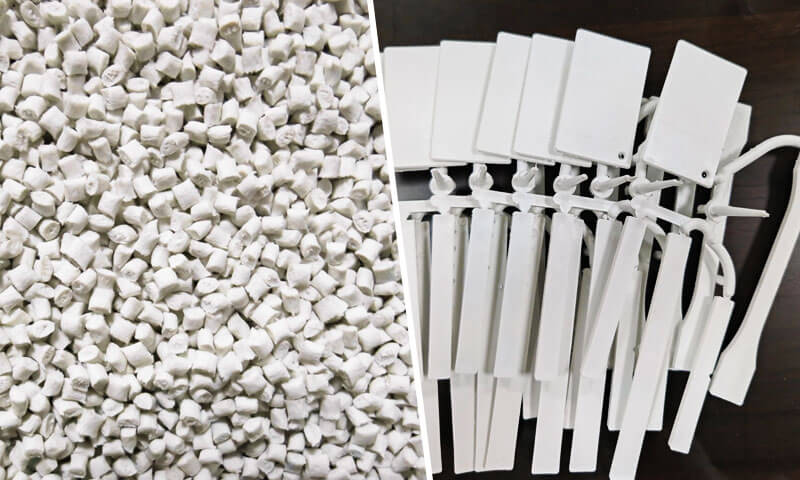
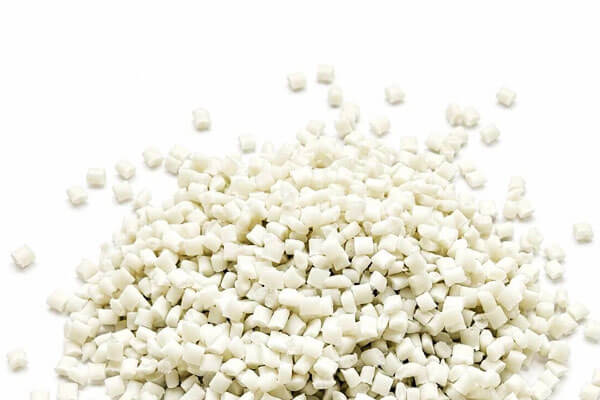
The material is produced by compounding: PP resin, fibras de vidrio, coupling agents, estabilizadores, and other additives are melt-mixed in a twin-screw extruder, peletizado, and supplied as cylindrical or lenticular pellets.
The glass fibers are dispersed throughout the polymer matrix, and a coupling agent—usually a maleic anhydride-grafted polypropylene (PP-g-MAH)—is used to bond the hydrophilic glass surface to the hydrophobic PP matrix.
Without this coupling agent, the glass fibers would simply act as voids, and the reinforcement effect would be minimal.
2. The Role of 40% Glass Fiber Reinforcement
To understand why PP GF40 performs the way it does, it helps to understand what glass fibers actually do inside the polymer matrix.
Load transfer.
Glass fibers are stiff and strong compared with the PP matrix. When the composite is loaded, stress is transferred from the relatively soft polymer to the much stiffer fibers through the fiber-matrix interface.
The coupling agent is critical here—it forms a chemical bridge between the glass surface and the polymer, allowing efficient stress transfer.
Stiffness increase.
The most dramatic effect of glass fiber reinforcement is the increase in tensile modulus and flexural modulus. Neat PP has a flexural modulus of roughly 1,200–1,500 MPa.
En 40% glass fiber loading, the flexural modulus rises to approximately 5,500–7,000 MPa—a four- to fivefold increase.
This transforms PP from a flexible, semi-rigid material into a genuinely stiff engineering material.
Strength increase.
Tensile strength increases from roughly 30–35 MPa for neat PP to 90–110 MPa for PP GF40.
The improvement is less dramatic than the stiffness increase because strength depends heavily on fiber length, orientación, and interfacial bonding, but it is still substantial.
Temperatura de deflexión del calor.
The heat deflection temperature (HDT) bajo 1.82 MPa load rises from approximately 55–65°C for neat PP to 140–155°C for PP GF40.
This is one of the most commercially important effects, because it allows PP GF40 parts to be used in under-hood and appliance applications where neat PP would soften and deform.
Resistencia a la fluencia.
Glass fibers dramatically improve creep resistance—the tendency of a material to deform slowly under sustained load.
PP GF40 maintains its dimensions far better than neat PP under long-term loading.
Estabilidad dimensional.
The coefficient of thermal expansion (CLTE) drops from approximately 100–180 × 10⁻⁶ /°C for neat PP to 20–40 × 10⁻⁶ /°C for PP GF40. This brings the material much closer to the thermal expansion behavior of metals and reduces warpage and fit-up problems in assemblies.
What glass fibers do not do.
Glass fibers do not significantly improve impact resistance. De hecho, they usually reduce notched impact strength compared with neat PP, because the fibers act as stress concentrators and the material becomes more brittle.
Impact-modified grades of PP GF40 are available, but the improvement comes from the addition of elastomeric impact modifiers, not from the glass fibers themselves.
3. Key Properties of PP GF40
PP GF40 combines polypropylene with 40% glass fiber reinforcement to achieve significantly higher strength, rigidez, and durability than standard polypropylene.
Its balanced performance makes it a widely used engineering plastic for structural components that require lightweight design, estabilidad dimensional, and reliable long-term service.
High Strength and Rigidity
The addition of glass fibers greatly improves the mechanical strength and stiffness of polypropylene.
Glass fibers act as a reinforcing structure that reduces polymer deformation under load, allowing PP GF40 to achieve tensile strengths of approximately 100–140 MPa and tensile modulus values around 8,000–9,500 MPa.
This makes it suitable for components requiring higher load-bearing capability than conventional PP.
Excelente estabilidad dimensional
PP GF40 offers much better dimensional stability than unfilled polypropylene.
Glass fiber reinforcement reduces molding shrinkage, expansión térmica, and deformation during long-term use.
Sin embargo, because glass fibers align with the melt flow direction during injection molding, designers must consider fiber orientation when controlling tolerances and part performance.
Improved Creep Resistance
Compared with standard PP, PP GF40 provides better resistance to creep deformation under continuous mechanical stress.
The glass fiber structure limits polymer chain movement, helping components maintain their shape and mechanical properties during extended operation.
Chemical Resistance and Low Moisture Absorption
PP GF40 retains polypropylene’s excellent resistance to moisture, ácidos, alcalino, sales, y muchos químicos.
Its low water absorption helps maintain stable dimensions and mechanical performance in humid or chemically exposed environments, providing an advantage over moisture-sensitive engineering plastics such as nylon.
Rendimiento térmico mejorado
Glass fiber reinforcement improves the heat resistance of polypropylene by increasing its heat deflection temperature and reducing thermal deformation.
Typical PP GF40 grades can withstand higher operating temperatures than standard PP, while maintaining a good balance between performance and cost.
Lightweight Structural Performance
With a density of approximately 1.2–1.3 g/cm³, PP GF40 provides high stiffness while remaining significantly lighter than metal materials.
This lightweight advantage allows designers to reduce component weight while maintaining required mechanical strength.
Fatigue Resistance and Electrical Properties
PP GF40 offers improved fatigue resistance compared with unfilled PP, making it suitable for components exposed to repeated loading and vibration.
It also maintains polypropylene’s excellent electrical insulation properties, providing stable performance in electrical and electronic applications.
Processing and Surface Characteristics
PP GF40 is suitable for injection molding and can produce complex structural components with good repeatability.
Sin embargo, glass fiber reinforcement may reduce surface gloss and create visible fiber patterns.
Diseño de molde adecuado, control de procesamiento, and fiber orientation management are essential to achieve consistent quality.
4. Injection Molding Performance of PP GF40
Compared with standard polypropylene, PP GF40 requires more careful control during moldura de inyección due to its high glass fiber content and increased melt viscosity.
La adición de 40% glass fiber improves strength and dimensional stability, but it also introduces challenges such as anisotropic shrinkage, fiber orientation effects, weld line weakness, and increased tool wear.
With proper process control and mold design, PP GF40 can be consistently molded into high-performance structural components.
Drying and Material Preparation
PP GF40 is a relatively low-moisture-absorption material and generally does not require pre-drying under normal storage conditions.
Sin embargo, if the material has absorbed moisture due to long-term exposure to humid environments, pre-drying at approximately 80–100°C for 1–2 hours can help prevent molding defects such as surface marks or reduced mechanical performance.
Proper material handling is important to maintain consistent processing quality.
Melt Temperature and Mold Temperature
The recommended melt temperature range for PP GF40 is typically around 220–260°C.
A higher melt temperature improves flowability and helps fill complex geometries, but excessive heat exposure may accelerate polymer degradation and reduce glass fiber integrity.
Lower melt temperatures increase viscosity and may lead to incomplete filling or higher internal stress.
Mold temperatures are generally controlled between 40–80°C. Higher mold temperatures can improve surface appearance, reduce residual stress, and enhance weld line strength, although they may increase cooling time and affect production efficiency.
Injection Pressure and Injection Speed
Due to the presence of glass fibers, PP GF40 has higher melt viscosity than unfilled polypropylene and usually requires higher injection pressure to achieve complete mold filling.
Holding pressure must be properly controlled to compensate for material shrinkage during cooling and maintain dimensional accuracy.
Medium to high injection speeds are commonly used to ensure the melt reaches all areas of the cavity before solidification.
Sin embargo, excessive injection speed can cause flow-related defects such as jetting, fiber orientation imbalance, and poor surface appearance.
A balanced filling profile is essential for achieving consistent mechanical performance.
Shrinkage and Warpage Control
One of the most important processing characteristics of PP GF40 is anisotropic shrinkage.
Because glass fibers align along the melt flow direction during injection molding, shrinkage is usually lower in the flow direction and higher perpendicular to the flow direction.
Typical shrinkage values are approximately 0.3–0.8%, dependiendo de la calificación, condiciones de procesamiento, y geometría de la pieza.
For large or complex components, uneven fiber orientation and cooling rates can lead to warpage.
To minimize deformation, manufacturers typically optimize gate location, cooling channel design, packing pressure, and mold filling balance.
Mold flow simulation is often used for critical components to predict fiber orientation and dimensional behavior before production.
Weld Line Performance
Weld lines are a key consideration when molding glass fiber reinforced polypropylene.
When two melt fronts meet, the glass fibers do not fully reconnect across the weld region, resulting in lower mechanical strength compared with the surrounding material.
Por lo tanto, part design and gate positioning should minimize weld lines in areas subjected to high mechanical loads.
For structural components, engineers typically place weld lines in low-stress areas and optimize injection parameters to improve weld line strength.
Surface Finish and Appearance
PP GF40 generally provides a more functional surface finish compared with unfilled polypropylene.
The glass fibers near the surface can create a slightly textured appearance, reduce gloss, and make high-polish surfaces more difficult to achieve.
For applications requiring improved appearance, manufacturers may optimize mold surface texture, temperatura de procesamiento, and injection parameters to reduce visible fiber marks.
Tool Wear and Mold Life
El 40% glass fiber content significantly increases material abrasiveness.
During long-term production, glass fibers can accelerate wear on injection molding screws, barrels, boquillas, and mold surfaces.
Aceros endurecidos, surface-treated components, and wear-resistant coatings are commonly recommended for molds used in high-volume PP GF40 production.
Proper tooling selection helps maintain dimensional consistency and reduces maintenance frequency.
5. Applications of PP GF40
PP GF40 is widely used in engineering applications where a balance of high stiffness, diseño liviano, resistencia química, estabilidad térmica, y se requiere rentabilidad.
Componentes automotrices
El automotor industry is one of the largest application areas for PP GF40.
Su combinación de baja densidad (aproximadamente 1.2–1.3 g/cm³) and high rigidity makes it suitable for lightweight structural components.
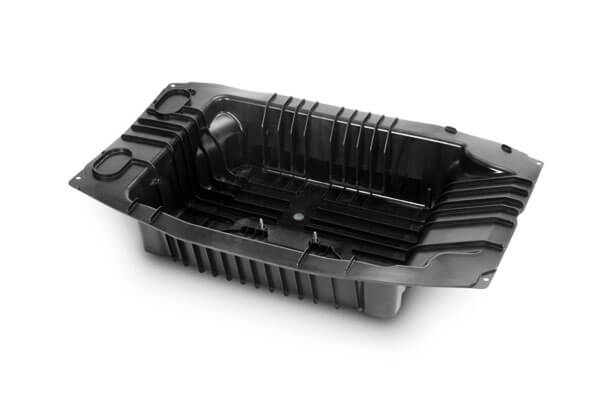
Typical applications include battery trays, radiator end tanks, fan shrouds, air intake components, corchetes, and under-hood support parts.
For electric vehicles, PP GF40 is increasingly used in battery-related components because it provides good mechanical strength, estabilidad dimensional, and resistance to automotive fluids and chemicals while reducing vehicle weight compared with traditional metal solutions.
In interior and exterior systems, PP GF40 is also used for instrument panel supports, door module structures, seat components, and reinforcement brackets where moderate mechanical loads and weight reduction are important.
Appliances and Household Equipment
PP GF40 is commonly used in appliances exposed to water, detergentes, and repeated thermal cycles.
Applications include washing machine components, dishwasher parts, vacuum cleaner housings, and structural support components.
Its low moisture absorption and strong chemical resistance allow it to maintain dimensional stability during long-term exposure to hot water, agentes de limpieza, and household chemicals.
Compared with metal components, PP GF40 can also reduce weight and eliminate corrosion concerns.
Componentes eléctricos y electrónicos
Due to its excellent electrical insulation properties and dimensional stability, PP GF40 is suitable for various electrical components, including motor end caps, switch housings, connector supports, coil bobbins, and protective enclosures.
The material provides stable performance under temperature changes while maintaining good dielectric properties.
Sin embargo, applications requiring flame retardancy or extreme electrical performance may require specially modified PP GF40 grades.
Industrial Equipment and Chemical Handling Components
PP GF40 is frequently selected for industrial components where chemical resistance and mechanical durability are required.
Typical examples include pump housings, componentes de la válvula, chemical storage parts, componentes transportadores, and equipment brackets.
Unlike metals, PP GF40 does not corrode when exposed to many acids, alcalino, y productos químicos industriales.
This makes it particularly suitable for environments where corrosion resistance is more important than extreme mechanical strength.
Consumer Products and General Engineering Parts
En productos de consumo, PP GF40 is used for products requiring higher rigidity than standard plastics, such as tool housings, luggage frames, componentes de muebles, and sporting equipment parts.
The material allows manufacturers to produce lightweight but durable components while maintaining competitive production costs through injection molding.
Construction and Infrastructure Applications
PP GF40 can also be found in construction-related components such as pipe fittings, drainage components, estructuras de soporte, and reusable formwork parts.
Its corrosion resistance and dimensional stability provide advantages in environments exposed to moisture and chemicals.
6. Advantages and Limitations of PP GF40
PP GF40 is considered one of the most cost-effective glass fiber reinforced thermoplastics because it provides a strong balance between mechanical performance, resistencia química, processing efficiency, y costo de materiales.
Sin embargo, like all engineering plastics, it also has limitations that must be considered during material selection.
Advantages of PP GF40
High Strength and Stiffness
La adición de 40% glass fiber significantly increases the mechanical performance of polypropylene.
PP GF40 typically achieves tensile strengths around 100–140 MPa and tensile modulus values of approximately 8,000–9,500 MPa, making it suitable for structural components that require higher rigidity than conventional PP.
Excelente estabilidad dimensional
Compared with unfilled polypropylene, PP GF40 has much lower molding shrinkage and improved resistance to thermal deformation.
This makes it suitable for precision components requiring stable dimensions during long-term operation.
Baja absorción de humedad
One of the major advantages of PP GF40 compared with materials such as PA6 GF30 is its very low water absorption.
Moisture exposure has limited influence on its mechanical properties and dimensional stability, making it suitable for humid environments.
Excelente resistencia química
PP GF40 maintains polypropylene’s strong resistance to many chemicals, including acids, alcalino, sales, and common industrial fluids.
This chemical stability is a major reason it is widely used in automotive, industrial, and chemical-handling applications.
Good Thermal Performance
Glass fiber reinforcement improves the heat resistance of polypropylene.
Many PP GF40 grades provide heat deflection temperatures of approximately 140–155°C at 1.82 MPA, allowing use in moderately high-temperature environments.
Lightweight and Cost Effective
With a density significantly lower than metals and many engineering plastics, PP GF40 offers a strong strength-to-weight ratio.
It is generally more economical than alternatives such as PA6 GF30, PBT GF30, and PPS GF40, making it attractive for large-volume production.
Established Injection Molding Technology
PP GF40 benefits from mature processing technology and wide industrial availability.
Manufacturers can achieve stable production with optimized mold design, proper processing parameters, and suitable tooling materials.
Limitations of PP GF40
Reduced Impact Resistance Compared with Unfilled PP
Although glass fibers improve stiffness and strength, they reduce the inherent toughness and impact flexibility of polypropylene.
PP GF40 is less suitable for applications requiring high impact absorption or large deformation capability.
Anisotropic Shrinkage and Warpage
Because glass fibers align with the melt flow direction during injection molding, PP GF40 exhibits different shrinkage rates in different directions.
Complex geometries require careful mold design to control warpage and dimensional variation.
Weak Weld Line Strength
The glass fibers do not fully reconnect across weld lines formed during injection molding.
Por lo tanto, weld line areas generally have lower mechanical strength and should be avoided in high-load regions through proper gate design.
Rougher Surface Appearance
Compared with unfilled PP, PP GF40 typically has a more textured surface because glass fibers may appear near the molded surface. It is better suited for functional components than high-gloss decorative parts.
Higher Tool Wear
The abrasive nature of glass fibers increases wear on screws, barrels, and mold surfaces. Long-term production usually requires hardened steel molds or surface coatings to maintain tool life.
Limited High-Temperature Capability
Although PP GF40 has improved heat resistance compared with standard PP, it cannot compete with high-temperature engineering plastics such as PPS GF40 or PEEK-based materials in continuous high-temperature applications.
7. PP GF40 vs Other Engineering Plastics
PP GF40 competes with several reinforced engineering thermoplastics, including PA6 GF30, PBT GF30, ABS GF20, and PPS GF40.
Although these materials may be used in similar component categories, they differ in moisture sensitivity, rendimiento térmico, comportamiento de impacto, resistencia química, y costo.
Comparación de material
| Propiedad o Factor | PP GF40 | PA6 GF30 | PBT GF30 | Abdominales GF20 | PPS GF40 |
| Base polímero | Polipropileno | Poliamida 6 | Polybutylene terephthalate | Acrylonitrile butadiene styrene | Polyphenylene sulfide |
| Main fortaleza | Baja densidad, resistencia química, alta rigidez | Mechanical strength and wear resistance | Dimensional precision and electrical performance | Impact performance and surface quality, dependiendo de la calificación | High-temperature and chemical resistance |
| Humedad absorption | Muy bajo | Relativamente alto | Bajo a moderado | Bajo | Muy bajo |
| Térmico capability | Moderado; dependiente del grado | Generally higher than PP in many reinforced grades | Suitable for many moderately high-temperature applications | Generally lower than PA6 GF30, PBT GF30, and PPS GF40 | Alto |
| Químico resistencia | Good against many acids and alkalis; solvent compatibility varies | Good against many oils, but sensitive to some chemicals and moisture effects | Good against many oils and solvents, but susceptible to certain chemical environments | Good against some aqueous chemicals; solvent resistance varies | Excellent resistance to many aggressive chemicals |
Estabilidad dimensional |
Good potential, but fiber orientation can cause warpage | Affected by moisture absorption | Often good, with grade-dependent shrinkage | Depends on formulation and reinforcement | Generally good at elevated temperatures |
| Típico costo colocación | Often economical for reinforced structural parts | Moderado | Moderado a alto | Moderado | Generally high |
| Típico aplicaciones | Soportes automotrices, alojamiento, soporte | Engranaje, partes estructurales, componentes debajo del capó | Conectores eléctricos, carcasa de precisión | Alojamiento, corchetes, consumer and industrial parts | Equipo químico, high-temperature electrical and industrial components |
8. Environmental Considerations and Recycling of PP GF40
PP GF40 is a thermoplastic composite, so it can generally be remelted and reprocessed under suitable conditions.
Sin embargo, recycling glass-fiber-reinforced polypropylene is more complicated than recycling unfilled PP because the reinforcement affects both processing and the properties of the recovered material.
Reciclaje Mecánico
Mechanical recycling usually involves collecting and sorting scrap, shredding or granulating it, and processing it into a material suitable for reuse.
During these steps, glass fibers may break or become shorter, reducing their effectiveness as reinforcement.
Repeated thermal and mechanical processing can also affect the polymer matrix and additives.
Como resultado, recycled PP GF40 may exhibit different strength, rigidez, resistencia al impacto, and flow behavior from virgin material.
Research on glass-fiber-reinforced PP has documented reductions in fiber length and changes in mechanical performance during recycling.
Reuse of Regrind
Regrind from production scrap may be reusable, but its suitability depends on the source material, contaminación, historial de procesamiento, and the performance requirements of the finished part.
Before introducing regrind into production, manufacturers should consider:
- Whether the scrap is clean and traceable to a known material grade.
- How much fiber breakage has occurred during grinding and remelting.
- Whether the recycled blend meets the component’s mechanical and dimensional requirements.
- Whether repeated processing changes color, apariencia superficial, or melt flow.
- Whether the part is subject to safety-critical or regulatory requirements.
A fixed regrind percentage should not be assumed suitable for every PP GF40 application. Production trials and material testing are needed to establish an acceptable limit.
Design for Sustainability
Several strategies can improve the environmental performance of PP GF40 components:
- Use material efficiently.Optimize ribs, espesor de la pared, and load paths to avoid unnecessary material consumption.
- Extend service life.Design for realistic loads, thermal exposure, and fatigue conditions to reduce premature replacement.
- Control manufacturing scrap.Optimize molding parameters and dimensional control to minimize rejected parts.
- Evaluate recycled content.Where technically feasible, qualify recycled or reprocessed material through testing.
- Consider end-of-life handling.Identify the polymer and reinforcement clearly to support sorting and appropriate recycling routes.
The environmental benefit of PP GF40 depends on the complete product life cycle, including material production, manufacturing energy, transporte, durabilidad, y tratamiento al final de la vida. A lower component weight does not by itself establish a lower overall environmental impact.
9. Conclusión
PP GF40 is a mature, well-understood engineering composite that occupies a valuable position in the materials landscape.
By reinforcing polypropylene with 40% fibra de vidrio, compounders achieve a material with stiffness, fortaleza, and heat resistance that approach those of engineering plastics such as PA6 GF30 and PBT GF30, while retaining the low density, resistencia química, estabilidad dimensional, and cost advantages of a polyolefin.
Its properties make it suitable for a wide range of applications, from automotive under-hood components and appliance parts to electrical housings, equipo industrial, y productos de consumo.
Its processing behavior is well characterized, and its recyclability—while complicated by the presence of glass fibers—is better than that of many thermosetting composites.
As the industry moves toward lighter, more sustainable materials, PP GF40 will continue to play an important role.
Continued development in bio-based feedstocks, recycled content, and improved coupling agents will further expand its applicability and reduce its environmental footprint.
Preguntas frecuentes
What does PP GF40 stand for?
PP GF40 stands for polypropylene reinforced with 40% glass fiber by weight. The “GF” denotes glass fiber, and “40” indicates the weight percentage of glass in the composite.
Can PP GF40 replace metal?
It can replace selected metal components when the required strength, rigidez, resistencia a la temperatura, vida de fatiga, and safety margins are met.
The design must account for differences in elastic modulus, arrastrarse, expansión térmica, and directional properties.
A direct material substitution without component-level validation is not recommended.
What is the difference between PP GF30 and PP GF40?
PP GF40 has a higher glass fiber content than PP GF30, giving it higher stiffness, fortaleza, y temperatura de deflexión del calor.
Sin embargo, it also has higher density, lower impact strength, and greater warpage potential. The choice depends on the required balance of properties.
Is PP GF40 better than PA6 GF30?
Depende de la aplicación. PP GF40 has better chemical resistance, menor absorción de humedad, menor densidad, y menor costo.
PA6 GF30 has higher strength, mayor resistencia a la temperatura, and better impact properties.
PP GF40 is preferred where moisture and chemicals are concerns; PA6 GF30 where high strength and temperature resistance are critical.
Why does PP GF40 warp?
PP GF40 exhibits anisotropic shrinkage: shrinkage is lower in the flow direction and higher in the cross-flow direction.
This differential shrinkage causes warpage, especially in parts with unbalanced flow or complex geometry. Diseño de moldes, ratero, and cooling must be optimized to minimize warpage.
Is PP GF40 food safe?
Some PP GF40 grades are formulated to comply with food contact regulations. Sin embargo, the glass fibers and additives must meet the applicable regulatory requirements. Always verify with the material supplier.
How does PP GF40 compare with PPS GF40?
PPS GF40 offers much higher temperature resistance (HDT above 260°C) and excellent chemical resistance, but it is significantly more expensive and more difficult to process.
PP GF40 is a lower-cost option for moderate-temperature applications.