1. Увођење
Увешавање од нехрђајућег челика, also known as precision casting or lost wax casting, is a highly precise and versatile manufacturing method used to produce complex, high-performance components with tight tolerances and excellent surface finishes.
It plays a critical role in modern industrial applications where dimensional accuracy, интегритет материјала, и отпорност на корозију су од суштинског значаја.
As demand for lightweight, издржљив, and intricately shaped parts continues to grow in industries like aerospace, медицински, петрохемијски, и прерада хране, stainless steel investment casting has become increasingly valuable.
This process allows manufacturers to create near-net-shape stainless steel parts while minimizing machining, материјални отпад, and assembly complexity.
2. Шта је инвестиционо ливење?
Инвестициони ливење—also known as lost‑wax or precision casting—is a metal‑forming process in which a disposable wax pattern is surrounded by a multi‑layered ceramic shell.
Once the shell hardens, восак се растопио ("Изгубљени восак"), leaving a precise cavity into which molten metal is poured.
После учвршћивања, the ceramic shell is broken away to reveal a metal part that faithfully replicates the original wax geometry.

3. Why Use Stainless Steel for Investment Casting?
Нехрђајући челик combines exceptional mechanical performance, отпорност на корозију, и естетске квалитете, making it one of the most versatile and reliable materials for precision investment casting.
Изузетна отпорност на корозију
- Passive Oxide Layer: All stainless steels form a thin, self‑healing chromium‑oxide surface layer that prevents rust and staining even in harsh environments.
- Отпорност на питтинг: Grades such as 316L and duplex 2205 exhibit high pitting resistance equivalent numbers (Дрва) of ≥25, ensuring long service life in chloride‑rich media (Нпр., морска вода, расила).
- Хемијска компатибилност: Resistant to a broad pH range (2-13), allowing use in chemical processing, food and beverage, and pharmaceutical applications without special coatings.
Висока чврстоћа и жилавост
- Wide Strength Spectrum:
-
- Аустенитнице (304Л, 316Л): tensile strength 480–600 MPa; yield strength 200–300 MPa.
- Precipitation‑hardening alloys (17--4пх): tensile strength up to 1,300 MPa after aging treatment.
- Мартензитски разреде (410, 420): can be heat‑treated to achieve yield strengths of 800 MPa or more.
- Excellent Toughness: Even in cryogenic or sub‑zero applications, austenitic stainless steels maintain impact toughness above 80 J at –196 °C.
Precision Casting Compatibility
- Fluidity and Melting Range: Stainless steels melt between 1,350 ° Ц и 1,500 ° Ц, providing a stable pouring window that works seamlessly with ceramic shell materials.
- Димензионална тачност: Achieves tolerances as tight as ±0.1 mm per 100 mm of nominal dimension, ideal for components requiring precise fits or intricate features.
- Површинска завршна обрада: Typical as‑cast finishes reach Ra 1.6–3.2 μm, reducing or eliminating the need for secondary polishing.
4. Step‑by‑Step Process of Stainless Steel Investment Casting
The investment‑casting workflow consists of six major stages, each carefully controlled to ensure dimensional accuracy, квалитет површине, и металуршки интегритет.
4.1 Креирање вакског узорка
Дизајн & Измишљотина
- Precision steel dies are CNC‑milled to mirror the final part geometry, accounting for shrinkage (typically 1.5–2 % за нерђајући челик).
Ињекција воска
- Растопљени восак (paraffin blends with plasticizers) is injected under pressure (4-6 бар) into the die, filling cavities in under 2 секунди.
- Target dimensional variation: ±0.03 mm per 25 мм.

Pattern Quality Check
- Visual inspection for voids, бљесак, or knit lines.
- Weight verification: each pattern’s mass is recorded to track yield and process consistency.
4.2 Assembly of Wax Patterns
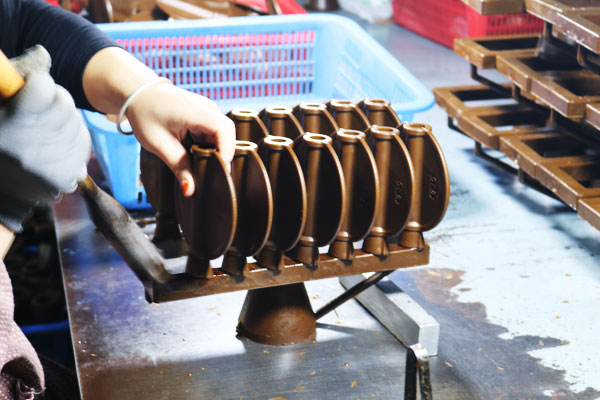
Pattern Treeing
- Individual wax patterns are “grafted” onto a central wax sprue bar to form a tree, optimizing metal feed and minimizing turbulence.
- Typical tree sizes: 10–50 patterns, depending on part size and furnace capacity.
Gate and Runner Design
- Gate cross‑sections sized to balance fill speed against turbulence (aiming for Reynolds numbers below 500).
- Hot‑tap gates or daily‑flared gates reduce turbulence and air entrapment.
4.3 Зграда шкољке (Ceramic Slurry and Stucco)
First Dipping (Главни капут)
- Fine refractory slurry (particle size 5–10 µm) coats the wax tree to capture fine detail.

Stucco Application
- Silica or zircon sand (40–80 µм) is stuccoed onto the wet prime coat for reinforcement.
Subsequent Coats
- Alternate slurry and stucco for 5–8 total layers, building shell thickness to 6–10 mm.
- Drying time between coats: 15–30 minutes at 20–25 °C and 40–60 % relative humidity.
Final Coating
- A coarser outer layer (150–250 µm particles) provides mechanical protection during handling and pouring.
4.4 Девексирање (Lost‑Wax)
Autoclave Dewax
- Rapid steam cycle at 120–150 °C and 2–5 bar pressure for 1–2 minutes to melt out the bulk of wax.
Oven Bake‑out
- Shells are transferred to an oven at 200–250 °C for 2–4 hours to remove residual wax and moisture.
Восак опоравак
- Melted wax is collected, filtered, and recycled back into the wax injection system, achieving over 95% reuse.
4.5 Preheating and Pouring Molten Stainless Steel
Shell Preheating
- Shell assemblies are baked at 1,000–1,200 °C for 1–3 hours to sinter the ceramic, drive off moisture, and reduce thermal shock.
Melting Furnace
- Induction or electric‑arc furnaces melt stainless charge metal to 1,400–1,550 °C, Зависно од легуре (Нпр., 316L at ~1,450 °C).
Сипајући
- Gravity pour, вакуум асистенција, or low‑pressure techniques fill molds at controlled rates (20–50 cm/s mold velocity) Да минимизира турбуленција.
- Typical pour weight per shell: 10–250 kg of molten metal.

4.6 Уклањање љуске, Завршњак
Once the stainless steel has fully solidified, the ceramic shell is removed through mechanical methods such as sandblasting, water jetting, or vibratory finishing.
У неким случајевима, chemical dissolution may be used for intricate geometries.
Након уклањања шкољке, the casting proceeds to finishing operations, which typically include removal of the sprue system, surface grinding, and polishing to achieve the desired surface quality.

Heat treatment may be applied to enhance mechanical properties such as strength, тврдоћа, или отпорност на корозију, depending on the alloy used.
Precision CNC machining is then employed to meet tight dimensional tolerances, especially on critical surfaces or mating interfaces.
5. Technical Advantages of Stainless Steel Investment Casting
Stainless steel investment casting offers a unique combination of precision, перформансе, and economy. Below are its principal technical advantages:

Изузетна прецизност димензије
- Typical tolerances of ±0.1 mm per 100 mm of nominal dimension enable net‑shape parts that require minimal or no secondary machining.
- Consistent pattern replication and controlled shell thickness ensure repeatability across production runs.
Супериорна површинска завршница
- As‑cast surface roughness in the range of Ra 1.6–3.2 μm yields smooth components ready for service or light polishing.
- Fine ceramic prime coats capture intricate details and sharp edges, reducing post‑cast grinding and buffing.
Комплексна способност геометрије
- Ability to produce thin walls down to 0.6 мм, Унутрашње шупљине, подрезати, and negative drafts without cores.
- Facilitates consolidation of multiple parts or features into a single casting, reducing assembly steps and potential leak paths.
High Material Utilization and Yield
- Wax patterns and ceramic shells are fully reclaimable, with wax reuse rates exceeding 95 %.
- Typical metal yield of 85–95 % minimizes scrap compared to subtractive processes.
Компатибилност широке легуре
- Successfully cast a wide spectrum of stainless grades—from 304/316 austenitics to 17‑4PH precipitation‑hardening and duplex 2205—each delivering tailored corrosion resistance, снага, и жилавост.
- Uniform microstructure and controlled cooling prevent segregation, ensuring consistent mechanical properties.
Cost‑Effectiveness in Medium to High Volumes
- Трошкови алата (wax dies and ceramic pattern tools) are amortized over production runs of hundreds to tens of thousands of parts, driving per‑part costs below those of machining from bar stock.
- Reduced secondary operations (заваривање, скупштина, extensive machining) further lower total manufacturing expenses.
Shorter Lead Times for Complex Parts
- From CAD approval to first production castings in as little as 4–6 weeks, outpacing custom machining or forging for geometrically intricate components.
- Automated shell‑building and dewaxing systems support rapid, repeatable cycle times.
Enhanced Mechanical Performance
- Near‑net shape pouring minimizes stress concentrators and machining‑induced work hardening, improving fatigue life.
- Optionally combined with heat treatments (Решење жарења, старење) to fine‑tune hardness, снага приноса, и жилавост.
6. Design Guidelines for Stainless Steel Investment Castings
When designing parts for stainless steel investment casting, following proven guidelines ensures reliable mold filling, sound metallurgy, and minimal post‑cast refinement.
| Design Feature | Препорука | Образложење |
| Дебљина зида | 1.0 - 12 мм; maintain variation ≤ 2:1 омјер | Promotes uniform cooling, смањује порозност |
| Нацрт углова | ≥ 1° per side for vertical walls; ≥ 2° for fine detail | Eases shell removal, prevents damage |
| Fillet Radii | Internal ≥ 0.5 мм; external ≥ 1.0 мм | Enhances metal flow, reduces stress risers |
| Подрезати | Avoid when possible; otherwise use collapsible cores or removable inserts | Simplifies mold construction, reduces defects |
| Tolerance Grades | ИСО 8062 CT5–CT7 for as‑cast features | CT5 (у реду): ± 0,05 мм; CT7 (standard): ±0.20 mm |
| Површинска завршна обрада | Ra 1.6–3.2 μm achievable; specify critical areas if finer finish is needed | Allows consolidation of finish and casting processes |
| Ребра & Шефови | Width ≤ 3× thickness; height ≤ 4× thickness; add radii at bases | Prevents hot spots and insufficient fill |
| Камен & Рисери | Place gates at thick sections; risers sized to feed shrinkage | Controls feed direction, avoids shrinkage porosity |
| Coring & Рупе | Use ceramic cores for internal features; holes ≥ 3 мм | Ensures accuracy of internal passages |
| Усмерено учвршћивање | Design solidification paths toward risers | Minimizes trapped liquid and porosity |
7. Common Stainless Steel Grades in Investment Casting
Stainless steel investment casting supports a wide range of alloy grades to meet diverse application demands across industries.

Each grade offers a unique combination of mechanical properties, отпорност на корозију, and heat treatment capabilities.
| Разреда | Equivalent Designation | Снага приноса (МПА) | Затезна чврстоћа (МПА) | Отпорност на питтинг (Дрва) | Типична употреба |
| 304 | ЦФ8 | 215 | 505 | 18 | Опрема за храну, архитектонски облог |
| 316 | ЦФ8М | 205 | 515 | 24 | Тела пумпе, вентили, морске компоненте |
| 304Л | ЦФ3 | 215 | 505 | 18 | Хемијска обрада, low‑carbon applications |
| 316Л | ЦФ3М | 205 | 515 | 24 | Фармацеутски, food‑grade equipment |
| 410 | - | 415 | 530 | 12 | Вентили, шахтови, причвршћивачи |
| 420 | - | 450 | 655 | 14 | Прибор за јело, носите делове, алат за алате |
| 17--4пх | - | 1,035 (Х900) | 1,150 | 20 | Ваздухопловна опрема, high‑stress components |
| 2205 | - | 450 | 620 | 32 | Уље & gas fittings, хемијска обрада |
8. Post-Casting Processes and Finishing Options
Post-casting operations are essential in transforming a raw stainless steel investment casting into a high-performance, precision component.
These processes improve dimensional accuracy, квалитет површине, механичка својства, and ensure that the casting meets functional and regulatory requirements.
Топлотни третман
Heat treatment is often applied to stainless steel castings to improve strength, тврдоћа, дуктилност, и отпорност на корозију. The specific treatment depends on the alloy type:
- Austenitic Stainless Steels (Нпр., 304, 316):
-
- Решење жарења (1,040-1,120 ° Ц): Dissolves chromium carbides, refines grain structure, и побољшава отпорност на корозију.
- Брза гашење: Prevents sensitization and intergranular corrosion.
- Мартенситски нерђајући челик (Нпр., 410, 420):
-
- Hardening and Tempering (950–1,050 °C): Increases hardness and tensile strength.
- Ублажавање: Adjusts toughness and reduces brittleness after hardening.
- Precipitation-Hardening Steels (Нпр., 17-4ПХ):
-
- Третман за старење (Нпр., Х900, Х1025): Improves yield strength and hardness via controlled precipitation of copper-rich phases.
Површински третмани
Surface finishing enhances the appearance, чистоћа, and corrosion resistance of the casting. Common treatments include:
- Кисело
-
- Removes surface oxides and scale using acid solutions (typically nitric and hydrofluoric acids).
- Prepares the casting for passivation or electropolishing.
- Пасивација
-
- Enhances corrosion resistance by forming a stable chromium oxide layer.
- Typically done using nitric acid or citric acid baths.
-
- Anodic dissolution process that smooths and brightens the surface by removing micro-roughness.
- Ideal for sanitary, медицински, и апликације за храну.
- Размазивање / Пескање песка
-
- Mechanically removes ceramic shell residue, оксидација, and surface defects.
- Commonly used as a pre-finish step before polishing or coating.
CNC Machining and Dimensional Finishing
Though investment casting achieves near-net-shape precision, some critical surfaces or tolerances may require post-machining.

- ЦНЦ глодање / Окретање
-
- Used to achieve tight tolerances (Нпр., ± 0,01 мм) and precision surface finishes on threads, расипање, or sealing faces.
- Especially important for mating parts or assemblies.
- Млевење & Полирање
-
- Applied to improve aesthetics, равност, or prepare parts for plating or welding.
- Mirror or satin finishes can be achieved depending on requirements.
Инспекција и контрола квалитета
After all finishing processes, castings undergo rigorous inspection to ensure conformance with specifications and reliability standards.
- Димензионална инспекција
-
- Алате: Цмм (Координиране мерне машине), digital calipers, мерачи
- Checks critical tolerances, концентричност, and geometry.
- Неразорно тестирање (НДТ)
-
- Визуелна инспекција (Вт): Surface flaws and defects
- Пробојно тестирање (Пт): Surface cracks and porosity
- Радиографски тестирање (Рт): Internal voids and inclusions
- Ултразвучно тестирање (Ут): Subsurface flaws in thicker sections
- Испитивање магнетним честицама (Мт): For ferromagnetic martensitic grades
- Mechanical Property Testing (ако је потребно)
-
- Затезан, утицај, тврдоћа, and elongation testing according to ASTM standards.
9. Applications of Stainless Steel Investment Castings
Stainless steel investment castings are used across a wide range of industries where precision, издржљивост, и отпорност на корозију су критични.
The ability to produce complex shapes with tight tolerances and excellent surface finish makes this process especially valuable for high-performance components.

Аероспаце индустрија
- Младе за турбине
- Кућишта мотора
- Компоненте за систем горива
- Landing gear brackets
Why Investment Casting?
Stainless steel castings in aerospace must withstand high temperatures, механички стрес, и корозивно окружење.
Investment casting enables the production of lightweight, complex geometries with minimal post-machining, crucial for performance and fuel efficiency.
Medical and Dental Industry
- Хируршки инструменти
- Ортопедски имплантати (ХИП СТЕМС, bone screws)
- Dental devices and brackets
- Diagnostic equipment parts
Why Stainless Steel Investment Casting?
Medical-grade stainless steels like 316L and 17-4PH provide biocompatibility and sterilization resistance.
Investment casting allows intricate, хигијенски, and repeatable parts required in medical settings.
Аутомобилска индустрија
- Turbocharger impellers
- Испушни разводници
- Sensor housings
- Компоненте мењача
Why Investment Casting?
In high-performance vehicles, precision-cast stainless steel parts offer weight savings, отпорност на топлоту, и снага.
Investment casting is ideal for low to mid-volume production of complex drivetrain or engine parts.
Индустрија хране и пића
- Кућишта пумпе
- Санитарни вентили
- Фитинги за цеви
- Mixer blades
Why Investment Casting Stainless Steel?
Оцене као што су 304 and 316L are widely used due to their corrosion resistance and hygienic properties.
Investment casting produces smooth, crevice-free surfaces that are easy to clean and comply with food safety standards.
Марине и оффсхоре апликације
- Пропелери и подстицаји
- Couplings and flanges
- Тела пумпе
- Anchor brackets
Why Investment Casting?
Marine environments are highly corrosive, especially with saltwater exposure.
Stainless grades like 316 и дуплекс 2205 offer excellent resistance to pitting, Цревице Цорросион, и пуцање корозије на стрес.
Уље, Гас, and Chemical Processing
- Тела вентила
- Sealing rings
- Компоненте пумпе
- Heat exchanger parts
Why Investment Casting Stainless Steel?
Components in oil & gas or chemical plants must handle pressure, Флуктуације температуре, and aggressive media.
Duplex and precipitation-hardening stainless steels provide the required mechanical and corrosion resistance, while investment casting ensures dimensional accuracy and integrity.
Defense and Firearms
- Trigger components
- Barrel extensions
- Optics mounts
- Weapon housings
Why Stainless Steel Investment Casting?
Defense-grade components benefit from stainless steel’s strength and wear resistance. Investment casting supports the precision needed for moving parts and safety-critical assemblies.
10. Investment Casting vs. Other Stainless Steel Manufacturing Methods
While investment casting offers numerous advantages for producing high-quality stainless steel components, it’s important to understand how it compares with other common manufacturing methods.
★ = Poor / Low ★★★★★ = Excellent / Високо
| Критеријуми | Инвестиционо ливење | Ливење песка | Ковање | ЦНЦ обрада | Дие Цастинг(mainly non-ferrous) |
| Димензионална тачност | ★★★★ ☆ (± 0,1 мм) | ★★ ☆☆☆ (±1.0 mm) | ★★★★ ☆ (± 0,3 мм) | ★★★★★ (± 0,01 мм) | ★★★★ ☆ (± 0,2 мм) |
| Површинска завршна обрада (По) | ★★★★ ☆ (1.6-3.2 μм) | ★★ ☆☆☆ (6.3-25 μм) | ★★ ☆☆☆ (3.2-12.5 μм) | ★★★★★ (<1.6 μм) | ★★★★ ☆ (1.6-3.2 μм) |
| Трошак алата | Средњи | Низак | Високо | Врло низак (per unit) | Веома висок |
| Подобност производње запремине | Средње висок | Ниски средњи | Средње висок | Ниски средњи | Веома висок |
| Сложена геометрија | ★★★★★ | ★★ ☆☆☆ | ★ ★ | ★★★★★ | ★★★ ☆☆ |
| Material Yield | Средње висок | Низак | Веома висок | Низак (high waste) | Високо |
| Part Size Flexibility | Мали средњи | Средња велика | Мале - веома велика | Мали средњи | Мали средњи |
| Strength of Final Part | Високо | Средњи | Веома висок | Високо | Средњи |
| Временско време | Средњи | Кратак | Дугачак | Средњи | Дугачак |
| Најбоље за | Прецизност, сложени делови | Велики, Једноставни облици | High-strength applications | Прототипови, fine tolerances | Mass production of small components |
| Типичне апликације | Ваздухопловство, медицински, вентили | Кућишта пумпе, оквир | Шахтови, зупчаници, прирубница | Mold bases, Прилагођени чвор | Аутомобилски кућишта, Делови уређаја |
11. Challenges and Limitations of Investment Casting Stainless Steel
- Контрола порозности: Requires optimized gating and solidification.
- Ограничења величине: Generally up to 1 м у димензији; larger parts may need segmentation.
- Временско време: 4–6 weeks from tooling to finished parts—longer than some rapid prototyping methods.
- Cost of Tooling: Initial wax die investment (~USD 3,000–5,000 per cavity) can be prohibitive for very low volumes.
12. Choosing a Stainless Steel Investment Casting Supplier—LangHe Industry
When selecting a partner, размислити:
- Technical Expertise: Experience with your required grades and tolerances.
- Quality Systems: ИСО 9001, Као 9100 (ваздухопловство), ИСО 13485 (медицински).
- Capacity & Скалабилност: Ability to ramp from prototypes to tens of thousands of parts.
- Supply Chain Transparency: Traceability of raw materials and certification.
- Value‑Added Services: In‑house machining, топлотни третман, завршњак, и инспекција.
Лангхе distinguishes itself with over 20 years in stainless steel investment casting, in‑house tool making, and full turnkey capabilities, ensuring single‑source accountability and rapid response from design to production.
13. Закључак
Stainless steel investment casting stands at the nexus of precision engineering and material science, offering unmatched freedom in design, висока тачност, and repeatable quality.
Whether you’re developing critical aerospace components or high‑precision medical instruments, the process delivers superior surface finish, Механичке перформансе, and cost efficiency at scale.
Често постављана питања
What is the tolerance of stainless steel investment castings?
Typically ±0.1 mm per 100 mm of nominal dimension (ИСО 8062 ЦТ5-ЦТ7), with tighter tolerances achievable via post‑machining.
What is the difference between investment casting and sand casting?
Investment casting yields finer detail (Ra 1.6–3.2 μm vs. РА 6.3-12.5 μм), чвршће толеранције (±0,1 мм вс. ± 0,5 мм), and supports more complex geometries, whereas sand casting is more economical for very large parts or low‑precision applications.
Моћи 316 stainless steel be investment cast?
Yes—grade 316L is one of the most common stainless alloys for investment casting, offering excellent corrosion resistance and good mechanical properties.
How does investment casting improve part performance?
By minimizing machining (reducing stress concentrators), Осигуравање јединствене микроструктуре, and achieving high surface finish, investment casting enhances fatigue life, Димензионална стабилност, и естетска жалба.