1. Увођење
Алуминијумске легуре are widely cast in sand, трајни калуп, умрљати, gravity or investment processes for automotive, ваздухопловство, consumer and industrial applications.
Compared with ferrous castings, aluminum presents specific metallurgical behaviours—high thermal conductivity, Брзо очвршћавање, significant sensitivity to hydrogen absorption and a strong tendency to form oxide films—that create unique defect modes.
Understanding the defect mechanisms and controlling melt, gating and solidification are essential to produce reliable castings with predictable mechanical properties.
2. Impact of Defects in Cast Aluminum Parts
Defects in ливени алуминијум parts are not merely cosmetic problems — they directly degrade performance, shorten service life, increase cost and can create safety and liability exposures.
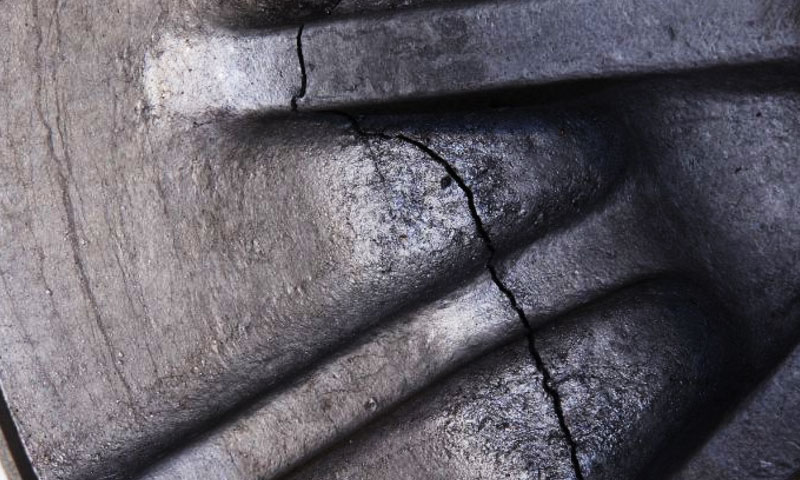
Internal and surface defects such as porosity, скупљање, инклузије, пукотина, and distortion reduce effective load-bearing area, create stress concentrators, and significantly degrade fatigue life, pressure tightness, тачност димензија, и отпорност на корозију.
У критичним апликацијама, these defects can lead to premature or catastrophic failure, safety risks, and regulatory or liability exposure.
Из перспективе производње, defects increase inspection complexity, scrap and rework rates, Цена производње, and delivery uncertainty, while also introducing large variability in mechanical properties that forces conservative design margins.
Сходно томе, effective control of casting defects is not merely a quality issue but a strategic requirement, demanding prevention-oriented process design, rigorous melt and mould control, simulation-driven engineering, and risk-based inspection and acceptance criteria.
3. Classification of Common Defects
Broadly, casting defects fall into two groups:
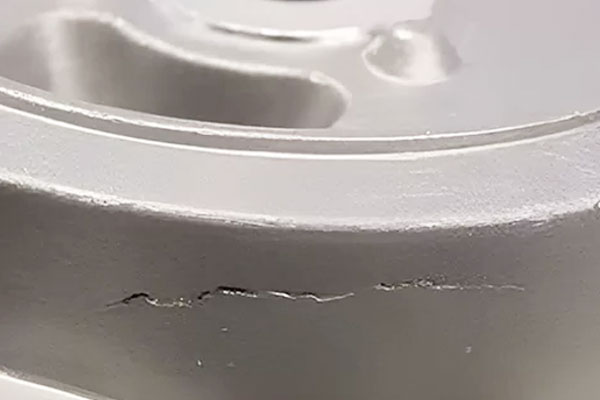
- Површина / visible defects — readily apparent on finished parts: fins/flash, хладноће, мисунс, shrinkage cavities visible at the surface, Индузије песка, surface porosity, топле сузе, overlap, and dimensional distortions.
- Унутрашњи / hidden defects — embedded within the part and often critical to strength: порозност гаса, internal shrinkage cavities, oxide and dross inclusions, slag entrapment, сегрегација, and internal cracks.
Both groups can reduce fatigue life, lower tensile strength, cause leak paths in pressure parts, or lead to outright rejection in safety-critical components.
4. Detailed Defect Descriptions
The table below summarizes the most common defects encountered in aluminum castings, their root causes, how they manifest, and practical countermeasures.
| Дефект | Узрок(с) | How it affects part | Detection methods | Превенција / remediation |
| Порозност гаса (младенци, microporosity) | Hydrogen dissolved in liquid Al; entrained air due to turbulent pouring; moisture in mould/cores | Internal voids reducing static and fatigue strength; leak paths | Радиографија (Кс-Раи / ЦТ), ултразвучни, sectioning | Дегастирање (ротациони, инертни гас), флуксирање, minimize turbulence, pre-dry cores/moulds, control melt temperature, ливење вакуума, improved gating |
| Shrinkage cavities / Порозност скупљања | Volumetric shrinkage on solidification with insufficient feeding; лоше постављање успона; wide freezing ranges in alloy | Large voids, often interdendritic; severe reduction in load capacity | Рендген, Цт, sectioning, visual if surface breaks | Усмерено учвршћивање, risers/chills, feeding systems, use of feeders and chills, alloy selection with narrower freezing range |
| Хладно затворено / cold lap | Low metal temperature or slow flow resulting in two streams not fusing | Surface discontinuity, stress concentrator, reduced local strength | Визуелна инспекција, dye-penetrant for surface cracks | Increase pouring temperature, Побољшајте дизајн карата, reduce abrupt changes in cross-section, increase metal velocity |
Вруће сузење (топло пуцање) |
Thermal contraction constrained during final solidification; high restraint; poor alloy or mould design | Cracks form during solidification — often at corners or thin sections | Визуелни, penetrant, sectioning | Reduce restraint, redesign geometry (избегавајте оштре углове), modify solidification path, use grain refiners, control pouring temperature |
| Oxide film entrainment / дрознути / инклузије | Surface oxides folded into liquid by turbulence; slag entrainment; лоше чишћење топљења | Internal inclusions acting as crack initiation sites; porosity adjacent to inclusions | Радиографија, металографија, sectioning | Skim dross, use ceramic filters, laminar filling, controlled pouring, флуксирање, proper furnace practice |
| Sand/slag inclusion | Poor mould integrity, degraded sand, insufficient core washing, slag carryover | Stress risers, Површинске недостатке, potential corrosion initiation | Визуелни, Рендген, sectioning | Improve sand quality and handling, better mould/core preparation, filtration of melt |
Misrun / Непотпуно попуњавање |
Low pouring temperature, blocked gating, overly long flow path | Missing features, weak sections, зарезати | Визуелни, CMM for geometry | Increase pouring temperature, optimize gating, increase sprue/runner size, reduce thin cross-sections |
| Храпавост површине / sand blow / gas scab | Gas evolution at mould surface (влагу, binder decomposition), poor venting | Poor surface finish, early crack initiation | Визуелна инспекција | Control mould moisture, improve venting, use proper binders and drying |
| Cold lap / laps / folds | Flow velocity too low causing metal to fold over | Surface crack, poor fatigue behaviour | Визуелни, penetrant | Increase metal temperature/velocity, change gating, reduce abrupt geometry changes |
Dimensional distortion (рата, зборник) |
Uneven cooling, non-uniform wall thickness, poor tooling | Out-of-tolerance parts, assembly issues | Цмм, 3D scanning | Уједначена дебљина зида, balanced cooling, proper fettling, design for casting tolerances |
| Сегрегација (chemical inhomogeneity) | Microsegregation during solidification, Широк распон смрзавања, споро хлађење | Local mechanical property variations, reduced corrosion resistance | Металографија, chemical spot tests | Optimized alloy choice, stirring (где је применљиво), Контролирано учвршћивање, homogenization heat treatment |
| Internal cracks (delayed cracking) | Водоник, преостали стрес, прекомерно старење, improper heat treatment | Catastrophic failure in service | Ултразвучни, dye-penetrant for surface, фракционара | Reduce hydrogen, ублажавање стреса, Контролирани топлотни третман, eliminate sharp transitions |
5. Advanced Detection Methods for Cast Aluminum Part Defects
Accurate and efficient defect detection is the core guarantee for qualified cast aluminum parts.
Targeting different defect types and locations, the industry adopts a combination of multiple detection technologies to achieve full-coverage quality control:
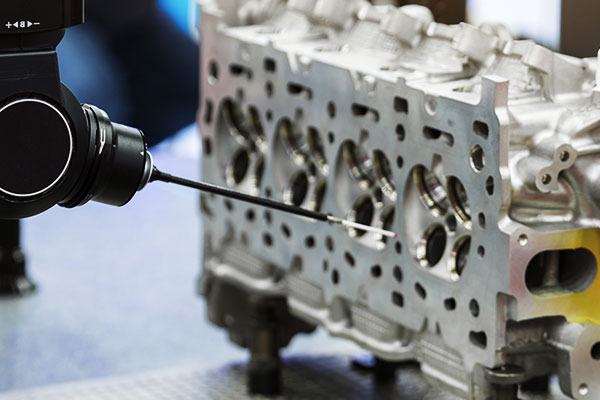
Визуелна инспекција
Applicable defects: Surface blowholes, surface shrinkage cavity/porosity, surface slag inclusion, Укључивање песка, obvious cracks, cold shut, misrun, surface flash/burrs, excess material, material loss.
Technical characteristics: Conducted by experienced quality inspectors with magnifying glasses (5–10× magnification) for detailed observation; једноставан, low-cost and efficient, serving as the first-line quality screening method.
Detection standard: Complies with ASTM E186, with surface defect size tolerance controlled within 0.05 mm for precision castings.
Рендгенски преглед
Applicable defects: Internal blowholes, internal shrinkage cavity/porosity, internal slag inclusion and hidden internal cracks.
Technical characteristics: Uses X-ray penetration to form images of internal structures; defects appear as dark (празнине) or bright (инклузије) spots in the image.
Core advantages: Неразорно тестирање (НДТ), high detection accuracy (defect size ≥0.02 mm can be identified), clear visualization of internal defect distribution and shape.
Compliance standard: Meets ASTM E94, mandatory for critical components in aerospace and automotive industries.
Флуоресцентно инспекција пенетранта (Фпи)
Applicable defects: Subsurface and surface micro-cracks, cold shut and tiny porosity that are invisible to the naked eye.
Technical characteristics: Penetrant with high fluorescence is applied to the casting surface; penetrant seeps into defect gaps, and excess penetrant is cleaned; ultraviolet light irradiation makes defects emit bright fluorescence.
Core advantages: High sensitivity, capable of detecting micro-cracks with width <0.01 mm and depth <0.05 мм; suitable for complex-shaped castings.
Compliance standard: Conforms to ASTM E1417, essential for detecting stress-sensitive cracks in high-strength aluminum alloy castings.
Endoscope Inspection
Applicable defects: Internal cavity flash, internal surface slag inclusion and dimensional deviation of complex internal cavities.
Technical characteristics: Flexible or rigid endoscopes with high-definition cameras are inserted into the casting’s internal cavity to capture real-time images of the inner surface.
Core advantages: Неразорнички, can detect complex internal structures that are inaccessible to other methods; supports precise positioning of internal defects.
Application scenario: Mandatory for cast aluminum parts with complex inner cavities (Нпр., engine cylinder heads, hydraulic valve bodies).
3D Scanning Technology
Applicable defects: Core shift, mismatch, casting deformation and dimensional deviation beyond design tolerance.
Technical characteristics: Uses laser or structured light 3D scanners to collect full-surface point cloud data of castings; compares with 3D design models to analyze dimensional deviations with high precision.
Core advantages: High measurement accuracy (± 0,005 мм), full-dimensional detection, digitized data output; can quantify deformation degree and position of castings.
Compliance standard: Meets ISO 10360, critical for precision cast aluminum parts requiring tight dimensional tolerances (± 0,01-0,05 мм).
6. Key Prevention Measures for Common Defects in Cast Aluminum Parts
Испод је компакт, engineering-oriented set of preventive measures keyed to the dominant defect mechanisms in aluminum casting.
Квалитет топљења & metal treatment
- Дегастирање: use rotary or vacuum degassing and monitor effectiveness (density-index or equivalent). Target consistently low dissolved-gas levels before pouring.
- Флуксање & скимминг: remove dross and oxidized surface films routinely; use appropriate flux chemistry and skimming practice to minimize non-metallic inclusions.
- Филтрација: install ceramic/foam filters in the gating system (appropriate pore rating for alloy and flow) to trap dross and inclusions.
- Temperature control & superheat: maintain repeatable melt and pouring temperatures with narrow control limits (appropriate superheat above liquidus for the alloy) so fill and fusion are reliable without excessive gas pickup.
- Alloy chemistry control: hold composition to specification limits to avoid wide freezing ranges and undesirable solidification behaviour; perform frequent sample analysis and retain heat traceability.
Камен, riser & mould filling design
- Laminar filling: design gates and runners to promote smooth, ламинарни проток (bottom or well-designed ingates, tapered runners) to avoid oxide folding and air entrapment.
- Controlled fill velocity: avoid turbulent splash that entrains air; use flow modelling to set runner dimensions and pour rates.
- Усмерено учвршћивање: place risers/feeders and chills to establish a predictable solidification front and prevent internal shrinkage.
- Adequate risering: size and locate feeders to ensure sufficient metal head and feeding during the final solidification stage; consider insulated risers or exothermic sleeves where beneficial.
Moulds, cores and pattern practice
- Dry, well-cured cores/moulds: maintain low moisture and proper binder cure to prevent gas evolution (sand blow) and scabbing.
- Одзрачивање & пропустљивост: provide vents and vent channels at high-gas zones, and control sand permeability to suit the alloy and casting section thickness.
- Clean mould surfaces & превлаке: use appropriate washes/coatings to control metal-mould reactions and improve surface finish; verify compatibility of coatings with billet temperature and pouring practice.
- Tool maintenance: replace worn patterns or dies to prevent excessive flash/parting-line defects.
Filling & pouring practice
- Bottom-or controlled-bottom filling: где је применљиво, use bottom or submerged gating to reduce surface oxide entrainment.
- Minimize turbulence at pour points: use tapered gate entries, well-designed pouring cups and steady pour techniques.
- Avoid re-melting of dross: do not pour from the surface skim into the mold; position ladles and tapping to draw from clean metal.
- Consistent operator procedures: enforce standard operating procedures (Сопс) for furnace, ladle, and pour that include checklist verification (degassing completed, filter installed, pour temp logged).
Контрола за солидби & топлотно управљање
- Chills and thermal controls: apply chills to promote directional solidification; place them based on simulation output.
- Reduce section thickness variations: design components with uniform wall thickness and generous fillets to avoid hot spots and stress concentrations.
- Control cooling rates: where feasible, use controlled cooling fixtures or molds to reduce thermal gradients and residual stress that lead to hot tearing and distortion.
Alloy-specific and metallurgical measures
- Учињење зрна / инокулација: use appropriate grain refiners or modifiers (Нпр., Sr for Al-Si systems) to improve feeding and reduce hot-tearing susceptibility.
- Hydrogen control: use degassing and dry crucibles/liners to minimize hydrogen sources; control moisture in fluxes, coatings and cores.
- Хомогенизација / растворљив: for castings that permit heat treatment, apply homogenization or solution anneal cycles to reduce segregation and dissolve detrimental phases.
Process simulation, design for castability & DFCAST
- Mold-fill and solidification simulation: run CFD/solidification models early in design to identify risky zones (cold spots, turbulence regions, shrinkage hot spots) and iterate gating, feeder and chill layouts.
- Design for castability (DFCAST): incorporate uniform section thickness, generous radii, avoidance of abrupt section changes, and castable features (drafts, accessible machining allowance) at the design stage.
Foundry practice, инспекција & in-process controls
- Process parameters logging: record melt chemistry, degassing metrics, Температура изливања, filter/flux usage and mold drying status for every heat/shift.
- Layered NDT strategy: define inspection tiers based on part criticality — visual → dye-penetrant for surface cracks → radiography/CT or phased-array UT for internal volumetric defects.
- Acceptance criteria tied to function: specify allowable porosity size, location and volume fraction relative to service loads (not just “pass/fail” surface counts).
- On-line monitoring: где је то могуће, use inline hydrogen monitoring, melt cleanliness indices and pour temperature alarms to stop non-conforming pours.
Post-cast remediation & verification
- Вруће-изостатичко пресовање (Кук): specify HIP for high-value or fatigue-critical castings to close internal porosity when permitted.
- Qualified repair procedures: weld or braze repairs only with controlled procedures and subsequent NDT and mechanical verification.
- Final machining & Функционално тестирање: remove surface defects by machining where acceptable; apply pressure/leak testing for pressure parts.
7. Закључак
Aluminum casting defects arise from metallurgical, thermal and process interactions.
Proactive control—starting with clean melt practice, careful gating and riser design, drying and venting of moulds/cores, and well-defined NDT strategies—substantially reduces defect incidence.
For mission-critical parts, invest in advanced inspection (Цт, phased-array UT), process simulation and, when warranted, post-casting HIP to assure structural integrity and long service life.
Често постављана питања
What is the single most common root cause of internal porosity in aluminum castings?
Hydrogen absorption and entrapment during solidification, exacerbated by turbulent fill and inadequate degassing, is the most common cause of internal gas porosity.
Can all porosity be removed by heat treatment?
Не. Conventional heat treatment does not eliminate gas or shrinkage porosity. Вруће изостатско прешање (Кук) can close internal porosity for high-value parts.
Which NDT is best for detecting small internal pores?
Цт (computed tomography) provides the best 3-D sensitivity and sizing accuracy; radiography and phased-array UT are also effective and more economical depending on defect size and accessibility.
How should I specify acceptance criteria for porosity?
Acceptance should be application-driven: specify maximum allowable defect size, volume fraction, or critical location limits (Нпр., no through-wall porosity in sealing surfaces), and mandate the inspection method used to verify.
Is aluminum casting always more defect-prone than steel casting?
Not inherently — each metal has its own dominant defect mechanisms.
Aluminum’s sensitivity to hydrogen, oxide films and its wide freezing range require specific controls; with proper process discipline, defect rates can be as low as other alloys.
Референце: Aluminum and Aluminum Alloys Subject Guide Overview