1. Ievads
Material selection is rarely about “the best metal” in the abstract.
It is about the best compromise among corrosion resistance, mehāniskā izturība, temperature capability, metināmība, fabrication complexity, pieejamība, and life-cycle cost.
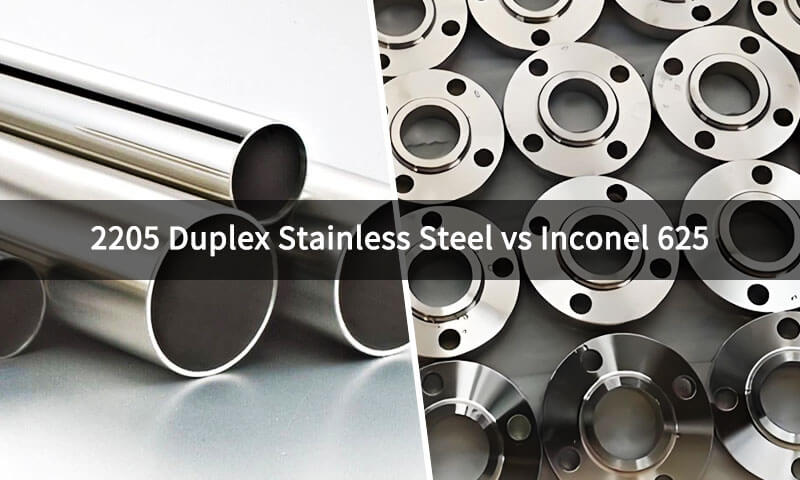
In that respect, 2205 Dupleksa nerūsējošā tērauda un Neiebilstība 625 are two of the most frequently discussed high-performance alloys in engineering practice, yet they belong to fundamentally different metallurgical families and are optimized for different service envelopes.
2205 duplex stainless steel is a cost-efficient, high-strength stainless steel designed to bridge the gap between conventional austenitic stainless steels and more exotic corrosion-resistant alloys.
Neiebilstība 625, turpretī, is a nickel-base alloy engineered for extreme corrosion resistance, outstanding stability, and reliable performance in aggressive or elevated-temperature environments.
2. Kas ir 2205 Dupleksa nerūsējošā tērauda?
2205 Dupleksa nerūsējošā tērauda (ASV S32205, Iekšā 1.4462) is one of the most widely used members of the duplex stainless steel family and is often regarded as the benchmark grade for balanced performance in corrosive industrial environments.
The term “duplex” refers to its dual-phase microstructure, which contains approximately equal amounts of Austenīts un ferīts.
This microstructural balance is not a minor metallurgical detail; it is the foundation of the alloy’s behavior.
In conventional austenitic stainless steels, corrosion resistance is often paired with moderate strength.
In ferritic stainless steels, strength and resistance to stress corrosion cracking may improve, but toughness and formability can become limiting factors. 2205 duplex stainless steel bridges these two worlds.
It combines the favorable corrosion resistance of austenitic stainless steels with the higher strength and better chloride stress corrosion cracking resistance of ferritic grades.
Rezultātā, it occupies a highly practical position in modern engineering: not the cheapest steel, not the most exotic alloy, but often one of the most rational choices.
The “2205” designation is generally associated with a composition containing about 22% hroms un 5% niķelis, kopā ar molibdēns, slāpeklis, and a controlled balance of other elements.
Chromium contributes to passivation and general corrosion resistance; molybdenum improves resistance to pitting and crevice corrosion; nitrogen strengthens the alloy and enhances localized corrosion resistance; nickel stabilizes the austenitic phase and supports toughness.
The result is an alloy that delivers unusually strong overall performance for its cost.
Metallurgical Structure and Why It Matters
The most important feature of 2205 ir tā two-phase structure. Ferrite contributes strength and resistance to chloride-induced stress corrosion cracking.
Austenite contributes toughness and helps preserve ductility and overall structural integrity.
When these phases are properly balanced, the alloy achieves a combination of properties that is difficult to replicate with single-phase stainless steels.
This balance, lai arī, is not accidental. It must be carefully controlled during production, izgatavošana, un metināšana.
If the phase balance is disturbed by improper heat input or unsuitable processing conditions, the alloy’s performance can deteriorate.
That is why 2205 is often described as a material that is highly capable, but also highly dependent on disciplined engineering practice.
Galvenās funkcijas
High strength with efficient weight usage
2205 offers significantly higher yield strength than standard austenitic stainless steels such as 304 un 316.
In structural design, this matters because higher yield strength allows the use of thinner sections without compromising safety.
The result may be lower weight, reduced material consumption, and improved load-bearing efficiency.
Excellent resistance to chloride stress corrosion cracking
One of the primary reasons engineers specify 2205 is its strong resistance to stress corrosion cracking in chloride environments.
This makes it particularly valuable in marine, jūrā, atsāšana, and chemical-processing service, where chloride attack is often a dominant failure mechanism.
Good resistance to pitting and crevice corrosion
Thanks to its chromium, molibdēns, un slāpekļa saturs, 2205 performs well in environments where localized corrosion is a concern.
While it is not invulnerable, it is much more robust than standard stainless steels in seawater, sālījums, and many process fluids.
Strong fatigue resistance
Because of its high yield strength and duplex microstructure, 2205 exhibits very good fatigue performance.
This is useful in applications that involve cyclic pressure, vibrācija, or repeated mechanical loading.
Moderate-temperature capability
2205 performs well at ambient and moderately elevated temperatures, but it is not intended for long-term high-temperature service.
Prolonged exposure to excessive heat can cause phase instability and the formation of brittle intermetallic phases, which may reduce toughness and corrosion resistance.
Cost-performance advantage
Compared with nickel-base alloys, 2205 is materially more economical.
Its lower nickel content helps keep cost relatively controlled while still delivering performance that is superior to many conventional stainless steels. In many projects, this economic balance is the decisive factor.
Mechanical Behavior
From a mechanical standpoint, 2205 is often described as a “high-strength stainless steel,” and that label is deserved.
Its yield strength is notably higher than that of standard austenitic grades. This means that under load, it resists permanent deformation more effectively.
That advantage has practical consequences. In pressure vessels, cauruļvadi, un strukturālās sastāvdaļas, a stronger alloy may allow engineers to reduce wall thickness.
That can lower total mass, improve transport and installation efficiency, and sometimes even offset a portion of the material cost.
Tajā pašā laikā, 2205 still retains useful ductility and toughness. It is not as easy to form as soft austenitic grades, but it remains workable with appropriate fabrication methods.
Fabrication and Welding Considerations
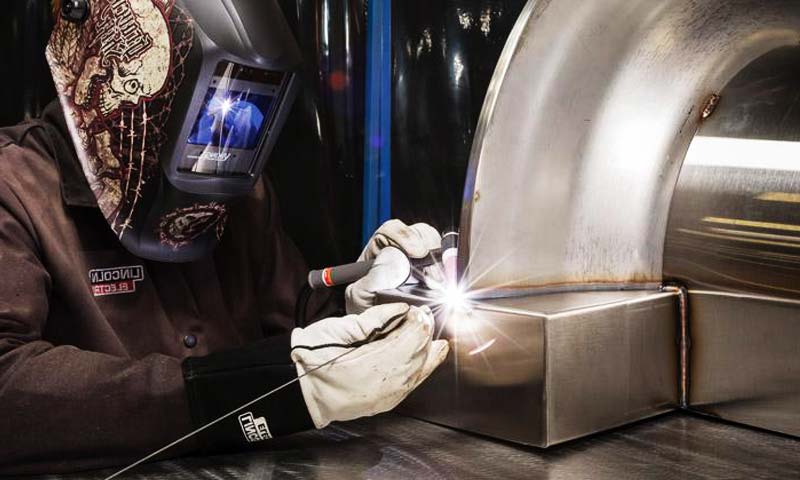
2205 is weldable, but it demands more control than ordinary stainless steels.
Siltuma ievade, interpass temperature, filler selection, and cooling rate all influence the final phase balance and therefore the final properties of the welded joint.
If the weld procedure is poorly controlled, the alloy can lose part of its corrosion resistance or toughness.
This does not make 2205 difficult in an absolute sense; rather, it means the alloy rewards good practice and punishes careless processing.
Fabricators who understand duplex stainless steels can use 2205 successfully and consistently. Those who treat it like a standard stainless steel may encounter avoidable problems.
Tipiski pielietojumi 2205 Dupleksa nerūsējošā tērauda
- Offshore platforms and marine structures
- Jūras ūdens cauruļvadu sistēmas
- Desalination equipment
- Pressure vessels and storage tanks
- Ķīmiskā apstrādes iekārta
- Siltummaiņi
- Pulp and paper machinery
- Vārsti, sūkņi, un armatūra
- Structural components in corrosive industrial environments
Engineering Value
The importance of 2205 lies in its balance. It is not simply a corrosion-resistant metal, and it is not merely a high-strength structural alloy.
It is a carefully engineered compromise that performs very well in a wide range of real-world conditions. Daudzos gadījumos, that balance is more valuable than extreme performance in a single category.
3. Kas ir Inconel 625?
Neiebilstība 625 (ASV N06625, Iekšā 2.4856) ir a nickel-based corrosion-resistant alloy designed for service in environments where conventional stainless steels may no longer provide adequate durability.
It is widely recognized for combining augsta izturība pret koroziju, excellent mechanical integrity, strong weldability, and broad temperature capability in a single material system.
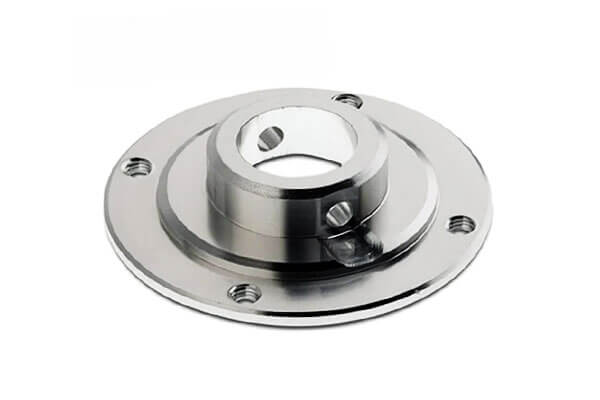
Unlike duplex stainless steels, which depend on a balanced ferrite-austenite microstructure, Neiebilstība 625 is built on a nickel matrix strengthened primarily by molybdenum and niobium.
This metallurgical architecture gives it a remarkable degree of stability under aggressive chemical exposure, termiskā riteņbraukšana, and mechanical loading.
It is not merely a “strong stainless steel”; it is a distinctly different class of alloy, developed for more severe operating conditions.
In practical engineering terms, Neiebilstība 625 is often selected when reliability matters more than first cost.
It is especially valuable in applications where corrosion, temperatūra, fabrication complexity, and long service life must all be managed at once.
Metalurģijas pamats
The performance of Inconel 625 is rooted in its chemistry. Nickel forms the base, while chromium supports oxidation resistance and general corrosion resistance.
Molybdenum improves resistance to pitting and crevice corrosion, and niobium contributes to solid-solution strengthening and stabilizes the alloy’s mechanical response.
This chemistry produces an alloy that does not rely on precipitation hardening for its core strength. Tā vietā, it achieves its performance through a stable solid-solution structure.
That gives Inconel 625 an important advantage: it retains its properties reliably after welding, izgatavošana, and long-term exposure, without depending on highly sensitive heat-treatment conditions.
Galvenās funkcijas
Izcila izturība pret koroziju
Neiebilstība 625 is widely respected for its ability to resist aggressive corrosive media.
It performs well in environments where pitting, plaisas korozija, and chloride-related attack are serious concerns.
It is also highly resistant to chloride stress corrosion cracking, which makes it especially useful in marine and seawater-related service.
Lieliska stabilitāte augstā temperatūrā
One of the alloy’s defining strengths is its wide usable temperature range. It can perform in cryogenic conditions and also retain structural integrity at elevated temperatures.
This makes it suitable for systems that undergo frequent thermal cycling or sustained heat exposure.
Strong weldability
Neiebilstība 625 is known for its excellent weldability. It can be joined with a relatively low risk of cracking, and it performs well in complex welded assemblies.
This is one of the reasons it is frequently used in fabricated equipment, repair applications, overlays, and dissimilar-metal joints.
Good fatigue and rupture resistance
The alloy maintains strong mechanical behavior under repeated loading and thermal stress.
That makes it a dependable choice in components exposed to vibration, spiediena svārstības, or prolonged service under load.
Broad environmental tolerance
Neiebilstība 625 can handle a wide variety of chemical and physical conditions.
It is not limited to one narrow niche, which is why it is used in industries ranging from offshore engineering to chemical processing and aerospace support systems.
High life-cycle value in severe service
Although the initial cost is higher than that of stainless steels, Neiebilstība 625 often delivers strong life-cycle value when maintenance, downtime, replacement risk, and corrosion-related failure consequences are taken into account.
Mechanical and Physical Character
Neiebilstība 625 is dense, stiprs, un dimensionāli stabils. Its mechanical advantage is not just room-temperature strength, but the fact that it retains useful properties across a broad service envelope.
Many materials look acceptable in the laboratory but become unreliable when exposed to heat, hlorīdi, or cyclic stress. Neiebilstība 625 was developed to resist exactly that type of degradation.
Its thermal conductivity is lower than that of typical stainless steels, which can be an advantage in some high-temperature or corrosion-critical systems, though it may require more careful thermal management during fabrication.
Its elastic modulus is in the range expected of high-performance engineering alloys, which contributes to predictable structural behavior.
Fabrication and Welding Behavior
From a fabrication standpoint, Neiebilstība 625 is generally considered more forgiving than many high-performance alloys.
Its strong weldability makes it particularly useful for fabricated equipment and complex assemblies.
It can be welded without demanding the kind of tight phase-control constraints associated with duplex stainless steels.
Tas teica, working with Inconel 625 still requires skill. Its strength and work-hardening behavior can make forming more demanding than working with soft austenitic stainless steels.
Tool wear, Pavasaris, and process control all deserve attention. Even so, the alloy’s joining behavior is one of its major practical advantages.
Typical Applications of Inconel 625
- offshore and subsea equipment
- seawater and marine systems
- chemical processing units
- heat exchangers exposed to aggressive media
- pollution control and flue-gas systems
- nuclear and power-generation components
- aerospace-related exhaust and structural parts
- welded overlays, plēšas, stiprinājumi, un avoti
4. Visaptverošs salīdzinājums: 2205 Duplex Stainless Steel vs Inconel 625
| Comparison item | 2205 Dupleksa nerūsējošā tērauda | Neiebilstība 625 |
| Sakausējuma ģimene / mikrostruktūra | Nitrogen-enhanced duplex stainless steel with a nearly equal austenite–ferrite balance. | Nickel-chromium alloy whose strength comes from molybdenum and niobium in a nickel-chromium matrix. |
| Limiting composition (key elements) | Ni 4.5–6.5%, Cr 22.0–23.0%, Mo 3.0–3.5%, N 0.14–0.20%, Fe līdzsvars. | Iekšā 58.0% minimāls, Cr 20.0–23.0%, Mo 8.0–10.0%, Nb+Ta 3.15–4.15%, Fe 5.0% maksimums. |
| Blīvums | 0.278 lb/in³, pret 7.70 G/cm³. | 0.305 lb/in³, 8.44 G/cm³. |
| Elastības modulis | 27.6×10⁶ psi at 70°F, pret 190 GPA. | 207.5 GPa at 70°F. |
| Siltumvadītspēja | 8.1 Btu·ft/(ft²·hr·°F) at 70°F, pret 14.0 Ar m/m · k. | 9.8 W/m·°C at 21°C. |
Room-temperature strength |
Minimum specified tensile strength 95 ksi (655 MPA), peļņas izturība 65 ksi (448 MPA), pagarināšana 25%. | Solution-treated rod/bar/plate: tensile strength 105–130 ksi (724–896 MPa), yield strength 42–60 ksi (290–414 MPa), elongation 40–65%. |
| Izturība pret koroziju | PREN about 35.8; critical pitting temperature about 130°F in 5.8% NaCl; strong resistance to chloride stress corrosion cracking and better pitting/crevice resistance than 316/317. | Lieliska izturība pret bedres, plaisas korozija, and chloride-ion stress-corrosion cracking; strong seawater performance and resistance to severe corrosive environments. |
| Temperature capability | ASME code use up to 600°F (316° C); embrittlement risk around 650–1000°F (343–538°C), with another harmful range from about 1200–1830°F (649–1000 ° C). | Service temperature range from cryogenic to 1800°F (982° C). |
Welding and fabrication |
Weldable, but phase balance must be controlled; E2209 or ER2209 fillers are used, and a fully ferritic weld should be avoided. | Excellent fabricability, including joining; readily joined by conventional welding processes, with strong dissimilar-metal joining capability. |
| Tipiskas lietojumprogrammas | Ķīmiskā procesa trauki, cauruļvadi, siltummaiņi, FGD skrubji, pulp mill equipment, food process equipment, and oil-field piping. | Seawater systems, marine and offshore components, ķīmiskā apstrāde, nuclear-related hardware, aerospace-adjacent parts, and welded overlays or critical joinings. |
| Best-fit selection logic | Best when the design needs strong chloride resistance, high yield strength, and controlled cost. | Best when the environment is more severe, the temperature is higher, or the welding margin must be exceptionally robust. |
5. Secinājums
2205 duplex stainless steel and Inconel 625 are both high-performance corrosion-resistant materials, but they address different engineering problems.
2205 is a highly efficient duplex stainless steel that offers excellent strength, very good chloride resistance, and strong value for money.
It is often the best answer for marine, ķīmisks, and process applications where conditions are severe but not extreme.
Neiebilstība 625 is a nickel-base alloy built for harsher territory. Tas piedāvā labāku pretestību korozijai, better high-temperature stability, and exceptional reliability in demanding environments, but at a significantly higher material cost.
FAQ
Ir Inconel 625 labāk nekā 2205 Dupleksa nerūsējošā tērauda?
Not universally. Neiebilstība 625 is better in more severe corrosive or high-temperature environments, bet 2205 is often the better practical choice when cost, izturība, and chloride resistance must be balanced efficiently.
Which one has better corrosion resistance?
Neiebilstība 625 generally has the broader and stronger corrosion-resistance envelope, especially in severe pitting, plaisa, un augstas temperatūras apstākļi.
Tomēr, 2205 also performs extremely well in many chloride-rich environments.
Kas ir stiprāks, 2205 duplex stainless steel vs Inconel 625?
2205 usually has very high yield strength for a stainless steel, kamēr Inconel 625 has strong overall mechanical performance and better retention of properties under heat.
The answer depends on the exact comparison basis and service condition.
Which one is better for seawater service?
Both can be used in seawater-related applications, bet 2205 is often chosen for cost-effective seawater exposure,
kamēr Inconel 625 is preferred when the seawater environment is more severe or the design margin must be higher.
Bēgt 2205 duplex stainless steel replace Inconel 625?
Only in some cases. If the service temperature is moderate and the corrosion severity is within duplex limits, 2205 may be a viable substitute. In highly aggressive or hot environments, it is usually not a safe replacement.
Kāpēc ir Inconel 625 so expensive?
Its high nickel content, molibdēns, and niobium addition significantly increase raw-material cost, and it is positioned as a premium alloy for demanding service.