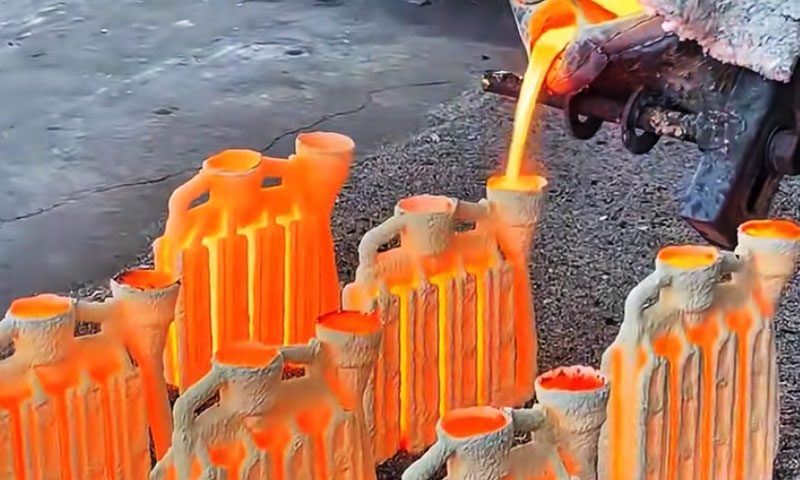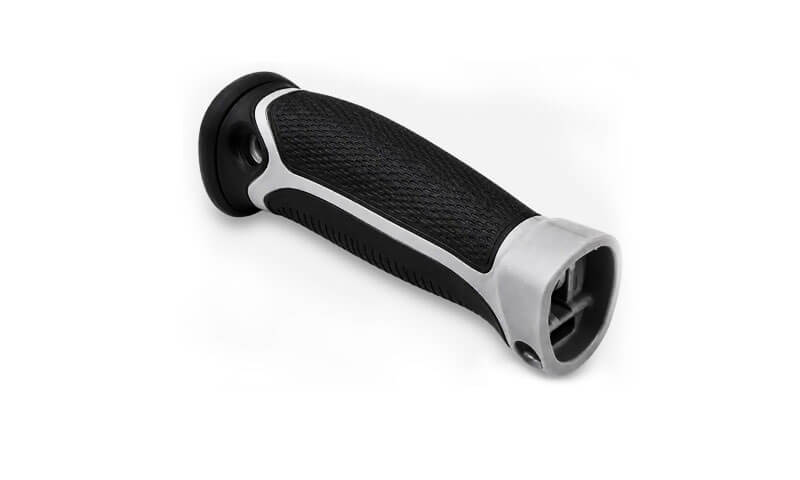
Overmolding adalah tingkat lanjut cetakan injeksi teknik yang digunakan untuk menggabungkan dua atau lebih bahan menjadi satu komponen fungsional.
Daripada membuat setiap komponen secara terpisah dan merakitnya setelahnya, overmolding memungkinkan material sekunder dicetak langsung di atas substrat yang telah dibentuk sebelumnya.
Hasilnya dapat menggabungkan sifat struktural material kaku dengan fleksibilitas, pegangan, penyegelan, isolasi, Dampak resistensi, atau karakteristik estetika dari elastomer atau polimer lainnya.
Proses ini banyak digunakan dalam produk dimana integrasi material, kinerja ergonomis, perlindungan lingkungan, dan pengurangan perakitan itu penting.
Contoh umum mencakup gagang perkakas listrik, saklar otomotif, Konektor Listrik, rumah perangkat medis, Elektronik Konsumen, komponen kabel, genggaman, segel, dan kontrol industri.
1. Apa Itu Cetakan Berlebihan?
Overmolding adalah proses manufaktur di mana material kedua dicetak dengan injeksi di sekitar atau ke material yang sudah ada substrat, menyisipkan, atau komponen yang dibentuk sebelumnya untuk membuat bagian multi-material yang terintegrasi.
Substrat menyediakan struktur dasar komponen, sedangkan material yang dicetak berlebihan menambah karakteristik fungsional atau estetika tertentu.
Tergantung pada aplikasinya, substratnya mungkin termoplastik kaku, sisipan logam, atau komponen lain yang telah dibentuk sebelumnya.
Cetakan berlebih mungkin merupakan elastomer termoplastik yang lebih lembut (TPE), poliuretan termoplastik (TPU), karet termoplastik, atau polimer lain yang kompatibel.
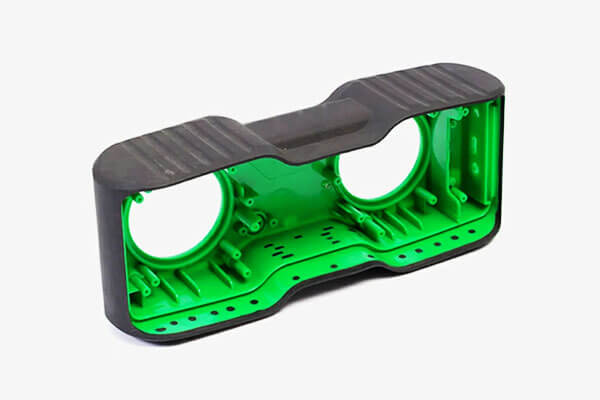
Representasi sederhana dari struktur tersebut adalah:
Substrat → Bahan Overmolding → Bagian Selesai Terintegrasi
Misalnya, pertimbangkan perkakas listrik genggam. Perumahan internal dapat dibentuk dari plastik rekayasa kaku seperti ABS atau nilon yang diperkuat untuk memberikan kekuatan struktural.
Lapisan TPE atau TPU yang lebih lembut kemudian dapat dicetak pada area tertentu pada housing untuk memberikan pegangan anti selip dan meningkatkan penyerapan getaran..
Daripada membuat pegangan karet terpisah dan memasangnya saat perakitan, overmolding mengintegrasikan cengkeraman langsung ke dalam housing.
Struktur Dasar Komponen Overmolded
Produk cetakan berlebih umumnya terdiri dari dua zona material fungsional:
| Komponen | Fungsi utama |
| Substrat | Memberikan dukungan struktural, stabilitas dimensi, atau lampiran mekanis |
| cetakan berlebih | Menambahkan pegangan, penyegelan, Bantalan, isolasi, perlindungan, atau estetika |
| Antarmuka Ikatan | Mentransfer beban dan mempertahankan keterikatan material |
Karakteristik Utama: Integrasi Multi-Material
Ciri khas dari overmolding adalah integrasi langsung bahan yang berbeda ke dalam satu komponen jadi.
Hal ini membedakan overmolding dari perakitan konvensional. Dalam proses perakitan tradisional, masing-masing komponen diproduksi secara terpisah dan kemudian disambung menggunakan pengencang, perekat, klip, tekan cocok, pengelasan, atau metode lain.
Overmolding memindahkan sebagian dari integrasi itu ke dalam proses pencetakan itu sendiri.
Hal ini dapat menghasilkan beberapa keuntungan manufaktur:
- Lebih sedikit komponen individual
- Mengurangi operasi perakitan
- Integrasi komponen yang ditingkatkan
- Penempatan material sekunder yang konsisten
- Penyegelan yang lebih baik dan perlindungan lingkungan
- Peningkatan ergonomi dan kinerja sentuhan
- Kebebasan desain yang lebih besar
- Potensi pengurangan cacat terkait perakitan
Namun, antarmuka antara media dan cetakan berlebih menjadi fitur teknik yang penting.
Kedua bahan tersebut harus tetap terpasang dengan aman dalam kondisi pengoperasian produk yang sebenarnya.
Perputaran suhu, kelembaban, bahan kimia, pembebanan mekanis, dampak, dan pelenturan berulang-ulang semuanya dapat memengaruhi kinerja antarmuka.
2. Jenis Cetakan Berlebihan
Overmolding bukanlah konfigurasi manufaktur standar tunggal.
Overmolding Plastik-ke-Plastik
Overmolding plastik-ke-plastik melibatkan pencetakan satu termoplastik langsung di atas substrat plastik yang telah dicetak sebelumnya.
Ini biasanya digunakan ketika dua polimer memberikan karakteristik kinerja yang saling melengkapi.
Misalnya, plastik rekayasa yang kaku dapat memberikan kerangka struktural sementara elastomer termoplastik yang lebih lembut membentuk pegangan, segel, tombol, atau lapisan pelindung.
Atau, dua polimer kaku dapat digabungkan untuk menciptakan zona fungsional berbeda dalam komponen yang sama.
Tantangan teknik utama adalah mencapai adhesi atau retensi mekanis yang memadai antara kedua polimer sekaligus mencegah deformasi substrat selama siklus pencetakan kedua..
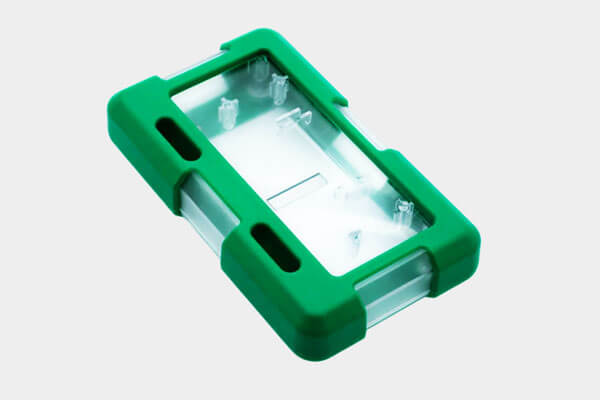
Kombinasi yang umum meliputi:
- ABS + TPE
- komputer + TPE
- PC/ABS + TPE
- Nilon + TPE
- hal + TPE atau TPV
- PBT + TPE
- ABS + TPU
Tidak semua kombinasi kompatibel secara inheren. Nilai yang tepat, perumusan, kondisi permukaan, suhu pemrosesan, dan kondisi pencetakan harus dievaluasi.
Overmolding Plastik-ke-Elastomer
Overmolding plastik-ke-elastomer adalah salah satu bentuk overmolding yang paling dikenal luas.
Bahan yang fleksibel seperti TPE, TPU, TONG, atau elastomer termoplastik lainnya dicetak di atas substrat plastik kaku.
Tujuannya biasanya bersifat fungsional dan bukan murni estetika. Elastomer dapat menyediakan:
- Peningkatan cengkeraman dan ergonomis
- Penyerapan guncangan dan benturan
- Redaman getaran
- Penyegelan
- Permukaan dengan sentuhan lembut
- Resistensi slip
- Isolasi listrik
- Perlindungan terhadap pencemaran lingkungan
Gagang perkakas listrik merupakan contoh tipikal. Substrat yang kaku memberikan dukungan struktural, sedangkan cetakan elastomer memberikan antarmuka yang nyaman dan tahan lama antara alat dan operator.
Ketebalan lapisan elastomer harus dikontrol dengan hati-hati. Ketebalan yang berlebihan dapat meningkatkan waktu siklus, penyusutan, dan konsumsi bahan, sementara lapisan yang tidak mencukupi mungkin tidak memberikan bantalan atau cengkeraman yang diperlukan.
Overmolding Logam-ke-Plastik
Overmolding logam-ke-plastik menempatkan polimer langsung di sekitar sisipan atau komponen logam.
Logam memberikan kekuatan, daya konduksi, Pakai ketahanan, kinerja termal, atau stabilitas dimensi, sedangkan polimer memberikan isolasi, perlindungan, penyegelan, atau integrasi struktural.
Overmolding logam-ke-plastik sangat berguna untuk terminal listrik, konektor, sensor, sisipan berulir, menangani, komponen kontrol, dan majelis industri.
Pertimbangan penting adalah perbedaannya koefisien ekspansi termal (CTE) antara logam dan polimer.
Selama perubahan suhu, kedua bahan tersebut memuai dan berkontraksi dengan laju yang berbeda.
Jika desain antarmuka tidak mengakomodasi pergerakan ini, tegangan sisa dapat menyebabkan keretakan, delaminasi, atau ketidakstabilan dimensi.
Masukkan Overmolding
Insert overmolding menggunakan insert yang telah dibentuk sebelumnya yang ditempatkan di dalam cetakan injeksi sebelum bahan overmolding disuntikkan.
Sisipannya bisa dari logam, plastik, keramik, elektronik, atau komponen manufaktur lainnya, Tergantung pada aplikasinya.
Insert overmolding dapat menghilangkan operasi perakitan terpisah karena proses pencetakan secara permanen mengintegrasikan insert ke dalam komponen jadi.
Sisipan harus diposisikan secara akurat dan ditopang dengan aman. Pemasangan yang buruk dapat menyebabkan insert bergerak selama injeksi, mengakibatkan kesalahan dimensi, cakupan material yang tidak merata, kilatan, atau kerusakan pada cetakan.
Overmolding Dua Tembakan
Overmolding dua tembakan, juga disebut 2Cetakan K atau cetakan injeksi dua komponen, menghasilkan komponen multi-bahan melalui operasi injeksi berurutan, umumnya dalam sistem pencetakan yang sama.
Dalam proses yang khas, bahan pertama membentuk substrat atau geometri komponen pertama.
Konfigurasi cetakan atau posisi bagian kemudian diubah sehingga bahan kedua dapat disuntikkan pada wilayah yang ditentukan.
Berbeda dengan overmolding konvensional yang menggunakan substrat yang diproduksi secara terpisah, pencetakan dua-shot dapat mengintegrasikan dua operasi pencetakan ke dalam siklus produksi yang sangat otomatis.
3. Bagaimana Cara Kerja Proses Overmolding?
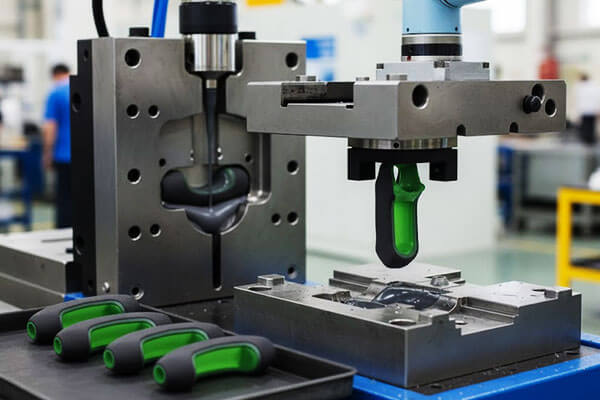
Proses overmolding melibatkan pencetakan material kedua langsung ke substrat atau sisipan yang telah dibentuk sebelumnya untuk membuat komponen terpadu.
Meskipun proses pastinya bervariasi tergantung pada kombinasi bahan, geometri produk, dan metode produksi, alur kerja inti tetap konsisten:
Desain Produk → Pemilihan Bahan → Pembuatan Substrat → Persiapan Cetakan → Pemuatan Substrat → Injeksi Overmolding → Pendinginan & Ejeksi → Inspeksi
Desain Produk dan Analisis DFM
Overmolding dimulai dengan produk dan Desain untuk Manufaktur (Dfm) analisa.
Insinyur mengevaluasi geometri substrat, ketebalan cetakan berlebih, draft sudut, garis perpisahan, lokasi gerbang, ventilasi, undercuts, dan dimensi kritis.
Substrat harus cukup kaku untuk menahan tekanan injeksi dan paparan panas selama operasi pencetakan kedua.
Fitur retensi mekanis seperti tulang rusuk, alur, lubang, atau undercut juga dapat dimasukkan ketika interlocking tambahan diperlukan.
Pemilihan dan Kompatibilitas Bahan
Substrat dan material overmolding harus dipilih bersama-sama. Insinyur mempertimbangkan sifat mekanik, suhu pemrosesan, penyusutan, ekspansi termal, resistensi kimia, sensitivitas kelembaban, dan yang paling penting, adhesi antarmuka.
Kombinasi material yang bekerja dengan baik secara individual mungkin tidak menghasilkan ikatan yang dapat diandalkan saat dibentuk bersama.
Untuk aplikasi penting, kompatibilitas material harus dikonfirmasi melalui data pemasok, uji coba prototipe, atau pengujian adhesi.
Pembuatan dan Persiapan Substrat
Substrat diproduksi sebelum operasi pencetakan kedua.
Substrat plastik biasanya dicetak dengan injeksi, sementara sisipan logam dapat dikerjakan dengan mesin, dicap, pemeran, atau diproduksi dengan cara lain.
Sebelum dicetak berlebihan, mungkin diperlukan oleh substrat:
- Membersihkan dan menghilangkan lemak
- Pengeringan untuk polimer yang sensitif terhadap kelembaban
- Perawatan permukaan
- Pemanasan awal
- Inspeksi Dimensi
Persiapan yang tepat membantu mencegah kontaminasi, variasi dimensi, Adhesi yang buruk, dan cacat terkait antarmuka lainnya.
Pemuatan Substrat dan Penutupan Cetakan
Substrat yang telah disiapkan ditempatkan secara akurat di dalam cetakan overmolding.
Ini dapat dimuat secara manual untuk produksi volume rendah atau secara otomatis menggunakan sistem penanganan robot untuk produksi volume tinggi.
Cetakan harus menopang substrat dengan aman dan mempertahankan ketebalan cetakan berlebih yang diperlukan.
Setelah diposisikan, cetakan menutup dan menerapkan gaya penjepitan yang cukup untuk menahan tekanan injeksi dan mencegah kilatan.
Injeksi Bahan Overmolding
Bahan kedua dipanaskan sampai suhu pemrosesan dan disuntikkan ke dalam rongga cetakan.
Bahan cair mengalir di sekitar area substrat yang ditentukan dan membentuk lapisan cetakan berlebih.
Parameter proses utama meliputi:
| Parameter | Efek Utama |
| Suhu leleh | Kemampuan mengalir dan ikatan |
| Suhu cetakan | Isian, pendinginan, dan kualitas permukaan |
| Kecepatan injeksi | Perilaku aliran dan jebakan udara |
| Tekanan injeksi | Pengisian rongga |
| Menahan tekanan | Kompensasi penyusutan dan stabilitas dimensi |
| Waktu pendinginan | Kekakuan bagian dan waktu siklus |
Prosesnya harus diimbangi dengan hati-hati. Suhu atau tekanan yang berlebihan dapat merusak bentuk media, sementara kondisi pengisian yang tidak mencukupi dapat menyebabkan pengambilan gambar yang pendek, ikatan yang lemah, atau cakupan yang tidak lengkap.
Ikatan dan Pendinginan
Saat bahan lelehan berlebih bersentuhan dengan substrat, antarmuka berkembang melalui adhesi kimia, saling mengunci secara mekanis, atau kombinasi keduanya.
Setelah diisi dan dikemas, komponen mendingin di dalam cetakan. Pendinginan harus dikontrol karena substrat dan cetakan berlebih mungkin memiliki karakteristik penyusutan dan pemuaian termal yang berbeda.
Pendinginan yang tidak terkontrol dengan baik dapat menyebabkan lengkungan, stres residual, Tanda Benang, atau kegagalan antarmuka.
Ejeksi dan Pemeriksaan Kualitas
Setelah pendinginan secukupnya, bagian cetakan yang sudah selesai dikeluarkan dari cetakan. Penghapusan gerbang, pemangkasan kilat, atau operasi sekunder lainnya dapat dilakukan bila diperlukan.
Pengendalian mutu biasanya berfokus pada:
Akurasi dimensi + cakupan yang berlebihan + penampilan permukaan + kekuatan ikatan + kinerja fungsional
Untuk aplikasi yang menuntut, produsen juga dapat melakukan pengelupasan, menarik, mencukur, torsi, siklus suhu, kelembaban, ketahanan terhadap bahan kimia, atau uji lingkungan lainnya.
4. Bahan yang Biasa Digunakan dalam Overmolding
Pemilihan material bisa dibilang merupakan keputusan teknis paling penting dalam overmolding. Kombinasi material yang ideal harus memenuhi dua persyaratan terpisah:
Materi harus berfungsi dengan baik sebagai materi individual, dan antarmuka material harus tetap dapat diandalkan sebagai sistem yang terintegrasi.
Bahan Substrat Umum
Substrat umumnya menyediakan landasan struktural komponen. Ini mungkin plastik atau logam kaku.
Bahan Substrat Plastik Umum
| Bahan Substrat | Karakteristik Penting | Aplikasi Overmolding yang Khas |
| ABS | Resistensi dampak yang baik, pemrosesan yang mudah, penampilan yang bagus | Produk Konsumen, menangani, perumahan |
| komputer | Kekuatan dampak tinggi, pilihan transparansi, kinerja dimensi yang baik | Elektronik, rumah pelindung, kontrol |
| PC/ABS | Ketangguhan yang seimbang, penampilan, dan kemampuan proses | Otomotif dan elektronik |
| PA (Nilon) | Kekuatan tinggi, kekakuan, Pakai ketahanan | Otomotif, Komponen Industri, peralatan |
hal |
Kepadatan rendah, resistensi kimia, resistensi kelelahan | Otomotif, produk konsumen, komponen engsel hidup |
| PBT | Stabilitas dimensi dan kinerja kelistrikan yang baik | Konektor Listrik, Komponen Otomotif |
| POM | Gesekan rendah, Pakai ketahanan, stabilitas dimensi | Komponen mekanis dan kontrol |
| PPS | Suhu tinggi dan ketahanan terhadap bahan kimia | Menuntut aplikasi otomotif dan industri |
Bahan Overmolding Umum
Bahan kedua umumnya dipilih untuk menambahkan fungsi yang tidak dapat disediakan oleh media secara efisien.
| Bahan Overmolding | Karakteristik utama | Fungsi Khas |
| TPE | Fleksibel, sentuhan lembut, dapat diproses | Pegangan, Bantalan, penyegelan |
| TPU | Ketahanan abrasi dan sobek yang tinggi | Permukaan pelindung, genggaman, komponen fleksibel |
| TONG | Elastisitas seperti karet dengan pengolahan termoplastik | Segel otomotif, genggaman, komponen tahan cuaca |
TPO |
Fleksibel, ringan, tahan cuaca | Komponen trim dan pelindung otomotif |
| Senyawa PP lunak | Ringan dan tahan bahan kimia | Produk konsumen dan otomotif |
| Sistem berbasis silikon | Fleksibilitas dan kinerja suhu yang sangat baik | Penyegelan khusus dan aplikasi medis |
| Elastomer khusus | Bahan kimia khusus aplikasi, panas, atau kinerja mekanis | Lingkungan industri dan menuntut |
5. Ikatan Mekanis vs. Ikatan Kimia dalam Overmolding
Antarmuka antara substrat dan material overmolding adalah wilayah paling kritis dari komponen cetakan multi-material.
Suatu bagian mungkin memiliki sifat mekanik yang sangat baik dan permukaan akhir yang menarik, namun masih gagal dalam servis jika cetakan berlebih terpisah dari media.
Ikatan Mekanis: Interlock Fisik
Ikatan mekanis bergantung pada resin cetakan berlebih yang mengalir ke bagian bawah yang telah dirancang sebelumnya, lubang, alur, permukaan menonjol atau bertekstur pada substrat.
Setelah pemadatan, resin membentuk kunci fisik permanen yang mentransfer beban melalui interferensi geometris daripada gaya antarmolekul.
- Prinsip inti: Polimer cair mengisi semua fitur negatif pada permukaan substrat dan mengeras menjadi geometri positif yang serasi, menciptakan interlock yang tidak dapat dipisahkan tanpa merusak salah satu material.
Jangkar lubang tembus menghasilkan ikatan mekanis terkuat, karena mereka membentuk paku keling polimer penuh yang menahan beban kupas dan geser. - Fitur penahan umum: Melalui lubang, pemotongan samping, slot pas, alur melingkar, teksturnya yang berpasir, permukaan knurled dan fitur duri yang dibentuk.
- Keuntungan: Bekerja dengan pasangan material apa pun, termasuk kombinasi yang sepenuhnya tidak kompatibel seperti silikon dibandingkan logam atau TPE dibandingkan POM; kekuatan ikatan sangat dapat diprediksi berdasarkan geometri; kurang sensitif terhadap kontaminasi permukaan dan penuaan lingkungan.
- Batasan: Memerlukan desain media tambahan dan kerumitan perkakas; kekuatan ikatan dilokalisasi pada titik jangkar; tidak cocok untuk lapisan cetakan berlebih yang sangat tipis di bawahnya 0.5 mm.
Ikatan Kimia: Interdifusi Molekul
Ikatan kimia terjadi ketika resin dan substrat yang mengalami overmold kompatibel secara kimia.
Pada suhu cetakan, rantai polimer dari cetakan berlebih berdifusi ke permukaan substrat, membentuk belitan antarmolekul dan ikatan sekunder (pasukan van der Waals, ikatan hidrogen, dan dalam beberapa kasus pembentukan ikatan kovalen melalui pertukaran ester).
- Prinsip inti: Agar ikatan kimia dapat terjadi, kedua bahan tersebut harus mempunyai parameter kelarutan yang sama (biasanya di dalam 2 (kal/cm³)^0,5 satu sama lain) dan permukaan media harus berada di atas suhu transisi gelas selama injeksi, memungkinkan mobilitas rantai dan interdifusi.
Lapisan interfase yang dihasilkan biasanya berkisar dari 20 tebalnya nm hingga beberapa mikrometer. - Faktor yang mempengaruhi: Pencocokan parameter kelarutan, pencocokan suhu leleh, energi permukaan substrat, tekanan kontak, dan waktu tinggal di antarmuka.
- Keuntungan: Kekuatan ikatan seragam di seluruh antarmuka; tidak diperlukan fitur media tambahan; memungkinkan lapisan cetakan berlebih yang sangat tipis dengan daya rekat yang konsisten; garis ikatan halus tanpa konsentrasi tegangan.
- Batasan: Membutuhkan kimia polimer yang kompatibel; sensitif terhadap kontaminasi permukaan, zat oksidasi dan pelepasan; dapat terdegradasi seiring waktu di lingkungan bersuhu tinggi atau dengan kelembapan tinggi.
Ikatan Hibrid: Menggabungkan Mekanisme Mekanik dan Kimia
Untuk aplikasi yang menuntut, solusi paling kuat mungkin adalah dengan menggabungkan kedua mekanisme tersebut.
Substrat dapat dirancang dengan alur, lubang, atau daerah bertekstur sedangkan bahan yang dipilih juga memberikan daya rekat antarmuka yang melekat.
Dalam konfigurasi ini, adhesi kimia memberikan perlekatan terdistribusi sementara fitur mekanis memberikan ketahanan tambahan terhadap pengelupasan, mencukur, atau pemisahan aksial.
Misalnya, sisipan logam dapat menerima perlakuan permukaan dan dicetak dengan polimer yang kompatibel sekaligus dilengkapi lubang tembus atau knurling.
Antarmuka yang dihasilkan tidak bergantung secara eksklusif pada adhesi kimia atau retensi geometri.
Pendekatan ini sangat berguna ketika kegagalan antarmuka dapat membahayakan keselamatan atau fungsionalitas produk.
6. Manfaat dan Keterbatasan Overmolding
Keuntungan Inti
Mengurangi Jumlah Bagian dan Perakitan
Overmolding dapat mengintegrasikan grip, segel, isolasi, Bantalan, dan lapisan pelindung langsung ke substrat.
Hal ini mengurangi jumlah komponen yang terpisah, pengencang, perekat, dan operasi perakitan, yang dapat menyederhanakan produksi dan meningkatkan konsistensi.
Integrasi Fungsional yang Ditingkatkan
Satu bagian dapat menggabungkan dukungan struktural yang kaku, pegangan ergonomis yang lembut, penyegelan lingkungan dan isolasi listrik dalam satu siklus pencetakan.
Hal ini memungkinkan kinerja bertingkat di berbagai wilayah komponen yang tidak dapat dicapai dengan desain material monolitik — misalnya, inti struktural yang kaku dengan lapisan pegangan peredam getaran yang lembut dan segel lingkungan yang tidak terpisahkan.
Peningkatan Daya Tahan dan Keandalan
Ikatan overmolded integral menghilangkan degradasi perekat, mode kegagalan pengikatan longgar dan ketidaksejajaran paking.
Seal dengan cetakan berlebih menghasilkan perlindungan masuknya IP67/IP68 yang konsisten dengan masa pakai 3–5x lebih lama dibandingkan sistem gasket rakitan, karena tidak ada komponen segel terpisah yang perlu digeser, rusak atau rontok .
Kinerja Ergonomis dan Sensorik yang Unggul
Cetakan luar elastomer lembut dapat disetel untuk cengkeraman yang tepat, peredam getaran dan penyerapan dampak.
Transmisi getaran ke pengguna dapat dikurangi hingga 30–60% dibandingkan dengan pegangan berbahan tunggal yang kaku, meningkatkan kenyamanan pengguna dan mengurangi risiko cedera stres berulang.
Fleksibilitas Desain dan Diferensiasi Produk
Overmolding memungkinkan multi-warna, desain multi-tekstur dan multi-kekerasan tanpa operasi sekunder, menciptakan diferensiasi produk dengan biaya perkakas tambahan yang minimal. Hal ini juga memungkinkan iterasi desain tanpa desain ulang perkakas secara penuh.
Mengurangi Total Biaya Kepemilikan
Sedangkan investasi perkakas 30–80% lebih tinggi dibandingkan pencetakan material tunggal, biaya perakitan yang lebih rendah,
pengurangan barang bekas dan klaim garansi yang lebih rendah biasanya menghasilkan total biaya kepemilikan 15–35% lebih rendah untuk volume produksi menengah dan tinggi.
Keterbatasan Inheren
Biaya Perkakas dan Pengembangan yang Lebih Tinggi
Perkakas overmold khusus memerlukan desain yang lebih kompleks, banyak rongga atau pelat berputar, dan waktu pengembangan yang lebih lama.
Biaya perkakas biasanya 2–3x lipat dari biaya cetakan bahan tunggal yang setara, dan siklus pengembangan 30–50% lebih lama.
Batasan Kompatibilitas Material
Tidak semua pasangan material terikat dengan andal. Kombinasi yang tidak kompatibel memerlukan penahan mekanis atau lapisan pengikat, Menambahkan kompleksitas dan biaya desain.
Misalnya, PP terkenal sulit untuk direkatkan ke sebagian besar grade TPE, memerlukan nilai TPE berbasis PP atau fitur retensi mekanis .
Jendela Proses yang Lebih Sempit
Overmolding membutuhkan kontrol suhu leleh yang lebih ketat, suhu cetakan, kecepatan injeksi dan tekanan penahan dibandingkan cetakan bahan tunggal.
Penyimpangan proses dapat menyebabkan kegagalan ikatan, masukkan pergeseran atau delaminasi. Penyiapan proses biasanya memerlukan uji coba 2–3x lebih banyak dibandingkan pencetakan material tunggal.
Penyusutan dan Stres Diferensial
Tingkat ekspansi dan penyusutan termal yang tidak sesuai antara substrat dan cetakan berlebih menciptakan tegangan sisa pada antarmuka, yang dapat menyebabkan kelengkungan, retak atau delaminasi selama siklus termal.
Hal ini terutama berlaku untuk polimer kaku di atas cetakan logam yang berlebihan.
Terbatas pada Bahan yang Dapat Diproses Meleleh
Overmolding terbatas pada termoplastik dan karet silikon cair (LSR).
Resin termoset konvensional dan sebagian besar bahan keramik tidak dapat dicetak berlebihan dengan peralatan cetakan injeksi standar.
7. Cacat Umum dan Strategi Mitigasi
Overmolding memperkenalkan mode kegagalan unik yang terkait dengan ikatan antarmuka, masukkan posisi dan penyusutan diferensial.
Tabel di bawah ini merangkum cacat yang paling umum, akar penyebab dan tindakan perbaikan yang terbukti.
| Mode Cacat | Penampilan | Akar Penyebab Utama | Tindakan korektif |
| Delaminasi / kegagalan kupas | Lapisan cetakan berlebih terpisah dari substrat | Ketidakcocokan materi; substrat dingin; permukaan yang terkontaminasi; tekanan antarmuka tidak mencukupi | Verifikasi kompatibilitas material; panaskan substrat terlebih dahulu; membersihkan permukaan substrat; meningkatkan tekanan paket |
| Masukkan shift / misalignment | Substrat diimbangi dari posisi yang diinginkan | Kecepatan aliran injeksi tinggi; fiksasi sisipan yang tidak memadai; aliran tidak seimbang | Tambahkan pin lokasi; mengoptimalkan posisi gerbang untuk mengurangi dampak aliran; menggunakan perlengkapan penahan |
| Tanda tenggelam di antarmuka | Permukaan tertekan pada garis ikatan | Penyusutan diferensial; bagian cetakan yang tebal; pengepakan tidak mencukupi | Kurangi ketebalan dinding yang terlalu berjamur; meningkatkan tekanan paket; mengoptimalkan profil pendinginan |
Berkedip di antarmuka |
Resin berlebih merembes di antara substrat dan bagian cetakan | Kesesuaian cetakan yang buruk; variasi dimensi substrat; tekanan injeksi yang berlebihan | Meningkatkan kecocokan rongga cetakan; memperketat toleransi substrat; mengurangi tekanan injeksi |
| Lepuh di antarmuka | Menimbulkan gelembung di bawah permukaan cetakan berlebih | Udara yang terperangkap; kelembaban pada substrat; mengeluarkan gas | Tingkatkan ventilasi; substrat kering sebelum dicetak; mengurangi suhu leleh |
| Retak stres internal | Retak pada garis ikatan setelah pendinginan | Penyusutan diferensial; tingkat ekspansi material yang tidak sesuai | Optimalkan suhu cetakan; mengurangi laju pendinginan; pilih bahan dengan nilai CTE yang lebih dekat |
8. Aplikasi Utama Overmolding
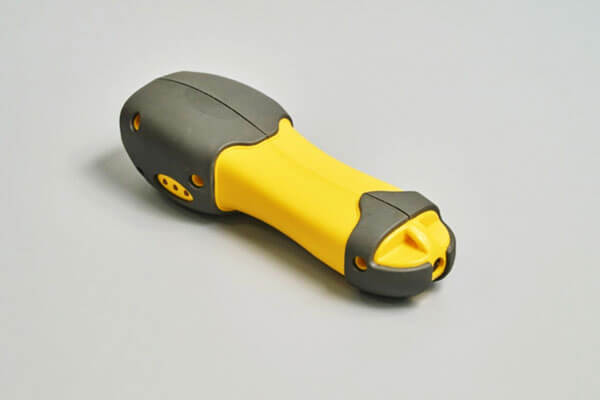
Overmolding digunakan di berbagai industri karena memungkinkan produsen menggabungkan material struktural dan fungsional tanpa bergantung sepenuhnya pada perakitan sekunder.
Aplikasi Otomotif
Pabrikan otomotif menggunakan overmolding untuk meningkatkan fungsionalitas, daya tahan, kenyamanan, dan integrasi komponen.
Contoh umum termasuk:
- Kontrol roda kemudi
- Sakelar dan tombol
- Rumah sensor
- Konektor Listrik
- Komponen pelindung kabel
- Komponen trim interior
- Komponen penyegelan
- Pegangan dan pegangan
- Penutup pelindung
- Komponen peredam getaran
Elektronik Konsumen
Barang elektronik konsumen mendapatkan keuntungan dari proses overmolding karena pengguna berinteraksi langsung dengan banyak permukaan luar produk.
Aplikasi termasuk:
- Aksesoris smartphone dan perangkat elektronik
- Kontrol jarak jauh
- Komponen perangkat yang dapat dipakai
- Komponen headphone
- Konektor pengisian daya
- Kabel berakhir
- Rumah pelindung
- Tombol dan antarmuka kontrol
Alat kesehatan
Overmolding digunakan dalam produk medis dan kesehatan yang ergonomis, penyegelan, isolasi, kebersihan, dan kinerja sentuhan yang terkontrol adalah penting.
Contohnya termasuk:
- Gagang instrumen medis
- Komponen peralatan diagnostik
- Genggaman perangkat bedah
- Komponen tabung dan konektor
- Elemen penyegelan
- Rumah pelindung
- Komponen perangkat sekali pakai
Perkakas Listrik dan Perkakas Tangan
Perkakas listrik adalah aplikasi klasik untuk overmolding yang kaku hingga fleksibel.
Substrat polimer struktural dapat memberikan kekakuan yang dibutuhkan, sedangkan TPE atau TPU dapat menciptakan zona pegangan yang ergonomis.
Cetakan berlebih mungkin membaik:
- Keamanan pegangan
- Kenyamanan pengguna
- Redaman getaran
- Dampak resistensi
- Daya tahan permukaan
- Penampilan produk
Komponen listrik dan elektronik
Aplikasi kelistrikan sering kali menggabungkan sisipan logam konduktif dengan bahan polimer isolasi.
Aplikasi tipikal termasuk:
- Konektor Listrik
- Terminal
- Komponen sensor
- Rakitan kabel
- Ganti komponen
- Kontak terisolasi
- Rumah konektor
- Komponen kontrol elektronik
Peralatan Industri
Produk industri seringkali memerlukan kombinasi kekuatan, Dampak resistensi, resistensi kimia, kontrol getaran, dan ergonomi operator.
Oleh karena itu overmolding digunakan untuk:
- Pegangan mesin
- Tombol kontrol
- Sakelar industri
- Pegangan alat
- Penutup pelindung
- Komponen penyegelan
- Rumah sensor
- Perlindungan kabel
- Komponen peredam getaran
9. Cetakan berlebih vs. Sisipkan Cetakan vs. Cetakan Dua Tembakan
cetakan berlebihan, masukkan cetakan, dan cetakan dua-shot adalah teknologi cetakan injeksi yang terkait erat, tetapi keduanya berbeda dalam cara substrat diproduksi, diposisikan, dan terintegrasi dengan materi kedua.
cetakan berlebihan
Overmolding umumnya melibatkan pencetakan material kedua di atas substrat atau komponen yang sudah ada.
Substratnya mungkin merupakan bagian plastik yang telah dibentuk sebelumnya, komponen logam mesin, sisipan yang dicap, atau elemen manufaktur lainnya.
Hal ini sangat cocok bila substrat dan cetakan luar diproduksi dalam operasi terpisah atau bila proses manufaktur berbeda diperlukan untuk kedua komponen.
Aplikasi yang umum mencakup genggaman dengan sentuhan lembut, penutup pelindung, Insulasi Listrik, segel, dan komponen pelepas regangan.
Masukkan Cetakan
Masukkan cetakan tempatkan sisipan yang telah dibentuk sebelumnya ke dalam cetakan injeksi sebelum plastik disuntikkan di sekitarnya.
Sisipannya bisa terbuat dari logam, plastik, keramik, atau bahan lain yang sesuai.
Cetakan sisipan logam banyak digunakan ketika komponen akhir membutuhkan kekuatan, daya konduksi, stabilitas dimensi, atau kemampuan pengikatan logam dikombinasikan dengan sifat ringan dan isolasi dari plastik.
Sisipan umum termasuk busing berulir, terminal, pin, poros, piring, dan kurung.
Berbeda dengan overmolding pada umumnya, cetakan sisipan secara khusus menekankan integrasi sisipan pra-produksi selama siklus injeksi.
Cetakan Dua Tembakan
Cetakan dua tembakan, juga disebut cetakan injeksi 2K atau dua komponen, menghasilkan dua wilayah material melalui operasi injeksi berurutan dalam sistem pencetakan yang sama.
Bahan pertama membentuk substrat awal, setelah itu cetakan atau bagian diposisikan ulang dan bahan kedua disuntikkan.
Pendekatan ini dapat memberikan registrasi dimensi yang sangat baik antara kedua material dan sangat cocok untuk produksi volume tinggi.
Hal ini juga dapat mengurangi penanganan karena media tidak perlu dipindahkan secara manual di antara operasi pencetakan terpisah.
Perbandingan Proses
| Fitur | cetakan berlebihan | Masukkan Cetakan | Cetakan Dua Tembakan |
| Substrat | Komponen atau sisipan yang telah dibentuk sebelumnya | Sisipan yang telah dibentuk sebelumnya | Dibentuk selama tembakan pertama |
| Bahan khas | Plastik, elastomer, logam | Terutama sisipan logam atau kaku | Dua polimer/elastomer yang kompatibel |
| Urutan produksi | Substrat + operasi pencetakan kedua | Masukkan dimuat + injeksi plastik | Tembakan pertama + tembakan kedua |
| Otomatisasi | Rendah hingga sangat otomatis | Rendah hingga sangat otomatis | Biasanya sangat otomatis |
| Kompleksitas perkakas | Sedang hingga tinggi | Sedang | Tinggi |
| Keuntungan utama | Integrasi multi-material yang fleksibel | Menggabungkan fungsionalitas sisipan dengan plastik | Produksi multi-material dengan presisi tinggi |
| Aplikasi khas | Genggaman, segel, perumahan, lapisan pelindung | Konektor, terminal, sisipan berulir | Tombol, perumahan, komponen multi-warna |
| Paling cocok untuk | Strategi manufaktur yang fleksibel | Integrasi logam/plastik | Produksi terintegrasi bervolume tinggi |
Dalam praktiknya, persyaratannya bisa tumpang tindih. Cetakan sisipan adalah bentuk cetakan khusus di sekitar sisipan yang telah dibentuk sebelumnya, sedangkan pencetakan dua-shot adalah proses multi-bahan yang sangat terintegrasi di mana substrat biasanya dibuat dalam siklus pencetakan yang sama.
Oleh karena itu, pemilihan proses harus didasarkan pada arsitektur produk sebenarnya dan bukan pada terminologi saja.
10. Tren dan Inovasi Tingkat Lanjut
Teknologi overmolding terus berkembang pesat, didorong oleh permintaan akan miniaturisasi, keberlanjutan dan peningkatan integrasi fungsional.
LSR Berlebihan
Karet silikon cair (LSR) overmolding ke dalam rekayasa termoplastik adalah segmen overmolding yang tumbuh paling cepat.
LSR memberikan ketahanan panas yang luar biasa (-60°C hingga 200 °C+), biokompatibilitas dan kinerja set kompresi, membuatnya ideal untuk perangkat medis, suku cadang kontak makanan dan aplikasi otomotif suhu tinggi.
Perkakas cold-runner yang canggih dan sistem takaran yang presisi memungkinkan overmolding LSR dengan ketebalan dinding yang rendah 0.2 mm.
Mikro-Overmolding
Miniaturisasi pada peralatan elektronik dan medis telah mendorong pengembangan proses micro-overmolding dengan ketebalan dinding overmold di bawahnya 0.3 mm dan akurasi posisi ±0,02 mm.
Hal ini memungkinkan fitur overmolded pada konektor mikro, perangkat elektronik yang dapat dipakai dan perangkat medis implan yang sebelumnya tidak mungkin diproduksi.
Overmolding yang Berkelanjutan dan Berbasis Bio
Pengembangan kualitas polimer berbasis bio dan daur ulang dengan sifat lelehan yang sesuai memungkinkan pembentukan pasangan material yang berkelanjutan secara berlebihan.
Hal ini mencakup substrat PP daur ulang yang dilapisi dengan TPE daur ulang, dan PA berbasis bio yang dilapisi dengan elastomer berbasis bio.
Merek semakin menentukan proses overmolding yang berkelanjutan untuk memenuhi target ekonomi sirkular dan pengurangan karbon.
Integrasi Perakitan Dalam Cetakan
Sel overmolding multi-stasiun yang canggih mengintegrasikan beberapa komponen pra-fabrikasi (segel, magnet, elektronik) menjadi satu siklus pencetakan, memproduksi komponen jadi yang dirakit sepenuhnya langsung dari cetakan.
Hal ini menghilangkan seluruh jalur perakitan dan mengurangi waktu tunggu produksi sebesar 70–90%.
Optimalisasi proses yang digerakkan oleh AI
Sistem pembelajaran mesin diterapkan untuk mengoptimalkan parameter proses overmolding secara real-time, mengatur kecepatan injeksi, tekanan dan suhu berdasarkan data sensor dalam cetakan dan kurva tekanan rongga.
Hal ini mengurangi tingkat kerusakan sebesar 30–50%, meningkatkan konsistensi ikatan dan mengurangi waktu penyetelan untuk suku cadang baru.
11. Overmolding untuk Persyaratan Produk yang Berbeda
Overmolding harus dipilih sesuai dengan persyaratan fungsional komponen jadi, bukan hanya sebagai metode untuk menggabungkan dua bahan.
| Persyaratan Produk | Solusi Overmolding yang Direkomendasikan | Pertimbangan Rekayasa Utama | Aplikasi khas |
| Peningkatan Genggaman dan Gesekan | Substrat kaku + Cetakan berlebih TPE/TPU | Kekerasan, Koefisien gesekan, tekstur permukaan, resistensi abrasi | Pegangan alat, kenop, produk konsumen |
| Perlindungan Dampak | Substrat kaku + elastomer yang kuat | Penyerapan dampak, kekuatan sobek, ketebalan, cakupan tepi | Rumah elektronik, peralatan pelindung, Komponen Industri |
| Perlindungan Air dan Debu | Perumahan yang kaku + lapisan penyegelan elastomer | Kontinuitas antarmuka, kompresi, akurasi dimensi, resistensi penuaan | Konektor, sensor, elektronik luar ruangan |
| Insulasi Listrik | Sisipan logam/elektronik + polimer isolasi | Kekuatan dielektrik, ketebalan isolasi, peringkat suhu, pencegahan batal | Terminal, konektor, rakitan kabel |
Pengurangan Getaran dan Kebisingan |
Substrat kaku + redaman elastomer | Kekerasan elastomer, ketebalan, respons dinamis, resistensi kelelahan | Perangkat Daya, Komponen Otomotif, mesin |
| Penanganan Ergonomis | Inti struktural + TPE/TPU dengan sentuhan lembut | Gradien kekerasan, geometri pegangan, nuansa sentuhan, pemakaian jangka panjang | Alat Tangan, instrumen medis, pegangan kendali |
| Perlindungan Kimia dan Lingkungan | Substrat + polimer yang tahan terhadap bahan kimia | Kompatibilitas kimia, suhu, UV, kelembaban, stabilitas adhesi | Peralatan Industri, Bagian otomotif, komponen penanganan cairan |
| Ketahanan aus dan abrasi | Substrat kaku + TPU/TPE tahan aus | Kekerasan Permukaan, resistensi abrasi, tekanan kontak, suhu layanan | Rol, pemandu, genggaman, kontrol industri |
12. Layanan Cetakan Injeksi Industri LangHe
Industri Langhe menyediakan solusi pencetakan injeksi dan overmolding yang disesuaikan mulai dari pengembangan prototipe hingga produksi volume tinggi, bahan pendukung termasuk PP, PE, ABS, komputer, nilon, TPE, TPU, LSR, dan mengintip.
Kemampuannya mencakup pencetakan dua-shot, overmolding pick-and-place, dan masukkan cetakan untuk logam, keramik, plastik, dan sisipan elektronik, didukung oleh desain dan manufaktur perkakas internal.
Sebagai Iso 9001:2015-produsen bersertifikat, LangHe Industry menerapkan kontrol kualitas yang sistematis melalui 100% inspeksi, pengukuran CMM, dan sistem visi mesin untuk memastikan akurasi dimensi, konsistensi penampilan, dan kinerja produk yang dapat diandalkan.
Warna yang disesuaikan, tekstur, dan penyelesaian permukaan juga tersedia untuk memenuhi persyaratan aplikasi dan branding tertentu.
Hubungi Industri LangHe hari ini untuk mendiskusikan proyek overmolding atau cetakan injeksi khusus Anda.
13. Kesimpulan
Overmolding lebih dari sekadar menambahkan lapisan plastik ke substrat.
Ini adalah teknologi manufaktur multi-material canggih yang mengintegrasikan struktural, ergonomis, fungsi penyegelan dan kosmetik menjadi satu komponen terintegrasi, memberikan kinerja yang tidak dapat ditandingi dengan pencetakan bahan tunggal atau metode perakitan tradisional.
Proposisi nilainya bertumpu pada tiga pilar inti: integrasi fungsional yang mengurangi jumlah komponen dan biaya perakitan, pengoptimalan kinerja khusus material yang memungkinkan fungsionalitas bertingkat di satu bagian, dan peningkatan keandalan yang berasal dari pengikatan integral, bukan penggabungan sekunder.
Seiring dengan berlanjutnya desain produk menuju integrasi yang lebih tinggi, miniaturisasi dan keberlanjutan, overmolding akan terus berkembang ke area aplikasi baru.
Kemajuan dalam pemrosesan LSR, cetakan mikro dan material berkelanjutan akan semakin memperluas kemampuannya, mengamankan posisinya sebagai salah satu teknologi manufaktur presisi paling penting dan serbaguna dalam industri modern.
FAQ
Apa perbedaan antara overmolding dan insert moulding?
Overmolding umumnya mengacu pada pencetakan material kedua di atas substrat yang telah dibentuk sebelumnya.
Pencetakan sisipan secara khusus melibatkan penempatan sisipan yang telah dibentuk sebelumnya—seringkali logam—ke dalam cetakan dan menyuntikkan plastik di sekitarnya. Kedua istilah tersebut dapat tumpang tindih bergantung pada arsitektur komponen.
Apa perbedaan antara overmolding dan two-shot molding?
Dalam overmolding konvensional, substrat biasanya diproduksi secara terpisah sebelum bahan kedua dicetak di atasnya.
Dalam cetakan dua tembakan, bahan pertama dicetak dan bahan kedua disuntikkan dalam sistem pencetakan terintegrasi yang sama, memberikan registrasi yang tepat dan efisiensi produksi yang tinggi.
Bisakah logam ditimpa dengan plastik?
Ya. Overmolding logam-ke-plastik banyak digunakan untuk menggabungkan kekuatan atau konduktivitas logam dengan insulasi, perlindungan, dan fleksibilitas desain polimer.
Sisipan logam harus diposisikan secara akurat dan dirancang untuk menahan suhu dan tekanan pencetakan.
Apakah overmolding lebih mahal dibandingkan cetakan injeksi konvensional?
Biaya perkakas dan pengembangan umumnya lebih tinggi karena cetakan berlebih memerlukan perkakas dan pengendalian proses yang lebih kompleks.
Namun, biaya produksi keseluruhan bisa lebih rendah bila proses menghilangkan komponen-komponen terpisah, operasi perakitan, perekat, pengencang, atau proses penyegelan sekunder.