

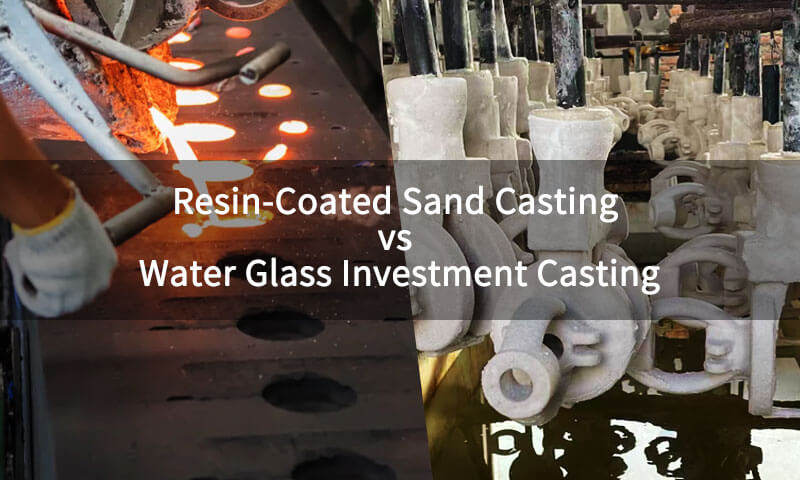
Hōʻikeʻike
In today’s foundry market, ʻAʻole i alakaʻi ʻia ke koho kaʻina hana e ka mana ʻenehana wale nō.
Hoʻonui ʻia ke ʻano e raw material inflation, ke kaumaha o ka uku hana, ka hoʻohanaʻana i ka pilina, hooponopono kaiapuni, and end-market price erosion.
This is especially true for low- and medium-grade investment casting products made by the water glass route.
As margins continue to shrink, many foundries are being pushed toward product upgrading, process restructuring, or outright replacement of older process routes.
Against this background, resin-coated sand casting has attracted renewed attention.
For many parts with moderate precision requirements, it offers a practical balance of cost, ʻOiaʻiʻo, and forming quality.
I nā noi maoli maoli, it can deliver dimensional accuracy around CT7–CT8 and surface roughness around RA 6.3-12.5 μM, which is often sufficient to replace lower-end water glass investment casting in selected product families.
That is the strategic reason this comparison matters. It is not simply a technical debate. It is a question of which process can produce the required quality at the lowest sustainable total cost.
1. What Is Resin-Coated Sand Casting
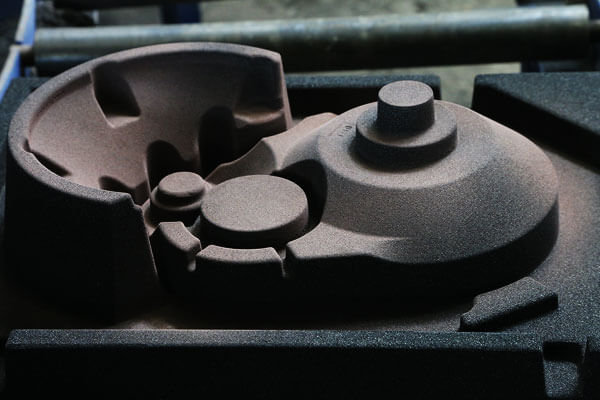
Resin-coated sand casting is a mature shell mold casting technology based on thermosetting phenolic resin curing reaction.
Precisely pre-coated sand with uniform resin film on silica sand surfaces is injected into heated metal molds through pneumatic shooting.
Electric heating rods maintain the mold temperature to trigger rapid thermal curing of the surface resin layer.
I loko 1 i 3 MAKANAKAI (adjustable according to workpiece structure), the loose resin-coated sand solidifies into a high-strength, dimensionally stable integrated shell mold.
After mold stripping, the finished shell molds are stacked for box stacking pouring.
The entire molding process relies on physical pneumatic filling and thermal chemical curing, featuring simple reaction logic, stable molding quality, and minimal dependence on environmental conditions.
The cured resin shell exhibits excellent rigidity and contour clarity, effectively resisting molten metal scouring and structural deformation during pouring.
Nā hiʻohiʻona koʻikoʻi
- High mold strength
- Good dimensional retention
- Relatively smooth mold surface
- Good reproducibility
- Suitable for medium-complexity parts
- Efficient batch production
Why it is attractive
Compared with ordinary sand casting, resin-coated sand systems reduce mold collapse, improve surface quality, and support more accurate cavity formation.
They are particularly useful where traditional clay-bonded sand is too rough or unstable, but full investment casting would be unnecessarily expensive or complex.
2. What Is Water Glass Investment Casting
ʻO ka wai inu wai wai wai is a traditional lost-wax precision casting process.
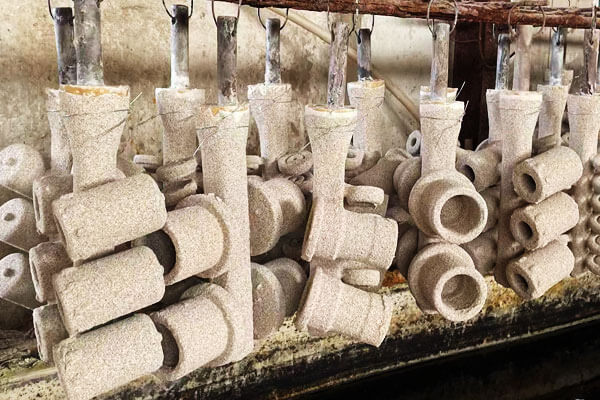
The complete workflow starts with wax pattern pressing and fabrication, followed by multi-layer shell coating using water glass as the binder and quartz sand as refractory aggregate.
Each coating layer requires natural hardening and air-drying curing.
After multi-cycle coating and drying, the assembled wax shell undergoes hot water dewaxing, high-temperature furnace sintering, and secondary shaping to form a complete ceramic shell mold.
Hope loa, molten metal is poured into the hollow shell, and finished castings are obtained after cooling, Shell lawe, a hoʻopau.
This process relies on multi-layer composite shell manufacturing and high-temperature sintering molding, with complex process links and strict requirements for temperature, kaulike, and curing time throughout production.
Nā hiʻohiʻona koʻikoʻi
- Better precision than conventional sand casting
- Smoother surface finish
- Relatively low material cost
- Suitable for moderate to high quality requirements
- Widely used in cost-sensitive precision casting
Why it is attractive
Water glass systems are often selected when the foundry wants to control cost while still producing parts with relatively refined geometry.
The process is particularly useful in applications where high-end silica sol investment casting would be too expensive, but ordinary sand molding would not meet the quality requirement.
2. The Market Pressure Behind the Shift
The reason many foundries are reconsidering water glass processes is not because they are technically obsolete.
It is because their economics are increasingly fragile in low-end markets.
Several trends are driving this pressure:
- rising material and auxiliary material costs,
- Ke hoʻonui nei i nā kumukūʻai hana,
- ʻoi aku ka nui o kaʻoihana,
- falling selling prices for low-precision casting products,
- and growing customer demand for faster turnaround and more consistent quality.
Ma ka hopena, foundries using water glass investment casting for lower-margin parts often face a strategic dilemma:
- upgrade the product,
- hoʻomaikaʻi i nā hana hana,
- or replace the route with a more economical alternative.
Resin-coated sand casting has become a serious candidate for that replacement role in many cases.
3. Comparative Technical Positioning
The key question is not which process is “better” in the abstract. It is which process is better for a given quality level and cost target.
| Dimension | Resin-Coated Sand Casting | ʻO ka wai inu wai wai wai |
| Process identity | Precision sand-based molding route | Precision investment-style casting route |
| Typical accuracy | CT7–CT8 | Typically better for finer detail and near-net-shape precision |
| Ka paakiki | RA 6.3-12.5 μM | Usually better than coated sand, depending on shell quality |
| Mold strength | High | Maikaʻi loa |
| Production steps | Fewer | More |
| Upfront investment | Haʻahaʻa | ʻOi aku ka kiʻekiʻe |
| Operating cost | Lower to moderate | Loli |
| Kūpono kūpono | Medium-complexity parts with moderate precision needs | Detail-sensitive parts with better surface requirements |
This table shows the real commercial relationship: resin-coated sand casting is not trying to beat water glass investment casting at ultra-fine precision.
It is trying to deliver acceptable precision with fewer steps, uku haʻahaʻa, and higher practical throughput.
4. Why Resin-Coated Sand Casting Is Economically Attractive
Lower one-time investment
Resin-coated sand hot core box casting requires extremely low upfront investment.
The core production equipment only includes a hot core box molding machine and customized metal molds.
The market price of a single molding machine ranges from 15,000 i 39,700 RMB, and each set of precision molds costs 6,000 i 10,000 RMB.
The equipment system is compact, with low site occupancy and no need for large-scale supporting facilities.
In sharp contrast, water glass investment casting requires a complete set of large-scale supporting equipment, including wax presses, wax melting furnaces, wax polishing machines, wax stirring machines, rain-type sand scattering machines, boiling-type sand scattering machines, dewaxing pools, and high-temperature shell firing furnaces.
The complete equipment system involves dozens of equipment units with huge one-time investment, long equipment commissioning cycles, and high threshold for factory entry.
Lower production cost
Resin-coated sand casting has extremely streamlined material consumption.
The only required production materials are standard resin-coated sand and release agents, with single-variety and low-consumption raw materials and stable material procurement costs.
Water glass investment casting involves a complex material system including wax materials, release agents, cleaning agents, refractory sand, water glass binders, hardening solutions, and diesel oil.
The diverse material types lead to high comprehensive material costs, complicated material management, and severe cost fluctuations affected by raw material market prices.
Lower energy burden
Resin-coated sand casting only consumes electric energy for the hot core box molding machine during shell making, with low total power consumption and concentrated energy use.
The short curing cycle further reduces unit product energy consumption.
Water glass investment casting requires continuous power supply for multiple high-energy-consuming equipment such as heating furnaces, drying systems, and dewaxing equipment throughout the whole process.
Long-term continuous operation leads to huge total power consumption and high unit energy cost, further compressing corporate profit margins.
5. Why Resin-Coated Sand Casting Is Faster
Speed is one of the most practical reasons resin-coated sand casting has gained attention as an alternative to water glass investment casting.
In many foundries, the real bottleneck is not only quality, aka, manawa manawa, process turnaround, and production throughput.
Resin-coated sand casting addresses these issues by simplifying the forming route, shortening shell preparation time, and reducing the number of operations required before pouring.
A shorter process chain by design
Resin-coated sand casting compresses the production sequence into a much simpler flow.
In many hot-core or shell-forming applications, the mold can be produced through one-time pneumatic sand shooting ukali rapid thermal curing.
The shell-forming stage may take only 1-3 mau minuke, depending on part size and equipment setup. That is an extremely short cycle compared with traditional water glass investment casting.
I nā hua'ōlelo kūpono, the process can often be reduced to three core stages:
- Shell making
- E ninini ana
- ʻO ka hoʻomaʻemaʻe / Ke hoʻopauʻana
That simplicity matters. Every eliminated step reduces:
- waiting time,
- handling time,
- inspection points,
- defect opportunities,
- and scheduling complexity.
Ma ka hoʻohālikelike, water glass investment casting typically requires repeated coating, hāwanaʻu, air-drying, hoomoana, and high-temperature sintering.
The shell may need 6–10 layers of composite coating, plus multi-day natural curing or staged drying.
Even when the process is well controlled, the production rhythm is inevitably slower because each shell must pass through more intermediate states before it becomes pour-ready.
Faster shell formation means faster production turnover
The most obvious efficiency gain comes from shell formation time.
Resin-coated sand systems achieve rapid hardening through heat, so the mold becomes functional quickly. That means the line can move from tooling to pouring with much less delay.
ʻO ka wai inu wai wai wai, Ma ka hoʻohālikelike, is inherently slower because the shell strength must be built gradually.
Each layer must be deposited, hākūʻia, and stabilized before the next layer is applied.
Even when automation is used, the process still contains more time-bound steps that limit turnover efficiency.
This difference becomes especially important when:
- product demand is repetitive,
- batch sizes are moderate to large,
- and delivery speed matters.
In those environments, a short shell-forming cycle can translate directly into higher effective capacity.
Higher production capacity through efficient equipment utilization
Resin-coated sand casting also benefits from equipment that is naturally suited to batch production.
ʻo kahi laʻana, dual-station core shooting or molding machines can maintain a steady rhythm of output.
In some production setups described in industry practice, a single machine may complete 150 molding cycles per shift, me 12 castings per mold, reaching roughly 1,800 castings per shift.
That kind of output is difficult to match with manual water glass shell-making routes.
What makes this important is not the headline number alone, aka o repeatable use of equipment time.
Resin-coated sand systems allow the same machine to produce more usable molds in less time, which improves:
- machine utilization,
- labor productivity,
- and production scheduling efficiency.
Ma ka hoʻohālikelike, manual or semi-manual water glass mold making often depends heavily on worker skill, 'Āpana Kūlana, and drying time.
That lowers throughput and increases variation from shift to shift.
Labor efficiency is significantly higher
A fast process is valuable, but a process that also reduces labor intensity is even better.
Resin-coated sand casting typically requires less manual intervention than water glass investment casting.
Because the shell-forming step is more direct and less dependent on repeated coating and curing cycles, fewer operators are needed to move parts through the system.
In production examples, the per-capita productivity of resin-coated sand casting can be about six times that of manual water glass mold making.
The exact ratio will vary by plant, but the underlying logic is clear: fewer process stages plus shorter cycle time means each worker can support far more output.
That has several practical consequences:
- labor cost per part declines,
- operator fatigue is reduced,
- process consistency improves,
- and production becomes easier to stabilize.
This is particularly important in markets where skilled labor is expensive or increasingly difficult to secure.
Higher yield through stack pouring and better box utilization
Resin-coated sand casting also supports stack pouring and other space-efficient production methods.
Because the molds are generally strong and the process is compact, mold box utilization can be improved.
That means more effective use of available space, fewer idle shells, and better casting yield.
In many practical operations, 'ōlelo comprehensive production yield can exceed 90% when the mold structure, molten metal quality, and pouring speed are properly controlled.
That is a strong performance level for a sand-based precision casting route.
ʻO ka wai inu wai wai wai, Ma ka hoʻohālikelike, often has more sensitivity to shell condition, drying state, and thermal processing.
That makes production yield more dependent on exact process discipline and environmental stability.
Less dependence on environmental temperature and humidity
One of the hidden speed advantages of resin-coated sand casting is that it is often less sensitive to ambient environment than water glass investment casting.
Water glass shells may depend heavily on air-drying conditions, curing duration, and temperature-humidity balance.
If the environment is unstable, the production schedule slows down.
Resin-coated sand systems, once properly set up, are generally easier to standardize. As long as:
- mold structure is correct,
- molten metal quality is stable,
- and pouring speed is controlled properly,
qualified castings can be produced reliably with fewer interruptions. This reduces the need to “wait for the process to recover,” which is a major source of hidden time loss in slower routes.
A clearer production logic means fewer delays
Speed in foundry production is not only about the shortest single step. It is also about how many times a part gets delayed because of:
- hana hou,
- curing delays,
- shell defects,
- environmental fluctuations,
- or process coordination problems.
Resin-coated sand casting is faster because its logic is simpler.
The shell can be formed quickly, the process chain is shorter, and the production rhythm is easier to maintain.
That means fewer bottlenecks between steps and fewer chances for the line to stall.
This is exactly where it becomes a strategic substitute for lower-end water glass investment casting: not just because it is cheaper, but because it is faster to convert raw materials into saleable castings.
6. Casting Dimensional Accuracy and Surface Quality Equivalence
When resin-coated sand casting is compared with water glass investment casting, the most important observation is not that one process always dominates the other in quality,
but that they can converge to a surprisingly similar practical quality level in many industrial castings.
For a wide range of parts that do not demand ultra-fine detail, both processes can deliver acceptable dimensional accuracy and surface quality.
The difference lies less in whether the casting is “good” and more in how much process cost is required to reach that good quality.
This is why the comparison becomes subtle. Water glass investment casting is traditionally associated with precision,
but resin-coated sand casting has developed to a level where it can produce CT7–CT8 dimensional accuracy and Ra 6.3–12.5 μm surface roughness I nā noi he nui.
I nā hua'ōlelo'ē aʻe, for a large class of medium-precision industrial castings, the final practical quality can be close enough that the real selection criterion becomes economics, production rhythm, and process robustness rather than theoretical maximum precision.
Dimensional pololei: different routes, overlapping results
Water glass investment casting is generally stronger when the part contains very fine geometry, Nā Paukū Kuhi, or small features that must be reproduced with high fidelity.
It is a precision route by design. Resin-coated sand casting, Akā naʻe,, has evolved into a capable medium-precision process whose rigidity and contour definition are significantly better than conventional sand casting.
That means the two processes often overlap in the middle ground:
- ʻO ka wai inu wai wai wai reaches precision through a more elaborate shell-building route.
- Resin-coated sand casting reaches similar usable accuracy through a stiffer, ʻoi aku ka wikiwiki, and more production-friendly mold-forming route.
For many industrial parts, the customer does not actually need micron-level distinction between the two. They need a casting that fits, functions, and machines reliably.
In those cases, resin-coated sand casting can achieve dimensional performance that is commercially equivalent.
Kahiki Pāʻani Waiwai: close enough for many industrial parts
Surface quality is another area where the difference is real, but often not decisive.
Water glass investment casting usually provides a smoother surface and better fine-detail reproduction.
Resin-coated sand casting, Akā naʻe,, significantly improves on ordinary sand molding and can produce surfaces that are fully acceptable for many mechanical and structural castings.
The practical question is whether the surface will be:
- directly visible,
- functionally sealed,
- heavily machined afterward,
- or hidden within an assembly.
If the part will be machined on critical faces, then the as-cast surface advantage of water glass investment casting may be less important.
If the part is robust and only needs moderate finishing, resin-coated sand casting can be entirely sufficient.
Quality equivalence is application-dependent, not absolute
The concept of equivalence here should be understood carefully. It does ʻaʻole mean the two processes are identical.
It means that, for many parts, they can deliver functionally equivalent outcomes after considering the actual service requirement and downstream machining allowance.
ʻo kahi laʻana:
- A medium-sized housing with moderate tolerance demand may perform equally well from either process.
- A decorative or fine-detail component may still favor water glass investment casting.
- A robust industrial casting with standard machining allowance may be better served by resin-coated sand casting because it reaches the required quality with lower process burden.
So the equivalence is not in the process itself. It is in the final engineering value delivered to the customer.
7. Process Limitations and Application Scenario Differentiation
Resin-Coated Sand Casting Application Scope and Limitations
This process is highly suitable for mass production of medium and low-precision, regular-structured metal castings,
including mechanical equipment parts, engineering hardware, pump valve fittings, and general industrial structural components.
Its limitations lie in poor adaptability for ultra-complex cavity structures, ultra-thin-walled parts, and high-precision aerospace castings, which cannot meet ultra-high tolerance requirements.
Water Glass Investment Casting Application Scope and Limitations
Water glass investment casting retains advantages in manufacturing complex special-shaped castings and small-batch customized precision parts due to its flexible wax mold forming.
Akā naʻe,, its high cost, low efficiency, and unstable batch consistency make it unsuitable for large-scale mass production of ordinary castings, resulting in continuous profit compression in the homogenized low-end casting market.
| Product family | Better choice | O ke kumu |
| Medium-duty industrial castings | Resin-coated sand casting | Good quality with lower cost |
| Fine-detail precision parts | ʻO ka wai inu wai wai wai | Better geometric fidelity |
| Cost-sensitive replacement parts | Resin-coated sand casting | Lower process burden |
| Small complex components | ʻO ka wai inu wai wai wai | Better surface and detail reproduction |
| Stable batch production with moderate precision | Resin-coated sand casting | Simpler control and faster cycle |
| Parts where finish is critical | ʻO ka wai inu wai wai wai | Better surface quality |
8. Industrial Transformation and Development Trend
Driven by rising factor costs and market upgrading, the low-end water glass investment casting industry is facing severe survival pressure.
The extensive production mode relying on low labor costs and low material investment is no longer sustainable.
As a low-cost, high-efficiency, and stable-quality alternative process, resin-coated sand hot core box casting has become the optimal transformation direction for traditional water glass investment foundries.
It not only maintains qualified casting precision and surface quality but also greatly reduces comprehensive production costs, improves automated production levels, and realizes green and efficient manufacturing.
In the future, resin-coated sand casting will gradually replace traditional water glass investment casting in most general industrial casting scenarios,
while water glass investment casting will be concentrated in high-precision, paʻakikī, and small-batch customized casting fields, forming a differentiated and complementary industrial pattern.
9. Hopena
Resin-coated sand casting vs water glass investment casting occupy overlapping but distinct positions in foundry practice.
Water glass investment casting remains useful for precision parts, but its cost structure becomes increasingly difficult in lower-margin markets.
Resin-coated sand casting offers a compelling alternative for many parts with moderate precision requirements because it can deliver good forming quality, fewer process steps, lower initial investment, and faster production rhythm.
Its practical value lies not in replacing every water glass process, but in replacing the right water glass process:
the one where the product does not truly need ultra-fine precision, but does need stable quality, efficient production, and lower cost.
ʻO ia ke kumu, in many modern foundries, resin-coated sand casting is not just an alternative. It is a strategic process upgrade.

