

Introduction
Parmi la famille des procédés de fonderie de précision, le moulage à modèle perdu, souvent appelé « moulage à la cire perdue », se distingue par sa capacité à produire des composants métalliques de forme proche de la forme finale avec une finition de surface exceptionnelle., géométrie complexe, et des tolérances dimensionnelles serrées.
Cet article décortique le processus de moulage de précision, des premiers principes aux applications avancées..
Nous explorerons ses fondements métallurgiques, flux de processus détaillé, variantes technologiques (verre à eau, Silice Sol, composite), mécanismes de défauts, positionnement comparatif par rapport à d’autres méthodes de fabrication, et cas d'usage industriels.
1. Qu'est-ce que le casting d'investissement?
Moulage de précision, Également connu sous le nom de processus de la chronométrage perdu, est une méthode de formage de métal de précision dans laquelle une cire jetable ou un motif fusible est recouvert d'une coque en céramique réfractaire, puis retiré pour créer une cavité remplie de métal en fusion.
Le processus est conçu pour reproduire le motif original avec un haut degré de fidélité, ce qui en fait l'une des voies de fabrication les plus efficaces pour les, pièces métalliques de forme presque nette.
Contrairement aux itinéraires de lancer conventionnels qui sont souvent optimisés uniquement pour la simplicité ou le volume., le casting d’investissement est construit autour réplication détaillée, contrôle dimensionnel, et flexibilité en alliage.
Il est utilisé lorsqu'un composant doit combiner une géométrie complexe, précision fonctionnelle, et une qualité métallurgique fiable dans une seule chaîne de processus.
C'est pourquoi il est largement adopté dans des industries telles que l'aérospatiale., énergie, automobile, équipement médical, et matériel industriel de précision.
Principaux avantages concurrentiels du moulage à modèle perdu
Comparé à d'autres procédés de formage des métaux, le moulage de précision offre six avantages fondamentaux qui lui confèrent une position distinctive et durable sur le marché:
Précision dimensionnelle et finition de surface supérieures
Le moulage de précision peut atteindre des tolérances dimensionnelles standard de CT4–CT7, nettement plus serré que le moulage au sable (CT9 à CT14).
La rugosité de la surface peut généralement être contrôlée à Ra 1,6–6,3 μm, ce qui réduit considérablement le besoin d'un broyage approfondi, polissage, ou finition secondaire sur des surfaces décoratives et fonctionnelles de précision.
Capacité exceptionnelle pour les géométries complexes
Ce procédé est particulièrement bien adapté aux pièces présentant des caractéristiques très complexes, y compris cavités internes, sous-dépouille, sections à paroi mince (vers le bas 0.5 mm), surfaces courbes complexes, et des motifs de trous fins.
Il peut reproduire presque toutes les géométries requises pour les composants industriels de précision.
Compatibilité en alliage large
La fonderie de précision est compatible avec une très large gamme d’alliages, y compris les métaux ferreux et non ferreux courants ainsi que les matériaux exigeants et performants.
Il peut être appliqué aux aciers inoxydables, aciers au carbone, alliages en aluminium, alliages de cuivre, Superalliages à base de nickel, alliages à base de cobalt, et même des alliages actifs comme le titane.
Cette large tolérance d'alliage donne aux ingénieurs beaucoup plus de liberté dans le choix des matériaux que de nombreux autres procédés de formage..
Haute qualité métallurgique
La coque en céramique chimiquement inerte minimise la contamination du métal en fusion.
En outre, une solidification contrôlée et des systèmes de portes bien conçus aident à réduire rétrécissement, porosité, et la ségrégation, produire des pièces avec une microstructure dense et des performances mécaniques stables.
Efficacité des matériaux élevés
En tant que processus de forme quasi nette, le moulage à modèle perdu offre un taux d'utilisation des matériaux d'environ 92%–98%, réduisant considérablement les déchets métalliques par rapport aux processus d'usinage soustractifs.
Échelle de production flexible
Le moulage de précision est hautement adaptable, le rendre adapté à prototypes personnalisés uniques, pièces spécialisées en petits lots, et production en grande série de composants standardisés.
2. Principes fondamentaux de la métallurgie et des procédés
Le moulage à modèle perdu n'est pas seulement une méthode de façonnage. Il s’agit d’un système étroitement intégré système métallurgique dans quel modèle fidélité, comportement du shell, gestion thermique, et la solidification de l'alliage interagissent tous.
La qualité de la pièce finale est déterminée par la façon dont ces quatre facteurs sont contrôlés ensemble.
Réplication géométrique par transfert de motifs
Le processus commence par un motif en cire ou thermocollant qui capture la géométrie finale de la pièce avec une haute fidélité..
Parce que le moule en céramique est construit directement autour de ce motif, la cavité reproduit la forme prévue presque point par point.
C’est ce qui donne à l’investissement casting son avantage pour produire:
- côtes fines,
- transitions brusques,
- rainures,
- petits trous,
- passages internes,
- et des caractéristiques de surface complexes.
Autrement dit, le moulage à modèle perdu ne « se rapproche » pas de la géométrie.
Il le transfère du motif au moule avec une très grande rétention des détails.. C’est le fondement de sa capacité de forme quasi nette.
Coque en céramique comme barrière thermique de précision
La coque en céramique n'est pas seulement un récipient pour le métal en fusion. C'est un structure réfractaire de précision qui doit satisfaire à deux exigences contradictoires en même temps.
Il doit être suffisamment solide pour résister:
- déwax,
- tir de la coquille,
- coulant,
- pression du métal,
- et choc thermique.
En même temps, il doit rester dimensionnellement fidèle pour que la cavité ne déforme pas la géométrie de la pièce.
Cet équilibre entre résistance mécanique et stabilité dimensionnelle est l’un des défis techniques centraux du fondage de précision.
Si la coque est trop faible, il se fissure ou s'érode. S'il est mal contrôlé, il se déforme ou perd en fidélité.
La coque constitue donc une interface technique essentielle entre le modèle et le moulage final..
Le contrôle de la solidification comme noyau métallurgique
Une fois que le métal en fusion pénètre dans la cavité de la coque, le processus devient une question de comment l'alliage se remplit et se solidifie.
Cette étape détermine si la pièce sera dense, son, et dimensionnellement stable, ou s'il contiendra de la porosité, rétrécissement, Ferme à froid, ou déséquilibre structurel.
Les principales variables de contrôle comprennent:
- conception de système de contrôle,
- placement des contremarches,
- température de préchauffage de la coque,
- température de versement,
- fluidité de l'alliage,
- et taux de solidification.
Ces facteurs façonnent la structure interne du moulage tout autant qu'ils façonnent la forme externe..
Une pièce peut paraître correcte de l'extérieur et néanmoins échouer en interne si la solidification n'est pas correctement gérée..
Pourquoi le procédé est métallurgique, pas seulement géométrique
Le moulage de précision est souvent décrit comme un processus de formage de précision., mais cette description est incomplète.
C'est aussi un procédé métallurgique, car les propriétés finales de la pièce se construisent lors de la fusion, coulant, remplissage, et solidification.
Cela signifie que la fonderie ne se contente pas de reproduire la forme. Il gère activement:
- structure de grains,
- densité,
- ségrégation,
- formation de défauts,
- et comportement mécanique final.
C'est pourquoi le moulage à modèle perdu occupe une place particulière parmi les technologies de formage des métaux..
Il combine réplication de forme avec consolidation métallurgique contrôlée, et les deux sont tout aussi importants.
3. Flux de travail complet du processus de moulage à modèle perdu
La fonderie industrielle est une chaîne de processus étroitement contrôlée dans laquelle chaque étape affecte la qualité finale de la coulée..
Précision dimensionnelle, état de surface, solidité interne, et les performances métallurgiques sont toutes déterminées par la façon dont le processus est géré, depuis le modèle en cire jusqu'à l'inspection finale..
En pratique, le moulage à modèle perdu n'est pas une opération unique mais une séquence d'étapes de fabrication interdépendantes.
3.1 Fabrication de modèles en cire et sélection des matériaux
Le motif en cire est la première représentation physique de la pièce finale, sa stabilité dimensionnelle définit donc directement le plafond de précision de la pièce moulée.
Sélection du matériau de cire
Le moulage de précision industriel utilise généralement trois catégories de cires:
- Cire basse température pour simple, pièces de faible précision
- Cire moyenne température pour la production à usage général
- Cire haute température pour applications d'ultra-précision ou spéciales
Parmi ces, cire à température moyenne est le plus utilisé. Il offre un faible retrait, bonne fluidité, performances de manipulation stables, et reproduction fiable des détails.
Cela le rend adapté à la plupart des aciers, alliage de cuivre, et pièces moulées en alliage d'aluminium.
Contrôle du moulage par injection
L'injection de cire doit être contrôlée par:
- température de la cire,
- pression d'injection,
- temps de maintien,
- et géométrie des pièces.
Si la cire est trop froide, la capacité de remplissage se détériore. S'il fait trop chaud, la stabilité dimensionnelle peut en souffrir.
La pression de maintien est également essentielle car les vides de retrait internes dans la cire peuvent ensuite être hérités par le moulage métallique sous forme de défauts..

Compensation du retrait
Le modèle en cire doit inclure une tolérance de retrait calculée en fonction de l'alliage à couler..
Différents alliages se solidifient avec un comportement de retrait différent, la compensation doit donc être intégrée à l'outillage dès le départ.
Contrôle des défauts
Les modèles de cire doivent être inspectés pour:
- bulles,
- dépressions,
- déformation,
- éclair,
- et dommages superficiels.
Tout modèle de cire défectueux doit être rejeté avant d'entrer dans la production de coques., car les défauts de cire deviennent souvent des défauts de moulage plus tard dans le processus.
3.2 Assemblage de modèles et conception de systèmes de déclenchement
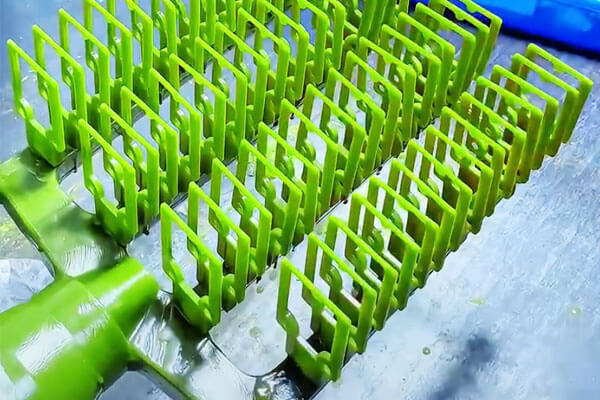
Individuel motifs de cire sont assemblés en un cluster ou arbre, ce qui améliore l'efficacité de la production et permet de produire plusieurs pièces moulées en un seul cycle de moulage.
Disposition des clusters
L'espacement entre les motifs doit être suffisant pour éviter toute interférence avec la coque pendant le revêtement et le séchage..
Le nombre de pièces par groupe doit également correspondre à la capacité du four., rythme de coulée, et comportement de solidification de l'alliage.
Conception de portail
Le système de contrôle doit prendre en charge:
- remplissage lisse,
- turbulence basse,
- et flux de métal contrôlé.
L'écoulement laminaire est préférable car la turbulence augmente le risque de:
- entraînement de l'air,
- pliage d'oxyde,
- et inclusion de scories.
Pour les alliages plus exigeants, notamment les aciers fortement alliés et les superalliages, des agencements à portes inférieures ou à glissières étagées sont couramment utilisés.
Des pièges à scories ou des extensions de canaux peuvent être ajoutés pour intercepter les impuretés flottantes avant qu'elles ne pénètrent dans la cavité..
Disposition des colonnes montantes
Les colonnes montantes sont positionnées au niveau des points chauds et des zones de dernière solidification pour fournir du métal pendant la solidification.. Ceci est essentiel pour prévenir:
- cavités de rétrécissement,
- microporosité,
- et rétrécissement de la ligne médiane.
Pour les alliages avec une large plage de congélation, plusieurs élévateurs auxiliaires peuvent être nécessaires pour maintenir un comportement alimentaire sain.
3.3 Fabrication de coques en céramique (Processus de base du moulage à modèle perdu)
La fabrication de coques en céramique est la procédure la plus longue et la plus techniquement exigeante.
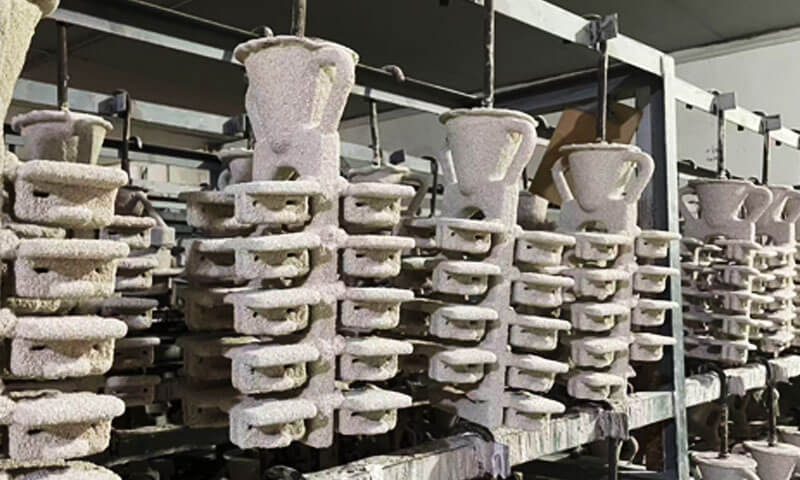
La coque est formée par un revêtement répété de coulis réfractaire et de stuc de sable sec., divisé en manteau de visage, couche de transition et couche de support avec matériaux et fonctions réfractaires différenciés.
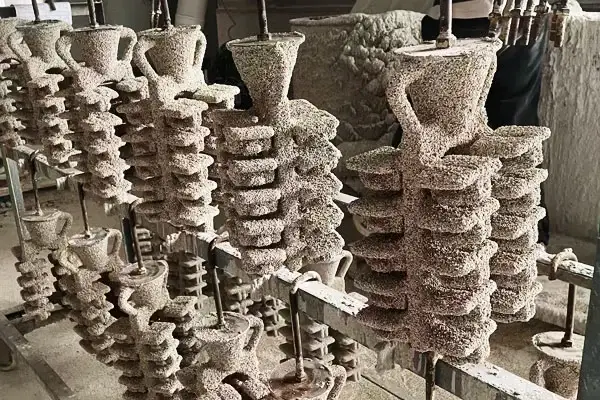
Structure en couches et correspondance des matériaux
- Manteau pour le visage (couche superficielle): Contacte directement le métal fondu à haute température, nécessitant un caractère réfractaire et une inertie chimique ultra-élevés.
Pour aciers inoxydables de haute qualité et superalliages, de la farine de zircon de haute pureté et du sable de zircon sont adoptés; pour l'acier au carbone général, l'alumine fondue est couramment utilisée.
Cette couche empêche la pénétration du métal, collage du sable et réaction chimique entre le métal en fusion et le réfractaire. - Manteau de transition: Améliore la force de liaison entre la couche de finition et la couche de support pour éviter le délaminage de la coque pendant la cuisson et le coulage..
- Couche de sauvegarde (couche arrière): Utilise du sable de quartz et des agrégats de mullite à faible coût pour améliorer la résistance structurelle globale de la coque et réduire le coût global des matériaux..
Contrôle du séchage:
Chaque couche enduite doit subir un séchage naturel complet à température constante (22~26°C) et une humidité constante (55%~65 % d'humidité relative).
Un séchage insuffisant laisse de l’eau libre résiduelle à l’intérieur de la coque, qui devient une source d'hydrogène et provoque une porosité sténopée dans les pièces moulées.
Le nombre total de couches de coque varie de 8 à 12; les grandes pièces moulées à paroi épaisse nécessitent plus de 12 couches pour une résistance accrue.
Différenciation des liants:
Le type de liant détermine le caractère réfractaire de la coque, teneur en impuretés et performances globales, qui sert également de base à la classification des principales voies techniques de fonderie de précision.
3.4 Déwax
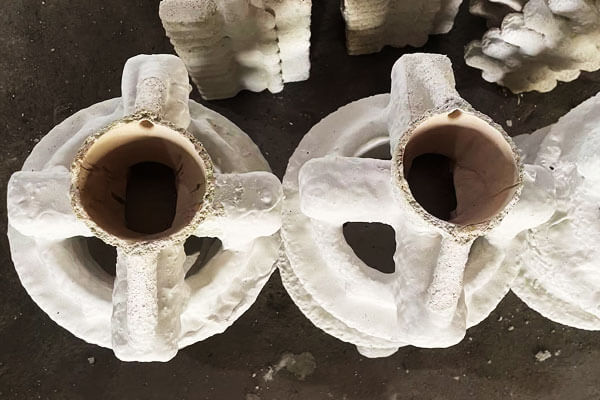
Le décirage enlève le matériau du motif de la coque en céramique et crée une cavité creuse qui sera ensuite remplie de métal en fusion..
Méthode industrielle standard
La méthode industrielle privilégiée est déparaffinage à la vapeur haute pression. Ceci est largement utilisé car il élimine rapidement la cire et réduit le risque d'endommagement de la coque..
Contrôle des processus
Le déparaffinage à la vapeur doit être soigneusement contrôlé afin que:
- la cire fond complètement,
- la coque n'est pas fissurée par choc thermique,
- et aucun résidu ne reste à l'intérieur de la cavité.
Tout reste de cire constitue un problème sérieux car il peut se décomposer lors d'une cuisson ultérieure et produire une contamination par le carbone., dégagement de gaz, ou défauts de surface dans la coulée finale.
Valorisation matière
La cire récupérée est généralement collectée, filtré, et recyclé, ce qui améliore l'économie de processus et prend en charge la réutilisation des matériaux.
3.5 Cuisson des coquilles et préchauffage avant coulée
La coque creuse en céramique nécessite une cuisson segmentée à haute température pour éliminer complètement les résidus organiques., fritter les particules réfractaires et stabiliser la structure de la coque; le préchauffage est effectué avant la coulée pour s'adapter à la température du métal en fusion.
Cuisson segmentée
Les tirs d'obus s'effectuent généralement par étapes:
- Étape basse température: élimine les matières organiques résiduelles et les traces de cire
- Étape à moyenne température: élimine l'humidité liée et décompose les résidus de liant restants
- Étape haute température: fritte la coque réfractaire et renforce la résistance finale
Ce chauffage par étapes empêche la fissuration de la coque et garantit que la coque atteint un état thermique et structurel stable..
Préchauffer avant de verser
La coque cuite est ensuite préchauffée pour réduire l'écart de température entre le moule et le métal en fusion.. Le préchauffage aide:
- améliorer le remplissage,
- réduire les risques de mauvais fonctionnement et de fermeture à froid,
- minimiser le choc thermique,
- et supporte les sections plus fines pendant le remplissage.
La plage de préchauffage exacte dépend de l'alliage, épaisseur de section, et en partie la complexité.
3.6 Fusion, Contrôle de l'atmosphère, et verser
C'est l'étape où se décident la pureté métallurgique et le remplissage des moules..
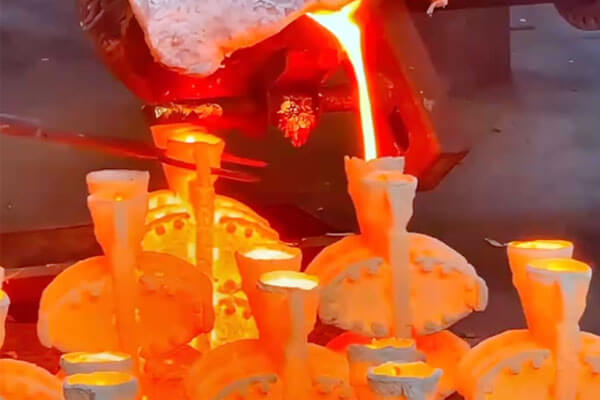
Équipement de fusion
La méthode de fusion doit correspondre à la famille d'alliage:
- Four à induction moyenne fréquence pour pièces moulées industrielles générales
- Fusion par induction sous vide (Vim) pour alliages de nickel, alliages de titane, et aciers inoxydables de haute pureté
Contrôle de l'atmosphère
Les exigences atmosphériques dépendent de l’alliage:
- les aciers au carbone ordinaires peuvent être fondus dans des systèmes à air,
- les aciers inoxydables et les alliages de cuivre nécessitent souvent un blindage à l'azote ou à l'argon,
- et les alliages réactifs ou hautes performances nécessitent un vide ou des atmosphères hautement contrôlées.
Contrôle de la température de coulée
La température de coulée est l’une des variables les plus sensibles dans le moulage de précision. Si c'est trop haut, augmentation du risque de ségrégation et de microporosité.
S'il est trop bas, la fluidité chute et un mauvais fonctionnement ou une fermeture à froid deviennent probables.
La surchauffe doit être adaptée à la chimie de l’alliage, fluidité, et comportement de solidification.
Mode versement
Le coulage par gravité est la méthode la plus courante. La coulée assistée par vide peut être utilisée pour des pièces ultra fines ou très complexes.
Quelle que soit la méthode, le flux doit rester stable et aussi laminaire que possible.
3.7 Refroidissement, Secouer, et nettoyage primaire
Après avoir versé, le métal doit se solidifier et refroidir dans des conditions contrôlées.
Régime de refroidissement
Les pièces moulées à l'intérieur de la coque en céramique adoptent un refroidissement lent naturel.
Pour les alliages sujets à la fissuration thermique (comme l'acier inoxydable fortement allié et les superalliages), le refroidissement rapide forcé est interdit pour libérer progressivement la contrainte de solidification.
Retrait de la coque
Une fois que le moulage atteint la température ambiante, la coque en céramique est retirée par:
- vibration mécanique,
- eau à haute pression,
- ou des méthodes de nettoyage abrasives telles que le grenaillage.
Le but est d'éliminer tous les résidus de coque sans endommager la surface de coulée..
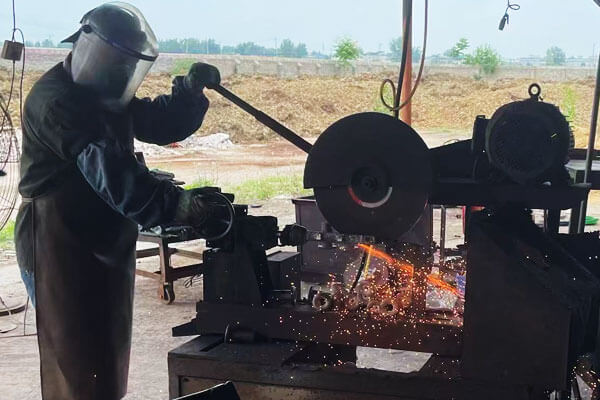
Taille primaire
À ce stade, le moulage est séparé du système de glissière et de colonne montante.
L'excédent de matière est retiré, et les premières étapes de meulage ou de nettoyage sont effectuées sur les régions de connecteur et les points de coupure.
3.8 Post-traitement et finition finale
Après la production du corps de coulée, des opérations supplémentaires sont utilisées pour respecter les dimensions finales, mécanique, et exigences de surface.
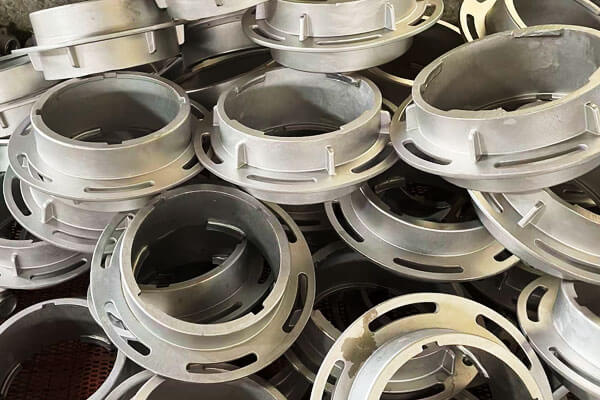
Étapes de post-traitement courantes
- Meulage et ébavurage de précision
- Traitement thermique
- Finition de surface
- Usinage de précision
- Contrôles non destructifs
- Contrôle dimensionnel final
Traitement thermique
La voie de traitement thermique dépend de l'alliage:
- l'acier au carbone peut nécessiter une normalisation, éteinte, et tempérer,
- l'acier inoxydable peut nécessiter un recuit de mise en solution,
- les alliages renforcés par précipitation peuvent nécessiter une solution et un vieillissement.
Cette étape est essentielle pour stabiliser la microstructure et obtenir les propriétés mécaniques finales.
Traitement de surface
Selon la demande, la pièce peut recevoir:
- dynamitage,
- décapage,
- passivation,
- Anodisation,
- électroplaste,
- ou revêtement protecteur.
Usinage de précision
Surfaces critiques telles que:
- faces d'assemblage,
- trous filetés,
- localisation des surfaces,
- et zones d'étanchéité
peut nécessiter un usinage supplémentaire avec de petites tolérances.
Inspection
Le contrôle de qualité final comprend généralement:
- tests de pénétrage,
- tests radiographiques,
- tests ultrasoniques,
- et mesure dimensionnelle.
Seules les pièces qui réussissent tous les contrôles requis sont classées, emballé, et livré.
4. Classification des technologies traditionnelles de moulage à modèle perdu
La manière la plus pratique de classer le moulage de précision traditionnel est de système de liant utilisé pour construire la coque en céramique.
Dans la pratique industrielle actuelle, les trois itinéraires dominants sont moulage de précision en verre d'eau, Caste d'investissement de silice Sol, et moulage de précision composite.
Cette classification est largement utilisée car le liant influence directement la résistance de la coque., précision dimensionnelle, qualité de surface, cycle de fabrication de coquilles, et les familles d'alliages que chaque itinéraire peut prendre en charge.
Coulée d'investissement en verre d'eau
Fonderie de précision en verre soluble usages silicate de sodium comme liant de coque.
Les descriptions de l'industrie le caractérisent comme un processus avec un cycle de fabrication de coques relativement court et un faible coût., ce qui le rend attrayant pour la production où les aspects économiques sont importants.
En même temps, plusieurs sources notent que les coques en verre soluble donnent généralement précision dimensionnelle inférieure et rugosité de surface plus élevée que les coquilles de sol de silice.
Cet itinéraire est donc mieux compris comme un méthode de coulée de précision axée sur les coûts.
Il est largement utilisé pour l'acier au carbone, acier à faible alliage, alliage en aluminium, et pièces moulées en alliage de cuivre, où l'équilibre du processus favorise la productivité et le prix par rapport au niveau de surface ou de tolérance le plus élevé.
Caste d'investissement de silice Sol
Moulage de précision en sol de silice usages silice colloïdale Comme le classeur.
Les sources techniques le décrivent systématiquement comme l'itinéraire de plus haute précision: il offre de meilleures tolérances dimensionnelles et géométriques, qualité de surface plus lisse, et des performances globales de coque plus élevées que celles du moulage en verre soluble.
Cela est également associé à un temps de construction des coques plus long et à un coût plus élevé., parce que la précision est obtenue grâce à une fabrication de coques plus contrôlée.
Cet itinéraire est généralement le choix privilégié pour acier inoxydable, acier résistant à la chaleur, et pièces moulées en alliage haute performance, surtout là où la pièce nécessite des détails fins, qualité de surface fiable, et un contrôle de tolérance plus strict.
En pratique, le sol de silice est la voie la plus souvent associée aux pièces industrielles exigeantes où la qualité du processus doit correspondre aux performances de l'alliage..
Moulage de précision composite
Le moulage de précision composite est un approche hybride qui combine des éléments des deux systèmes de reliure afin d'équilibrer la précision, productivité, et coûter.
Les sources de la fonderie décrivent ce type d'itinéraire comme un terrain d'entente pratique, où la conception de la coque ou la sélection du liant est ajustée de sorte que le processus ne soit pas entièrement coûteux comme le sol de silice, mais pas aussi limité en termes de coûts que le décorticage en verre soluble pur.
En termes d'ingénierie, le routage composite est utilisé lorsque la pièce a besoin meilleure rentabilité que la coulée entièrement en sol de silice mais il faut aussi meilleure qualité que le moulage en verre soluble pur.
La mise en œuvre exacte varie selon la fonderie, car les systèmes composites dépendent fortement de la façon dont le revêtement facial, manteau de sauvegarde, et la chimie des liants sont combinées.
5. Défauts de coulée typiques: Causes profondes et mesures correctives ciblées
Moulage de précision, malgré sa précision, est sensible à plusieurs types de défauts. Le tableau ci-dessous résume les défauts courants, leurs origines, et actions correctives.
| Défaut | Visuel / Signature CND | Cause première | Mesures correctives |
| Porosité des gaz | Rond, vides internes à parois lisses | Gaz dissous (H₂, N₂) dans le métal en fusion; faible désoxydation | Fusion sous vide; dégazer avec du gaz inerte; bonne pratique de désoxydation |
| Porosité de rétrécissement | Déchiqueté, vides irréguliers | Alimentation insuffisante; mauvaise conception des colonnes montantes | Augmenter la taille de la contremarche; ajouter des frissons; modifier le déclenchement pour favoriser la solidification directionnelle |
| Larme chaude | Crack avec déchiqueté, bords oxydés | Contrainte de traction lors d'une solidification tardive; contrainte de moisissure | Réduire la rigidité de la coque; température de coulée plus basse; Modifier la composition des alliages |
| Inclusion (scories, scories) | Particules non métalliques irrégulières | Coulée turbulente; fondre sale; réfractaire érodé | Utiliser une charge propre; filtres en céramique; coulée par le bas; remplissage doux |
Rugosité de surface / veinage |
Lignes surélevées ou « nageoires » au lancer | Fissuration de la coque lors du remplissage; faible résistance de la coque | Augmenter l'épaisseur de la coque; teneur plus élevée en liant; utiliser un réfractaire plus résistant |
| Egypte / fermeture à froid | Remplissage incomplet; surface pliée | Faible température de coulée; mauvaise fluidité; section mince | Augmenter la température de coulée; améliorer le déclenchement; évacuer la moisissure (moulage à vide) |
| Changement de base | Variation de l'épaisseur de paroi | Mouvement du noyau pendant la construction du gros œuvre ou le coulage | Meilleur support de base (chapelets); séchage plus lent de la coquille; pression de versement inférieure |
6. Comparaison avec le moulage au sable, Moulage sous pression, et forgeage
Les ingénieurs comparent souvent le moulage de précision avec trois voies de fabrication alternatives. Le tableau ci-dessous présente un compromis quantitatif.
| Critère d'évaluation | Moulage d'investissement | Coulée de sable | Moulage sous pression (HPDC) | Forgeage |
| Finition de surface (Rampe, µm) | 1.6–6.3 | 6.3–25 | 0.8–3.2 | 0.4–3.2 |
| Tolérance dimensionnelle (mm / 25 mm) | ±0,1–0,3 | ±0,5–1,0 | ±0,1–0,3 | ±0,05–0,2 |
| Section pratique minimale (mm) | 0.5–1.5 | 3–5 | 0.5–1.0 | 1–3 |
| Complexité géométrique | Très haut; sous-dépouille, détails fins, caractéristiques internes | Haut avec des noyaux, mais précision limitée | Modéré; capacité de contre-dépouille limitée | Faible à modéré; idéal pour les formes plus simples |
| Utilisation des matériaux | 90–95% | 60–80% | 90–95% | 60–80% |
| Coût d'outillage | Modéré à élevé | Faible à modéré | Haut | Très haut |
| Coût par pièce à volume élevé | Modéré | Faible | Très bas | Modéré |
| Coût par pièce à faible volume | Élevé sauf si l'outillage est amorti | Faible à modéré | Peu pratique en raison de la charge d'outillage | Très haut |
| Poids maximum typique | Jusqu'à environ 150 kg pour les pièces moulées en acier | Très grand; sur 10,000 kg possibles | Généralement environ 15 kg | Sur 500 kg possibles |
| Gamme alliage | Presque tous les alliages coulables | Presque tous les alliages coulables | Alliages principalement non ferreux | Tous les métaux, mais limité en géométrie |
7. Applications industrielles du moulage de précision
Le moulage à modèle perdu est utilisé dans les industries où complexité géométrique, qualité de surface, performances de l'alliage, et répétabilité importe plus que le coût de fabrication le plus bas possible.
Turbines aérospatiales et à gaz
L'aérospatiale est l'un des domaines d'application les plus exigeants techniquement pour le moulage à modèle perdu..
Composants tels que lames de turbine, aubes, buses de carburant, boîtiers de diffuseur, et autres pièces à section chaude nécessitent souvent une géométrie de profil aérodynamique complexe, murs fins, passages internes précis, et une excellente résistance à haute température.
Les superalliages à base de nickel et les alliages à base de cobalt sont largement utilisés car ils peuvent conserver leur intégrité mécanique dans des conditions thermiques et de contraintes sévères..
Dispositifs médicaux et implants
Les applications médicales imposent un ensemble différent d'exigences au processus.
Des pièces telles que implants orthopédiques, tiges de hanche, plateaux de genou, instruments chirurgicaux, et matériel anatomique de précision nécessitent une biocompatibilité, qualité de surface, précision dimensionnelle, et des performances mécaniques fiables.
Les matériaux communs comprennent 316L en acier inoxydable, Alliages Co-Cr-Mo, et des alliages de titane tels que TI-6AL-4V.
Automobile et transports
Dans le secteur automobile, le moulage de précision est utilisé pour des composants tels que roues de turbocompresseur, collecteurs d'échappement, Composants liés à l'EGR, fourchettes de changement de vitesse, supports, et autres matériels hautes performances.
Ces pièces nécessitent souvent un équilibre de résistance thermique, contrôle du poids, et complexité géométrique.
Les aciers inoxydables et les aciers à haute teneur en carbone ou alliés sont couramment utilisés en fonction du cas de charge thermique et mécanique..
Pétrole et gaz, traitement chimique, et gestion des fluides
Les industries pétrolières, gazières et chimiques dépendent fortement du fondage de précision pour corps de valve, pompes, boîtiers de débitmètre, raccords, et composants d'écoulement résistants à la corrosion.
Les matériaux typiques comprennent Acier inoxydable de type CF-8M, aciers inoxydables duplex, et alliages résistants à la corrosion à base de nickel.
Production d'électricité et équipements thermiques
La production d’électricité place les investissements dans certaines de ses conditions de service les plus sévères.
Composants tels que revêtements de combustion, pièces de transition, anneaux de buse, et autres matériels à gaz chauds sont exposés à l’oxydation, cyclisme thermique, et flux de gaz à haute température.
Les aciers inoxydables tels que 310 et les alliages à base de nickel tels que Décevoir 625 sont couramment utilisés en raison de leur capacité à températures élevées.
10. Conclusion
Le casting d’investissement est une entreprise mature, technologie de formage de précision des métaux à branches multiples et en constante évolution.
Sa valeur fondamentale réside dans la suppression des limites structurelles des moules traditionnels et dans la réalisation d'un formage intégré proche de la forme nette de composants complexes hautes performances..
Les trois principales filières techniques basées sur les liants forment un marché clairement hiérarchisé: Le moulage de précision en verre soluble à faible coût domine les pièces industrielles générales de précision moyenne,
tandis que le moulage de précision au sol de silice de haute pureté devient la référence en matière de composants de précision haut de gamme dans l'aérospatiale., domaines médicaux et énergétiques haut de gamme.
La qualité des pièces moulées de précision dépend du contrôle précis de la chaîne complète de fabrication des modèles en cire., fabrication de coquilles, déwax, cuisson, fondre et verser.
Chaque paramètre de processus et norme opérationnelle est verrouillé, et toute négligence déclenchera des défauts en cascade.
Bien que limité par le cycle de production et le coût dans certains scénarios, ses avantages uniques dans la formation de structures complexes, la qualité métallurgique et l'adaptabilité des matériaux assurent son statut irremplaçable dans la fabrication haut de gamme.
Poussé par une fabrication intelligente, production verte et itération de nouveaux matériaux, Le moulage de précision moderne permettra de surmonter davantage les goulots d'étranglement techniques, améliorer l'efficacité de la production et réduire les coûts globaux.
En tant que technologie fondamentale de moulage de précision, il continuera à soutenir la mise à niveau de la fabrication mondiale d'équipements haut de gamme et à élargir ses limites d'application dans les industries émergentes.
FAQ
Quelle est l’idée principale derrière le casting d’investissement?
Un patron jetable en cire ou en plastique est entouré d'une coque en céramique, le motif est supprimé, et le métal en fusion est versé dans la cavité pour créer une pièce de forme presque nette.
Pourquoi le moulage de précision est-il choisi plutôt que le moulage en sable?
Parce que cela donne généralement des détails plus fins, meilleure finition de surface, et des tolérances plus strictes, qui réduisent les travaux de finition.
Quel système de reliure donne la plus haute précision?
Le sol de silice est généralement utilisé pour la plus haute précision, moulages de précision à surface lisse, tandis que les systèmes de verre à eau sont plus axés sur les coûts.
Quels sont les défauts les plus courants?
Inclusions, porosité, Défauts de retrait, mauvais fonctionnement/fermeture à froid, et la fissuration des coques sont parmi les problèmes de moulage les plus courants..

