1. Introduction
3Impression D, également connu sous le nom de fabrication additive, a révolutionné la production moderne en permettant un prototypage rapide, personnalisation, et fabrication rentable.
Contrairement à la fabrication soustractive traditionnelle, qui enlève de la matière d'un bloc solide, 3L’impression D construit des objets couche par couche à partir de modèles numériques.
Initialement développé pour le prototypage, il s'est maintenant étendu à des applications industrielles à grande échelle, allant de l'aérospatiale à la santé.
Cet article explore les principes fondamentaux de l'impression 3D, technologies clés, options matérielles, applications de l'industrie, avantages, défis, et les innovations futures qui façonnent cette technologie transformatrice.
2. Fondamentaux de l'impression 3D
3Impression D, également connu sous le nom de fabrication additive, a transformé la façon dont les produits sont conçus, prototypé, et fabriqué.
Contrairement à la fabrication soustractive traditionnelle, où la matière est retirée d'un bloc solide, 3L’impression D construit des objets couche par couche à partir de modèles numériques.
Cette approche permet des géométries complexes, réduit les déchets de matériaux, et permet une production à la demande.
Qu'est-ce que l'impression 3D?
3L'impression D est un procédé de fabrication additive qui crée des objets physiques à partir de conceptions numériques en ajoutant successivement de la matière en couches.
Le processus est guidé par des machines contrôlées par ordinateur qui suivent les instructions d'un 3Modèle D.
Flux de travail de base de l'impression 3D
Le processus d'impression 3D suit un flux de travail standardisé:
- 3D Modélisation – L’objet est conçu à l’aide GOUJAT (Conception Assistée par Ordinateur) logiciel.
- Tranchage – Le modèle est converti en calques et instructions à l’aide d’un logiciel de slicing.
- Impression – L’imprimante 3D suit les instructions pour construire l’objet.
- Post-traitement – L’objet imprimé subit un nettoyage, durcissement, ou traitements de finition.
3. Technologies de base dans l'impression 3D
3Les technologies d’impression D ont considérablement évolué, offrant des solutions diverses pour diverses industries.
Chaque méthode présente des avantages distincts en termes de précision, compatibilité des matériaux, vitesse de production, et champ d'application.
Les technologies les plus largement utilisées comprennent Modélisation des dépôts fusionnés (FDM), Stéréolithmicromographie (Sla), Frittage laser sélectif (SLS),
Frittage laser en métal direct (DML) / Maisse par faisceau d'électrons (EBM), Jet de liant, et Jet de matériau.
Modélisation des dépôts fusionnés (FDM) – Abordable et polyvalent
Processus:
FDM, également connu sous le nom Fabrication de filaments fondus (FFF), extrude le filament thermoplastique à travers une buse chauffée, déposer du matériau couche par couche pour créer un objet.
L'imprimante se déplace selon le modèle numérique découpé, construire progressivement la structure.

Caractéristiques clés:
- Matériaux communs: PLA, ABS, PETG, Nylon, TPU
- Résolution: 50–400 microns
- Forces: Faible coût, convivial, prototypage rapide
- Limites: Lignes de calque visibles, qualité de surface limitée, résistance inférieure par rapport aux méthodes industrielles
Aperçu de l'industrie:
Selon une analyse de marché, FDM représente plus de 50% des applications d'impression 3D de bureau, ce qui en fait la technique la plus utilisée au monde.
Stéréolithmicromographie (Sla) – Impression en résine haute résolution
Processus:
SLA emploie un ultra-violet (UV) laser pour solidifier la résine liquide, former des couches précises. Le laser durcit sélectivement le photopolymère, façonner progressivement l'objet final.

Caractéristiques clés:
- Matériaux communs: Résines standards, résines résistantes, résines dentaires
- Résolution: 25–100 microns
- Forces: Haute précision, finition de surface lisse, détails fins
- Limites: Nécessite le post-traitement (lavage, durcissement), matériaux cassants
Frittage laser sélectif (SLS) – Pièces solides et durables
Processus:
SLS utilise un laser haute puissance faire fondre un matériau en poudre, typiquement nylon ou thermoplastique, en couches solides.
Puisque SLS ne nécessite pas de structures de support, il permet la création de géométries complexes.

Caractéristiques clés:
- Matériaux communs: Nylon, TPU, poudres composites
- Résolution: 50–120 microns
- Forces: Fort, pièces durables avec des conceptions complexes, aucune structure de support n'est nécessaire
- Limites: Imprimantes coûteuses de qualité industrielle, finition de surface rugueuse
Aperçu de l'industrie:
SLS est largement utilisé pour les applications industrielles, avec Nylon 12 étant le document le plus couramment imprimé en raison de son haute résistance à la traction et flexibilité.
Frittage laser en métal direct (DML) & Maisse par faisceau d'électrons (EBM) – Impression 3D métal pour applications industrielles
Processus:
DMLS et EBM sont des technologies de fabrication additive métallique qui utiliser des sources à haute énergie (lasers ou faisceaux d'électrons) fondre des poudres métalliques en pièces solides.
La principale différence est que DMLS utilise un laser dans un environnement de gaz inerte, alors que EBM utilise un faisceau d'électrons dans une chambre à vide.

Caractéristiques clés:
- Matériaux communs: Titane, aluminium, acier inoxydable, chrome de cobalt
- Résolution: 20–100 microns
- Forces: Pièces métalliques à haute résistance, Excellentes propriétés mécaniques, structures légères
- Limites: Cher, vitesses d'impression lentes, post-traitement approfondi requis
Aperçu de l'industrie:
Par 2030, le l’industrie de l’impression 3D métal devrait dépasser $20 milliard, porté par les progrès de l’aérospatiale et de la médecine.
Jet de liant – Fabrication rapide et évolutive
Processus:
Le jet de liant pulvérise un liant liquide sur des couches de matériau en poudre, les lier ensemble.
Contrairement à SLS ou DMLS, le jet de liant n'utilise pas de lasers, le faire plus rapide et plus rentable pour une production à volume élevé.

Caractéristiques clés:
- Matériaux communs: Métal, sable, céramique, polymères polychromes
- Résolution: 50–200 microns
- Forces: Vitesses de production rapides, capacités multi-matériaux, impression en couleur
- Limites: Nécessite le post-traitement (frittage, infiltration), résistance mécanique inférieure
Aperçu de l'industrie:
Le jet de liant gagne du terrain pour production de pièces métalliques en série, offre 50–Vitesse d'impression 100 fois plus rapide que DMLS.
Jetting de matériaux – Impression couleur et multi-matériaux
Processus:
Le jet de matériau dépose des gouttelettes liquides de photopolymère, qui sont ensuite durcis couche par couche à l'aide de la lumière UV.
Cela permet une impression haute résolution avec plusieurs couleurs et combinaisons de matériaux.

Caractéristiques clés:
- Matériaux communs: Photopolymères, cire, céramique
- Résolution: 16–50 microns
- Forces: Grande précision, capacité de couleur, surfaces lisses
- Limites: Cher, matériaux cassants, résistance limitée
Aperçu de l'industrie:
Le jet de matière permet impression multi-matériaux avec plus de 500,000 variations de couleurs, ce qui en fait un choix de premier plan pour prototypage de produits haut de gamme.
4. Matériaux utilisés dans l'impression 3D
Le choix des matériaux est un facteur crucial en impression 3D, influençant les propriétés mécaniques, durabilité, coût, et champ d'application des pièces imprimées.
Largement, 3Les matériaux d'impression D peuvent être classés en polymères, métaux, céramique, et composites.
Chaque catégorie possède des caractéristiques uniques qui la rendent adaptée à des applications spécifiques.
4.1 Polymères – polyvalents et économiques
Les polymères sont les matériaux les plus couramment utilisés dans l’impression 3D en raison de leur prix abordable., facilité de traitement, et large gamme d'applications. Ces matériaux sont disponibles en filament, résine, ou sous forme de poudre, en fonction du processus d'impression 3D.
Thermoplastique (FDM, SLS)
Les thermoplastiques se ramollissent lorsqu'ils sont chauffés et se solidifient en refroidissant, les rendre adaptés à Modélisation des dépôts fusionnés (FDM) et Frittage laser sélectif (SLS).
| Matériel | Propriétés clés | Applications communes |
|---|---|---|
| PLA (Acide polylactique) | Biodégradable, facile à imprimer, faible déformation | Prototypage, modèles amateurs |
| ABS (Acrylonitrile butadiène styrène) | Difficile, résistant à l'impact, résistant à la chaleur | Pièces automobiles, biens de consommation |
| PETG (Polyéthylène téréphtalate glycol) | Fort, résistant aux produits chimiques, alimentaire | Dispositifs médicaux, bouteilles d'eau |
| Nylon (Polyamide) | Flexible, à l'usure, durable | Engrenages, pièces mécaniques |
Photopolymères (Sla, DLP)
Les photopolymères sont résines photosensibles utilisé dans Stéréolithmicromographie (Sla) et Traitement numérique de la lumière (DLP) impression.
Ils offrent haute résolution et finitions de surface lisses, mais a tendance à être fragile.
| Matériel | Propriétés clés | Applications communes |
|---|---|---|
| Résine standard | Détail élevé, finition lisse | Prototypes, figurines |
| Résine résistante | Résistant aux chocs, plus résistant que la résine standard | Pièces fonctionnelles |
| Résine souple | Similaire au caoutchouc, propriétés élastiques | Appareils portables, poignées |
| Résine dentaire | Biocompatible, précis | Aligneurs dentaires, couronnes |
Polymères haute performance (Jeter un coup d'œil, Ultem)
Utilisé dans applications industrielles et aérospatiales, exposition sur les polymères hautes performances propriétés mécaniques et thermiques supérieures.
| Matériel | Propriétés clés | Applications communes |
|---|---|---|
| Jeter un coup d'œil (Polyether Ether Ketone) | Chaleur élevée & résistance chimique, fort | Aérospatial, implants médicaux |
| Ultem (Polyétherimide – Î.-P.-É.) | Forte résistance, ignifuge | Intérieurs d'avions, automobile |
4.2 Métaux – Haute résistance et applications industrielles
L'impression 3D métal permet de créer complexe, pièces à haute résistance pour les industries exigeantes comme l'aéronautique, médical, et l'automobile.
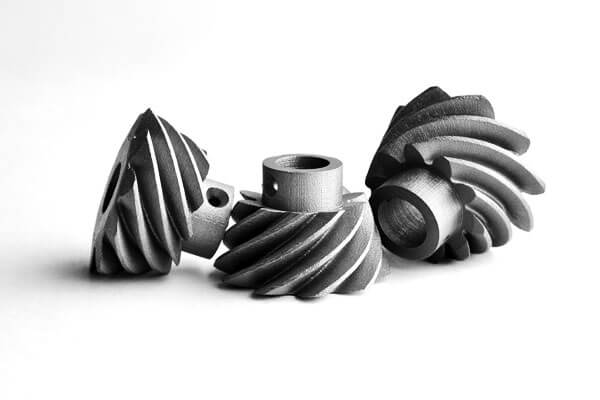
Ces matériaux sont généralement utilisés dans Frittage laser en métal direct (DML), Maisse par faisceau d'électrons (EBM), et jet de liant.
| Matériel | Propriétés clés | Applications communes |
|---|---|---|
| Titane (TI-6AL-4V) | Léger, fort, résistant à la corrosion | Aérospatial, implants médicaux |
| Acier inoxydable (316L, 17-4 PH) | Durable, à l'usure | Outils industriels, instruments chirurgicaux |
Aluminium (ALSI10MG) |
Léger, bonne conductivité thermique | Automobile, électronique |
| Cobalt-Chrome (CoCr) | Biocompatible, résistant aux hautes températures | Implants dentaires, lames de turbine |
| Alliages nickel (Décevoir 625, 718) | Résistant à la chaleur et à la corrosion | Moteurs à réaction, centrales électriques |
4.3 Céramique – Résistance à la chaleur et à l’usure
Les matériaux céramiques sont utilisés dans des applications qui nécessitent résistance aux hautes températures, stabilité chimique, et la dureté.
Ces documents sont imprimés en utilisant jet de liant, Sla, ou méthodes basées sur l'extrusion.
| Matériel | Propriétés clés | Applications communes |
|---|---|---|
| Carbure de silicium (Sic) | Forte résistance, résistant à la chaleur | Aérospatial, électronique |
| Alumine (Al2o3) | Dur, chimiquement inerte | Implants biomédicaux, composants industriels |
| Zircone (Zro2) | Difficile, à l'usure | Couronnes dentaires, outils de coupe |
4.4 Composite & Matériaux avancés – Performances améliorées
Les composites se combinent polymères, métaux, ou céramiques avec fibres de renfort pour améliorer résistance mécanique, conductivité, ou flexibilité.
Composites renforcés de fibres
La fibre de carbone et la fibre de verre sont incorporé dans des thermoplastiques pour améliorer la force et réduire le poids.
| Matériel | Propriétés clés | Applications communes |
|---|---|---|
| Fibre de carbone Nylon renforcé | Ratio de force / poids élevé | Drones, robotique, automobile |
| PLA renforcé de fibre de verre | Rigide, résistant à l'impact | Composants structurels |
Matériaux intelligents et biodégradables
Innovations dans matériaux biosourcés et auto-réparateurs étendent les possibilités d’impression 3D.
| Matériel | Propriétés clés | Applications communes |
|---|---|---|
| Polymères conducteurs | Conductivité électrique | Electronique imprimée, capteurs |
| Polymères auto-guérison | Répare les dégâts mineurs | Portables, composants aérospatiaux |
| Mélanges de PLA biodégradables | Écologique, compostable | Emballage durable, implants médicaux |
5. Impressions 3D en post-traitement
Le post-traitement est une étape critique de l'impression 3D qui améliore les propriétés mécaniques, qualité de surface, et fonctionnalité des pièces imprimées.
Étant donné que les objets bruts imprimés en 3D présentent souvent lignes de calque, rugosité de la surface, et matières résiduelles, diverses techniques de post-traitement sont appliquées en fonction de type de matériau, processus d'impression, et l'application prévue.

Le choix de la méthode de post-traitement dépend de facteurs tels que exigences esthétiques, précision dimensionnelle, intégrité structurelle, et les conditions environnementales la pièce sera exposée à.
Ci-dessous se trouve un analyse complète des techniques de post-traitement les plus courantes pour différentes technologies d'impression 3D.
Pourquoi le post-traitement est-il important?
- Améliore la finition de la surface – Réduit la rugosité et améliore l’esthétique.
- Améliore la résistance mécanique – Supprime les micro-défauts et renforce la durabilité des pièces.
- Optimise la fonctionnalité – Ajuste les propriétés telles que la flexibilité, conductivité, et porter une résistance.
- Supprime les supports & Matière résiduelle – Garantit que la pièce est exempte d’excès de matériau ou d’artefacts disgracieux.
- Permet des traitements supplémentaires – Permet de peinture, placage, ou scellé, en fonction des besoins de l'application.
Techniques de post-traitement courantes par technologie d'impression
Modélisation des dépôts fusionnés (FDM) Post-traitement
Les impressions FDM ont souvent lignes de couche visibles et nécessitent le retrait du support. Les techniques de post-traitement les plus courantes comprennent:
| Technique | Processus | Avantages | Défis |
|---|---|---|---|
| Suppression du support | Couper ou dissoudre les structures de support (Le PVA se dissout dans l'eau, HIPS se dissout dans le limonène). | Prévient les dommages superficiels. | Nécessite une manipulation soigneuse pour éviter la casse. |
| Ponçage & Polissage | Utiliser du papier de verre (120–2000 grains) pour lisser la surface. | Améliore l'esthétique et réduit la visibilité des couches. | Prend du temps, peut modifier les dimensions. |
Lissage chimique |
Exposition d'une pièce aux vapeurs de solvants (acétone pour ABS, acétate d'éthyle pour PLA). | Obtient une finition brillante, élimine les lignes de calque. | Peut affaiblir la structure de la pièce en cas de surexposition. |
| Peinture & Revêtement | Apprêt et application de peinture, revêtements transparents, ou traitements hydrophobes. | Améliore la couleur, durabilité, et protection. | Nécessite une bonne préparation de la surface. |
Stéréolithmicromographie (Sla) & Traitement numérique de la lumière (DLP) Post-traitement
Puisque SLA et DLP utilisent de la résine liquide, le post-traitement se concentre sur durcir et améliorer la finition de surface fragile.
| Technique | Processus | Avantages | Défis |
|---|---|---|---|
| Durcissement UV | Exposer les impressions à la lumière UV pour renforcer la résine. | Améliore la durabilité. | Nécessite un temps de durcissement approprié pour éviter la fragilité. |
| Alcool isopropylique (API) Rincer | Nettoyer l'excès de résine non durcie avec de l'IPA (90%+ concentration). | Assure une douceur, impressions propres. | Un trempage excessif peut provoquer une déformation. |
| Ponçage & Polissage | Ponçage humide pour obtenir une surface plus lisse. | Améliore l’esthétique et l’adhérence de la peinture. | Peut supprimer des détails fins. |
| Revêtement transparent & Peinture | Application de revêtements ou de colorants résistants aux UV. | Ajoute de la couleur et de la protection. | Peut modifier la translucidité de l’impression. |
Exemple de l'industrie:
Dans applications dentaires et médicales, imprimé SLA guides chirurgicaux et modèles orthodontiques subir Nettoyage IPA et durcissement UV pour assurer la biocompatibilité et la résistance mécanique.
Frittage laser sélectif (SLS) Post-traitement
Les impressions SLS sont à base de poudre et présentent souvent une texture granuleuse. Le post-traitement se concentre principalement sur lissage et renforcement les pièces.
| Technique | Processus | Avantages | Défis |
|---|---|---|---|
| Élimination de la poudre | Sablage à l'air comprimé ou culbutage pour éliminer l'excès de poudre. | Assure des pièces propres et fonctionnelles. | Les poudres fines nécessitent une élimination appropriée. |
| Teinture & Coloration | Immerger les pièces dans des bains de teinture pour une coloration uniforme. | Améliore esthétiquement les pièces. | Limité aux couleurs sombres. |
| Lissage de la vapeur | Utiliser des vapeurs chimiques pour faire fondre et lisser les couches externes. | Crée une finition semi-brillante, améliore les propriétés mécaniques. | Nécessite une exposition chimique contrôlée. |
| Microbillage & Culbutage | Utiliser des médias fins (céramique, perles de verre) aux surfaces lisses. | Réduit la porosité et améliore la finition. | Peut légèrement modifier les dimensions. |
Exemple de l'industrie:
Nike et Adidas utiliser SLS pour la fabrication de semelles de chaussures, où lissage et teinture à la vapeur offrent une finition douce au toucher et mieux se résistance à l'usure.
Frittage laser en métal direct (DML) & Maisse par faisceau d'électrons (EBM) Post-traitement
Les impressions 3D métalliques nécessitent post-traitement approfondi pour obtenir les propriétés mécaniques et la finition de surface souhaitées.
| Technique | Processus | Avantages | Défis |
|---|---|---|---|
| Suppression du support (Électroérosion à fil, Découpe CNC) | Découpe de structures de support métalliques par usinage par électroérosion (GED). | Assure la précision dans les géométries complexes. | Travail intensif pour les pièces complexes. |
| Traitement thermique (Recuit, HANCHE) | Chauffage pour réduire les contraintes résiduelles et améliorer la ténacité. | Améliore la résistance des pièces, empêche les fissures. | Nécessite des cycles thermiques contrôlés. |
| Usinage (CNC, Affûtage, Clapotis) | Affinage des dimensions avec fraisage ou meulage CNC. | Permet d'obtenir une haute précision et des finitions lisses. | Ajoute du temps et des coûts de traitement. |
| Électropolition | Utiliser un procédé électrolytique pour lisser les surfaces. | Améliore la résistance à la corrosion, esthétique. | Fonctionne uniquement sur les métaux conducteurs. |
Exemple de l'industrie:
Dans applications aérospatiales, Pièces en titane produites par DMLS pour moteurs à réaction subir Pressage isostatique chaud (HANCHE) éliminer micro-porosité et améliorer résistance à la fatigue.
Techniques de finition avancées
Pour applications hautes performances, des techniques de finition supplémentaires sont utilisées:
- Galvanoplastie – Revêtement des pièces avec nickel, cuivre, ou or pour améliorer la conductivité et la résistance à la corrosion.
- Revêtement céramique – Améliorer la résistance à l’usure et la protection thermique des composants métalliques.
- Fabrication hybride – Combiner 3Impression D avec usinage CNC pour pièces de haute précision.
6. Avantages et défis de l'impression 3D
Cette section propose une analyse approfondie de principaux avantages et défis de l'impression 3D dans les industries modernes.
Principaux avantages de l'impression 3D
Liberté de conception et personnalisation
Contrairement à la fabrication traditionnelle, qui s'appuie sur des moules, coupe, et assemblage,
3L'impression D permet création de géométries complexes ce serait impossible ou d'un coût prohibitif en utilisant des méthodes conventionnelles.
- Personnalisation de masse – Les produits peuvent être personnalisés pour des clients individuels sans frais supplémentaires.
- Géométries complexes – Structures de treillis complexes, canaux internes, et les formes organiques sont réalisables.
- Conceptions légères – Les industries aérospatiale et automobile utilisent l’optimisation de la topologie pour réduire le poids sans sacrifier la résistance.
Prototypage rapide et production plus rapide
Le prototypage traditionnel peut prendre semaines ou mois, mais 3L'impression D accélère le cycle de développement de manière significative.
- 90% prototypage plus rapide – Un concept peut partir de conception d'un prototype fonctionnel dans une affaire de heures ou jours.
- Innovation accélérée – Les entreprises peuvent tester rapidement plusieurs itérations de conception, amélioration efficacité du développement de produits.
- Production à la demande – Élimine les longues chaînes d’approvisionnement, réduire frais d'entreposage et d'inventaire.
Réduction des déchets de matériaux et durabilité
Contrairement à la fabrication soustractive (Par exemple, Usinage CNC), qui enlève de la matière pour façonner un objet, 3L'impression D construit des pièces couche par couche, réduire considérablement les déchets.
- Jusqu'à 90% moins de déchets matériels par rapport à l'usinage conventionnel.
- Matériaux recyclables tels que le PLA biosourcé et les polymères recyclés améliorent la durabilité.
- Production localisée réduit l’empreinte carbone associée aux chaînes d’approvisionnement mondiales.
Réduction des coûts dans la production à faible volume
Pour fabrication en faible volume ou spécialisée, 3L'impression D est significativement plus rentable que la fabrication traditionnelle.
- Pas de frais de moule ou d'outillage – Idéal pour la production en petites séries et marchés à faible demande.
- Réduit les étapes d'usinage coûteuses – Élimine plusieurs processus de fabrication (fonderie, fraisage, forage).
- Abordable pour les startups & petites entreprises – Réduit les barrières à l’entrée pour l’innovation manufacturière.
Intégration fonctionnelle & Réduction de l'assemblage
3L'impression D permet consolidation de pièces, permettant de combiner plusieurs composants en un seul conception intégrée.
- Réduit la complexité de l’assemblage – Moins de pièces signifie moins de travail et moins de points de défaillance potentiels.
- Améliore l’intégrité structurelle – Élimine le besoin de vis, soudures, ou des adhésifs.
Défis et limites de l'impression 3D
Sélection de matériaux limités
Alors que l’impression 3D s’est étendue au-delà des plastiques pour inclure les métaux, céramique, et composites, le la gamme de documents imprimables reste limitée par rapport à la fabrication traditionnelle.
- Propriétés mécaniques – De nombreux documents imprimés ne correspondent pas aux force, ductilité, ou résistance à la chaleur de pièces fabriquées de manière conventionnelle.
- Coûts du matériel – Matériaux performants (Par exemple, titane, Jeter un coup d'œil, Ultem) sont chers.
- Manque de standardisation – Les propriétés des matériaux varient selon les modèles et fabricants d'imprimantes.
Exigences de post-traitement
La plupart des pièces imprimées en 3D nécessitent étapes de finition supplémentaires avant qu'ils soient utilisables.
- Lissage des surfaces – De nombreuses pièces sont visibles lignes de calque et exiger ponçage, polissage, ou lissage à la vapeur.
- Traitement thermique – Les impressions métalliques nécessitent souvent recuit ou pressage isostatique à chaud (HANCHE) pour éliminer les contraintes internes.
- Suppression de la structure de support – De nombreux processus, tel que Sla, SLS, et DMLS, nécessiter une attention particulière élimination des excédents de matière.
Coûts d’investissement initiaux élevés
Même si les coûts diminuent, les imprimantes et matériaux 3D de qualité industrielle restent chers.
- Imprimantes 3D métal coût $250,000 à $1 million.
- Imprimantes polymères haut de gamme (Sla, SLS) vont de $50,000 à $200,000.
- Coûts du matériel sont souvent 5–10x plus élevé que les matériaux de fabrication conventionnels.
Problèmes de vitesse et d'évolutivité
Alors que le prototypage est rapide, la production de masse avec l’impression 3D reste plus lente que le moulage par injection ou l'usinage.
- Faibles vitesses d'impression – Les grandes pièces peuvent prendre plusieurs jours imprimer.
- Évolutivité limitée – Impression des milliers de pièces est toujours plus lent et plus cher que les méthodes traditionnelles.
- Traitement par lots requis – Pour gagner en efficacité, plusieurs parties sont souvent imprimées en même temps, ce qui complique le contrôle qualité.
7. Applications de l'impression 3D dans tous les secteurs
Du prototypage rapide à la production en série de géométries complexes, 3Offres d'impression D une flexibilité de conception sans précédent, réduction des coûts, et efficacité des matériaux.
Son impact s’étend à un large éventail de secteurs, y compris la fabrication, aérospatial, Soins de santé, automobile, construction, Et plus.
Fabrication & Prototypage
Prototypage rapide
L'une des applications les plus importantes de l'impression 3D dans le secteur manufacturier est prototypage rapide.
Méthodes de prototypage traditionnelles, comme le moulage par injection, peut prendre des semaines ou des mois pour être mis en place et produire.
En revanche, 3L'impression D permet itération plus rapide, avec des prototypes généralement créés dans heures ou jours, permettant des tests et une validation de conception rapides.
- Économie: 3L'impression D élimine le besoin de moules coûteux, outillage, et les longs temps de configuration associés.
- Personnalisation: Complexe, des pièces personnalisées peuvent être produites sans coûts ni configuration supplémentaires.
Ceci est particulièrement utile dans production en petites séries ou lors de la création de composants qui doivent être adaptés aux besoins spécifiques du client.
Production d'outillage et d'utilisation finale
Au-delà du prototypage, 3L'impression D joue également un rôle clé dans outillage Et même pièces d'utilisation finale.
Composants comme des gabarits, luminaires, et les moules peuvent être produits rapidement et efficacement grâce à l'impression 3D, réduisant le temps et les coûts de production.
- Outillage à la demande permet des ajustements rapides de la conception sans longs délais de livraison.
- Les entreprises produisent de plus en plus pièces d'utilisation finale pour des applications spécifiques, tels que des implants médicaux personnalisés ou des composants automobiles légers.
Aérospatial & Automobile
Applications aérospatiales
L'industrie aérospatiale a été à l'avant-garde de l'adoption de l'impression 3D en raison de sa capacité à produire léger, parties complexes avec rapport résistance/poids exceptionnel.
Composants fabriqués à partir de frittage laser direct des métaux (DML) ou fusion par faisceau d'électrons (EBM) sont essentiels pour réduire le poids des avions,
qui contribue directement à efficacité énergétique et économies de coûts.
- Personnalisation: 3L'impression D permet de réaliser des pièces sur mesure pour applications aérospatiales spécifiques, tels que des pales de turbine ou des supports optimisés pour les performances.
- Économies de coûts: La production de géométries complexes qui nécessiterait autrement plusieurs étapes de fabrication peut réduire considérablement les coûts.
Applications automobiles
Dans le secteur automobile, 3L'impression D est utilisée pour créer prototypes fonctionnels, pièces personnalisées, Et même outils de production.
À mesure que l'industrie s'oriente vers davantage durable et économe en énergie véhicules, 3L'impression D offre des moyens de produire des produits légers, composants complexes.
- Personnalisation: 3L'impression D permet aux constructeurs automobiles de produire pièces personnalisées sur demande,
tels que des composants intérieurs spécialisés, prototypes pour nouveaux modèles, et même léger, pièces de moteur durables. - Une mise sur le marché plus rapide: 3L'impression D réduit le temps de développement en permettant des tests et des itérations plus rapides des prototypes.

Médical & Soins de santé
Prothèses et implants personnalisés
L'une des utilisations les plus marquantes de l'impression 3D réside dans dispositifs médicaux, en particulier pour prothèses sur mesure et implants.
Les méthodes de fabrication traditionnelles ont souvent du mal à produire des appareils hautement personnalisés, mais l'impression 3D excelle dans la création solutions spécifiques au patient.
- Personnalisation: Avec l'impression 3D, les prothèses peuvent être conçues et produites pour spécifications exactes, assurer un ajustement parfait pour le patient.
- Rentabilité: Les prothèses et implants traditionnels impliquent souvent des processus coûteux et longs. 3L'impression D permet production plus rapide et réduire les coûts.
Bio-impression
La bio-impression est un domaine émergent de l'impression 3D qui utilise des cellules vivantes pour créer structures tissulaires Et même modèles d'orgues.
Même si nous en sommes encore aux premiers stades, la bio-impression est très prometteuse pour l'avenir de médecine personnalisée, pouvant conduire à la création de tissus et organes issus de la bio-ingénierie.
- Ingénierie tissulaire: Les tissus bio-imprimés pourraient éventuellement être utilisés pour tester des médicaments, réduire le besoin d’expérimentation animale.
- Médecine régénérative: La recherche en bio-impression explore la possibilité de impression d'organes entièrement fonctionnels pour transplantation.
Construction & Architecture
3Bâtiments imprimés en D
Dans le secteur du bâtiment, 3L'impression D révolutionne la manière bâtiments et structure sont conçus et construits.
La technologie a permis de imprimer des bâtiments entiers, réduisant considérablement les coûts et les délais de construction.
- Réduction des coûts: 3L'impression D peut réduire les coûts de construction jusqu'à 50%, car cela nécessite moins de travailleurs et de matériaux.
- Durabilité: Avec la possibilité d'utiliser des matériaux recyclés dans le processus d'impression, 3L'impression D contribue à des méthodes de construction plus durables.
Géométries complexes
L'un des principaux avantages de l'impression 3D dans le secteur de la construction est la possibilité de concevoir et d'imprimer. formes architecturales complexes difficiles ou impossibles à créer avec des méthodes traditionnelles.
Cela ouvre de nouvelles possibilités pour des conceptions architecturales innovantes et structures.
Biens de consommation & Électronique
Produits de consommation personnalisés
Dans l'industrie des biens de consommation, 3L'impression D permet aux fabricants de produire personnalisé, produits sur commande.
Qu'il s'agisse de bijoux personnalisés, chaussures sur mesure, ou accessoires de mode sur mesure, 3L'impression D offre une personnalisation inégalée à une fraction du coût des méthodes traditionnelles.
- Personnalisation du produit: Les consommateurs peuvent concevoir leurs produits et les faire imprimer à la demande, éliminer la production de masse et réduire les déchets.
- Industrie de la mode: Les créateurs exploitent l'impression 3D pour créer des pièces de mode innovantes, tel que bijoux personnalisés Et même technologie portable.
Fabrication d'électronique
3L'impression D joue également un rôle important dans le industrie électronique, où il est utilisé pour imprimer cartes de circuits imprimées, composants miniaturisés, et enclos pour appareils électroniques.
La capacité de produire des géométries complexes à petite échelle, des pièces complexes ont ouvert des possibilités pour électronique personnalisée.
- Electronique fonctionnelle: Les entreprises utilisent désormais matériaux d'impression 3D conducteurs imprimer composants électroniques fonctionnels, comme les antennes, condensateurs, et traces de circuits.
- Prototypage et tests: 3L'impression D permet une itération et tests de nouveaux produits et appareils électroniques.
8. Fabrication additive vs fabrication traditionnelle
La comparaison entre fabrication additive (3Impression D) et méthodes de fabrication traditionnelles,
tel que soustraire et fabrication formative, met en évidence les forces et les défis uniques de chaque approche.
Comprendre ces méthodes est crucial pour les industries qui cherchent à sélectionner le processus de fabrication le plus efficace et le plus rentable en fonction de leurs besoins spécifiques..
Fabrication additive (3D Impression)
Aperçu du processus
Fabrication additive (SUIS), communément appelé 3Impression D, implique de créer objets tridimensionnels en déposant du matériau couche par couche basé sur une conception numérique.
Contrairement à la fabrication traditionnelle, où le matériau est enlevé ou façonné par la force, La fabrication additive est un processus de construire matériel, ce qui lui confère des avantages uniques en termes de liberté de conception et d'efficacité des matériaux.
Caractéristiques clés
- Efficacité des matériaux: AM utilise uniquement le matériel nécessaire à la pièce, Réduire les déchets.
Contrairement aux méthodes soustractives, qui coupe le matériau d'un bloc solide, 3L'impression D construit l'objet, utiliser moins de matière première. - Flexibilité de conception: La FA permet la création de géométries complexes avec facilité,
y compris des structures internes complexes, formes organiques, et des conceptions personnalisées qui seraient impossibles ou coûteuses avec les méthodes traditionnelles. - Vitesse: Même si la fabrication additive peut être plus lente que les processus traditionnels pour les gros lots, il offre capacités de prototypage rapide.
Vous pouvez créer et tester un prototype en quelques heures ou jours, un processus qui pourrait prendre semaines avec des méthodes traditionnelles.
Fabrication soustractive
Aperçu du processus
La fabrication soustractive consiste à retirer de la matière d'un bloc solide (désigné comme un vide) en utilisant des outils mécaniques comme fraisage, tournant, et affûtage.
La matière est découpée progressivement pour façonner l'objet, laissant derrière lui la dernière partie. Cette méthode est l’une des plus anciennes et des plus couramment utilisées dans la fabrication.
Caractéristiques clés
- Précision et finition de surface: La fabrication soustractive est connue pour haute précision et
capacité à créer des pièces avec d'excellentes finitions de surface, ce qui le rend idéal pour produire des composants avec des tolérances serrées. - Déchets: Un inconvénient majeur de la fabrication soustractive est déchets généré pendant le processus de coupe.
La majorité du matériel est jeté comme ferraille, ce qui le rend moins efficace en termes de matériaux par rapport aux processus additifs. - Coûts d’outillage et d’installation: Les méthodes soustractives nécessitent souvent un outillage coûteux, tel que moules et décède, ce qui peut augmenter les coûts, surtout pour les petites séries de production.
Fabrication formative
Aperçu du processus
La fabrication formative consiste à créer des objets en façonnant le matériau à travers chaleur, pression, ou les deux.
Des exemples de méthodes formatives comprennent moulage par injection, moulage, extrusion, et estampillage.
Ces méthodes sont souvent utilisées pour la production en grand volume de pièces de formes simples à moyennement complexes..
Caractéristiques clés
- Production à grande vitesse: Des méthodes formatives comme moulage par injection permettre production de masse rapide de pièces,
ce qui les rend idéaux pour les industries nécessitant de grandes quantités de composants identiques. - Utilisation des matériaux: Comme la fabrication additive, les méthodes formatives sont économe en matériaux, car ils impliquent souvent de créer des pièces à partir d'un moule avec peu de déchets.
- Coûts d'outillage: Alors que la vitesse de production est élevée, coûts de moule et de matrice peut être important, Surtout pour les formes complexes.
Ces coûts sont généralement répartis sur de grands volumes de production, rendre la méthode économiquement viable pour les séries à grand volume.
Comparaison de la fabrication additive avec la fabrication traditionnelle
| Fonctionnalité | Fabrication additive (3D Impression) | Fabrication soustractive | Fabrication formative |
|---|---|---|---|
| Efficacité des matériaux | Élevé – Utilise uniquement le matériau nécessaire à la pièce. | Faible – Déchets de matériaux dus à la réduction du stock. | Élevé – Déchets minimes dans les processus de moulage. |
| Complexité de la conception | Peut créer des formes complexes et des structures internes. | Limité par la géométrie de l'outil et les trajectoires de coupe. | Modéré – Les formes complexes nécessitent des moules coûteux. |
Vitesse de production |
Plus lent pour les gros lots mais rapide pour le prototypage. | Rapide pour la production en série de pièces simples. | Extrêmement rapide pour les gros lots, installation lente pour les moules. |
| Coût de l'équipement | Modéré – Coûts d’entrée inférieurs pour les imprimantes de bureau. | Les machines et outils à haute CNC peuvent être coûteux. | Élevé – L’outillage et les moules sont coûteux. |
| Options matérielles | Limité, mais en pleine croissance (plastiques, métaux, céramique). | Large – Métaux, plastiques, et composites. | Large – Principalement les plastiques et les métaux. |
| Personnalisation | Élevé – Idéal pour le sur mesure, à faible volume, pièces personnalisées. | Pièces peu standardisées. | Modéré – Limité aux capacités de moulage. |
| Échelle de production | Idéal pour les petits volumes, complexe, et pièces personnalisées. | Idéal pour les gros volumes, pièces de haute précision. | Idéal pour la production en série de pièces simples. |
9. Conclusion
3L’impression D continue de remodeler les industries en offrant une flexibilité sans précédent, efficacité, et l'innovation.
Bien qu'il présente des limites en termes de propriétés matérielles et d'évolutivité, progrès continus dans la fabrication hybride, Intégration d'IA, et les matériaux durables amélioreront encore ses capacités.
LangIl est le choix parfait pour vos besoins de fabrication si vous avez besoin de services d'impression 3D de haute qualité.
Référence à l'article: https://www.hubs.com/guides/3d-printing/